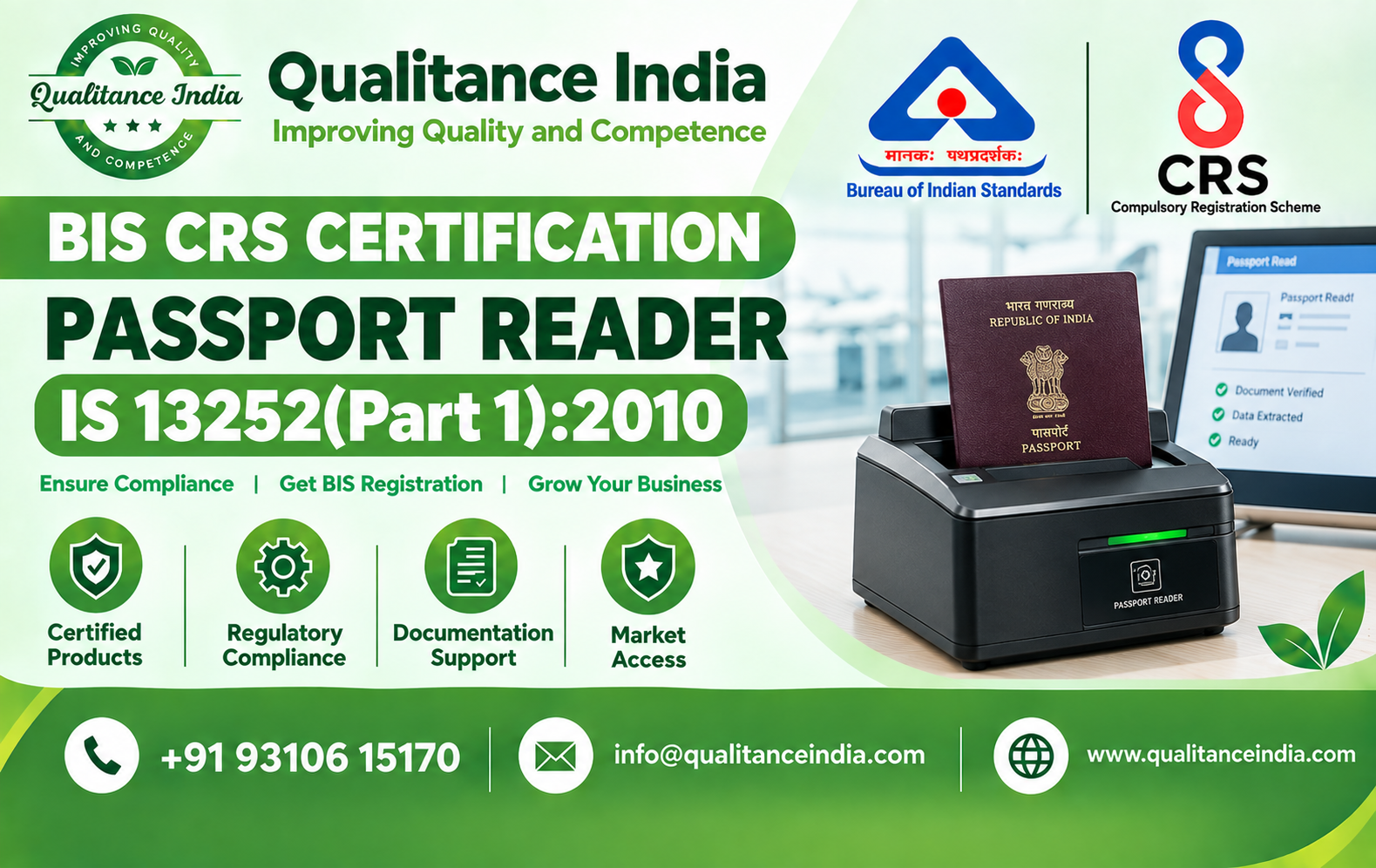
BIS CRS Certification for Passport Reader | IS 13252 (Part 1):2010 | BIS Consultancy
Introduction
Passport Readers are specialized electronic devices used to read and process information stored in passports and other machine-readable travel documents. They are commonly used at airports, immigration and border-control facilities, government offices, financial institutions, hotels and other locations where identity-document information needs to be captured electronically.
For products covered under the applicable Compulsory Registration Scheme, the relevant Indian Standard for a Passport Reader is IS 13252 (Part 1):2010 – Information Technology Equipment – Safety – Part 1: General Requirements. BIS lists Passport Reader specifically against this standard in its uniform test-report formats under CRS.
Obtaining BIS CRS registration demonstrates that the specified product has been evaluated for conformity with the applicable safety requirements before being placed on the Indian market.
Qualitance India provides complete consultancy support for CRS registration, including applicability assessment, product testing coordination, documentation, online application support, clarification handling and registration assistance.
What Is BIS CRS Certification?
The Compulsory Registration Scheme (CRS) is a BIS conformity-assessment framework applicable to specified electronic and IT products.
Under CRS, the manufacturer is required to have the product tested through a BIS-recognized laboratory and submit the required test report and documents to BIS for registration. BIS states that applicants must apply online and submit original test reports issued by laboratories recognized by BIS under CRS.
For a Passport Reader covered by the applicable CRS product list, registration is based on conformity to:
IS 13252 (Part 1):2010
The BIS test-report format specifically identifies “Passport Reader” under this Indian Standard.
What Is IS 13252 (Part 1):2010?
IS 13252 (Part 1):2010 is titled:
Information Technology Equipment – Safety – Part 1: General Requirements
It is the second revision of the standard identified by BIS LIMS for these products. Current BIS laboratory listings continue to show Passport Readers among the product categories covered under this standard.
The standard addresses general product-safety requirements applicable to information technology equipment, with the exact applicable requirements depending on the construction, electrical characteristics and intended use of the equipment.
For Passport Readers, the BIS test-report template identifies the applicable test basis as:
IS 13252 (Part 1):2010 + A1:2013 + A2:2015 / IEC 60950-1:2005 + A1:2009 + A2:2013 in the published Passport Reader test-report format.
Is BIS CRS Registration Mandatory for Passport Readers?
Passport Reader is specifically identified by BIS under the CRS test-report framework against IS 13252 (Part 1):2010.
The actual applicability of compulsory registration should be confirmed for the exact product configuration, manufacturer, model and intended market before commercial introduction.
Manufacturers should not rely only on the product's commercial name. The technical functionality and product classification should be evaluated against the current CRS requirements.
Passport Reader Under BIS CRS
BIS's official uniform test-report list identifies the product category:
PASSPORT READER
under:
IS 13252 (Part 1):2010.
The official BIS Passport Reader test-report form also specifies a dedicated test-report format for this product:
BIS_IT/PR_IS13252_V1.2.
This is important because the laboratory testing report should be prepared using the applicable BIS/CRS test-report requirements.
Important Safety Requirements
Passport Readers can contain electronic power supplies, processing electronics, displays, scanning/reading mechanisms, communication interfaces and other electrical components.
Depending on the construction of the product, the applicable safety assessment can involve areas such as:
- Protection against electric shock
- Electrical insulation
- Dielectric strength
- Leakage current
- Earthing requirements
- Temperature rise
- Protection against fire
- Mechanical safety
- Power supply safety
- Creepage and clearance
- Wiring and terminals
- Enclosure requirements
- Component safety
- Marking and instructions
The actual test program must be determined by the recognized laboratory according to the product's construction and the applicable requirements of IS 13252 (Part 1):2010.
BIS CRS Testing for Passport Reader
Testing is one of the most important stages in obtaining CRS registration.
The manufacturer needs to submit representative product samples to a laboratory recognized by BIS under CRS.
The laboratory evaluates the Passport Reader against the applicable requirements and prepares the required test report.
BIS specifically states that the test report submitted with the application must be an original report issued by a laboratory recognized by BIS under CRS.
The Passport Reader test report template published by BIS provides the product description and technical information fields required for the testing record.
Product Sample for Testing
The exact number and configuration of samples should be confirmed with the selected recognized laboratory before submission.
The sample should represent the model for which registration is being sought and should correspond with:
- Manufacturer
- Brand
- Model number
- Electrical ratings
- Product description
- Hardware configuration
- Power supply configuration
- Accessories supplied with the product
A mismatch between the tested sample and application details can lead to delays or additional clarification.
Product and Model Information
A CRS application is closely linked to the product's specific identification.
Typical technical information includes:
- Product name
- Brand name
- Model number
- Manufacturer name
- Manufacturing address
- Input voltage
- Rated frequency
- Power consumption
- Power supply type
- Hardware configuration
- Relevant accessories
- Product photographs
- Rating label information
The BIS Passport Reader test-report format itself contains fields for manufacturer, trade mark, model/type reference, ratings and description of the tested item.
BIS CRS Registration Process for Passport Reader
Step 1 – Check CRS Applicability
First, determine whether the Passport Reader falls within the applicable CRS product category and standard.
Step 2 – Identify the Manufacturer
The actual manufacturing unit must be correctly identified.
The manufacturing address should correspond with the official documentary evidence submitted during registration.
Step 3 – Select BIS-Recognized Laboratory
The product should be submitted to a laboratory recognized by BIS under CRS for the applicable standard.
Step 4 – Product Testing
The Passport Reader is tested against the applicable requirements of IS 13252 (Part 1):2010.
Step 5 – Obtain Test Report
The test report is issued by the recognized laboratory.
BIS's current CRS instructions state that at the time of online submission, the test report should not be more than 90 days old.
Step 6 – Prepare Registration Documents
The required technical, manufacturing, legal and declaration documents are prepared.
Step 7 – Submit Online Application
The application is submitted through the BIS CRS portal.
BIS's registration instructions specify online application submission and the prescribed application process.
Step 8 – Submit Required Hard Copies
BIS currently states that hard copies of the application are to be submitted within 15 days of online submission under the applicable procedure.
Step 9 – BIS Review
BIS reviews the test report, application details and supporting documents.
Step 10 – Registration Grant
After satisfactory evaluation, BIS grants CRS registration for the approved product/model/brand scope.
Documents Required for BIS CRS Certification
Common documents can include:
- Manufacturer registration documents
- Proof of manufacturing unit name and address
- Product technical specification
- Product photographs
- Product label/rating label
- User manual
- Circuit diagrams
- Block diagram
- Critical component list
- PCB details, where applicable
- Transformer/power supply details
- Test report from BIS-recognized laboratory
- Brand/trademark documents
- Authorization documents, where applicable
- Declaration/undertaking
- Authorized signatory details
- Contact information
- Factory-related documents
- Other documents requested under the current CRS checklist
BIS requires valid documentary proof of the name and address of the manufacturing unit, and the document should reflect the manufacturing activity relevant to products under the Registration Scheme. BIS also states that an ISO certificate alone is not sufficient as address proof.
Requirements for Foreign Manufacturers
Foreign manufacturers that do not have a liaison office or branch office in India are required to appoint an Authorized Indian Representative (AIR) according to BIS guidelines.
The AIR acts as the Indian representative for communication and regulatory matters under the CRS process.
BIS also requires the prescribed affidavit-cum-undertaking for the applicable foreign-manufacturer arrangement.
Requirements for Indian Manufacturers
For manufacturers located in India, the application must contain the required manufacturer information, authorized representative details and prescribed declarations.
BIS's CRS instructions also require the applicable affidavit-cum-undertaking in the prescribed format.
The applicant should ensure that the manufacturing unit information remains consistent across:
- Test report
- Application
- Legal documents
- Product label
- Brand documents
- Registration records
Brand and Model Requirements
A CRS registration is not simply a generic approval for every product sold under a broad product name.
The tested and registered product needs to be properly identified by its:
Brand + Model + Manufacturer + Technical Configuration
BIS's advisory for CRS applicants states that the product name in the application must be the same as the product name mentioned in the test report. It also provides specific guidance regarding brand status and brand authorization.
Therefore, manufacturers should finalize the intended branding and model identification before testing.
Product Label and Marking
The product label is an important part of the CRS application and post-registration compliance.
The information appearing on the product should be consistent with the approved registration details.
Manufacturers should carefully check:
- Brand
- Model number
- Electrical ratings
- Manufacturer details
- Required regulatory marking
- Other prescribed information
Any mismatch between the test report, application and actual product marking can create compliance problems.
BIS CRS Registration Number
After registration, BIS assigns a CRS registration number to the approved manufacturer/product scope.
The registration is linked to the approved product details and model/brand information recorded by BIS.
Manufacturers should ensure that the applicable registration details are correctly reflected on products and related records.
BIS CRS Testing Charges for Passport Readers
Testing charges vary between laboratories and can change over time.
Current BIS LIMS listings show different laboratory-specific charges for IS 13252 (Part 1):2010.
For example, current listings include:
- Approximately ₹40,000 for Class III products including Passport Readers at one BIS laboratory listing.
- Approximately ₹75,000 in another laboratory listing for Passport Readers within a combined IT-equipment testing category.
- Approximately ₹90,000 at another listed laboratory for Passport Readers.
These figures are laboratory-specific testing charges excluding applicable taxes and should not be treated as a universal CRS fee.
A final project estimate may also include application fees, sample transportation, consultant charges, additional testing and other expenses.
BIS CRS Registration Fee
CRS registration involves the applicable BIS fee structure in addition to laboratory testing expenses.
The exact government fee payable should be checked against the current BIS CRS fee schedule at the time of application.
Testing cost and BIS registration fee are separate components.
How Long Does BIS CRS Certification Take?
The timeline depends on:
- Test laboratory availability
- Product testing duration
- Sample readiness
- Technical document completeness
- Test result
- Application accuracy
- BIS review
- Clarifications, if required
One of the key ways to avoid unnecessary delay is to make sure the test report and application contain exactly matching manufacturer, product, brand and model information.
The BIS CRS portal currently requires the test report submitted at online application to be no more than 90 days old.
Common Reasons for CRS Application Delays
Product Name Mismatch
The product name in the application should match the test report. BIS specifically highlights this requirement.
Model Number Mismatch
The model tested should correspond with the model submitted for registration.
Brand Documentation Issues
Brand ownership or authorization documents may need to be submitted depending on the applicant's brand status.
Old Test Report
BIS states that the test report should not be more than 90 days old at online submission.
Incorrect Manufacturing Address
The address in the test report and application should correspond with the manufacturer's documentary proof.
Incomplete Technical Documents
Missing circuit diagrams, labels, specifications or component information can lead to queries.
Incorrect Product Classification
The product should be assessed against the correct CRS category before testing.
Non-Conforming Product
Failure during laboratory testing may require product modification and retesting.
Benefits of BIS CRS Certification for Passport Readers
CRS registration provides several important benefits for manufacturers and businesses:
- Regulatory compliance for applicable products
- Greater customer confidence
- Demonstration of product safety conformity
- Easier market acceptance
- Better credibility with institutional customers
- Improved documentation and traceability
- Support for distribution and commercial sales where registration is required
For products used in sensitive identity and document-processing environments, demonstrating conformity with applicable safety requirements is particularly important.
Who Needs BIS CRS Certification for Passport Readers?
CRS applicability primarily concerns manufacturers of covered electronic and IT products.
A manufacturer should evaluate whether its product falls under the current CRS list and whether the product is required to be registered under IS 13252 (Part 1):2010.
Importers, brand owners and distributors should also verify the compliance status of the actual manufacturer before bringing covered products into the Indian market.
Can an Importer Apply for CRS Registration?
CRS registration is associated with the manufacturer and the specified product/model/brand arrangement.
For imported products manufactured outside India, the foreign manufacturer may need an Authorized Indian Representative where the manufacturer does not have a liaison office or branch office in India.
The importer should therefore first establish the relationship between:
Foreign Manufacturer → Brand Owner → Indian Representative → Product Model
before starting the CRS application.
Can Multiple Models Be Covered Under One Registration?
Model coverage depends on the applicable CRS requirements, product construction and BIS registration conditions.
Manufacturers should not assume that every Passport Reader model can automatically be covered under one registration.
Each model should be evaluated for similarity, technical configuration and the applicable BIS procedure before testing and application submission.
Can Different Brands Be Covered?
Brand-related requirements depend on the ownership and authorization structure.
BIS's CRS advisory specifically provides guidance concerning the registered/applied-for brand status and brand authorization from the brand owner to the manufacturing unit.
What Is the Difference Between BIS Certification and CRS Registration?
BIS operates several different conformity-assessment schemes.
For products covered under the Compulsory Registration Scheme, the product is tested through a BIS-recognized laboratory and the manufacturer applies for registration under the CRS process.
This is different from the traditional BIS product certification/ISI licence model.
For a Passport Reader under the applicable CRS framework, the relevant route is CRS registration rather than the conventional ISI Mark certification route.
Passport Reader Testing – Important Technical Information
Before submitting the product for testing, the manufacturer should prepare a proper technical file containing:
- Product specification
- Electrical input
- Rated power
- Power adapter information
- PCB information
- Internal photographs
- External photographs
- Circuit diagrams
- Block diagram
- Critical components
- Safety-critical components
- Product construction
- User instructions
- Model identification
- Label information
Good technical preparation helps the laboratory correctly understand the product and reduces clarification during testing.
Quick BIS CRS Process for Passport Reader
CRS Applicability Check
↓
Product & Model Identification
↓
Select BIS-Recognized Laboratory
↓
Submit Passport Reader Sample
↓
Testing as per IS 13252 (Part 1):2010
↓
Receive Test Report
↓
Prepare CRS Documents
↓
Online BIS Application
↓
BIS Review
↓
Clarification/Compliance, if Required
↓
CRS Registration Grant
↓
Maintain Product Compliance
Frequently Asked Questions
1. What is BIS CRS Certification for Passport Reader?
It is the BIS Compulsory Registration Scheme registration route applicable to Passport Readers covered under the relevant CRS requirements and tested against IS 13252 (Part 1):2010.
2. Which IS standard applies to Passport Readers?
The BIS CRS listing identifies Passport Readers under IS 13252 (Part 1):2010.
3. Is Passport Reader included in the CRS testing list?
Yes. BIS's official uniform test-report list specifically identifies Passport Reader under IS 13252 (Part 1):2010.
4. What is the test-report format for Passport Reader?
BIS has published a dedicated Passport Reader test-report format identified as BIS_IT/PR_IS13252_V1.2.
5. Where should Passport Reader testing be done?
Testing should be conducted through a laboratory recognized by BIS under CRS for the applicable standard.
6. How old can the test report be?
BIS currently states that the test report should not be more than 90 days old at the time of online submission.
7. Is an Authorized Indian Representative required for foreign manufacturers?
Yes, foreign manufacturers without a liaison office or branch office in India are required to appoint an AIR according to BIS CRS guidelines.
8. Is factory inspection conducted under CRS?
The CRS registration process is primarily based on the prescribed test report and application/document review; it is not the same factory-inspection model used for a conventional BIS Scheme-I product licence.
9. Does CRS registration cover every Passport Reader automatically?
No. Registration is linked to the approved product/model/brand/manufacturer scope.
10. What documents are required?
Documents generally include manufacturer proof, product technical documents, test report, model/brand information, declarations and other documents specified by BIS.
11. Can the same test report be used for another brand?
Not automatically. Brand ownership and authorization requirements must be examined according to the CRS procedure.
12. What is the BIS testing cost for Passport Reader?
It varies by laboratory. Current BIS LIMS listings show different charges, including approximately ₹40,000, ₹75,000 and ₹90,000 in different laboratory listings.
13. Does testing cost include BIS registration fee?
No. Laboratory testing charges and BIS registration-related government fees are separate.
14. Can a non-compliant sample be modified and retested?
The laboratory/BIS procedure applicable to the case determines the requirements for additional testing or retesting.
15. Is an importer the manufacturer for CRS purposes?
No. The actual manufacturing entity is a key part of the CRS registration information.
16. What happens if the product label does not match the application?
It can result in clarification or compliance issues because product identification must remain consistent across the application and supporting records.
17. Why is the technical file important?
It allows the laboratory and BIS to correctly identify the product, model and safety-related construction.
18. Is IS 13252 (Part 1):2010 still listed for Passport Reader?
Current BIS LIMS listings continue to show Passport Readers under IS 13252 (Part 1):2010.
19. Can Qualitance India help with Passport Reader CRS registration?
Yes. Qualitance India provides consultancy support for applicability review, testing coordination, documentation, application filing and CRS registration assistance.
20. What is the first step for CRS registration?
The first step is to verify that the exact Passport Reader product falls under the current CRS scope and determine the correct test and registration requirements.
People Also Ask
Is BIS certification mandatory for Passport Readers in India?
Passport Readers are specifically identified by BIS in the CRS test-report framework under IS 13252 (Part 1):2010. Applicability should be confirmed for the exact product configuration and current regulatory scope.
Which IS code is used for Passport Reader BIS registration?
IS 13252 (Part 1):2010.
What is CRS registration?
CRS registration is a BIS registration process for specified electronic and IT products that requires conformity testing through recognized laboratories and submission of the prescribed application and documents.
What is the Passport Reader test standard?
IS 13252 (Part 1):2010, with the applicable test-report format published by BIS.
How long is a CRS test report valid for application?
The current BIS CRS online instructions state that the report should not be more than 90 days old when submitted with the application.
Can a foreign manufacturer obtain CRS registration?
Yes, subject to the applicable BIS process; a foreign manufacturer without an Indian liaison office or branch office needs an Authorized Indian Representative.
Why Choose Qualitance India for BIS CRS Consultancy?
Qualitance India provides end-to-end support for electronic products requiring BIS CRS registration.
Our assistance includes:
- CRS applicability assessment
- Product and model assessment
- Applicable IS standard identification
- Test laboratory coordination
- Sample submission support
- Test report coordination
- Technical document preparation
- CRS application filing
- Brand documentation support
- AIR coordination for foreign manufacturers
- BIS clarification support
- Registration follow-up
- Model/brand scope assistance
- Post-registration compliance guidance
Our objective is to help manufacturers complete CRS registration correctly and efficiently with properly aligned technical and regulatory documentation.
BIS CRS Certification for Passport Reader – Contact Qualitance India
Are you a Passport Reader manufacturer, brand owner, importer or technology company looking for BIS CRS Registration under IS 13252 (Part 1):2010?
Qualitance India provides professional consultancy support from product assessment and laboratory testing through BIS CRS application and registration.
Qualitance India BIS CRS Certification Consultancy
Phone: +91 93106 15170 Email: info@qualitanceindia.com Website: https://qualitanceindia.com/
Conclusion
BIS CRS Registration is an important regulatory requirement for products falling within the applicable Compulsory Registration Scheme. Passport Reader is specifically identified by BIS under IS 13252 (Part 1):2010, and BIS has published a dedicated Passport Reader test-report format for laboratory testing.
The certification process begins with correctly determining product applicability and continues through laboratory testing, preparation of technical documents, online submission, BIS review and grant of registration.
For manufacturers and brand owners, careful attention to the model number, brand, manufacturer details, technical configuration, product label and test-report validity can help prevent avoidable delays. BIS currently requires the test report submitted with the online CRS application to be no more than 90 days old.
For professional assistance with BIS CRS Certification for Passport Reader as per IS 13252 (Part 1):2010, Qualitance India offers complete consultancy support for testing, documentation, application filing and registration.