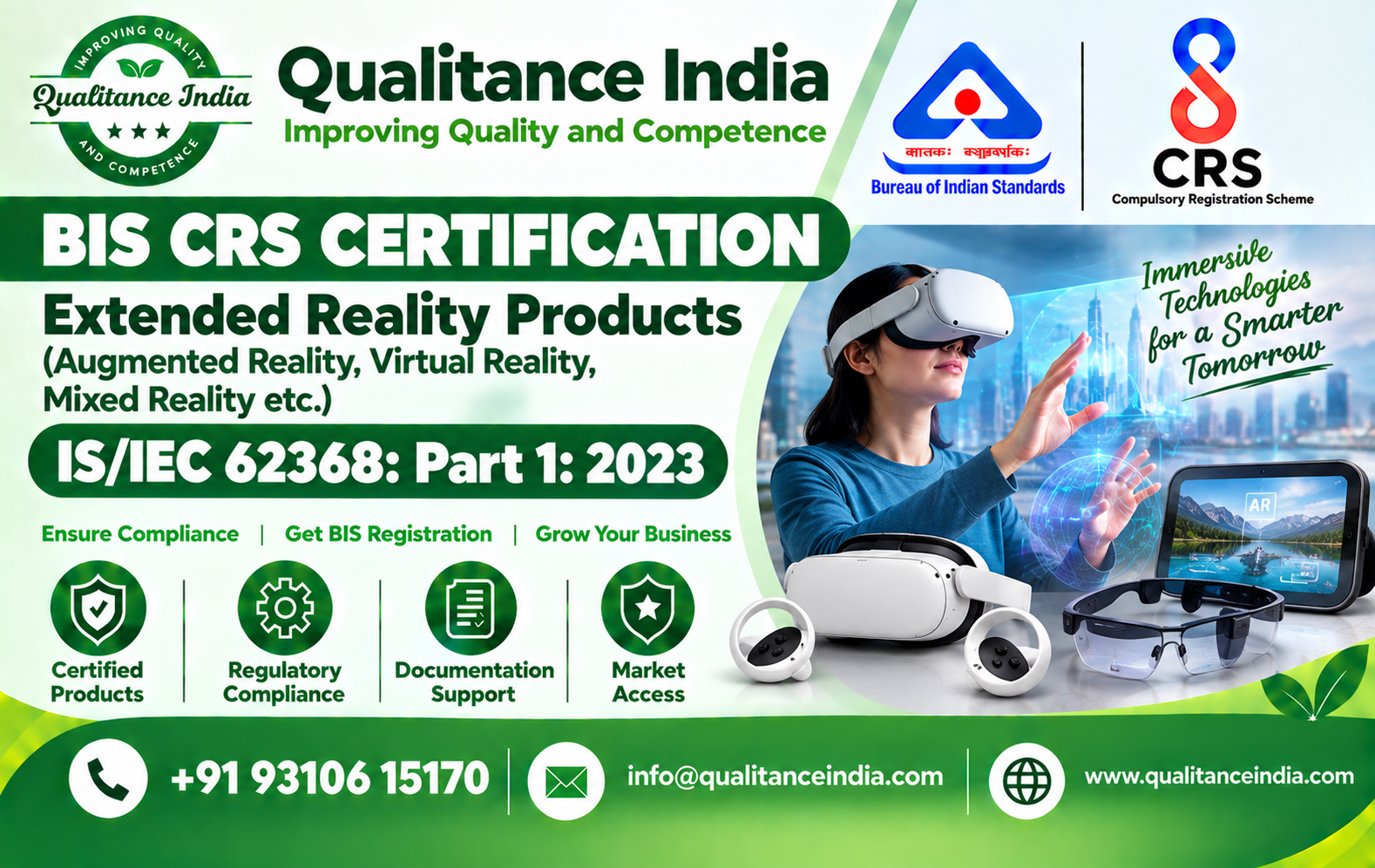
BIS CRS Certification for Extended Reality Products (AR, VR & MR) | IS/IEC 62368 Part 1:2023 | BIS Consultancy
Introduction
Extended Reality (XR) technologies are transforming the way users interact with digital content by combining physical and virtual environments. The term Extended Reality generally includes technologies such as Augmented Reality (AR), Virtual Reality (VR), and Mixed Reality (MR).
XR products are increasingly used in gaming, education, industrial training, healthcare applications, enterprise solutions, simulation, entertainment and other technology-driven environments. These products can incorporate displays, cameras, processors, batteries, wireless communication, audio systems, sensors and other electronic components.
For manufacturers and importers supplying these products in India, compliance with applicable Bureau of Indian Standards (BIS) requirements is important.
The current BIS Compulsory Registration Scheme (CRS) specifically lists Extended Reality Products (Augmented Reality, Virtual Reality, Mixed Reality etc.) under IS/IEC 62368: Part 1:2023 – Audio/Video, Information and Communication Technology Equipment – Part 1: Safety Requirements.
What Is BIS CRS Certification for Extended Reality Products?
BIS CRS is a compulsory conformity-registration framework applicable to notified electronic and IT products in India.
Under the current BIS Scheme-II listing, Extended Reality Products are covered by:
IS/IEC 62368: Part 1:2023
Title: Audio/Video, Information and Communication Technology Equipment – Part 1: Safety Requirements.
The category specifically includes:
- Augmented Reality (AR) products
- Virtual Reality (VR) products
- Mixed Reality (MR) products
- Other Extended Reality products covered by the notified category
Manufacturers and importers should evaluate the complete product configuration before beginning laboratory testing because XR devices can differ significantly in power architecture, display technology, battery configuration, wireless functionality and intended use.
Important Update: Migration to IS/IEC 62368 Part 1:2023
Extended Reality Products were specifically added to the BIS framework through the migration notification issued in 2025.
The notification states that the product category “Extended Reality Products (Augmented Reality, Virtual Reality, Mixed Reality etc.)” is covered under IS/IEC 62368 Part 1:2023. It also specifies that the earlier standards IS 13252 Part 1:2010 and IS 616:2017 could run concurrently with IS/IEC 62368 Part 1:2023 for this category only until 1 May 2026.
As the current date is September 2026, the concurrent-running period has already ended for Extended Reality Products. Therefore, new compliance planning for XR products should be based on IS/IEC 62368 Part 1:2023, subject to the product's exact classification and applicable BIS requirements.
The current BIS Scheme-II page also lists Extended Reality Products under IS/IEC 62368 Part 1:2023.
What Are Extended Reality Products?
Extended Reality is a broad category of technologies that create or enhance digital experiences by combining digital information with physical or virtual environments.
Augmented Reality (AR)
AR products overlay digital information, graphics, images or other content onto the user's view of the real world.
Examples can include:
- AR glasses
- AR smart eyewear
- Industrial AR headsets
- Navigation-oriented AR devices
- Enterprise AR equipment
- AR display systems
Virtual Reality (VR)
VR products create an immersive digital environment that users can interact with.
Examples include:
- VR headsets
- VR goggles
- Gaming VR devices
- Training VR systems
- Simulation headsets
- Immersive virtual-reality equipment
Mixed Reality (MR)
MR products combine physical surroundings with digital objects and interactive virtual content.
Examples can include:
- MR headsets
- Spatial-computing devices
- Interactive mixed-reality eyewear
- Enterprise MR systems
- Industrial mixed-reality equipment
The exact BIS classification depends on the actual product and its technical construction.
Why Is BIS Certification Important for AR, VR and MR Products?
Modern XR devices can contain several electrical and electronic systems in one product.
These may include:
- Display panels
- Cameras
- Processors
- Batteries
- Charging circuits
- Wireless communication modules
- Sensors
- Speakers
- Microphones
- Power-management circuits
- USB interfaces
- External power supplies
- Bluetooth
- Wi-Fi
- Other electronic interfaces
IS/IEC 62368 Part 1:2023 provides safety requirements for applicable audio/video and information and communication technology equipment.
BIS compliance therefore provides a structured process for evaluating the applicable safety aspects of these products before they are supplied in the Indian market.
Products That May Fall Within the XR Category
Depending on the product's design and intended function, the category can include:
- AR glasses
- AR headsets
- VR headsets
- VR goggles
- MR headsets
- Mixed-reality glasses
- Extended-reality head-mounted devices
- Immersive display devices
- Enterprise XR equipment
- Industrial XR devices
- Training and simulation XR equipment
- Gaming-oriented XR equipment
The exact classification should be verified before testing because product names alone do not determine the applicable BIS requirements.
IS/IEC 62368 Part 1:2023
IS/IEC 62368 Part 1:2023 is titled:
Audio/Video, Information and Communication Technology Equipment – Part 1: Safety Requirements
The standard represents a modern safety approach for audio/video and information and communication technology equipment.
For Extended Reality Products, BIS has specifically assigned this standard as the applicable standard in the CRS product schedule.
Safety Areas Covered Under IS/IEC 62368 Part 1:2023
Depending on the product construction and applicable requirements, safety assessment can involve areas such as:
- Electric shock
- Electrical energy hazards
- Fire hazards
- Mechanical hazards
- Thermal hazards
- Insulation
- Creepage and clearance
- Protective earthing
- Power supply safety
- Battery-related safety
- Enclosure requirements
- Components
- Marking
- Safety instructions
- Abnormal operating conditions
- Safeguards
- Accessible parts
The exact test programme depends on the product's design, power source, construction and applicable clauses.
Electrical Safety of XR Devices
Many AR, VR and MR devices contain rechargeable batteries and electronic power-management systems.
Safety assessment may therefore consider:
- Input power
- Battery voltage
- Charging system
- Internal power circuits
- Insulation
- Electrical separation
- Accessible conductive parts
- Protection against hazardous energy
- External power supplies
- USB charging interfaces
Manufacturers should provide accurate electrical specifications when preparing the product for laboratory testing.
Battery-Powered AR, VR and MR Devices
Many XR products are battery-powered and may contain lithium-based rechargeable batteries.
Technical documentation should clearly identify:
- Battery type
- Battery voltage
- Battery capacity
- Number of cells
- Charging method
- Charging voltage
- Charging current
- Battery protection
- Battery management system
- Battery manufacturer
- Battery model
The complete product configuration should be reviewed to determine which battery-related requirements are applicable.
Charging Requirements for XR Products
An XR device may be supplied with:
- USB charging
- USB-C charging
- Dedicated charging adaptor
- Charging dock
- External power supply
- Proprietary charging system
The charging arrangement should be included in the product documentation and evaluated as part of the overall product safety assessment.
Wireless Functions in XR Products
Modern XR devices can incorporate several wireless communication technologies, including:
- Wi-Fi
- Bluetooth
- Other wireless interfaces
The presence of wireless functionality should be accurately declared during the certification process.
The BIS CRS safety assessment under IS/IEC 62368 Part 1:2023 should not be confused with separate regulatory requirements that may apply to radio-frequency or wireless equipment under other Indian regulatory frameworks.
Display and Optical Components
VR and MR headsets can contain:
- OLED displays
- LCD displays
- Micro-displays
- Optical lenses
- Cameras
- Eye-tracking systems
- Depth sensors
The manufacturer should provide accurate technical information about these components during product assessment.
Testing for Extended Reality Products
Laboratory testing is an important part of the BIS CRS process.
Testing is conducted according to the applicable requirements of IS/IEC 62368 Part 1:2023 and the product's technical configuration.
Depending on the product, the evaluation can address:
- Electrical safety
- Protection against electric shock
- Energy hazards
- Fire hazards
- Mechanical hazards
- Temperature
- Insulation
- Power supply
- Battery system
- Components
- Marking
- Instructions
- Abnormal conditions
- Safeguards
The exact laboratory test programme should be confirmed for the specific XR product before sample submission.
Product Classification Before Testing
Product classification is an important first step.
For example, an XR device may be:
- Fully battery operated
- Battery operated with external charging
- Mains powered
- Supplied with an external adaptor
- Connected to a computer
- Connected to a smartphone
- Connected to a gaming console
- Equipped with wireless communication
- Equipped with an external docking station
These characteristics can affect the technical assessment.
A pre-testing review can help determine the applicable test scope and documentation requirements.
Documents Required for BIS CRS Certification
The exact document list depends on the applicant and product, but manufacturers commonly need to prepare:
- Manufacturer name and address
- Manufacturing-unit details
- Brand/trademark information
- Product name
- Model number
- Product datasheet
- Technical specifications
- Rated voltage
- Rated current
- Rated power
- Battery specifications
- Charging specifications
- Circuit diagram
- Block diagram
- PCB information
- Component details
- Critical component information
- Power supply/adaptor details
- User manual
- Installation instructions
- Product photographs
- Label artwork
- Internal and external photographs
- Existing test reports, where applicable
- Brand authorization documents, where applicable
- BIS application documents
- Undertakings and declarations as applicable
Technical Information Needed Before Testing
Before submitting an XR product to a laboratory, manufacturers should prepare accurate technical information regarding:
- Product type
- AR/VR/MR functionality
- Model number
- Input voltage
- Input current
- Power consumption
- Battery voltage
- Battery capacity
- Charging voltage
- Charging current
- Display technology
- Processor
- Wireless interfaces
- USB interfaces
- External adaptor
- Charging dock
- Enclosure
- Cooling arrangement
- Audio system
- Camera modules
- Sensors
- Safety-critical components
Providing complete technical information helps the laboratory determine the appropriate testing scope.
BIS CRS Certification Process for AR, VR and MR Products
Step 1: Product Assessment
The product is reviewed to determine whether it falls within the notified Extended Reality Products category.
Step 2: Standard Verification
The applicable standard is identified.
For Extended Reality Products, the current BIS product schedule specifies IS/IEC 62368 Part 1:2023.
Step 3: Technical Document Review
Product specifications, circuit diagrams, components, battery information and other technical documents are reviewed.
Step 4: Laboratory Selection
A suitable BIS-recognized laboratory with the required scope is identified.
Step 5: Sample Submission
Representative product samples are submitted to the laboratory according to the testing requirements.
Step 6: Product Testing
The laboratory conducts the applicable safety tests under IS/IEC 62368 Part 1:2023.
Step 7: Test Report
The laboratory prepares the relevant test documentation.
Step 8: BIS Application
The application and supporting documents are submitted through the applicable BIS CRS process.
Step 9: BIS Scrutiny
BIS reviews the submitted application and supporting documents.
Step 10: Clarification
If BIS raises a query or requests additional information, the applicant provides the required clarification or documents.
Step 11: Registration
After successful completion of the applicable requirements, BIS registration is granted.
BIS Certification for Imported XR Products
Foreign manufacturers intending to sell AR, VR or MR products in India should also evaluate BIS CRS requirements.
The process can involve:
- Foreign manufacturer
- Indian representative/importer, where applicable
- BIS-recognized laboratory
- BIS application
- Product testing
- Technical documentation
- Brand authorization
- Compliance follow-up
The product information should remain consistent across the sample, test report, product label, technical documents and BIS application.
BIS Certification for Different AR, VR and MR Models
Manufacturers may have several XR models with differences in:
- Display
- Processor
- Memory
- Storage
- Battery
- Camera
- Sensors
- Wireless connectivity
- Power rating
- Charging method
- Housing
- Operating system
Whether multiple models can be covered together depends on their technical similarity and applicable BIS grouping requirements.
A model-family review before testing can help identify which variants require consideration.
Product Marking and Labeling
The applicable product markings and safety information should be provided according to BIS requirements.
Depending on the product and applicable requirements, markings may include:
- Manufacturer name
- Product/model number
- Rated input
- Rated output where applicable
- Battery information where required
- Serial number
- Safety warnings
- Required identification information
- BIS registration information/marking as applicable
The final marking should be reviewed before commercial production and market supply.
Common Reasons for Delay in XR BIS Certification
Manufacturers can experience delays due to:
- Incorrect product classification
- Incomplete technical documentation
- Incorrect model numbers
- Differences between sample and production model
- Missing battery details
- Missing adaptor information
- Incomplete circuit diagrams
- Incorrect electrical ratings
- Incomplete component information
- Test report discrepancies
- Incomplete product labeling
- Unclear brand ownership
- Multiple variants without proper assessment
- Laboratory scope limitations
- Delayed response to BIS queries
A technical review before testing can reduce the possibility of avoidable documentation and testing issues.
BIS Certification for AR Glasses
AR glasses can combine:
- Optical displays
- Cameras
- Sensors
- Speakers
- Microphones
- Processor
- Battery
- Wireless communication
- Charging interface
The complete technical configuration should be reviewed before testing.
BIS Certification for VR Headsets
VR headsets can contain:
- Dual displays
- Optical lenses
- Cameras
- Motion sensors
- Tracking systems
- Processor
- Battery
- Wireless communication
- Audio components
These features should be accurately documented for the BIS testing process.
BIS Certification for Mixed Reality Headsets
MR products can combine real-world sensing with immersive digital content.
They may include:
- Multiple cameras
- Depth sensors
- Spatial tracking
- Eye tracking
- Gesture tracking
- Display systems
- Audio
- Wireless communication
- Rechargeable batteries
The applicable BIS requirements should be determined from the actual construction and intended use.
Role of a BIS Certification Consultant for XR Products
A professional BIS consultant can assist manufacturers and importers with:
- Product classification
- Standard verification
- Technical document review
- Laboratory selection
- Testing coordination
- Sample submission support
- Test report review
- BIS application preparation
- Documentation support
- Clarification response
- Registration follow-up
- Model and variant assessment
For emerging technologies such as AR, VR and MR, proper classification and technical assessment can be particularly important because product designs can vary considerably.
Why Choose Qualitance India for BIS Consultancy?
Qualitance India provides professional BIS certification consultancy services for manufacturers and importers of electronic, IT, electrical and technology products.
For Extended Reality Products, our support can include:
- BIS CRS certification consultancy
- Product classification
- IS/IEC 62368 Part 1:2023 requirement verification
- Technical documentation support
- Laboratory coordination
- Product testing coordination
- Test report review
- BIS application assistance
- Clarification support
- Registration follow-up
- Compliance guidance
Our objective is to help manufacturers organize the BIS certification process according to their product configuration and applicable requirements.
Frequently Asked Questions
1. What standard applies to Extended Reality Products in India?
The current BIS Scheme-II listing specifies IS/IEC 62368 Part 1:2023 for Extended Reality Products including Augmented Reality, Virtual Reality and Mixed Reality products.
2. Are AR products covered under BIS CRS?
Extended Reality Products, including Augmented Reality products, are specifically listed under the BIS CRS framework.
3. Are VR headsets covered under BIS CRS?
VR products fall within the notified Extended Reality Products category, subject to their classification under the applicable BIS requirements.
4. Are MR products covered under BIS CRS?
Yes. Mixed Reality products are expressly included in the Extended Reality Products description in the BIS notification.
5. What is IS/IEC 62368 Part 1:2023?
It is the safety standard titled Audio/Video, Information and Communication Technology Equipment – Part 1: Safety Requirements. BIS assigns this standard to Extended Reality Products under the current CRS schedule.
6. Were XR products previously covered under IS 13252 or IS 616?
The 2025 migration notification states that IS 13252 Part 1:2010 and IS 616:2017 were the previous standards relevant to the migration and permitted concurrent running with IS/IEC 62368 Part 1:2023 for Extended Reality Products until 1 May 2026.
7. Can I use an old IS 13252 test report for a new XR BIS application?
The concurrent-running period for Extended Reality Products ended on 1 May 2026. New certification planning should therefore be evaluated against the current IS/IEC 62368 Part 1:2023 requirements.
8. Is testing required for XR BIS certification?
Laboratory testing is an important part of the BIS CRS conformity process.
9. Do battery-powered VR headsets require BIS certification?
If the product falls within the notified Extended Reality Products category, the applicable BIS requirements should be evaluated regardless of whether it is battery-powered.
10. Does an external adaptor affect XR certification?
Yes. The power architecture, including an external adaptor or charging unit, should be declared and considered during technical assessment.
11. Do wireless AR glasses need BIS certification?
Wireless functionality does not by itself determine the entire BIS classification. The complete product should be assessed against the applicable requirements.
12. Can multiple AR/VR models be covered under one BIS registration?
This depends on the technical similarity of the models and applicable BIS grouping requirements.
13. Can imported VR headsets obtain BIS registration?
Yes, subject to the applicable BIS requirements and documentation for the foreign manufacturer/importer structure.
14. What documents are needed for XR BIS certification?
Common documents include manufacturer details, product specifications, circuit diagrams, component information, battery details, manuals, photographs, labels and laboratory test documentation.
15. Does the battery capacity matter?
Battery voltage, capacity, charging arrangement and protection design are important technical characteristics and should be provided during product assessment.
16. Does the display type matter?
Display technology forms part of the product's technical construction and should be included in the documentation submitted for assessment.
17. Do AR glasses with cameras require additional consideration?
The complete product configuration, including cameras, sensors, display and wireless functions, should be reviewed to determine the applicable safety assessment.
18. Is factory inspection mandatory for XR CRS certification?
CRS operates differently from traditional BIS ISI Mark licensing. Manufacturers should follow the product-specific CRS requirements rather than assuming that a factory inspection is mandatory for every XR product.
19. Can Qualitance India help with BIS certification for AR, VR and MR products?
Yes. Qualitance India provides BIS certification consultancy, technical documentation support, laboratory coordination, testing support and BIS application assistance.
20. How can I start BIS certification for an XR product?
You can begin by providing the product datasheet, model number, electrical ratings, battery specifications, adaptor details, product photographs, circuit/block diagram and manufacturer information. These details can be reviewed to determine the applicable BIS certification route.
Get BIS CRS Certification Consultancy for AR, VR & MR Products
If you manufacture or import Augmented Reality (AR), Virtual Reality (VR), Mixed Reality (MR), smart glasses, VR headsets or other Extended Reality products for the Indian market, Qualitance India can assist with the applicable BIS CRS certification process.
Our consultancy support can include product classification, standard verification, technical documentation, laboratory coordination, product testing, test-report review, BIS application assistance and registration follow-up.
Qualitance India – BIS Certification Consultancy
Phone: +91-9310-615-170 Email: info@qualitanceindia.com Website: https://qualitanceindia.com/
Contact Qualitance India to discuss your Extended Reality product and understand the applicable BIS testing and certification requirements.
Conclusion
Extended Reality products such as AR, VR and MR devices are specifically covered under the BIS Compulsory Registration Scheme. The current BIS Scheme-II listing specifies IS/IEC 62368 Part 1:2023 – Audio/Video, Information and Communication Technology Equipment – Part 1: Safety Requirements for this product category.
The 2025 migration notification established the transition from the earlier IS 13252 Part 1:2010 and IS 616:2017 standards and permitted concurrent running for Extended Reality Products only until 1 May 2026.
Manufacturers and importers should therefore assess their AR, VR or MR product against the current requirements, prepare the necessary technical documentation, complete applicable laboratory testing and follow the BIS CRS application procedure.
With appropriate technical and certification support, manufacturers can organize the BIS compliance process for their Extended Reality products and prepare them for the Indian market.