
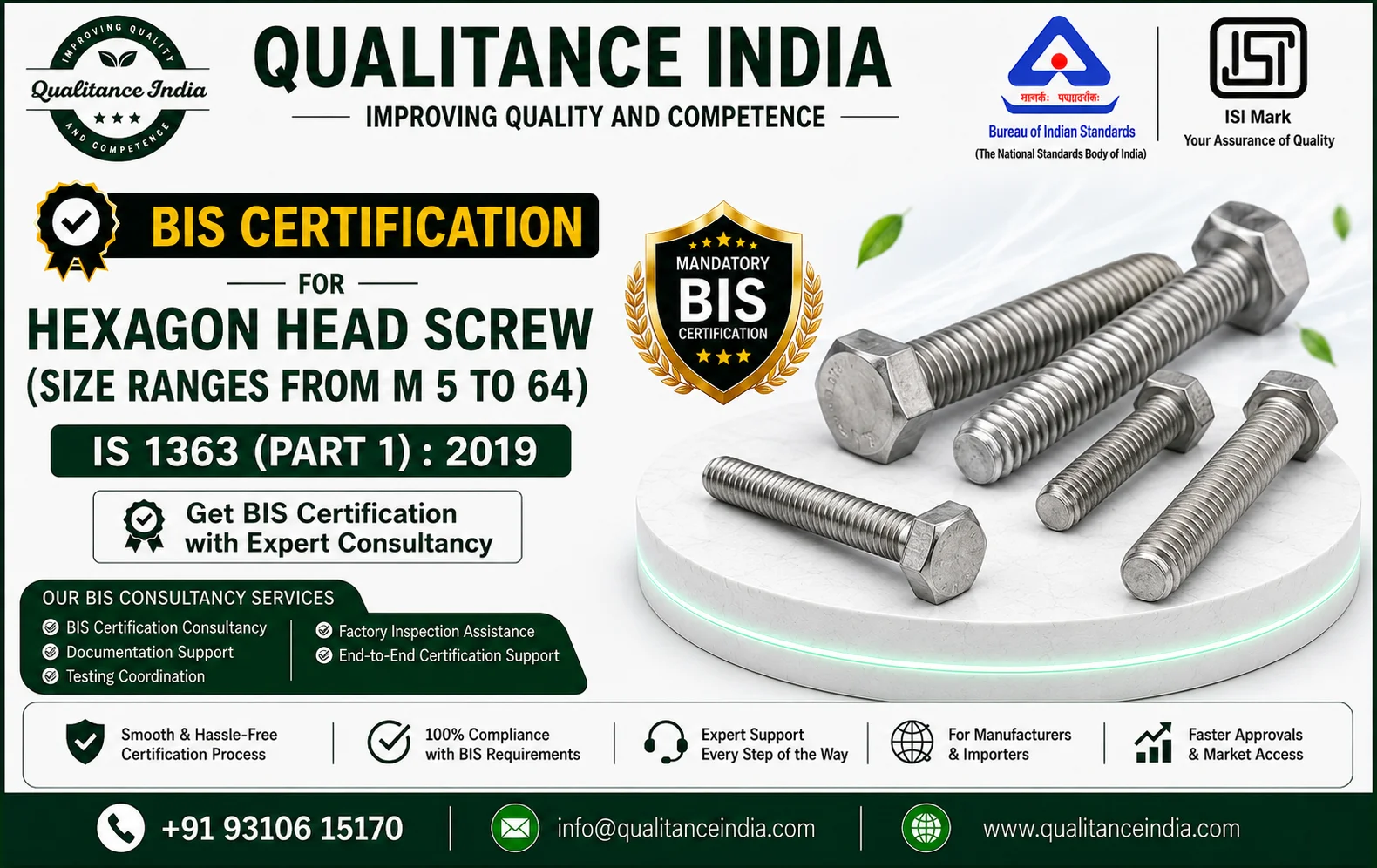
BIS Certification for Hexagon Head Bolts – IS 1363 (Part 1)
Introduction
Hexagon Head Bolts are widely used fastening components in construction, engineering, automobile manufacturing, machinery, fabrication, industrial equipment and structural applications. Their six-sided head allows tightening with a suitable wrench or socket, making them suitable for applications where a reliable and secure mechanical connection is required.
IS 1363 (Part 1):2023 specifies requirements for Hexagon Head Bolts in the size range M5 to M64, belonging to Product Grade C. The current standard is the sixth revision and is aligned with ISO 4016:2022.
BIS currently lists this product under the Bolts, Nuts and Fasteners category in its Scheme-I product certification framework. The applicable regulatory framework includes the Bolts, Nuts and Fasteners (Quality Control) Order, 2023, as amended/supplemented by the 2024 Order.
For manufacturers of Hexagon Head Bolts, understanding the standard, product grouping, testing requirements and BIS application process is therefore important before applying for a BIS licence.
About Hexagon Head Bolts
A Hexagon Head Bolt is a mechanical fastening component with a six-sided head and an externally threaded shank.
The hexagonal head provides a convenient surface for applying torque with:
- Spanners
- Wrenches
- Sockets
- Torque tools
Hexagon Head Bolts are available in different:
- Thread sizes
- Lengths
- Property classes
- Materials
- Surface conditions
- Coatings
IS 1363 (Part 1):2023 specifically covers M5 to M64 Hexagon Head Bolts of Product Grade C.
What is IS 1363 (Part 1):2023?
IS 1363 (Part 1):2023 is titled:
Hexagon Head Bolts, Screws and Nuts of Product Grade C – Part 1 Hexagon Head Bolts (Size Range M5 to M64).
The standard specifies the characteristics and requirements for Hexagon Head Bolts made from steel, having metric coarse-pitch threads from M5 through M64 and Product Grade C.
The current BIS Product Manual identifies:
- Product Grade: C
- Thread Size Range: M5 to M64
- Property Class: 4.6 / 4.8 / as declared by manufacturer
- Sample Size: 6 bolts
Size Range Covered
The standard covers:
M5 to M64
This means manufacturers producing Hexagon Head Bolts within this metric coarse-thread size range can seek certification according to the applicable requirements and licence scope.
The exact sizes included in a manufacturer's licence depend on the applicable product grouping and the manufacturer's approved scope.
Product Grade
IS 1363 (Part 1):2023 covers:
Product Grade C
Grade C is intended for general-purpose fastening applications where the dimensional and performance requirements specified by the standard are applicable.
The manufacturer should clearly define the applicable product grade and property class while preparing the product documentation.
BIS Certification for Hexagon Head Bolts
BIS Certification confirms that the manufacturer's product has been assessed against the applicable Indian Standard.
IS 1363 (Part 1) is currently included by BIS under Scheme-I in the Bolts, Nuts and Fasteners category. BIS's current listing identifies the product as Hexagon Head Bolts, Size Range M5 to M64 and links it to the applicable Quality Control Orders.
The certification process generally involves:
- Product assessment
- Product grouping
- Documentation
- Sample testing
- Factory assessment
- Quality-control verification
- BIS scrutiny
- Test report evaluation
- Licence grant
After certification, the manufacturer must use the BIS Standard Mark in accordance with the licence conditions.
Applicable Quality Control Order
Hexagon Head Bolts under IS 1363 (Part 1) fall within the Bolts, Nuts and Fasteners regulatory framework.
BIS's current Scheme-I listing identifies IS 1363 (Part 1):2019 in the applicable product list and associates it with the Bolts, Nuts and Fasteners (Quality Control) Order, 2023 and 2024.
The current Indian Standard has subsequently been revised to IS 1363 (Part 1):2023. BIS's current standard database identifies the 2023 version as Active.
Manufacturers should therefore verify the latest BIS/QCO requirements applicable to their product before making an application.
Products Covered
The product covered is:
Hexagon Head Bolts
within the applicable:
- M5 to M64 size range
- Product Grade C
- Applicable property classes
- Applicable surface conditions
- Applicable finishes/coatings
The final licence scope depends on the product grouping and approved manufacturing/testing capability.
Applications of Hexagon Head Bolts
Hexagon Head Bolts are commonly used in:
- Automobile manufacturing
- Industrial machinery
- Construction equipment
- Engineering industries
- Fabrication
- Agricultural machinery
- Industrial equipment
- Structural assemblies
- Manufacturing plants
- Mechanical assemblies
- General engineering
- Maintenance applications
Their hexagonal head makes them convenient for applications requiring controlled tightening and removal.
Dimensions
Dimensional conformity is one of the important requirements for Hexagon Head Bolts.
Depending on the applicable requirements, dimensional inspection can cover:
- Nominal diameter
- Bolt length
- Head dimensions
- Head height
- Width across flats
- Thread length
- Thread diameter
- Other specified dimensions
- Dimensional tolerances
The current BIS Product Manual identifies Dimensions as a specific testing requirement under the standard.
Thread Requirements
The threaded portion must comply with the applicable requirements of the standard.
Thread-related inspection can include:
- Thread size
- Thread profile
- Thread pitch
- Thread tolerance
- Thread gauge inspection
- Thread condition
BIS laboratory information identifies Thread as one of the applicable testing areas for IS 1363 Part 1.
Mechanical Properties
Mechanical properties are important because Hexagon Head Bolts must withstand the loads experienced during fastening and service.
The applicable evaluation can include:
- Tensile properties
- Proof load
- Hardness
- Strength-related characteristics
- Other applicable mechanical requirements
The current BIS Product Manual identifies 4.6 / 4.8 / as declared by manufacturer as the property-class scope for the product.
Surface Condition
The surface condition of the bolt should comply with the applicable requirements.
The evaluation may consider:
- Surface appearance
- Defects
- Corrosion-related issues
- Manufacturing marks
- Surface discontinuities
BIS laboratory information includes Surface Condition among the applicable testing areas.
Surface Integrity
Surface integrity is particularly important for fasteners because cracks and other defects can negatively affect performance.
Possible defects that need attention include:
- Cracks
- Seams
- Laps
- Folds
- Tool marks
- Other unacceptable surface discontinuities
The BIS testing information identifies Surface Integrity as a separate testing area.
Tolerances
Manufacturing tolerances must be maintained within the applicable limits specified by the standard.
This can involve:
- Dimensional tolerances
- Thread tolerances
- Head tolerances
- Length tolerances
- Other applicable manufacturing tolerances
BIS laboratory information specifically lists Tolerances among the testing requirements.
Surface Finish and Coating
Hexagon Head Bolts may be supplied with different surface finishes or protective coatings.
Depending on the product specification, this can include:
- Electrolytic zinc coating
- Other applicable protective finishes
- Uncoated surface condition
The applicable finish should be clearly identified in the product specification and certification scope.
Raw Materials
Suitable steel raw material should be selected to achieve the required dimensional and mechanical characteristics.
Manufacturers should maintain proper control over:
- Raw-material specifications
- Material certificates
- Heat numbers
- Batch identification
- Incoming inspection
- Material traceability
Raw-material requirements should be verified against the latest applicable standard and the manufacturer's declared property class.
Manufacturing Process
A typical Hexagon Head Bolt manufacturing process can include:
Raw Material Selection
Suitable steel wire/rod is selected.
Wire Preparation
The raw material is prepared according to the manufacturing process.
Heading
The hexagonal bolt head is formed.
Thread Formation
Threads are produced through rolling or another suitable manufacturing process.
Heat Treatment
Where applicable, heat treatment is carried out to achieve the required mechanical properties.
Surface Treatment
The bolt may undergo cleaning, coating or finishing.
Inspection
Dimensions, threads, surface condition and appearance are checked.
Testing
Representative samples are tested against applicable requirements.
Packing
The finished bolts are identified and packed appropriately.
Testing Requirements
Testing and evaluation can cover:
- Dimensions
- General requirements
- Thread
- Mechanical properties
- Tolerances
- Surface condition
- Surface integrity
- Acceptability
- Marking and labelling
- Designation
Current BIS LIMS information lists these testing areas for the active IS 1363 Part 1 product entry.
BIS Laboratory Testing
BIS LIMS currently lists laboratories providing testing facilities for IS 1363 Part 1:2023.
For example, one current listing shows a testing charge of ₹14,000 excluding taxes for a specified complete scope. Another laboratory listing shows ₹15,000 excluding taxes for testing up to M33 size.
Individual testing charges may vary depending on:
- Laboratory
- Product size
- Testing scope
- Property class
- Surface condition
- Applicable requirements
Therefore, the final testing cost should be confirmed for the exact product scope before submitting samples.
Sample Requirement
The current BIS Product Manual specifies:
Sample Size: 6 Bolts
for IS 1363 (Part 1):2023.
The actual sampling procedure should always be confirmed against the latest BIS Product Manual and applicable certification instructions.
Product Grouping
Product grouping is an important part of BIS certification because a manufacturer may produce multiple:
- Sizes
- Property classes
- Surface conditions
- Finishes
The current Product Manual provides product grouping guidelines under Annex A.
Proper grouping can help determine which representative samples need to be tested for a particular licence scope.
Manufacturers should not assume that testing one size automatically covers every size and variant. The applicable BIS grouping requirements should be followed.
Who Needs BIS Certification?
The certification requirements may apply to manufacturers producing Hexagon Head Bolts covered by the applicable regulatory framework.
This can include:
- Fastener manufacturers
- Bolt manufacturers
- Industrial fastener manufacturers
- Automobile component manufacturers
- Engineering component manufacturers
- OEM suppliers
- Hardware manufacturers
- Machinery component manufacturers
- Manufacturers supplying bolts to industrial customers
Importers and other businesses should separately verify their obligations under the applicable QCO.
Eligibility Requirements
A manufacturer should generally have suitable:
- Manufacturing premises
- Heading machinery
- Threading machinery
- Heat-treatment facilities where applicable
- Surface-treatment facilities where applicable
- Measuring instruments
- Testing facilities or permitted testing arrangements
- Quality-control system
- Calibration system
- Raw-material control
- Production records
- Inspection records
- Storage facilities
- Packing facilities
Documents Required
Documents commonly required for the certification process can include:
- Company registration documents
- Factory address proof
- Factory layout
- Manufacturing process flow
- Machinery list
- Product drawings
- Product specifications
- Size-range details
- Property-class details
- Raw-material specifications
- Material test certificates
- Testing equipment list
- Calibration certificates
- Internal test reports
- Quality-control records
- Inspection records
- Product photographs
- Packaging details
- Marking details
- Trademark documents where applicable
- Authorized signatory documents
The exact document list depends on the applicant and product scope.
BIS Certification Process
1. Product Identification
The product and applicable standard are identified.
2. Standard Review
Requirements of IS 1363 Part 1 are reviewed.
3. Factory Assessment
Manufacturing facilities and quality-control arrangements are evaluated.
4. Product Grouping
Applicable size and property-class grouping is determined.
5. Documentation
Technical and legal documents are prepared.
6. Sample Preparation
Representative samples are prepared.
7. Laboratory Testing
Samples are tested against applicable requirements.
8. BIS Application
The application is submitted through the applicable BIS certification route.
9. BIS Scrutiny
BIS reviews the application and documents.
10. Factory Inspection
The manufacturing facility is assessed as required.
11. Test Report Evaluation
Testing results are reviewed.
12. Observation Closure
Any observations or non-conformities are addressed.
13. Licence Grant
The BIS licence is granted after successful completion of the applicable requirements.
14. Standard Mark
The Standard Mark is used according to the licence conditions.
Factory Inspection
During the factory assessment, important areas can include:
Raw Material
Verification of material specifications and traceability.
Manufacturing Machinery
Inspection of heading, threading, heat treatment and finishing facilities.
Production Process
Review of manufacturing controls.
Testing Equipment
Verification of relevant measuring and testing equipment.
Calibration
Review of calibration records.
Quality Control
Inspection of incoming, in-process and finished-product inspection systems.
Traceability
Checking batch/lot identification.
Marking
Verification of applicable product marking.
Packing
Inspection of storage and packing arrangements.
Common Reasons for Certification Delays
Manufacturers may experience delays due to:
- Incorrect standard selection
- Using an outdated standard
- Incorrect product grouping
- Incomplete product drawings
- Incorrect dimensions
- Thread non-conformity
- Mechanical test failure
- Surface defects
- Improper heat treatment
- Coating problems
- Missing material certificates
- Missing calibration records
- Incomplete quality-control records
- Incorrect marking
- Factory not ready for inspection
- Incomplete application documents
Proper preparation before application can reduce unnecessary delays.
BIS Certification Cost
The total cost depends on:
- BIS application charges
- Laboratory testing
- Product size
- Number of variants
- Property class
- Surface condition
- Product grouping
- Factory inspection
- Sample transportation
- Retesting, if required
- Documentation
- Consultancy charges
Current BIS LIMS listings show different testing costs depending on laboratory and scope. For example, current listings include ₹14,000 for one complete listed scope and ₹15,000 for another scope up to M33, excluding taxes.
The actual certification cost should therefore be calculated after reviewing the manufacturer's complete product range.
Certification Timeline
The time required depends on:
- Document readiness
- Factory readiness
- Sample availability
- Laboratory schedule
- Testing
- BIS scrutiny
- Factory inspection
- Test report evaluation
- Observation closure
A product-specific timeline can be estimated after reviewing the factory and product scope.
Benefits of BIS Certification
Regulatory Compliance
Helps manufacturers meet applicable requirements under the relevant regulatory framework.
Product Quality
Encourages consistent manufacturing and inspection.
Customer Confidence
The BIS Standard Mark provides additional assurance regarding conformity.
Market Acceptance
Supports supply of certified products where BIS compliance is applicable.
Better Traceability
Quality-control documentation improves product and batch traceability.
Business Credibility
BIS certification can strengthen confidence among industrial and institutional buyers.
Why Choose Qualitance India?
Qualitance India provides BIS certification consultancy services for manufacturers dealing with products covered by Indian Standards.
For Hexagon Head Bolts as per IS 1363 (Part 1):2023, assistance can include:
- Product applicability assessment
- Standard requirement review
- Product grouping
- Size-range assessment
- Property-class assessment
- Documentation support
- Laboratory coordination
- Sample preparation guidance
- BIS application support
- Factory inspection preparation
- Quality-control documentation
- Test report coordination
- Observation closure assistance
- BIS licence support
Qualitance India
Phone: +91-9310-615-170
Email: info@qualitanceindia.com
Website: Qualitance India
Certification Process
Product Identification
↓
IS 1363 Part 1 Requirement Review
↓
Factory Assessment
↓
Documentation Preparation
↓
Product Grouping
↓
Sample Preparation
↓
Laboratory Testing
↓
BIS Application
↓
BIS Scrutiny
↓
Factory Inspection
↓
Test Report Evaluation
↓
Observation Closure
↓
BIS Licence
↓
Standard Mark Compliance
Frequently Asked Questions
1. What is IS 1363 Part 1?
IS 1363 Part 1 is the Indian Standard for Hexagon Head Bolts, Product Grade C, Size Range M5 to M64. The current version is IS 1363 (Part 1):2023.
2. What is the size range covered?
The standard covers M5 to M64.
3. What product grade is covered?
The standard covers Product Grade C Hexagon Head Bolts.
4. What property classes are covered?
The current Product Manual identifies 4.6, 4.8 or as declared by the manufacturer, subject to the applicable requirements.
5. Is BIS Certification required for Hexagon Head Bolts?
IS 1363 Part 1 is listed by BIS under Scheme-I in the Bolts, Nuts and Fasteners category and is associated with the applicable Quality Control Orders.
6. What is the current version of the standard?
The current BIS standard database identifies IS 1363 Part 1:2023 as active.
7. How many samples are required?
The current Product Manual specifies 6 bolts as the sample size.
8. What tests are performed?
Testing can cover dimensions, general requirements, thread, mechanical properties, tolerances, surface condition, surface integrity, acceptability, marking and designation.
9. Is thread testing required?
Yes. Thread is included in the applicable testing requirements.
10. Are mechanical properties tested?
Yes. Mechanical properties are included among the applicable requirements.
11. Is surface integrity checked?
Yes. Surface integrity is one of the testing areas identified by BIS LIMS.
12. Is marking required?
Yes. Applicable marking and labelling requirements must be followed.
13. Can M5 to M64 be included in one licence?
The licence scope depends on applicable BIS product grouping, representative sampling, property class and manufacturing/testing capabilities. The Product Manual provides grouping guidelines under Annex A.
14. What is the BIS testing cost?
Testing costs vary according to the laboratory and scope. Current BIS LIMS listings show examples of ₹14,000 and ₹15,000 excluding taxes for specified scopes.
15. Is factory inspection required?
Factory assessment can form part of the applicable BIS certification process.
16. What documents are required?
Documents can include factory details, product drawings, machinery information, raw-material details, testing equipment, calibration records and quality-control documents.
17. Who can apply for certification?
Eligible manufacturers producing the applicable Hexagon Head Bolts can apply under the relevant BIS certification requirements.
18. Can different sizes be covered?
Different sizes can be included according to the applicable grouping requirements and approved licence scope.
19. What is Product Grade C?
Product Grade C is the product grade specified for the Hexagon Head Bolts covered by IS 1363 Part 1.
20. Can Qualitance India help with BIS certification?
Yes. Qualitance India can assist with product assessment, documentation, product grouping, laboratory testing coordination, BIS application and factory inspection preparation.
People Also Ask
What is IS 1363 Part 1?
It is the Indian Standard covering Hexagon Head Bolts, Product Grade C, M5 to M64.
What is the difference between IS 1363 Part 1 and Part 2?
Part 1 covers Hexagon Head Bolts, while Part 2 covers Hexagon Head Screws in the M5 to M64 range. BIS lists both separately under the Bolts, Nuts and Fasteners category.
What sizes are covered under IS 1363 Part 1?
The applicable size range is M5 to M64.
What grade are IS 1363 Part 1 bolts?
The standard covers Product Grade C Hexagon Head Bolts.
Is ISI Mark applicable to Hexagon Head Bolts?
The product is listed under BIS Scheme-I and the applicable Bolts, Nuts and Fasteners regulatory framework.
What tests are required for Hexagon Head Bolts?
Testing can include dimensions, threads, mechanical properties, tolerances, surface condition and surface integrity, along with other applicable requirements.
Website Image Text
HEXAGON HEAD BOLTS
IS 1363 (PART 1):2023
SIZE RANGE: M5 TO M64
PRODUCT GRADE C
BIS CERTIFICATION CONSULTANCY
Qualitance India
+91-9310-615-170
info@qualitanceindia.com
qualitanceindia.com
Image ALT Text
- BIS Certification for Hexagon Head Bolts
- Hexagon Head Bolts IS 1363 Part 1
- Hexagon Head Bolts M5 to M64
- BIS Licence for Hexagon Head Bolts
- IS 1363 Part 1:2023 Certification
- Product Grade C Hexagon Head Bolts
- Hexagon Bolt BIS Certification
- Hexagon Head Bolt Testing
- Hexagon Head Bolt ISI Mark
- Hexagon Bolt Mechanical Testing
- Hexagon Bolt Thread Testing
- Hexagon Bolt Surface Integrity Testing
- Bolts Nuts and Fasteners BIS Certification
- Hexagon Head Bolt Manufacturer BIS Licence
- Qualitance India Hexagon Bolt Certification
Related Services
- BIS Certification Consultancy
- BIS Licence for Fasteners
- BIS Certification for Bolts
- BIS Certification for Screws
- BIS Certification for Nuts
- BIS Product Testing
- BIS Factory Inspection
- ISI Mark Certification
- Fastener Certification
- BIS Certification under Bolts, Nuts and Fasteners QCO
Related Blog Topics
- BIS Certification for Hexagon Head Screws – IS 1363 Part 2
- BIS Certification for Hexagon Nuts – IS 1363 Part 3
- BIS Certification for Hexagon Head Bolts Grades A and B – IS 1364 Part 1
- BIS Certification for Hexagon Head Screws – IS 1364 Part 2
- BIS Certification for Step Bolts – IS 10238
- BIS Certification for Transmission Tower Bolts – IS 12427
- BIS Certification for High Strength Structural Bolts – IS 3757
- BIS Certification for High Strength Structural Nuts – IS 6623
- BIS Certification Process for Fastener Manufacturers
- Bolts, Nuts and Fasteners Quality Control Order
Need BIS Certification for Hexagon Head Bolts?
If you manufacture Hexagon Head Bolts from M5 to M64 and require assistance with BIS certification, product grouping, testing, documentation or factory inspection preparation, Qualitance India can assist throughout the certification process.
Phone: +91-9310-615-170
Email: info@qualitanceindia.com
Website: qualitanceindia.com
Conclusion
Hexagon Head Bolts are widely used fastening components across engineering, automobile, construction, machinery and industrial applications. IS 1363 (Part 1):2023 specifies requirements for Product Grade C Hexagon Head Bolts in the M5 to M64 size range.
The certification requirements cover important areas such as dimensions, thread, mechanical properties, tolerances, surface condition, surface integrity, marking and other applicable requirements.
BIS currently includes this product within the Bolts, Nuts and Fasteners category under Scheme-I. Manufacturers should therefore carefully review the latest standard, applicable QCO requirements, product grouping and testing provisions before applying.
Qualitance India can support manufacturers with product assessment, documentation, product grouping, laboratory testing coordination, BIS application and factory inspection preparation for Hexagon Head Bolts as per IS 1363 (Part 1):2023.