Aluminium Cans for Beverages BIS Certification | IS 14407:2023 | Complete ISI Mark Guide | Enforcement Date 01 October 2026
Aluminium Cans for Beverages BIS Certification under IS 14407:2023
Introduction
Aluminium beverage cans have become one of the most widely used packaging solutions for soft drinks, carbonated beverages, fruit juices, energy drinks, sports drinks, flavored water, ready-to-drink tea and coffee, malt beverages, and several other liquid food products. Their lightweight construction, excellent recyclability, high strength, corrosion resistance, and ability to preserve product freshness make them the preferred choice for beverage manufacturers worldwide.
India's beverage industry has experienced significant growth in recent years due to increasing consumer demand, expansion of organized retail, e-commerce, and changing consumption patterns. As the use of aluminium beverage cans continues to rise, maintaining consistent quality and ensuring food-contact safety have become increasingly important.
To improve product quality and protect consumers, the Government of India has brought Aluminium Cans for Beverages under the applicable Quality Control Order, requiring compliance with IS 14407:2023 and certification under the Bureau of Indian Standards (BIS). Manufacturers covered by the Order must obtain a BIS licence and apply the ISI Mark before supplying these products in the Indian market. The implementation timeline begins 01 October 2026 for general enterprises, with later dates for eligible small and micro enterprises.
Whether you are an Indian manufacturer, an overseas supplier exporting to India, or a brand owner sourcing aluminium beverage cans, understanding the BIS Certification process is essential. This guide explains the product scope, applicable standard, certification requirements, documentation, testing, and key compliance considerations.
What are Aluminium Cans for Beverages?
Aluminium beverage cans are seamless metal containers manufactured primarily from aluminium alloy sheets and designed for packaging beverages intended for human consumption. They are engineered to withstand filling, sealing, transportation, storage, and internal pressure while helping preserve product quality.
These cans are commonly used for:
- Carbonated Soft Drinks
- Energy Drinks
- Fruit Juices
- Packaged Water
- Sparkling Water
- Ready-to-Drink Coffee
- Ready-to-Drink Tea
- Functional Beverages
- Sports Drinks
- Malt-Based Drinks
- Flavoured Milk (where suitable)
- Other Non-Alcoholic Beverages
Their lightweight design also reduces transportation costs and supports recycling initiatives, making aluminium one of the most sustainable packaging materials used in the beverage industry.
Indian Standard – IS 14407:2023
The applicable Indian Standard for this product is:
IS 14407:2023 – Aluminium Cans for Beverages
This standard specifies technical and quality requirements related to the manufacture and performance of aluminium beverage cans, including aspects such as construction, dimensions, material quality, workmanship, and performance characteristics. Manufacturers should consult the official standard and applicable BIS notifications for the complete technical requirements.
Enforcement Date
The mandatory implementation timeline is:
- General Enterprises: 01 October 2026
- Small Enterprises: 01 January 2027
- Micro Enterprises: 01 April 2027
Manufacturers should begin preparing well in advance to complete testing, documentation, and certification before the applicable implementation date.
Industries That Use Aluminium Beverage Cans
Aluminium beverage cans are widely used in:
- Soft Drink Manufacturing
- Juice Processing
- Mineral Water Packaging
- Energy Drink Manufacturing
- Functional Beverage Production
- Dairy Beverage Packaging
- Brewery & Beverage Packaging (where applicable)
- Contract Beverage Filling
- Beverage Export Companies
- FMCG Manufacturing
- Food & Beverage Packaging Industry
Why Aluminium Cans Are Preferred
Modern aluminium beverage cans offer several advantages:
- Lightweight Construction
- Excellent Strength-to-Weight Ratio
- High Recyclability
- Corrosion Resistance
- Efficient Transportation
- Fast Filling Line Compatibility
- Attractive Printing & Branding
- Good Barrier Properties
- Support for Circular Economy Initiatives
Typical Manufacturing Process
Although manufacturing methods may vary, a typical process includes:
- Aluminium Coil Procurement
- Sheet Preparation
- Cup Forming
- Drawing and Ironing
- Trimming
- Cleaning and Washing
- Internal Coating
- External Printing and Decoration
- Necking and Flanging
- Inspection
- Leak Testing
- Packaging
Quality control at every stage helps ensure consistent product performance and compliance with applicable standards.
What is BIS Certification?
The Bureau of Indian Standards (BIS) is India's National Standards Body. Under Scheme-I (ISI Mark Scheme), products covered by mandatory Quality Control Orders must comply with the applicable Indian Standard and obtain a BIS licence before being supplied in the Indian market.
For Aluminium Cans for Beverages, the applicable standard is IS 14407:2023. After successfully completing the certification process, manufacturers are authorized to apply the ISI Mark in accordance with BIS requirements.
Benefits of BIS Certification
Obtaining BIS Certification offers multiple advantages:
- Compliance with mandatory regulations
- Authorization to use the ISI Mark
- Greater customer confidence
- Improved product consistency
- Better acceptance by industrial buyers
- Enhanced brand credibility
- Stronger quality management practices
- Support for long-term business growth
Who Should Apply?
BIS Certification may be relevant for:
- Indian Manufacturers
- Foreign Manufacturers exporting to India
- Beverage Can Manufacturers
- OEM Manufacturers
- Contract Manufacturing Units
- Brand Owners (where applicable under the certification framework)
Why Early Preparation Matters
Manufacturers should not wait until the last minute. Early preparation allows time for:
- Reviewing the applicability of IS 14407:2023
- Preparing technical documentation
- Establishing quality control procedures
- Completing laboratory testing
- Calibrating inspection equipment
- Preparing for factory assessment (where applicable)
- Filing the BIS application
- Addressing any BIS queries
Early planning helps reduce delays and supports timely compliance before the applicable enforcement date.
Complete BIS Certification Process for Aluminium Cans for Beverages
BIS Certification under IS 14407:2023
Mandatory BIS Certification | Enforcement Date: 01 October 2026 (General Enterprises)
Complete BIS Certification Process for Aluminium Cans for Beverages under IS 14407:2023
Manufacturers intending to manufacture, import, distribute, or sell Aluminium Cans for Beverages in India must comply with the applicable Bureau of Indian Standards (BIS) requirements before the mandatory enforcement date.
As per the applicable Quality Control Order (QCO), Aluminium Cans for Beverages conforming to IS 14407:2023 require BIS Certification before being supplied in the Indian market. Upon successful certification, manufacturers are authorized to use the ISI Mark, demonstrating compliance with Indian quality and safety requirements.
The BIS Certification process is comprehensive and includes product testing, technical documentation, quality management review, factory assessment (where applicable), and regulatory approval. Manufacturers are advised to begin preparations early to avoid delays before the 01 October 2026 enforcement date.
Step 1 – Verify Product Applicability
The first step is to confirm that your product falls under the applicable Indian Standard and the notified Quality Control Order.
Manufacturers should verify:
- Product Category
- Product Design
- Beverage Can Capacity
- Aluminium Alloy Grade
- Manufacturing Process
- End Use
- Applicable Indian Standard
- Latest BIS Notification
- Certification Scheme
Correct classification is essential because applying under the wrong standard can delay certification.
Step 2 – Technical Evaluation of the Product
Before submitting the BIS application, manufacturers should evaluate the product to ensure compliance with IS 14407:2023.
The technical review generally includes:
- Can Diameter
- Can Height
- Wall Thickness
- Neck Dimensions
- Flange Dimensions
- Base Profile
- Internal Coating
- External Printing Quality
- Seam Integrity
- Material Specification
- Dimensional Accuracy
- Product Identification Marking
Any deviations should be corrected before laboratory testing.
Step 3 – Documentation Preparation
Proper documentation is one of the most important requirements for BIS Certification.
Manufacturers must demonstrate that they have an effective quality management system capable of consistently producing Aluminium Cans that comply with IS 14407:2023.
Preparing complete documentation before submitting the application helps reduce approval time.
Company Documents Required
Manufacturers generally prepare:
- Certificate of Incorporation
- GST Registration
- PAN Card
- Factory Licence
- MSME Registration (if applicable)
- Import Export Code (for exporters)
- Trademark Registration (if available)
- Factory Address Proof
- Board Resolution / Authorization Letter
- Authorized Signatory Details
Manufacturing Documents
The following manufacturing records are commonly required:
- Manufacturing Process Flow Chart
- Factory Layout
- Production Capacity Details
- Machinery List
- Standard Operating Procedures (SOPs)
- Process Control Plan
- Packaging Procedure
- Storage Procedure
- Inspection Procedure
- Maintenance Schedule
Technical Documents
Manufacturers should prepare:
- Product Drawings
- Product Specifications
- Material Specifications
- Aluminium Alloy Details
- Internal Coating Specifications
- External Printing Specifications
- Product Catalogue
- Packaging Specifications
- Technical Datasheets
Quality Control Documents
Quality management documentation generally includes:
- Quality Manual
- Incoming Material Inspection Procedure
- In-Process Inspection Reports
- Final Inspection Reports
- Calibration Certificates
- Internal Test Reports
- Corrective Action Reports
- Customer Complaint Register
- Product Traceability Records
- Internal Audit Reports
Maintaining organized records demonstrates a manufacturer's commitment to quality and continuous compliance.
Step 4 – Product Testing
Product testing is one of the most important stages of BIS Certification.
Testing verifies that Aluminium Cans for Beverages comply with the technical requirements of IS 14407:2023.
Testing is generally carried out in accordance with the applicable standard through a BIS-recognized laboratory or as required under the certification scheme.
Typical Product Tests
1. Dimensional Verification
The can is measured to verify:
- Height
- Diameter
- Wall Thickness
- Neck Diameter
- Flange Dimensions
- Bottom Profile
Dimensional accuracy is essential for compatibility with beverage filling and sealing equipment.
2. Material Verification
The aluminium alloy used for manufacturing is verified to ensure conformity with applicable material specifications.
3. Coating Inspection
Internal lacquer or coating is examined to ensure:
- Uniform Application
- Proper Adhesion
- Food Contact Suitability
- Surface Integrity
Proper coating helps protect both the beverage and the container.
4. Internal Pressure Resistance Test
The can is evaluated to verify its ability to withstand internal pressure during filling, transportation, storage, and consumer use.
5. Leak Test
Leak testing confirms that the can maintains product integrity and does not allow leakage during normal handling conditions.
6. Buckling Resistance Test
The container is tested to verify its resistance to deformation under stacking and handling loads.
7. Drop Performance Evaluation
The filled or simulated can may be evaluated for its ability to withstand handling impacts without failure, depending on the applicable testing requirements.
8. Surface Finish Inspection
The product is examined for:
- Scratches
- Surface Defects
- Dents
- Burrs
- Printing Defects
- Coating Defects
- Corrosion
A high-quality finish supports both product appearance and performance.
9. Printing and Decoration Verification
The external decoration is inspected for:
- Print Clarity
- Colour Consistency
- Ink Adhesion
- Label Accuracy
10. Product Marking Verification
The required markings are checked, including:
- Manufacturer Identification
- Batch Identification
- Product Details
- Other mandatory information specified by BIS
Importance of Product Testing
Proper testing helps manufacturers achieve:
- Compliance with IS 14407:2023
- Consistent Product Quality
- Better Consumer Confidence
- Reduced Product Failures
- Improved Packaging Performance
- Enhanced Brand Reputation
- Regulatory Compliance
Manufacturers who conduct internal quality checks before laboratory testing generally experience smoother certification.
Step 5 – BIS Application Submission
After completing documentation and testing, the manufacturer submits the BIS application.
The application generally includes:
- Company Details
- Factory Details
- Product Description
- Applicable Indian Standard
- Test Reports
- Supporting Documents
- Authorized Signatory Information
Providing complete and accurate information helps avoid unnecessary delays.
Step 6 – Technical Review by BIS
BIS conducts a detailed review of the submitted application.
The review generally includes:
- Product Specifications
- Technical Drawings
- Manufacturing Process
- Test Reports
- Quality Management Documents
- Product Marking
- Factory Details
If additional information is required, BIS may issue technical queries. Prompt responses help speed up the certification process.
Step 7 – Factory Inspection
Depending on the applicable certification scheme, BIS may conduct a factory inspection.
The inspection evaluates whether the manufacturing facility is capable of consistently producing Aluminium Cans that comply with IS 14407:2023.
Manufacturing Facility Verification
Inspectors may review:
- Aluminium Coil Storage
- Cup Forming Section
- Drawing & Ironing Line
- Trimming Area
- Washing & Cleaning Section
- Internal Coating Line
- Printing & Decoration Area
- Necking & Flanging Section
- Inspection Line
- Packaging Department
- Finished Goods Warehouse
Production Process Review
The inspection may verify:
- Manufacturing Flow
- Process Controls
- Production Records
- Batch Traceability
- Work Instructions
- Preventive Maintenance Records
Quality Control Review
Inspectors may examine:
- Incoming Material Inspection
- In-Process Quality Checks
- Final Product Inspection
- Calibration Records
- Test Reports
- Non-Conforming Product Control
- Corrective Action Reports
Testing Equipment Verification
Manufacturers should maintain suitable equipment such as:
- Thickness Gauge
- Vernier Calipers
- Height Gauge
- Pressure Testing Equipment
- Leak Testing Equipment
- Buckling Test Equipment
- Surface Inspection Tools
- Coating Thickness Measurement Equipment
All measuring and testing equipment should be calibrated periodically.
Finished Product Inspection
Inspectors may verify that finished cans are:
- Properly Marked
- Correctly Packed
- Easily Traceable
- Stored Under Suitable Conditions
Step 8 – Grant of BIS Licence
If all applicable requirements are successfully met, BIS grants the licence under Scheme-I (ISI Mark Scheme).
The manufacturer is then authorized to apply the Standard Mark (ISI Mark) to Aluminium Cans for Beverages manufactured in accordance with IS 14407:2023 and the conditions of the licence.
Post-Certification Compliance
Manufacturers should continue to maintain compliance by:
- Producing conforming products consistently
- Maintaining production records
- Preserving calibration certificates
- Conducting routine inspections
- Retaining test reports
- Managing customer complaints effectively
- Cooperating with BIS surveillance activities
- Renewing the BIS licence on time
Common Reasons for Delay or Rejection
Manufacturers may experience delays due to:
- Incorrect Product Classification
- Incomplete Documentation
- Non-Conforming Test Results
- Expired Calibration Certificates
- Weak Quality Control Procedures
- Incorrect Product Marking
- Delayed Responses to BIS Queries
- Poor Record Keeping
- Lack of Product Traceability
Careful planning and documentation can significantly reduce these risks.
Tips for Faster BIS Certification
Manufacturers can improve efficiency by:
- Identifying the correct Indian Standard (IS 14407:2023)
- Reviewing the latest BIS notifications
- Preparing complete documentation
- Conducting internal quality audits
- Calibrating all measuring instruments
- Completing laboratory testing early
- Organizing production records
- Responding promptly to BIS communications
- Seeking professional consultancy support where required
Why Choose Qualitance India?
Obtaining BIS Certification for Aluminium Cans for Beverages requires technical expertise, accurate documentation, product testing, and coordination with BIS authorities.
Qualitance India provides complete end-to-end BIS Certification consultancy services to help manufacturers achieve compliance efficiently.
Our Services
- BIS Certification Consultancy
- ISI Mark Consultancy
- Product Standard Identification
- Documentation Preparation
- BIS Application Filing
- Product Testing Coordination
- Factory Inspection Assistance
- Technical Compliance Review
- BIS Query Resolution
- Licence Approval Support
- Renewal & Ongoing Compliance
Our experienced professionals work closely with manufacturers to simplify the certification process, minimize delays, and support long-term regulatory compliance.
SEO, FAQs, Google AI Optimization & Contact Section
Aluminium Cans for Beverages BIS Certification | IS 14407:2023 | Enforcement Date: 01 October 2026
This section is designed to maximize your chances of appearing in Google Search, Google AI Overviews, Bing AI, ChatGPT Search, Perplexity, Gemini, and other AI-powered search engines. It focuses on answering common user questions, covering related search intents, and improving your website's topical authority.
Frequently Asked Questions (FAQs)
1. What is BIS Certification for Aluminium Cans for Beverages?
BIS Certification is a conformity assessment process conducted by the Bureau of Indian Standards (BIS) to verify that Aluminium Cans for Beverages comply with the applicable Indian Standard IS 14407:2023 before being sold in India.
2. Which Indian Standard applies to Aluminium Cans for Beverages?
The applicable Indian Standard is IS 14407:2023 – Aluminium Cans for Beverages.
3. Is BIS Certification mandatory for Aluminium Cans for Beverages?
Yes. Under the notified Quality Control Order (QCO), BIS Certification is mandatory for products covered by the Order before they can be manufactured, imported, sold, or distributed in India.
4. What is the enforcement date?
For General Enterprises, the enforcement date is 01 October 2026.
For eligible Small and Micro Enterprises, later implementation dates may apply as notified by the Government.
5. Who needs BIS Certification?
- Indian Manufacturers
- Foreign Manufacturers exporting to India
- Beverage Can Manufacturers
- Packaging Manufacturers
- OEM Manufacturers
- Contract Manufacturers
6. Which industries use Aluminium Beverage Cans?
- Soft Drinks
- Energy Drinks
- Carbonated Beverages
- Fruit Juices
- Packaged Water
- Ready-to-Drink Coffee
- Tea Beverages
- Dairy Drinks
- Functional Beverages
7. Can foreign manufacturers obtain BIS Certification?
Yes. Foreign manufacturers exporting Aluminium Beverage Cans to India can apply through the applicable BIS certification framework.
8. What documents are required?
Common documents include:
- Company Registration
- Factory Licence
- Manufacturing Process
- Machinery List
- Product Specifications
- Test Reports
- Calibration Certificates
- Quality Manual
- Factory Layout
- Authorized Signatory Documents
9. Is factory inspection required?
Depending on the applicable BIS certification scheme, BIS may conduct a factory inspection to assess manufacturing capability and quality control systems.
10. Why is BIS Certification important?
It helps ensure product quality, regulatory compliance, consumer confidence, and authorization to use the ISI Mark.
11. What happens if manufacturers fail to comply before the enforcement date?
Products covered under the mandatory Quality Control Order cannot be legally manufactured, imported, sold, or distributed in India without complying with the applicable BIS requirements after the enforcement date.
12. How long does the BIS Certification process take?
The timeline depends on product readiness, documentation quality, testing, inspection, and BIS processing. Early preparation is recommended.
13. Does BIS Certification need renewal?
Yes. Manufacturers should comply with BIS licence conditions and complete renewal or surveillance requirements as applicable.
14. Can one licence cover multiple manufacturing locations?
Generally, each manufacturing location is evaluated separately unless otherwise permitted under the applicable BIS scheme.
15. How can Qualitance India help?
Qualitance India assists with product applicability review, documentation, application filing, testing coordination, inspection support, query handling, and end-to-end BIS certification consultancy.
High-Intent SEO Keywords
Use these naturally throughout your website and related pages:
- Aluminium Cans for Beverages BIS Certification
- BIS Certification for Aluminium Beverage Cans
- IS 14407:2023
- ISI Mark for Aluminium Cans
- Beverage Can BIS Consultant
- BIS Consultancy India
- BIS Licence for Beverage Packaging
- BIS Certification Services
- Aluminium Can Manufacturer BIS
- Beverage Packaging Standards India
- ISI Certification Consultancy
- BIS Approval for Aluminium Packaging
- Food Contact Packaging BIS
- BIS Registration for Packaging Products
- BIS Compliance IS 14407:2023
Long-Tail Keywords
- How to get BIS Certification for Aluminium Cans for Beverages
- BIS Certification process for IS 14407:2023
- Documents required for Aluminium Can BIS Certification
- Cost of BIS Certification for Beverage Cans
- BIS consultant for Aluminium Can manufacturers
- ISI Mark requirements for Aluminium Beverage Cans
- BIS Certification for packaging manufacturers in India
- Mandatory BIS Certification for Aluminium Cans
- Enforcement date for IS 14407:2023
- Beverage packaging compliance in India
Suggested Internal Links
Link this article to other relevant pages on your website, such as:
- BIS Certification Services
- ISI Mark Certification
- Product Testing Services
- Factory Inspection Assistance
- Documentation Support
- Foreign Manufacturer Certification
- BIS for Packaging Products
- BIS for Metal Products
- Quality Control Orders (QCO)
- Contact Us
Internal linking helps search engines understand your site's structure and improves SEO.
Suggested Image SEO
When uploading the featured image:
File Name:
aluminium-cans-for-beverages-bis-certification-is-14407-2023.webp
Alt Text:
Aluminium Cans for Beverages BIS Certification under IS 14407:2023 with ISI Mark consultancy by Qualitance India.
Image Title:
Aluminium Cans for Beverages BIS Certification | IS 14407:2023
Caption:
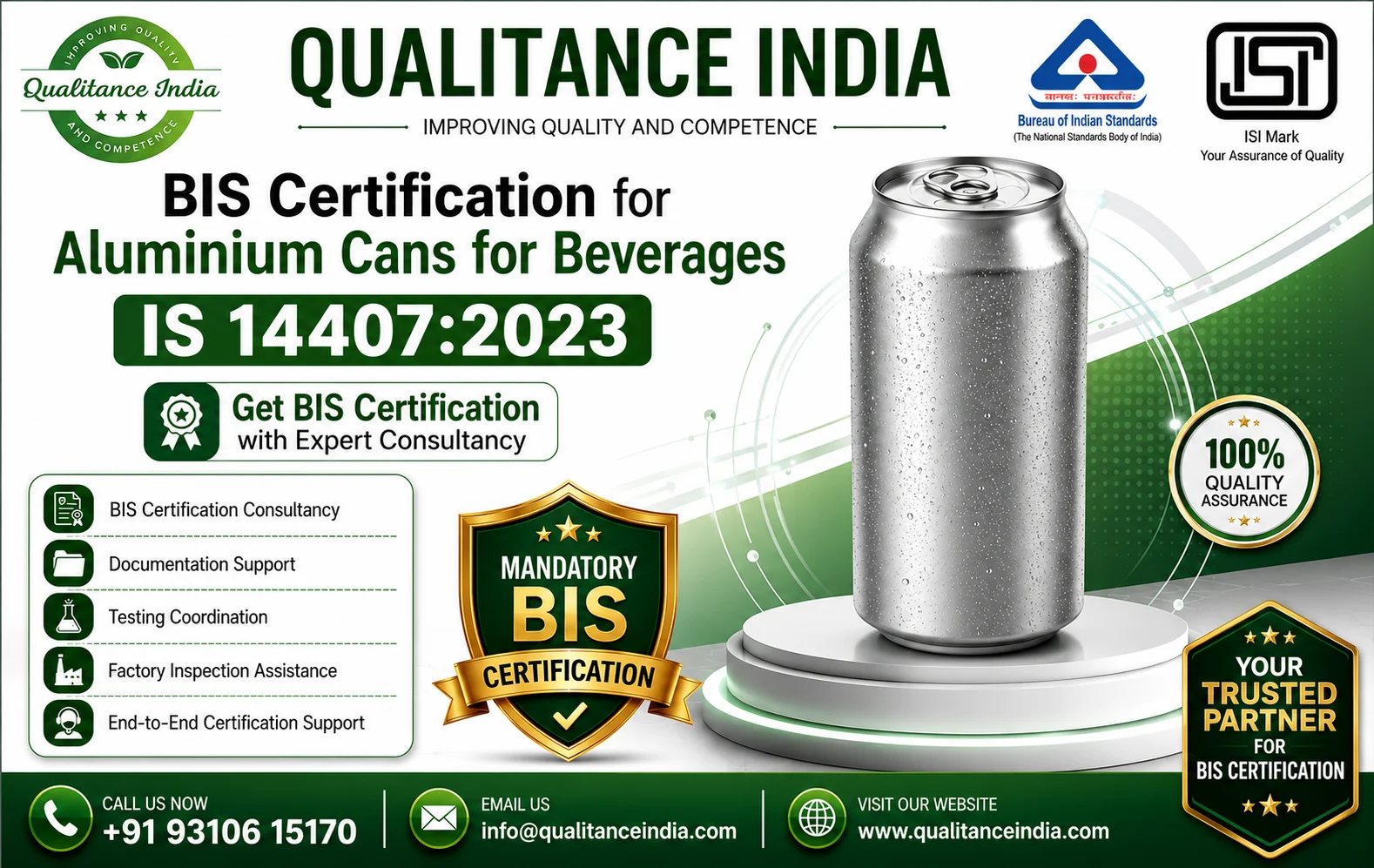
BIS Certification consultancy for Aluminium Cans for Beverages as per IS 14407:2023 with enforcement date 01 October 2026.
Google E-E-A-T Recommendations
To strengthen Experience, Expertise, Authoritativeness, and Trustworthiness:
- Mention that the content is prepared or reviewed by experienced BIS certification professionals.
- Keep the article updated whenever BIS notifications or Quality Control Orders change.
- Add your company profile, years of experience, and areas of specialization.
- Publish related product compliance guides to build topical authority.
- Include a clear contact page and business information.
Call to Action
Need BIS Certification for Aluminium Cans for Beverages?
If your company manufactures or supplies Aluminium Cans for Beverages covered under IS 14407:2023, preparing early for the mandatory implementation date can help avoid business disruptions.
Qualitance India provides end-to-end BIS Certification consultancy, including:
- Product Applicability Review
- Documentation Preparation
- BIS Application Filing
- Product Testing Coordination
- Factory Inspection Assistance
- Technical Query Support
- Licence Grant Assistance
- Renewal and Ongoing Compliance
Contact Qualitance India
Qualitance India – Improving Quality and Competence
BIS Certification Consultancy Services
📞 Phone: +91 93106 15170
📧 Email: info@qualitanceindia.com
🌐 Website: https://qualitanceindia.com
Conclusion
The mandatory implementation of BIS Certification for Aluminium Cans for Beverages under IS 14407:2023 from 01 October 2026 marks an important step toward strengthening quality and regulatory compliance in India's beverage packaging industry. Manufacturers should begin preparations early by reviewing the applicable standard, organizing documentation, coordinating product testing, and establishing effective quality control systems.
With proper planning and expert guidance, businesses can complete the certification process efficiently and continue supplying compliant products to the Indian market. Qualitance India supports manufacturers throughout the BIS certification journey with technical expertise and end-to-end consultancy services.