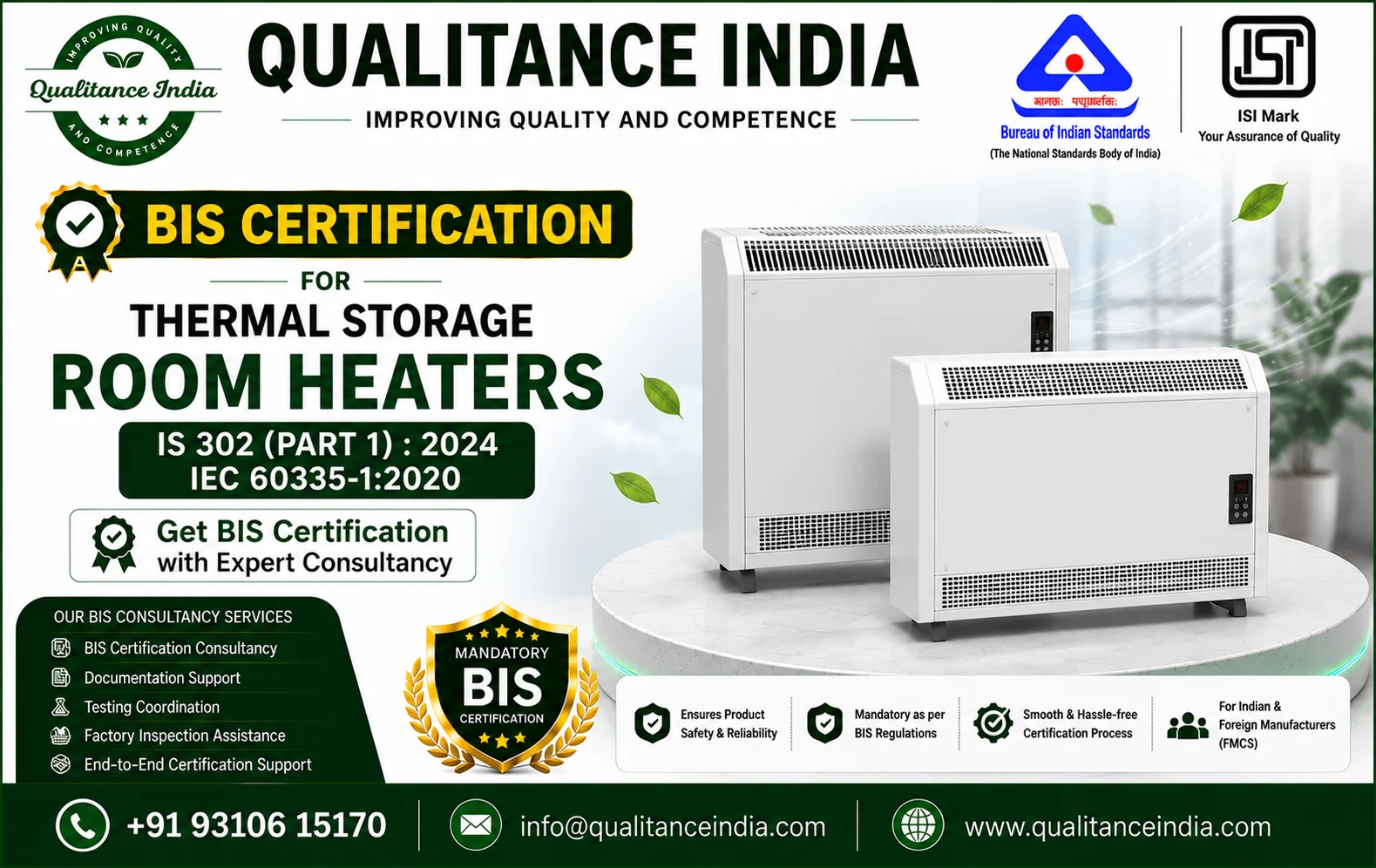
BIS Certification Consultancy for Thermal Storage Room Heaters – IS 302 (Part 1):2024 | IEC 60335-1:2020
Introduction: BIS Certification for Thermal Storage Room Heaters
Thermal Storage Room Heaters are electrical heating appliances designed to store thermal energy and release heat into a room or surrounding area. Because these appliances involve electrical heating elements, high operating temperatures and thermal energy storage, safety and performance requirements are important considerations for manufacturers and businesses supplying these products in India.
The Bureau of Indian Standards (BIS) has identified Thermal Storage Room Heaters within the product-wise testing scope associated with IS 302 (Part 1):2024 | IEC 60335-1:2020. BIS Laboratory Information Management System (LIMS) also provides a specific testing entry for Thermal Storage Room Heaters under IS 302: Part 1, confirming that the product category is covered within the relevant laboratory testing framework.
The revised IS 302 (Part 1):2024 corresponds to IEC 60335-1:2020 and establishes general safety requirements for applicable household and similar electrical appliances. BIS lists the standard under the safety framework for electrical appliances.
For businesses preparing for mandatory compliance, it is important to identify the correct product category, applicable Indian Standard, certification route, testing requirements and latest Quality Control Order provisions before placing applicable products in the Indian market.
This complete guide explains the BIS Certification Consultancy requirements for Thermal Storage Room Heaters, including applicable standards, BIS testing, required documents, certification process, factory inspection, cost factors, timelines, common rejection reasons, FAQs and compliance requirements.
About Thermal Storage Room Heaters
Thermal Storage Room Heaters are electrical appliances designed to generate and store heat before gradually releasing that stored thermal energy into the surrounding environment.
Unlike conventional room heaters that may continuously generate heat while operating, thermal storage heating appliances generally use a thermal storage medium or material that retains heat and releases it over a period of time.
Depending on the product design, these appliances may incorporate:
- Electrical heating elements
- Thermal storage materials
- Insulation systems
- Temperature control mechanisms
- Thermostats
- Safety cut-outs
- Electrical control components
- Protective enclosures
- Ventilation or heat-release arrangements
Since these appliances combine electrical systems with thermal energy storage, their design must address safety considerations such as protection against electric shock, excessive temperature, overheating, abnormal operation, insulation failure and fire-related hazards.
The exact BIS applicability should always be determined based on the actual construction, intended use, electrical rating and regulatory classification of the product.
What is BIS Certification for Thermal Storage Room Heaters?
BIS Certification is a conformity assessment process administered by the Bureau of Indian Standards (BIS).
Where a product is covered by a mandatory Quality Control Order, manufacturers are required to demonstrate conformity with the applicable Indian Standard and obtain the required BIS licence before manufacturing, importing or selling the covered product in India, subject to the applicable regulatory provisions.
For the relevant general safety framework, the applicable standard is:
IS 302 (Part 1):2024
Corresponding international standard:
IEC 60335-1:2020
The standard is titled:
Household and Similar Electrical Appliances – Safety – Part 1: General Requirements
BIS identifies IS 302 (Part 1):2024 as the seventh revision of the general safety standard and lists it under the electrical appliances and accessories category.
BIS certification under the applicable Scheme-I / ISI Mark framework is intended to demonstrate that products conform to the relevant requirements and that the manufacturer has the capability to maintain consistent product quality.
Applicable Standard: IS 302 (Part 1):2024 | IEC 60335-1:2020
The relevant standard is:
IS 302 (Part 1):2024
IEC 60335-1:2020
Title: Household and Similar Electrical Appliances – Safety – Part 1: General Requirements
The revised Indian Standard is identified by BIS as being identical under dual numbering with IEC 60335-1:2020.
Depending on the specific product and applicable requirements, safety evaluation may cover areas such as:
- Classification
- Marking and instructions
- Protection against access to live parts
- Power input
- Current input
- Heating
- Temperature rise
- Leakage current
- Electric strength
- Moisture resistance
- Abnormal operation
- Mechanical strength
- Construction
- Internal wiring
- Components
- Earthing
- Supply connections
- Clearances and creepage distances
- Solid insulation
- Resistance to heat and fire
- Resistance to rusting
- Radiation, toxicity and similar hazards, where applicable
The exact test programme depends on the construction and characteristics of the Thermal Storage Room Heater.
Products Covered Under Thermal Storage Room Heaters
The product-wise BIS testing scope specifically identifies:
Thermal Storage Room Heaters
under:
IS 302 (Part 1):2024
BIS LIMS provides a specific product entry for Thermal Storage Room Heaters and lists testing charges for the product category.
Depending on product configuration, the relevant category may include applicable:
- Thermal Storage Room Heaters
- Electrically operated thermal storage heating appliances
- Room heating appliances using stored thermal energy
- Similar electrical heating appliances falling within the applicable product scope
However, product classification should not be based only on the product's commercial name.
A proper BIS applicability assessment should consider:
- Product function
- Heating technology
- Electrical input
- Rated voltage
- Rated power
- Thermal storage mechanism
- Heating element design
- Intended application
- Construction
- Control mechanism
- Product specifications
- Applicable QCO provisions
BIS Implementation Date and QCO Applicability
The BIS upcoming QCO information lists the broader category of electrical appliances intended for household, commercial or similar applications with rated voltage not exceeding 250 V for single-phase appliances and 480 V for other appliances, including direct-current supplied and battery-operated appliances, under IS 302 (Part 1):2024 | IEC 60335-1:2020, with an implementation date of 01 October 2026.
For Thermal Storage Room Heaters, businesses should verify the latest notified QCO and product scope before relying on the implementation date for a specific product.
Key Compliance Information
| Particular | Details |
|---|---|
| Product | Thermal Storage Room Heaters |
| Indian Standard | IS 302 (Part 1):2024 |
| International Reference | IEC 60335-1:2020 |
| Certification Framework | BIS Scheme-I / ISI Mark Scheme, where applicable |
| Product Testing | BIS-recognized laboratory testing, as applicable |
| Implementation | Verify latest QCO applicability |
| BIS Testing Scope | Thermal Storage Room Heaters listed in BIS LIMS |
BIS currently lists the relevant electrical appliance QCO framework and the 01 October 2026 implementation date for the broader applicable category.
Who Needs BIS Certification for Thermal Storage Room Heaters?
Indian Manufacturers
Indian manufacturers producing applicable Thermal Storage Room Heaters for the Indian market may need to obtain the required BIS licence under the applicable certification framework.
Foreign Manufacturers
Foreign manufacturers supplying applicable products to India must comply with the applicable BIS requirements.
OEM Manufacturers
OEM manufacturers producing Thermal Storage Room Heaters for another company or brand should ensure that manufacturing, testing and brand-related documentation is properly managed.
Private Label Brands
Businesses selling products under their own brand should ensure that applicable brand authorization and BIS marking requirements are correctly addressed.
Importers
Importers should verify the BIS compliance status of applicable Thermal Storage Room Heaters before importing and commercially selling them in India.
Eligibility Criteria for BIS Certification
A manufacturer seeking BIS Certification should generally have:
- Clearly identified manufacturing premises
- Defined product scope
- Applicable Indian Standard
- Technical product specifications
- Manufacturing process
- Quality control system
- Required testing facilities
- Calibrated testing equipment, where applicable
- Representative product samples
- Quality control records
- Product marking details
- Brand ownership or authorization documents
Foreign manufacturers may have additional requirements depending on the applicable BIS certification procedure.
Complete BIS Certification Process for Thermal Storage Room Heaters
Step 1: Product Applicability Assessment
The first step is to determine the correct BIS certification requirement for the product.
This involves reviewing:
- Product description
- Product photographs
- Technical specifications
- Rated voltage
- Rated power
- Heating technology
- Thermal storage method
- Intended application
- Product construction
Step 2: Applicable Standard Identification
The product should be mapped to the appropriate Indian Standard.
For the relevant general safety framework:
IS 302 (Part 1):2024 | IEC 60335-1:2020
Any applicable product-specific standard should also be evaluated.
Step 3: Technical Documentation
Prepare the complete technical file, including product specifications and manufacturing information.
Step 4: Sample Preparation
Prepare representative samples for laboratory testing.
Step 5: Laboratory Testing
Submit samples to the appropriate BIS-recognized laboratory for testing as per the applicable requirements.
Step 6: BIS Application
Submit the required application and supporting documents through the applicable BIS certification process.
Step 7: Document Scrutiny
BIS reviews the application, test reports, factory information and supporting documentation.
Step 8: Factory Inspection
Where required, BIS may assess the manufacturing facility and quality control arrangements.
Step 9: Corrective Action
If non-conformities are identified, corrective actions and applicable re-testing may be required.
Step 10: Grant of BIS Licence
After successful completion of the applicable requirements, BIS may grant the certification licence.
Step 11: ISI Marking
The manufacturer must follow the applicable BIS Standard Marking requirements.
Step 12: Post-Certification Compliance
The manufacturer must maintain ongoing conformity through quality control, testing, marking and surveillance requirements.
Required Documents for BIS Certification
Common documents may include:
- BIS application documents
- Company registration certificate
- Factory registration documents
- Factory address proof
- Manufacturing process flow chart
- Product technical specifications
- Product datasheet
- Product photographs
- Circuit diagram
- Wiring diagram
- Component list
- Critical component details
- Quality control plan
- Quality control records
- Testing equipment list
- Calibration certificates
- In-house testing facility details
- Laboratory test reports, where applicable
- Trademark documents
- Brand authorization documents
- Foreign manufacturer documents
- Authorized Indian Representative details, where applicable
- Required declarations and undertakings
The exact documentation depends on the product, manufacturer location, certification route and applicable BIS requirements.
Laboratory Testing Requirements
Laboratory testing is one of the most important stages of BIS Certification for Thermal Storage Room Heaters.
BIS LIMS specifically lists Thermal Storage Room Heaters under IS 302: Part 1 and provides a product-specific testing scope. One BIS LIMS entry shows a testing charge of ₹30,000 excluding taxes, while a separate BIS product-wise testing document lists ₹45,000 for Thermal Storage Room Heaters at the referenced laboratory. This demonstrates that testing costs can vary by laboratory and testing scope.
Potential testing areas may include:
- Classification
- Rating
- Marking and instructions
- Protection against access to live parts
- Power input
- Current input
- Heating
- Temperature rise
- Leakage current
- Electric strength
- Moisture resistance
- Abnormal operation
- Mechanical strength
- Stability
- Construction
- Internal wiring
- Components
- Earthing
- Supply connection
- Clearances and creepage distances
- Solid insulation
- Resistance to heat and fire
- Resistance to rusting
The actual testing requirements must be determined based on the product's construction and applicable test clauses.
Factory Inspection Process
Where applicable under the BIS certification procedure, factory inspection is conducted to evaluate whether the manufacturer can consistently produce products conforming to the relevant Indian Standard.
The assessment may include:
- Manufacturing infrastructure
- Production process
- Raw material control
- Incoming inspection
- In-process inspection
- Final inspection
- Testing facilities
- Calibration system
- Quality control records
- Trained technical personnel
- Product sampling
Before inspection, manufacturers should ensure that:
- Production facilities are operational
- Required testing equipment is available
- Calibration certificates are valid
- Quality control procedures are documented
- Testing personnel are available
- Production records are maintained
- Inspection records are properly documented
Common Reasons for BIS Certification Delay or Rejection
Incorrect Product Classification
Incorrect product classification may result in the wrong certification route or standard being selected.
Wrong Standard Selection
The product must be correctly mapped to the applicable Indian Standard.
Incomplete Documentation
Missing documents can result in queries and processing delays.
Laboratory Test Failure
Failure during testing may require corrective action and re-testing.
Inconsistent Model Numbers
Model numbers must be consistent across applications, test reports, technical documents and product marking.
Incorrect Product Marking
Improper marking can lead to compliance issues.
Poor Quality Control
Manufacturers must maintain appropriate quality control systems.
Factory Readiness Issues
Where factory inspection applies, the manufacturing facility should be properly prepared.
Brand Authorization Problems
Brand ownership and authorization should be clearly documented.
Delayed Response to BIS Queries
Failure to respond promptly to BIS queries can extend the certification timeline.
BIS Certification Cost Factors
The total cost may depend on:
- BIS government fees
- Application fees
- Laboratory testing charges
- Number of product models
- Product complexity
- Number of samples
- Factory location
- Inspection expenses
- Testing equipment requirements
- Documentation requirements
- Consultancy charges
- Foreign manufacturer requirements
BIS LIMS data shows different testing charges for Thermal Storage Room Heaters across laboratory listings. One listing shows ₹30,000 excluding taxes, while a product-wise testing document lists ₹45,000 for the category at another laboratory. Therefore, manufacturers should obtain a product-specific testing quotation before budgeting for certification.
The total BIS certification cost should not be assumed from laboratory testing charges alone.
BIS Certification Timeline
The overall timeline depends on:
- Product complexity
- Laboratory availability
- Testing results
- Documentation readiness
- Factory readiness
- Inspection scheduling
- BIS queries
- Corrective actions
- Re-testing requirements
Manufacturers should start the certification preparation process well before the applicable implementation date.
Early preparation allows sufficient time for:
Product Assessment → Standard Identification → Testing → Corrective Action → Documentation → Application → Inspection → Approval
Benefits of BIS Certification
Regulatory Compliance
Helps businesses comply with applicable mandatory certification requirements.
Product Safety
Demonstrates conformity with relevant safety requirements.
Market Access
Supports legal market access where BIS certification is mandatory.
Consumer Confidence
Applicable BIS Standard Marking can increase confidence in product safety and quality.
Brand Credibility
Certification can strengthen the credibility of manufacturers and brands.
Quality Assurance
The certification process supports systematic quality control.
Reduced Compliance Risk
Proper certification reduces the risk of regulatory action against non-compliant products.
Business Growth
BIS compliance can help businesses meet the requirements of institutional and commercial customers.
Why Choose Qualitance India for BIS Certification Consultancy?
Qualitance India provides professional BIS Certification Consultancy support for manufacturers, importers, OEMs and businesses dealing with applicable Thermal Storage Room Heaters.
Our consultancy support can include:
✓ Product Applicability Assessment
✓ Applicable Standard Identification
✓ BIS Documentation Support
✓ Technical Compliance Assistance
✓ Laboratory Testing Coordination
✓ BIS Application Assistance
✓ Factory Inspection Preparation
✓ BIS Query Assistance
✓ Corrective Action Support
✓ BIS Licence Assistance
✓ Post-Certification Compliance Guidance
Our goal is to simplify the BIS certification journey and help businesses prepare for regulatory compliance in a structured manner.
Step-by-Step BIS Certification Flow Chart
Thermal Storage Room Heater Product Identification
↓
BIS Applicability Assessment
↓
IS 302 (Part 1):2024 & QCO Verification
↓
Check Product-Specific Standard Applicability
↓
Technical Document Review
↓
Product Sample Preparation
↓
BIS-Recognized Laboratory Testing
↓
BIS Application Submission
↓
Document Scrutiny
↓
Factory Inspection – Where Applicable
↓
Corrective Action / Compliance
↓
BIS Licence Approval
↓
ISI Standard Marking
↓
Post-Certification Compliance & Surveillance
20 SEO FAQs for BIS Certification for Thermal Storage Room Heaters
1. Is BIS Certification mandatory for Thermal Storage Room Heaters?
Thermal Storage Room Heaters must comply with applicable BIS certification requirements where they fall under a mandatory QCO and certification scope.
2. Which standard applies to Thermal Storage Room Heaters?
The relevant general safety standard is IS 302 (Part 1):2024 | IEC 60335-1:2020, subject to product-specific applicability.
3. Are Thermal Storage Room Heaters listed in BIS testing scope?
Yes. BIS LIMS specifically lists Thermal Storage Room Heaters under IS 302: Part 1.
4. What is the implementation date?
The BIS upcoming QCO page currently lists 01 October 2026 for the broader applicable electrical appliance category under IS 302 (Part 1):2024. Product-specific applicability should be verified against the latest QCO.
5. Who needs BIS Certification?
Applicable Indian manufacturers and eligible foreign manufacturers supplying covered products to India may require BIS certification.
6. Is laboratory testing required?
Yes. Laboratory testing is an important part of the applicable BIS certification process.
7. Is factory inspection required?
Factory inspection depends on the applicable BIS certification procedure and requirements.
8. How much does BIS Certification cost?
The cost depends on BIS fees, laboratory testing, product models, product complexity, factory inspection and consultancy requirements.
9. How long does BIS Certification take?
The timeline varies depending on testing, documentation, laboratory availability, inspection and BIS processing.
10. Can foreign manufacturers obtain BIS Certification?
Yes. Eligible foreign manufacturers can apply under the applicable BIS certification process after fulfilling the required conditions.
11. What documents are required?
Documents may include factory details, product specifications, circuit diagrams, quality control records, test reports, brand documents and declarations.
12. What happens if the product fails laboratory testing?
The manufacturer may need to identify the cause, implement corrective action and complete applicable re-testing.
13. Can multiple models be included in one BIS licence?
Model grouping depends on applicable BIS grouping guidelines and the technical similarity of the products.
14. What causes BIS Certification delays?
Common causes include incomplete documents, incorrect standard selection, laboratory failures, inconsistent model numbers, factory readiness problems and delayed responses.
15. What is IS 302 (Part 1):2024?
It is the Indian Standard covering general safety requirements for applicable household and similar electrical appliances.
16. What is IEC 60335-1:2020?
It is the international reference standard corresponding to IS 302 (Part 1):2024.
17. Why is safety important for Thermal Storage Room Heaters?
These appliances involve electrical heating and thermal energy storage, making protection against electric shock, excessive temperature and abnormal operation important safety considerations.
18. Can Qualitance India help with BIS testing?
Yes. Qualitance India can provide consultancy and assist with laboratory testing coordination.
19. When should manufacturers start BIS preparation?
Manufacturers should begin early to allow sufficient time for product testing, documentation, corrective actions and certification procedures.
20. Why hire a BIS Certification Consultant?
A BIS consultant can assist with applicability assessment, documentation, laboratory coordination, application support and factory inspection preparation.
FAQ Schema Content
Question: Is BIS Certification mandatory for Thermal Storage Room Heaters?
Answer: Thermal Storage Room Heaters covered under an applicable mandatory Quality Control Order must comply with the relevant BIS certification requirements before commercial market access in India.
Question: Which standard applies to Thermal Storage Room Heaters?
Answer: The relevant general safety standard is IS 302 (Part 1):2024, corresponding to IEC 60335-1:2020, subject to product-specific applicability.
Question: Are Thermal Storage Room Heaters included in BIS testing scope?
Answer: Yes. BIS LIMS lists Thermal Storage Room Heaters as a product category under IS 302: Part 1.
Question: What is the implementation date?
Answer: BIS currently lists 01 October 2026 as the implementation date for the broader applicable electrical appliance category under IS 302 (Part 1):2024. Product-specific QCO applicability should be verified before making a final compliance decision.
Question: How do I obtain BIS Certification for Thermal Storage Room Heaters?
Answer: The process generally includes product applicability assessment, standard identification, technical documentation, laboratory testing, BIS application submission, factory inspection where applicable, compliance verification and licence approval.
Question: How much does BIS Certification cost?
Answer: The cost depends on BIS fees, laboratory testing charges, number of models, product complexity, inspection requirements and consultancy services.
Question: How long does BIS Certification take?
Answer: The timeline varies depending on laboratory testing, documentation, factory inspection, corrective actions and BIS processing.
Service Schema Suggestion
Service Name: BIS Certification Consultancy for Thermal Storage Room Heaters
Service Type: BIS Certification Consultancy
Applicable Standard: IS 302 (Part 1):2024
Reference Standard: IEC 60335-1:2020
Certification Scheme: BIS Scheme-I / ISI Mark Scheme, where applicable
Provider: Qualitance India
Service Area: India and eligible foreign manufacturers supplying applicable products to India
Organization Schema Suggestion
Organization Name: Qualitance India
Tagline: Improving Quality and Competence
Business Type: BIS Certification Consultancy
Services: BIS Certification, BIS Licence Consultancy, Product Testing Coordination, Documentation Support, Factory Inspection Assistance, Technical Compliance Support
Breadcrumb Schema Suggestion
Home
→ BIS Certification
→ Electrical Appliances
→ Thermal Storage Room Heaters
→ BIS Certification for Thermal Storage Room Heaters – IS 302 (Part 1):2024
Article Schema Suggestion
Article Title: BIS Certification Consultancy for Thermal Storage Room Heaters – IS 302 (Part 1):2024
Article Type: Article
Category: BIS Certification
Main Topic: BIS Certification for Thermal Storage Room Heaters
Applicable Standard: IS 302 (Part 1):2024
Reference Standard: IEC 60335-1:2020
Publisher: Qualitance India
Image ALT Tags
- BIS Certification for Thermal Storage Room Heaters IS 302 Part 1 2024
- Thermal Storage Room Heaters BIS Certification Consultancy
- BIS Licence for Thermal Storage Room Heaters in India
- Thermal Storage Room Heater BIS Certification
- IS 302 Part 1 2024 Thermal Storage Room Heater Certification
- BIS Testing for Thermal Storage Room Heaters
- BIS Laboratory Testing for Thermal Storage Room Heaters
- BIS Factory Inspection for Thermal Storage Room Heaters
- ISI Mark Certification for Thermal Storage Room Heaters
- IEC 60335-1 2020 Thermal Storage Room Heater Certification
- Mandatory BIS Certification for Thermal Storage Room Heaters
- BIS Compliance for Thermal Storage Room Heater Manufacturers
- Thermal Storage Room Heater BIS Certification Process
- Qualitance India BIS Certification Consultancy
- BIS Consultant for Thermal Storage Room Heaters
Internal Linking Strategy
Add contextual internal links to related Qualitance India service pages using natural anchor text.
Recommended internal links:
- BIS Certification under IS 302 (Part 1):2024
- BIS Certification for Fixed Immersion Heaters
- BIS Certification for Water-Bed Heaters
- BIS Certification for Foot Warmers & Heating Mats
- BIS Certification for Air-Cleaning Appliances
- BIS Certification for Vaporizers
- BIS Certification for Fabric Steamers
- BIS Certification for Outdoor Barbecues
- BIS Certification for Toilet Appliances
- BIS Certification for Commercial Electric Kitchen Machines
Recommended anchor texts:
BIS Certification for Electrical Appliances
BIS Certification under IS 302 Part 1:2024
BIS Certification for Heating Appliances
BIS Certification Consultancy in India
BIS Certification for Thermal Heating Appliances
External Authority References
For regulatory verification and future updates, refer to:
- Bureau of Indian Standards (BIS)
- BIS Product Certification
- BIS Scheme-I / ISI Mark Scheme
- BIS Indian Standards
- BIS LIMS
- Safety of Household, Commercial and Similar Electrical Appliances Quality Control Order
- BIS Act, 2016
- BIS Conformity Assessment Regulations
The BIS official Scheme-I page lists the relevant IS 302 (Part 1):2024 framework and the applicable electrical appliance QCO orders, while BIS LIMS provides product-specific testing information for Thermal Storage Room Heaters.
Related BIS Services
- BIS Certification for Fixed Immersion Heaters
- BIS Certification for Water-Bed Heaters
- BIS Certification for Air-Cleaning Appliances
- BIS Certification for Foot Warmers & Heating Mats
- BIS Certification for Vaporizers
- BIS Certification for Fabric Steamers
- BIS Certification for Outdoor Barbecues
- BIS Certification for Toilet Appliances
- BIS Certification for Commercial Electric Kitchen Machines
- BIS Certification for Commercial Electric Hoods
Related Blog Suggestions
- IS 302 (Part 1):2024 – Complete BIS Certification Guide for Electrical Appliances
- BIS Certification for Thermal Storage Room Heaters in India
- BIS Certification for Electrical Heating Appliances – Complete Guide
- BIS Certification Process Under IS 302 (Part 1):2024
- BIS Certification Cost and Timeline for Electrical Appliances
- Documents Required for BIS Certification in India
- BIS Laboratory Testing Requirements Under IS 302 (Part 1):2024
- BIS Factory Inspection Process – Complete Guide
- Common Reasons for BIS Certification Rejection
- BIS Certification for Foreign Manufacturers and Importers
Strong Lead Generation CTA
Need BIS Certification for Thermal Storage Room Heaters?
Are you a manufacturer, importer, OEM or brand dealing with applicable Thermal Storage Room Heaters?
BIS LIMS already provides a specific testing scope for Thermal Storage Room Heaters under IS 302: Part 1, and the BIS QCO framework for the broader applicable electrical appliance category lists 01 October 2026 as the implementation date.
Do not wait until the last moment to start your compliance preparation.
Qualitance India can assist you with:
✓ BIS Product Applicability Assessment
✓ Applicable Standard Identification
✓ Technical Documentation
✓ Laboratory Testing Coordination
✓ BIS Application Filing Support
✓ Factory Inspection Preparation
✓ BIS Query Assistance
✓ Corrective Action Support
✓ BIS Licence Assistance
✓ Post-Certification Compliance Guidance
Start your BIS Certification preparation today and reduce the risk of last-minute compliance delays.
Call: +91-9310-615-170
Email: info@qualitanceindia.com
Website: qualitanceindia.com
Contact Qualitance India for expert BIS Certification Consultancy for Thermal Storage Room Heaters under IS 302 (Part 1):2024.
SEO-Optimized Conclusion
BIS Certification for Thermal Storage Room Heaters under IS 302 (Part 1):2024 | IEC 60335-1:2020 is an important compliance consideration for manufacturers and businesses supplying applicable electrical heating appliances in India.
Thermal Storage Room Heaters are specifically identified in the BIS product-wise testing scope under IS 302 (Part 1), and BIS LIMS provides a dedicated testing entry for this product category.
The BIS upcoming QCO information currently lists 01 October 2026 as the implementation date for the broader applicable category of household, commercial and similar electrical appliances covered by IS 302 (Part 1):2024. Businesses should verify the latest QCO and product-specific applicability before making final compliance decisions.
Manufacturers should begin preparation early because product applicability assessment, technical documentation, laboratory testing, corrective actions, application processing and factory inspection where applicable can take time.
With the right compliance strategy and professional BIS consultancy support, businesses can prepare their products and documentation in advance and reduce the risk of delays.
Qualitance India provides BIS Certification Consultancy support for manufacturers, importers, OEMs and businesses seeking assistance with product applicability, documentation, laboratory testing coordination, BIS application, factory inspection preparation and certification compliance.
If you manufacture, import or supply applicable Thermal Storage Room Heaters, contact Qualitance India today to assess your BIS certification requirements and begin your compliance preparat