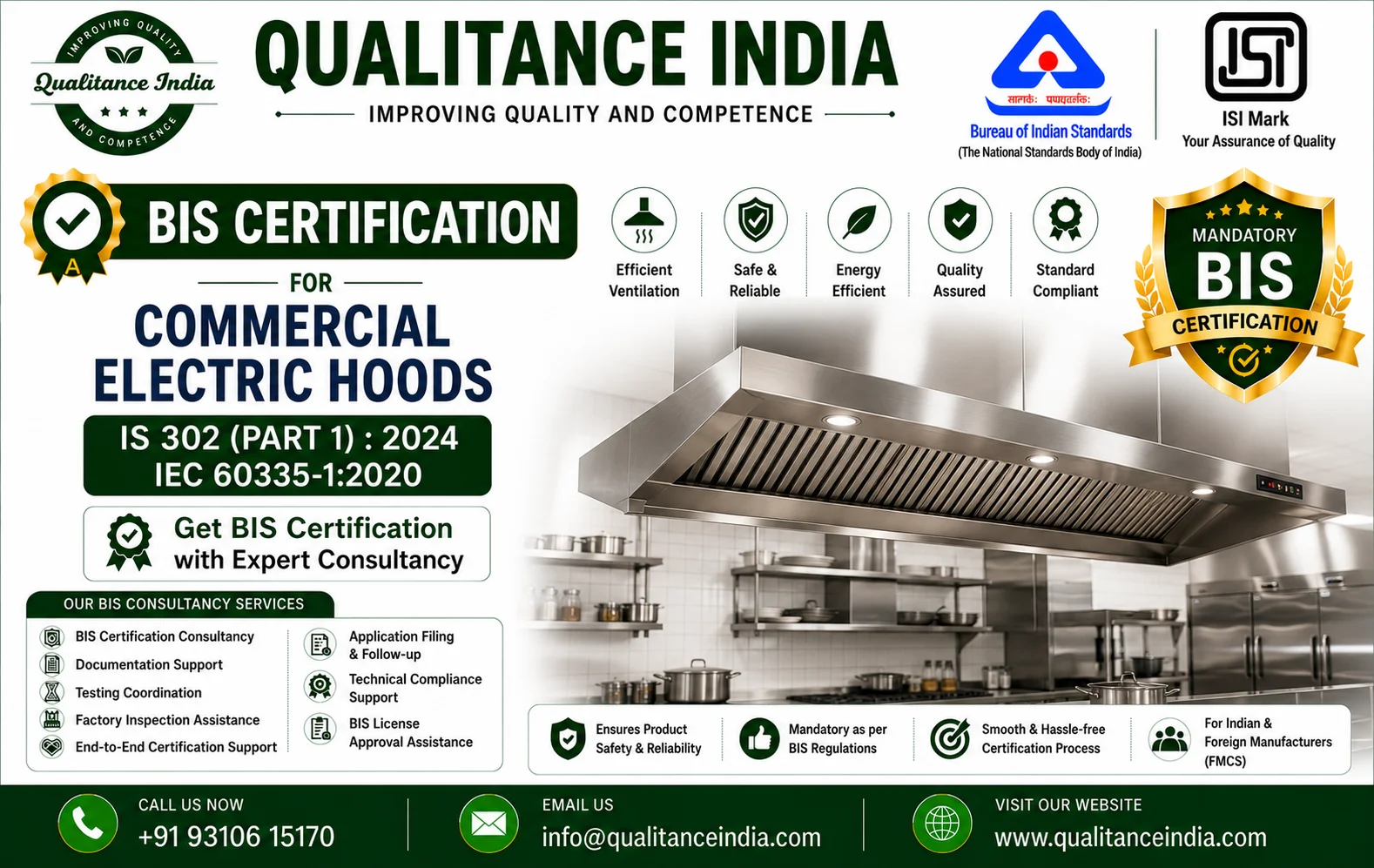
BIS Certification Consultancy for Commercial Electric Hoods – IS 302 (Part 1):2024 | IEC 60335-1:2020
Introduction
Commercial electric hoods are widely used in restaurants, hotels, commercial kitchens, food processing facilities, canteens, and other professional cooking environments. As electrical appliances become increasingly important in commercial applications, ensuring product safety, reliability, and compliance with applicable Indian Standards is essential.
The BIS Certification requirement for Commercial Electric Hoods under IS 302 (Part 1):2024, based on IEC 60335-1:2020, is an important compliance consideration for manufacturers and businesses supplying these products in the Indian market.
The applicable requirement is scheduled for enforcement from 01 October, 2026. Manufacturers and other relevant businesses should therefore begin preparing their products, technical documentation, testing, and certification process in advance to avoid last-minute compliance challenges.
Qualitance India provides expert BIS Certification Consultancy for Commercial Electric Hoods, supporting manufacturers through documentation, testing coordination, application filing, technical compliance, and the overall BIS certification process.
About Commercial Electric Hoods
Commercial electric hoods are electrically operated ventilation and exhaust appliances designed primarily for professional and commercial cooking environments. These appliances help remove heat, smoke, vapours, grease-laden air, and cooking fumes from kitchen areas.
Depending on their design and intended application, commercial electric hoods may incorporate electrical components such as motors, fans, lighting systems, control panels, switches, sensors, and other electrical assemblies.
Because these products combine electrical systems with ventilation functions, appropriate safety and performance requirements must be considered during product design, manufacturing, and certification.
What is BIS Certification?
BIS Certification is a conformity assessment mechanism administered by the Bureau of Indian Standards (BIS). It helps ensure that products comply with applicable Indian Standards relating to quality, safety, performance, and technical requirements.
For products covered under mandatory BIS certification requirements, manufacturers are required to obtain the applicable BIS licence or certification before the product can be legally manufactured, imported, distributed, or sold in the Indian market, subject to the applicable regulatory framework.
For commercial electric hoods covered by the applicable requirement, manufacturers should assess the product against IS 302 (Part 1):2024 / IEC 60335-1:2020 and complete the required compliance process before the enforcement date.
Applicable Indian Standard
Indian Standard: IS 302 (Part 1):2024
International Reference: IEC 60335-1:2020
Product Category: Commercial Electric Hoods
Enforcement Date: 01 October, 2026
The exact applicability of the standard should be determined based on the product's construction, electrical characteristics, intended use, and applicable BIS/QCO requirements.
Scope of IS 302 (Part 1):2024
IS 302 (Part 1):2024 specifies general safety requirements applicable to electrical appliances intended for household and similar purposes, including certain appliances used in commercial environments, subject to the scope and exclusions of the standard.
For commercial electric hoods, compliance assessment may involve evaluating electrical safety, protection against electric shock, construction, internal wiring, insulation, leakage current, dielectric strength, temperature-related safety, abnormal operation, mechanical strength, and other applicable safety requirements.
The precise testing requirements depend on the product design and applicable certification scope.
Products Covered
Depending on the applicable regulatory scope, the category may include different types and configurations of electrically operated commercial hoods, such as:
• Commercial electric kitchen hoods
• Commercial exhaust hoods
• Electric cooking ventilation hoods
• Commercial kitchen ventilation appliances
• Electrically operated extraction hoods
• Commercial hoods incorporating fans and electrical controls
• Other similar electrical hood appliances falling within the applicable scope
Manufacturers should conduct a BIS applicability assessment before beginning the certification process to confirm the correct standard and certification route.
Enforcement Date – 01 October, 2026
The enforcement date for the applicable requirement is 01 October, 2026.
This means manufacturers and businesses dealing with covered products should not wait until the last moment to begin certification preparation.
Early preparation can help manufacturers:
• Identify the correct applicable standard
• Complete product testing on time
• Prepare technical documentation
• Address testing failures or non-conformities
• Prepare the manufacturing facility for inspection
• Submit the BIS application correctly
• Reduce the risk of delays before enforcement
Manufacturers planning to launch or continue supplying covered commercial electric hoods in India should initiate the compliance process well before the enforcement date.
Who Needs BIS Certification?
BIS certification requirements may apply to relevant manufacturers supplying covered products in the Indian market, including:
• Indian manufacturers
• Foreign manufacturers exporting to India
• Original Equipment Manufacturers (OEMs)
• Private-label manufacturers
• Businesses manufacturing products under their own brand
• Manufacturers supplying commercial electric hoods to Indian distributors or importers
The exact applicability should always be confirmed based on the product, manufacturer, standard, and current BIS regulatory requirements.
Eligibility Criteria
Before applying for BIS certification, manufacturers should generally ensure that:
• The manufacturing unit is clearly identified
• The product falls within the applicable Indian Standard
• The manufacturing facility has suitable production capabilities
• Required testing facilities and quality-control arrangements are available
• Product samples are available for testing
• Technical documents are complete and accurate
• The manufacturer has appropriate quality-control procedures
• The product complies with applicable safety requirements
Foreign manufacturers may also need to comply with additional requirements applicable to overseas manufacturing units and representation in India, depending on the applicable BIS certification scheme.
Complete BIS Certification Process
The BIS certification process generally involves multiple stages.
Step 1: Product Applicability Assessment
The first step is to determine whether the commercial electric hood falls under the applicable BIS requirement and which Indian Standard applies.
Step 2: Documentation Preparation
The manufacturer must prepare the required technical, manufacturing, and legal documents for submission.
Step 3: Product Testing
Product samples are tested according to applicable requirements at the appropriate BIS-recognized or otherwise permitted laboratory, as applicable.
Step 4: BIS Application Filing
After completing the required preparation and testing, the application is submitted through the applicable BIS process.
Step 5: Factory Inspection
Where required under the applicable certification scheme, BIS officials inspect the manufacturing facility to verify production capability, quality-control arrangements, testing facilities, and other compliance requirements.
Step 6: Sample Evaluation and Compliance
Any observations or non-conformities identified during testing or inspection must be addressed by the manufacturer.
Step 7: BIS Licence Grant
Once the applicable requirements are successfully completed and BIS approves the application, the manufacturer may receive the applicable BIS licence or certification approval.
Step 8: Post-Certification Compliance
After certification, the manufacturer must continue to maintain product quality, follow applicable marking requirements, conduct required routine testing, and comply with BIS surveillance requirements.
Required Documents
Depending on the certification scheme and product category, commonly required documents may include:
• Application forms
• Manufacturing unit details
• Factory address and contact information
• Company registration documents
• List of manufacturing equipment
• Manufacturing process flow chart
• Product technical specifications
• Product drawings
• Circuit diagrams
• Bill of Materials (BOM)
• Critical component details
• Test reports
• Quality-control plan
• In-house testing facility details
• Calibration certificates
• Details of testing equipment
• Trademark or brand authorization documents
• Authorization documents for foreign manufacturers, where applicable
• Undertakings and declarations as required by BIS
The exact document requirements should be confirmed before application submission.
Testing Requirements
Testing is one of the most important stages of the BIS certification process.
Commercial electric hoods may require evaluation of applicable electrical and safety parameters, which can include:
• Protection against electric shock
• Power input and current
• Leakage current
• Dielectric strength
• Insulation resistance
• Temperature rise
• Heating effects
• Abnormal operation
• Mechanical strength
• Construction requirements
• Internal wiring
• Earthing and grounding
• Electrical connections
• Stability and mechanical hazards
• Marking and instructions
The actual test programme depends on the product design, construction, rating, components, and applicable requirements of the standard.
Factory Inspection Process
For certification schemes requiring factory inspection, BIS may assess the manufacturing facility to verify whether the manufacturer has adequate systems to consistently produce compliant products.
The inspection may cover:
• Manufacturing infrastructure
• Production machinery
• Quality-control systems
• Raw material control
• In-process inspection
• Final product inspection
• Testing facilities
• Calibration of measuring equipment
• Record maintenance
• Personnel competence
• Routine testing procedures
Manufacturers should ensure that the factory is properly prepared before the inspection.
Common Reasons for Application Rejection or Delay
BIS applications may face delays or complications due to:
• Incorrect selection of Indian Standard
• Incomplete documentation
• Incorrect product specifications
• Test report deficiencies
• Product failure during testing
• Missing technical drawings
• Inconsistent product and test report details
• Inadequate quality-control arrangements
• Missing calibration records
• Improper factory preparation
• Incorrect marking or labelling
• Failure to respond to BIS observations within the required timeframe
Professional BIS consultancy can help manufacturers identify and address these issues before they cause significant delays.
Cost of BIS Certification
The total cost of BIS certification varies depending on several factors, including:
• Applicable BIS government fees
• Product testing charges