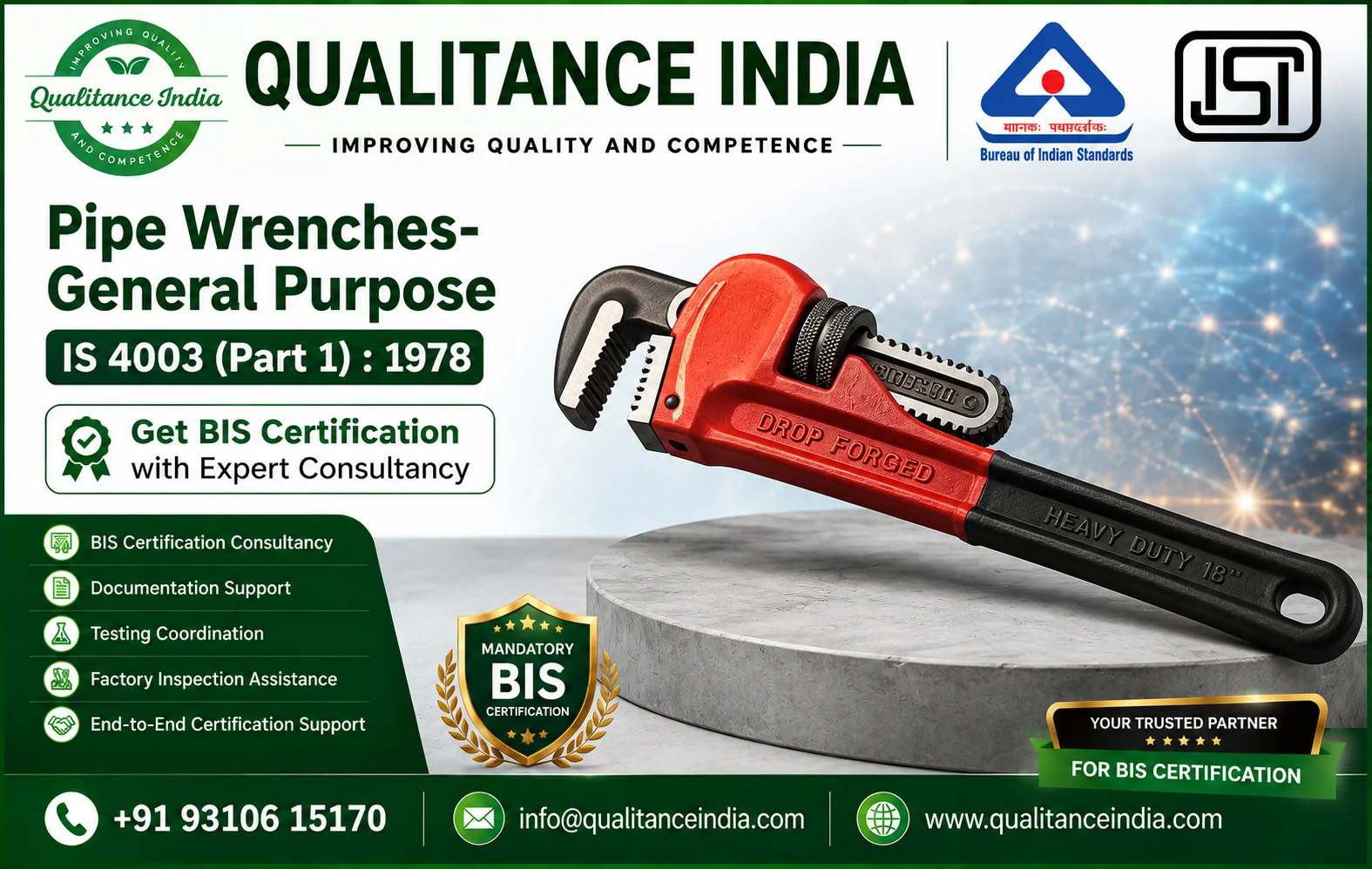
Pipe Wrenches – General Purpose BIS Certification | IS 4003 (Part 1):1978 | Complete ISI Mark Consultancy Guide | Enforcement Date 31 July 2026
Pipe Wrenches – General Purpose BIS Certification under IS 4003 (Part 1):1978
Introduction
The Indian hand tools industry plays a significant role in supporting construction, plumbing, manufacturing, infrastructure development, oil & gas, mechanical engineering, and maintenance operations. Among the essential tools used across these industries, Pipe Wrenches – General Purpose are widely recognized for their ability to grip, tighten, and loosen threaded pipes and fittings efficiently.
To ensure that manufacturers supply reliable, durable, and high-quality products to the Indian market, the Bureau of Indian Standards (BIS) has established quality requirements for Pipe Wrenches under Indian Standard IS 4003 (Part 1):1978. Manufacturers covered under the applicable Quality Control Order (QCO) are required to comply with the prescribed standard and obtain a valid BIS Certification (ISI Mark Licence) before selling their products in India.
As per the information provided for this article, the enforcement date is 31 July 2026. Manufacturers should begin preparing their documentation, testing, and compliance activities well in advance to avoid delays in product approvals and market entry.
Whether you are an Indian manufacturer, foreign manufacturer, importer, OEM supplier, or private label brand owner, obtaining BIS Certification demonstrates your commitment to quality, regulatory compliance, and customer confidence. It also helps businesses build trust in the marketplace while ensuring that products meet the applicable Indian Standard.
This comprehensive guide explains everything you need to know about Pipe Wrenches – General Purpose BIS Certification under IS 4003 (Part 1):1978, including the product overview, standard requirements, certification process, documentation, testing, benefits, and how expert consultancy can simplify the approval process.
What are Pipe Wrenches – General Purpose?
Pipe Wrenches are adjustable hand tools specially designed for gripping and rotating threaded pipes, couplings, cylindrical fittings, and other round objects. Unlike conventional spanners, Pipe Wrenches use hardened serrated jaws that automatically tighten their grip as greater force is applied.
General Purpose Pipe Wrenches are widely used by plumbers, maintenance technicians, mechanical contractors, industrial workers, utility service providers, and engineering professionals. Their rugged construction makes them suitable for heavy-duty applications where secure gripping and high torque are required.
Because these tools are often used in demanding environments, their quality, strength, heat treatment, dimensional accuracy, and durability are critical. BIS certification helps ensure that every certified product meets these essential performance and safety expectations.
Applications of Pipe Wrenches
Pipe Wrenches are used across a wide range of industries and applications, including:
- Plumbing and sanitary installations
- Water supply projects
- Oil & Gas pipelines
- Petrochemical plants
- Fire protection systems
- HVAC installation and maintenance
- Power generation facilities
- Construction and infrastructure projects
- Mechanical engineering workshops
- Manufacturing industries
- Municipal water utilities
- Industrial maintenance services
- Building maintenance operations
- Steel fabrication units
- Heavy engineering industries
Their versatility makes them one of the most important hand tools used by professionals across multiple sectors.
Product Variants Covered
Manufacturers commonly produce Pipe Wrenches in different sizes and capacities to meet varying industrial requirements. Typical product variants include:
- 8 Inch Pipe Wrench
- 10 Inch Pipe Wrench
- 12 Inch Pipe Wrench
- 14 Inch Pipe Wrench
- 18 Inch Pipe Wrench
- 24 Inch Pipe Wrench
- 36 Inch Pipe Wrench
- Heavy Duty Pipe Wrench
- Industrial Grade Pipe Wrench
- General Purpose Pipe Wrench
If these products fall under the applicable mandatory certification requirements, manufacturers must ensure compliance with the relevant BIS standard before offering them for sale in India.
Product Materials
High-quality Pipe Wrenches are generally manufactured using carefully selected materials to ensure durability and long service life. Common materials include:
- Carbon Steel
- Alloy Steel
- Chrome Vanadium Steel
- Forged Steel
- Hardened Steel
- Heat Treated Components
Proper heat treatment and quality control play an important role in improving jaw hardness, wear resistance, and gripping performance.
About BIS Certification
The Bureau of Indian Standards (BIS) is India's National Standards Body responsible for developing Indian Standards and operating product certification schemes. BIS certification helps ensure that products available in the Indian market conform to prescribed quality, safety, and performance requirements.
For products covered under mandatory certification, manufacturers must obtain a valid BIS licence before manufacturing, importing, or selling those products in India. Once certified, eligible products can bear the Standard Mark (ISI Mark) in accordance with BIS requirements.
For Pipe Wrenches – General Purpose, compliance with IS 4003 (Part 1):1978 signifies that the product has been manufactured in accordance with the applicable Indian Standard and has successfully completed the prescribed conformity assessment process.
Indian Standard – IS 4003 (Part 1):1978
The Indian Standard IS 4003 (Part 1):1978 specifies the technical requirements for General Purpose Pipe Wrenches. The standard lays down requirements relating to design, dimensions, materials, workmanship, performance, marking, and quality verification.
The objective of the standard is to ensure that Pipe Wrenches manufactured for the Indian market provide reliable gripping performance, mechanical strength, dimensional consistency, and durability during normal service conditions.
Compliance with the standard also helps manufacturers improve product quality, reduce customer complaints, strengthen brand reputation, and meet regulatory expectations.
Why BIS Certification is Important
Obtaining BIS Certification is not merely a regulatory requirement; it is also a valuable business investment. Certified manufacturers benefit from improved credibility, increased customer confidence, and better market acceptance.
Key benefits include:
- Compliance with Indian regulations
- Permission to use the ISI Mark
- Higher customer trust
- Improved product quality
- Better brand reputation
- Competitive advantage in the market
- Reduced product quality complaints
- Enhanced opportunities in government and institutional procurement
- Easier acceptance by distributors and dealers
- Stronger long-term business growth
For manufacturers planning to expand their business in India, BIS Certification serves as an important indicator of quality and reliability.
Part 2 – BIS Certification Process, Documents, Testing & Factory Inspection
Pipe Wrenches – General Purpose BIS Certification under IS 4003 (Part 1):1978
Enforcement Date: 31 July 2026
Note: Use the enforcement date that applies to your compliance plan. Before publishing, always verify it against the latest applicable BIS/Quality Control Order (QCO) notification if there has been any update.
Complete BIS Certification Process for Pipe Wrenches – General Purpose
Manufacturers intending to manufacture, import, distribute, or sell Pipe Wrenches – General Purpose in the Indian market should understand the BIS certification procedure thoroughly. Proper planning helps avoid unnecessary delays, repeated testing, and rejection due to incomplete documentation.
BIS Certification is designed to ensure that products conform to the applicable Indian Standard before they are introduced into the market. The certification process evaluates not only the product but also the manufacturer's quality management system and production capability.
Step 1 – Determine Product Applicability
The first step is to confirm whether your product falls under the applicable Quality Control Order (QCO) and requires BIS Certification.
The manufacturer should verify:
- Product Category
- Applicable Indian Standard
- Manufacturing Process
- Product Design
- Intended Use
- Product Specifications
- Applicable BIS Scheme
Correct identification of the applicable standard is critical because selecting the wrong standard may result in rejection or delays during certification.
Step 2 – Product Technical Review
Before filing the BIS application, manufacturers should conduct a detailed technical review of the product.
This review generally includes:
- Product Design
- Engineering Drawings
- Material Specifications
- Manufacturing Process
- Product Dimensions
- Jaw Design
- Thread Design
- Heat Treatment Process
- Surface Finish
- Product Marking
This stage helps identify technical issues before laboratory testing begins.
Step 3 – Documentation Preparation
Documentation is one of the most important stages of BIS Certification. Incomplete or incorrect documentation is one of the most common reasons for delays.
Manufacturers should prepare all necessary technical, legal, and quality documents before submitting the application.
Documents Required for BIS Certification
The document list generally includes:
Company Documents
- Certificate of Incorporation
- GST Registration Certificate
- PAN Card
- MSME Certificate (if applicable)
- Factory Licence
- Trade Licence
- Import Export Code (for importers)
- Trademark Certificate (if applicable)
Manufacturing Documents
- Factory Layout
- Manufacturing Flow Chart
- Production Process Details
- List of Manufacturing Machinery
- Capacity Details
- Process Control Plan
- Inspection Procedure
Quality Documents
- Quality Manual
- Incoming Material Inspection Records
- In-Process Inspection Records
- Final Inspection Procedure
- Calibration Certificates
- Internal Testing Records
- Quality Control Plan
Product Documents
- Product Drawings
- Technical Specifications
- Bill of Materials
- Material Grade Details
- Product Catalogue
- Product Labels
- User Instructions (if applicable)
Authorized Signatory Documents
- Authorization Letter
- Identity Proof
- Contact Details
- Email Address
- Mobile Number
Step 4 – Product Testing
Testing is one of the most critical stages of the BIS Certification process.
The product must be tested in accordance with the applicable Indian Standard to verify that it meets all prescribed quality and performance requirements.
Testing is conducted in a BIS-recognized laboratory.
Typical Testing Parameters
Depending on the applicable requirements, the product may be evaluated for:
Dimensional Accuracy
The product dimensions should comply with the prescribed specifications.
Material Verification
The material used should conform to the required grade and quality.
Hardness Test
The jaws and critical components should meet the specified hardness requirements.
Heat Treatment Verification
Heat treatment is checked to ensure sufficient strength and durability.
Jaw Performance Test
The gripping jaws should securely hold pipes without excessive deformation.
Torque Test
The wrench should withstand the required operating torque without failure.
Surface Finish
The product should be free from defects such as cracks, burrs, sharp edges, corrosion, or poor finishing.
Workmanship
Overall workmanship should demonstrate proper manufacturing quality.
Marking Verification
The product markings should comply with BIS requirements.
Why Testing is Important
Testing ensures that:
- Products are safe.
- Products are durable.
- Product quality is maintained.
- Customer complaints are minimized.
- Manufacturing consistency is verified.
- Regulatory requirements are fulfilled.
Manufacturers who perform internal quality checks before laboratory testing often experience fewer issues during certification.
Step 5 – BIS Application Submission
Once testing and documentation are complete, the manufacturer can submit the BIS application.
The application generally includes:
- Manufacturer Details
- Factory Address
- Product Details
- Applicable Standard
- Test Reports
- Supporting Documents
- Authorized Signatory Information
Accurate information helps reduce processing time.
Step 6 – Technical Scrutiny by BIS
After submission, BIS reviews the application.
Officials may examine:
- Product Details
- Test Reports
- Factory Information
- Manufacturing Capability
- Quality Documents
- Product Marking
- Technical Drawings
If any clarification is required, BIS may raise technical queries.
Responding quickly and accurately helps avoid unnecessary delays.
Step 7 – Factory Inspection
Depending on the applicable certification scheme, BIS may inspect the manufacturing facility.
During inspection, officials may verify:
Manufacturing Infrastructure
- Production Machines
- Assembly Area
- Storage Facilities
- Material Handling
Quality Control
Officials may examine:
- Incoming Inspection
- Process Inspection
- Final Inspection
- Quality Records
- Calibration Records
Testing Facilities
The manufacturer should maintain suitable testing equipment for routine quality verification.
Typical inspection includes:
- Measuring Instruments
- Hardness Testing Equipment
- Inspection Gauges
- Calibration Certificates
Raw Material Verification
Inspectors may verify:
- Raw Material Source
- Purchase Records
- Material Identification
- Storage Practices
Finished Product Inspection
Finished products should be:
- Properly Marked
- Properly Packed
- Properly Identified
- Traceable
Step 8 – Grant of BIS Licence
If the product successfully satisfies all applicable requirements, BIS grants the certification licence.
After approval, the manufacturer is authorized to use the Standard Mark (ISI Mark) on certified products in accordance with BIS guidelines.
The licence is subject to ongoing compliance with BIS requirements.
Post-Certification Compliance
Receiving the BIS licence is not the end of the compliance process.
Manufacturers should continue maintaining:
- Product Quality
- Production Records
- Testing Records
- Calibration Records
- Inspection Reports
- Complaint Handling Records
BIS may conduct surveillance activities to ensure continued conformity.
Common Reasons for Delay or Rejection
Many manufacturers experience delays because of avoidable mistakes.
Some common reasons include:
- Incorrect Product Standard
- Incomplete Documentation
- Inconsistent Product Specifications
- Poor Product Testing Results
- Improper Product Marking
- Expired Calibration Certificates
- Inadequate Quality Control Procedures
- Incorrect Factory Information
- Delay in Responding to BIS Queries
Proper preparation significantly reduces the likelihood of these issues.
Tips for Faster BIS Approval
Manufacturers can improve the certification process by:
- Reviewing the applicable Indian Standard thoroughly.
- Preparing all documentation before applying.
- Conducting internal quality checks.
- Ensuring manufacturing processes are standardized.
- Maintaining calibrated testing equipment.
- Keeping production and inspection records up to date.
- Responding promptly to BIS communications.
- Seeking guidance from an experienced BIS consultancy where needed.
Why Choose Qualitance India?
Obtaining BIS Certification can be a technical and documentation-intensive process. Qualitance India assists manufacturers throughout the certification journey by providing professional consultancy and compliance support.
Our services include:
- Product Standard Identification
- BIS Documentation Support
- Application Filing Assistance
- Product Testing Coordination
- Factory Inspection Preparation
- Technical Compliance Review
- BIS Query Handling
- Licence Approval Support
- Renewal Assistance
- Post-Certification Compliance Guidance
With extensive experience in BIS certification projects, our team helps manufacturers streamline the approval process and minimize delays.
Part 3 – FAQs, SEO Optimization, Why Choose Qualitance India & Call to Action
Frequently Asked Questions (FAQs)
1. Is BIS Certification mandatory for Pipe Wrenches – General Purpose?
Yes. Manufacturers should verify whether their product falls under the applicable Quality Control Order (QCO). If it does, obtaining a valid BIS licence is mandatory before manufacturing, importing, or selling the product in India.
2. Which Indian Standard applies to Pipe Wrenches – General Purpose?
The product is covered under IS 4003 (Part 1):1978. Manufacturers should also verify if a revised version of the standard is applicable at the time of certification.
3. What is the enforcement date?
According to the information provided for this article, the enforcement date is 31 July 2026.
4. Who can apply for BIS Certification?
The following entities can apply:
- Indian Manufacturers
- Foreign Manufacturers
- OEM Manufacturers
- Brand Owners
- Private Label Manufacturers
5. Can importers apply directly?
Importers generally work with the product manufacturer because the BIS licence is typically issued to the manufacturing unit.
6. What documents are required?
Some commonly required documents include:
- GST Registration
- Factory Licence
- Manufacturing Process
- Machinery List
- Product Drawings
- Test Reports
- Quality Control Documents
- Trademark Documents (if applicable)
7. Is product testing mandatory?
Yes. Products are generally required to be tested according to the applicable BIS standard before certification.
8. Is factory inspection required?
Depending on the applicable certification scheme, BIS may conduct a factory inspection.
9. How long does BIS Certification take?
The timeline depends on documentation readiness, testing, application review, and BIS processing.
10. Can foreign manufacturers obtain BIS Certification?
Yes. Foreign manufacturers can apply under the applicable BIS certification framework.
11. What are the benefits of BIS Certification?
- Legal compliance
- ISI Mark usage
- Better product quality
- Customer trust
- Improved brand image
- Market acceptance
- Business growth
12. What happens if products are sold without BIS Certification?
If the product falls under mandatory certification, selling it without the required BIS licence may lead to regulatory action under applicable laws.
13. What testing is generally performed?
Typical testing may include:
- Dimensional Checks
- Hardness Test
- Material Verification
- Torque Test
- Surface Finish
- Workmanship
- Marking Verification
14. Can MSME manufacturers apply?
Yes. Eligible MSMEs can also apply if their products are covered under the applicable certification requirements.
15. Why should manufacturers start early?
Starting early provides sufficient time for documentation, testing, factory readiness, and application processing before the enforcement date.
Why Choose Qualitance India?
Obtaining BIS Certification requires technical knowledge, accurate documentation, and careful coordination with testing laboratories and regulatory procedures. Qualitance India supports manufacturers throughout the certification process.
Our Services
- BIS Certification Consultancy
- ISI Mark Consultancy
- Documentation Support
- Product Testing Coordination
- Factory Inspection Assistance
- BIS Application Filing
- Technical Compliance Support
- Renewal Assistance
- Compliance Management
- End-to-End Project Handling
Industries We Serve
- Hand Tools
- Electrical Products
- Electronics
- Furniture
- Steel Products
- Aluminium Products
- Consumer Goods
- Construction Materials
- Engineering Products
- Industrial Equipment
Why Manufacturers Trust Qualitance India
Our consultancy focuses on helping businesses achieve compliance efficiently by offering structured guidance throughout the certification lifecycle.
We aim to support manufacturers by:
- Reducing documentation errors
- Coordinating testing activities
- Assisting with BIS applications
- Helping prepare for inspections
- Responding to technical queries
- Supporting post-certification compliance
Related BIS Certification Services
You can also explore consultancy for:
- Open Jaw Wrenches
- Ring Wrenches
- Ring Slugging Wrenches
- Combination Side Cutting Pliers
- Adjustable Wrenches
- Aluminium Cans
- Furniture Products
- Stainless Steel Products
- Fasteners
- Electrical Appliances
- Electronics
- FMCS Certification
- CRS Registration
- Pipe Wrenches BIS Certification
- Pipe Wrenches General Purpose
- IS 4003 Part 1 1978
- BIS Certification Consultant
- BIS Consultant India
- BIS Licence
- BIS Registration
- ISI Mark
- ISI Certification
- Pipe Wrench Manufacturer
- Hand Tools BIS Certification
- Hand Tools QCO
- Pipe Wrench Testing
- BIS Compliance
- Product Certification
- Quality Control Order
- BIS Application
- Factory Inspection
- BIS Documentation
- Pipe Wrench Standards
- How to get BIS Certification for Pipe Wrenches
- BIS Certification process for Pipe Wrenches
- ISI Mark for Pipe Wrenches
- Pipe Wrench manufacturer BIS approval
- BIS consultant for hand tools
- Pipe Wrench testing requirements
- BIS licence for manufacturers
- BIS registration for industrial hand tools
- Pipe Wrench compliance in India
- Hand tools certification guide
Conclusion
As India continues to strengthen product quality regulations, compliance with BIS standards has become an important requirement for manufacturers seeking long-term success in the Indian market. For manufacturers of Pipe Wrenches – General Purpose, understanding the applicable Indian Standard, completing the required testing, maintaining proper documentation, and obtaining a BIS licence are key steps toward regulatory compliance.
Preparing early allows manufacturers to avoid last-minute delays and helps ensure uninterrupted manufacturing, imports, and market supply after the applicable enforcement date.
If your organization requires professional guidance for BIS Certification of Pipe Wrenches – General Purpose, working with an experienced consultancy can simplify the process from documentation and testing coordination to application support and ongoing compliance.
Contact Qualitance India
Need BIS Certification for Pipe Wrenches – General Purpose?
Qualitance India provides complete consultancy support for manufacturers across India and overseas.
Our Services
- BIS Certification Consultancy
- ISI Mark Consultancy
- Documentation Support
- Product Testing Coordination
- Factory Inspection Assistance
- BIS Application Filing
- Technical Compliance
- Licence Grant Support
- Renewal & Compliance Assistance
Contact Details
Qualitance India
📞 Phone: +91-93106-15170
📧 Email: info@qualitanceindia.com
🌐 Website: https://qualitanceindia.com
📍 Office: D-15, Ground Floor, Office No. 7, Sector-3, Noida, Uttar Pradesh – 201301