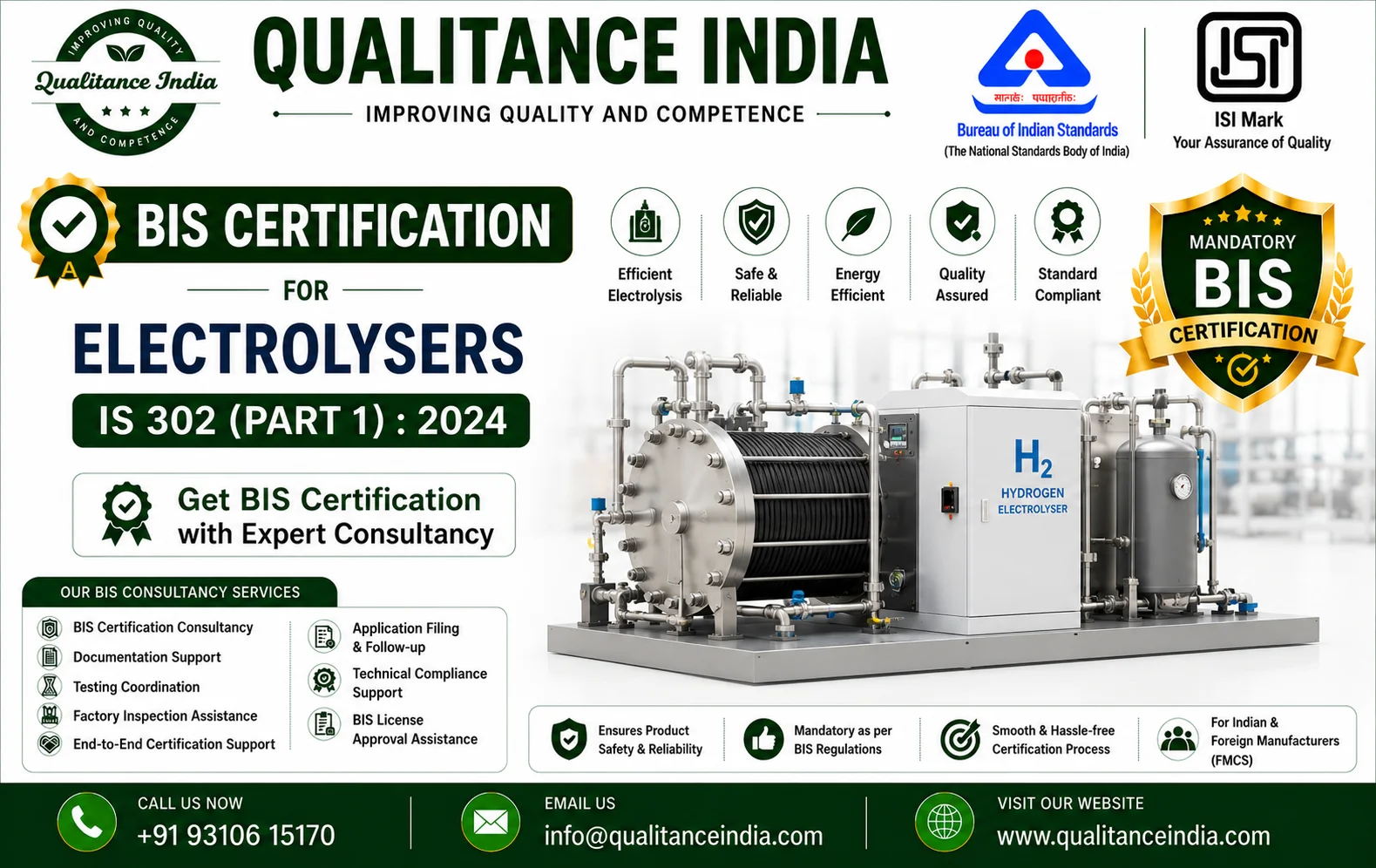
BIS Certification for Electrolysers IS 302 (Part 1):2024 – Complete Certification Guide | Enforcement Date 01 October 2026
Introduction
The Indian hydrogen economy is expanding rapidly, and Electrolysers are becoming one of the most important technologies for producing green hydrogen. As demand for safe, efficient, and reliable Electrolysers increases, regulatory compliance has become equally important. Manufacturers, importers, and suppliers must ensure that their products comply with applicable Indian safety standards before entering the Indian market.
To strengthen electrical product safety and protect consumers, the Government of India has notified several products under the Safety of Household, Commercial and Similar Electrical Appliances (Quality Control) Order. Electrolysers covered by this notification must comply with IS 302 (Part 1):2024, which specifies the general safety requirements for electrical appliances.
Manufacturers covered under the applicable Quality Control Order (QCO) are required to obtain BIS Certification before manufacturing, importing, selling, or distributing Electrolysers in India after the notified enforcement date of 01 October 2026.
This comprehensive guide explains everything manufacturers need to know about BIS Certification for Electrolysers IS 302 (Part 1):2024, including product scope, applicable regulations, certification requirements, eligibility, testing, documentation, factory inspection, and the complete BIS approval process.
Whether you are an Indian manufacturer, foreign manufacturer, importer, exporter, OEM supplier, renewable energy company, or hydrogen technology provider, this guide will help you understand the complete BIS certification process.
Table of Contents
- About Electrolysers
- What is BIS Certification?
- Scope of IS 302 (Part 1):2024
- Products Covered
- Enforcement Date
- Applicable Quality Control Order (QCO)
- Who Needs BIS Certification?
- Eligibility Criteria
- Complete BIS Certification Process
- Required Documents
- Testing Requirements
- Factory Inspection
- Cost Factors
- Timeline
- Benefits of BIS Certification
- Why Choose Qualitance India
- Frequently Asked Questions
About Electrolysers
Electrolysers are advanced electrical systems designed to produce hydrogen by splitting water into hydrogen and oxygen through the process of electrolysis. Powered by electricity, these systems play a central role in the production of green hydrogen, especially when operated using renewable energy sources such as solar, wind, or hydroelectric power.
As countries focus on reducing carbon emissions and transitioning to cleaner energy sources, Electrolysers have become critical components in hydrogen generation plants, energy storage projects, fuel cell applications, industrial manufacturing, transportation, and research facilities.
Modern Electrolysers incorporate complex electrical components such as power supply systems, control panels, electronic circuits, insulation systems, protective devices, sensors, and safety mechanisms. Since these products operate using electricity and often function continuously under demanding conditions, they must meet stringent electrical safety requirements to protect users, operators, and surrounding equipment.
Electrical hazards such as insulation failure, overheating, leakage current, short circuits, fire risks, and mechanical failures can pose serious safety concerns if products are not properly designed and tested. Therefore, compliance with recognized Indian Standards is essential to ensure product safety, reliability, and long-term performance.
BIS Certification demonstrates that an Electrolyser has been evaluated according to applicable Indian Standards and satisfies the required safety and quality benchmarks before entering the Indian market.
What is BIS Certification?
The Bureau of Indian Standards (BIS) is India's National Standards Body responsible for establishing quality, safety, and performance standards for products manufactured, imported, and sold within the country.
BIS Certification is a formal conformity assessment process that verifies whether a product complies with the applicable Indian Standard. Products that successfully complete the certification process receive a BIS License and are authorized to use the ISI Mark, indicating conformity with prescribed safety and quality requirements.
For Electrolysers covered under the applicable Quality Control Order, BIS Certification is a mandatory legal requirement before the products can be introduced into the Indian market.
The certification process generally includes:
- Product applicability verification
- Technical documentation review
- Laboratory testing
- BIS application submission
- Product evaluation
- Factory assessment (where applicable)
- Resolution of technical observations
- Grant of BIS License
- Permission to use the ISI Mark
- Ongoing compliance and surveillance
Obtaining BIS Certification helps manufacturers demonstrate regulatory compliance, improve product credibility, and strengthen customer confidence.
Scope of IS 302 (Part 1):2024
IS 302 (Part 1):2024 specifies the general safety requirements applicable to household, commercial, and similar electrical appliances. The standard is harmonized with IEC 60335-1:2020 and provides the foundational safety framework for electrical appliances covered under various BIS notifications.
The standard addresses multiple aspects of electrical safety, including:
- Protection against electric shock
- Insulation performance
- Leakage current limits
- Temperature rise
- Mechanical strength
- Stability requirements
- Moisture resistance
- Earthing continuity
- Electrical endurance
- Abnormal operation
- Fire hazard prevention
- Construction requirements
- Marking and labeling
- User safety
- Electrical component reliability
While IS 302 (Part 1):2024 establishes general safety requirements, product-specific standards may prescribe additional technical requirements depending on the type of appliance.
Manufacturers of Electrolysers must ensure that their products comply with all applicable provisions of IS 302 (Part 1):2024 and any additional relevant standards before applying for BIS Certification.
Products Covered
Depending on the applicable Quality Control Order and product classification, BIS Certification requirements may apply to various types of Electrolysers used for hydrogen production and related applications.
Products may include:
- Hydrogen Electrolysers
- Water Electrolysis Systems
- PEM Electrolysers
- Alkaline Electrolysers
- Solid Oxide Electrolysers
- Industrial Electrolysers
- Commercial Electrolysers
- Renewable Energy Electrolysers
- Green Hydrogen Production Systems
- Electrolysis Equipment
- Hydrogen Generation Units
- Modular Electrolyser Systems
- High-Capacity Electrolysers
- Integrated Hydrogen Production Equipment
- Electrical Electrolysis Systems
Manufacturers should verify the exact product applicability under the relevant BIS notification before commencing the certification process.
Enforcement Date
The Government of India has notified 01 October 2026 as the enforcement date for the applicable provisions covering Electrolysers under IS 302 (Part 1):2024.
From this date onward, applicable products must comply with the prescribed BIS requirements before being manufactured, imported, sold, distributed, or supplied in the Indian market.
Manufacturers are strongly advised to begin the certification process several months before the enforcement date to allow sufficient time for:
- Product testing
- Technical documentation
- BIS application review
- Factory inspection (where applicable)
- Technical query resolution
- License approval
Early planning helps avoid regulatory delays and market disruptions.
Applicable Quality Control Order (QCO)
Electrolysers are covered under the Safety of Household, Commercial and Similar Electrical Appliances (Quality Control) Order, issued by the Government of India.
The QCO has been introduced to ensure that notified electrical products meet minimum safety and quality standards before reaching consumers or industrial users.
Under the applicable QCO:
- Only compliant products may be manufactured or imported.
- BIS Certification is mandatory for notified products.
- Products must comply with the relevant Indian Standard.
- Manufacturers must obtain a valid BIS License.
- Certified products are permitted to bear the ISI Mark.
- Non-compliant products may face regulatory action, including restrictions on manufacture, import, sale, or distribution.
Manufacturers should regularly monitor official BIS and Government notifications for updates, amendments, or additional product coverage.
Who Needs BIS Certification?
BIS Certification is generally required for all eligible manufacturers whose Electrolysers fall within the scope of the applicable Quality Control Order.
This includes:
- Indian Manufacturers
- Foreign Manufacturers exporting Electrolysers to India
- Original Equipment Manufacturers (OEMs)
- Brand Owners
- Private Label Manufacturers
- Hydrogen Technology Companies
- Renewable Energy Equipment Manufacturers
- Industrial Equipment Manufacturers
- Importers (through compliant manufacturers)
- Exporters supplying products to the Indian market
Obtaining BIS Certification is not only a regulatory obligation but also a valuable business investment. It enhances product credibility, supports market access, improves customer trust, and demonstrates compliance with nationally recognized safety standards.
Eligibility Criteria for BIS Certification for Electrolysers IS 302 (Part 1):2024
Manufacturers planning to manufacture, import, or sell Electrolysers in India must ensure that they meet the eligibility requirements prescribed by the Bureau of Indian Standards (BIS). Compliance with these requirements helps streamline the certification process and reduces the possibility of delays or application rejection.
The following entities are generally eligible to apply for BIS Certification:
- Indian Manufacturers
- Foreign Manufacturers exporting to India
- Original Equipment Manufacturers (OEMs)
- Private Label Manufacturers
- Brand Owners
- Hydrogen Equipment Manufacturers
- Renewable Energy Equipment Manufacturers
- Industrial Equipment Manufacturers
- Government Suppliers
- Public Sector Manufacturers
The manufacturing unit should have:
- A legally established manufacturing facility.
- Production and quality control infrastructure.
- Testing equipment as required under applicable standards.
- Qualified technical personnel.
- A documented quality management system.
- Capability to consistently manufacture products conforming to IS 302 (Part 1):2024.
Foreign manufacturers must also comply with the applicable BIS certification requirements, including the appointment of an Authorized Indian Representative (AIR), wherever applicable.
Complete BIS Certification Process for Electrolysers IS 302 (Part 1):2024
Obtaining BIS Certification involves several technical and regulatory stages. A systematic approach ensures faster approval and minimizes compliance risks.
Step 1 – Product Applicability Verification
The first step is to verify whether the Electrolyser falls under the applicable Quality Control Order (QCO) and whether IS 302 (Part 1):2024 applies to the product.
This assessment includes:
- Product category identification
- Product functionality review
- Electrical safety assessment
- Applicable Indian Standard verification
- BIS certification scheme determination
Step 2 – Technical Compliance Review
A detailed review of the product is conducted to evaluate compliance with the requirements of IS 302 (Part 1):2024.
The review generally includes:
- Product design
- Electrical construction
- Component evaluation
- Safety features
- Insulation systems
- Earthing arrangements
- Protective devices
- Product markings
- User instructions
- Warning labels
Any gaps identified during this stage should be addressed before testing.
Step 3 – Documentation Preparation
Comprehensive technical documentation is prepared in accordance with BIS requirements.
Proper documentation significantly improves the efficiency of the certification process.
Step 4 – Product Testing
Representative product samples are submitted to a BIS-recognized laboratory for testing.
Testing verifies compliance with the applicable safety requirements of IS 302 (Part 1):2024.
Step 5 – BIS Application Submission
After documentation and testing are completed, the BIS application is prepared and submitted through the prescribed BIS procedure.
The application includes:
- Manufacturer details
- Factory information
- Product specifications
- Test reports
- Technical documents
- Supporting declarations
Step 6 – Technical Evaluation by BIS
BIS officials examine the submitted application, review technical documents, verify laboratory reports, and assess compliance with the applicable Indian Standard.
If additional clarification is required, BIS may issue technical observations.
Step 7 – Factory Inspection
Where applicable, BIS officers visit the manufacturing facility to verify:
- Manufacturing process
- Production capability
- Testing infrastructure
- Calibration records
- Quality management practices
- Raw material control
- Finished product inspection
- Product traceability
The inspection helps confirm that the manufacturer is capable of consistently producing compliant Electrolysers.
Step 8 – Resolution of BIS Queries
If BIS raises technical observations, manufacturers must submit appropriate responses along with supporting documents and corrective actions.
Timely responses help avoid unnecessary delays.
Step 9 – Grant of BIS License
Once BIS is satisfied with the product evaluation, laboratory testing, documentation, and inspection findings, the BIS License is granted.
The manufacturer is then authorized to use the ISI Mark on compliant Electrolysers.
Required Documents
Although documentation requirements may vary depending on the certification scheme and product, manufacturers generally need the following:
Company Documents
- Company Registration Certificate
- Factory License
- GST Registration
- MSME Certificate (if applicable)
- PAN Details
Manufacturing Documents
- Manufacturing Process Flow Chart
- Plant Layout
- Machinery List
- Production Capacity Details
- Factory Address Proof
Technical Documents
- Product Specification
- Product Catalogue
- Engineering Drawings
- Electrical Circuit Diagrams
- Bill of Materials (BOM)
- Component Specifications
- Product Labels
- User Manual
- Installation Instructions
Quality Documents
- Quality Control Plan
- Incoming Inspection Procedure
- In-Process Inspection Records
- Final Inspection Procedure
- Calibration Certificates
- Internal Testing Procedures
BIS Documents
- BIS Application Form
- Laboratory Test Report
- Declaration Forms
- Authorization Letter
- Trademark Authorization (where applicable)
Preparing complete and accurate documentation is essential for a smooth certification process.
Testing Requirements
Testing is one of the most critical stages of BIS Certification.
Electrolysers must be tested in a BIS-recognized laboratory to verify compliance with IS 302 (Part 1):2024.
Depending on the product design and applicable requirements, testing may include:
- Protection Against Electric Shock
- Input Power Verification
- Current Measurement
- Leakage Current Test
- Insulation Resistance Test
- High Voltage (Dielectric Strength) Test
- Temperature Rise Test
- Abnormal Operation Test
- Mechanical Strength Test
- Stability Test
- Moisture Resistance Test
- Earthing Continuity Test
- Component Safety Verification
- Wiring Evaluation
- Marking and Label Verification
- Construction Examination
- Fire Hazard Assessment
- Endurance Testing
- Protective Device Verification
Only products that successfully comply with the applicable safety requirements proceed to the next stage of certification.
Factory Inspection Process
Where applicable, BIS officials conduct a detailed inspection of the manufacturing facility.
The inspection generally covers:
- Manufacturing capability
- Assembly process
- Production equipment
- Quality control laboratory
- Testing instruments
- Calibration records
- Skilled manpower
- Incoming material inspection
- In-process quality checks
- Finished goods inspection
- Product identification system
- Batch traceability
- Storage conditions
- Packaging process
- Record maintenance
Manufacturers should ensure that all production and testing facilities are operational and properly documented before the inspection.
Common Reasons for Application Rejection
Many BIS applications are delayed or rejected because of avoidable errors.
Common reasons include:
- Incorrect product classification
- Incomplete documentation
- Missing declarations
- Inconsistent technical information
- Laboratory test failures
- Incorrect product markings
- Poor quality management system
- Calibration issues
- Factory non-compliance
- Inadequate testing facilities
- Delay in responding to BIS queries
- Mismatch between tested samples and production models
Working with experienced BIS consultants helps reduce these risks and improves the likelihood of successful certification.
Cost Factors
The cost of BIS Certification varies depending on several factors, including:
- Product complexity
- Number of product models
- Laboratory testing charges
- Documentation preparation
- BIS application fees
- Factory inspection expenses
- Technical consultancy services
- Product modifications (if required)
- Travel expenses (where applicable)
- Renewal and surveillance costs
Manufacturers should budget for both the initial certification process and ongoing compliance requirements.
Timeline
The overall certification timeline depends on product readiness and BIS processing.
Typical stages include:
- Product applicability assessment
- Documentation preparation
- Laboratory testing
- BIS application submission
- Technical review
- Factory inspection (if applicable)
- Query resolution
- License approval
Starting the certification process well before the 01 October 2026 enforcement date helps avoid business disruptions and ensures products are ready for the market on time.
Benefits of BIS Certification
Obtaining BIS Certification for Electrolysers offers numerous advantages for manufacturers, importers, and end users.
Regulatory Compliance
Ensures compliance with applicable Indian laws and Quality Control Orders.
Legal Market Access
Allows manufacturers to legally manufacture, import, distribute, and sell Electrolysers in India.
Enhanced Product Safety
Confirms compliance with recognized electrical safety requirements.
Improved Customer Confidence
The ISI Mark demonstrates product quality and reliability, increasing customer trust.
Stronger Brand Reputation
Certified products enjoy greater credibility in both domestic and international markets.
Competitive Advantage
BIS Certification differentiates compliant manufacturers from non-certified competitors.
Government & Institutional Procurement
Many government departments, public sector organizations, and institutional buyers prefer or require BIS-certified products.
Reduced Product Risk
Compliance with Indian Standards helps minimize electrical hazards, product failures, and safety-related issues.
Long-Term Business Growth
Certification supports sustainable business expansion by ensuring regulatory compliance and improving market acceptance.
Why Choose Qualitance India for BIS Certification Consultancy for Electrolysers IS 302 (Part 1):2024
Obtaining BIS Certification for Electrolysers requires technical expertise, accurate documentation, product testing coordination, and continuous communication with the Bureau of Indian Standards (BIS). Even minor documentation errors or technical non-conformities can delay approval and increase certification costs.
Qualitance India provides complete end-to-end BIS Certification Consultancy for manufacturers, importers, startups, MSMEs, OEMs, and foreign manufacturers seeking BIS approval for Electrolysers under IS 302 (Part 1):2024.
With extensive experience in Indian regulatory compliance, our experts guide clients through every stage of the certification process—from product applicability verification to final BIS license approval.
Our BIS Consultancy Services Include
- Product Applicability Assessment
- BIS Certification Strategy
- Technical Compliance Review
- Documentation Preparation
- Product Testing Coordination
- BIS Application Filing
- Liaison with BIS Authorities
- Factory Inspection Assistance
- Technical Query Resolution
- BIS License Approval Support
- Post Certification Compliance
- Renewal and Surveillance Assistance
- Support for Indian Manufacturers
- Support for Foreign Manufacturers (FMCS)
Why Manufacturers Trust Qualitance India
- Experienced BIS Regulatory Experts
- End-to-End Project Management
- Faster Documentation Preparation
- Complete Technical Guidance
- Reduced Risk of Application Rejection
- Transparent Consultancy Process
- Dedicated Project Coordinator
- Timely Compliance Updates
- PAN India Support
- Assistance for International Manufacturers
Our goal is to simplify the BIS certification process while helping manufacturers achieve compliance within the required timelines.
Step-by-Step BIS Certification Flow Chart (Text Format)
Product Identification
          │
          ▼
Applicability Check under IS 302 (Part 1):2024
          │
          ▼
Technical Compliance Review
          │
          ▼
Documentation Preparation
          │
          ▼
Product Testing in BIS Recognized Laboratory
          │
          ▼
Preparation of BIS Application
          │
          ▼
Submission of Application to BIS
          │
          ▼
Technical Evaluation by BIS
          │
          ▼
Factory Inspection (Where Applicable)
          │
          ▼
Resolution of BIS Queries
          │
          ▼
Grant of BIS License
          │
          ▼
Permission to Use ISI Mark
          │
          ▼
Ongoing Compliance & Renewal
People Also Ask (PAA)
Is BIS Certification mandatory for Electrolysers in India?
Yes. Electrolysers covered under the applicable Quality Control Order (QCO) must comply with BIS requirements before they can be manufactured, imported, or sold in India from the notified enforcement date.
Which Indian Standard applies to Electrolysers?
Electrolysers are covered under IS 302 (Part 1):2024, which specifies the general safety requirements for electrical appliances.
What is the enforcement date for BIS Certification of Electrolysers?
The notified enforcement date is 01 October 2026. Manufacturers should complete the certification process before this date to avoid business disruptions.
Can foreign manufacturers obtain BIS Certification?
Yes. Foreign manufacturers can obtain BIS Certification under the Foreign Manufacturers Certification Scheme (FMCS) after fulfilling BIS requirements and appointing an Authorized Indian Representative (AIR), where applicable.
How long does BIS Certification take?
The certification timeline depends on documentation readiness, product testing, BIS evaluation, and factory inspection. Early planning helps ensure timely approval before the enforcement deadline.
Is laboratory testing mandatory?
Yes. Product testing in a BIS-recognized laboratory is an essential requirement to demonstrate compliance with IS 302 (Part 1):2024.
Can one BIS license cover multiple models?
It depends on product design, technical similarities, and BIS guidelines. Similar product variants may sometimes be covered under a single license, subject to BIS approval.
Featured Snippet Optimized Answers
What is BIS Certification for Electrolysers?
BIS Certification for Electrolysers is a regulatory approval issued by the Bureau of Indian Standards (BIS) that verifies compliance with IS 302 (Part 1):2024. It confirms that the product meets applicable electrical safety requirements and can be legally marketed in India where mandated.
Why is BIS Certification important?
BIS Certification ensures product safety, regulatory compliance, consumer confidence, and legal market access. It also helps manufacturers improve product quality and strengthen their market reputation.
Who needs BIS Certification?
Indian manufacturers, foreign manufacturers, importers, brand owners, OEMs, and private label manufacturers producing Electrolysers covered under the applicable QCO need BIS Certification before supplying products in the Indian market.
What documents are required?
Manufacturers generally need company registration documents, factory details, technical drawings, product specifications, quality documents, laboratory test reports, and BIS application forms.
How can Qualitance India help?
Qualitance India provides complete consultancy including applicability assessment, documentation, laboratory coordination, BIS application filing, inspection assistance, technical query handling, and post-certification support.
Voice Search Optimization
Voice search users typically ask complete questions rather than short keywords. Including conversational content improves the chances of appearing in voice search results.
Examples include:
- What is BIS Certification for Electrolysers?
- Is BIS Certification mandatory for Electrolysers in India?
- How do I apply for BIS Certification for Electrolysers?
- Which IS standard applies to Electrolysers?
- What is IS 302 (Part 1):2024?
- Who can apply for BIS Certification?
- What documents are required for BIS Certification?
- How much time does BIS Certification take?
- Can foreign manufacturers get BIS Certification?
- Which consultancy provides BIS Certification support in India?
Google AI Overview Optimization Tips
To improve visibility in Google's AI-generated search results:
- Begin the article with a clear answer to the main search query.
- Use descriptive H2 and H3 headings.
- Add concise definitions before detailed explanations.
- Include tables, lists, and process steps where appropriate.
- Answer common user questions directly.
- Mention the applicable Indian Standard and enforcement date naturally.
- Keep technical content accurate and easy to understand.
- Update the article whenever BIS or QCO notifications change.
- Include author expertise and company credentials to strengthen E-E-A-T signals.
Internal Linking Strategy
Strengthen your website's SEO by internally linking this article to related service and information pages, such as:
- BIS Certification Consultancy Services
- BIS Certification for Electrical Appliances
- FMCS Certification Services
- BIS Registration Process Guide
- BIS Documentation Support
- Product Testing Services
- Factory Inspection Assistance
- Technical File Preparation
- Quality Control Order (QCO) Updates
- BIS Compliance Blog
These internal links help users explore related content and improve overall website authority.
External Authority References (BIS/QCO)
To enhance credibility and support E-E-A-T, reference authoritative government sources within the article, including:
- Bureau of Indian Standards (BIS)
- Ministry of Commerce and Industry
- Department for Promotion of Industry and Internal Trade (DPIIT)
- Official Gazette Notifications for applicable Quality Control Orders
- BIS Product Certification Guidelines
- Relevant Indian Standards issued by BIS
Using official sources improves trustworthiness and keeps readers informed with authentic regulatory information.
Related BIS Services
You can also explore our professional consultancy services for:
- BIS Certification for Electrical Appliances
- BIS Certification under IS 302 Series
- BIS Certification for Consumer Electronics
- BIS Certification for Industrial Equipment
- FMCS Certification for Foreign Manufacturers
- Technical Documentation Preparation
- Product Testing Coordination
- BIS Factory Inspection Assistance
- BIS License Renewal Services
- Regulatory Compliance Consultancy
Related Blog Suggestions
Expand your knowledge with these related articles:
- Complete Guide to BIS Certification for Electrical Appliances
- Understanding IS 302 (Part 1):2024 Requirements
- BIS Certification Process for Foreign Manufacturers
- Common BIS Certification Mistakes and How to Avoid Them
- How to Prepare for a BIS Factory Inspection
- BIS Testing Requirements Explained
- Difference Between BIS CRS and ISI Certification
- Latest Quality Control Orders in India
- BIS Certification Timeline and Cost Guide
- Electrical Product Compliance Checklist for Manufacturers
Strong Lead Generation Call-to-Action
Get Expert BIS Certification Consultancy for Electrolysers
Planning to manufacture, import, or sell Electrolysers in India? Ensure your products comply with IS 302 (Part 1):2024 before the enforcement date of 01 October 2026.
Qualitance India offers complete end-to-end BIS Certification Consultancy, including product applicability assessment, documentation support, laboratory testing coordination, BIS application filing, factory inspection assistance, technical query resolution, and post-certification compliance.
Whether you are an Indian manufacturer, importer, startup, OEM, or foreign manufacturer, our experienced compliance professionals are ready to help you obtain your BIS License efficiently and with confidence.
Contact Qualitance India today to begin your BIS Certification journey and ensure your Electrolysers are fully compliant for the Indian market.
20 SEO FAQs – BIS Certification for Electrolysers IS 302 (Part 1):2024
1. What is BIS Certification for Electrolysers?
BIS Certification is an approval issued by the Bureau of Indian Standards that confirms Electrolysers comply with the applicable Indian Standard IS 302 (Part 1):2024 and mandatory safety requirements.
2. Is BIS Certification mandatory for Electrolysers?
Yes. If Electrolysers are covered under the applicable Quality Control Order (QCO), BIS Certification becomes mandatory from the notified enforcement date.
3. Which Indian Standard applies to Electrolysers?
Electrolysers are required to comply with IS 302 (Part 1):2024 for electrical safety requirements.
4. What is the enforcement date for Electrolysers?
The enforcement date is 01 October 2026.
5. Who can apply for BIS Certification?
Indian manufacturers, foreign manufacturers, OEMs, brand owners, and importers (through the manufacturer) can apply, subject to BIS eligibility requirements.
6. Can foreign manufacturers obtain BIS Certification?
Yes. Foreign manufacturers can obtain BIS Certification under the FMCS (Foreign Manufacturers Certification Scheme).
7. Is product testing mandatory?
Yes. Product testing in a BIS-recognized laboratory is mandatory.
8. Which laboratory should be used?
Testing must be carried out only in BIS-recognized laboratories.
9. How long does BIS Certification take?
The timeline depends on documentation, laboratory testing, BIS review, and factory inspection. Starting early helps avoid delays before the enforcement date.
10. What documents are required?
Company documents, factory details, technical drawings, product specifications, quality documents, and laboratory test reports are generally required.
11. Does BIS inspect the factory?
Yes. BIS may conduct a factory inspection to verify manufacturing capability and quality control systems.
12. What happens if the product fails testing?
The manufacturer must implement corrective actions, modify the product if required, and undergo retesting before certification can proceed.
13. Can one license cover multiple models?
Depending on BIS guidelines and technical similarity, multiple variants may be covered under one license.
14. Is the ISI Mark mandatory after certification?
Yes. Certified products must use the ISI Mark in accordance with BIS requirements.
15. What are the common reasons for application rejection?
Incomplete documentation, failed laboratory tests, incorrect product classification, technical non-conformities, and delayed responses to BIS queries.
16. Does BIS Certification improve product credibility?
Yes. It enhances customer confidence, demonstrates regulatory compliance, and supports market acceptance.
17. Can startups apply for BIS Certification?
Yes. Any eligible manufacturer meeting BIS requirements can apply.
18. Can imported Electrolysers be sold without BIS Certification?
No. Products covered under the applicable QCO cannot be legally imported or sold without mandatory BIS Certification.
19. Does Qualitance India provide end-to-end consultancy?
Yes. Qualitance India assists with documentation, testing coordination, BIS application filing, inspection support, and license approval.
20. Why should manufacturers start early?
Starting early allows sufficient time for documentation, testing, BIS review, and query resolution before the enforcement deadline of 01 October 2026.
FAQ Schema Content (Without Code)
Page Type: Frequently Asked Questions
Primary Topic: BIS Certification for Electrolysers IS 302 (Part 1):2024
Questions Covered:
- What is BIS Certification for Electrolysers?
- Is BIS Certification mandatory?
- Which standard applies?
- What is the enforcement date?
- Who should apply?
- What documents are required?
- Is testing mandatory?
- Does BIS conduct factory inspections?
- How long does certification take?
- How can Qualitance India assist?
Service Schema Suggestion (Without Code)
Service Name
BIS Certification Consultancy for Electrolysers
Service Provider
Qualitance India
Service Category
BIS Certification Consultancy
Service Description
Professional consultancy for BIS Certification of Electrolysers under IS 302 (Part 1):2024, including applicability assessment, documentation, laboratory testing coordination, BIS application filing, factory inspection assistance, technical compliance support, and post-certification services.
Service Area
India and International Manufacturers exporting to India
Organization Schema Suggestion (Without Code)
Organization Name
Qualitance India
Organization Type
BIS Certification Consultancy
Business Category
Regulatory Compliance Consultancy
Services
- BIS Certification Consultancy
- FMCS Consultancy
- CRS Registration
- ISI Certification
- Product Testing Coordination
- Factory Inspection Assistance
- Technical Documentation
- Regulatory Compliance Services
Breadcrumb Schema Suggestion (Without Code)
Home
↓
BIS Certification
↓
Electrical Products
↓
Electrolysers
↓
BIS Certification for Electrolysers IS 302 (Part 1):2024
Article Schema Suggestion (Without Code)
Article Title
BIS Certification for Electrolysers IS 302 (Part 1):2024 – Complete Guide
Article Category
Regulatory Compliance
Author
Qualitance India
Publisher
Qualitance India
Primary Keyword
BIS Certification for Electrolysers
Industry
Electrical Equipment
Image ALT Tags (15)
- BIS Certification for Electrolysers IS 302 Part 1 2024
- Electrolysers BIS Certification Consultancy India
- ISI Certification for Electrolysers
- Electrolyser Safety Standard IS 302 Part 1 2024
- BIS Approval for Electrolysers
- Hydrogen Electrolyser BIS Certification
- Electrical Appliance BIS Compliance India
- Electrolyser Testing BIS Laboratory
- BIS License for Electrolysers
- Bureau of Indian Standards Electrolysers
- BIS Certification Consultant India
- IS 302 Part 1 2024 Compliance
- BIS Certification Process for Electrolysers
- Electrolyser Manufacturer BIS Approval
- Qualitance India BIS Consultancy
Open Graph & Twitter Card Suggestions
Open Graph Title
BIS Certification for Electrolysers IS 302 (Part 1):2024 | Qualitance India
Open Graph Description
Complete guide to BIS Certification for Electrolysers under IS 302 (Part 1):2024. Learn about eligibility, testing, documentation, BIS process, enforcement date, and expert consultancy from Qualitance India.
Open Graph Image
BIS Certification for Electrolysers IS 302 (Part 1):2024 Banner
Twitter Title
BIS Certification for Electrolysers | IS 302 (Part 1):2024
Twitter Description
Expert BIS Certification Consultancy for Electrolysers. End-to-end support for documentation, testing, factory inspection, and BIS license approval.
Keyword Density Guidance
Use the primary keyword naturally throughout the article without keyword stuffing.
Recommended keyword usage for a 4,500-word blog:
- Focus Keyword: "BIS Certification for Electrolysers" – 18–25 times
- IS 302 (Part 1):2024 – 15–20 times
- Electrolysers – 35–50 times
- BIS Certification Consultancy – 10–15 times
- ISI Certification – 8–12 times
- Quality Control Order (QCO) – 6–10 times
- BIS License – 8–12 times
- BIS Recognized Laboratory – 5–8 times
Use keywords naturally within headings, introductory paragraphs, FAQs, and conclusion.
SEO-Optimized Conclusion
BIS Certification for Electrolysers under IS 302 (Part 1):2024 is an essential regulatory requirement for manufacturers and foreign suppliers planning to sell their products in the Indian market. With the enforcement date of 01 October 2026, businesses should begin the certification process well in advance to avoid regulatory delays and ensure uninterrupted market access.
The certification journey involves product applicability assessment, technical documentation, laboratory testing, BIS application submission, factory inspection (where applicable), and successful grant of the BIS License. A well-planned approach helps manufacturers reduce compliance risks, improve product quality, and build customer confidence through the authorized use of the ISI Mark.
Qualitance India provides comprehensive BIS Certification Consultancy with end-to-end support for Indian and foreign manufacturers. Our experienced compliance professionals assist with documentation, testing coordination, technical reviews, BIS liaison, inspection preparation, and post-certification compliance, ensuring a smooth and efficient certification process.
If you are planning to manufacture, import, or supply Electrolysers in India, now is the right time to start your BIS Certification process. Contact Qualitance India today to receive expert guidance and ensure your products are fully compliant with IS 302 (Part 1):2024 before the mandatory enforcement date.