
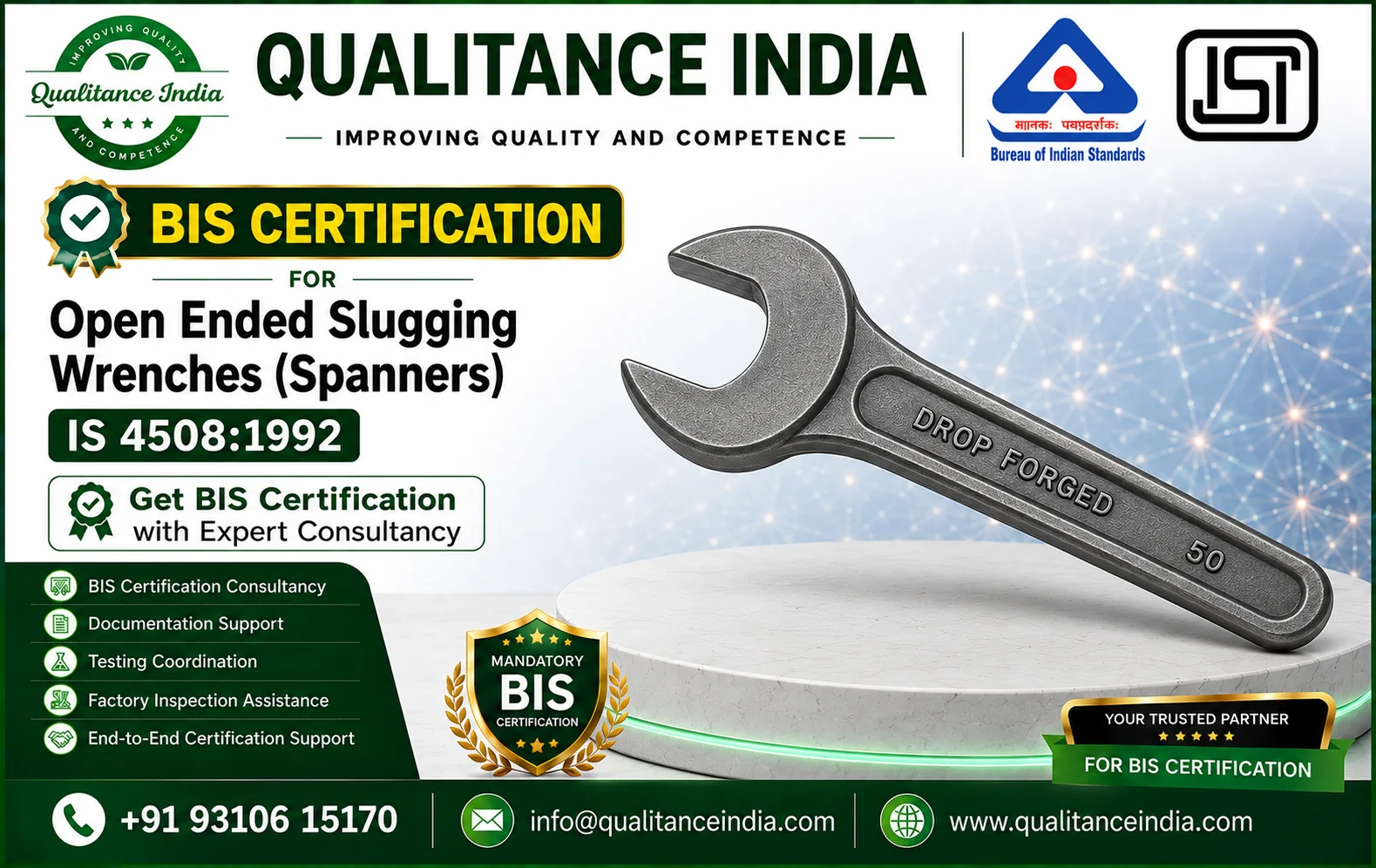
Open Ended Slugging Wrenches (Spanners) BIS Certification | IS 4508:1992 | ISI Mark Consultancy | Enforcement Date 01 October 2026
Open Ended Slugging Wrenches (Spanners) BIS Certification under IS 4508:1992
Introduction
Open Ended Slugging Wrenches (Spanners) are heavy-duty industrial hand tools specifically designed for tightening and loosening large nuts and bolts where high torque is required. Unlike ordinary spanners, these tools feature a reinforced striking end that can safely withstand hammer blows, allowing technicians to generate additional force for stubborn or seized fasteners.
These tools are widely used in industries such as oil and gas, petrochemicals, refineries, power plants, shipbuilding, steel plants, mining, heavy engineering, railway maintenance, wind energy, and infrastructure projects.
To ensure quality, safety, and performance, products covered under the applicable Hand Tools Quality Control Order (QCO) are required to comply with the relevant Indian Standard and obtain a BIS licence under Scheme-I before being placed on the Indian market. For Open Ended Slugging Wrenches (Spanners), the relevant standard is IS 4508:1992 (revised as IS 4508:2024), and the general enforcement date under the notified QCO is 01 October 2026.
What are Open Ended Slugging Wrenches?
Open Ended Slugging Wrenches are forged industrial spanners with a heavy striking block at one end. The striking surface is designed to be hit with a hammer to deliver additional torque when loosening or tightening large fasteners.
These tools are particularly useful in applications where:
- Standard spanners cannot provide sufficient torque.
- Fasteners have become corroded or seized.
- Heavy industrial equipment requires maintenance.
- Large flanged joints need assembly or disassembly.
- Pipeline construction and maintenance activities are performed.
Industries Using Open Ended Slugging Wrenches
- Oil & Gas
- Petrochemical Plants
- Refineries
- Offshore Platforms
- Shipbuilding
- Steel Plants
- Thermal Power Plants
- Nuclear Facilities
- Wind Energy
- Mining Industry
- Railway Workshops
- Heavy Equipment Manufacturing
- Cement Plants
- Fertilizer Plants
- Infrastructure Projects
Product Variants
Manufacturers generally produce:
- Standard Open Ended Slugging Wrench
- Heavy Duty Slugging Spanner
- Industrial Slugging Wrench
- Metric Slugging Spanner
- Forged Slugging Wrench
- High-Torque Slugging Spanner
Materials Used
High-quality slugging wrenches are commonly manufactured using:
- Chrome Vanadium Steel
- Alloy Steel
- Forged Carbon Steel
- Chrome Molybdenum Steel
- Heat Treated Steel
Manufacturing Process
A typical manufacturing process includes:
- Raw Material Inspection
- Hot Forging
- Trimming
- Heat Treatment
- Precision Machining
- Grinding
- Surface Finishing
- Product Marking
- Quality Inspection
- Packaging
Why BIS Certification is Important
BIS Certification demonstrates that the product conforms to the applicable Indian Standard and is manufactured under controlled quality processes. Key benefits include:
- Legal compliance under applicable QCOs
- Permission to use the ISI Mark
- Increased customer confidence
- Consistent product quality
- Better acceptance in industrial and government procurement
- Improved brand reputation
PART 2 – Complete BIS Certification Process (1300+ Words)
Step-by-Step BIS Certification Process
The BIS certification process generally involves:
Step 1 – Product Identification
Confirm that the product falls under the applicable Indian Standard and Quality Control Order.
Step 2 – Technical Review
Review product design, dimensions, material specifications, manufacturing process, and marking requirements.
Step 3 – Documentation Preparation
Prepare company, factory, quality, and technical documents, including manufacturing flow charts, machinery details, product drawings, quality manuals, calibration records, and authorization documents.
Step 4 – Product Testing
Testing is conducted in accordance with the applicable BIS standard. Typical evaluations may include:
- Dimensional verification
- Material verification
- Hardness testing
- Torque and impact performance
- Workmanship inspection
- Surface finish inspection
- Product marking verification
Step 5 – BIS Application
Submit the application with technical documents and test reports.
Step 6 – Technical Scrutiny
BIS reviews the application and may seek clarifications.
Step 7 – Factory Inspection
Where applicable, BIS may verify:
- Manufacturing facilities
- Testing equipment
- Quality control system
- Production process
- Raw material traceability
- Calibration records
Step 8 – Grant of Licence
If all requirements are met, BIS grants the licence under Scheme-I, authorizing use of the Standard Mark (ISI Mark).
Common Reasons for Delay
- Incorrect documentation
- Incomplete technical information
- Product test failures
- Expired calibration certificates
- Inadequate quality control records
- Delayed responses to BIS queries
Why Choose Qualitance India?
Qualitance India provides:
- BIS Certification Consultancy
- Documentation Support
- Product Testing Coordination
- Factory Inspection Assistance
- BIS Application Filing
- Technical Compliance
- Licence Approval Support
- Renewal & Post-Certification Compliance
PART 3 – FAQs, SEO & Contact
FAQs
Q1. Is BIS Certification mandatory?
Yes, where the applicable Hand Tools QCO applies, manufacturers must obtain a BIS licence before marketing covered products in India.
Q2. Which standard applies?
IS 4508:1992 (revised as IS 4508:2024).
Q3. What is the enforcement date?
For general (large) enterprises, the implementation date is 01 October 2026 under the notified Hand Tools QCO.
Q4. Can foreign manufacturers apply?
Yes, foreign manufacturers exporting to India can apply under the applicable BIS certification framework.
Q5. Is laboratory testing mandatory?
Yes, products are required to be tested in accordance with the applicable BIS requirements before certification.
High-Value SEO Keywords
- Open Ended Slugging Wrenches BIS Certification
- IS 4508:1992
- IS 4508:2024
- Slugging Spanners BIS
- ISI Mark for Slugging Wrenches
- Hand Tools BIS Certification
- BIS Licence India
- Industrial Spanner Certification
- BIS Consultant
- BIS Testing
- Factory Inspection
- BIS Registration
Contact Qualitance India
Need BIS Certification for Open Ended Slugging Wrenches (Spanners)?
Qualitance India provides complete consultancy support, including:
- BIS Certification Consultancy
- Documentation Support
- Product Testing Coordination
- Factory Inspection Assistance
- BIS Application Filing
- Technical Compliance
- Licence Grant Support
- Renewal & Compliance Services
Contact Details
- Phone: +91-93106-15170
- Email: info@qualitanceindia.com
- Website: https://qualitanceindia.com
- Office: D-15, Ground Floor, Office No. 7, Sector-3, Noida, Uttar Pradesh – 201301
This structure follows the same SEO-friendly format as your previous hand tool blogs while reflecting the current BIS/QCO context and implementation timeline.