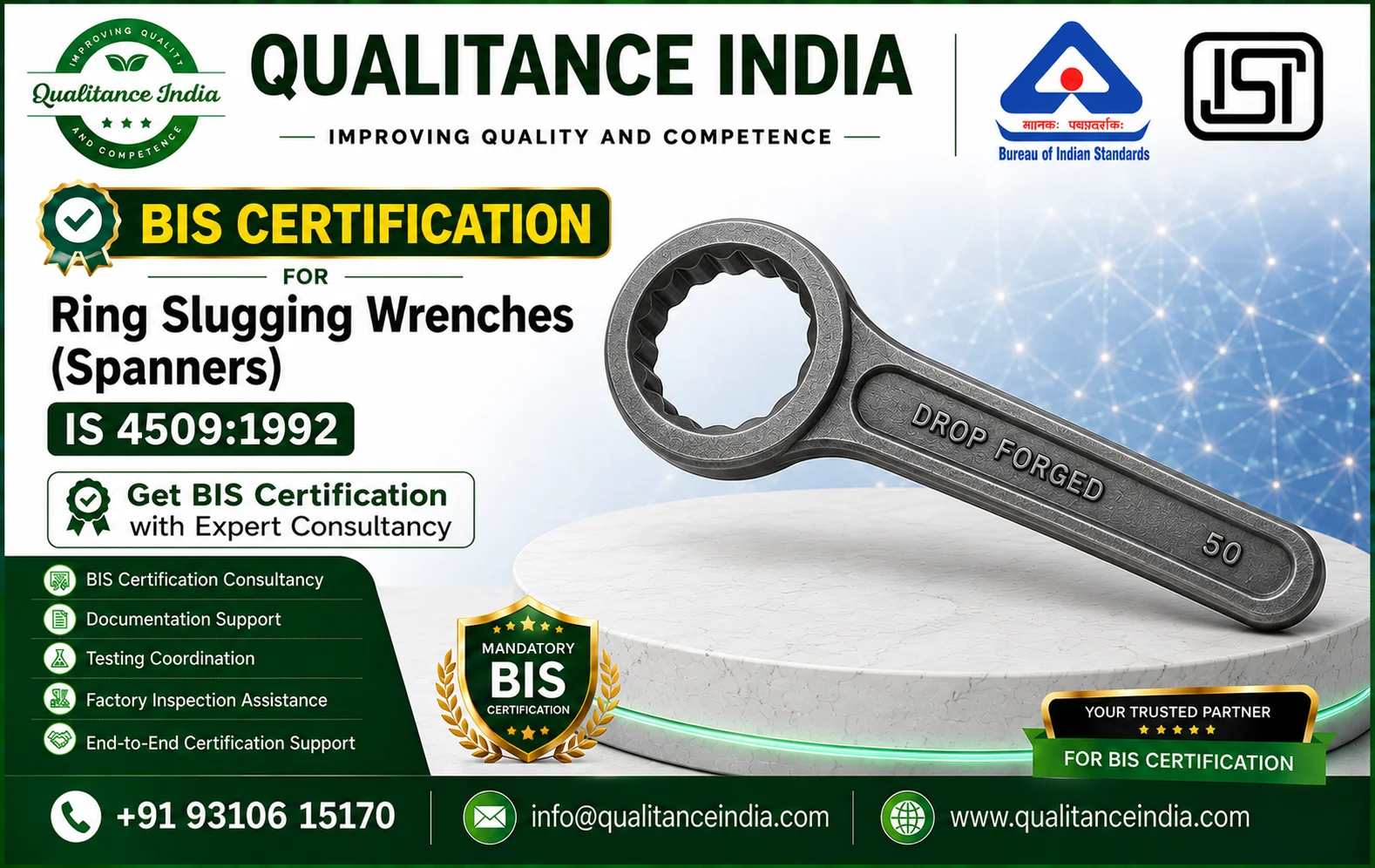
Ring Slugging Wrenches (Spanners) BIS Certification | IS 4509:1992 | Complete ISI Mark Consultancy Guide | Enforcement Date 01 October 2026
Ring Slugging Wrenches (Spanners) BIS Certification under IS 4509:1992
Introduction
The Indian industrial sector depends heavily on reliable hand tools for maintenance, installation, heavy engineering, and infrastructure projects. Among these essential tools, Ring Slugging Wrenches (Spanners) are specially designed for high-torque industrial applications where ordinary spanners cannot generate sufficient force. These heavy-duty tools are commonly used in refineries, petrochemical plants, power stations, mining operations, shipbuilding yards, railway workshops, steel plants, and large infrastructure projects.
Because these tools are subjected to repeated hammer impact and high mechanical loads, maintaining consistent manufacturing quality is critical. To ensure safety, durability, and performance, the Government of India has included several hand tools under the Hand Tools (Quality Control) Order, requiring manufacturers to obtain BIS Certification under Scheme-I (ISI Mark) before supplying covered products in the Indian market. The implementation timeline for general manufacturers has been extended to 01 October 2026, while different timelines apply to eligible MSMEs.
If you manufacture, import, supply, or distribute Ring Slugging Wrenches in India, understanding the BIS certification process is essential for uninterrupted business operations and regulatory compliance.
What are Ring Slugging Wrenches (Spanners)?
Ring Slugging Wrenches are specially engineered forged hand tools featuring a closed ring head on one end and a heavy striking block on the opposite end. Unlike ordinary ring spanners, these tools are specifically designed to withstand repeated hammer blows while safely transmitting high torque to large nuts and bolts.
The ring design provides complete contact around the fastener, reducing the possibility of slipping or damaging bolt heads during heavy-duty operations.
These tools are extensively used where:
- Extremely tight bolts must be loosened.
- High torque applications are involved.
- Heavy industrial machinery requires maintenance.
- Large flanges require assembly.
- Pipeline construction projects are undertaken.
- Offshore installations require reliable fastening tools.
- Mining equipment requires field maintenance.
Industries Using Ring Slugging Wrenches
These tools are widely used in:
- Oil & Gas Industry
- Petrochemical Plants
- Refineries
- Thermal Power Plants
- Nuclear Power Stations
- Steel Manufacturing Plants
- Cement Plants
- Mining Industry
- Heavy Engineering Industries
- Shipbuilding & Marine Industry
- Railway Maintenance
- Wind Energy Projects
- Infrastructure Projects
- Heavy Equipment Manufacturing
- Industrial Maintenance Contractors
Their rugged construction makes them suitable for demanding environments where safety and performance are critical.
Product Variants Covered
Manufacturers produce Ring Slugging Wrenches in multiple configurations, including:
- Standard Ring Slugging Wrench
- Heavy Duty Ring Slugging Spanner
- Industrial Ring Slugging Wrench
- Forged Ring Slugging Spanner
- Metric Ring Slugging Wrench
- High Torque Ring Wrench
- Single Ring Slugging Wrench
- Impact Ring Slugging Spanner
The BIS licence scope generally identifies the nominal size range covered by the manufacturer.
Available Sizes
Manufacturers commonly produce sizes ranging from:
- 19 mm
- 22 mm
- 24 mm
- 27 mm
- 30 mm
- 32 mm
- 36 mm
- 41 mm
- 46 mm
- 50 mm
- 55 mm
- 60 mm
- 65 mm
- 70 mm
- 75 mm
- 80 mm
- 90 mm
- 100 mm
- Up to large industrial sizes as covered by the applicable standard and licence scope.
Materials Used
High-quality Ring Slugging Wrenches are generally manufactured from premium engineering steels such as:
- Chrome Vanadium Steel
- Chrome Molybdenum Steel
- Forged Alloy Steel
- Carbon Alloy Steel
- Heat Treated Steel
Proper material selection ensures:
- High Impact Strength
- Better Toughness
- Excellent Wear Resistance
- Improved Service Life
- High Torque Capacity
- Corrosion Resistance (where applicable)
Manufacturing Process
The manufacturing process generally includes:
- Raw Material Inspection
- Cutting of Steel Billets
- Hot Forging
- Trimming
- Heat Treatment
- Precision Machining
- Grinding
- Surface Finishing
- Marking
- Final Inspection
- Packaging
Each stage contributes to the overall quality and consistency of the finished product.
What is BIS Certification?
The Bureau of Indian Standards (BIS) is India's National Standards Body responsible for developing Indian Standards and operating product certification schemes. Under Scheme-I (ISI Mark Scheme), manufacturers of products covered by mandatory Quality Control Orders must obtain a BIS licence before marketing those products in India. Ring Slugging Wrenches covered by the applicable QCO must conform to IS 4509:1992 (or the latest applicable revision notified by BIS) and bear the Standard Mark under a valid licence.
Why BIS Certification is Important
Obtaining BIS Certification provides both regulatory and commercial advantages:
- Compliance with Indian regulations
- Authorization to use the ISI Mark
- Improved customer confidence
- Consistent manufacturing quality
- Enhanced product reliability
- Better acceptance in government and industrial procurement
- Reduced product quality complaints
- Competitive market advantage
- Stronger brand reputation
- Long-term business growth
For manufacturers planning to supply Ring Slugging Wrenches in India, early preparation before the applicable implementation date helps avoid compliance delays and supply chain disruptions
Complete BIS Certification Process for Ring Slugging Wrenches (Spanners)
BIS Certification under IS 4509:1992
Enforcement Date: 01 October 2026
Complete BIS Certification Process for Ring Slugging Wrenches (Spanners)
Manufacturers planning to manufacture, import, distribute, or sell Ring Slugging Wrenches (Spanners) in the Indian market must comply with the applicable Bureau of Indian Standards (BIS) requirements before the enforcement date. BIS Certification under IS 4509:1992 (or the latest applicable revision notified by BIS) ensures that the product meets the prescribed standards for quality, strength, safety, dimensions, and performance.
The certification process is more than just obtaining an ISI Mark. It is a comprehensive assessment of the manufacturer's quality management system, production capability, testing infrastructure, and ability to consistently produce conforming products. By completing the certification process in advance, manufacturers can avoid regulatory issues and continue supplying products to the Indian market without interruption.
Step 1 – Verify Product Applicability
The first step is to confirm that your Ring Slugging Wrench falls under the applicable Indian Standard and the relevant Hand Tools Quality Control Order.
Manufacturers should verify:
- Product Category
- Product Design
- Intended Application
- Manufacturing Process
- Material Specification
- Product Dimensions
- Applicable Indian Standard
- Certification Scheme
- Latest BIS Notification
Using the correct Indian Standard is essential because applying under an incorrect standard may result in delays or rejection of the application.
Step 2 – Product Design & Technical Evaluation
Before applying, manufacturers should conduct a detailed technical review of the product.
The evaluation generally includes:
- Ring Diameter
- Overall Length
- Head Thickness
- Striking Face Dimensions
- Material Grade
- Heat Treatment Process
- Surface Finish
- Product Identification Marking
- Dimensional Tolerances
- Manufacturing Accuracy
Any deviations identified during this stage should be corrected before laboratory testing begins.
Step 3 – Documentation Preparation
Documentation plays a critical role in the BIS certification process. Manufacturers must demonstrate that they have a controlled manufacturing process and an effective quality management system capable of producing products that consistently comply with the applicable Indian Standard.
Preparing complete documentation before filing the application significantly reduces the likelihood of delays.
Company Documents Required
Manufacturers generally need to prepare:
- Certificate of Incorporation
- GST Registration Certificate
- PAN Card
- Factory Licence
- MSME Registration (if applicable)
- Import Export Code (for exporters)
- Trademark Registration (if available)
- Factory Address Proof
- Authorized Signatory Details
Manufacturing Documents
The following documents help BIS understand the production process:
- Manufacturing Flow Chart
- Factory Layout
- Production Capacity Details
- Machinery List
- Process Control Plan
- Manufacturing Procedure
- Inspection Procedure
- Packaging Procedure
- Storage Procedure
Quality Control Documents
Manufacturers should maintain documented quality systems such as:
- Quality Manual
- Incoming Raw Material Inspection Procedure
- In-Process Inspection Procedure
- Final Inspection Procedure
- Calibration Records
- Internal Test Reports
- Product Traceability Records
- Complaint Handling Procedure
- Corrective Action Records
Technical Documents
Technical documentation generally includes:
- Engineering Drawings
- Product Catalogue
- Product Specifications
- Bill of Materials
- Material Grade Details
- Heat Treatment Process
- Product Identification Details
- Product Labels
- Packaging Specifications
Step 4 – Product Testing
Product testing is one of the most critical stages of BIS Certification. Testing verifies that Ring Slugging Wrenches comply with the requirements specified in IS 4509:1992.
Testing is conducted in a BIS-recognized laboratory using the prescribed test methods.
Typical Product Tests
Depending on the standard and licence scope, the product may undergo the following evaluations:
1. Dimensional Accuracy Test
The product is checked to ensure that dimensions such as ring size, overall length, head thickness, and striking face dimensions conform to the specified tolerances.
2. Material Verification
The material composition is verified to confirm that the correct grade of steel has been used for manufacturing.
3. Hardness Test
Hardness testing ensures the wrench has the required mechanical strength and wear resistance for heavy-duty industrial use.
4. Torque Test
The wrench is subjected to specified torque values to verify that it can withstand operational loads without deformation or failure.
5. Impact Resistance Test
Since Ring Slugging Wrenches are designed to receive hammer blows, the striking end is evaluated for its ability to withstand repeated impact without cracking or chipping.
6. Heat Treatment Verification
The effectiveness of the heat treatment process is verified to ensure the product achieves the required balance of hardness and toughness.
7. Surface Finish Inspection
The finished product is inspected for defects such as:
- Cracks
- Burrs
- Sharp Edges
- Surface Imperfections
- Rust
- Manufacturing Defects
A high-quality surface finish contributes to both safety and durability.
8. Product Marking Verification
The required product markings, including manufacturer identification, size, and relevant standard information, are checked for compliance.
Importance of Product Testing
Comprehensive testing helps manufacturers achieve:
- Consistent Product Quality
- Improved Durability
- Better Mechanical Performance
- Compliance with BIS Requirements
- Enhanced Customer Confidence
- Reduced Product Failure
- Improved Brand Reputation
Manufacturers who conduct internal quality checks before laboratory testing generally experience fewer non-conformities during certification.
Step 5 – BIS Application Submission
After completing testing and documentation, the manufacturer submits the BIS application.
The application typically includes:
- Company Details
- Factory Information
- Product Description
- Applicable Indian Standard
- Test Reports
- Supporting Documents
- Authorized Signatory Details
Providing complete and accurate information helps reduce processing time.
Step 6 – Technical Review by BIS
BIS officials review the submitted documents and technical information to verify compliance with the applicable standard.
The review may include:
- Test Reports
- Engineering Drawings
- Product Specifications
- Manufacturing Process
- Quality Management Documents
- Product Marking
- Factory Information
If additional clarification is required, BIS may issue technical queries. Prompt responses help avoid unnecessary delays.
Step 7 – Factory Inspection
Depending on the applicable certification scheme, BIS may conduct a factory inspection to verify the manufacturer's production capability and quality control system.
During the inspection, BIS officials may examine:
Manufacturing Facilities
- Raw Material Storage
- Forging Section
- Heat Treatment Area
- Machining Section
- Grinding Operations
- Surface Finishing Area
- Product Marking Area
- Packaging Section
Production Process
The inspection may verify:
- Manufacturing Flow
- Process Controls
- Work Instructions
- Production Records
- Batch Identification
- Traceability System
Quality Control System
Inspectors may review:
- Incoming Material Inspection
- In-Process Quality Checks
- Final Inspection Reports
- Calibration Records
- Non-Conforming Product Control
- Internal Audit Reports
Testing Equipment
Manufacturers should maintain suitable testing equipment such as:
- Vernier Calipers
- Micrometers
- Hardness Testing Machine
- Torque Testing Equipment
- Impact Testing Equipment
- Measuring Gauges
- Surface Inspection Tools
All measuring and testing equipment should be calibrated periodically.
Finished Product Inspection
BIS officials may verify that finished products are:
- Properly Marked
- Correctly Packed
- Easily Traceable
- Stored Under Suitable Conditions
Step 8 – Grant of BIS Licence
If the product successfully meets all applicable requirements, BIS grants the licence under Scheme-I (ISI Mark Scheme).
The manufacturer is then authorized to use the Standard Mark (ISI Mark) on certified Ring Slugging Wrenches (Spanners) in accordance with BIS requirements.
The licence remains valid subject to continued compliance with BIS rules, surveillance, and renewal requirements.
Post-Certification Compliance
Obtaining the BIS licence is not the end of the process. Manufacturers must continue to maintain compliance by:
- Producing products that consistently conform to the standard.
- Maintaining production and inspection records.
- Keeping calibration certificates up to date.
- Preserving test reports.
- Handling customer complaints effectively.
- Supporting BIS surveillance activities.
Common Reasons for Delay or Rejection
Manufacturers may experience delays due to:
- Incorrect Product Classification
- Incomplete Documentation
- Non-Conforming Test Results
- Expired Calibration Certificates
- Poor Quality Control System
- Improper Product Marking
- Delayed Responses to BIS Queries
- Inadequate Production Records
- Lack of Product Traceability
Careful planning and thorough documentation can significantly reduce these risks.
Tips for Faster BIS Certification
Manufacturers can improve the efficiency of the certification process by:
- Identifying the correct Indian Standard.
- Reviewing the latest BIS notifications and amendments.
- Preparing complete documentation before applying.
- Conducting internal quality checks.
- Ensuring all measuring instruments are calibrated.
- Maintaining organized production and inspection records.
- Responding promptly to BIS communications.
- Seeking expert consultancy support when required.
Why Choose Qualitance India?
Obtaining BIS Certification for Ring Slugging Wrenches involves technical evaluation, documentation, product testing, and coordination with BIS authorities. Qualitance India provides end-to-end consultancy services to help manufacturers complete the certification process efficiently and in compliance with applicable requirements.
Our BIS Consultancy Services
- BIS Certification Consultancy
- ISI Mark Consultancy
- Product Standard Identification
- Documentation Preparation
- BIS Application Filing
- Product Testing Coordination
- Factory Inspection Assistance
- Technical Compliance Review
- BIS Query Resolution
- Licence Approval Support
- Renewal & Ongoing Compliance
With our experienced team and industry knowledge, we assist manufacturers in achieving timely BIS Certification while minimizing delays and ensuring smooth regulatory compliance.
FAQs, SEO Strategy, Google AI Optimization & Contact
Ring Slugging Wrenches (Spanners) BIS Certification under IS 4509:1992
Enforcement Date: 01 October 2026
Frequently Asked Questions (FAQs)
1. What is BIS Certification for Ring Slugging Wrenches (Spanners)?
BIS Certification confirms that Ring Slugging Wrenches comply with the applicable Indian Standard (IS 4509:1992 or the latest applicable revision notified by BIS) and meet the required quality, safety, dimensional, and performance requirements. Certified manufacturers are authorized to use the ISI Mark under a valid BIS licence.
2. Is BIS Certification mandatory for Ring Slugging Wrenches?
Yes. Where the product is covered under the applicable Hand Tools Quality Control Order (QCO), manufacturers must obtain a valid BIS licence before manufacturing, importing, or selling the product in India.
3. Which Indian Standard applies?
The applicable standard is:
IS 4509:1992 – Ring Slugging Wrenches (Spanners)
Manufacturers should also check for the latest BIS revisions or amendments before applying.
4. What is the enforcement date?
The enforcement date mentioned for this product is:
01 October 2026
Manufacturers should complete the certification process before this date to ensure uninterrupted business operations.
5. Who can apply for BIS Certification?
The following entities may apply:
- Indian Manufacturers
- Foreign Manufacturers
- OEM Manufacturers
- Contract Manufacturers
- Brand Owners
6. Can foreign manufacturers obtain BIS Certification?
Yes. Foreign manufacturers exporting Ring Slugging Wrenches to India can apply through the applicable BIS certification scheme.
7. Is laboratory testing mandatory?
Yes. Products must be tested in accordance with the applicable Indian Standard before a BIS licence can be granted.
8. Is factory inspection required?
Depending on the applicable BIS certification scheme, factory inspection may be required to verify manufacturing capability and quality control systems.
9. What are the common tests?
Typical tests include:
- Dimensional Verification
- Material Verification
- Hardness Test
- Torque Test
- Impact Resistance Test
- Heat Treatment Verification
- Surface Finish Inspection
- Product Marking Verification
10. What documents are required?
Manufacturers generally need:
- Company Registration Documents
- Factory Licence
- GST Registration
- Manufacturing Flow Chart
- Machinery Details
- Product Drawings
- Quality Manual
- Calibration Certificates
- Test Reports
- Authorization Documents
11. What are the benefits of BIS Certification?
- Legal Compliance
- ISI Mark Authorization
- Better Product Quality
- Increased Customer Trust
- Higher Market Acceptance
- Improved Brand Reputation
- Better Opportunities in Government & Industrial Procurement
12. What happens if a manufacturer does not obtain BIS Certification?
If a product covered under a mandatory Quality Control Order is supplied without the required BIS licence, the manufacturer may face regulatory action under the applicable laws.
13. Can MSME manufacturers apply?
Yes. MSMEs are also eligible to apply and should verify any applicable implementation timelines or concessions announced by the Government.
14. Why should manufacturers begin early?
Early preparation helps complete testing, documentation, factory readiness, and BIS review before the enforcement date, reducing the risk of delays.
15. Why choose Qualitance India?
Qualitance India provides end-to-end BIS consultancy, including documentation support, testing coordination, application filing, factory inspection assistance, and post-certification compliance.
Why Choose Qualitance India?
Qualitance India is a trusted consultancy helping manufacturers achieve BIS Certification efficiently. We simplify the certification process with technical expertise and end-to-end support.
Our Services
- BIS Certification Consultancy
- ISI Mark Consultancy
- Documentation Preparation
- Product Testing Coordination
- Factory Inspection Assistance
- BIS Application Filing
- Technical Compliance Support
- BIS Query Resolution
- Licence Grant Assistance
- Renewal & Compliance Management
Industries We Serve
We assist manufacturers from sectors including:
- Hand Tools
- Power Tools
- Industrial Equipment
- Automotive Components
- Steel Products
- Construction Tools
- Heavy Engineering
- Oil & Gas Equipment
- Railway Products
- Mining Equipment
- Infrastructure Products
- Export-Oriented Manufacturing
Manufacturer Checklist Before Applying
Before submitting your application, ensure that you have:
✔ Identified the correct Indian Standard (IS 4509:1992)
✔ Verified product applicability under the QCO
✔ Prepared all company registration documents
✔ Maintained product drawings and technical specifications
✔ Established a documented manufacturing process
✔ Implemented quality control procedures
✔ Calibrated all measuring and testing equipment
✔ Arranged testing through a BIS-recognized laboratory
✔ Reviewed product marking requirements
✔ Organized production and inspection records
✔ Ensured raw material traceability
✔ Prepared the factory for BIS inspection (if applicable)
High-Ranking
- Ring Slugging Wrenches BIS Certification
- Ring Slugging Spanners BIS
- IS 4509:1992
- Ring Wrench ISI Mark
- BIS Certification Consultant
- BIS Consultant India
- Hand Tools BIS Certification
- BIS Licence
- ISI Certification
- BIS Registration
- Industrial Ring Wrench
- Heavy Duty Ring Spanner
- BIS Testing
- Factory Inspection
- Product Certification India
- Engineering Hand Tools
- Standard Mark
- Hand Tools QCO
- BIS Scheme-I
- Industrial Tool Certification
Internal Linking Strategy
Link this article to related pages on your website:
- BIS Certification Services
- Hand Tools BIS Certification
- Open-Jaw Wrenches (Spanners) BIS Certification
- Open Ended Slugging Wrenches BIS Certification
- Pipe Wrenches – General Purpose BIS Certification
- Adjustable Wrenches BIS Certification
- Combination Side Cutting Pliers BIS Certification
- FMCS Certification
- CRS Registration
- About Qualitance India
- Contact Us
- BIS Blog
Google AI & E-E-A-T Optimization
To improve visibility in Google Search and AI-powered search experiences:
- Keep the article updated whenever BIS issues a new notification or revises the standard.
- Clearly display the publication date and last updated date.
- Mention the author (for example, Technical Team – Qualitance India).
- Use original product images with descriptive ALT text.
- Link to related BIS certification pages on your website.
- Reference official BIS notifications where relevant.
- Avoid making guarantees such as "100% approval" or fixed approval timelines.
Conclusion
Ring Slugging Wrenches (Spanners) are essential heavy-duty industrial tools used in demanding sectors such as oil & gas, mining, power, steel, and infrastructure. Compliance with IS 4509:1992 (or the latest applicable BIS standard) helps ensure consistent quality, safety, and performance.
Manufacturers should begin preparing for BIS Certification well before the 01 October 2026 enforcement date by organizing documentation, completing product testing, strengthening quality control systems, and ensuring factory readiness.
Partnering with an experienced consultancy can simplify the certification journey and help manufacturers navigate documentation, testing coordination, and regulatory requirements more efficiently.
Contact Qualitance India
Complete BIS Certification Consultancy for Ring Slugging Wrenches (Spanners)
Qualitance India offers end-to-end consultancy services for manufacturers across India and international markets.
Our Services
- BIS Certification Consultancy
- ISI Mark Consultancy
- Documentation Support
- Product Testing Coordination
- Factory Inspection Assistance
- BIS Application Filing
- Technical Compliance
- BIS Query Resolution
- Licence Approval Support
- Renewal & Ongoing Compliance
Contact Details
Qualitance India
📞 Phone: +91-93106-15170
📧 Email: info@qualitanceindia.com
🌐 Website: https://qualitanceindia.com
📍 Office: D-15, Ground Floor, Office No. 7, Sector-3, Noida, Uttar Pradesh – 201301