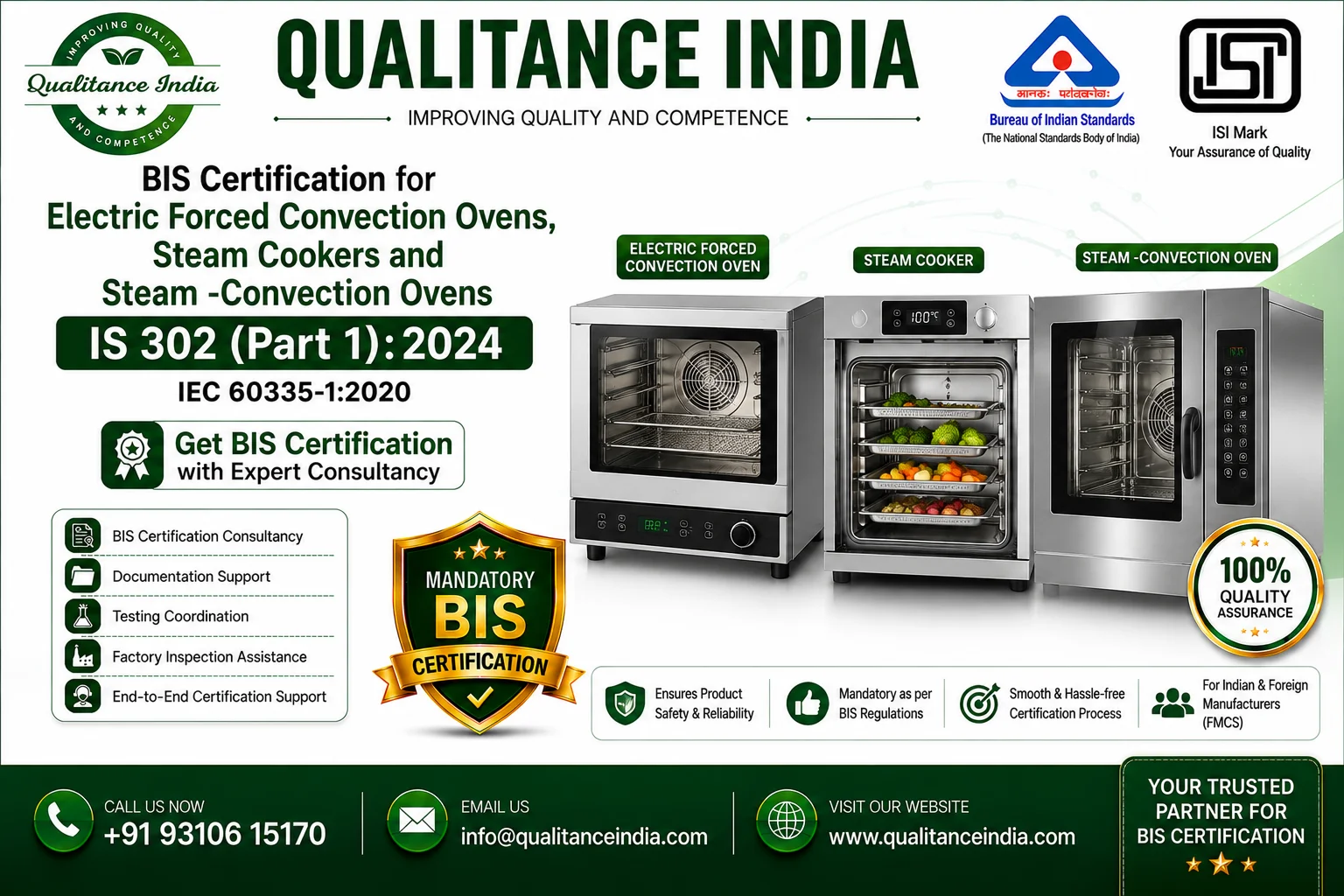
BIS Certification for Electric Forced Convection Ovens, Steam Cookers and Steam-Convection Ovens | IS 302 (Part 1):2024 | IEC 60335-1:2020
Introduction
BIS Certification for Electric Forced Convection Ovens, Steam Cookers and Steam-Convection Ovens – Complete Guide
Electric Forced Convection Ovens, Steam Cookers, and Steam-Convection Ovens have become indispensable appliances in commercial kitchens, hotels, restaurants, bakeries, hospitals, catering units, food processing industries, and institutional kitchens. These appliances are designed to cook food efficiently by combining advanced heating technology with forced air circulation and steam generation, resulting in faster cooking, uniform heat distribution, improved food quality, and better energy efficiency.
Since these appliances operate using electricity and generate high temperatures and steam pressure, they present potential risks such as electric shock, overheating, fire hazards, insulation failure, and mechanical failures if not designed and manufactured according to recognized safety standards. To ensure consumer safety and product reliability, the Bureau of Indian Standards (BIS) has established mandatory certification requirements for applicable products.
Manufacturers and importers intending to sell Electric Forced Convection Ovens, Steam Cookers, and Steam-Convection Ovens in India must comply with IS 302 (Part 1):2024, aligned with IEC 60335-1:2020, along with any applicable product-specific safety requirements. BIS Certification demonstrates that the product has successfully met prescribed safety, quality, and performance requirements through testing and evaluation.
Obtaining BIS Certification not only ensures compliance with Indian regulations but also enhances consumer confidence, strengthens brand reputation, and facilitates smooth market access across India. Non-compliance with applicable Quality Control Orders (QCOs) may result in restrictions on manufacturing, import, sale, or distribution of the product.
Whether you are an Indian manufacturer, foreign manufacturer, importer, OEM, private label owner, or exporter, understanding the BIS Certification process is essential for launching compliant products in the Indian market.
At Qualitance India, we provide complete end-to-end BIS Certification Consultancy services. Our experienced team assists manufacturers with product applicability assessment, documentation, laboratory testing coordination, application filing, factory inspection assistance (where applicable), compliance support, and successful grant of the BIS license.
This comprehensive guide explains everything you need to know about BIS Certification for Electric Forced Convection Ovens, Steam Cookers, and Steam-Convection Ovens, including eligibility, applicable standards, required documents, testing procedures, certification process, inspection requirements, timelines, fees, renewal, compliance obligations, common mistakes, and frequently asked questions.
What is BIS Certification?
BIS (Bureau of Indian Standards) Certification is the national product certification system established under the BIS Act, 2016. It ensures that products placed in the Indian market meet the required safety, quality, and performance standards.
For electrical appliances, BIS Certification helps protect consumers against electrical hazards, fire risks, mechanical failures, and unsafe products while promoting high manufacturing quality.
Applicable Standard
Product:
- Electric Forced Convection Ovens
- Steam Cookers
- Steam-Convection Ovens
Applicable Standard:
IS 302 (Part 1):2024
International Standard
IEC 60335-1:2020
Scope of the Standard
The standard applies to electrically operated appliances intended for commercial or similar use that utilize convection heating, steam generation, or a combination of both for cooking food.
It covers safety requirements related to:
- Protection against electric shock
- Insulation resistance
- Temperature rise
- Heating elements
- Leakage current
- Moisture resistance
- Mechanical strength
- Fire resistance
- Stability
- Abnormal operation
- Construction requirements
- Marking and user instructions
Products Covered
- Electric Forced Convection Ovens
- Commercial Baking Ovens
- Steam Cookers
- Steam Ovens
- Combination Steam Ovens
- Steam-Convection Ovens
- Commercial Food Cooking Equipment
- Institutional Cooking Appliances
Why BIS Certification is Important
BIS Certification offers several key benefits:
- Ensures compliance with Indian regulations
- Protects consumers from unsafe electrical products
- Enhances brand credibility and trust
- Improves product quality and reliability
- Facilitates legal sale in India
- Reduces product recalls and safety incidents
- Supports participation in government and institutional tenders
- Strengthens market competitiveness
Who Needs BIS Certification?
The following entities may need BIS Certification where applicable:
- Indian Manufacturers
- Foreign Manufacturers
- Importers
- OEM Manufacturers
- Brand Owners
- Private Label Companies
- Commercial Kitchen Equipment Manufacturers
- Exporters supplying products to India
BIS Certification Process for Electric Forced Convection Ovens, Steam Cookers and Steam-Convection Ovens (IS 302 (Part 1):2024 | IEC 60335-1:2020)
Complete BIS Certification Process, Required Documents, Laboratory Testing, Factory Inspection, Timeline, Fees, Common Mistakes & Compliance Guide
Obtaining BIS Certification for Electric Forced Convection Ovens, Steam Cookers, and Steam-Convection Ovens is an important step for manufacturers and importers who wish to sell their products in the Indian market. BIS Certification demonstrates that the product complies with applicable Indian safety requirements and has successfully passed the prescribed testing procedures.
The certification process involves multiple stages, including identifying the applicable standard, preparing technical documents, laboratory testing, application submission, BIS verification, inspection (where applicable), and the grant of certification. Proper planning and expert guidance can significantly reduce delays and improve the chances of approval.
Step 1: Identify the Applicable BIS Standard
The first and most important step is determining whether your product falls under the applicable BIS requirements.
For Electric Forced Convection Ovens, Steam Cookers, and Steam-Convection Ovens, the applicable safety standard is:
IS 302 (Part 1):2024
Read together with
IEC 60335-1:2020
Manufacturers should also verify whether any product-specific Indian Standard or Quality Control Order (QCO) applies to their product category.
During this stage, BIS consultants also verify:
- Product category
- Product ratings
- Intended use
- Commercial or household application
- Applicable certification scheme
- Scope of testing
Correct product classification prevents rejection during the application process.
Step 2: Product Design Review
Before laboratory testing begins, manufacturers should ensure that the product design complies with BIS safety requirements.
The design review generally includes verification of:
- Electrical insulation
- Earthing arrangement
- Heating system
- Wiring quality
- PCB design
- Component ratings
- Temperature protection
- Thermal cut-off devices
- Overload protection
- Moisture resistance
- Mechanical safety
- User safety features
- Product labeling
Many applications are delayed because manufacturers submit products without performing a technical compliance review.
Step 3: Documentation Preparation
Documentation plays a crucial role in obtaining BIS Certification.
Incomplete or incorrect documents are among the most common reasons for application delays.
Typical documents include:
Manufacturer Documents
- Company Registration Certificate
- Factory License
- Manufacturing Address Proof
- Factory Layout
- GST Registration (Indian manufacturers)
- ISO 9001 Certificate (if available)
- Trademark Certificate
- Brand Authorization Letter
- Authorization Letter
Technical Documents
- Product Specification Sheet
- Circuit Diagram
- PCB Layout
- Component List (BOM)
- User Manual
- Product Catalogue
- Product Photographs
- Nameplate Artwork
- Label Design
- Packaging Artwork
Foreign Manufacturer Documents
- Business License
- Manufacturing Registration
- Authorized Indian Representative (AIR) Appointment Letter
- AIR Agreement
- Passport/Identity Documents (where required)
Proper documentation reduces BIS queries and speeds up approval.
Step 4: Laboratory Testing
One of the most important stages of BIS Certification is product testing.
The product must be tested in a BIS-recognized laboratory according to the applicable Indian Standard.
Testing verifies whether the appliance satisfies all mandatory safety requirements.
Typical tests include:
- Protection against electric shock
- Leakage current test
- High Voltage Test (HV Test)
- Insulation Resistance Test
- Earth Continuity Test
- Temperature Rise Test
- Heating Performance Test
- Mechanical Strength Test
- Stability Test
- Abnormal Operation Test
- Moisture Resistance Test
- Endurance Test
- Fire Hazard Test
- Component Safety Evaluation
- Marking Verification
If the product fails any mandatory test, corrective actions must be implemented before retesting.
Step 5: BIS Application Submission
Once laboratory testing is completed successfully, the manufacturer can submit the BIS application.
The application generally includes:
- Online application
- Laboratory Test Report
- Technical Documents
- Manufacturing Details
- Product Information
- Factory Details
- Trademark Documents
- Authorization Documents
- Declaration Forms
BIS carefully examines every document before processing the application.
Step 6: BIS Document Verification
After submission, BIS officials review the application thoroughly.
They verify:
- Test Reports
- Manufacturing Details
- Product Description
- Applicable Standards
- Brand Ownership
- Product Label
- Factory Information
- Technical Drawings
- Supporting Documents
If discrepancies are identified, BIS may issue technical queries.
Applicants must respond promptly to avoid delays.
Step 7: Factory Inspection (Where Applicable)
Depending on the applicable BIS scheme and product category, BIS may require a factory inspection.
The inspection is conducted to evaluate whether the manufacturer has adequate facilities and quality control systems to consistently produce compliant products.
During inspection, BIS officials may verify:
- Manufacturing process
- Raw material inspection
- Production line
- Quality Control Equipment
- Calibration Records
- Testing Facilities
- Storage Area
- Finished Goods Inspection
- Product Traceability
- Quality Management System
- Production Records
Manufacturers should ensure that factory personnel are prepared for the inspection.
Step 8: Grant of BIS Certification
After successful completion of all requirements, BIS grants the certification.
The manufacturer receives permission to use the BIS Standard Mark according to the applicable certification conditions.
Once certified, the manufacturer can legally market the approved product in India, subject to ongoing compliance with BIS requirements.
Estimated Timeline
The overall certification timeline depends on product complexity, testing duration, document readiness, and BIS processing.
Typical duration:
Activity Estimated Time Documentation Preparation 5–10 Days Laboratory Testing 15–30 Days Application Filing 2–5 Days BIS Verification 10–20 Days Factory Inspection (if applicable) As scheduled by BIS Certification Grant After satisfactory completion of the process Projects with complete documentation and technically compliant products are generally completed much faster.
BIS Certification Fees
The overall cost depends on several factors, including:
- Government Fees
- Laboratory Testing Charges
- Number of Product Models
- Product Complexity
- Factory Location
- Applicable BIS Scheme
- Consultancy Charges
- Inspection Expenses (if applicable)
Manufacturers should obtain an updated quotation before starting the certification process, as costs vary by product and scope.
Common Reasons for BIS Application Rejection
Many applications face delays because of avoidable mistakes.
Common issues include:
- Incorrect product classification
- Incomplete documentation
- Test report errors
- Wrong product labeling
- Missing technical drawings
- Incorrect circuit diagrams
- Brand authorization issues
- Non-compliant product design
- Poor quality control system
- Delayed responses to BIS queries
- Incorrect factory information
Working with experienced BIS consultants significantly reduces these risks.
Post-Certification Compliance
Obtaining BIS Certification is not the end of the compliance journey.
Manufacturers must continue to meet BIS requirements throughout the validity of the certification.
Important compliance obligations include:
- Maintain consistent product quality.
- Use only approved designs and components.
- Apply the BIS Standard Mark correctly.
- Maintain production and quality records.
- Cooperate with BIS surveillance activities.
- Implement corrective actions if non-conformities are identified.
- Update BIS regarding changes in manufacturing location, product design, brand ownership, or production process where required.
Failure to maintain compliance may result in suspension, cancellation, or other regulatory actions under applicable BIS provisions.
Why Choose Qualitance India for BIS Certification?
Qualitance India provides complete end-to-end BIS Certification Consultancy services for Electric Forced Convection Ovens, Steam Cookers, and Steam-Convection Ovens.
Our services include:
- Product applicability assessment
- BIS standard identification
- Technical documentation support
- Laboratory testing coordination
- Online BIS application filing
- Factory inspection assistance
- Technical query resolution
- Certification approval support
- Renewal guidance
- Ongoing compliance support
With our experienced team, manufacturers can streamline the certification process, reduce delays, and improve the likelihood of successful certification while ensuring compliance with applicable BIS requirements.
FAQ Schema Content
1. Is BIS Certification mandatory for Electric Forced Convection Ovens?
Yes. If covered under the applicable Quality Control Order (QCO), manufacturers and importers must obtain BIS Certification before selling the product in India.
2. Which Indian Standard applies?
The applicable safety standard is IS 302 (Part 1):2024, read together with IEC 60335-1:2020 and any relevant product-specific standard.
3. Who can apply for BIS Certification?
Applications may be submitted by Indian manufacturers or foreign manufacturers through the applicable BIS scheme and representative requirements.
4. How long does BIS Certification take?
The complete process generally takes 4–8 weeks, depending on testing, documentation, and BIS processing.
5. Is laboratory testing mandatory?
Yes. Products must be tested at a BIS-recognized laboratory before certification.
6. Is factory inspection required?
Inspection requirements depend on the applicable BIS certification scheme and product category.
7. Can imported products obtain BIS Certification?
Yes. Foreign manufacturers can obtain certification through the applicable BIS scheme before exporting products to India.
8. What happens if products are sold without BIS Certification?
Where BIS certification is mandatory, selling non-compliant products may lead to regulatory action under applicable laws.
9. What documents are required?
Typical documents include company registration, factory documents, product specifications, circuit diagrams, test reports, trademark documents, authorization letters, and technical information.
10. Why choose Qualitance India?
Qualitance India provides complete BIS Certification consultancy including documentation, testing coordination, application filing, inspection support, compliance guidance, and renewal assistance.
Google Featured Snippet Content
What is BIS Certification for Electric Forced Convection Ovens?
BIS Certification for Electric Forced Convection Ovens, Steam Cookers, and Steam-Convection Ovens is the process of demonstrating compliance with applicable Indian safety standards. Certification involves product testing, documentation review, and compliance with BIS requirements before eligible products can be legally marketed in India where certification is mandatory.
Voice Search Optimized Content
Q: How can I get BIS Certification for Electric Forced Convection Ovens?
Answer: Manufacturers must identify the applicable BIS standard, prepare the required documents, complete product testing at a BIS-recognized laboratory, submit the BIS application, satisfy any applicable verification or inspection requirements, and obtain certification before marketing products where certification is mandatory.
Why Choose Qualitance India?
We provide:
- End-to-End BIS Consultancy
- Technical Documentation Support
- Product Testing Coordination
- BIS Application Filing
- Factory Inspection Assistance
- Technical Query Resolution
- Compliance Support
- Renewal Assistance
- Support for Indian & Foreign Manufacturers
- Dedicated BIS Experts
Call to Action (CTA)
Get Your BIS Certification with Qualitance India
Planning to manufacture, import, or sell Electric Forced Convection Ovens, Steam Cookers, or Steam-Convection Ovens in India? Our experienced consultants can help you navigate the BIS certification process efficiently—from documentation and testing to application filing and compliance support.
Our Services Include:
- BIS Certification Consultancy
- Documentation Preparation
- Product Testing Coordination
- Factory Inspection Assistance
- BIS Application Filing
- FMCS Support for Foreign Manufacturers
- Renewal & Post-Certification Compliance
Complete
To maximize search visibility, optimize the page around these core topics:
- BIS Certification for Electric Forced Convection Ovens
- BIS Certification for Steam Cookers
- BIS Certification for Steam-Convection Ovens
- IS 302 (Part 1):2024
- IEC 60335-1:2020
- Commercial Kitchen Equipment Certification
- BIS Consultant India
- Product Testing
- BIS Documentation
- Factory Inspection
- BIS Registration Process
- Electrical Appliance Safety Standards
- BIS Compliance
- Indian Standard Certification
- Kitchen Equipment BIS Approval
Include descriptive headings (H2/H3), concise paragraphs, optimized images with ALT text, FAQ schema, internal links to related BIS services, and regularly updated content. This combination improves topical authority, user experience, and the likelihood of higher rankings for relevant searches on Google.