
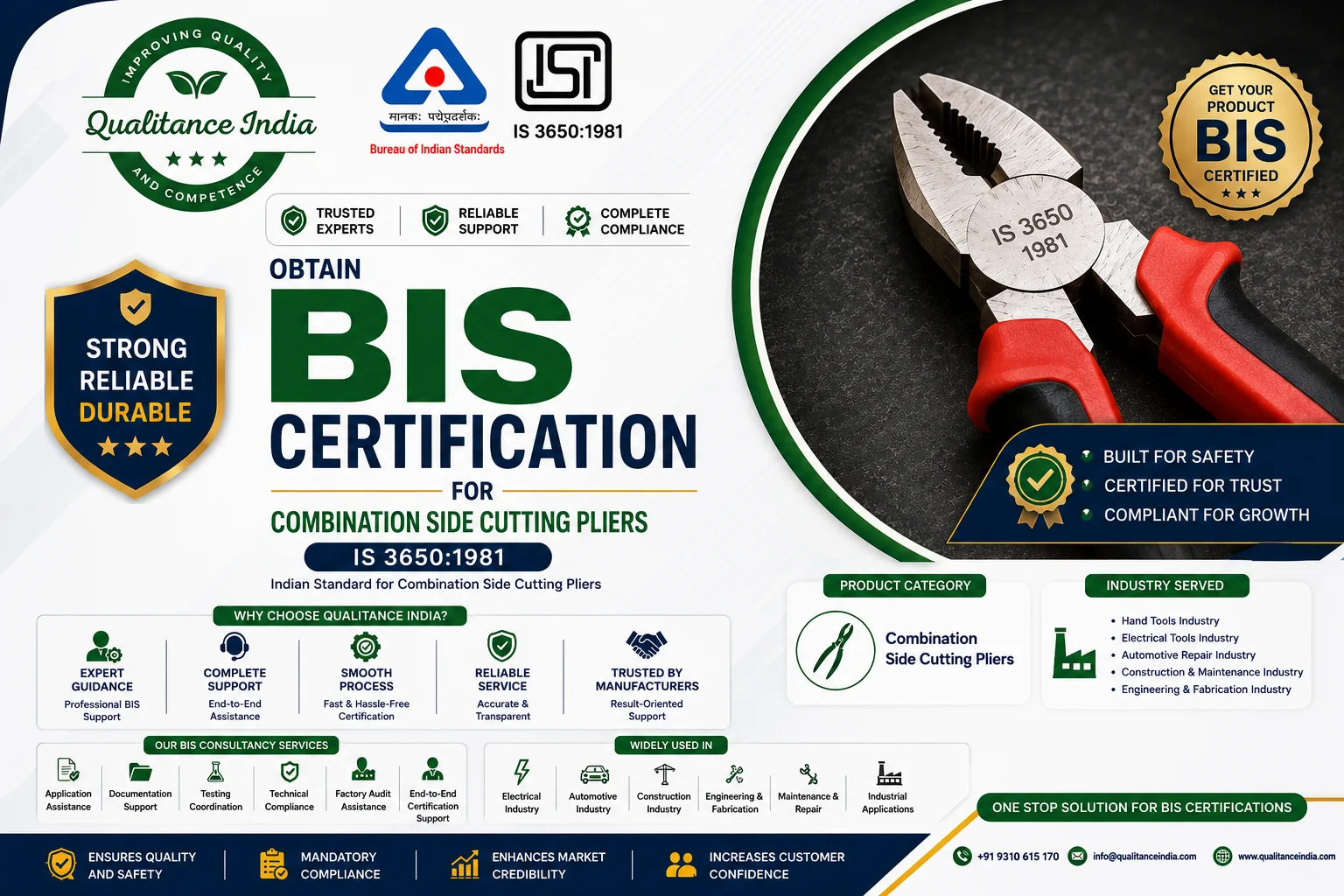
BIS Certification for Combination Side Cutting Pliers IS 3650:1981 | Qualitance India
Introduction, BIS Certification, ISI Mark, IS 3650:1981, Scope, Importance & Benefits
Introduction
The Indian hand tools industry is one of the fastest-growing manufacturing sectors, supplying high-quality tools to domestic as well as international markets. Among the most widely used hand tools are Combination Side Cutting Pliers, which play an essential role in electrical work, automobile repair, engineering workshops, fabrication units, construction projects, maintenance operations, and industrial manufacturing.
Because these tools are frequently used in demanding environments where precision, durability, and user safety are critical, maintaining consistent product quality is essential. Inferior or non-compliant pliers may wear out quickly, fail during operation, or create safety risks for users. To address these concerns, the Bureau of Indian Standards (BIS) has established IS 3650:1981, the Indian Standard that specifies the quality and performance requirements for Combination Side Cutting Pliers.
Manufacturers producing Combination Side Cutting Pliers that fall under the mandatory certification scheme must obtain BIS Certification and use the ISI Mark only after receiving the appropriate licence from BIS. The ISI Mark indicates that the product conforms to the applicable Indian Standard and has been manufactured under an approved quality management system.
For manufacturers, obtaining BIS Certification is more than just meeting a regulatory requirement. It is an investment in product quality, customer trust, and long-term business growth. Products carrying the ISI Mark are generally preferred by distributors, institutional buyers, government organizations, and quality-conscious consumers because they demonstrate compliance with recognized Indian standards.
Whether you are a new manufacturer planning to launch Combination Side Cutting Pliers or an established company seeking BIS Certification, understanding the complete certification process is essential. Proper documentation, product testing, factory preparedness, and compliance with BIS requirements all contribute to a successful application.
This comprehensive guide by Qualitance India explains everything you need to know about BIS Certification for Combination Side Cutting Pliers (IS 3650:1981), including eligibility, certification process, documentation, testing, benefits, and expert consultancy support.
What is BIS Certification?
The Bureau of Indian Standards (BIS) is the National Standards Body of India responsible for developing Indian Standards and ensuring that products comply with prescribed quality, safety, and performance requirements.
BIS Certification is a conformity assessment process through which manufacturers demonstrate that their products meet the applicable Indian Standard. After successful evaluation, eligible manufacturers are granted a licence to use the ISI Mark on their products.
The certification process generally involves:
- Submission of the BIS application
- Review of technical documents
- Product testing in a BIS-recognized laboratory
- Factory inspection
- Verification of manufacturing capabilities
- Assessment of quality control systems
- Grant of BIS Licence
The BIS certification system helps improve product reliability while promoting consistency in manufacturing and consumer confidence.
What is the ISI Mark?
The ISI Mark is one of the most recognized quality marks in India. It signifies that a product complies with the applicable Indian Standard and has been manufactured under the supervision of a BIS-licensed manufacturer.
The ISI Mark demonstrates that:
- The product conforms to the relevant Indian Standard.
- The manufacturing process is monitored under an approved quality system.
- Product quality is maintained consistently.
- Required testing and inspection procedures are followed.
- The manufacturer complies with BIS requirements.
For customers, the ISI Mark serves as a trusted symbol of quality, reliability, and compliance.
About IS 3650:1981
IS 3650:1981 is the Indian Standard that specifies the requirements for Combination Side Cutting Pliers.
This standard establishes the technical requirements related to:
- Design
- Dimensions
- Materials
- Hardness
- Strength
- Cutting performance
- Finish
- Workmanship
- Marking
- Quality requirements
- Inspection criteria
The objective of the standard is to ensure that Combination Side Cutting Pliers manufactured in India provide consistent performance, durability, and user safety.
What are Combination Side Cutting Pliers?
Combination Side Cutting Pliers are versatile hand tools used for gripping, bending, twisting, holding, and cutting wires and small metal components. They combine gripping jaws with integrated cutting edges, making them suitable for a wide range of industrial and domestic applications.
These pliers are commonly used by:
- Electricians
- Technicians
- Engineers
- Maintenance professionals
- Automobile mechanics
- Fabricators
- Construction workers
- Industrial operators
- DIY users
Their multi-purpose functionality makes them one of the most essential tools in any toolkit.
Scope of IS 3650:1981
The standard covers quality requirements for Combination Side Cutting Pliers intended for professional and industrial use.
It includes specifications related to:
- Product dimensions
- Jaw design
- Cutting edge geometry
- Material composition
- Heat treatment
- Surface finish
- Hardness values
- Mechanical strength
- Performance testing
- Product marking
- Inspection procedures
Manufacturers are expected to ensure that every product consistently meets these requirements before it is supplied to the market.
Why is BIS Certification Important for Combination Side Cutting Pliers?
Combination Side Cutting Pliers are frequently used in applications where precision and safety are critical. Poor-quality tools may fail under load, wear rapidly, or compromise user safety.
BIS Certification helps ensure that products meet recognized quality benchmarks and perform reliably during regular use.
Some key reasons why BIS Certification is important include:
- Compliance with applicable Indian Standards
- Improved product quality
- Enhanced consumer confidence
- Greater market acceptance
- Better brand reputation
- Reduced quality-related complaints
- Consistent manufacturing practices
- Increased competitiveness
Manufacturers who invest in quality certification often strengthen their position in both domestic and institutional markets.
Objectives of BIS Certification
The primary objectives of BIS Certification are to:
- Promote standardized manufacturing practices
- Improve product safety
- Maintain consistent quality
- Protect consumer interests
- Encourage compliance with Indian Standards
- Support industrial quality improvement
- Increase confidence in certified products
- Facilitate fair competition
These objectives contribute to a stronger and more reliable manufacturing ecosystem.
Industries Using Combination Side Cutting Pliers
Combination Side Cutting Pliers are widely used across multiple industries, including:
Electrical Industry
Used for cutting electrical wires, bending conductors, stripping insulation (where applicable), and general installation work.
Automotive Industry
Essential for vehicle repair, wiring, maintenance, and assembly operations.
Construction Industry
Used during electrical installations, reinforcement work, and mechanical fitting.
Engineering Workshops
Required for fabrication, machine maintenance, and precision work.
Industrial Manufacturing
Used in assembly lines, production units, and maintenance departments.
Maintenance & Repair
Widely used for equipment servicing, repairs, and troubleshooting.
Fabrication Industry
Useful for handling wires, cutting small components, and shaping materials.
Educational Institutions
Used in technical training laboratories and engineering workshops.
Benefits of BIS Certification for Manufacturers
Obtaining BIS Certification offers several business advantages.
Improved Product Credibility
Products carrying the ISI Mark are generally perceived as more reliable and trustworthy.
Better Customer Confidence
Customers are more likely to purchase products that comply with recognized Indian Standards.
Competitive Advantage
Certified products stand out in the marketplace and help manufacturers strengthen their brand image.
Legal Compliance
Certification helps manufacturers comply with applicable regulatory requirements.
Improved Market Opportunities
Many institutional buyers and government procurement agencies prefer certified products.
Consistent Manufacturing
The certification process encourages better quality management and production control.
Reduced Product Defects
Standardized inspection and testing help minimize manufacturing defects.
Stronger Brand Reputation
A commitment to quality enhances long-term customer loyalty and business growth.
Why Manufacturers Should Obtain BIS Certification
Manufacturers should view BIS Certification not merely as a compliance requirement but as a strategic investment in quality assurance and customer satisfaction.
Certified products are often associated with:
- Reliable performance
- Better durability
- Higher quality standards
- Professional manufacturing practices
- Increased customer trust
- Improved business reputation
As competition in the hand tools industry continues to grow, manufacturers who prioritize quality certification are better positioned to build sustainable businesses and strengthen their presence in the market.
BIS Certification Process, Documents Required, Product Testing, Factory Inspection & Application Procedure for Combination Side Cutting Pliers (IS 3650:1981)
In Part 1, we discussed the importance of BIS Certification, the ISI Mark, the scope of IS 3650:1981, and the benefits of obtaining certification for Combination Side Cutting Pliers. In this section, we will explain the complete certification process, documentation requirements, product testing, factory inspection, and other essential compliance requirements that every manufacturer should understand before applying for BIS Certification.
Who Needs BIS Certification for Combination Side Cutting Pliers?
Manufacturers producing Combination Side Cutting Pliers that fall under the applicable BIS certification requirements should obtain the necessary BIS licence before using the ISI Mark on their products.
The following entities generally apply for BIS Certification:
- Indian Manufacturers
- MSME Manufacturers
- Large Manufacturing Companies
- OEM Manufacturers
- Private Label Manufacturers
- Government Suppliers
- Industrial Tool Manufacturers
- Export-Oriented Manufacturers (where applicable)
Only eligible manufacturers can apply for a BIS licence under the applicable scheme.
Eligibility Criteria for BIS Certification
Before submitting an application, manufacturers should ensure that they meet the eligibility requirements prescribed by BIS.
Generally, manufacturers should have:
- A legally established manufacturing unit
- Adequate production facilities
- Required manufacturing machinery
- Product testing facilities (as applicable)
- Qualified technical personnel
- Documented quality control procedures
- Consistent manufacturing capability
- Proper inspection arrangements
Meeting these requirements improves the likelihood of a smooth certification process.
Complete BIS Certification Process
The BIS Certification process involves several structured stages. Following each step carefully helps reduce delays and improves the chances of successful approval.
Step 1 – Product Identification
The first step is to determine whether the product falls under the applicable Indian Standard.
For this product:
Product Name: Combination Side Cutting Pliers
Indian Standard: IS 3650:1981
Manufacturers should verify that the product specifications align with the requirements of the standard before proceeding.
Step 2 – Understanding the Applicable Standard
Before manufacturing begins, the company should thoroughly study IS 3650:1981.
The standard specifies requirements related to:
- Product dimensions
- Jaw configuration
- Cutting edge performance
- Material quality
- Heat treatment
- Hardness
- Mechanical strength
- Surface finish
- Product marking
- Inspection methods
A clear understanding of the standard helps manufacturers design products that comply from the beginning.
Step 3 – Factory Assessment
Before applying, manufacturers should evaluate whether their factory is ready for BIS inspection.
The assessment generally includes:
- Manufacturing equipment
- Production capability
- Skilled workforce
- Calibration of measuring instruments
- Testing arrangements
- Quality control procedures
- Record maintenance
- Storage facilities
- Inspection systems
Factories with organized quality systems typically experience a smoother certification process.
Step 4 – Preparation of Documents
Proper documentation is one of the most important aspects of BIS Certification.
Incomplete or incorrect documentation is a common reason for delays.
Manufacturers should prepare all required technical and business documents before submitting the application.
Documents Required for BIS Certification
Although documentation requirements may vary depending on the applicant and BIS requirements, commonly required documents include:
Business Documents
- Company Registration Certificate
- GST Registration
- PAN Card
- Factory Licence (where applicable)
- MSME Certificate (if applicable)
- Import Export Code (if applicable)
Manufacturing Documents
- Manufacturing Process Flow Chart
- Plant Layout
- Machinery List
- Manufacturing Equipment Details
- Production Capacity
- Raw Material Information
- Quality Control Procedures
Technical Documents
- Product Drawings
- Product Specifications
- Test Reports (where applicable)
- Inspection Procedures
- Calibration Records
- Quality Manual
- Process Control Documents
Authorised Signatory Documents
- Identity Proof
- Address Proof
- Authorisation Letter
Product Testing Requirements
Product testing is one of the most critical stages of BIS Certification.
Testing verifies that the product complies with the requirements specified in IS 3650:1981.
Depending on the applicable requirements, testing may evaluate:
- Dimensional accuracy
- Material quality
- Hardness
- Cutting performance
- Mechanical strength
- Surface finish
- Workmanship
- Functional performance
- Marking requirements
Testing should be carried out in accordance with applicable BIS procedures and recognized laboratory requirements.
Why Product Testing is Important
Testing helps ensure:
- Product consistency
- Customer safety
- Reliable performance
- Manufacturing quality
- Compliance with Indian Standards
Manufacturers should establish internal quality control systems to maintain consistency even after certification.
BIS Application Submission
Once documentation is complete, the manufacturer submits the BIS application along with the required information.
The application generally includes:
- Manufacturer details
- Factory details
- Product details
- Applicable Indian Standard
- Manufacturing capability
- Quality control information
- Supporting documents
Accurate information helps avoid unnecessary clarification requests.
Application Review
After receiving the application, BIS reviews the submitted information.
During this stage, BIS may examine:
- Completeness of documentation
- Product details
- Manufacturing capability
- Compliance information
- Supporting technical documents
If additional information is required, the applicant may be asked to provide clarification or supplementary documents.
Factory Inspection
Factory inspection is a key component of the certification process.
BIS officials assess whether the manufacturing facility has the capability to consistently produce products that comply with IS 3650:1981.
The inspection may include verification of:
- Production facilities
- Manufacturing process
- Quality control system
- Testing arrangements
- Measuring instruments
- Raw material handling
- Product identification
- Record maintenance
- Inspection procedures
- Finished goods management
A well-organized factory reflects a strong commitment to quality and compliance.
Quality Control Requirements
Manufacturers are expected to implement effective quality control systems.
Quality control activities generally include:
- Incoming material inspection
- In-process inspection
- Final product inspection
- Testing procedures
- Equipment calibration
- Inspection records
- Non-conforming product control
- Corrective actions
These measures help ensure consistent product quality throughout production.
Common Reasons for Application Delays
Many certification applications are delayed because of avoidable mistakes.
Common issues include:
- Incomplete documentation
- Incorrect product details
- Missing technical information
- Poor factory preparation
- Inadequate quality records
- Improper testing arrangements
- Delayed responses to BIS queries
Preparing thoroughly before submission significantly improves efficiency.
Timeline for BIS Certification
The overall certification timeline depends on several factors, including:
- Documentation readiness
- Product testing
- Factory preparedness
- BIS review process
- Inspection schedule
- Timely submission of required information
Manufacturers should plan the certification process well in advance to avoid delays in product launch or market supply.
Role of Quality Management
An effective quality management system plays a vital role in obtaining and maintaining BIS Certification.
A robust system helps manufacturers:
- Maintain consistent production quality
- Reduce defects
- Improve efficiency
- Ensure traceability
- Strengthen customer confidence
- Support continuous improvement
Companies that invest in quality management often experience long-term operational benefits beyond certification.
How Qualitance India Supports Manufacturers
The BIS Certification process can involve multiple technical and administrative steps. Managing documentation, coordinating product testing, understanding compliance requirements, and responding to regulatory queries can be challenging without expert guidance.
Qualitance India offers complete consultancy support to simplify the certification journey.
Our services include:
- BIS Certification Consultancy
- Product Standard Guidance
- Documentation Preparation
- Application Filing Assistance
- Testing Coordination
- Factory Audit Preparation
- Technical Compliance Support
- Query Resolution Assistance
- End-to-End Project Management
- Post-Certification Guidance
With experienced professionals and a structured approach, we help manufacturers navigate the certification process efficiently while minimizing delays.
Benefits of BIS Certification, Product Applications, Legal Compliance, Factory Quality Control & Why Choose Qualitance India
In Part 1, we discussed the importance of BIS Certification, the ISI Mark, and the scope of IS 3650:1981. In Part 2, we explained the complete BIS Certification process, documentation requirements, product testing, factory inspection, and application procedure. In this section, we will explore the practical benefits of BIS Certification, industries that use Combination Side Cutting Pliers, manufacturer responsibilities, quality control requirements, legal compliance, and why partnering with an experienced BIS consultant can make the certification process faster and more efficient.
Benefits of BIS Certification for Manufacturers
BIS Certification is much more than obtaining permission to use the ISI Mark. It demonstrates a manufacturer's commitment to quality, safety, consistency, and regulatory compliance. Certified products inspire greater confidence among distributors, institutional buyers, government departments, and end users.
1. Improved Product Credibility
The ISI Mark is one of India's most trusted quality symbols. It assures buyers that the product has been manufactured according to the applicable Indian Standard and is produced under a monitored quality management system.
A certified product generally enjoys greater acceptance in the marketplace than an uncertified product.
2. Enhanced Customer Trust
Customers are increasingly aware of quality certifications. Products carrying the ISI Mark are often preferred because they indicate adherence to recognized quality standards.
Higher customer trust often results in:
- Better customer satisfaction
- Increased repeat purchases
- Stronger brand loyalty
- Positive market reputation
3. Competitive Advantage
In today's competitive market, manufacturers must differentiate themselves through quality and compliance. BIS Certification provides a competitive edge by demonstrating that the product meets nationally recognized standards.
Certified manufacturers often gain better opportunities when dealing with:
- Government tenders
- Institutional buyers
- Large distributors
- Industrial procurement departments
- Corporate purchasing teams
4. Better Market Acceptance
Products manufactured according to Indian Standards are generally viewed as more reliable. BIS Certification can improve market acceptance across multiple industries where quality compliance is an important purchasing criterion.
5. Reduced Product Complaints
Implementing proper quality control systems during manufacturing helps reduce defects and customer complaints.
Benefits include:
- Improved consistency
- Lower rejection rates
- Reduced warranty issues
- Better customer experience
6. Stronger Brand Image
Quality-certified products enhance the overall image of a manufacturing company. Businesses known for maintaining high standards often build stronger relationships with customers and business partners.
Benefits for Distributors and Dealers
Distributors also benefit from certified products because they can supply products that meet recognized quality standards.
Advantages include:
- Better customer confidence
- Lower product return rates
- Easier product promotion
- Increased dealer credibility
- Higher customer satisfaction
Benefits for Industrial Buyers
Industrial buyers often prioritize quality-certified products because they reduce operational risks and improve long-term reliability.
Benefits include:
- Reliable product performance
- Consistent manufacturing quality
- Reduced maintenance issues
- Better operational efficiency
- Improved workplace safety
Applications of Combination Side Cutting Pliers
Combination Side Cutting Pliers are versatile hand tools used in numerous industries and applications.
Common uses include:
- Cutting electrical wires
- Holding metal components
- Twisting conductors
- Bending wires
- Mechanical repairs
- Electrical installation
- Maintenance work
- Fabrication
- Machine assembly
- Industrial production
- Workshop operations
- Household repairs
Their multifunctional design makes them an essential tool for professionals and technicians.
Industries Using Combination Side Cutting Pliers
Combination Side Cutting Pliers are widely used in:
Electrical Industry
Electricians use these pliers for wire cutting, gripping, bending, and electrical installation work.
Automotive Industry
Mechanics rely on Combination Side Cutting Pliers during vehicle assembly, repair, maintenance, and wiring.
Construction Industry
Construction professionals use these tools for electrical installation, reinforcement work, and equipment maintenance.
Engineering Workshops
Engineering workshops use pliers for fabrication, assembly, precision work, and machine servicing.
Fabrication Industry
Fabricators use these pliers while working with metal components, wires, and structural assemblies.
Industrial Manufacturing
Production facilities use Combination Side Cutting Pliers for assembly line operations, equipment maintenance, and quality inspection.
Maintenance & Repair Industry
Maintenance engineers and technicians depend on these tools for servicing industrial machinery and equipment.
Manufacturer Responsibilities After BIS Certification
Obtaining BIS Certification is not the final step. Manufacturers must continue to comply with BIS requirements throughout the validity of the licence.
Responsibilities generally include:
- Maintaining consistent product quality
- Following approved manufacturing practices
- Conducting regular quality checks
- Maintaining inspection records
- Using calibrated measuring instruments
- Producing products that conform to IS 3650:1981
- Cooperating during BIS surveillance activities
- Complying with applicable licence conditions
Maintaining consistent compliance helps protect both the manufacturer and the end user.
Importance of Factory Quality Control
A robust quality control system is essential for producing reliable Combination Side Cutting Pliers.
Key quality control activities include:
Incoming Material Inspection
Raw materials should be inspected before use to ensure they meet required specifications.
In-Process Inspection
Regular inspection during manufacturing helps detect issues before final production.
Final Product Inspection
Every batch should be checked before dispatch to verify compliance with quality requirements.
Equipment Calibration
Testing and measuring equipment should be calibrated periodically to maintain accuracy.
Record Maintenance
Manufacturers should maintain proper records related to production, inspection, and testing for traceability.
Common Non-Conformities Observed During Certification
Some common issues that may delay or affect certification include:
- Incomplete documentation
- Inconsistent manufacturing practices
- Poor quality records
- Lack of calibration records
- Improper product marking
- Inadequate inspection procedures
- Insufficient testing arrangements
- Incorrect technical documentation
Addressing these issues before applying can significantly improve the certification process.
Legal Compliance and BIS Certification
Compliance with applicable BIS requirements helps manufacturers operate responsibly and meet regulatory expectations. Manufacturers should stay informed about the latest notifications, amendments, and licensing requirements relevant to their products.
Using the ISI Mark without a valid BIS licence or making misleading claims about certification can lead to regulatory action. Therefore, manufacturers should ensure that certification is obtained and maintained in accordance with BIS rules.
Why Choose Qualitance India?
Navigating the BIS Certification process requires technical knowledge, accurate documentation, and timely coordination with testing laboratories and regulatory authorities. Qualitance India offers end-to-end consultancy services designed to simplify this journey.
Our experienced professionals help manufacturers understand applicable standards, prepare documentation, coordinate product testing, and support compliance throughout the certification process.
Our Services Include:
- BIS Certification Consultancy
- ISI Mark Certification Assistance
- Product Standard Guidance
- Documentation Preparation
- Application Filing Support
- Testing Coordination
- Factory Audit Preparation
- Technical Compliance Assistance
- Renewal Support
- Modification Assistance
- End-to-End BIS Consultancy
Why Businesses Trust Qualitance India
Manufacturers across India choose Qualitance India because of our commitment to professionalism, transparency, and client satisfaction.
Our strengths include:
✔ Experienced BIS Consultants
✔ Dedicated Project Management
✔ Complete Documentation Support
✔ Fast Response Time
✔ PAN India Consultancy
✔ Transparent Process
✔ Technical Expertise
✔ Compliance-Focused Approach
✔ Reliable Customer Support
✔ End-to-End Assistance
Our BIS Certification Process
At Qualitance India, we follow a systematic approach to help manufacturers achieve certification efficiently.
Step 1: Initial Consultation
↓
Step 2: Product Standard Review
↓
Step 3: Documentation Preparation
↓
Step 4: Application Filing
↓
Step 5: Product Testing Coordination
↓
Step 6: Factory Inspection Preparation
↓
Step 7: BIS Query Support
↓
Step 8: Licence Grant Assistance
↓
Step 9: Post-Certification Compliance Support
Industries We Serve
Our BIS consultancy services cater to:
- Hand Tool Manufacturers
- Electrical Tool Manufacturers
- Industrial Equipment Manufacturers
- Engineering Companies
- Automotive Component Manufacturers
- Fabrication Units
- Construction Equipment Suppliers
- OEM Manufacturers
- MSMEs
- Large Manufacturing Companies
What's Coming in PART 4?
In the final part of this premium guide, we will cover:
- BIS Certification Cost for Combination Side Cutting Pliers
- 30+ Frequently Asked Questions (FAQs)
- 150+ High-Volume SEO Keywords
- Local SEO Strategy for Ranking in Different Cities
- EEAT Optimization Tips
- Internal Linking Strategy
- Image ALT Tags
- Meta Tags & Schema Recommendations
- Strong SEO Conclusion
- Lead Generation Call-to-Action
- Contact Details for Qualitance India
BIS Certification Cost, FAQs, SEO Strategy, EEAT Optimization & Why Choose Qualitance India
In the previous sections, we discussed the complete BIS Certification process, documentation, testing requirements, factory inspection, product applications, and the benefits of obtaining BIS Certification for Combination Side Cutting Pliers (IS 3650:1981). In this final section, we will cover the certification cost, frequently asked questions, SEO best practices, and why Qualitance India is the ideal partner for your BIS Certification journey.
BIS Certification Cost for Combination Side Cutting Pliers
One of the most common questions manufacturers ask is:
"How much does BIS Certification for Combination Side Cutting Pliers cost?"
There is no single fixed cost applicable to every manufacturer. The overall cost depends on several factors, including the product category, manufacturing setup, testing requirements, government fees, and consultancy services.
The total cost generally includes:
- BIS Application Fees
- Government Fees
- Product Testing Charges
- Factory Inspection Expenses
- Documentation Preparation
- Consultancy Charges (if applicable)
- Technical Compliance Support
- Licence Grant Fees
- Renewal Charges (when applicable)
Manufacturers should always verify the latest BIS fee structure before submitting their application.
Factors Affecting BIS Certification Cost
The certification cost depends on several important factors, including:
- Type of Manufacturing Unit
- Product Category
- Number of Product Variants
- Testing Requirements
- Factory Readiness
- Documentation Status
- Number of Manufacturing Locations
- Quality Management System
- Consultancy Requirements
Proper preparation before applying can help reduce delays and avoid unnecessary expenses.
Why BIS Certification is a Smart Investment
Many manufacturers consider BIS Certification as an additional expense, but in reality, it is a long-term investment that delivers significant business value.
Certified products enjoy:
- Better market acceptance
- Higher customer confidence
- Improved brand reputation
- Increased sales opportunities
- Better participation in government tenders
- Higher distributor confidence
- Reduced customer complaints
- Stronger competitive position
The ISI Mark demonstrates your commitment to quality and helps build long-term trust with customers.
Common Mistakes to Avoid During BIS Certification
Many manufacturers face delays because of avoidable errors. Some of the most common mistakes include:
- Incomplete application forms
- Incorrect technical documentation
- Missing quality control records
- Poor factory preparation
- Improper calibration of measuring instruments
- Inadequate testing facilities
- Incorrect product specifications
- Delayed responses to BIS queries
Careful planning and expert guidance can help avoid these issues.
Frequently Asked Questions (FAQs)
1. What is BIS Certification for Combination Side Cutting Pliers?
BIS Certification confirms that Combination Side Cutting Pliers comply with the requirements of IS 3650:1981 and are manufactured under an approved quality system.
2. What is IS 3650:1981?
IS 3650:1981 is the Indian Standard that specifies the quality, performance, dimensions, materials, workmanship, and testing requirements for Combination Side Cutting Pliers.
3. What is the ISI Mark?
The ISI Mark is a certification mark issued by the Bureau of Indian Standards (BIS), indicating that a product conforms to the applicable Indian Standard.
4. Who can apply for BIS Certification?
Eligible applicants include:
- Indian Manufacturers
- OEM Manufacturers
- MSMEs
- Large Manufacturing Companies
- Industrial Tool Manufacturers
5. Is BIS Certification mandatory?
Manufacturers should verify whether their product falls under the applicable mandatory certification requirements issued by the Government of India and BIS.
6. How long does the certification process take?
The timeline depends on documentation, product testing, factory inspection, BIS review, and timely compliance with all requirements.
7. What documents are required?
Common documents include:
- GST Certificate
- PAN Card
- Company Registration
- Factory Licence
- Manufacturing Process Flow Chart
- Machinery List
- Plant Layout
- Quality Manual
- Calibration Certificates
- Technical Specifications
8. What happens during the factory inspection?
BIS officials may review:
- Manufacturing process
- Testing facilities
- Quality control procedures
- Production capability
- Inspection records
- Measuring equipment
- Product traceability
9. Can MSMEs apply?
Yes. Eligible MSME manufacturers can apply for BIS Certification.
10. Why should I choose Qualitance India?
Qualitance India provides complete BIS Certification consultancy, including documentation, testing coordination, application filing, factory audit preparation, and post-certification compliance support.
Why Choose Qualitance India?
Obtaining BIS Certification requires technical expertise, proper documentation, and a clear understanding of BIS procedures. At Qualitance India, we simplify the entire certification process for manufacturers across India.
Our Services Include:
- BIS Certification Consultancy
- ISI Mark Certification Assistance
- Product Standard Guidance
- Documentation Support
- Application Filing
- Product Testing Coordination
- Factory Audit Preparation
- Technical Compliance
- Renewal Assistance
- End-to-End BIS Consultancy
Why Manufacturers Trust Qualitance India
Our commitment to quality, transparency, and customer satisfaction makes us a preferred consultancy partner.
Our Strengths:
- Experienced BIS Consultants
- Dedicated Project Manager
- PAN India Service
- Complete Documentation Support
- Technical Expertise
- Fast Response Time
- Transparent Process
- Compliance-Focused Approach
- Reliable Customer Support
- End-to-End Project Assistance
Image ALT Tags for Better SEO
When uploading images to your website, use descriptive ALT tags such as:
- BIS Certification for Combination Side Cutting Pliers
- ISI Mark Certification IS 3650:1981
- Combination Side Cutting Pliers BIS Consultant
- BIS Certification Process for Hand Tools
- ISI Mark for Combination Side Cutting Pliers
- BIS Consultant India
- Hand Tools BIS Certification
- IS 3650:1981 Certification Guide
- Product Testing for Combination Side Cutting Pliers
- Qualitance India BIS Certification Services
Internal Linking Strategy
Strengthen your website's SEO by linking this page to related services and blogs, such as:
- BIS Certification Services
- ISI Mark Certification
- CRS Registration
- FMCS Certification
- Scheme X Certification
- Product Testing Services
- NABL Laboratory Support
- About Qualitance India
- Contact Us
- BIS Blog Library
Internal linking improves crawlability, user engagement, and topical authority.
Local SEO Strategy
Create dedicated landing pages for major cities to target local searches, such as:
- BIS Certification Consultant in Delhi
- BIS Certification Consultant in Noida
- BIS Certification Consultant in Gurugram
- BIS Certification Consultant in Faridabad
- BIS Certification Consultant in Ghaziabad
- BIS Certification Consultant in Mumbai
- BIS Certification Consultant in Pune
- BIS Certification Consultant in Ahmedabad
- BIS Certification Consultant in Bengaluru
- BIS Certification Consultant in Hyderabad
- BIS Certification Consultant in Chennai
- BIS Certification Consultant in Kolkata
- BIS Certification Consultant in Jaipur
- BIS Certification Consultant in Lucknow
- BIS Certification Consultant in Surat
Ensure that each city page contains original content to maximize SEO effectiveness.
High-Volume SEO Keywords
Primary Keywords
- BIS Certification for Combination Side Cutting Pliers
- ISI Mark Certification IS 3650:1981
- Combination Side Cutting Pliers BIS Certification
- BIS Consultant India
- ISI Mark Consultant
Secondary Keywords
- BIS Certification Process
- IS 3650:1981
- Hand Tools BIS Certification
- Product Testing for Hand Tools
- BIS Registration
- BIS Licence
- Quality Certification
- BIS Documentation
- Factory Inspection
- ISI Licence
Long-Tail Keywords
- How to Apply for BIS Certification for Combination Side Cutting Pliers
- BIS Certification Consultant for Hand Tools
- ISI Mark Certification Process for Combination Side Cutting Pliers
- Documents Required for BIS Certification IS 3650:1981
- BIS Certification Cost for Combination Side Cutting Pliers
- BIS Certification Services in India
- ISI Mark Registration for Hand Tools
- Combination Side Cutting Pliers Quality Standard
- BIS Certification Guide 2026
- Qualitance India BIS Consultancy
Contact Qualitance India
Need expert assistance with BIS Certification for Combination Side Cutting Pliers?
Our experienced consultants are ready to guide you through every stage of the certification process.
Qualitance India
Phone: +91-9310615170
Alternate: +91-8527631041
Email: info@qualitanceindia.com
Website: https://qualitanceindia.com
Conclusion
BIS Certification for Combination Side Cutting Pliers (IS 3650:1981) is an important step toward demonstrating product quality, regulatory compliance, and manufacturing excellence. Certified products carrying the ISI Mark inspire greater confidence among customers, distributors, industrial buyers, and government organizations.
Whether you are an MSME, a growing manufacturer, or an established industrial enterprise, obtaining BIS Certification helps improve your credibility, expand market opportunities, and strengthen your competitive position.
At Qualitance India, we provide comprehensive BIS Certification consultancy services tailored to your business needs. From documentation and application filing to product testing coordination, factory audit preparation, and post-certification support, our team is committed to making the certification process efficient and hassle-free.
If you are planning to apply for BIS Certification for Combination Side Cutting Pliers or require expert guidance on BIS compliance, contact Qualitance India today and let our experts help you achieve certification with confidence.
Ready to Get BIS Certified?
Partner with Qualitance India for reliable, professional, and end-to-end BIS Certification consultancy services across India.
Call Now: +91-9310615170
Email: info@qualitanceindia.com
Website: https://qualitanceindia.com
Qualitance India – Your Trusted Partner for BIS Certification, ISI Mark Registration, Product Testing & Regulatory Compliance Services Across India.