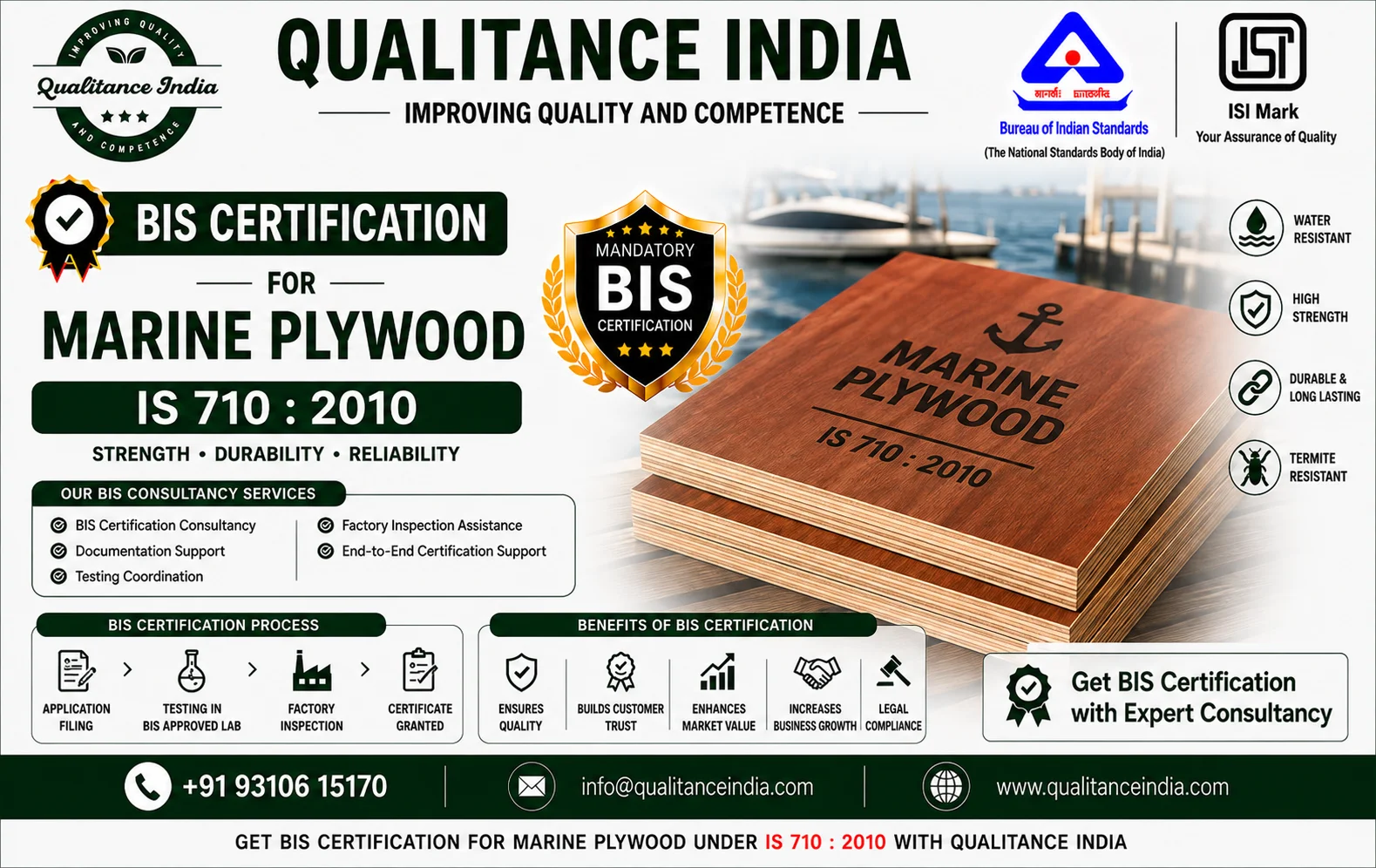
BIS Certification for Marine Plywood as per IS 710:2010 (ISI)
Introduction
Marine plywood is a specially manufactured plywood product designed for applications where the material may be exposed to moisture, humidity, wet conditions and demanding environments.
IS 710:2010 – Marine Plywood – Specification was the Indian Standard specifying requirements for materials, manufacture and performance of marine plywood intended for applications such as the construction, repair and maintenance of marine and river craft, pontoons and similar applications.
Marine plywood requires controlled manufacturing, suitable timber and veneers, appropriate adhesive systems and satisfactory performance against applicable tests.
For manufacturers seeking BIS certification, understanding the applicable Indian Standard, product requirements, testing procedures, manufacturing controls and documentation is important.
Current standard update: IS 710:2010 has been revised to IS 710:2024 – Marine Plywood – Specification (Third Revision). BIS's implementation guidelines stated that 26 December 2024 was the last date for implementation of the revised standard, after which the previous standard was to stand withdrawn.
About Marine Plywood
Marine plywood is manufactured using multiple layers of wood veneers bonded together with suitable adhesive.
It is intended for applications where plywood may encounter:
- High humidity
- Moisture
- Wetting and drying cycles
- Marine environments
- River environments
- Temperature variations
- Demanding structural applications
The BIS draft product manual describes marine plywood as plywood used in the construction, repair and maintenance of marine and river craft and capable of withstanding conditions involving changes in temperature, humidity and alternate wetting and drying.
Marine plywood is commonly associated with applications such as:
- Boats
- Marine craft
- River craft
- Pontoons
- Marine interiors
- Moisture-prone construction
- Specialized outdoor applications
What is IS 710:2010?
IS 710:2010 was titled:
Marine Plywood – Specification
It was the second revision of the Marine Plywood standard.
The standard incorporated changes based on developments in manufacturing and experience with the use of marine plywood.
BIS documentation relating to the revision noted provisions for plantation timber species such as poplar, eucalyptus and silver oak, an alternate accelerated water-resistance test method and a new wet-bending-strength requirement.
The standard was subsequently revised to IS 710:2024.
What is BIS Certification for Marine Plywood?
BIS Certification is a conformity assessment mechanism through which manufacturers demonstrate that their products meet the applicable requirements of an Indian Standard.
For Marine Plywood, the relevant historical standard was IS 710:2010 and the current standard is IS 710:2024.
The BIS Product Manual for IS 710:2010 was issued for certification under Scheme-I and included requirements concerning raw materials, product grouping, samples, testing equipment, inspection and testing arrangements and licence scope.
Scope of Marine Plywood Standard
The Marine Plywood standard addresses areas such as:
- Timber requirements
- Veneer requirements
- Adhesive requirements
- Manufacturing requirements
- Glueing
- Thickness
- Moisture content
- Dimensions
- Workmanship
- Finish
- Water resistance
- Glue adhesion
- Tensile strength
- Bending strength
- Wet bending strength
- Mycological performance
- Preservative retention
- Formaldehyde requirements
- Marking
The exact requirements and test methods depend on the applicable edition of the standard.
Raw Materials Used in Marine Plywood
The selection and control of raw materials are important parts of marine plywood manufacturing.
Important materials include:
Timber
The timber used for veneer production must comply with the applicable requirements of the standard.
Face Veneers
Face veneers form the outer surfaces of the plywood.
Core Veneers
Core veneers form the internal layers.
Cross-Bands
Cross-bands are arranged to provide the required construction and strength characteristics.
Adhesive
The adhesive is an important component because marine plywood needs suitable bonding performance under moisture and water exposure.
The earlier BIS Product Manual for IS 710:2010 specified BWP-grade adhesive conforming to IS 848 as a relevant raw material.
Manufacturing Process of Marine Plywood
A typical manufacturing process may include:
Timber Selection
Suitable timber is selected according to the applicable requirements.
Veneer Production
Logs are processed to produce veneers of appropriate thickness.
Veneer Preparation
Veneers are inspected, conditioned and prepared for assembly.
Drying
Veneers are dried and controlled for moisture content.
Grading
Veneers are checked for applicable defects and quality characteristics.
Glue Application
Suitable adhesive is applied to the veneers.
Lay-Up
Veneers are arranged in the required sequence and grain orientation.
Pressing
The assembled veneers are pressed under controlled conditions.
Trimming
The plywood sheet is trimmed to the required dimensions.
Sanding
Surfaces are finished as required.
Inspection
The finished plywood is checked for dimensions, workmanship, finish and applicable performance characteristics.
Testing
Samples are tested according to the applicable requirements.
Marking and Packing
The finished product is marked and packed according to applicable requirements.
Marine Plywood Testing
Testing plays an important role in determining conformity.
For IS 710, BIS laboratory listings include testing related to several characteristics, including:
- Moisture content
- Glue adhesion
- Adhesion of plies
- Water resistance
- Tensile strength
- Mycological performance
- Static bending strength
- Modulus of elasticity
- Modulus of rupture
- Wet bending
- Preservative retention
- Formaldehyde content
- Formaldehyde emission
- Dimensions
- Squareness
- Workmanship
- Finish
- Marking
Current BIS laboratory listings also show facilities for IS 710:2024, demonstrating that testing activity has transitioned to the revised standard.
Water Resistance Test
Water resistance is one of the important characteristics of marine plywood.
The purpose of this testing is to assess the performance of the bonded plywood construction when subjected to applicable water exposure.
The test may evaluate:
- Glue shear strength
- Adhesion between plies
- Water resistance
- Integrity of bonding
BIS laboratory listings for IS 710 identify water-resistance and glue-adhesion testing among the applicable tests.
Glue Adhesion Test
Proper bonding between veneers is essential for plywood performance.
The applicable evaluation can include:
- Glue shear strength
- Adhesion of plies
- Dry-state adhesion
- Water-resistance adhesion
Failure of glue adhesion can significantly affect the durability and performance of marine plywood.
Static Bending Strength
Marine plywood is required to demonstrate appropriate mechanical performance.
Static bending testing can evaluate:
- Modulus of elasticity
- Modulus of rupture
- Average performance
- Minimum individual performance
- Along-face-grain properties
- Across-face-grain properties
BIS laboratory information for IS 710 includes these testing parameters.
Wet Bending Strength
Wet bending performance is particularly important for plywood intended for demanding moisture-related applications.
The revision of IS 710:2010 introduced a new requirement concerning wet bending strength.
The current IS 710:2024 also contains wet-bending-related testing requirements.
Tensile Strength
Tensile strength testing evaluates the ability of the plywood to withstand tensile loading.
Depending on the applicable test requirement, evaluation may include strength:
- Along the grain
- Across the grain
BIS laboratory listings for IS 710 include tensile-strength testing.
Mycological Test
Marine plywood may encounter humid environments where fungal growth can become a concern.
The applicable mycological testing evaluates the resistance/performance of plywood under specified conditions.
BIS laboratory information lists mycological testing for IS 710.
Preservative Retention
Where applicable, preservative treatment and retention are important aspects of marine plywood performance.
The applicable test evaluates the retention of preservative in the plywood according to the standard.
BIS laboratory listings include retention of preservative among the tests for IS 710.
Formaldehyde Requirements
Formaldehyde-related requirements are also included in the testing framework for Marine Plywood.
BIS laboratory listings for IS 710 include:
- Formaldehyde content
- Steady-state formaldehyde emission
The exact applicability depends on the relevant edition and product requirements.
Dimensions and Workmanship
Marine plywood is also evaluated for physical characteristics such as:
- Length
- Width
- Thickness
- Squareness
- Edge characteristics
- Workmanship
- Surface finish
These characteristics help ensure consistency between manufactured sheets.
Product Grouping
Product grouping is important when applying for a BIS licence.
The BIS Product Manual for IS 710:2010 included specific grouping guidelines and stated that the relevant grouping provisions should be followed when determining the scope of the licence.
The current Product Manual for IS 710:2024 also contains grouping guidelines.
The exact scope should therefore be determined based on:
- Product type
- Thickness
- Grade
- Construction
- Applicable characteristics
- Manufacturing capability
- Test results
Sample Requirements
Under the earlier IS 710:2010 Product Manual, the sample requirements included:
- Marine Plywood – 1 sheet
- Face/Core veneers and cross-bands – 2 sheets of suitable size
- Resin – 5 litres
These were specified for the relevant certification activities under the 2010 Product Manual.
The current 2024 Product Manual specifies Marine Plywood – 1 sheet as the product sample quantity, with raw-material compliance requirements also addressed.
Who Can Apply for BIS Certification?
BIS certification may be relevant to manufacturers involved in producing marine plywood for the Indian market.
Potential applicants include:
- Marine plywood manufacturers
- Plywood manufacturing companies
- Timber-product manufacturers
- OEM manufacturers
- Industrial plywood manufacturers
- Manufacturers supplying marine construction products
- Manufacturers supplying plywood for high-moisture applications
The applicable current standard and regulatory requirements should be checked before filing a new application.
Eligibility Requirements
A manufacturer should have appropriate:
- Manufacturing premises
- Timber processing facilities
- Veneer manufacturing facilities
- Drying facilities
- Glueing equipment
- Pressing equipment
- Trimming equipment
- Sanding equipment
- Quality-control arrangements
- Testing equipment
- Measuring instruments
- Calibration arrangements
- Raw-material inspection system
- Finished-product inspection system
- Product identification system
Documents Required
The documentation may include:
- Company registration documents
- Factory address details
- Manufacturing licence
- Factory layout
- Manufacturing process flow
- Machinery list
- Product specifications
- Product drawings
- Timber details
- Veneer details
- Adhesive details
- Raw-material specifications
- Quality-control plan
- Testing equipment list
- Calibration certificates
- Internal test reports
- Product photographs
- Packaging details
- Marking details
- Authorized signatory documents
- Trademark documents, where applicable
- Previous BIS documents, if applicable
The exact documentation depends on the application and product scope.
BIS Certification Process for Marine Plywood
Step 1 – Product Assessment
The product and its intended application are reviewed.
Step 2 – Standard Verification
The applicable Indian Standard is identified.
For a current application, this should be checked against IS 710:2024, rather than relying on the withdrawn IS 710:2010.
Step 3 – Factory Assessment
Manufacturing facilities and quality-control arrangements are reviewed.
Step 4 – Documentation
Required technical and legal documents are prepared.
Step 5 – Product Grouping
The appropriate licence scope is determined.
Step 6 – Sample Preparation
Representative samples are prepared.
Step 7 – Laboratory Testing
Samples are submitted to an appropriate BIS-recognized testing facility.
Step 8 – Application
The BIS application is submitted through the applicable certification process.
Step 9 – BIS Scrutiny
BIS reviews the application and supporting documents.
Step 10 – Factory Inspection
The manufacturing facility is assessed where required.
Step 11 – Test Report Review
The laboratory results are evaluated.
Step 12 – Observation Closure
Any observations or non-conformities are addressed.
Step 13 – Licence
After successful completion of the applicable requirements, the BIS licence can be granted.
Factory Inspection
During factory assessment, the following areas may be reviewed:
Raw Material Control
Inspection of timber, veneers and adhesive materials.
Manufacturing Process
Verification of veneer production, drying, glueing, lay-up and pressing.
Machinery
Availability and suitability of required production machinery.
Testing Facilities
Verification of applicable testing arrangements.
Calibration
Review of calibration records for measuring equipment.
Quality Control
Inspection of incoming, in-process and finished-product quality controls.
Records
Verification of production and inspection records.
Product Marking
Review of product identification and applicable BIS marking requirements.
Common Problems During Certification
Manufacturers may face difficulties because of:
- Wrong standard selection
- Using outdated standard requirements
- Incomplete product specifications
- Incorrect product grouping
- Poor veneer quality
- Improper moisture control
- Adhesive non-conformity
- Glueing problems
- Inadequate pressing control
- Insufficient testing facilities
- Missing calibration certificates
- Test failures
- Incorrect marking
- Incomplete manufacturing records
- Factory not being ready for inspection
- Incomplete documentation
For new applications in 2026, relying only on IS 710:2010 can create a major compliance issue because BIS has moved the standard to IS 710:2024.
BIS Certification Cost
The total cost depends on the product and certification scope.
The cost can be influenced by:
- BIS application charges
- Laboratory testing
- Number of product variants
- Product grouping
- Thickness range
- Raw-material testing
- Factory inspection
- Sample transportation
- Retesting, if required
- Consultancy charges
Current BIS laboratory listings for IS 710:2024 show different testing charges depending on the laboratory and testing scope. For example, current listings include complete testing figures such as ₹14,000, ₹16,700, ₹18,000 and ₹20,300 at different facilities, with exclusions and testing scopes varying by laboratory.
Therefore, the final testing cost should be confirmed based on the exact product scope.
Certification Timeline
The certification timeline depends on:
- Factory readiness
- Documentation
- Sample availability
- Laboratory availability
- Testing requirements
- Product grouping
- BIS scrutiny
- Factory inspection
- Test results
- Closure of observations
A product-specific timeline can be estimated after reviewing the manufacturer's product and factory details.
Benefits of BIS Certification
Better Product Quality
The certification process helps manufacturers maintain consistent product quality.
Customer Confidence
BIS certification can provide greater confidence to buyers regarding conformity with the applicable Indian Standard.
Market Acceptance
Certification supports compliance with applicable market requirements.
Improved Manufacturing Control
Manufacturers establish systematic quality-control procedures.
Better Product Consistency
Regular inspection and testing help maintain consistent manufacturing performance.
Stronger Business Reputation
Compliance with Indian Standards can improve credibility among institutional and commercial buyers.
Why Choose Qualitance India?
Qualitance India provides BIS certification consultancy services for manufacturers dealing with products covered by Indian Standards.
For Marine Plywood, assistance can include:
- Product applicability assessment
- Standard verification
- Current-standard transition guidance
- Product grouping guidance
- Document preparation
- Technical document review
- Laboratory coordination
- Sample testing assistance
- BIS application assistance
- Factory inspection preparation
- Quality-control documentation
- Test report coordination
- Observation closure assistance
- Licence-related support
Qualitance India
Phone: +91-9310-615-170
Email: info@qualitanceindia.com
Website: Qualitance India
Certification Process at a Glance
Product Identification
↓
Applicable IS Standard Check
↓
Factory Assessment
↓
Documentation
↓
Product Grouping
↓
Sample Preparation
↓
Laboratory Testing
↓
BIS Application
↓
BIS Scrutiny
↓
Factory Inspection
↓
Test Report Evaluation
↓
Observation Closure
↓
BIS Licence
Frequently Asked Questions
1. What is the BIS standard for Marine Plywood?
The current standard is IS 710:2024 – Marine Plywood – Specification (Third Revision). IS 710:2010 was the previous edition.
2. What was IS 710:2010?
IS 710:2010 was the second revision of the Indian Standard for Marine Plywood.
3. Is IS 710:2010 still the current standard?
No. BIS revised IS 710:2010 to IS 710:2024. BIS specified 26 December 2024 as the last date for implementation of the revised standard.
4. What is Marine Plywood?
Marine plywood is plywood manufactured for demanding applications involving moisture, humidity and wet conditions.
5. Where is Marine Plywood used?
It can be used in marine and river craft, pontoons and other applications requiring suitable moisture-resistant plywood.
6. What adhesive is used for Marine Plywood?
The earlier IS 710:2010 Product Manual referred to BWP-grade adhesive conforming to IS 848. The current requirements should be checked against IS 710:2024.
7. Is testing required for Marine Plywood?
Yes. Applicable testing includes physical, mechanical, bonding, water-resistance and other requirements.
8. What is tested under IS 710?
Testing can include moisture content, glue adhesion, water resistance, tensile strength, mycological performance, bending strength, wet bending, preservative retention and formaldehyde-related requirements.
9. Is water-resistance testing required?
Water-resistance testing is an important part of the applicable requirements for Marine Plywood.
10. Is glue shear strength tested?
Yes. BIS laboratory listings include glue shear strength testing under IS 710.
11. Is bending strength tested?
Yes. Static bending and wet bending requirements are included in the applicable testing framework.
12. Is formaldehyde testing applicable?
Formaldehyde content and emission testing are included in the testing information for the current standard.
13. What sample is required?
The current Product Manual for IS 710:2024 specifies one sheet of Marine Plywood as the product sample quantity.
14. What was the sample requirement under IS 710:2010?
The earlier Product Manual specified one Marine Plywood sheet, two suitable sheets of veneers/cross-bands and five litres of resin for the relevant sampling requirements.
15. Is product grouping required?
Yes. BIS Product Manuals contain product-grouping provisions for determining the licence scope.
16. Can a manufacturer apply for BIS certification?
Eligible manufacturers can apply under the applicable BIS conformity-assessment requirements.
17. Is factory inspection required?
Factory assessment may be part of the BIS certification process depending on the applicable certification route.
18. How much does Marine Plywood testing cost?
Testing charges vary according to the laboratory and scope. Current BIS LIMS listings show different prices for IS 710:2024.
19. How long does BIS certification take?
The timeline depends on documentation, testing, factory readiness, inspection and closure of observations.
20. Can Qualitance India help with Marine Plywood certification?
Yes. Qualitance India can assist manufacturers with standard applicability, documentation, testing coordination, BIS application and factory inspection preparation.
People Also Ask
What is IS 710 in plywood?
IS 710 is the Indian Standard covering Marine Plywood – Specification. The current edition is IS 710:2024.
Is IS 710 plywood waterproof?
Marine plywood is designed for demanding moisture and water-exposure applications, but “waterproof” should not be treated as an unlimited performance claim. Compliance should be assessed against the applicable requirements of the standard.
What is the difference between IS 303 and IS 710 plywood?
IS 303 relates to plywood for general purposes, while IS 710 specifically covers Marine Plywood. BIS's current plywood compendium lists both standards separately.
What is BWP plywood?
BWP refers to Boiling Water Proof plywood terminology commonly used in the plywood industry. The applicable product classification and requirements should be checked against the relevant Indian Standard.
What tests are done on marine plywood?
Tests can include moisture, glue adhesion, water resistance, tensile strength, bending strength, wet bending, mycological performance, preservative retention and formaldehyde-related tests.
Image ALT Text
- BIS Certification for Marine Plywood
- Marine Plywood IS 710 Certification
- IS 710 Marine Plywood
- Marine Plywood BIS Licence
- Marine Plywood Testing
- BIS Certification for Marine Plywood Manufacturers
- Marine Plywood Manufacturing Process
- Marine Plywood Water Resistance Testing
- Marine Plywood Glue Adhesion Testing
- Marine Plywood Bending Strength Test
- Marine Plywood ISI Mark
- IS 710:2024 Marine Plywood
- Marine Plywood BIS Certification India
- Marine Plywood Quality Testing
- Qualitance India Marine Plywood BIS Consultancy
Related Services
- BIS Certification Consultancy
- ISI Mark Certification
- BIS Licence
- BIS Product Testing
- BIS Factory Inspection
- Plywood BIS Certification
- BIS Certification for General Purpose Plywood
- BIS Certification for Concrete Shuttering Plywood
- BIS Certification for Block Boards
- BIS Certification for Wood-Based Products
Related Blog Topics
- BIS Certification for Marine Plywood as per IS 710:2024
- IS 710:2024 Marine Plywood – Complete Guide
- Difference Between IS 710:2010 and IS 710:2024
- Marine Plywood Testing Requirements
- BIS Licence for Marine Plywood Manufacturers
- Marine Plywood Water Resistance Test
- Marine Plywood Glue Shear Strength Test
- Marine Plywood Wet Bending Test
- Marine Plywood Formaldehyde Requirements
- Marine Plywood Product Grouping
- Documents Required for Marine Plywood BIS Certification
- BIS Certification Process for Plywood Manufacturers
- IS 303 vs IS 710 Plywood
- BWP Plywood and Marine Plywood Difference
- BIS Testing Requirements for Plywood
Contact Qualitance India
Need BIS Certification for Marine Plywood?
If you manufacture Marine Plywood and need assistance with BIS certification, product testing, documentation, product grouping or factory inspection preparation, Qualitance India can assist throughout the certification process.
Call: +91-9310-615-170
Email: info@qualitanceindia.com
Website: Qualitance India
Discuss your Marine Plywood certification requirement with our team today.
Conclusion
Marine plywood is designed for applications where plywood may be exposed to demanding moisture, humidity and wet conditions. IS 710:2010 established requirements relating to the materials, manufacturing process and performance of Marine Plywood.
However, manufacturers planning certification now should refer to IS 710:2024, because BIS revised the earlier standard and specified 26 December 2024 as the implementation deadline for the revised standard.
The current BIS framework includes requirements covering raw materials, manufacturing, dimensions, workmanship, bonding, water resistance, mechanical performance, wet bending, mycological performance, preservative retention and formaldehyde-related characteristics.
For manufacturers, properly identifying the current standard, preparing the factory, arranging applicable testing and maintaining appropriate quality-control records are important steps toward successful BIS certification.
Qualitance India can assist manufacturers with the complete BIS certification journey for Marine Plywood, from initial product assessment and documentation to testing, application support and factory inspection preparation.