Aluminium and Aluminium Alloy Products (Quality Control) Order, 2026 – Complete Guide to BIS Certification for Aluminium Products
Introduction
India's aluminium industry is one of the fastest-growing sectors, supplying essential materials to industries such as infrastructure, construction, electrical equipment, renewable energy, transportation, aerospace, automotive, packaging, defence, railways, consumer goods, and engineering. Aluminium is widely preferred because of its lightweight properties, corrosion resistance, excellent conductivity, high strength-to-weight ratio, recyclability, and long service life.
As the demand for aluminium products continues to increase, ensuring consistent quality has become a national priority. Poor-quality aluminium materials can lead to structural failures, electrical hazards, reduced product life, safety risks, and significant economic losses. To address these concerns, the Government of India has strengthened its regulatory framework by introducing the Aluminium and Aluminium Alloy Products (Quality Control) Order, 2026 (Aluminium QCO 2026).
The Quality Control Order has been issued by the Department for Promotion of Industry and Internal Trade (DPIIT) under the Ministry of Commerce and Industry, with implementation through the Bureau of Indian Standards (BIS). The objective of this order is to ensure that notified aluminium and aluminium alloy products manufactured, imported, or sold in India comply with the applicable Indian Standards (IS) and meet uniform safety and quality requirements.
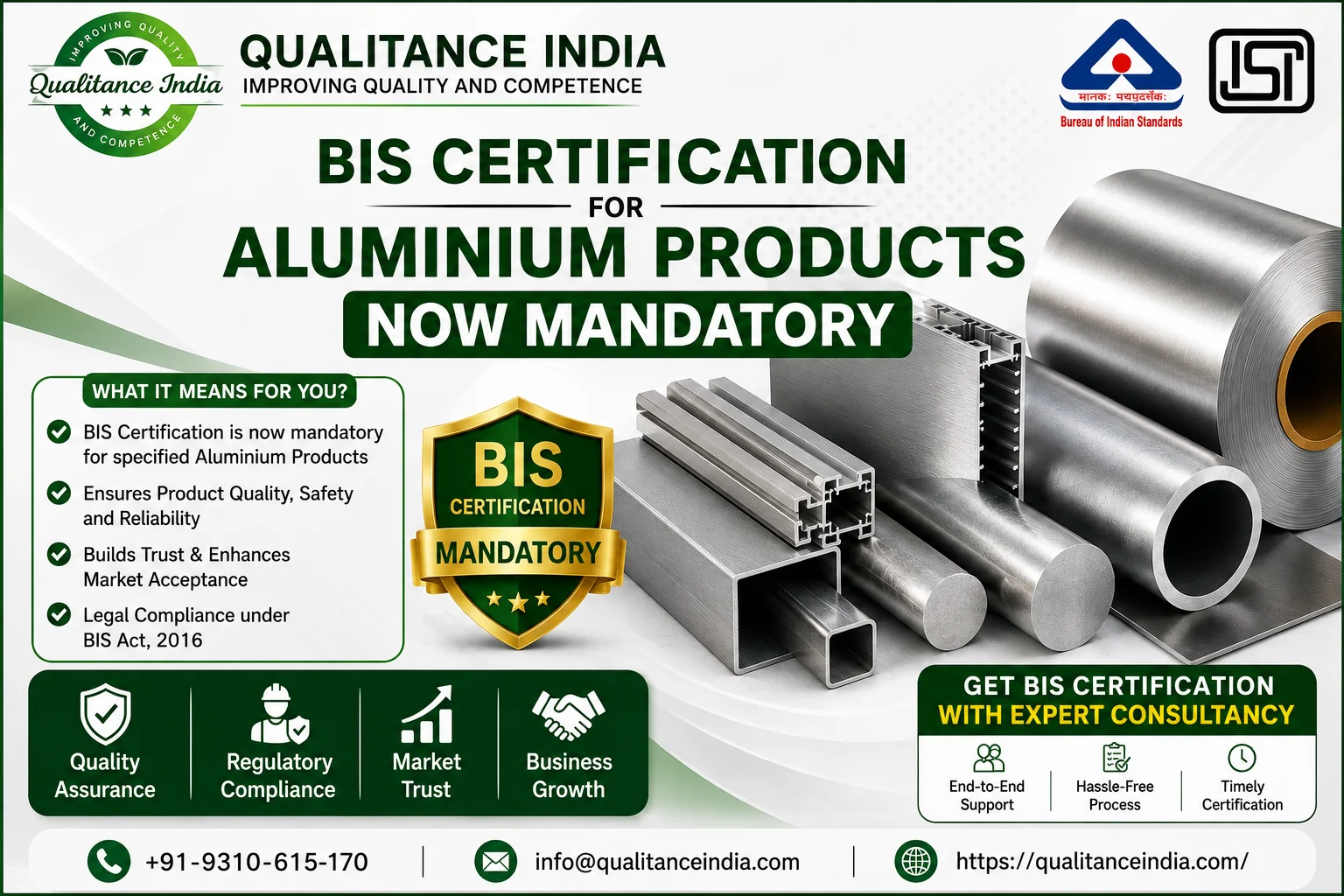
Under Aluminium QCO 2026, specified aluminium products must obtain a BIS License under Scheme-I (ISI Mark Scheme) before they can be legally manufactured, imported, distributed, or sold in the Indian market. Products that do not comply with the notified standards may face regulatory restrictions and enforcement action under the BIS Act, 2016.
The order replaces the earlier notification issued in 2025 and significantly expands the range of regulated aluminium products. It covers products used across diverse industries, including aluminium tubes, rods, bars, sheets, strips, plates, wires, foils, extrusions, forgings, irrigation products, aluminium composite panels, pharmaceutical packaging materials, electrical conductors, and utensils. The phased implementation schedule also provides additional compliance time for small and micro enterprises for certain products.
For manufacturers, importers, brand owners, OEMs, and foreign manufacturers exporting to India, compliance with Aluminium QCO 2026 is no longer optional—it is a legal requirement for the notified products. Early preparation, product testing, documentation, and factory readiness are essential to avoid delays in certification and disruptions to business operations.
This comprehensive guide explains everything you need to know about the Aluminium QCO 2026, including the products covered, applicable Indian Standards, implementation timelines, BIS certification requirements, eligibility, exemptions, documentation, laboratory testing, factory inspection, penalties for non-compliance, and the complete certification process.
Whether you are planning to launch a new aluminium product, expand your manufacturing operations, or export aluminium products to India, this guide will help you understand the regulatory framework and prepare for successful BIS certification.
What is the Aluminium and Aluminium Alloy Products (Quality Control) Order, 2026?
The Aluminium and Aluminium Alloy Products (Quality Control) Order, 2026, commonly referred to as Aluminium QCO 2026, is a mandatory quality regulation issued by the Government of India under the provisions of the Bureau of Indian Standards (BIS) Act, 2016.
The primary objective of this Quality Control Order is to ensure that aluminium products available in the Indian market conform to the prescribed Indian Standards and maintain consistent levels of quality, safety, and performance. By making BIS certification compulsory for specified products, the government aims to eliminate substandard materials from the supply chain, protect consumers, support domestic manufacturing, and improve confidence in Indian industrial products.
Under this order:
- Specified aluminium products must comply with the relevant Indian Standard (IS).
- Manufacturers must obtain a valid BIS License before marketing the products.
- Certified products are required to bear the ISI Standard Mark.
- Products without the required BIS certification cannot be legally manufactured, imported, sold, or distributed in India where the QCO applies.
The QCO applies equally to Indian manufacturers and foreign manufacturers supplying aluminium products to the Indian market.
Quick Overview of Aluminium QCO 2026
| Particular | Details |
|---|---|
| Order Name | Aluminium and Aluminium Alloy Products (Quality Control) Order, 2026 |
| Issued By | Department for Promotion of Industry and Internal Trade (DPIIT) |
| Ministry | Ministry of Commerce & Industry |
| Implementing Authority | Bureau of Indian Standards (BIS) |
| Applicable Scheme | Scheme-I (ISI Mark Scheme) |
| Mandatory Certification | BIS Certification (ISI Mark) |
| Applicable To | Indian Manufacturers, Foreign Manufacturers, Importers |
| Product Coverage | Aluminium & Aluminium Alloy Products |
| Governing Law | BIS Act, 2016 |
| Certification Type | Product Certification |
| Market Requirement | Mandatory before sale/import where applicable |
Why Was Aluminium QCO 2026 Introduced?
The Government introduced Aluminium QCO 2026 to improve product quality and strengthen regulatory oversight across the aluminium industry. With increasing demand in infrastructure, electrical systems, packaging, transportation, and engineering, ensuring the reliability of aluminium products has become essential.
The Quality Control Order supports several key objectives:
- Ensure that aluminium products comply with Indian Standards.
- Improve consumer safety by reducing the use of substandard materials.
- Promote fair competition among manufacturers.
- Restrict the circulation of low-quality imports.
- Encourage manufacturers to adopt robust quality management systems.
- Enhance confidence in Indian-manufactured aluminium products.
- Support the "Make in India" initiative by improving manufacturing standards.
- Facilitate long-term industrial growth through standardization.
Who Should Read This Guide?
This guide is especially useful for:
- Aluminium Manufacturers
- Aluminium Alloy Manufacturers
- Aluminium Extrusion Companies
- Aluminium Foil Manufacturers
- Aluminium Composite Panel Manufacturers
- Electrical Conductor Manufacturers
- Utensil Manufacturers
- Engineering Product Manufacturers
- Importers of Aluminium Products
- Foreign Manufacturers Exporting to India
- OEM Manufacturers
- Brand Owners
- Compliance Managers
- Quality Assurance Professionals
- Procurement Teams
- BIS Consultants
If your business manufactures, imports, or supplies aluminium products covered under the QCO, understanding these requirements is essential for legal compliance and uninterrupted market access.
Why BIS Certification is Mandatory for Aluminium Products
BIS Certification under the ISI Mark Scheme ensures that aluminium products meet the applicable Indian Standards before they reach the market. It serves as a quality assurance mechanism that benefits manufacturers, consumers, regulators, and the overall industry.
Key objectives of mandatory certification include:
- Quality Assurance: Products are tested and verified against relevant Indian Standards.
- Consumer Protection: Reduces the risk of unsafe or poor-quality products entering the market.
- Standardization: Promotes consistency in manufacturing and product performance.
- Regulatory Compliance: Helps manufacturers meet legal obligations under the BIS Act, 2016.
- Market Confidence: Builds trust among customers, distributors, and institutional buyers.
- Control of Non-Compliant Imports: Ensures imported products meet the same quality requirements as domestically manufactured products.
- Support for Industrial Growth: Encourages adoption of recognized manufacturing and quality practices.
Benefits of Aluminium QCO 2026
| Benefit | Impact |
|---|---|
| Better Product Quality | Ensures compliance with Indian Standards |
| Consumer Safety | Reduces risks associated with substandard materials |
| Legal Compliance | Enables lawful manufacture, import, and sale where certification is mandatory |
| Market Access | Facilitates entry into regulated markets in India |
| Stronger Brand Reputation | Demonstrates commitment to quality |
| Reduced Regulatory Risk | Helps avoid enforcement actions and disruptions |
| Support for Domestic Manufacturing | Encourages high-quality production under the Make in India initiative |
| Improved Industry Standardization | Creates uniform quality benchmarks across the aluminium sector |
Products Covered Under Aluminium QCO 2026, BIS Certification Requirements, Implementation Timeline & Applicability
After understanding the objective and importance of the Aluminium and Aluminium Alloy Products (Quality Control) Order, 2026, the next step is to identify which aluminium products are covered under the notification, when the order becomes applicable, and what manufacturers and importers must do to comply with the BIS requirements.
The Aluminium QCO 2026 expands the scope of mandatory BIS Certification by covering a wide range of aluminium and aluminium alloy products used in engineering, construction, electrical applications, pharmaceutical packaging, transportation, irrigation, aerospace, and general manufacturing. Every manufacturer and importer dealing with these products should carefully verify whether their products fall under the notified Indian Standards.
Businesses that fail to obtain the required BIS License before the applicable implementation date may face restrictions on manufacturing, importing, selling, or distributing these products in India.
PRODUCTS COVERED UNDER ALUMINIUM QCO 2026
The following aluminium and aluminium alloy products are covered under the Quality Control Order, 2026.
| Sl. No. | Indian Standard | Product Name | Large Enterprises | Small Enterprises | Micro Enterprises |
|---|---|---|---|---|---|
| 1 | IS 7092 (Part 1):1992 | Aluminium Alloy Tubes for Irrigation Purposes – Welded Tubes | Immediate | Immediate | Immediate |
| 2 | IS 7092 (Part 2):1987 | Aluminium Alloy Tubes for Irrigation Purposes – Extruded Tubes | Immediate | Immediate | Immediate |
| 3 | IS 5484:1997 | EC Grade Aluminium Rod Produced by Continuous Casting and Rolling | Immediate | Immediate | Immediate |
| 4 | IS 16011:2012 | Aluminium and Aluminium Alloy Foil for Pharmaceutical Packaging | Immediate | Immediate | Immediate |
| 5 | IS 17682:2021 | Aluminium Composite Panel | Immediate | Immediate | Immediate |
| 6 | IS 1254:2007 | Corrugated Aluminium Sheet | Immediate | Immediate | Immediate |
| 7 | IS 7902:2001 | Aluminium Alloy Forging Stock and Forgings for Aerospace Applications | Immediate | Immediate | Immediate |
| 8 | IS 733:1983 | Wrought Aluminium and Aluminium Alloy Bars, Rods & Sections | 01 December 2026 | 01 March 2027 | 01 June 2027 |
| 9 | IS 734:1975 | Wrought Aluminium Alloy Forging Stock & Forgings | 01 December 2026 | 01 March 2027 | 01 June 2027 |
| 10 | IS 736:1986 | Wrought Aluminium Alloy Plates | 01 December 2026 | 01 March 2027 | 01 June 2027 |
| 11 | IS 737:2008 | Wrought Aluminium Alloy Sheets & Strips | 01 December 2026 | 01 March 2027 | 01 June 2027 |
| 12 | IS 739:1992 | Wrought Aluminium Alloy Wire | 01 December 2026 | 01 March 2027 | 01 June 2027 |
| 13 | IS 740:1977 | Wrought Aluminium Alloy Rivet Stock | 01 December 2026 | 01 March 2027 | 01 June 2027 |
| 14 | IS 1285:2002 | Extruded Round Tubes & Hollow Sections | 01 December 2026 | 01 March 2027 | 01 June 2027 |
| 15 | IS 2067:1975 | Wrought Aluminium Wire for Electrical Purposes | 01 December 2026 | 01 March 2027 | 01 June 2027 |
| 16 | IS 21:1992 | Wrought Aluminium & Aluminium Alloys for Manufacture of Utensils | 01 December 2026 | 01 March 2027 | 01 June 2027 |
| 17 | IS 5082:1998 | Aluminium Products for Electrical Applications | 01 December 2026 | 01 March 2027 | 01 June 2027 |
INDUSTRIES AFFECTED BY ALUMINIUM QCO 2026
The Quality Control Order impacts almost every industry that manufactures, imports, or uses aluminium products.
Major industries include:
• Construction Industry
• Infrastructure Projects
• Electrical Equipment Manufacturing
• Solar Energy Industry
• Power Transmission Sector
• Pharmaceutical Packaging Industry
• Automotive Industry
• Railway Industry
• Aerospace Industry
• Defence Manufacturing
• Consumer Goods Manufacturing
• Kitchenware & Utensil Industry
• Irrigation Equipment Manufacturers
• Engineering Industries
• Fabrication Industry
• Aluminium Extrusion Industry
• Metal Processing Industry
• OEM Manufacturers
IMPLEMENTATION TIMELINE
The Government has introduced both immediate implementation and phased implementation depending on the product category.
Implementation Schedule
Immediate Implementation
Applicable for:
• Aluminium Composite Panels
• Pharmaceutical Foils
• Corrugated Aluminium Sheets
• EC Grade Aluminium Rods
• Irrigation Tubes
• Aerospace Forgings
Phased Implementation
For General (Large) Manufacturers
Effective Date
01 December 2026
For Small Enterprises
Effective Date
01 March 2027
For Micro Enterprises
Effective Date
01 June 2027
The phased implementation provides additional time to MSMEs for upgrading manufacturing facilities, establishing quality control systems, conducting product testing, and obtaining BIS Certification before the mandatory compliance dates.
WHO MUST OBTAIN BIS CERTIFICATION?
BIS Certification under the ISI Mark Scheme is mandatory for all notified products covered under Aluminium QCO 2026.
The requirement applies to:
• Indian Manufacturers
• Foreign Manufacturers
• Importers
• Brand Owners
• OEM Manufacturers
• Contract Manufacturers
• Private Label Manufacturers
• Exporters supplying products to India
Even if a manufacturer is located outside India, the products cannot be imported into India unless the applicable BIS certification requirements are fulfilled.
BIS CERTIFICATION REQUIREMENTS
To comply with Aluminium QCO 2026, manufacturers are required to obtain a valid BIS Licence under Scheme-I (ISI Mark Scheme).
The certification process generally involves:
• Identification of the applicable Indian Standard (IS)
• Product design review
• Preparation of technical documentation
• Testing at a BIS-recognized laboratory
• Submission of the BIS application
• Technical scrutiny by BIS
• Factory inspection (where required under the applicable scheme)
• Grant of BIS Licence
• Use of the ISI Standard Mark on certified products
Only after successful completion of these requirements can the manufacturer legally use the BIS Standard Mark on the notified products.
ELIGIBILITY FOR BIS CERTIFICATION
Indian Manufacturers
Manufacturers with production facilities in India are eligible to apply for BIS Certification for products covered under the Quality Control Order.
Foreign Manufacturers
Manufacturers located outside India intending to export aluminium products to India must obtain BIS Certification under the applicable BIS provisions before supplying notified products.
Importers
Importers must ensure that the products they source from overseas manufacturers comply with the applicable BIS requirements before importing them into India.
OEM Manufacturers
Companies manufacturing products for other brands must also ensure compliance with the relevant Indian Standards and certification requirements.
EXEMPTIONS UNDER ALUMINIUM QCO 2026
Although the Quality Control Order makes BIS Certification mandatory for notified products, certain limited exemptions are available.
Export Products
Products manufactured exclusively for export are generally exempt from the requirement to obtain BIS Certification for sale within India, provided they are not placed on the domestic market.
Research & Development
Limited imports for research, testing, product development, or evaluation may be permitted under the conditions specified in the notification. These products must not be sold commercially and should be handled in accordance with the applicable requirements.
Manufacturers should carefully review the notification to determine whether any exemption applies to their specific situation.
PRE-CERTIFICATION COMPLIANCE CHECKLIST
Before submitting a BIS application, manufacturers should ensure that:
✓ The correct Indian Standard has been identified.
✓ Product design complies with applicable technical requirements.
✓ Manufacturing processes are documented.
✓ Quality control procedures are established.
✓ Internal testing facilities or arrangements are available, where required.
✓ Product labels and markings meet BIS requirements.
✓ Technical documentation is complete.
✓ Factory records are properly maintained.
✓ Product samples are ready for laboratory testing.
✓ Management is prepared for any applicable BIS verification or inspection activities.
A well-prepared manufacturer is more likely to experience a smoother certification process with fewer queries and delays.
Complete BIS Certification Process for Aluminium Products under Aluminium QCO 2026 – Documents, Testing, Factory Inspection, Timeline, Fees, Compliance & Penalties
After identifying whether your aluminium products are covered under the Aluminium and Aluminium Alloy Products (Quality Control) Order, 2026, the next and most important step is obtaining BIS Certification under the ISI Mark Scheme.
Obtaining a BIS licence is not just a documentation exercise. It is a comprehensive conformity assessment process that verifies whether the product consistently meets the applicable Indian Standard (IS). The Bureau of Indian Standards evaluates the manufacturer's quality management system, manufacturing capability, testing facilities, product quality, and compliance with the notified Indian Standard before granting permission to use the ISI Mark.
For manufacturers and importers, understanding each stage of the certification process helps reduce delays, avoid rejection, and ensure faster approval.
──────────────────────────────
Complete BIS Certification Process for Aluminium Products
The BIS certification process under Scheme-I generally consists of the following stages:
Step 1 – Product Applicability Assessment
The first step is determining whether your aluminium product is covered under Aluminium QCO 2026.
Manufacturers should identify:
• Applicable Indian Standard (IS)
• Product category
• Manufacturing process
• Product specifications
• Implementation date
Selecting the wrong Indian Standard is one of the most common reasons for delays in BIS certification.
──────────────────────────────
Step 2 – Technical Documentation Preparation
Before applying, manufacturers should prepare all technical and legal documents required by BIS.
Typical documents include:
• Company Registration Certificate
• Factory Registration Certificate
• GST Registration
• Manufacturing License
• Trademark Certificate (if applicable)
• Brand Authorization Letter
• Factory Layout Plan
• Manufacturing Process Flow Chart
• Quality Control Plan
• List of Manufacturing Machinery
• List of Testing Equipment
• Calibration Certificates
• Raw Material Specifications
• Product Drawings
• Product Specifications
• Test Reports (where applicable)
• Authorized Signatory Details
• ISO 9001 Certificate (if available)
• Packaging Details
• Product Labelling Artwork
• Internal Test Records
Proper documentation significantly reduces BIS queries during application review.
──────────────────────────────
Step 3 – Product Testing at BIS-Recognized Laboratory
Product testing is one of the most important stages of BIS certification.
Manufacturers must submit product samples to a BIS-recognized laboratory for testing according to the applicable Indian Standard.
Depending on the product category, testing may include:
Chemical Composition Analysis
Verifies whether the aluminium alloy composition meets the applicable IS requirements.
Mechanical Strength Test
Measures tensile strength, yield strength, and elongation.
Dimensional Verification
Checks dimensions, tolerances, thickness, diameter, width, and length.
Surface Finish Inspection
Examines surface defects, scratches, cracks, corrosion, and finish quality.
Hardness Test
Measures material hardness using specified testing methods.
Flattening Test
Applicable for tubes and hollow sections.
Bend Test
Checks flexibility and resistance to cracking.
Electrical Conductivity Test
Applicable for electrical-grade aluminium products.
Visual Examination
Ensures products are free from visible manufacturing defects.
Additional tests may apply depending on the applicable Indian Standard.
Only products that successfully pass laboratory testing can proceed to the certification stage.
──────────────────────────────
Step 4 – Submission of BIS Application
After successful testing, the manufacturer submits the BIS application along with supporting documents.
The application generally includes:
• Company Details
• Factory Details
• Product Details
• Applicable IS Standard
• Laboratory Test Reports
• Manufacturing Process Details
• Quality Control Information
• Product Drawings
• Factory Information
• Technical Documents
The application is then reviewed by BIS officials.
──────────────────────────────
Step 5 – Factory Inspection
Factory inspection is a critical stage under the ISI Mark Scheme.
During inspection, BIS officers verify whether the manufacturing facility is capable of consistently producing products that comply with the applicable Indian Standard.
The inspection normally includes verification of:
✓ Raw Material Storage
✓ Incoming Material Inspection
✓ Manufacturing Process
✓ Production Equipment
✓ Production Capacity
✓ Process Control
✓ In-house Laboratory
✓ Testing Equipment
✓ Calibration Records
✓ Quality Management System
✓ Product Identification
✓ Traceability System
✓ Packaging Process
✓ Finished Goods Inspection
✓ Internal Test Records
✓ Employee Competency
✓ Quality Manual
✓ Standard Operating Procedures
✓ Complaint Handling System
Any non-conformities identified during inspection may require corrective actions before the licence is granted.
──────────────────────────────
Step 6 – Grant of BIS Licence
After successful evaluation of:
• Documentation
• Product Testing
• Factory Assessment
• Technical Review
BIS grants the manufacturer a licence to use the ISI Standard Mark on the certified aluminium products.
Only after receiving the licence can the manufacturer legally manufacture, import, or sell the notified products in India.
──────────────────────────────
Estimated BIS Certification Timeline
The certification timeline depends on document readiness, laboratory testing, and BIS processing.
Typical timeline:
Product Applicability Review – 2 to 5 Working Days
Documentation Preparation – 5 to 10 Working Days
Laboratory Testing – 15 to 30 Working Days
Application Review – 7 to 15 Working Days
Factory Inspection – As Scheduled by BIS
Grant of Licence – After Successful Compliance
Estimated Total Duration: Approximately 4 to 8 Weeks (subject to product category and document completeness).
──────────────────────────────
BIS Certification Cost
The total cost varies depending on the product, applicable Indian Standard, laboratory testing, and scope of certification.
The cost generally includes:
• BIS Application Fee
• Government Processing Fee
• Laboratory Testing Charges
• Inspection Expenses (where applicable)
• Product Sample Cost
• Documentation Cost
• Professional Consultancy Charges (if engaged)
Manufacturers should plan their certification budget in advance to avoid delays.
──────────────────────────────
Common Reasons for Delay or Rejection
Many applications are delayed because of avoidable mistakes.
Some of the most common reasons include:
• Wrong Indian Standard selected
• Incomplete documentation
• Incorrect application details
• Laboratory test failures
• Improper product marking
• Missing calibration certificates
• Inadequate quality control procedures
• Inconsistent manufacturing process
• Factory readiness issues
• Delayed response to BIS queries
A thorough pre-assessment can significantly improve the chances of first-time approval.
──────────────────────────────
Post-Certification Compliance
Obtaining the BIS licence is not the end of the compliance process.
Manufacturers are expected to maintain ongoing conformity throughout the licence validity period.
Key post-certification responsibilities include:
• Consistent product quality
• Maintenance of manufacturing records
• Calibration of testing equipment
• Proper use of the ISI Mark
• Record of customer complaints
• Internal quality audits
• Compliance with surveillance activities
• Cooperation during BIS inspections
Failure to maintain compliance may result in suspension or cancellation of the licence.
──────────────────────────────
Penalties for Non-Compliance
Manufacturing, importing, or selling notified aluminium products without the required BIS certification may attract action under the Bureau of Indian Standards Act, 2016.
Possible consequences include:
• Monetary penalties
• Product seizure
• Ban on manufacture or sale
• Cancellation of approvals
• Legal proceedings
• Market recalls
• Damage to brand reputation
Timely compliance with Aluminium QCO 2026 helps businesses avoid regulatory risks and maintain uninterrupted access to the Indian market.
──────────────────────────────
Why Choose Qualitance India for BIS Certification?
Obtaining BIS Certification can be a complex process involving technical standards, extensive documentation, laboratory testing, factory readiness, and continuous coordination with BIS authorities. At Qualitance India, we provide complete end-to-end consultancy services to simplify the certification journey for manufacturers across India and overseas.
Our services include:
• Product applicability assessment
• Identification of the correct Indian Standard (IS)
• Complete documentation support
• Coordination with BIS-recognized laboratories
• BIS application filing
• Technical query resolution
• Factory inspection guidance
• Assistance during licence approval
• Post-certification compliance support
• Renewal and surveillance assistance
Our experienced compliance professionals work closely with manufacturers to ensure timely approvals while minimizing delays and documentation errors.
Whether you are an Indian manufacturer, foreign manufacturer, importer, OEM, or brand owner, Qualitance India helps you achieve BIS Certification efficiently and in compliance with the latest regulatory requirements.
Conclusion
The Aluminium and Aluminium Alloy Products (Quality Control) Order, 2026 marks a significant step towards improving product quality, safety, and standardization in the Indian aluminium industry. Manufacturers and importers dealing with notified aluminium products must obtain BIS Certification under the ISI Mark Scheme before the applicable implementation dates to ensure legal compliance and uninterrupted market access.
By understanding the applicable Indian Standards, preparing accurate documentation, completing laboratory testing, ensuring factory readiness, and maintaining post-certification compliance, businesses can streamline the certification process and avoid unnecessary delays or penalties.
If your organization requires expert guidance for BIS Certification of aluminium products, Qualitance India offers complete consultancy support—from applicability assessment and documentation to laboratory coordination, factory inspection assistance, and successful licence approval—helping you achieve