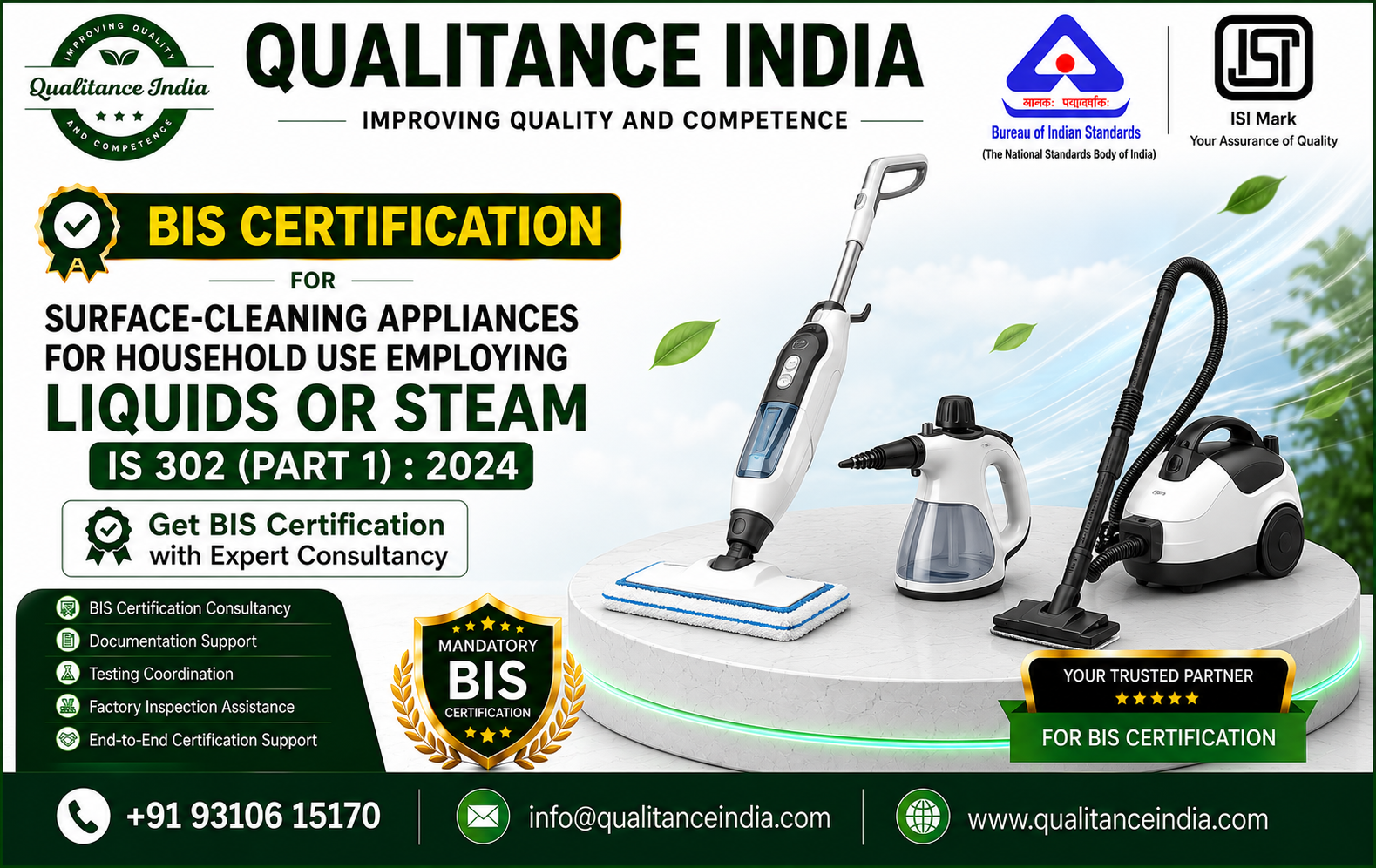
BIS CERTIFICATION CONSULTANCY FOR SURFACE-CLEANING APPLIANCES FOR HOUSEHOLD USE EMPLOYING LIQUIDS OR STEAM – IS 302 (PART 1):2024
IntroductionSurface-cleaning appliances that use liquids or steam are widely used for cleaning floors, tiles, kitchens, bathrooms, glass surfaces and other household areas. As these appliances combine electrical systems with water, steam, heating elements, pumps, motors and other components, product safety and electrical protection are important considerations.
For manufacturers and businesses supplying such appliances in India, understanding the applicable BIS certification requirements is essential. The Bureau of Indian Standards (BIS) lists “Surface-Cleaning Appliances for Household use Employing Liquids or Steam” under the product categories associated with IS 302 (Part 1):2024 / IEC 60335-1:2020. BIS's Scheme-I information also includes this category within the broader framework for safety of household, commercial and similar electrical appliances.
Important Implementation Date: 01 August 2026
Businesses planning to manufacture, import or market covered products should begin their compliance preparation well before the applicable implementation date. The exact applicability should always be confirmed based on the product design, electrical characteristics, intended use and the latest BIS/QCO notifications applicable to the product.
About Surface-Cleaning Appliances Employing Liquids or Steam
Surface-cleaning appliances employing liquids or steam are electrical appliances designed to clean surfaces using water, cleaning liquids, heated water or steam. Depending on their design, these appliances may include heating systems, pumps, motors, pressure systems, water reservoirs, steam-generation systems and electrical controls.
Because electrical energy and moisture are used together, safety evaluation is particularly important. The appliance should be designed and manufactured to meet applicable safety requirements related to protection against electric shock, temperature rise, insulation, moisture resistance, abnormal operation, mechanical safety, construction and marking.
The applicable product-specific requirements must be assessed according to the exact appliance configuration and relevant BIS certification requirements.
What is BIS Certification?
BIS Certification is a conformity assessment mechanism through which the Bureau of Indian Standards evaluates products against applicable Indian Standards. Under the BIS Product Certification Scheme, eligible manufacturers may obtain a licence to use the Standard Mark, commonly known as the ISI Mark, subject to the applicable conformity assessment requirements.
For electrical appliances covered by the relevant Quality Control Order, manufacturers are required to comply with the applicable Indian Standard and certification requirements before the product can be legally placed on the Indian market.
BIS's Scheme-I product certification framework identifies IS 302 (Part 1):2024 / IEC 60335-1:2020 as the standard for safety of household and similar electrical appliances and includes surface-cleaning appliances using liquids or steam in the listed product categories.
Applicable Indian Standard: IS 302 (Part 1):2024 / IEC 60335-1:2020
IS 302 (Part 1):2024 is titled “Household and Similar Electrical Appliances — Safety Part 1: General Requirements (Seventh Revision)” and is identical under dual numbering with IEC 60335-1:2020. It establishes general safety requirements applicable to covered household and similar electrical appliances.
For surface-cleaning appliances, the general requirements under IS 302 (Part 1):2024 must be considered together with any applicable particular requirements, product-specific standards or other regulatory provisions, depending on the appliance type.
A proper product applicability assessment is therefore recommended before starting the BIS certification process.
Scope of BIS Certification for Surface-Cleaning Appliances
The relevant BIS certification framework applies to covered electrical appliances intended for household, commercial or similar applications within the voltage limits and scope specified by the applicable QCO.
The 2026 QCO published by BIS covers electrical appliances intended for household, commercial or similar applications, including direct-current supplied and battery-operated appliances, within the specified voltage limits. The QCO's illustrative product list specifically includes “Surface-Cleaning Appliances for Household use Employing Liquids or Steam.”
Therefore, manufacturers should not assume that every cleaning machine automatically falls under the same certification route. Product classification, intended use, voltage, construction and applicable standards must be reviewed individually.
Products That May Fall Under This Category
Depending on their design and intended application, the category may include certain household surface-cleaning appliances that employ liquids or steam, such as:
• Household steam cleaning appliances
• Steam-based surface cleaners
• Liquid-based surface cleaning appliances
• Electrical steam mops
• Household appliances using heated water for surface cleaning
• Appliances designed to clean household surfaces using steam
• Other covered surface-cleaning appliances employing liquids or steam
The exact product scope should be confirmed against the applicable BIS standard, product requirements and current regulatory notifications before making a certification claim.
Implementation Date: 01 August 2026
The implementation date provided for this service is 01 August 2026.
Manufacturers and businesses should complete their product assessment, documentation, testing and certification planning before the applicable implementation date to avoid last-minute compliance issues.
It is important to note that BIS implementation schedules and regulatory requirements can be updated through official notifications or amendments. Therefore, the latest BIS and Government of India notification should be checked before relying on an implementation date for commercial decisions.
BIS's current Scheme-I information and the 2026 QCO identify IS 302 (Part 1):2024 / IEC 60335-1:2020 and list surface-cleaning appliances employing liquids or steam among the covered illustrative categories.
Who Needs BIS Certification?
BIS certification requirements may apply to:
• Indian manufacturers producing covered surface-cleaning appliances
• Foreign manufacturers exporting covered products to India
• Manufacturers supplying products through Indian importers
• Businesses introducing covered electrical appliances into the Indian market
• OEM/ODM manufacturers producing covered appliances under another brand
The actual legal obligation depends on the applicable QCO and product scope. Businesses should conduct a product applicability assessment before manufacturing or importing products for the Indian market.
Why BIS Certification is Important for Surface-Cleaning Appliances
BIS certification helps demonstrate that the covered product has been assessed against applicable safety requirements.
Key benefits include:
• Improved electrical safety
• Better protection against electric shock hazards
• Improved product reliability
• Greater confidence among customers and distributors
• Compliance with applicable Indian regulatory requirements
• Easier access to the Indian market where certification is mandatory
• Improved brand credibility
• Reduced risk of regulatory action for non-compliance
For appliances involving water, liquids and steam, appropriate safety evaluation is particularly important because moisture and electricity create additional safety considerations.
Eligibility Criteria for BIS Certification
Before applying for BIS certification, the manufacturer should generally ensure that:
• The manufacturing facility is clearly identified
• The product is covered by an applicable Indian Standard
• The manufacturer has appropriate production and quality-control facilities
• Required testing facilities and equipment are available as applicable
• Necessary technical personnel are available
• The product design conforms to applicable requirements
• Manufacturing and quality-control processes are documented
• Product samples can be submitted for testing
• Required documents are available for BIS application
For foreign manufacturers, additional requirements may apply under the applicable BIS certification route, including arrangements related to the foreign manufacturer's certification process.
Complete BIS Certification Process for Surface-Cleaning Appliances
The BIS certification process generally involves multiple technical and regulatory stages.
Step 1: Product Applicability Assessment
The first step is to identify whether the specific surface-cleaning appliance falls within the applicable BIS/QCO scope.
The product should be assessed based on:
• Product type
• Intended use
• Electrical rating
• AC/DC operation
• Battery operation
• Heating function
• Steam-generation system
• Liquid handling system
• Construction
• Product-specific requirements
This step is critical because incorrect product classification can lead to application delays or rejection.
Step 2: Applicable Standard Identification
The manufacturer must identify the applicable Indian Standard and determine whether any particular requirements or additional standards apply to the product.
For the covered category, IS 302 (Part 1):2024 / IEC 60335-1:2020 is the relevant general safety standard referenced in the BIS framework.
Step 3: Technical Documentation Preparation
The manufacturer prepares the technical documents required for the certification application.
These may include:
• Product specifications
• Technical datasheets
• Circuit diagrams
• Wiring diagrams
• Component details
• User manual
• Product photographs
• Rating label information
• Bill of materials
• Critical component details
• Manufacturing process information
• Quality-control documents
Step 4: Product Testing
Product samples are tested against applicable requirements through the appropriate BIS-recognized or BIS-approved laboratory route, as applicable.
BIS laboratory information for IS 302 (Part 1):2024 includes testing provisions for the standard and lists surface-cleaning appliances employing liquids or steam among the product categories. The BIS LIMS information also shows testing charges for this category; however, laboratory charges and certification costs can change, so current official charges should be verified before budgeting.
Step 5: BIS Application Submission
After the necessary preparation and testing, the manufacturer submits the BIS application with the required documentation and test reports through the applicable certification process.
Step 6: Factory Inspection
Where required under the applicable BIS conformity assessment procedure, BIS officials assess the manufacturing facility.
The inspection may cover:
• Production facilities
• Quality-control arrangements
• Testing equipment
• Calibration records
• Manufacturing processes
• Raw-material controls
• In-process inspection
• Final product inspection
• Product identification and traceability
Step 7: Compliance with Inspection Observations
If BIS identifies observations or deficiencies, the manufacturer may need to submit corrective actions or make improvements before certification can proceed.
Step 8: Grant of BIS Licence
Once the applicable requirements are successfully completed and BIS is satisfied with the conformity assessment process, the licence may be granted under the applicable certification scheme.
Step 9: Ongoing Compliance
BIS certification is not simply a one-time activity. The manufacturer must maintain ongoing compliance with applicable requirements, including production consistency, quality control, testing and surveillance requirements.
Required Documents for BIS Certification
The exact documentation depends on the manufacturer and product, but commonly required documents may include:
• BIS application details
• Manufacturer's business registration documents
• Factory address and contact details
• Manufacturing process flow chart
• Product technical specifications
• Product datasheet
• Circuit diagram
• Wiring diagram
• User manual
• Product photographs
• Rating label artwork
• Bill of Materials
• List of critical components
• Component certificates, where applicable
• In-house testing equipment details
• Calibration certificates
• Quality-control records
• Test reports
• Authorized signatory documents
• Trademark/brand authorization documents, where applicable
Foreign manufacturers may require additional documents depending on the applicable BIS certification route.
Laboratory Testing Requirements
Testing is one of the most important parts of BIS certification.
For surface-cleaning appliances using liquids or steam, the evaluation may involve requirements relating to:
• Protection against electric shock
• Input power and current
• Heating conditions
• Temperature rise
• Leakage current
• Electric strength
• Moisture resistance
• Insulation
• Earthing provisions
• Creepage and clearance distances
• Mechanical strength
• Abnormal operation
• Endurance
• Construction
• Marking and instructions
• Resistance to heat and fire
• Protection against moisture-related hazards
The exact tests depend on the construction and functions of the product.
BIS laboratory information for IS 302 (Part 1):2024 identifies multiple safety clauses and testing parameters, and BIS LIMS provides product-wise testing information.
Factory Inspection Process
During the factory inspection stage, the manufacturer should be prepared to demonstrate that the production system can consistently manufacture products conforming to the applicable standard.
The assessment may focus on:
- Manufacturing infrastructure
- Quality-control system
- Availability of testing equipment
- Calibration of measuring instruments
- Incoming raw-material inspection
- In-process quality checks
- Final product testing
- Product traceability
- Record maintenance
- Handling of non-conforming products
A well-prepared factory can help reduce delays during the certification process.
Common Reasons for BIS Application Rejection or Delay
Manufacturers may face delays due to:
• Incorrect product classification
• Selecting the wrong standard
• Incomplete documentation
• Inconsistent technical specifications
• Test sample failure
• Inadequate product labelling
• Missing technical drawings
• Incomplete component information
• Lack of required testing facilities
• Poor quality-control records
• Calibration issues
• Factory inspection non-conformities
• Incorrect application information
• Failure to address BIS observations on time
Professional BIS consultancy can help identify potential issues before the application is submitted.
BIS Certification Cost Factors
The total cost of BIS certification cannot be determined by a single fixed amount because it depends on several factors.
Major cost factors may include:
• BIS application and processing charges
• Laboratory testing charges
• Number of product models
• Number of variants
• Testing complexity
• Factory inspection expenses
• Sample requirements
• Documentation requirements
• Additional testing, if required
• Consultancy charges
• Foreign manufacturer-related expenses, where applicable
BIS LIMS currently provides product-specific testing charge information for IS 302 (Part 1):2024. For the surface-cleaning appliance category, a listed testing charge of ₹45,000 appears in the BIS testing-charge document, but applicants should verify the latest applicable laboratory charges directly before relying on this figure.
BIS Certification Timeline
The time required for certification depends on:
• Product complexity
• Testing requirements
• Laboratory availability
• Sample test results
• Documentation accuracy
• Factory readiness
• BIS inspection schedule
• Response time to queries or observations
Manufacturers should therefore begin the process well in advance of the 01 August 2026 implementation date.
BIS Certification Compliance Requirements After Approval
After obtaining certification, manufacturers must continue to comply with applicable BIS requirements.
This may include:
• Maintaining product quality
• Manufacturing according to approved specifications
• Conducting required routine tests
• Maintaining test records
• Using the Standard Mark correctly
• Maintaining quality-control systems
• Cooperating with BIS surveillance activities
• Reporting relevant changes where required
• Renewing or maintaining the licence as applicable
Any significant product or manufacturing changes should be evaluated before implementation to determine whether BIS approval or an update to the certification is required.
BIS Certification for Indian and Foreign Manufacturers
Both Indian and foreign manufacturers supplying covered products to the Indian market should carefully evaluate BIS compliance requirements.
Foreign manufacturers may need to follow the applicable BIS certification route for overseas manufacturers and meet additional requirements associated with supplying products to India.
Qualitance India can assist manufacturers with understanding the certification pathway, preparing documentation, coordinating testing and supporting the application process.
Why Choose Qualitance India for BIS Certification Consultancy?
Qualitance India provides end-to-end BIS certification consultancy support for manufacturers seeking compliance with applicable Indian Standards.
Our support can include:
• Product applicability assessment
• BIS standard identification
• Documentation support
• Technical compliance guidance
• Laboratory testing coordination
• BIS application assistance
• Factory inspection preparation
• Compliance support
• Query and observation assistance
• BIS licence approval support
• Post-certification compliance guidance
Our objective is to help manufacturers navigate the BIS certification process efficiently and reduce avoidable delays.
BIS Certification Process – Quick Flow Chart
Product Identification
↓
Applicability Assessment
↓
Applicable IS Standard Review
↓
Technical Documentation
↓
Sample Preparation
↓
Laboratory Testing
↓
Test Report Evaluation
↓
BIS Application Submission
↓
Factory Inspection
↓
Correction of Observations, if any
↓
BIS Evaluation
↓
Grant of BIS Licence
↓
ISI Mark Compliance
↓
Ongoing Surveillance & Compliance
Frequently Asked Questions – BIS Certification for Surface-Cleaning Appliances
1. Is BIS certification required for surface-cleaning appliances using liquids or steam?
Where the product falls within the applicable QCO scope, BIS certification is mandatory. The exact applicability should be confirmed based on the product design and regulatory scope.
2. Which standard applies to these appliances?
The relevant general safety standard is IS 302 (Part 1):2024 / IEC 60335-1:2020.
3. What is the implementation date?
The implementation date provided for this service is 01 August 2026. Manufacturers should verify the latest applicable BIS notification before relying on this date.
4. Can foreign manufacturers apply for BIS certification?
Yes, foreign manufacturers supplying covered products to India may need to follow the applicable BIS certification route for overseas manufacturers.
5. Does a steam mop require BIS certification?
It may require BIS certification if it falls within the applicable product and regulatory scope. Product classification should be confirmed before applying.
6. What documents are required?
Documents may include technical specifications, circuit diagrams, user manuals, product photographs, BOM, component details, factory documents and quality-control information.
7. Is laboratory testing compulsory?
Testing is generally an important part of the BIS certification process and must be conducted according to the applicable certification requirements.
8. Is factory inspection required?
Factory inspection requirements depend on the applicable BIS conformity assessment procedure. Manufacturers should be prepared for inspection where required.
9. How long does BIS certification take?
The timeline varies depending on testing, documentation, factory readiness and BIS processing.
10. How much does BIS certification cost?
The total cost depends on testing, BIS charges, product variants, inspection requirements and other factors.
11. Can one BIS licence cover multiple models?
Model grouping depends on BIS grouping guidelines and product similarities. A technical assessment is required to determine the applicable grouping.
12. What happens if the product fails laboratory testing?
The manufacturer may need to identify the cause of failure, make appropriate corrections and undergo the required testing again.
13. Can an appliance be sold in India without mandatory BIS certification?
If the product is covered by a mandatory QCO, it should not be manufactured, imported or sold in India without complying with the applicable certification requirements.
14. Does BIS certification improve product credibility?
Yes. BIS certification can strengthen consumer confidence and demonstrate compliance with applicable Indian safety standards.
15. Are battery-operated surface-cleaning appliances covered?
The applicable QCO framework includes DC-supplied and battery-operated appliances within its broader scope, subject to the specific product and voltage requirements.
16. What is the role of BIS consultancy?
A BIS consultant can assist with product assessment, documentation, testing coordination, application filing and certification process support.
17. Can Qualitance India help with laboratory testing?
Yes. Qualitance India can provide testing coordination and certification support based on the applicable requirements.
18. What is the ISI Mark?
The ISI Mark is the BIS Standard Mark used under applicable BIS product certification schemes to indicate conformity with the relevant Indian Standard.
19. What should manufacturers do before the implementation date?
Manufacturers should assess product applicability, review the standard, prepare documentation, arrange testing and initiate certification planning as early as possible.
20. How can I start BIS certification for my surface-cleaning appliance?
You can contact Qualitance India for a product applicability assessment and guidance on the applicable BIS certification process.
21. Does every cleaning appliance come under this category?
No. Product classification depends on its design, function, intended use and applicable Indian Standards. Some products may fall under other standards or QCOs.
22. Is BIS certification a one-time process?
No. After certification, manufacturers must continue meeting applicable BIS requirements and maintain ongoing compliance.
23. What if my product is already certified under another BIS standard?
The applicability of the new requirement should be evaluated carefully. Products already covered under another applicable QCO may be treated differently depending on the regulatory framework.
24. Can Qualitance India help foreign manufacturers?
Yes. Qualitance India can support Indian and foreign manufacturers with BIS certification consultancy and compliance coordination.
25. Why should certification preparation start early?
Early preparation provides sufficient time for testing, corrective actions, documentation and factory readiness before the applicable implementation date.
Featured Snippet Answer: What is BIS Certification for Surface-Cleaning Appliances?
BIS certification for surface-cleaning appliances using liquids or steam is a conformity assessment requirement applicable to products falling under the relevant BIS/QCO scope. Such products are evaluated against applicable safety requirements, including the requirements of IS 302 (Part 1):2024 / IEC 60335-1:2020, with certification and Standard Mark requirements applying where mandated.
People Also Ask – SEO Questions
• Is BIS certification mandatory for steam cleaners in India?
• What is IS 302 Part 1 2024?
• What is the BIS certification process for electrical appliances?
• What is the implementation date for IS 302 Part 1 2024?
• Does a steam mop require an ISI Mark?
• How much does BIS certification cost in India?
• How long does BIS certification take?
• Can foreign manufacturers obtain BIS certification?
• What documents are needed for BIS certification?
• What laboratory tests are required for electrical appliances?
Voice Search Optimized Questions
“Do I need BIS certification for a steam cleaning appliance in India?”
“Which BIS standard applies to household surface-cleaning appliances using steam?”
“What is the implementation date for surface-cleaning appliances under IS 302 Part 1 2024?”
“How can I get BIS certification for a steam cleaner?”
“Can a foreign manufacturer obtain BIS certification for selling steam cleaning appliances in India?”
SEO Content Keywords Naturally Covered in This Article
BIS Certification for Surface-Cleaning Appliances, BIS Certification Consultancy, Surface-Cleaning Appliances Employing Liquids or Steam, IS 302 Part 1 2024, IEC 60335-1:2020, BIS Certification for Steam Cleaners, BIS Certification for Steam Mops, BIS Certification for Electrical Appliances, BIS Licence, ISI Mark, BIS Testing, BIS Laboratory Testing, BIS Factory Inspection, BIS Certification Process, BIS Compliance, BIS Certification for Indian Manufacturers, BIS Certification for Foreign Manufacturers, BIS Certification Consultant in India.
Suggested Internal Linking Opportunities
For better website SEO and user navigation, this page can be internally linked with:
• BIS Certification Consultancy for Oral Hygiene Appliances
• BIS Certification Consultancy for Sauna Heating Appliances & Infrared Cabins
• BIS Certification Consultancy for Air-Cleaning Appliances
• BIS Certification Consultancy for Commercial Electric Rinsing Sinks
• BIS Certification Consultancy for Commercial Electric Kitchen Machines
• BIS Certification Consultancy for Water-Bed Heaters
• BIS Certification Consultancy for Fixed Immersion Heaters
• BIS Certification Consultancy for Foot Warmers & Heating Mats
• BIS Certification Consultancy for Fabric Steamers
• BIS Certification Consultancy for Toilet Appliances
• BIS Certification Consultancy under IS 302 (Part 1):2024
• BIS Certification Process in India
Related Blog Topics for Google and AI Visibility
- Complete Guide to BIS Certification for Electrical Appliances in India
- IS 302 (Part 1):2024 – Complete BIS Certification Guide
- BIS Certification Process for Household Electrical Appliances
- BIS Certification for Steam-Based Electrical Appliances
- BIS Laboratory Testing Requirements for Electrical Appliances
- BIS Factory Inspection Process – Complete Guide
- BIS Certification Cost and Timeline in India
- Common Reasons for BIS Certification Application Rejection
- BIS Certification for Indian and Foreign Manufacturers
- ISI Mark Requirements for Electrical Appliances
Strong Lead Generation CTA
Need BIS Certification for Surface-Cleaning Appliances Employing Liquids or Steam?
The implementation date is approaching, and manufacturers should begin their compliance preparation early. Qualitance India provides end-to-end BIS certification consultancy covering product applicability assessment, documentation, laboratory testing coordination, BIS application support, factory inspection assistance and certification compliance.
Contact Qualitance India today for professional BIS Certification Consultancy.
Call: +91 93106 15170
Email: info@qualitanceindia.com
Website: www.qualitanceindia.com
Get expert guidance for your BIS certification process and prepare your product for the applicable regulatory requirements.
SEO-Optimized Conclusion
The introduction of updated safety requirements under IS 302 (Part 1):2024 / IEC 60335-1:2020 makes regulatory preparedness increasingly important for manufacturers of covered electrical appliances. Surface-cleaning appliances for household use employing liquids or steam require careful assessment because their combination of electrical systems, moisture, heating and cleaning functions can create specific safety considerations.
Manufacturers and businesses should review their product applicability, technical documentation, testing requirements and certification pathway well before the applicable 01 August 2026 implementation date stated for this service. Early preparation can help reduce testing delays, documentation issues and compliance risks.
With professional BIS certification consultancy from Qualitance India, manufacturers can receive structured support throughout the certification journey—from initial product assessment and documentation to laboratory testing, factory inspection and BIS licence assistance.