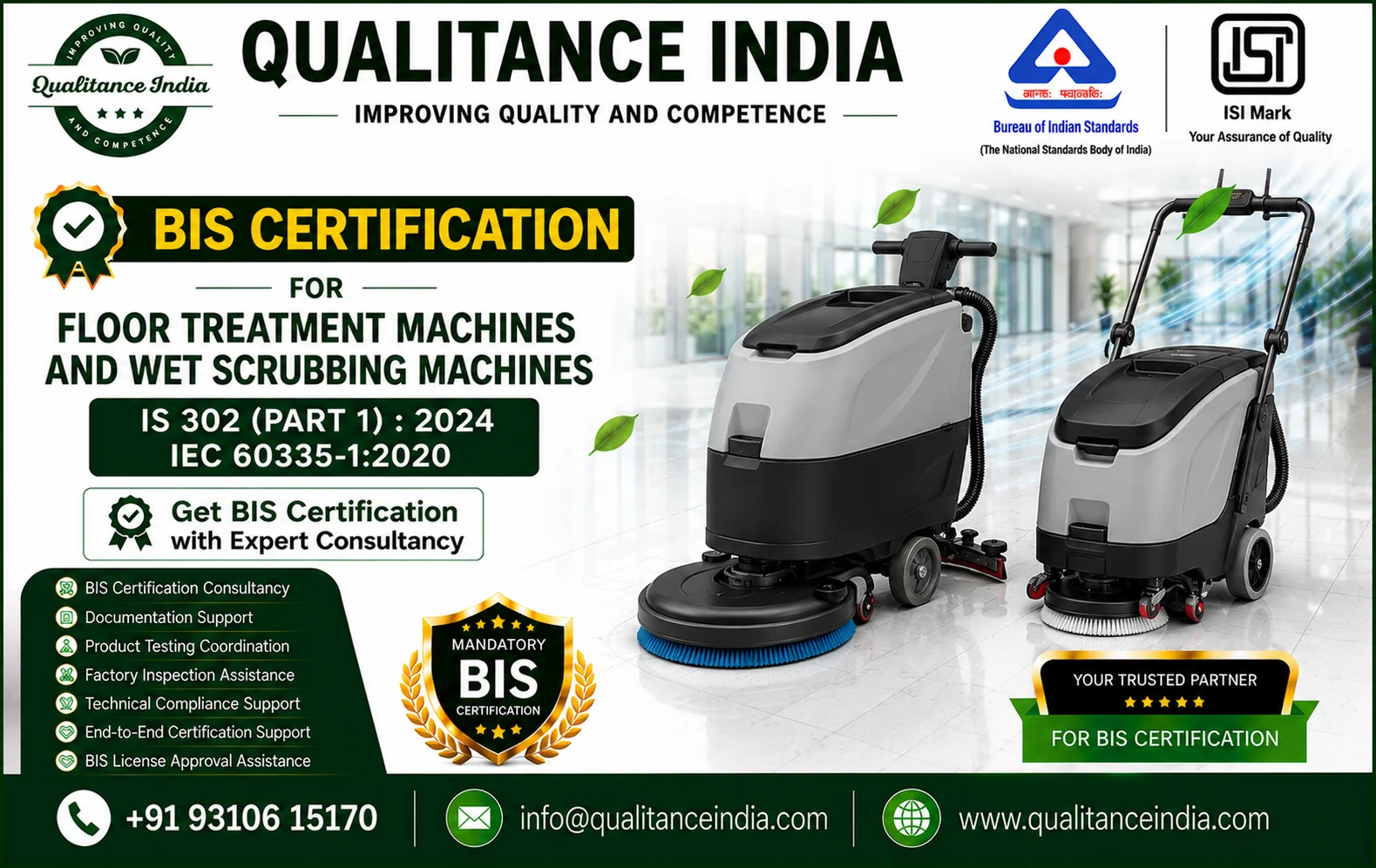
BIS Certification for Floor Treatment Machines & Wet Scrubbing Machines – IS 302 (Part 1):2024 | IEC 60335-1:2020
Introduction: BIS Certification for Floor Treatment Machines & Wet Scrubbing Machines
Floor Treatment Machines and Wet Scrubbing Machines are electrically operated appliances used for cleaning, scrubbing, polishing, treating and maintaining floors in residential, commercial, industrial and institutional environments. These machines are commonly used in offices, shopping malls, hotels, hospitals, factories, warehouses, airports and other large facilities.
Depending on their design, these appliances may combine electric motors, rotating brushes, cleaning pads, water or cleaning-liquid systems, pumps, control switches and other electrical components. As a result, electrical safety, mechanical safety and protection against moisture are important considerations for applicable products.
With the stated 01 August 2026 implementation date, manufacturers, importers and businesses dealing with applicable Floor Treatment Machines and Wet Scrubbing Machines should begin their BIS compliance preparation in advance.
The general safety standard referenced for this service is IS 302 (Part 1):2024 | IEC 60335-1:2020.
Qualitance India provides professional BIS Certification Consultancy for Floor Treatment Machines and Wet Scrubbing Machines, supporting manufacturers with product applicability assessment, technical documentation, laboratory testing coordination, BIS application assistance and applicable certification procedures.
About Floor Treatment Machines & Wet Scrubbing Machines
Floor Treatment Machines and Wet Scrubbing Machines are electrically powered appliances designed to perform various floor-cleaning and floor-maintenance operations.
Depending on their configuration, these machines may be used for:
- Wet floor scrubbing
- Floor cleaning
- Floor polishing
- Floor treatment
- Removal of dirt and stains
- Surface maintenance
- Commercial cleaning operations
- Industrial floor cleaning
- Institutional cleaning applications
These appliances may include:
- Electric motors
- Rotating brushes
- Cleaning pads
- Scrubbing discs
- Water tanks
- Cleaning-liquid tanks
- Pumps
- Suction systems
- Control switches
- Electronic controls
- Power cords
- Rechargeable battery systems, where applicable
- Safety switches
- Protective guards
Because these machines may operate with water or cleaning liquids in proximity to electrical components, appropriate protection against electric shock, moisture-related hazards, overheating and mechanical risks is important.
What is BIS Certification?
BIS Certification is a conformity assessment mechanism administered by the Bureau of Indian Standards (BIS).
For products covered under applicable mandatory BIS requirements, manufacturers must demonstrate conformity with the relevant Indian Standards before placing covered products on the Indian market.
BIS certification helps demonstrate compliance with prescribed safety and quality requirements.
For Floor Treatment Machines and Wet Scrubbing Machines, manufacturers should first confirm the exact regulatory applicability based on:
- Product design
- Rated voltage
- Rated power
- Intended use
- Cleaning mechanism
- Wet or dry operation
- Water or liquid handling system
- Construction
- Applicable product requirements
A product-specific applicability assessment should be completed before starting the formal certification process.
Applicable Standard: IS 302 (Part 1):2024 | IEC 60335-1:2020
The general safety standard referenced for this service is:
IS 302 (Part 1):2024 | IEC 60335-1:2020
The standard provides general safety requirements for applicable electrical appliances within its scope.
Depending on the product design and applicable conformity assessment requirements, evaluation may cover:
- Protection against electric shock
- Electrical insulation
- Leakage current
- Electric strength
- Earthing
- Temperature rise
- Protection against overheating
- Abnormal operation
- Mechanical strength
- Construction
- Internal wiring
- Creepage and clearance
- Resistance to heat and fire
- Marking and instructions
For Wet Scrubbing Machines and Floor Treatment Machines, the interaction between electrical systems, water or cleaning liquids and moving mechanical components may require particular technical attention.
The exact applicable requirements should be confirmed based on the actual product design and regulatory scope.
Scope of BIS Certification for Floor Treatment Machines & Wet Scrubbing Machines
BIS compliance assessment may be relevant to applicable electrically operated machines designed for floor cleaning, wet scrubbing and floor treatment applications.
The applicability assessment may consider:
- Rated voltage
- Rated power
- Electrical supply
- Motor type
- Brush rotation system
- Scrubbing mechanism
- Water supply system
- Cleaning-liquid system
- Pump system
- Suction system
- Product capacity
- Intended application
- Protection against moisture
- Electrical safety features
Manufacturers should conduct a product-specific assessment to determine the applicable BIS certification requirements.
Products Covered Under This Category
Depending on product classification and applicable requirements, this category may include:
- Floor Treatment Machines
- Wet Scrubbing Machines
- Electric Floor Scrubbing Machines
- Floor Cleaning Machines
- Commercial Floor Treatment Machines
- Industrial Floor Scrubbing Machines
- Automatic Floor Scrubbing Machines
- Professional Wet Cleaning Machines
- Electric Floor Polishing and Treatment Appliances
- Similar Electrically Operated Floor Treatment Appliances
The exact scope should be confirmed based on the product's actual function, construction, electrical characteristics and intended application.
Implementation Date: 01 August 2026
The implementation date provided for this category is:
01 August 2026
Manufacturers and businesses dealing with applicable Floor Treatment Machines and Wet Scrubbing Machines should begin compliance preparation well before the implementation date.
A typical compliance roadmap may include:
Product Applicability Assessment → Applicable Standard Review → Technical Documentation → Laboratory Testing → BIS Application → Factory Inspection, Where Applicable → Certification Approval → Ongoing Compliance
Starting early can provide sufficient time to identify technical gaps, complete laboratory testing and prepare documentation.
Important: Manufacturers should verify the latest official BIS notification, QCO requirements, product scope and applicable transition provisions before making final regulatory decisions.
Who Needs BIS Certification?
Depending on applicable mandatory BIS requirements, compliance may be relevant to:
- Indian manufacturers
- Foreign manufacturers exporting to India
- OEM manufacturers
- ODM manufacturers
- Private-label manufacturers
- Commercial cleaning equipment manufacturers
- Industrial cleaning machine manufacturers
- Floor treatment equipment manufacturers
- Facility management equipment manufacturers
- Professional cleaning equipment manufacturers
Importers and distributors should also verify whether the products they source are covered by mandatory BIS requirements.
Eligibility Criteria for BIS Certification
A manufacturer seeking applicable BIS certification should generally have:
- Clearly identified manufacturing premises
- Suitable production infrastructure
- Adequate manufacturing facilities
- Quality-control arrangements
- Required testing facilities or testing arrangements
- Technical personnel
- Product samples
- Technical documentation
- Calibrated testing equipment, where applicable
- Quality-control and inspection records
Foreign manufacturers may have additional requirements depending on the applicable BIS certification procedure.
Complete BIS Certification Process for Floor Treatment Machines
Step 1: Product Applicability Assessment
The first step is to determine whether the Floor Treatment Machine or Wet Scrubbing Machine falls under applicable BIS requirements.
The assessment may consider:
- Product type
- Household, commercial or industrial application
- Rated voltage
- Rated power
- Motor configuration
- Wet or dry operation
- Water and cleaning-liquid systems
- Brush and pad mechanisms
- Suction systems
- Product capacity
- Construction
Correct product classification is important before laboratory testing begins.
Step 2: Identify the Applicable Indian Standard
The manufacturer should identify the relevant Indian Standard applicable to the product.
For this service, the referenced general safety standard is:
IS 302 (Part 1):2024 | IEC 60335-1:2020
If a product-specific standard or additional applicable requirement exists, the complete compliance framework should be evaluated before testing.
Step 3: Prepare Technical Documentation
The manufacturer should prepare complete and consistent technical documentation, which may include:
- Product specifications
- Technical datasheet
- Circuit diagrams
- Wiring diagrams
- Product drawings
- Bill of Materials
- Critical component list
- Motor specifications
- Pump specifications
- Water tank details
- Cleaning mechanism details
- Suction system details
- Safety interlock details
- Product photographs
- User manual
- Rating label artwork
- Manufacturing process flow
- Quality-control plan
The information provided in technical documents should be consistent with the actual product and laboratory test sample.
Step 4: Laboratory Testing
Applicable product samples may need to undergo testing according to relevant BIS requirements.
Testing may involve evaluation of:
- Protection against electric shock
- Leakage current
- Electric strength
- Insulation resistance
- Earthing
- Temperature rise
- Abnormal operation
- Overheating protection
- Mechanical strength
- Stability
- Construction
- Internal wiring
- Creepage and clearance
- Resistance to heat and fire
- Marking and instructions
For Wet Scrubbing Machines, particular attention may be given to:
- Protection of electrical parts against water and moisture
- Safe operation during wet cleaning
- Motor and pump operation
- Brush rotation
- Mechanical safety
- Overheating protection
The final testing requirements should be confirmed based on the actual product design and applicable BIS certification requirements.
Step 5: BIS Application Submission
After completing applicable testing and documentation, the manufacturer can proceed with the BIS application.
The application should accurately identify:
- Manufacturer
- Manufacturing premises
- Product
- Model numbers
- Applicable standard
- Product specifications
- Test reports
- Quality-control arrangements
Any mismatch between the product, test report, model details and technical documents can result in BIS queries or delays.
Step 6: Factory Inspection
Where required under the applicable BIS certification procedure, BIS officials may inspect the manufacturing facility.
The inspection may verify:
- Manufacturing infrastructure
- Production processes
- Quality-control systems
- Testing equipment
- Calibration records
- Raw-material inspection
- In-process quality checks
- Final product inspection
- Product traceability
- Handling of non-conforming products
Step 7: Address BIS Observations
If BIS identifies deficiencies during document review, testing or factory inspection, the manufacturer may need to provide clarification or implement corrective actions.
Timely responses and effective corrective actions can help avoid unnecessary delays.
Step 8: Grant of BIS Licence
After successful completion of applicable certification requirements, BIS may grant the licence to the eligible manufacturer.
The manufacturer must then comply with applicable requirements for using the BIS Standard Mark.
Step 9: Ongoing Compliance
After certification, manufacturers should maintain:
- Consistent product quality
- Approved manufacturing processes
- Quality-control records
- Required routine testing
- Calibration of testing equipment
- Correct product marking
- Technical documentation
- Applicable surveillance compliance
Any significant change to the motor, pump, electrical system, cleaning mechanism, water system or critical components should be evaluated for its impact on certification.
Required Documents for BIS Certification
Common documents may include:
- Company registration documents
- Factory registration details
- Factory address proof
- Factory layout
- Manufacturing process flow chart
- Product technical specifications
- Product datasheet
- Circuit diagram
- Wiring diagram
- Product photographs
- Rating label artwork
- Bill of Materials
- Critical component details
- Motor specifications
- Pump specifications
- Water tank and liquid system details
- Component certificates, where applicable
- User manual
- Quality-control plan
- Testing equipment list
- Calibration certificates
- In-house test records
- Authorized signatory details
- Brand or trademark authorization documents, where applicable
The exact documentation requirements depend on the product and applicable BIS certification procedure.
Testing Requirements for Floor Treatment & Wet Scrubbing Machines
The exact testing requirements depend on the appliance's construction, motor system, cleaning mechanism, water or liquid system and electrical configuration.
Important safety considerations may include:
Electrical Safety
Verification of protection against electric shock and other electrical hazards.
Temperature Rise
Assessment of temperatures generated by motors, pumps and other components during normal operation.
Overheating Protection
Evaluation of the appliance under foreseeable operating conditions.
Leakage Current
Verification that leakage current remains within applicable limits.
Electric Strength
Evaluation of insulation under specified electrical stress.
Earthing
Verification of protective earthing provisions where applicable.
Water and Moisture Protection
Assessment of protection provided to electrical components against water, cleaning liquids and moisture during intended operation.
Mechanical Safety
Evaluation of rotating brushes, cleaning pads, moving parts and structural components.
Abnormal Operation
Assessment of safety during foreseeable abnormal operating conditions.
Marking and Instructions
Verification of applicable product markings, warnings and safety instructions.
The final testing requirements should be confirmed after technical evaluation of the actual machine model.
Factory Inspection Process
Where factory inspection is applicable, BIS officials may evaluate the manufacturer's ability to consistently manufacture compliant products.
The inspection may cover:
- Production infrastructure
- Manufacturing processes
- Quality-control procedures
- Testing facilities
- Calibration systems
- Raw-material control
- In-process inspection
- Final product testing
- Record maintenance
- Product traceability
Manufacturers should ensure that all relevant facilities, testing equipment and quality records are available and properly maintained.
Common Reasons for BIS Certification Delays or Rejection
Common issues may include:
- Incorrect product classification
- Incorrect standard selection
- Incomplete application
- Inconsistent technical documentation
- Laboratory test failure
- Electrical safety deficiencies
- Excessive temperature rise
- Inadequate insulation
- Leakage current issues
- Insufficient protection against moisture
- Water ingress-related safety concerns
- Motor overheating
- Inadequate mechanical protection
- Incorrect rating label
- Missing testing equipment
- Expired calibration certificates
- Incomplete quality-control records
- Factory inspection non-conformities
- Incorrect model information
- Unapproved changes in critical components
- Delayed response to BIS observations
A pre-certification technical review can help manufacturers identify and correct potential compliance issues before formal submission.
BIS Certification Cost Factors
The overall certification cost may depend on:
- BIS government fees
- Laboratory testing charges
- Number of product models
- Product variants
- Testing complexity
- Sample requirements
- Factory inspection requirements
- Additional testing
- Documentation requirements
- Consultancy charges
The exact cost should be determined based on the product design, number of models and applicable certification scope.
BIS Certification Timeline
The certification timeline can vary depending on:
- Product complexity
- Laboratory availability
- Testing results
- Document completeness
- Factory readiness
- Inspection scheduling
- BIS observations
- Corrective actions
Considering the stated 01 August 2026 implementation date, manufacturers are advised to start the compliance process as early as possible.
Benefits of BIS Certification
BIS certification can provide several benefits, including:
- Regulatory compliance
- Improved product safety
- Increased customer confidence
- Better market acceptance
- Stronger brand credibility
- Reduced compliance risks
- Improved quality consistency
- Enhanced business reputation
- Better market access
For Wet Scrubbing Machines and Floor Treatment Machines, compliance is particularly important because these appliances may combine electrical systems with water, cleaning liquids, motors and moving mechanical components.
Why Choose Qualitance India?
Qualitance India provides professional BIS Certification Consultancy services for electrical and electronic products.
Our support may include:
- Product applicability assessment
- Applicable standard identification
- BIS documentation support
- Technical compliance guidance
- Laboratory testing coordination
- BIS application assistance
- Factory inspection preparation
- BIS query and observation support
- Certification follow-up
- Post-certification compliance guidance
Our objective is to simplify the BIS certification journey and help manufacturers prepare their products and documentation efficiently.
BIS Certification Process – Step-by-Step Flow Chart
Product Identification
↓
BIS Applicability Assessment
↓
IS 302 (Part 1):2024 Requirement Review
↓
Technical Documentation Preparation
↓
Sample Preparation
↓
Laboratory Testing
↓
Test Report Evaluation
↓
BIS Application Submission
↓
Factory Inspection, Where Applicable
↓
Corrective Action / Compliance
↓
BIS Evaluation
↓
Grant of BIS Licence
↓
BIS Standard Mark Compliance
↓
Ongoing Quality Control & Surveillance
Frequently Asked Questions (FAQs)
1. Is BIS certification mandatory for Floor Treatment Machines?
If the product falls within the applicable mandatory BIS certification scope, the manufacturer must fulfill the relevant BIS requirements before placing the product on the Indian market.
2. Which standard applies to Wet Scrubbing Machines?
The general safety standard referenced for this service is IS 302 (Part 1):2024 | IEC 60335-1:2020. The exact applicable requirements should be confirmed based on the product classification.
3. What is the implementation date for Floor Treatment Machines?
The implementation date provided for this category is 01 August 2026. Manufacturers should verify the latest official notification and applicable transition provisions.
4. Do Wet Scrubbing Machines require BIS certification in India?
The exact requirement depends on the product's classification and applicable regulatory scope. A product-specific BIS applicability assessment is recommended.
5. Is laboratory testing required?
Testing may be required as part of the applicable BIS certification process.
6. Is factory inspection required?
Factory inspection requirements depend on the applicable BIS conformity assessment procedure.
7. What documents are required for BIS certification?
Technical specifications, circuit diagrams, BOM, motor and pump details, factory documents, product photographs, quality-control documents and applicable test reports may be required.
8. How much does BIS certification cost?
The cost varies depending on the product, number of models, laboratory testing requirements, BIS fees and applicable inspection requirements.
9. How long does BIS certification take?
The timeline depends on testing, documentation, laboratory availability, factory readiness and BIS processing.
10. What safety tests are important for Wet Scrubbing Machines?
Electrical safety, temperature rise, overheating protection, leakage current, electric strength, insulation, construction, mechanical safety and protection against water-related electrical hazards are important considerations.
11. Can multiple models be included in one BIS licence?
Model grouping depends on applicable BIS guidelines and the technical similarities between the models.
12. What happens if a Wet Scrubbing Machine fails laboratory testing?
The manufacturer may need to correct the identified non-conformity and complete applicable re-testing or evaluation.
13. What is the role of a BIS consultant?
A BIS consultant can support product assessment, documentation, laboratory testing coordination, application filing and certification follow-up.
14. Is BIS certification required for imported Floor Treatment Machines?
If the imported product falls under mandatory BIS certification requirements, applicable certification must be completed before market placement.
15. Why is BIS certification important for Floor Treatment Machines?
It helps demonstrate that covered electrical appliances comply with applicable Indian safety and quality requirements.
16. Can Qualitance India help with laboratory testing?
Yes. Qualitance India can provide coordination and support for applicable laboratory testing requirements.
17. When should manufacturers start the BIS certification process?
Manufacturers should begin the process as early as possible before the stated 01 August 2026 implementation date.
18. Does BIS certification improve customer trust?
Yes. Compliance with applicable BIS requirements can strengthen customer confidence and demonstrate a commitment to product safety and quality.
19. What is the BIS Standard Mark?
The BIS Standard Mark is used by licensed manufacturers in accordance with applicable BIS certification requirements and marking rules.
20. How can Qualitance India help with BIS Certification?
Qualitance India can assist with applicability assessment, documentation, testing coordination, BIS application support, factory inspection preparation and certification consultancy.
Featured Snippet Optimized Answer
What is BIS Certification for Floor Treatment Machines and Wet Scrubbing Machines?
BIS certification for Floor Treatment Machines and Wet Scrubbing Machines is the applicable conformity assessment requirement for covered electrically operated floor-cleaning and treatment appliances. The general safety standard referenced for this service is IS 302 (Part 1):2024 | IEC 60335-1:2020. Depending on the applicable regulatory scope, assessment may include electrical safety, insulation, leakage current, electric strength, temperature rise, overheating protection, mechanical safety, protection against water and moisture, construction, marking and safe operation. The stated implementation date for this category is 01 August 2026.
People Also Ask (PAA) Questions
- Is BIS certification mandatory for Floor Treatment Machines in India?
- What is the BIS standard for Wet Scrubbing Machines?
- What is IS 302 Part 1 2024?
- What is the implementation date for Wet Scrubbing Machines?
- How can I get BIS certification for a Floor Treatment Machine?
- What documents are required for BIS certification?
- Is laboratory testing required for Wet Scrubbing Machines?
- Is factory inspection required for BIS certification?
- How much does BIS certification cost in India?
- What are the common reasons for BIS certification rejection?
Voice Search Optimization
“Do Floor Treatment Machines require BIS certification in India?”
“What BIS standard applies to Wet Scrubbing Machines?”
“What is the implementation date for Floor Treatment Machines?”
“How can I get BIS certification for a Wet Scrubbing Machine?”
“What documents are required for BIS certification of Floor Treatment Machines?”
SEO Keywords Naturally Covered in This Blog
BIS Certification for Floor Treatment Machines, BIS Certification Consultancy for Floor Treatment Machines, Wet Scrubbing Machine BIS Certification, BIS Certification for Wet Scrubbing Machines, Floor Cleaning Machine BIS Certification, Electric Floor Scrubbing Machine BIS Certification, Commercial Floor Cleaning Equipment BIS Certification, Industrial Floor Scrubbing Machine BIS Certification, Floor Treatment Machine Certification in India, IS 302 Part 1 2024, IEC 60335-1:2020, BIS Testing, BIS Factory Inspection, BIS Licence, ISI Mark Certification, BIS Compliance, Electrical Cleaning Equipment BIS Certification, Commercial Cleaning Machine BIS Certification, BIS Consultant in India.
Internal Linking Strategy
This service page can be internally linked with relevant Qualitance India pages and blogs, including:
- BIS Certification under IS 302 (Part 1):2024
- BIS Certification for Dishwashers
- BIS Certification for Commercial Electric Dishwashing Machines
- BIS Certification for Commercial Electric Rinsing Sinks
- BIS Certification for Commercial Electric Kitchen Machines
- BIS Certification for Air-Cleaning Appliances
- BIS Certification for Vacuum Cleaners and Water Suction Cleaning Appliances
- Complete BIS Certification Process in India
- BIS Certification Testing Requirements
- BIS Factory Inspection Process
Related BIS Blog Topics
- Complete Guide to BIS Certification under IS 302 (Part 1):2024
- BIS Certification Process for Electrical Cleaning Appliances
- BIS Certification for Commercial Cleaning Equipment
- BIS Certification for Vacuum Cleaners and Water Suction Cleaning Appliances
- BIS Laboratory Testing Requirements for Electrical Appliances
- BIS Factory Inspection Process Explained
- BIS Certification Cost and Timeline in India
- Common Reasons for BIS Certification Rejection
- BIS Certification for Foreign Manufacturers
- How to Prepare for BIS Certification Before the Implementation Date
Strong Lead Generation CTA
Need BIS Certification for Floor Treatment Machines or Wet Scrubbing Machines?
The stated 01 August 2026 implementation date is approaching. Manufacturers should start BIS compliance preparation early to allow sufficient time for product applicability assessment, technical documentation, laboratory testing and applicable certification procedures.
Qualitance India provides professional BIS Certification Consultancy support, including:
Product Applicability Assessment | Documentation Support | Testing Coordination | BIS Application | Factory Inspection Preparation | Certification Support
Contact Qualitance India Today
Phone: +91 93106 15170
Email: info@qualitanceindia.com
Website: qualitanceindia.com
Get Professional BIS Certification Consultancy and Prepare Your Floor Treatment Machines and Wet Scrubbing Machines for Indian Regulatory Compliance.
SEO-Optimized Conclusion
Floor Treatment Machines and Wet Scrubbing Machines are widely used in commercial, industrial and institutional cleaning operations. Since these appliances may combine electrical systems, motors, rotating brushes, water, cleaning liquids and mechanical components, appropriate safety and compliance requirements are essential.
Manufacturers dealing with applicable Floor Treatment Machines and Wet Scrubbing Machines should assess their products against the relevant requirements of IS 302 (Part 1):2024 | IEC 60335-1:2020 and prepare for the stated 01 August 2026 implementation date.
Starting the BIS compliance process early can provide sufficient time for product applicability assessment, technical documentation, laboratory testing and applicable certification procedures.
Qualitance India provides professional BIS Certification Consultancy to support manufacturers throughout the certification journey, from initial product applicability assessment and documentation to laboratory testing coordination, BIS application support and factory inspection preparation.
Prepare Early. Stay Compliant. Build Market Trust with Qualitance India.