
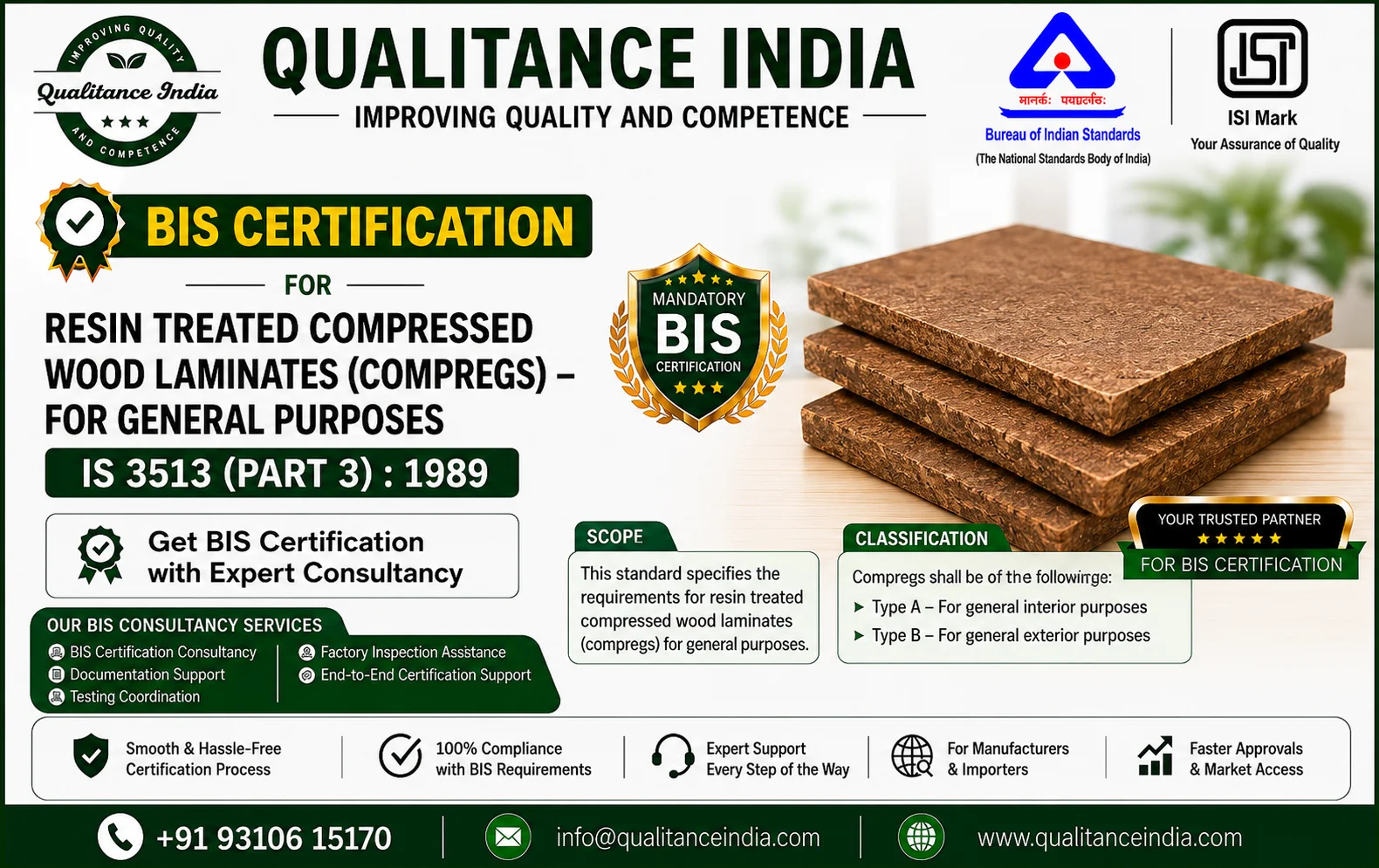
BIS Certification for Resin Treated Compressed Wood Laminates (Compregs) for General Purposes – IS 3513 (Part 3):1989
Introduction
Resin Treated Compressed Wood Laminates, commonly known as Compregs, are engineered wood-based materials manufactured using thin wood veneers and thermosetting synthetic resins. Through resin treatment, bonding, heat and pressure, the material obtains improved mechanical strength, dimensional stability, moisture resistance, machinability and resistance to certain corrosive agents and termite attack.
IS 3513 (Part 3):1989 specifies requirements for Resin Treated Compressed Wood Laminates (Compregs) for General Purposes. The standard covers requirements relating to raw materials, manufacture, grades, types, dimensions, physical properties and mechanical properties.
Compregs manufactured for general engineering, textile and jute industry applications and other covered uses may fall within this standard. BIS currently lists IS 3513 (Part 3):1989 in its product manuals, and the applicable regulatory framework places resin-treated compressed wood laminates under mandatory compliance.
About Resin Treated Compressed Wood Laminates
Compregs are manufactured from thin layers of wood veneer that are treated or combined with synthetic resin and subsequently bonded and densified under controlled heat and pressure.
Unlike ordinary solid wood, Compregs can provide improved:
- Mechanical strength
- Dimensional stability
- Moisture resistance
- Machinability
- Resistance to termite attack
- Resistance to certain corrosive agents
- Durability
They can be manufactured in different forms such as:
- Sheets
- Boards
- Rods
- Moulded shapes
- Machined components
The BIS description specifically identifies applications in general engineering, textile industry, jute industry and certain specialised installations.
What is IS 3513 (Part 3):1989?
IS 3513 (Part 3):1989 is the Indian Standard titled:
Specification for Resin Treated Compressed Wood Laminates (Compregs) – Part 3: For General Purposes
It is the first revision of the standard. BIS's Product Manual identifies it as the applicable standard for certification under Scheme-I of the BIS Conformity Assessment Regulations, 2018.
The standard covers Compregs intended for general purposes and specifically excludes the requirements for solid compressed wood.
Scope of the Standard
IS 3513 (Part 3):1989 covers resin treated compressed wood laminates intended for general purposes.
The standard does not cover solid compressed wood.
The material can be supplied in different forms and configurations depending on the manufacturer's product and intended application.
Grades of Compregs
The standard identifies two principal grades for general-purpose Compregs.
GH – General Purpose High Density
GH is a partially impregnated high-density material suitable for applications such as:
- Textile and jute mill accessories
- Tools
- Engineering applications
- General engineering applications
The grade includes:
- Type II
- Type III
- Type V
- Type VI
GM – General Purpose Medium Density
GM is a partially impregnated medium-density material intended for general purposes.
It includes:
- Type II
- Type III
- Type V
- Type VI
These grades and types are identified in the BIS material describing IS 3513 (Part 3):1989.
Types of Compregs
The classification of Compregs is also based on the orientation of the grain in the veneers.
The applicable types include:
- Type II
- Type III
- Type V
- Type VI
The exact grade and type should be selected according to the intended application and the requirements of the standard.
Applications of General Purpose Compregs
General-purpose Compregs are used in several engineering and industrial applications.
Typical applications include:
Textile Industry
Compregs can be used for manufacturing textile machinery components such as:
- Picking sticks
- Slay bases
- Race boards
- Swells
- Picking levers
- Stick wedges
Jute Industry
They can be used for accessories and components used in jute processing machinery.
General Engineering
Compregs can be machined into components where good dimensional stability, mechanical properties and machinability are required.
Automobile Industry
The BIS description also identifies applications such as silent gears and spinning chucks.
Raw Materials
The BIS Product Manual identifies the principal raw-material requirements for this product.
These include:
Timber
Timber requirements are specified with reference to Clause 5.1 of IS 3513 (Part 3).
Synthetic Resin
Synthetic resins are required to comply with IS 848 where applicable.
Varnishes
Varnishes are required according to the applicable requirements of the standard.
The Product Manual specifically identifies timber, synthetic resins and varnishes as relevant raw materials.
Manufacturing Process
The manufacturing process generally involves several controlled stages.
Selection of Timber
Suitable timber is selected according to the requirements of the standard.
Veneer Preparation
Thin veneers are prepared to the required dimensions and quality.
Resin Treatment
The veneers are impregnated or treated with suitable synthetic resin.
Assembly
The treated veneers are arranged according to the required grain orientation and product type.
Compression and Bonding
The veneers are subjected to controlled heat and pressure for bonding and densification.
Curing
Controlled curing ensures proper hardening of the thermosetting resin and bonding of the veneers.
Finishing
The finished Compreg may be trimmed, machined, sanded or otherwise finished according to the product requirements.
Inspection
The finished product is checked for dimensions, workmanship and applicable physical and mechanical properties.
Physical Properties
IS 3513 (Part 3):1989 specifies physical-property requirements to help determine the suitability of Compregs for different applications.
These can include:
- Specific gravity
- Moisture content
- Volatile matter
The required values depend on the applicable grade and type.
Mechanical Properties
Mechanical performance is an important part of Compreg quality.
The standard addresses properties such as:
- Tensile strength
- Static bending strength
- Compressive strength
- Shear strength
- Hardness
- Impact strength
These properties help determine whether the material is suitable for its intended engineering application.
Dimensions and Tolerances
IS 3513 (Part 3):1989 also specifies dimensions and tolerances for different forms of Compregs.
Depending on the product form, dimensional checks can include:
- Length
- Width
- Thickness
- Thickness variation
- Rod diameter
- Rod length
- Other applicable dimensions
The BIS Product Manual identifies dimensions and thickness as part of the product evaluation requirements.
Workmanship and Finish
Finished Compregs should meet the applicable requirements relating to workmanship and surface finish.
The Product Manual specifically identifies:
Thickness of veneers, dimensions and thickness, workmanship and finish
among the requirements that can be evaluated.
The finished material should be properly manufactured, bonded and finished without unacceptable defects that could affect its intended use.
BIS Certification for Compregs
BIS Certification provides a conformity assessment mechanism for manufacturers whose products are covered by the applicable Indian Standard and regulatory requirements.
For Compregs for General Purposes, IS 3513 (Part 3):1989 is included in the BIS product-manual system. BIS identifies certification under Scheme-I for this product.
The certification process may involve:
- Factory assessment
- Product testing
- Raw-material verification
- Manufacturing-process assessment
- Quality-control verification
- Documentation
- Product grouping
- BIS application
- Test report evaluation
- Licence grant
Applicable Quality Control Order
The BIS current Scheme-I listing places the three parts of the Compregs standards under the:
Resin Treated Compressed Wood Laminates (Quality Control) Order
For IS 3513 (Part 3):1989, BIS lists:
Resin Treated Compressed Wood Laminates (Quality Control) Order, 2023 – S.O. 3139(E), dated 14 July 2023
and
Resin Treated Compressed Wood Laminates (Quality Control) Order, 2024 – S.O. 1018(E), dated 29 February 2024.
Therefore, manufacturers should verify the current requirements of the applicable QCO before manufacturing or supplying products covered by the order.
Who Needs BIS Certification?
BIS certification requirements can apply to manufacturers producing Compregs covered by IS 3513 (Part 3):1989 under the applicable regulatory framework.
This can include:
- Compreg manufacturers
- Resin-treated wood laminate manufacturers
- Engineered wood product manufacturers
- Textile machinery component manufacturers
- Jute machinery component manufacturers
- General engineering component manufacturers
- Industrial component manufacturers
- Manufacturers supplying Compregs to Indian customers
Importers and other supply-chain businesses should separately verify the obligations applicable to their particular activity.
Eligibility Requirements
A manufacturer should have suitable facilities for:
- Timber processing
- Veneer preparation
- Resin treatment
- Veneer assembly
- Hot pressing
- Curing
- Finishing
- Machining
- Dimensional inspection
- Physical-property testing
- Mechanical-property testing
- Quality control
- Product identification
- Storage and packing
The exact facilities required depend on the manufacturer's product range and manufacturing process.
Documents Required
Documents commonly required for the certification process can include:
- Company registration documents
- Factory address proof
- Factory layout
- Manufacturing process flow
- Machinery list
- Product specifications
- Product drawings
- Grade details
- Type details
- Raw-material specifications
- Timber details
- Resin details
- Varnish details
- Raw-material test reports
- Testing equipment list
- Calibration certificates
- Internal inspection records
- Quality-control documents
- Product photographs
- Packaging details
- Marking details
- Trademark documents, where applicable
- Authorized signatory documents
The final document list depends on the manufacturer's factory and product scope.
Product Sampling
The BIS Product Manual specifies the following sample requirements for IS 3513 (Part 3):1989:
- Compregs – 1 full sheet
- Face and core veneers – 2 sheets each
- Resin – 5 litres
- Varnish – 3 × 500 ml
The exact sampling procedure should be confirmed against the latest BIS instructions before submitting samples.
Testing Requirements
Testing and evaluation can cover various characteristics of the product.
Important areas include:
Raw Materials
- Timber
- Synthetic resin
- Varnish
- Veneers
Manufacturing
- Curing
- Bonding pressure
- Thickness
- Thickness variation
Dimensions
- Board length
- Board width
- Board thickness
- Rod length
- Rod diameter
- Applicable tolerances
Physical Properties
- Specific gravity
- Moisture content
- Volatile matter
Mechanical Properties
- Tensile strength
- Static bending strength
- Compressive strength
- Shear strength
- Hardness
- Impact strength
Finished Product
- Workmanship
- Finish
- Marking
The BIS Product Manual provides the testing framework and equipment requirements for certification.
BIS Laboratory Testing
BIS LIMS currently lists testing facilities for IS 3513 Part 3:1989.
One current BIS LIMS listing shows a testing charge of ₹14,000 excluding taxes for the listed scope. The same listing provides individual charges for various tests, including manufacturing parameters and dimensional characteristics.
The actual laboratory cost may vary depending on:
- Laboratory
- Product grade
- Product type
- Testing scope
- Sample requirements
- Additional tests
- Applicable product variants
Therefore, the final testing cost should be confirmed for the exact product scope.
Factory Inspection
During the factory assessment, important areas can include:
Raw Material Control
Verification of timber, veneer, resin and varnish specifications.
Manufacturing Machinery
Inspection of veneer preparation, resin treatment, pressing, curing and finishing equipment.
Process Control
Review of resin treatment, bonding, compression and curing processes.
Testing Facilities
Verification of relevant measuring and testing equipment.
Calibration
Checking calibration certificates and records.
Quality Control
Review of incoming, in-process and finished-product inspection.
Traceability
Verification of batch and raw-material traceability.
Storage
Inspection of storage arrangements for raw materials and finished Compregs.
Packing and Marking
Verification of applicable product identification and packing requirements.
Common Reasons for Certification Delays
Manufacturers may face delays due to:
- Incorrect product classification
- Incorrect grade or type selection
- Incomplete product specifications
- Improper raw-material documentation
- Timber not meeting requirements
- Resin non-conformity
- Incorrect veneer thickness
- Improper resin impregnation
- Incorrect pressing conditions
- Improper curing
- Thickness variation
- Dimensional non-conformity
- Mechanical test failure
- Inadequate testing facilities
- Missing calibration records
- Incorrect marking
- Incomplete quality-control records
- Factory not ready for inspection
Proper preparation before submitting the application can reduce avoidable delays.
BIS Certification Cost
The overall cost depends on:
- BIS application charges
- Laboratory testing
- Product grade
- Product type
- Number of product variants
- Sample transportation
- Factory inspection
- Testing equipment
- Retesting, if required
- Documentation
- Consultancy charges
Current BIS LIMS information lists a ₹14,000 excluding taxes testing charge for one listed laboratory scope for IS 3513 Part 3:1989.
The final cost should be calculated after reviewing the manufacturer's exact product range.
Certification Timeline
The time required depends on:
- Factory readiness
- Documentation
- Product grouping
- Sample preparation
- Laboratory availability
- Testing
- BIS application scrutiny
- Factory inspection
- Test report evaluation
- Closure of observations
A product-specific timeline can be estimated after reviewing the manufacturer's factory and product details.
Benefits of BIS Certification
Compliance with Applicable Requirements
Helps manufacturers meet the requirements of the applicable Indian regulatory framework.
Consistent Product Quality
The certification process encourages systematic production and quality control.
Customer Confidence
BIS certification provides confidence that the product has been assessed against the applicable standard.
Market Acceptance
Certification supports supply where compliance with the applicable QCO is required.
Better Manufacturing Control
Testing and inspection help manufacturers identify and control production variations.
Improved Traceability
Proper records help maintain traceability of raw materials and finished products.
Business Credibility
BIS certification can strengthen the manufacturer's credibility among industrial customers.
Why Choose Qualitance India?
Qualitance India provides BIS certification consultancy for manufacturers dealing with products covered by Indian Standards.
For Resin Treated Compressed Wood Laminates (Compregs) for General Purposes as per IS 3513 (Part 3):1989, assistance can include:
- Product applicability assessment
- Standard requirement review
- Grade and type assessment
- Product grouping guidance
- Documentation support
- Testing laboratory coordination
- Sample preparation guidance
- BIS application assistance
- Factory inspection preparation
- Quality-control documentation
- Test report coordination
- Observation closure assistance
- BIS licence support
Qualitance India
Phone: +91-9310-615-170
Email: info@qualitanceindia.com
Website: https://qualitanceindia.com/
BIS Certification Process
Product Identification
↓
IS 3513 (Part 3):1989 Requirement Review
↓
Grade & Type Selection
↓
Factory Assessment
↓
Documentation Preparation
↓
Sample Preparation
↓
Laboratory Testing
↓
BIS Application
↓
BIS Scrutiny
↓
Factory Inspection
↓
Test Report Evaluation
↓
Observation Closure
↓
BIS Licence
↓
Standard Mark Compliance
Frequently Asked Questions
1. What is IS 3513 Part 3:1989?
IS 3513 Part 3:1989 is the Indian Standard for Resin Treated Compressed Wood Laminates (Compregs) for General Purposes.
2. What are Compregs?
Compregs are resin-treated compressed wood laminates made from thin wood veneers combined with thermosetting synthetic resins and bonded/densified under heat and pressure.
3. What are general-purpose Compregs used for?
They are used in general engineering, textile industry, jute industry and other applications where the properties of Compregs are suitable.
4. Which grades are covered?
The standard identifies GH General Purpose High Density and GM General Purpose Medium Density grades.
5. Which types are covered?
The grades include Type II, Type III, Type V and Type VI.
6. Is BIS certification applicable to Compregs?
Yes. IS 3513 Part 3:1989 is included in the BIS product certification framework, and the current BIS regulatory listing places it under the Resin Treated Compressed Wood Laminates Quality Control Order.
7. Which Quality Control Order applies?
BIS lists the Resin Treated Compressed Wood Laminates (Quality Control) Order, 2023 and the 2024 Order for this product category.
8. What raw materials are required?
Important raw materials include timber, synthetic resin and varnish.
9. What resin is used in Compregs?
Compregs are generally made using thermosetting resins such as phenol or cresol formaldehyde resin.
10. What tests are performed?
Testing can include physical properties, mechanical properties, dimensions, thickness, workmanship, finish and manufacturing-related requirements.
11. Are mechanical properties tested?
Yes. Tensile, static bending, compressive, shear, hardness and impact properties are among the characteristics identified for Compregs.
12. Are dimensions checked?
Yes. Dimensions and tolerances for sheets/boards and rods are covered by the standard and Product Manual.
13. What sample is required for Compregs?
The Product Manual specifies one full sheet of Compreg, along with specified quantities of face/core veneers, resin and varnish.
14. What is the current laboratory testing cost?
One current BIS LIMS listing shows ₹14,000 excluding taxes for the listed testing scope. Actual charges depend on the laboratory and testing requirements.
15. Is factory inspection required?
Factory assessment forms part of the applicable certification process under Scheme-I.
16. Can Compregs be manufactured as rods?
Yes. Compregs can be manufactured in different forms including sheets, rods and moulded shapes.
17. Can Compregs be machined?
Yes. One of the advantages of Compregs is their suitability for machining.
18. Are Compregs the same as solid compressed wood?
No. IS 3513 Part 3 specifically states that the standard does not cover solid compressed wood.
19. Who can apply for certification?
Manufacturers producing Compregs covered by IS 3513 Part 3 and the applicable regulatory requirements can seek certification.
20. Can Qualitance India help with BIS certification?
Yes. Qualitance India can assist with product assessment, documentation, testing coordination, BIS application and factory inspection preparation.
People Also Ask
What is Compreg material?
Compreg is a resin-treated compressed wood laminate manufactured from wood veneers and thermosetting resin.
What is IS 3513 Part 3?
It is the Indian Standard covering Resin Treated Compressed Wood Laminates (Compregs) for General Purposes.
What is the difference between Compreg Part 1, Part 2 and Part 3?
Part 1 covers Compregs for electrical purposes, Part 2 covers Compregs for chemical purposes, and Part 3 covers Compregs for general purposes. BIS lists all three standards separately.
What are GH and GM Compregs?
GH refers to General Purpose High Density Compreg, while GM refers to General Purpose Medium Density Compreg.
Where are Compregs used?
They can be used in general engineering, textile and jute machinery and other applications requiring suitable mechanical and dimensional properties.
Is BIS certification mandatory for Compregs?
Compregs covered by the applicable Resin Treated Compressed Wood Laminates Quality Control Order are subject to mandatory compliance requirements.
Website Image Text
RESIN TREATED COMPRESSED WOOD LAMINATES
COMPREGS – FOR GENERAL PURPOSES
IS 3513 (PART 3):1989
BIS CERTIFICATION CONSULTANCY
Qualitance India
+91-9310-615-170
info@qualitanceindia.com
qualitanceindia.com
Image ALT Text
- BIS Certification for Resin Treated Compressed Wood Laminates
- Compregs BIS Certification IS 3513 Part 3:1989
- Resin Treated Compressed Wood Laminates for General Purposes
- BIS Licence for Compregs
- IS 3513 Part 3:1989 Certification
- General Purpose Compregs BIS Certification
- GH Grade Compregs
- GM Grade Compregs
- Compregs Testing Laboratory
- Resin Treated Wood Laminates BIS Certification
- Compressed Wood Laminates Testing
- Compregs Manufacturer BIS Licence
- BIS Certification for Wood Products
- ISI Mark for Compregs
- Qualitance India BIS Certification Consultancy
Related Services
- BIS Certification Consultancy
- BIS Licence for Wood Products
- BIS Certification for Compregs
- BIS Certification for Marine Plywood
- BIS Certification for Plywood
- BIS Product Testing
- BIS Factory Inspection
- ISI Mark Certification
- Resin Treated Wood Laminate Certification
- BIS Certification under Quality Control Orders
Related Topics for Your Website
- BIS Certification for Compregs for Electrical Purposes – IS 3513 Part 1
- BIS Certification for Compregs for Chemical Purposes – IS 3513 Part 2
- BIS Certification for Marine Plywood – IS 710
- BIS Certification for Plywood for General Purposes
- BIS Certification for Veneered Wood Products
- BIS Certification for Laminated Veneer Lumber
- BIS Certification for Bamboo-Based Boards
- BIS Certification for Wooden Products
- BIS Certification Process for Wood Product Manufacturers
- Resin Treated Compressed Wood Laminates Quality Control Order
Need BIS Certification for Compregs?
If you manufacture Resin Treated Compressed Wood Laminates (Compregs) for General Purposes and need assistance with IS 3513 (Part 3):1989, Qualitance India can help with product assessment, documentation, laboratory testing coordination, BIS application and factory inspection preparation.
Qualitance India
Phone: +91-9310-615-170
Email: info@qualitanceindia.com
Website: https://qualitanceindia.com/
Contact our team to discuss your BIS certification requirement for Compregs.
Conclusion
Resin Treated Compressed Wood Laminates, commonly known as Compregs, are engineered wood materials designed to provide improved mechanical performance, dimensional stability, machinability, moisture resistance and durability compared with ordinary wood.
IS 3513 (Part 3):1989 covers Compregs intended for general purposes, including the GH and GM grades and their applicable types. The standard addresses raw materials, manufacturing, dimensions, physical properties, mechanical properties, workmanship and finish.
BIS currently includes this product within the Resin Treated Compressed Wood Laminates Quality Control Order framework, making compliance important for manufacturers covered by the applicable requirements.
For manufacturers planning BIS certification, proper preparation of raw-material controls, manufacturing processes, testing facilities, product specifications, documentation and factory quality-control systems is essential.
Qualitance India can assist manufacturers throughout the BIS certification process for Resin Treated Compressed Wood Laminates (Compregs) – IS 3513 (Part 3):1989.