
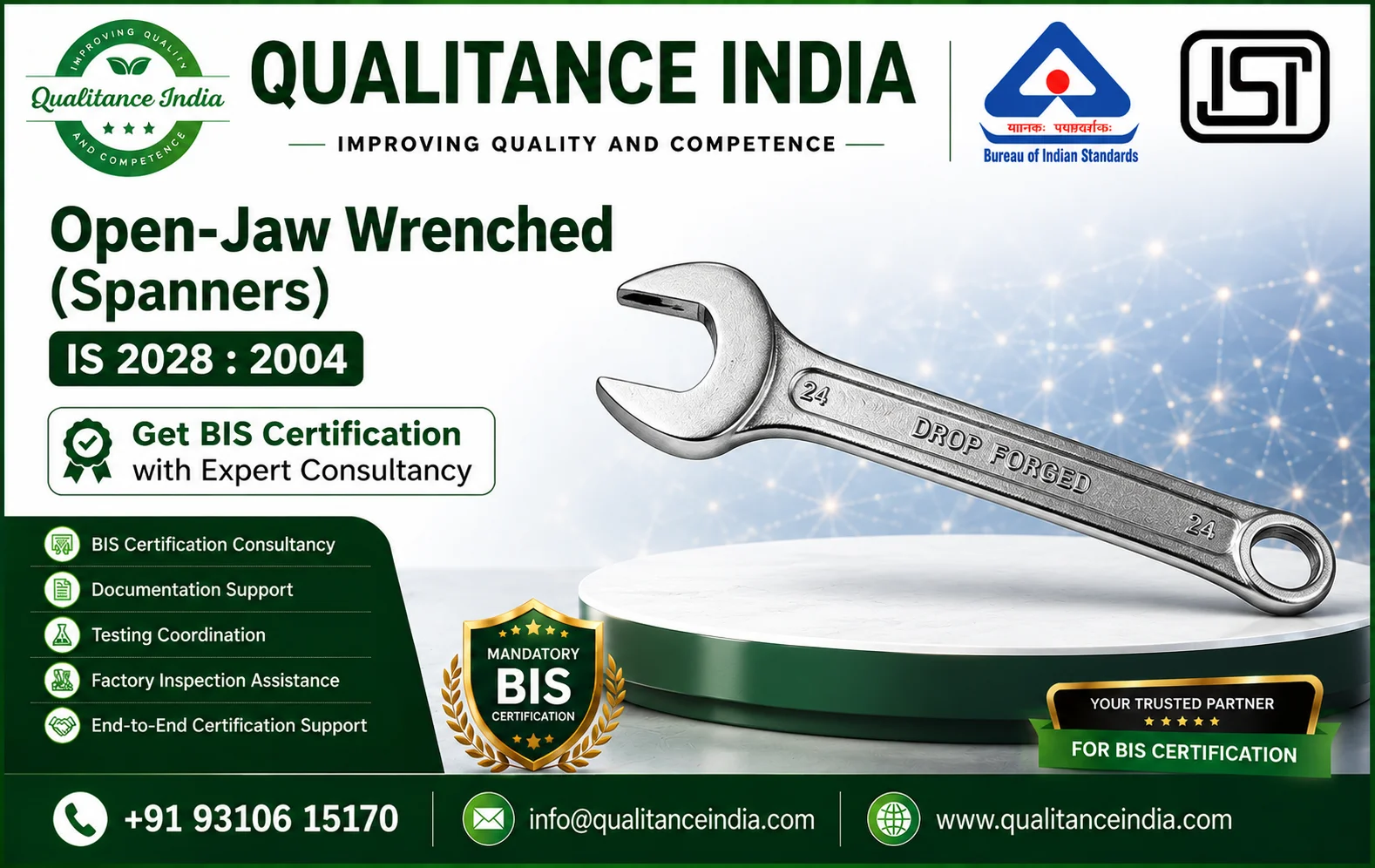
Open-Jaw Wrenches (Spanners) BIS Certification | IS 2028:2004 | Complete ISI Mark Consultancy Guide | Enforcement Date 01 October 2026
Open-Jaw Wrenches (Spanners) BIS Certification under IS 2028:2004
The Indian hand tools industry is one of the fastest-growing manufacturing sectors, supplying products to automotive, engineering, construction, maintenance, railways, oil & gas, power plants, heavy engineering, and infrastructure projects. Among the most commonly used hand tools are Open-Jaw Wrenches (Spanners), which are designed to tighten and loosen nuts and bolts efficiently in both industrial and domestic applications.
To maintain product quality and uniform manufacturing standards, the Government of India has brought several hand tools under the Hand Tools Quality Control Order (QCO). Open-Jaw Wrenches (Spanners) covered under IS 2028:2004 are included in this framework. Manufacturers must comply with the applicable Indian Standard and obtain a valid BIS Licence under Scheme-I (ISI Mark Scheme) before supplying covered products in the Indian market. The general implementation date for this requirement is 01 October 2026.
For manufacturers, importers, OEMs and private-label brands, obtaining BIS Certification is more than a regulatory obligation—it demonstrates a commitment to quality, reliability and customer confidence.
What are Open-Jaw Wrenches (Spanners)?
Open-Jaw Wrenches, commonly called Open-End Spanners, are forged hand tools with one or two U-shaped jaws designed to grip the flat sides of nuts and bolts. Their open-ended design allows quick engagement with fasteners, especially where socket tools cannot be easily used.
According to IS 2028:2004, the standard covers forged open-jaw wrenches of specified torque series and defines requirements for dimensions, material, hardness, workmanship, marking and testing.
These tools are widely used in:
- Automobile repair workshops
- Industrial machinery maintenance
- Mechanical engineering
- Construction projects
- Manufacturing plants
- Power generation facilities
- Agricultural equipment servicing
- Railway maintenance
- Oil & Gas installations
- HVAC installation and maintenance
Common Types of Open-Jaw Wrenches
Manufacturers produce several variants, including:
- Single-Ended Open-Jaw Wrench
- Double-Ended Open-Jaw Wrench
- Engineer's Open-Jaw Wrench
- Automotive Open-Jaw Wrench
- Heavy-Duty Open-Jaw Wrench
- Metric Open-End Spanner
- Industrial Open-End Spanner
Common Sizes
Typical sizes include:
- 6 × 7 mm
- 8 × 9 mm
- 10 × 11 mm
- 12 × 13 mm
- 14 × 15 mm
- 16 × 17 mm
- 18 × 19 mm
- 20 × 22 mm
- 24 × 27 mm
- 30 × 32 mm
The exact dimensions and tolerances are governed by IS 2028:2004.
Materials Used
High-quality Open-Jaw Wrenches are generally manufactured using:
- Carbon Steel
- Chrome Vanadium Steel
- Chrome Alloy Steel
- Forged Steel
- Heat-Treated Steel
The standard specifies material, hardness and performance requirements to ensure durability and safe operation.
Manufacturing Process
A typical manufacturing process includes:
- Raw Material Inspection
- Hot Forging
- Trimming
- Heat Treatment
- Machining
- Grinding
- Surface Finishing
- Marking
- Inspection
- Packaging
Consistent process control is essential for maintaining compliance with BIS requirements.
What is BIS Certification?
The Bureau of Indian Standards (BIS) is India's National Standards Body responsible for developing Indian Standards and administering certification schemes. Under Scheme-I (ISI Mark Scheme), manufacturers of products covered by mandatory Quality Control Orders must obtain a BIS licence before marketing those products in India.
For Open-Jaw Wrenches, certification demonstrates conformity with IS 2028:2004, including requirements related to dimensions, materials, hardness, workmanship and performance.
Why BIS Certification Matters
Obtaining BIS Certification provides several advantages:
- Compliance with Indian regulations
- Permission to use the ISI Mark
- Greater customer confidence
- Improved product quality
- Better acceptance in industrial and government procurement
- Enhanced brand credibility
- Reduced risk of non-compliance
Complete BIS Certification Process, Documents, Testing & Factory Inspection
Open-Jaw Wrenches (Spanners) BIS Certification under IS 2028:2004
Enforcement Date: 01 October 2026
Complete BIS Certification Process for Open-Jaw Wrenches (Spanners)
Manufacturers planning to manufacture, import, distribute, or sell Open-Jaw Wrenches (Spanners) in India must comply with the applicable BIS requirements before placing their products on the market. BIS Certification ensures that the product meets the quality, safety, dimensional, and performance requirements specified under IS 2028:2004.
Obtaining BIS Certification is not only a legal requirement for products covered under the applicable Quality Control Order (QCO), but it also strengthens customer confidence, enhances product quality, and improves the manufacturer's reputation in domestic and international markets.
The certification process involves documentation, product testing, factory assessment, application review, and ongoing compliance monitoring. Understanding each step helps manufacturers complete the process efficiently while minimizing delays.
Step 1 – Identify Product Applicability
The first step is to confirm that your product falls under IS 2028:2004 and the applicable Hand Tools Quality Control Order.
Manufacturers should verify:
- Product Category
- Product Design
- Manufacturing Process
- Product Specifications
- Intended Application
- Applicable BIS Scheme
- Indian Standard Number
Correct identification of the applicable standard is essential because using the wrong standard may result in delays or rejection of the application.
Step 2 – Technical Product Evaluation
Before applying for BIS Certification, manufacturers should carry out a technical review of the product to ensure compliance with IS 2028:2004.
The review generally includes:
- Product Design
- Engineering Drawings
- Dimensions
- Jaw Opening
- Overall Length
- Material Grade
- Heat Treatment Process
- Surface Finish
- Product Marking
- Manufacturing Tolerances
A technical evaluation helps identify any non-conformities before laboratory testing begins.
Step 3 – Documentation Preparation
Documentation is one of the most important stages of the BIS Certification process. Proper documentation demonstrates that the manufacturer has the capability to consistently produce products that comply with the Indian Standard.
Preparing all documents before submitting the application reduces processing time and avoids unnecessary queries from BIS.
Documents Required for BIS Certification
The following documents are generally required:
Company Documents
- Certificate of Incorporation
- GST Registration Certificate
- PAN Card
- Factory Licence
- Trade Licence
- MSME Registration (if applicable)
- Import Export Code (for foreign trade)
- Trademark Registration (if applicable)
Manufacturing Documents
- Factory Layout
- Manufacturing Flow Chart
- Production Process Description
- List of Manufacturing Machinery
- Production Capacity
- Process Control Plan
- Inspection Procedure
Quality Control Documents
- Quality Manual
- Incoming Material Inspection Procedure
- In-Process Inspection Records
- Final Inspection Procedure
- Calibration Certificates
- Internal Testing Reports
- Quality Control Plan
- Complaint Handling Procedure
Product Documents
- Product Drawings
- Technical Specifications
- Material Details
- Bill of Materials
- Product Catalogue
- Product Labels
- Packaging Details
- Product Identification Method
Authorized Signatory Documents
- Authorization Letter
- Identity Proof
- Email ID
- Mobile Number
- Address Proof
Step 4 – Product Testing
Product testing is one of the most important requirements for BIS Certification. Testing verifies that Open-Jaw Wrenches conform to the requirements of IS 2028:2004.
Testing is carried out in a BIS-recognized laboratory using the methods specified in the applicable standard.
Typical Testing Parameters
Depending on the applicable requirements, the product may undergo tests such as:
Dimensional Accuracy
The jaw opening, overall dimensions, and tolerances are checked to ensure compliance with the standard.
Material Verification
The material used for manufacturing is verified to ensure conformity with the specified grade.
Hardness Test
The hardness of the wrench is tested to ensure adequate strength and wear resistance.
Torque Test
The wrench is subjected to torque to verify that it can withstand normal working conditions without permanent deformation or failure.
Bending Strength
The product is tested for resistance to bending under specified loading conditions.
Surface Finish Inspection
The wrench should be free from defects such as:
- Cracks
- Burrs
- Sharp Edges
- Rust
- Surface Damage
- Manufacturing Defects
Workmanship
The overall workmanship is evaluated to ensure that the product has been manufactured using good engineering practices.
Product Marking
The required product markings, including manufacturer identification and standard-related information, are verified.
Importance of Product Testing
Testing helps ensure:
- Consistent Product Quality
- Better Durability
- Reliable Performance
- Customer Safety
- Compliance with BIS Standards
- Reduced Product Failures
- Increased Customer Satisfaction
Manufacturers who conduct internal quality checks before laboratory testing generally experience a smoother certification process.
Step 5 – BIS Application Submission
After completing documentation and testing, the manufacturer submits the BIS application.
The application generally contains:
- Company Information
- Factory Address
- Product Details
- Applicable Indian Standard
- Test Reports
- Supporting Documents
- Authorized Signatory Details
Providing complete and accurate information reduces the likelihood of delays.
Step 6 – Technical Review by BIS
Once the application is submitted, BIS carries out a technical review.
Officials may examine:
- Test Reports
- Product Specifications
- Engineering Drawings
- Factory Information
- Quality Management Documents
- Product Marking
- Manufacturing Process
If clarification is required, BIS may issue technical queries. Prompt and accurate responses help speed up the approval process.
Step 7 – Factory Inspection
Depending on the applicable certification scheme, BIS may inspect the manufacturing facility to verify production capability and quality control systems.
During the inspection, BIS officials may assess:
Manufacturing Infrastructure
- Forging Section
- Heat Treatment Area
- Machining Section
- Grinding Operations
- Finishing Area
- Assembly Section
- Packing Area
Quality Control System
Inspectors may review:
- Incoming Material Inspection
- In-Process Quality Checks
- Final Inspection Records
- Calibration Records
- Product Traceability
- Non-Conforming Product Control
Testing Equipment
Manufacturers should maintain appropriate testing facilities, such as:
- Vernier Calipers
- Micrometers
- Hardness Testing Machine
- Torque Testing Equipment
- Surface Inspection Tools
- Measuring Gauges
All testing equipment should be properly calibrated.
Raw Material Verification
Inspectors may verify:
- Raw Material Source
- Material Identification
- Purchase Records
- Storage Conditions
- Traceability
Finished Product Inspection
Finished products should be:
- Properly Marked
- Properly Packed
- Easily Traceable
- Stored in Suitable Conditions
Step 8 – Grant of BIS Licence
If all applicable requirements are satisfactorily fulfilled, BIS grants the licence under Scheme-I.
The manufacturer is then authorized to use the Standard Mark (ISI Mark) on certified Open-Jaw Wrenches (Spanners) in accordance with BIS requirements.
The licence remains valid subject to compliance with applicable BIS rules and surveillance requirements.
Post-Certification Compliance
Receiving the BIS licence is the beginning of an ongoing compliance responsibility.
Manufacturers should continue to maintain:
- Product Quality
- Production Records
- Inspection Reports
- Test Records
- Calibration Certificates
- Complaint Records
- Internal Audit Records
BIS may conduct periodic surveillance to verify continued conformity.
Common Reasons for Delay or Rejection
Some of the most common issues include:
- Incorrect Product Classification
- Incomplete Documentation
- Non-Conforming Test Results
- Expired Calibration Certificates
- Poor Quality Control System
- Improper Product Marking
- Delayed Response to BIS Queries
- Inadequate Manufacturing Records
- Lack of Traceability
Proper planning and documentation can significantly reduce these risks.
Tips for Faster BIS Approval
Manufacturers can improve the certification process by:
- Reviewing IS 2028:2004 carefully.
- Preparing complete documentation before applying.
- Conducting internal product testing.
- Maintaining calibrated measuring instruments.
- Standardizing manufacturing processes.
- Keeping production and inspection records up to date.
- Responding promptly to BIS communications.
- Seeking professional consultancy support where required.
Why Choose Qualitance India?
Obtaining BIS Certification for Open-Jaw Wrenches (Spanners) involves technical compliance, laboratory testing, documentation, and coordination with BIS authorities. Qualitance India provides end-to-end consultancy support to help manufacturers complete the certification process efficiently.
Our Services Include
- BIS Certification Consultancy
- ISI Mark Consultancy
- Product Standard Identification
- Documentation Preparation
- BIS Application Filing
- Product Testing Coordination
- Factory Inspection Assistance
- Technical Compliance Review
- BIS Query Resolution
- Licence Approval Support
- Renewal & Post-Certification Compliance
With our industry expertise and dedicated support, we assist manufacturers in achieving BIS compliance while minimizing delays and ensuring a smooth certification journey
FAQs, SEO Optimization, EEAT, Google AI Optimization & Call to Action
Open-Jaw Wrenches (Spanners) BIS Certification under IS 2028:2004
Enforcement Date: 01 October 2026
Frequently Asked Questions (FAQs)
1. Is BIS Certification mandatory for Open-Jaw Wrenches (Spanners)?
Yes. If the product is covered under the applicable Hand Tools Quality Control Order (QCO), manufacturers are required to obtain a valid BIS Licence (ISI Mark) before manufacturing, importing, or selling the product in India.
2. Which Indian Standard is applicable?
The applicable Indian Standard is:
IS 2028:2004 – Open-Jaw Wrenches (Spanners)
Manufacturers should always verify whether any amendments or revisions to the standard have been notified before applying.
3. What is the enforcement date for mandatory BIS Certification?
As per the information used for this article, the enforcement date is:
01 October 2026
Manufacturers should complete their certification process well before this date to avoid supply disruptions.
4. Who can apply for BIS Certification?
The following entities are generally eligible:
- Indian Manufacturers
- Foreign Manufacturers
- OEM Manufacturers
- Private Label Manufacturers
- Brand Owners
5. Can foreign manufacturers obtain BIS Certification?
Yes. Foreign manufacturers supplying Open-Jaw Wrenches to the Indian market can apply through the applicable BIS certification process.
6. Can importers obtain the BIS licence?
Generally, the BIS licence is issued to the manufacturing unit. Importers should coordinate with the manufacturer to ensure the product is certified before import.
7. Is factory inspection compulsory?
Depending on the applicable BIS certification scheme, factory inspection may be required to assess manufacturing capability and quality control systems.
8. Is laboratory testing mandatory?
Yes. Product testing in accordance with the applicable Indian Standard is generally required before the BIS licence is granted.
9. What are the common product tests?
Typical tests may include:
- Dimensional Verification
- Hardness Test
- Torque Test
- Material Verification
- Workmanship Inspection
- Surface Finish Inspection
- Product Marking Verification
10. What documents are generally required?
Manufacturers typically need:
- Factory Licence
- GST Registration
- Company Registration Documents
- Manufacturing Flow Chart
- Machinery List
- Product Drawings
- Quality Control Documents
- Test Reports
- Calibration Certificates
11. What are the benefits of BIS Certification?
Manufacturers can benefit from:
- Compliance with Indian regulations
- Permission to use the ISI Mark
- Improved product quality
- Increased customer confidence
- Better market acceptance
- Enhanced brand reputation
- Eligibility for government and institutional procurement
12. How long does the certification process take?
The timeline depends on factors such as document readiness, laboratory testing, factory inspection (where applicable), and BIS processing.
13. What happens if a manufacturer sells products without mandatory BIS Certification?
If a product covered under a mandatory Quality Control Order is sold without the required BIS licence, it may lead to regulatory action under the applicable laws and rules.
14. Can MSME manufacturers apply?
Yes. MSMEs manufacturing covered products are also eligible to apply for BIS Certification.
15. Why should manufacturers begin the certification process early?
Starting early helps manufacturers:
- Complete testing on time
- Prepare documentation
- Resolve technical issues
- Avoid last-minute delays
- Ensure uninterrupted market supply after the enforcement date
Why Choose Qualitance India?
Qualitance India provides end-to-end consultancy for BIS Certification, helping manufacturers navigate technical requirements and regulatory procedures efficiently.
Our BIS Consultancy Services
- BIS Certification Consultancy
- ISI Mark Consultancy
- Product Standard Identification
- Documentation Preparation
- BIS Application Filing
- Product Testing Coordination
- Factory Inspection Assistance
- Technical Compliance Support
- BIS Query Handling
- Licence Grant Assistance
- Renewal & Ongoing Compliance
Our objective is to simplify the certification process while helping manufacturers achieve timely compliance.
Industries We Serve
Our consultancy services support manufacturers across various sectors, including:
- Hand Tools
- Power Tools
- Industrial Equipment
- Automotive Components
- Construction Materials
- Electrical Products
- Electronics
- Furniture
- Aluminium Products
- Steel Products
- Consumer Goods
- Engineering Products
Why Manufacturers Choose Qualitance India
Manufacturers work with Qualitance India because we provide:
- Experienced BIS consultancy
- End-to-end documentation support
- Product testing coordination
- Technical guidance
- Inspection preparation
- Faster query resolution
- Post-certification assistance
- Customer-focused service
Manufacturer Checklist Before Applying
Before submitting your BIS application, ensure that you have:
✔ Identified the correct Indian Standard (IS 2028:2004)
✔ Confirmed product applicability under the Quality Control Order
✔ Prepared all company registration documents
✔ Completed technical drawings and specifications
✔ Established a documented manufacturing process
✔ Maintained quality control procedures
✔ Calibrated all testing and measuring equipment
✔ Arranged product testing through a BIS-recognized laboratory
✔ Reviewed product marking requirements
✔ Organized production and inspection records
✔ Verified raw material traceability
✔ Prepared for factory inspection (if applicable)
- Open-Jaw Wrenches BIS Certification
- Open-End Spanner BIS Certification
- IS 2028:2004
- BIS Certification Consultant
- BIS Consultant India
- BIS Licence
- ISI Mark
- ISI Certification
- Open-End Wrench Manufacturer
- Hand Tools BIS Certification
- Hand Tools QCO
- BIS Registration
- Product Certification India
- BIS Testing
- Factory Inspection
- BIS Documentation
- Engineering Hand Tools
- Industrial Spanners
- Open-End Spanners
- BIS Compliance
QUALITANCE INDIA GIVE
- How to get BIS Certification for Open-Jaw Wrenches
- BIS Certification process for Open-End Spanners
- ISI Mark for Open-Jaw Wrenches
- BIS consultant for hand tools
- Open-End Spanner testing requirements
- IS 2028:2004 certification guide
- BIS registration for spanner manufacturers
- Hand tools certification in India
- Open-End wrench manufacturer compliance
- BIS licence for industrial hand tools
LSI (Related)
- Forged Spanners
- Industrial Hand Tools
- Metric Spanners
- Double End Spanners
- Chrome Vanadium Spanners
- Torque Performance
- Hardness Test
- Heat Treatment
- Quality Control
- Mechanical Tools
- Engineering Tools
- Manufacturing Standards
- BIS Scheme-I
- Standard Mark
- Product Conformity
Internal Linking Suggestions
To improve topical authority and user navigation, link this article to related pages on your website:
- BIS Certification Services
- Hand Tools BIS Certification
- Pipe Wrenches – General Purpose BIS Certification
- Ring Slugging Wrenches BIS Certification
- Combination Side Cutting Pliers BIS Certification
- Adjustable Wrenches BIS Certification
- About Qualitance India
- Contact Us
- Blogs
- FMCS Certification
- CRS Registration
E-E-A-T (Experience, Expertise, Authoritativeness, Trustworthiness)
To strengthen trust signals:
- Mention the publication and last-updated date.
- Clearly identify the author (e.g., "Technical Team, Qualitance India").
- Keep information aligned with official BIS notifications.
- Avoid guaranteeing licence approval or unrealistic timelines.
- Update the page whenever the relevant standard or QCO changes.
Conclusion
Open-Jaw Wrenches (Spanners) are essential tools used across industries, and compliance with IS 2028:2004 helps ensure consistent quality and performance. Where mandatory certification applies, obtaining a BIS licence before the applicable enforcement date is crucial for uninterrupted business operations.
Manufacturers that prepare documentation, complete product testing, and establish effective quality control systems early are generally better positioned for a smoother certification process.
If your organization needs guidance with BIS Certification for Open-Jaw Wrenches (Spanners), professional consultancy can help streamline the application, testing coordination, and compliance process.
Contact Qualitance India
Complete BIS Certification Consultancy for Open-Jaw Wrenches (Spanners)
Qualitance India offers professional consultancy for manufacturers across India and international markets.
Our Services
- BIS Certification Consultancy
- ISI Mark Consultancy
- Documentation Support
- Product Testing Coordination
- Factory Inspection Assistance
- BIS Application Filing
- Technical Compliance
- Licence Grant Support
- Renewal & Compliance Management
Contact Details
Qualitance India
📞 Phone: +91-93106-15170
📧 Email: info@qualitanceindia.com
🌐 Website: https://qualitanceindia.com
📍 Office: D-15, Ground Floor, Office No. 7, Sector-3, Noida, Uttar Pradesh – 201301