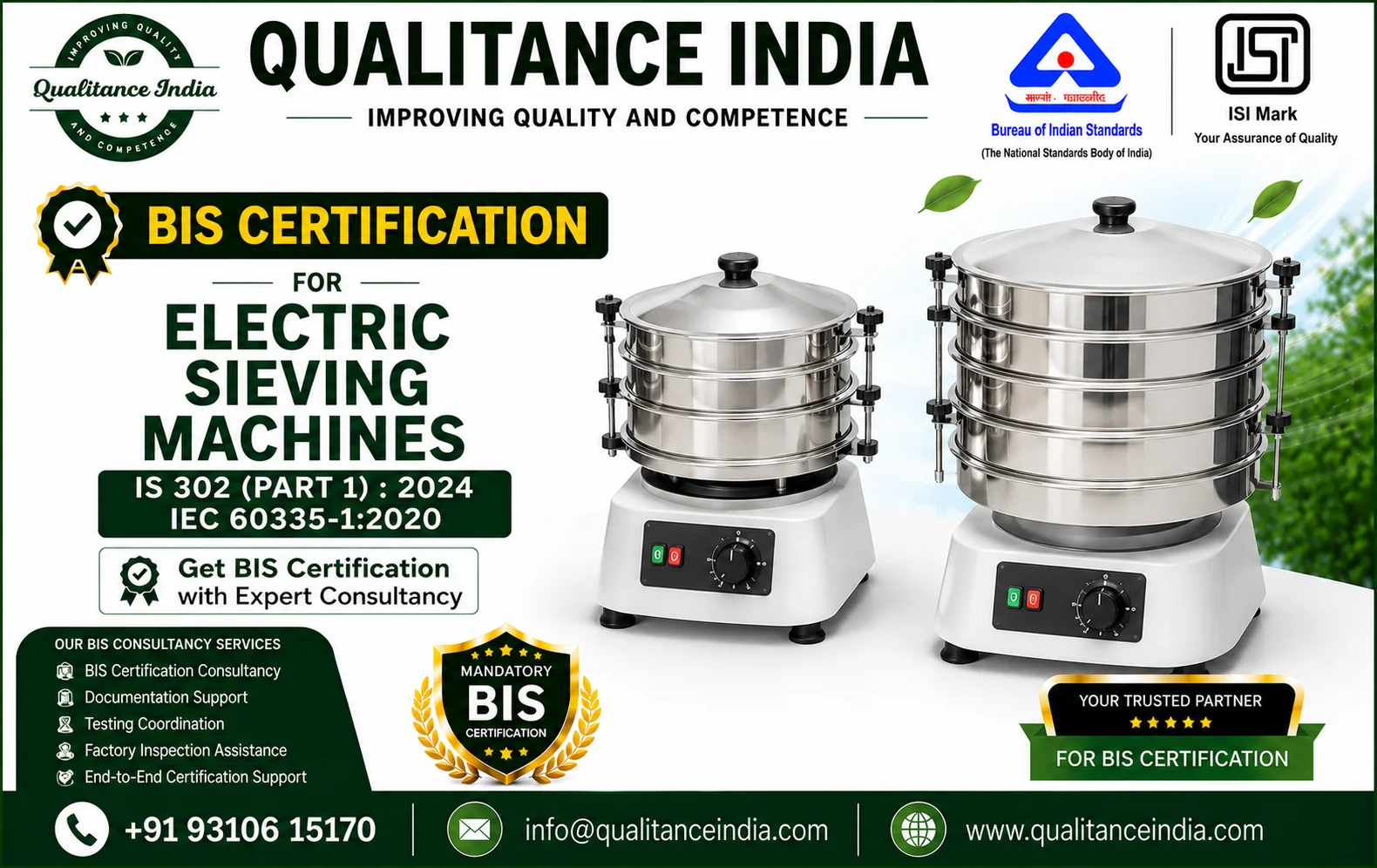
BIS Certification Consultancy for Electric Sieving Machines | IS 302 (Part 1):2024
Expert BIS Certification Consultancy for Electric Sieving Machines in India
Electric Sieving Machines are electrically operated appliances or equipment designed to separate, classify or sieve materials through mechanical movement, vibration or other electrically powered mechanisms. Depending on their design, rated voltage, intended application and regulatory classification, such products may be subject to applicable Indian safety standards and BIS certification requirements.
For products falling within the applicable scope, IS 302 (Part 1):2024 | IEC 60335-1:2020 may be relevant for assessing general electrical safety requirements.
The implementation date provided for this service is 01 August 2026.
Qualitance India provides professional BIS Certification Consultancy for Electric Sieving Machines, helping manufacturers, importers and businesses understand applicable requirements and navigate the certification process—from product applicability assessment and documentation to laboratory testing, application support and certification compliance.
Quick Answer: Is BIS Certification Required for Electric Sieving Machines?
Whether BIS Certification is mandatory for a particular Electric Sieving Machine depends on the exact product classification, electrical specifications, intended use, applicable Indian Standard and the latest BIS/QCO regulatory requirements.
Where the product is covered by a mandatory BIS certification requirement, the manufacturer must complete the prescribed conformity assessment process before the product can be legally marketed in India.
The applicable requirements should be checked against the latest official BIS notification and QCO before commercial production, import or sale.
What is BIS Certification for Electric Sieving Machines?
BIS Certification is a conformity assessment process through which a product's compliance with the applicable Indian Standard is evaluated under the relevant BIS certification scheme.
For applicable electrical products, the process may involve:
- Identifying the correct Indian Standard
- Reviewing product construction and specifications
- Product testing
- Technical documentation
- Factory quality-control requirements
- BIS application submission
- Factory inspection or assessment, where applicable
- Addressing BIS queries
- Grant of BIS Licence
- Use of ISI Mark, where permitted under the applicable licence
For Electric Sieving Machines, proper product classification is an important first step because the certification requirements may differ based on the machine's construction and intended use.
IS 302 (Part 1):2024 | IEC 60335-1:2020
IS 302 (Part 1):2024 specifies general safety requirements applicable to electrical appliances within its scope.
The standard addresses safety considerations associated with electrical appliances, including areas such as:
- Protection against electric shock
- Electrical insulation
- Leakage current
- Dielectric strength
- Temperature rise
- Protection against mechanical hazards
- Abnormal operation
- Moisture resistance
- Mechanical strength
- Construction
- Internal wiring
- Components
- Supply connections
- Marking
- Instructions for use
- Protection against fire and overheating
Depending on the exact Electric Sieving Machine and its intended application, a relevant product-specific Part 2 standard may also need to be considered alongside the general requirements.
Therefore, a product-specific applicability assessment is recommended before beginning the BIS certification process.
Electric Sieving Machines – Implementation Date
01 August 2026
The implementation date provided for this service is 01 August 2026.
Manufacturers, importers and businesses planning to introduce Electric Sieving Machines into the Indian market should begin compliance planning in advance.
Early preparation can help businesses manage:
- Product classification
- Standard identification
- Laboratory testing
- Technical documentation
- BIS application preparation
- Factory readiness
- Quality-control requirements
- Implementation deadlines
Starting early is particularly important if the product requires testing or factory assessment.
Which Electric Sieving Machines May Need Applicability Assessment?
Depending on their construction and intended use, the following types of products may require regulatory assessment:
- Electrically operated Sieving Machines
- Electric Vibratory Sieving Machines
- Electric Screening Machines
- Electrically powered Sieve Shakers
- Laboratory Electric Sieving Machines
- Commercial Electric Sieving Appliances
- Electrically operated material separation equipment
- Machines using electric motors for sieving or screening
- Other electrically powered appliances performing sieving functions
Note: The inclusion of a product in this list does not automatically mean that BIS certification is mandatory. The exact applicability must be determined based on the product's technical characteristics and the applicable regulatory framework.
Who Needs BIS Certification Consultancy?
Our BIS consultancy services may be useful for:
Indian Manufacturers
Manufacturers producing Electric Sieving Machines in India may need to assess applicable BIS requirements before placing regulated products on the market.
Foreign Manufacturers
Overseas manufacturers exporting applicable products to India may need to follow the relevant BIS certification route.
Importers
Importers should ensure that products requiring mandatory certification meet the applicable Indian regulatory requirements.
OEM & ODM Companies
Businesses manufacturing products under another company's brand may need support in determining certification responsibilities.
Brand Owners
Private-label businesses should verify whether their products are covered by mandatory BIS requirements.
New Product Launches
Companies planning to introduce new Electric Sieving Machines in India should conduct a compliance assessment before commercial launch.
Complete BIS Certification Process for Electric Sieving Machines
Step 1: Product Applicability Assessment
The first step is to understand whether the Electric Sieving Machine is covered under mandatory BIS certification requirements.
Our team can review:
- Product name
- Product photographs
- Technical specifications
- Rated voltage
- Rated power
- Frequency
- Electrical input
- Intended application
- Product construction
- Manufacturing location
- Model range
Step 2: Applicable Standard Identification
After reviewing the product, the applicable Indian Standard is identified.
For the service discussed on this page, the relevant general standard is:
IS 302 (Part 1):2024 | IEC 60335-1:2020
If a relevant product-specific standard exists, the applicability of the corresponding Part 2 requirements should also be evaluated.
Step 3: Documentation Preparation
The required technical and legal documents are prepared according to the applicable BIS certification route.
Common documents may include:
- Manufacturer information
- Factory address
- Company registration documents
- Product specifications
- Product photographs
- Circuit diagram
- Wiring diagram
- PCB details, where applicable
- Bill of Materials
- Critical component list
- User manual
- Product labels
- Trademark documents
- Manufacturing process flow
- Quality-control documents
- Testing equipment details
- Calibration certificates
- Factory layout
- Authorization documents, where applicable
Step 4: Product Testing
Where required, the Electric Sieving Machine must undergo testing according to the applicable standard and certification requirements.
Testing may cover areas related to:
- Electrical safety
- Protection against electric shock
- Insulation
- Leakage current
- Dielectric strength
- Temperature rise
- Mechanical safety
- Abnormal operation
- Construction
- Moisture resistance
- Marking
- User instructions
The exact tests depend on the product design and applicable standard.
Step 5: BIS Application
After completing the applicable testing and documentation, the BIS application is prepared and submitted through the prescribed process.
The application should accurately reflect:
- Manufacturer details
- Factory location
- Brand
- Product description
- Model numbers
- Applicable standard
- Technical specifications
- Test documentation
- Critical components
Any mismatch between the product, documents and test report may lead to additional queries or delays.
Step 6: BIS Scrutiny
BIS may examine the application and supporting documents.
If additional information or clarification is requested, the applicant must respond as required.
Professional consultancy can help in coordinating the documentation and response process.
Step 7: Factory Assessment
Where required under the applicable BIS certification scheme, BIS may conduct a factory inspection or assessment.
The assessment may review:
- Manufacturing facilities
- Production process
- Quality-control system
- Testing facilities
- Calibration records
- Raw material control
- Inspection procedures
- Finished product inspection
- Quality records
The factory should be adequately prepared before the assessment.
Step 8: Grant of BIS Licence
After successful completion of the applicable requirements, BIS may grant the licence under the relevant certification scheme.
Once authorized, the manufacturer can use the ISI Mark according to the applicable licence conditions and regulatory requirements.
Documents Required for Electric Sieving Machine BIS Certification
Depending on the certification route, commonly required documents may include:
- Company registration documents
- Factory registration details
- Manufacturer address proof
- Authorized signatory details
- Product technical specifications
- Product photographs
- Circuit diagrams
- Wiring diagrams
- PCB details, if applicable
- Bill of Materials
- Critical component details
- User manual
- Product label artwork
- Trademark/brand documents
- Manufacturing process flow chart
- Quality-control plan
- Testing equipment details
- Calibration certificates
- Factory layout
- Authorization documents for foreign manufacturers, where applicable
The exact document requirements should be confirmed based on the applicable BIS scheme.
BIS Certification Cost for Electric Sieving Machines
There is no single fixed price for BIS Certification because the total cost depends on several factors.
The overall expense may include:
- Application fees
- BIS processing fees
- Product testing charges
- Laboratory charges
- Factory inspection expenses
- Licence-related charges
- Sample testing
- Consultancy fees
- Travel and other applicable expenses
Factors affecting the final cost include:
- Product complexity
- Number of models
- Number of variants
- Testing requirements
- Factory location
- Applicant type
- Foreign or Indian manufacturer
- Applicable certification scheme
For an accurate quotation, the product's technical details should be reviewed first.
BIS Certification Timeline
The time required for certification varies from case to case.
The timeline may depend on:
- Availability of laboratory testing
- Completeness of documents
- Product testing results
- BIS scrutiny
- Factory assessment requirements
- Applicant response time
- Resolution of technical queries
Therefore, businesses should avoid assuming a fixed timeline without a preliminary assessment.
For products with an implementation date of 01 August 2026, early preparation is recommended.
Common Reasons for BIS Certification Delays
Businesses may experience delays because of:
- Incorrect product classification
- Wrong standard selection
- Incomplete documentation
- Incorrect test reports
- Model mismatch
- Inconsistent technical specifications
- Missing critical component details
- Inadequate testing facilities
- Expired calibration records
- Factory preparedness issues
- Incomplete application information
- Delayed responses to BIS queries
A professional BIS consultant can help identify potential compliance gaps before submission.
Benefits of BIS Certification
Where BIS certification is mandatory, obtaining certification helps businesses achieve regulatory compliance.
Other potential benefits include:
1. Regulatory Compliance
Helps meet applicable mandatory requirements.
2. Product Safety
Demonstrates compliance with applicable safety requirements.
3. Market Access
Supports lawful marketing of regulated products in India.
4. Consumer Confidence
Certification can improve customer confidence in product quality and safety.
5. Brand Credibility
Supports a stronger reputation for compliant products.
6. Business Expansion
Helps businesses establish a more reliable presence in the Indian market.
Why Choose Qualitance India?
Qualitance India provides professional BIS Certification Consultancy services to manufacturers, importers and businesses seeking product compliance support.
Our consultancy support can include:
✔ Product Applicability Assessment
✔ Indian Standard Identification
✔ Documentation Assistance
✔ Laboratory Testing Coordination
✔ BIS Application Support
✔ Factory Assessment Preparation
✔ Technical Compliance Guidance
✔ BIS Query Support
✔ Certification Process Coordination
✔ Post-Certification Compliance Guidance
Our goal is to help businesses understand the certification requirements and manage the compliance process in a structured manner.
Frequently Asked Questions – Electric Sieving Machine BIS Certification
1. What is BIS Certification for Electric Sieving Machines?
It is the conformity assessment process used to demonstrate that an applicable product meets the relevant Indian Standard and BIS certification requirements.
2. Is BIS Certification mandatory for Electric Sieving Machines?
It depends on the latest applicable BIS/QCO requirements and the exact product classification.
3. Which standard is mentioned for this service?
The standard mentioned for this service is IS 302 (Part 1):2024 | IEC 60335-1:2020.
4. What is the implementation date?
The implementation date provided for this service is 01 August 2026.
5. Is IS 302 Part 2 also applicable?
It may be, depending on the exact product category and applicable product-specific requirements.
6. Do Electric Sieving Machines require product testing?
Testing may be required according to the applicable certification scheme and Indian Standard.
7. Can foreign manufacturers obtain BIS Certification?
Foreign manufacturers may be eligible under the applicable BIS certification route, subject to the relevant requirements.
8. Can an importer obtain a BIS Licence?
The applicable certification scheme determines who can hold the licence. Importers should coordinate with the manufacturer to ensure compliance.
9. What documents are required?
Technical specifications, circuit diagrams, product information, component details, manufacturer documents and other applicable documents may be required.
10. Is factory inspection required?
Factory inspection or assessment may be required depending on the applicable BIS certification scheme.
11. How much does BIS Certification cost?
The cost depends on testing, models, factory location, certification scheme and other applicable charges.
12. How long does certification take?
The timeline varies depending on testing, documentation, BIS processing and assessment requirements.
13. Can multiple models be included in one BIS Licence?
This depends on BIS grouping requirements and the applicable certification scheme.
14. What happens if the product fails laboratory testing?
The reasons for failure must be addressed, after which applicable corrective action and retesting may be required.
15. Can Qualitance India help with BIS Certification?
Yes. Qualitance India provides consultancy support for product assessment, documentation, testing coordination, application assistance and certification process guidance.
Get BIS Certification Consultancy for Electric Sieving Machines
Planning to manufacture, import or launch Electric Sieving Machines in India?
With the provided implementation date of 01 August 2026, starting the compliance process early can help your business prepare for applicable requirements.
Qualitance India can assist you in understanding the applicable BIS requirements and guide you through the certification process.
Our Services Include:
BIS Applicability Assessment | Documentation | Product Testing Coordination | BIS Application Support | Factory Assessment Preparation | ISI Mark Compliance
📞 Call: +91-9310-615-170
📧 Email: info@qualitanceindia.com
🌐 Website: Qualitance India
Contact Qualitance India today for a product-specific BIS Certification assessment.