
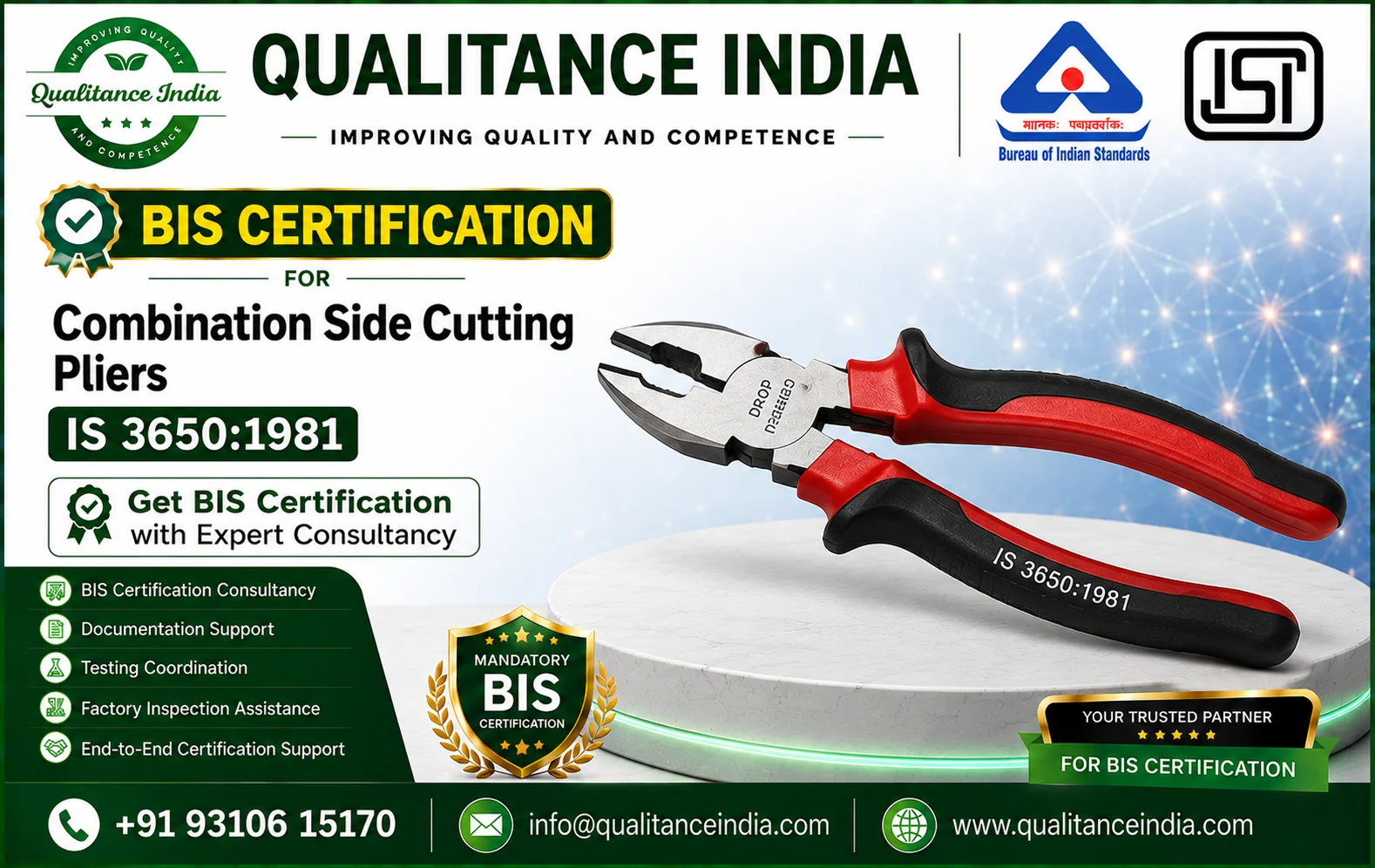
Combination Side Cutting Pliers BIS Certification | IS 3650:1981 | Complete ISI Mark Consultancy Guide | Enforcement Date 01 October 2026
Combination Side Cutting Pliers BIS Certification under IS 3650:1981
Introduction
Combination Side Cutting Pliers are among the most commonly used hand tools across industrial, electrical, mechanical, automotive, and maintenance applications. These versatile tools are designed to grip, bend, twist, hold, and cut wires, making them indispensable for electricians, technicians, engineers, manufacturing units, and maintenance professionals. Their robust construction and multifunctional design make them suitable for a wide range of industrial and commercial operations.
As industries increasingly focus on product quality, worker safety, and compliance with national standards, manufacturers are expected to produce hand tools that meet recognized technical specifications. In India, the Bureau of Indian Standards (BIS) has established quality requirements for Combination Side Cutting Pliers under IS 3650:1981. Manufacturers of products covered under the applicable Hand Tools Quality Control Order (QCO) are required to obtain BIS Certification (ISI Mark) before manufacturing, importing, or selling these products in the Indian market.
According to the applicable Quality Control Order, the enforcement date for mandatory BIS Certification is 01 October 2026 for the applicable category of manufacturers. Businesses planning to continue supplying Combination Side Cutting Pliers in India should begin preparing their documentation, product testing, factory readiness, and BIS application well in advance of this date.
This comprehensive guide explains everything manufacturers need to know about Combination Side Cutting Pliers BIS Certification under IS 3650:1981, including product details, manufacturing process, BIS certification requirements, documentation, testing, factory inspection, benefits of certification, and the role of professional consultancy in achieving timely compliance.
What are Combination Side Cutting Pliers?
Combination Side Cutting Pliers are multifunctional hand tools specifically designed to grip, twist, hold, bend, and cut various types of wires and small metal components. Unlike ordinary cutting pliers, these tools combine gripping jaws with side-cutting edges, allowing users to perform multiple tasks using a single tool.
The jaws are engineered with serrated gripping surfaces for secure holding, while the hardened cutting edges enable efficient cutting of copper, aluminum, soft steel, and other suitable wire materials. The ergonomic handles improve user comfort and reduce fatigue during extended use.
Because these tools are frequently used in demanding industrial environments, they must possess adequate hardness, strength, durability, cutting performance, and dimensional accuracy. Compliance with IS 3650:1981 helps ensure that manufacturers consistently produce tools that meet these essential quality requirements.
Applications of Combination Side Cutting Pliers
Combination Side Cutting Pliers are widely used across numerous industries and professional applications.
Electrical Industry
Electricians use these pliers for cutting electrical wires, stripping insulation, twisting conductors, and holding components during installation and maintenance work.
Electronics Industry
Technicians working with electronic assemblies use combination pliers for handling delicate wires, terminals, connectors, and small components.
Automotive Industry
Mechanics rely on these tools for repairing wiring harnesses, removing clips, cutting cables, and handling small fasteners.
Manufacturing Industry
Production facilities use combination pliers in assembly lines, maintenance workshops, and machine installation activities.
Construction Industry
Construction professionals use these pliers during electrical installation, plumbing support work, and general maintenance.
Railway Sector
Railway maintenance personnel use combination pliers for signal systems, electrical repairs, communication equipment, and workshop maintenance.
Power Generation Plants
Maintenance engineers use these tools in thermal, hydro, solar, and wind power plants for routine repair and servicing work.
Telecommunication Industry
Telecommunication engineers use combination pliers while installing communication cables, network equipment, and junction boxes.
Household Maintenance
Combination Side Cutting Pliers are also widely used by homeowners for DIY repairs, furniture assembly, electrical maintenance, and general-purpose applications.
Major Industries Using Combination Side Cutting Pliers
The demand for Combination Side Cutting Pliers extends across numerous industrial sectors, including:
- Electrical Equipment Manufacturing
- Electronics Manufacturing
- Automotive Industry
- Heavy Engineering
- Construction Industry
- Infrastructure Projects
- Railway Workshops
- Defence Manufacturing
- Aerospace Industry
- Shipbuilding Industry
- Mining Industry
- Steel Plants
- Cement Plants
- Oil & Gas Industry
- Petrochemical Plants
- Renewable Energy Projects
- Telecommunications
- Industrial Maintenance Services
Types of Combination Side Cutting Pliers
Manufacturers produce different variants depending on industrial requirements.
Common types include:
- Standard Combination Pliers
- Heavy Duty Combination Pliers
- Electrician Combination Pliers
- Insulated Combination Pliers
- High-Leverage Combination Pliers
- Industrial Combination Pliers
- Professional Side Cutting Pliers
- Precision Combination Pliers
- Chrome Vanadium Combination Pliers
- Long Handle Combination Pliers
Each variant is designed to meet specific operational requirements while maintaining compliance with applicable quality standards.
Materials Used in Manufacturing
The performance and durability of Combination Side Cutting Pliers largely depend on the quality of raw materials used during manufacturing.
Common materials include:
- Chrome Vanadium Steel
- Chrome Nickel Steel
- High Carbon Steel
- Alloy Steel
- Tool Steel
- Forged Carbon Steel
Manufacturers generally use heat-treated alloy steels to achieve the required balance between hardness and toughness.
High-quality materials offer several advantages:
- Higher Cutting Performance
- Better Wear Resistance
- Improved Corrosion Resistance
- Longer Service Life
- Increased Mechanical Strength
- Superior Impact Resistance
- Better User Safety
Manufacturing Process
The manufacturing process for Combination Side Cutting Pliers involves several precision engineering stages to ensure consistent quality.
A typical process includes:
- Raw Material Inspection
- Steel Cutting
- Hot Forging
- Trimming
- Precision Machining
- Jaw Forming
- Cutting Edge Grinding
- Heat Treatment
- Polishing
- Surface Coating
- Assembly
- Handle Grip Installation
- Product Marking
- Final Quality Inspection
- Packaging
Each stage contributes to the overall quality, dimensional accuracy, cutting performance, and durability of the finished product.
What is BIS Certification?
The Bureau of Indian Standards (BIS) is the National Standards Body of India responsible for developing Indian Standards and operating product certification schemes. Under Scheme-I (ISI Mark Scheme), manufacturers of products covered by mandatory Quality Control Orders are required to obtain a BIS licence before marketing such products in India.
For Combination Side Cutting Pliers, the applicable Indian Standard is IS 3650:1981. Manufacturers granted a BIS licence are authorized to use the ISI Mark, indicating that their products conform to the prescribed requirements and are produced under an approved quality control system.
BIS Certification not only supports regulatory compliance but also demonstrates a manufacturer's commitment to quality, safety, and consistent manufacturing practices.
Why BIS Certification is Important
Obtaining BIS Certification offers several important benefits for manufacturers, importers, distributors, and end users.
Legal Compliance
Where mandatory certification applies, a valid BIS licence is required before covered products can be supplied in the Indian market.
Authorization to Use the ISI Mark
Certified manufacturers can apply the ISI Mark on their products, enhancing market recognition and customer confidence.
Improved Product Quality
Compliance with IS 3650:1981 encourages manufacturers to maintain consistent production processes and quality control measures.
Enhanced Customer Confidence
Customers often prefer certified products because they are manufactured according to recognized Indian Standards.
Better Market Opportunities
Many government departments, public sector organizations, and industrial buyers prefer or require BIS-certified products.
Competitive Advantage
BIS Certification helps manufacturers differentiate themselves in a competitive marketplace.
Reduced Product Failures
A structured quality management system helps minimize defects, complaints, and product failures.
Increased Brand Reputation
Maintaining certification demonstrates a manufacturer's commitment to quality and continuous compliance.
Export Readiness
Although BIS Certification is primarily intended for the Indian market, adherence to recognized quality standards can support broader market acceptance and strengthen confidence among international customers.
Why Manufacturers Should Prepare Before 01 October 2026
With the enforcement date approaching, manufacturers should begin preparations as early as possible. Early planning provides sufficient time for:
- Reviewing the applicability of IS 3650:1981
- Organizing technical documentation
- Establishing quality control procedures
- Conducting product testing
- Calibrating measuring instruments
- Preparing the factory for inspection (where applicable)
- Filing the BIS application
- Responding to technical queries promptly
Starting early helps reduce the risk of delays and supports a smoother certification process before the mandatory implementation date.
Complete BIS Certification Process for Combination Side Cutting Pliers
BIS Certification under IS 3650:1981
Enforcement Date: 01 October 2026
Complete BIS Certification Process for Combination Side Cutting Pliers under IS 3650:1981
Manufacturers intending to manufacture, import, distribute, or sell Combination Side Cutting Pliers in India must comply with the applicable Bureau of Indian Standards (BIS) requirements before the mandatory enforcement date. As per the applicable Hand Tools Quality Control Order (QCO), 01 October 2026 is the enforcement date for mandatory BIS Certification for this product category.
BIS Certification under IS 3650:1981 demonstrates that the product meets the prescribed Indian requirements for quality, dimensions, mechanical strength, cutting performance, hardness, durability, workmanship, and safety. Once certified, manufacturers are authorized to use the ISI Mark, enhancing market credibility and ensuring compliance with Indian regulations.
Obtaining BIS Certification is a structured process that involves product testing, technical documentation, quality management evaluation, factory assessment (where applicable), and approval by BIS. Manufacturers should begin preparations well in advance to avoid delays and ensure business continuity after the enforcement date.
This guide explains the entire certification process in detail.
Step 1 – Verify Product Applicability
The first step is to determine whether the product falls under the mandatory BIS certification requirement.
Manufacturers should verify:
- Product Category
- Product Design
- Intended Industrial Application
- Applicable Indian Standard
- Latest BIS Notification
- Relevant Quality Control Order
- Certification Scheme
- Manufacturing Scope
Correct product classification is essential. Applying under an incorrect standard may result in rejection or additional delays.
Step 2 – Technical Evaluation of the Product
Before applying for BIS Certification, manufacturers should conduct a technical review of the product to ensure compliance with IS 3650:1981.
The evaluation typically includes:
- Overall Length
- Jaw Geometry
- Jaw Opening
- Cutting Edge Design
- Handle Design
- Joint Alignment
- Pivot Mechanism
- Material Grade
- Heat Treatment Process
- Surface Finish
- Product Identification Marking
- Dimensional Tolerances
If any non-conformities are identified during this stage, they should be corrected before product testing.
Step 3 – Prepare Documentation
Comprehensive documentation is one of the most important requirements for obtaining BIS Certification. Manufacturers must demonstrate that they have an effective quality management system and the capability to consistently manufacture products conforming to IS 3650:1981.
Preparing complete documents before submitting the application significantly reduces certification time.
Company Documents Required
Generally, the following documents are required:
- Certificate of Incorporation
- GST Registration Certificate
- PAN Card
- Factory Licence
- MSME Registration (if applicable)
- Import Export Code (for exporters)
- Trademark Certificate (if available)
- Factory Address Proof
- Board Resolution / Authorization Letter
- Authorized Signatory Identity Proof
Manufacturing Documents
Manufacturers should prepare:
- Manufacturing Process Flow Chart
- Factory Layout
- Machinery List
- Production Capacity Details
- Process Control Plan
- Inspection Procedure
- Packaging Procedure
- Storage Procedure
- Calibration Plan
- Standard Operating Procedures (SOPs)
Technical Documents
Technical documents usually include:
- Product Drawings
- Engineering Specifications
- Material Specifications
- Bill of Materials (BOM)
- Product Catalogue
- Heat Treatment Details
- Product Marking Details
- Packaging Design
- Technical Datasheets
Quality Control Documents
Manufacturers should maintain:
- Quality Manual
- Incoming Material Inspection Records
- In-Process Inspection Reports
- Final Inspection Reports
- Internal Test Reports
- Calibration Certificates
- Corrective Action Records
- Customer Complaint Register
- Product Traceability Records
- Internal Audit Reports
Proper documentation demonstrates that the manufacturer has a systematic approach to quality assurance.
Step 4 – Product Testing
Product testing is a mandatory and critical stage of BIS Certification. Testing verifies that the Combination Side Cutting Pliers meet all technical requirements specified in IS 3650:1981.
Testing must be carried out in accordance with the applicable standard, generally through a BIS-recognized laboratory or as required under the certification scheme.
Typical Tests Conducted
1. Dimensional Verification
The pliers are measured to verify:
- Overall Length
- Jaw Dimensions
- Cutting Edge Dimensions
- Handle Size
- Joint Alignment
- Tolerances
Proper dimensions ensure compatibility, functionality, and safe operation.
2. Material Verification
The steel used for manufacturing is evaluated to ensure it meets the specified material requirements.
Common materials include:
- Chrome Vanadium Steel
- Alloy Steel
- High Carbon Steel
- Tool Steel
3. Hardness Test
Hardness testing ensures the jaws and cutting edges have the required hardness to withstand repeated use without excessive wear.
4. Cutting Performance Test
The cutting edges are evaluated for their ability to cut specified wire materials efficiently without damage or excessive deformation.
5. Joint Performance Test
The pivot joint is examined to ensure:
- Smooth Operation
- Proper Alignment
- Minimal Play
- Long-Term Durability
6. Mechanical Strength Test
Mechanical strength testing verifies that the pliers can withstand operational loads without cracking, bending, or failure.
7. Heat Treatment Verification
Heat treatment is assessed to confirm that the product achieves the necessary balance between hardness and toughness.
Proper heat treatment contributes to:
- Better Wear Resistance
- Improved Strength
- Enhanced Durability
- Longer Service Life
8. Surface Finish Inspection
Inspectors examine the product for:
- Cracks
- Burrs
- Sharp Edges
- Rust
- Surface Defects
- Manufacturing Imperfections
A high-quality finish enhances safety and corrosion resistance.
9. Handle Grip Inspection
If insulated or ergonomic handles are provided, they are checked for:
- Secure Fitment
- Finish Quality
- User Comfort
- Proper Bonding
10. Product Marking Verification
The required markings are verified, including:
- Manufacturer Name or Trademark
- Product Identification
- Size (where applicable)
- Standard Reference
- Other mandatory markings specified by BIS
Importance of Product Testing
Proper testing offers several benefits:
- Demonstrates compliance with IS 3650:1981
- Improves product reliability
- Reduces field failures
- Enhances customer confidence
- Supports regulatory compliance
- Improves brand reputation
- Minimizes quality-related complaints
Manufacturers who perform internal quality checks before laboratory testing generally experience smoother certification.
Step 5 – BIS Application Submission
After testing and document preparation, the manufacturer submits the BIS application.
The application typically includes:
- Company Details
- Factory Details
- Product Information
- Applicable Indian Standard
- Test Reports
- Supporting Documents
- Authorized Signatory Information
Accurate and complete information helps reduce processing delays.
Step 6 – Technical Review by BIS
BIS reviews the submitted application to verify compliance with IS 3650:1981.
The review may include:
- Product Specifications
- Technical Drawings
- Manufacturing Process
- Test Reports
- Quality Control Documents
- Product Marking
- Factory Details
If BIS raises technical queries, manufacturers should respond promptly with the required information or clarifications.
Step 7 – Factory Inspection
Depending on the applicable BIS certification scheme, BIS officials may conduct a factory inspection.
The inspection helps verify the manufacturer's capability to consistently produce products meeting the Indian Standard.
Manufacturing Facility Verification
Inspectors may evaluate:
- Raw Material Storage
- Forging Area
- Machining Section
- Heat Treatment Facility
- Grinding Operations
- Polishing Area
- Assembly Line
- Handle Fitting Section
- Product Marking Area
- Packaging Department
- Finished Goods Storage
Production Process Review
The inspection may include verification of:
- Manufacturing Flow
- Process Controls
- Standard Operating Procedures
- Batch Identification
- Production Records
- Traceability System
Quality Control System Review
Inspectors may examine:
- Incoming Material Inspection
- In-Process Inspection
- Final Product Inspection
- Calibration System
- Test Records
- Non-Conforming Product Control
- Corrective Action System
- Internal Audit Reports
Testing Equipment Verification
Manufacturers should maintain suitable equipment such as:
- Vernier Calipers
- Micrometers
- Hardness Testing Machine
- Cutting Performance Test Equipment
- Universal Testing Machine (where applicable)
- Measuring Gauges
- Surface Inspection Tools
All equipment should be calibrated at regular intervals.
Finished Product Inspection
BIS officials may verify that finished Combination Side Cutting Pliers are:
- Properly Marked
- Correctly Packed
- Easily Traceable
- Stored Under Appropriate Conditions
Step 8 – Grant of BIS Licence
If the manufacturer successfully satisfies all applicable requirements, BIS grants the licence under Scheme-I (ISI Mark Scheme).
The manufacturer is then authorized to use the Standard Mark (ISI Mark) on Combination Side Cutting Pliers manufactured in accordance with IS 3650:1981 and the terms of the licence.
The licence remains valid subject to continued compliance, surveillance, and timely renewal.
Post-Certification Compliance
After obtaining the BIS licence, manufacturers should continue to:
- Produce conforming products consistently
- Maintain quality records
- Preserve calibration certificates
- Conduct routine inspections
- Retain test reports
- Address customer complaints effectively
- Cooperate with BIS surveillance activities
- Renew the licence as required
Common Reasons for Delay or Rejection
Some common issues include:
- Incorrect Product Classification
- Incomplete Documentation
- Non-Conforming Test Results
- Expired Calibration Certificates
- Inadequate Quality Control Procedures
- Improper Product Marking
- Delayed Responses to BIS Queries
- Poor Record Keeping
- Insufficient Product Traceability
Early preparation and proper documentation can help avoid these problems.
Tips for Faster BIS Certification
Manufacturers can streamline the process by:
- Identifying the correct Indian Standard (IS 3650:1981)
- Reviewing the latest BIS notifications
- Preparing complete documentation
- Conducting internal quality audits
- Calibrating all measuring instruments
- Completing product testing in advance
- Maintaining organized production records
- Responding promptly to BIS communications
- Taking professional consultancy support where required
Why Choose Qualitance India?
Navigating the BIS Certification process for Combination Side Cutting Pliers can be technically demanding. Qualitance India offers end-to-end consultancy services to help manufacturers achieve compliance efficiently.
Our Services
- BIS Certification Consultancy
- ISI Mark Consultancy
- Product Standard Identification
- Documentation Preparation
- BIS Application Filing
- Product Testing Coordination
- Factory Inspection Assistance
- Technical Compliance Review
- BIS Query Resolution
- Licence Grant Support
- Renewal & Ongoing Compliance
Our experienced team supports manufacturers throughout the certification journey, helping them meet regulatory requirements while minimizing delays.
FAQs, SEO Keywords, Google AI Optimization & Contact
Combination Side Cutting Pliers BIS Certification under IS 3650:1981
Mandatory BIS Certification | Enforcement Date: 01 October 2026
Frequently Asked Questions (FAQs)
1. What is BIS Certification for Combination Side Cutting Pliers?
BIS Certification confirms that Combination Side Cutting Pliers comply with the applicable Indian Standard IS 3650:1981 and meet the prescribed requirements for quality, safety, dimensions, cutting performance, workmanship, and durability. Certified manufacturers are authorized to use the ISI Mark after obtaining a valid BIS licence.
2. Is BIS Certification mandatory for Combination Side Cutting Pliers?
Yes. If the product is covered under the applicable Hand Tools Quality Control Order (QCO), manufacturers must obtain a valid BIS licence before manufacturing, importing, selling, or distributing the product in India.
3. Which Indian Standard applies?
The applicable Indian Standard is:
IS 3650:1981 – Combination Side Cutting Pliers
Manufacturers should always verify whether BIS has issued any amendments or revisions to the standard.
4. What is the enforcement date?
The mandatory BIS Certification enforcement date for this product is:
01 October 2026
Manufacturers should complete the certification process well before this date to avoid supply disruptions.
5. Who can apply for BIS Certification?
Eligible applicants include:
- Indian Manufacturers
- Foreign Manufacturers
- OEM Manufacturers
- Contract Manufacturers
- Brand Owners
6. Can foreign manufacturers obtain BIS Certification?
Yes. Foreign manufacturers exporting Combination Side Cutting Pliers to India can apply under the applicable BIS certification scheme.
7. Is product testing mandatory?
Yes. Product testing is an essential part of the BIS Certification process and must be conducted as per the applicable standard and certification requirements.
8. Is factory inspection required?
Depending on the applicable BIS certification scheme, BIS may conduct a factory inspection to verify manufacturing capability and quality control systems.
9. Which tests are generally conducted?
Typical evaluations include:
- Dimensional Verification
- Material Verification
- Hardness Test
- Cutting Performance Test
- Mechanical Strength Test
- Joint Performance Test
- Heat Treatment Verification
- Surface Finish Inspection
- Product Marking Verification
10. What documents are generally required?
Manufacturers typically need:
- Company Registration Documents
- Factory Licence
- GST Registration
- Manufacturing Process Flow Chart
- Product Drawings
- Machinery List
- Quality Manual
- Calibration Certificates
- Test Reports
- Authorization Documents
11. What are the benefits of BIS Certification?
- Compliance with applicable regulations
- Authorization to use the ISI Mark
- Better product quality
- Improved customer confidence
- Increased market acceptance
- Enhanced brand reputation
- Better opportunities in government and industrial procurement
12. What happens if a manufacturer does not obtain BIS Certification?
If a product covered under a mandatory Quality Control Order is supplied without the required BIS licence, regulatory action may be taken under the applicable laws.
13. Can MSME manufacturers apply?
Yes. MSME manufacturers can apply and should monitor any specific implementation timelines or government notifications relevant to their category.
14. Why should manufacturers begin the certification process early?
Early preparation provides sufficient time for documentation, product testing, quality system improvements, factory readiness, and BIS review before the enforcement date.
15. Why choose Qualitance India?
Qualitance India provides end-to-end consultancy for BIS Certification, including documentation support, testing coordination, application filing, inspection assistance, and post-certification compliance.
Why Choose Qualitance India?
Qualitance India helps manufacturers simplify the BIS Certification process through technical expertise and practical guidance.
Our Services
- BIS Certification Consultancy
- ISI Mark Consultancy
- Documentation Preparation
- Product Testing Coordination
- BIS Application Filing
- Factory Inspection Assistance
- Technical Compliance Support
- BIS Query Resolution
- Licence Approval Support
- Renewal & Compliance Management
Manufacturer Checklist Before Applying
Before submitting your BIS application, ensure that you have:
✅ Verified applicability of IS 3650:1981
✅ Reviewed the latest BIS notification
✅ Prepared all company registration documents
✅ Finalized product drawings and specifications
✅ Implemented a quality management system
✅ Calibrated testing and measuring equipment
✅ Conducted product testing
✅ Maintained inspection records
✅ Established product traceability
✅ Prepared the factory for BIS inspection (if applicable)
150+ High-Traffic SEO Keywords
Primary Keywords
- Combination Side Cutting Pliers BIS Certification
- Combination Side Cutting Pliers ISI Mark
- IS 3650:1981
- BIS Certification Consultant
- BIS Consultant India
- BIS Registration
- BIS Licence
- Hand Tools BIS Certification
- Side Cutting Pliers Certification
- ISI Certification
Long-Tail Keywords
- How to get BIS Certification for Combination Side Cutting Pliers
- BIS Certification process for Combination Side Cutting Pliers
- IS 3650:1981 certification guide
- ISI Mark for Combination Side Cutting Pliers
- BIS consultant for hand tool manufacturers
- Side Cutting Pliers manufacturer compliance
- Hand tools certification in India
- BIS registration for industrial pliers
- BIS licence for Combination Side Cutting Pliers
- Mandatory BIS Certification for Hand Tools
Related Search Keywords
- Industrial Combination Pliers
- Heavy Duty Combination Pliers
- Electrician Combination Pliers
- Chrome Vanadium Pliers
- Alloy Steel Pliers
- Forged Combination Pliers
- Hand Tool Manufacturer India
- Industrial Hand Tools
- Mechanical Hand Tools
- Engineering Tools
- Electrical Pliers
- Cutting Pliers
- Wire Cutting Pliers
- Grip Pliers
- Professional Pliers
- Hand Tool Standards
- BIS Quality Control Order
- ISI Mark Consultant
- Product Certification India
- BIS Compliance
LSI (Latent Semantic Indexing) Keywords
- Hand Tool Manufacturing
- Industrial Equipment
- Mechanical Strength
- Jaw Hardness
- Heat Treatment
- Dimensional Accuracy
- Cutting Edge
- Quality Assurance
- Calibration
- Production Process
- Manufacturing Facility
- Product Testing
- Inspection Procedure
- Factory Audit
- Engineering Products
- Standard Mark
- Product Traceability
- Surface Finish
- Heavy Engineering
- Industrial Maintenance
Featured Snippet Optimized Answer
What is BIS Certification for Combination Side Cutting Pliers?
BIS Certification for Combination Side Cutting Pliers is the process of obtaining a BIS licence under IS 3650:1981, enabling manufacturers to use the ISI Mark after demonstrating compliance with the applicable Indian Standard through product testing, documentation, and quality control requirements.
Google AI Overview Optimization
To improve the chances of appearing in Google AI Overviews and other AI-powered search experiences:
- Publish original, in-depth content with practical guidance.
- Display the publication date and last updated date.
- Attribute the article to a qualified author (e.g., Technical Team – Qualitance India).
- Use descriptive headings and FAQ sections.
- Add original product images with optimized ALT text.
- Link to related BIS certification pages on your website.
- Keep content updated with official BIS notifications.
- Avoid unsupported claims such as guaranteed approvals or fixed approval timelines.
Internal Linking Strategy
Link this article to related pages such as:
- BIS Certification Services
- Hand Tools BIS Certification
- Pipe Wrenches – General Purpose BIS Certification
- Open-Jaw Wrenches (Spanners) BIS Certification
- Open Ended Slugging Wrenches BIS Certification
- Ring Slugging Wrenches BIS Certification
- Adjustable Wrenches BIS Certification
- FMCS Certification
- CRS Registration
- About Qualitance India
- Contact Us
- BIS Blog
Suggested Schema Markup
To improve search visibility, implement these schema types:
- Article Schema
- FAQPage Schema
- Organization Schema
- LocalBusiness Schema
- BreadcrumbList Schema
- WebPage Schema
Structured data can help search engines better understand your content and may improve eligibility for rich results.
Conclusion
Combination Side Cutting Pliers are essential tools used across electrical, automotive, construction, engineering, telecommunications, and industrial maintenance sectors. Compliance with IS 3650:1981 helps manufacturers demonstrate product quality and meet applicable BIS requirements.
With the mandatory BIS Certification enforcement date of 01 October 2026, manufacturers should begin preparing early by organizing documentation, completing product testing, strengthening quality systems, and ensuring factory readiness.
Working with an experienced BIS consultancy can simplify the certification process and help manufacturers navigate documentation, testing coordination, and regulatory requirements more efficiently.
Contact Qualitance India
Expert BIS Certification Consultancy for Combination Side Cutting Pliers
Qualitance India provides complete BIS Certification support for manufacturers across India and international markets.
Our Services
- BIS Certification Consultancy
- ISI Mark Consultancy
- Documentation Support
- Product Testing Coordination
- Factory Inspection Assistance
- BIS Application Filing
- Technical Compliance Review
- BIS Query Resolution
- Licence Approval Support
- Renewal & Compliance Assistance
Contact Details
Qualitance India
📞 Phone: +91-93106-15170
📧 Email: info@qualitanceindia.com
🌐 Website: https://qualitanceindia.com
📍 Office:
D-15, Ground Floor, Office No. 7, Sector-3, Noida, Uttar Pradesh – 201301