BIS Certification for Vacuum Cleaners and Water Suction Cleaning Appliances – IS 302 (Part 1):2024 | IEC 60335-1:2020 | Mandatory from 01 October 2026
BIS Certification for Vacuum Cleaners and Water Suction Cleaning Appliances under IS 302 (Part 1):2024 | IEC 60335-1:2020
Introduction
Vacuum Cleaners and Water Suction Cleaning Appliances have become essential cleaning equipment in residential, commercial, industrial, healthcare, hospitality, educational, and public infrastructure sectors. Modern consumers expect these appliances to provide efficient cleaning while ensuring electrical safety, durability, and reliable performance.
To protect consumers and ensure product safety, the Government of India has introduced mandatory compliance requirements for many household electrical appliances. Manufacturers and importers must obtain BIS Certification before placing regulated products on the Indian market.
For Vacuum Cleaners and Water Suction Cleaning Appliances, the applicable safety standard is:
IS 302 (Part 1):2024
Aligned with
IEC 60335-1:2020
The mandatory enforcement date is 01 October 2026. After this date, applicable products must comply with BIS requirements before they are manufactured, imported, sold, or distributed in India.
If you are a manufacturer, importer, exporter, OEM, or brand owner, understanding these requirements in advance will help you avoid regulatory delays and ensure uninterrupted business operations.
Product Overview
Vacuum Cleaners and Water Suction Cleaning Appliances are electrically operated machines designed to remove dust, dirt, debris, liquids, and other contaminants from floors, carpets, upholstery, industrial workspaces, and various surfaces.
These appliances are widely used in:
- Homes
- Offices
- Hotels
- Hospitals
- Shopping malls
- Airports
- Railway stations
- Schools
- Warehouses
- Manufacturing facilities
- Commercial buildings
- Industrial plants
Modern vacuum cleaning equipment includes advanced safety features, high-efficiency motors, filtration systems, and electronic controls. Because these appliances operate using electricity, they must comply with strict safety requirements to minimize risks such as electric shock, overheating, insulation failure, fire hazards, and mechanical injury.
Applicable Indian Standard
The applicable standard is:
IS 302 (Part 1):2024
Equivalent to
IEC 60335-1:2020
This standard specifies general safety requirements for household and similar electrical appliances, including construction, electrical insulation, temperature rise, leakage current, earthing continuity, moisture resistance, mechanical strength, and overall operational safety.
Compliance with this standard helps ensure that products meet accepted safety benchmarks before reaching consumers.
Mandatory Enforcement Date
Product
Vacuum Cleaners and Water Suction Cleaning Appliances
Applicable Standard
IS 302 (Part 1):2024
International Reference
IEC 60335-1:2020
Mandatory BIS Enforcement Date
01 October 2026
Manufacturers and importers should initiate the certification process well in advance, as obtaining BIS Certification typically involves documentation, testing, technical review, and regulatory approvals.
What is BIS Certification?
The Bureau of Indian Standards (BIS) is India's National Standards Body responsible for establishing product standards and operating certification schemes that promote product safety, quality, and consumer confidence.
For applicable products, BIS Certification confirms that the product complies with the relevant Indian Standard and satisfies prescribed safety requirements.
Following successful certification, eligible manufacturers are authorized to use the ISI Mark, which indicates conformity with the applicable BIS standard.
Importance of BIS Certification
BIS Certification offers several important benefits:
- Demonstrates compliance with Indian safety standards
- Builds customer trust and confidence
- Supports legal market access in India
- Enhances product credibility
- Improves brand reputation
- Helps reduce safety-related risks
- Facilitates participation in institutional procurement and commercial supply chains
- Strengthens overall quality management
Why Early Compliance Matters
Beginning the certification process well before 01 October 2026 helps manufacturers:
- Complete product testing on time
- Prepare technical documentation
- Address any non-conformities
- Coordinate factory inspections if required
- Avoid shipment delays
- Prevent disruptions to manufacturing and imports
- Ensure timely market availability
Qualitance India provides end-to-end BIS Certification consultancy, including standard identification, documentation support, testing coordination, application filing, inspection assistance, and post-certification guidance for manufacturers and importers.
BIS Certification Process, Documents, Testing, Factory Inspection & Business Benefits
BIS Certification for Vacuum Cleaners and Water Suction Cleaning Appliances
IS 302 (Part 1):2024 | IEC 60335-1:2020
Mandatory Enforcement Date: 01 October 2026
Complete BIS Certification Process
Obtaining BIS Certification for Vacuum Cleaners and Water Suction Cleaning Appliances involves multiple technical and regulatory stages. Manufacturers should begin preparations well before the enforcement date to avoid delays.
The typical certification process includes:
Step 1: Product Standard Identification
The first step is confirming that your product falls under:
IS 302 (Part 1):2024
aligned with
IEC 60335-1:2020
Correct product classification is essential because BIS applications are processed according to the applicable Indian Standard.
Step 2: Technical Documentation Preparation
Manufacturers must prepare comprehensive technical documentation before submitting the application.
This generally includes:
- Product Technical Specification
- Product Catalogue
- User Manual
- Product Drawings
- Internal Circuit Diagram
- Electrical Rating Details
- Safety Features
- Component Details
- Manufacturing Process Flow Chart
- Factory Layout
- Quality Control Procedures
- Test Equipment List
- Calibration Certificates
- Quality Management Documents
Well-prepared documentation significantly reduces the likelihood of BIS queries.
Step 3: Product Testing
The product must undergo testing to verify compliance with IS 302 (Part 1):2024.
Testing generally evaluates:
- Electrical Safety
- Protection Against Electric Shock
- Leakage Current
- Insulation Resistance
- Earth Continuity
- Temperature Rise
- Abnormal Operation
- Mechanical Strength
- Moisture Resistance
- Stability
- Durability
- Construction Safety
- Wiring Safety
- Component Safety
- Fire Hazard Protection
Only products meeting the prescribed safety requirements can proceed toward certification.
Step 4: BIS Application Submission
Once documentation and testing are complete, the manufacturer submits the BIS application along with the required supporting documents.
The application typically contains:
- Manufacturer Details
- Factory Information
- Product Details
- Technical Specifications
- Test Reports
- Production Capacity
- Quality Control Information
- Authorized Signatory Documents
Step 5: Factory Inspection
Depending on the applicable certification scheme, BIS officials may inspect the manufacturing facility.
The inspection generally reviews:
- Manufacturing Process
- Production Capability
- Testing Facilities
- Quality Control System
- Calibration Records
- Raw Material Inspection
- Finished Product Inspection
- Storage System
- Traceability
- Process Control
A well-maintained quality management system improves the inspection outcome.
Step 6: BIS Technical Review
BIS evaluates:
- Test Reports
- Technical Documentation
- Inspection Findings
- Product Compliance
- Quality Assurance System
If additional information is required, BIS may issue technical queries, which should be addressed promptly.
Step 7: Grant of BIS Licence
After satisfactory review and compliance, BIS grants the certification licence.
The manufacturer is then authorized to use the ISI Mark on eligible products in accordance with BIS requirements.
Documents Required for BIS Certification
Common documents include:
- Company Registration Certificate
- Factory Registration
- GST Registration
- PAN Card
- Trademark Certificate (if applicable)
- Manufacturing Licence
- Factory Layout Plan
- Production Flow Chart
- Product Drawings
- Circuit Diagram
- User Manual
- Product Specification Sheet
- Quality Manual
- List of Manufacturing Equipment
- List of Testing Equipment
- Calibration Certificates
- Test Reports
- Authorized Signatory ID Proof
- Address Proof
- Brand Authorization Letter (if applicable)
Product Testing Requirements
Testing is one of the most important stages of the certification process.
Typical evaluations include:
- Input Power Verification
- Electrical Insulation
- Leakage Current
- Heating Test
- Mechanical Strength
- Moisture Resistance
- Stability Test
- Endurance Test
- Safety During Normal Operation
- Abnormal Operation Test
- Earthing Verification
- Fire Resistance
- Component Safety
- Construction Verification
- Protective Measures
Testing ensures the appliance operates safely under expected conditions.
Benefits of BIS Certification
Manufacturers obtaining BIS Certification benefit from:
- Legal permission to sell regulated products in India
- Increased customer confidence
- Enhanced product credibility
- Improved brand reputation
- Better acceptance in retail and institutional markets
- Compliance with Indian regulations
- Reduced risk of regulatory action
- Easier access to government and large-scale procurement opportunities
- Stronger quality assurance processes
- Competitive advantage in the marketplace
Common Challenges Faced by Manufacturers
Many manufacturers encounter issues such as:
- Incorrect product classification
- Incomplete documentation
- Delays in testing
- Non-compliance during product evaluation
- Factory inspection observations
- Calibration issues
- BIS technical queries
- Delays in application processing
Working with an experienced BIS consultancy can help identify and resolve these challenges early, reducing the overall certification timeline.
How Qualitance India Can Help
Qualitance India provides comprehensive support throughout the BIS Certification process, including:
- Product Standard Identification
- BIS Certification Consultancy
- Documentation Preparation
- Technical File Review
- Product Testing Coordination
- BIS Application Filing
- Factory Inspection Assistance
- BIS Query Resolution
- ISI Mark Certification Guidance
- FMCS Support for Foreign Manufacturers
- Post-Certification Compliance
- Licence Renewal Assistance
Our objective is to simplify the certification process and help manufacturers achieve compliance efficiently before the 01 October 2026 enforcement date.
BIS Certification for Vacuum Cleaners and Water Suction Cleaning Appliances
IS 302 (Part 1):2024 | IEC 60335-1:2020
Mandatory Enforcement Date: 01 October 2026
Frequently Asked Questions (FAQs)
1. Is BIS Certification mandatory for Vacuum Cleaners and Water Suction Cleaning Appliances?
Yes. Vacuum Cleaners and Water Suction Cleaning Appliances covered under the applicable Quality Control Order (QCO) must obtain BIS Certification under IS 302 (Part 1):2024 before they can be manufactured, imported, sold, or distributed in India. The mandatory enforcement date is 01 October 2026.
2. Which Indian Standard applies to Vacuum Cleaners?
The applicable standard is:
IS 302 (Part 1):2024
Aligned with:
IEC 60335-1:2020
This standard specifies the general safety requirements for household and similar electrical appliances.
3. What is the enforcement date?
The mandatory enforcement date for BIS Certification is:
01 October 2026
Manufacturers should begin the certification process well before this date to avoid delays in testing, documentation, inspections, and licence approval.
4. Is the ISI Mark mandatory?
Yes. Once the manufacturer receives the BIS licence, eligible products must bear the ISI Mark in accordance with BIS requirements.
5. Can foreign manufacturers apply for BIS Certification?
Yes. Foreign manufacturers exporting Vacuum Cleaners to India can obtain certification under the Foreign Manufacturers Certification Scheme (FMCS).
6. Is product testing compulsory?
Yes. Product testing is a mandatory step. The product must successfully comply with the safety requirements specified in IS 302 (Part 1):2024.
7. Is factory inspection required?
Depending on the applicable BIS certification scheme, BIS may conduct a factory inspection to verify the manufacturer's quality management system and production capabilities.
8. Who can apply for BIS Certification?
Generally, the manufacturer applies for BIS Certification. Importers, OEMs, and brand owners usually coordinate with the manufacturer to complete the certification process.
9. How long does the BIS Certification process take?
The timeline depends on factors such as:
- Documentation readiness
- Product testing
- BIS technical review
- Factory inspection (if applicable)
- Response to BIS queries
Starting early helps avoid delays.
10. What happens if a manufacturer sells products without mandatory BIS Certification?
Selling regulated products without mandatory BIS Certification after the enforcement date may result in regulatory action, restrictions on sale, or other consequences under applicable laws.
11. Why should manufacturers start the process early?
Early preparation allows sufficient time for:
- Technical documentation
- Product testing
- Compliance corrections
- Factory inspection
- BIS review
- Licence approval
12. Does Qualitance India provide complete BIS Certification consultancy?
Yes. Qualitance India offers end-to-end consultancy covering documentation, application filing, testing coordination, inspection assistance, BIS query handling, and licence approval support.
Google AI Overview Optimized Summary
Vacuum Cleaners and Water Suction Cleaning Appliances covered under IS 302 (Part 1):2024 and IEC 60335-1:2020 require mandatory BIS Certification before the enforcement date of 01 October 2026. Manufacturers must complete product testing, prepare technical documentation, comply with BIS requirements, and obtain a BIS licence before using the ISI Mark. Qualitance India provides comprehensive BIS Certification consultancy, including documentation support, testing coordination, factory inspection assistance, application filing, and post-certification compliance services.
Featured Snippet Optimized Answer
What is BIS Certification for Vacuum Cleaners and Water Suction Cleaning Appliances?
BIS Certification is a mandatory conformity assessment that ensures Vacuum Cleaners and Water Suction Cleaning Appliances comply with the safety requirements of IS 302 (Part 1):2024, aligned with IEC 60335-1:2020. It is required before applicable products can be manufactured, imported, or sold in India after 01 October 2026.
Why Choose Qualitance India?
Qualitance India assists Indian and international manufacturers with complete BIS compliance services.
Our Expertise Includes
- BIS Certification Consultancy
- ISI Mark Certification
- FMCS for Foreign Manufacturers
- Product Standard Identification
- Technical Documentation
- BIS Application Filing
- Product Testing Coordination
- Factory Inspection Assistance
- BIS Query Resolution
- Licence Approval Support
- Renewal & Ongoing Compliance
High-Ranking SEO Keywords
Include these naturally throughout your content:
- BIS Certification for Vacuum Cleaners
- Vacuum Cleaner BIS Certification
- Water Suction Cleaning Appliances BIS
- IS 302 (Part 1):2024
- IEC 60335-1:2020
- Vacuum Cleaner ISI Certification
- BIS Consultant India
- BIS Certification Consultancy
- BIS Licence for Vacuum Cleaners
- Household Appliance BIS Certification
- Electrical Appliance Certification
- FMCS BIS Certification
- Product Testing for BIS
- Mandatory BIS Certification 2026
- Quality Control Order India
- BIS Registration India
- ISI Mark for Vacuum Cleaners
- BIS Approval for Household Appliances
- Qualitance India BIS Services
- BIS Compliance for Manufacturers
Image SEO
Image File Name
vacuum-cleaners-water-suction-cleaning-appliances-bis-certification-is302-part1-2024.jpg
Image Alt Text
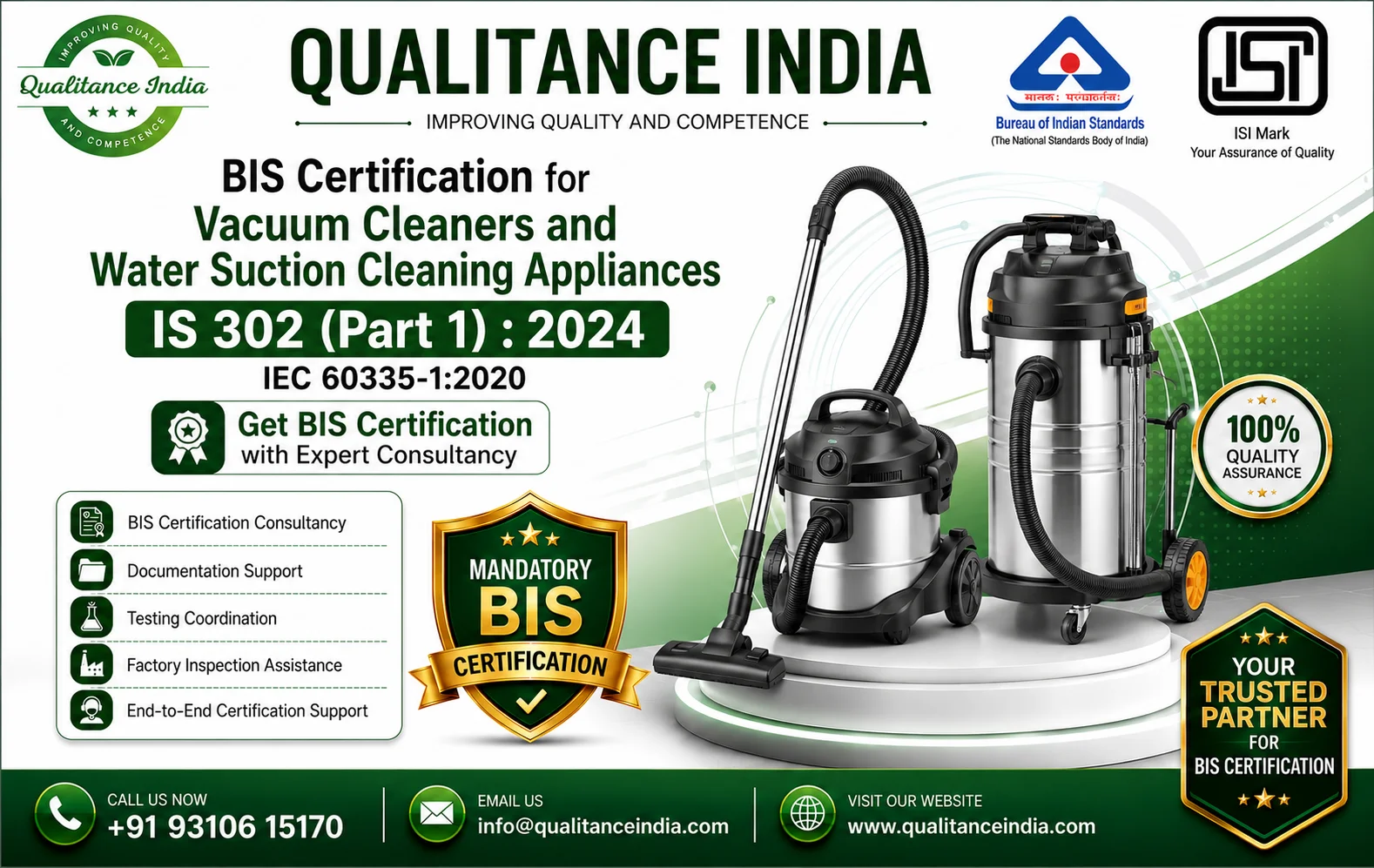
BIS Certification for Vacuum Cleaners and Water Suction Cleaning Appliances under IS 302 (Part 1):2024 and IEC 60335-1:2020
Image Title
Vacuum Cleaner BIS Certification – IS 302 (Part 1):2024
Image Caption
Mandatory BIS Certification for Vacuum Cleaners and Water Suction Cleaning Appliances | IS 302 (Part 1):2024 | Enforcement Date: 01 October 2026
Internal Linking Strategy
To improve SEO and user engagement, link this article to:
- BIS Certification Consultancy
- ISI Mark Certification
- Household Electrical Appliances Certification
- FMCS for Foreign Manufacturers
- Product Testing Services
- Documentation Support
- Factory Inspection Assistance
- BIS Quality Control Orders (QCO)
- Contact Us
- About Qualitance India
Internal linking helps search engines understand your website structure and improves crawlability.
Recommended Schema Markup
Implement these schema types to improve search engine understanding and eligibility for rich results:
- Article Schema
- FAQ Schema
- Organization Schema
- Service Schema
- LocalBusiness Schema
- Breadcrumb Schema
- WebPage Schema
Structured data can increase the chances of appearing in rich snippets and AI-powered search experiences.
Conclusion
Vacuum Cleaners and Water Suction Cleaning Appliances are widely used electrical appliances that must comply with stringent safety standards before entering the Indian market. Under IS 302 (Part 1):2024, aligned with IEC 60335-1:2020, applicable products require mandatory BIS Certification before the 01 October 2026 enforcement date.
Manufacturers and importers should begin the certification process early to complete documentation, testing, inspections, and BIS approval without business disruptions. Achieving BIS Certification not only ensures legal compliance but also strengthens product quality, consumer trust, and market competitiveness.
Contact Qualitance India
Get Expert BIS Certification Consultancy
If you manufacture, import, or supply Vacuum Cleaners and Water Suction Cleaning Appliances, Qualitance India can assist you throughout the complete BIS Certification process.
Our Services
- BIS Certification Consultancy
- ISI Mark Certification
- FMCS for Foreign Manufacturers
- Product Testing Coordination
- Documentation Preparation
- Factory Inspection Assistance
- BIS Application Filing
- Technical Compliance Review
- BIS Query Resolution
- Licence Approval Support
- Renewal & Compliance Management
Contact Details
Qualitance India
📞 Phone: +91 93106 15170
📧 Email: info@qualitanceindia.com
🌐 Website: www.qualitanceindia.com