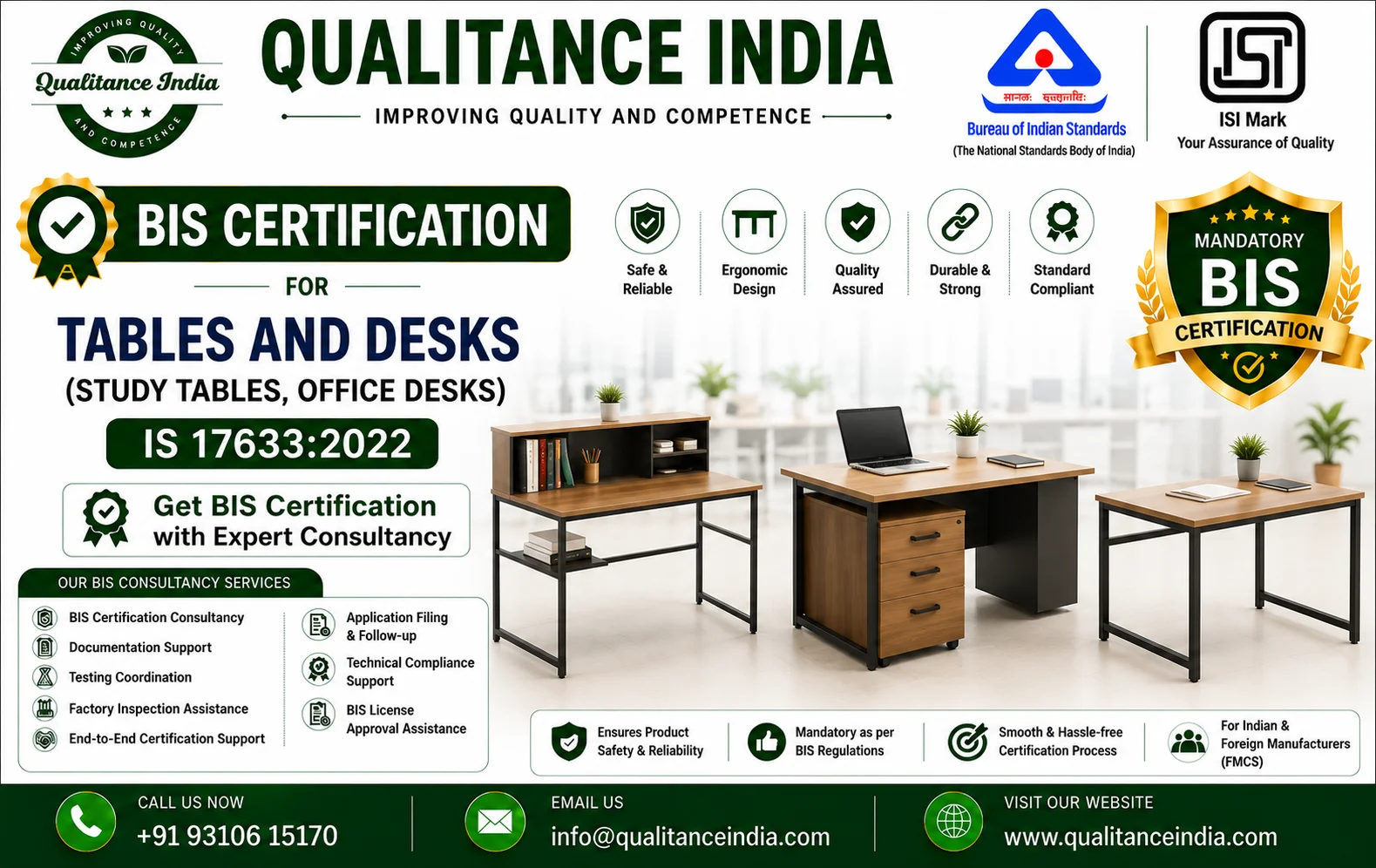
BIS Certification for Tables & Desks (Study Tables & Office Desks) as per IS 17633:2022 – Complete Guide for Manufacturers & Importers
ntroduction
Tables and desks are among the most commonly used furniture products in homes, offices, educational institutions, government departments, hospitals, laboratories, libraries, coworking spaces, and commercial establishments. Whether used for studying, working, writing, meetings, or computer operations, these furniture products must provide stability, durability, structural strength, and user safety throughout their service life.
To ensure uniform quality standards across the furniture industry, the Bureau of Indian Standards (BIS) has established IS 17633:2022, the Indian Standard for Tables and Desks (Study Tables & Office Desks). Where notified under the applicable Quality Control Order (QCO), manufacturers must obtain BIS Certification before manufacturing, selling, importing, or distributing these products in the Indian market.
BIS Certification confirms that the product complies with prescribed Indian Standards relating to design, construction, safety, durability, workmanship, performance, and quality. It also demonstrates a manufacturer's commitment to regulatory compliance and customer satisfaction.
Whether you are an Indian manufacturer, foreign manufacturer, OEM supplier, institutional furniture producer, or office furniture brand, obtaining BIS Certification under IS 17633:2022 enhances product credibility, improves market acceptance, enables participation in government tenders, and strengthens your competitive position.
This comprehensive guide explains everything you need to know about BIS Certification for Tables & Desks under IS 17633:2022, including the scope of the standard, products covered, eligibility requirements, and regulatory applicability.
About Tables & Desks (Study Tables & Office Desks)
Tables and desks are functional furniture products designed to provide a stable and comfortable working surface for writing, reading, studying, computer work, meetings, drafting, administrative tasks, and various commercial applications. These products are manufactured using materials such as solid wood, engineered wood, plywood, MDF, particle board, metal, glass, laminate, or combinations of these materials.
Modern furniture is expected to deliver not only aesthetic appeal but also ergonomic comfort, structural integrity, and long-term durability. Poorly designed tables or desks may lead to instability, premature failure, unsafe usage, and reduced productivity. Therefore, compliance with recognized quality standards is essential.
Tables and desks covered under IS 17633:2022 are widely used in:
- Corporate offices
- Educational institutions
- Schools and colleges
- Government offices
- Hospitals
- Libraries
- Laboratories
- Commercial buildings
- Residential homes
- Coworking spaces
- Training centers
- Conference rooms
- Reception areas
- Industrial offices
Key characteristics expected from quality tables and desks include:
- High structural strength
- Stable construction
- Proper load-bearing capacity
- Smooth and durable surface finish
- Resistance to daily wear and tear
- Safe edges and corners
- Long service life
- Ergonomic dimensions
- Consistent workmanship
- Reliable performance
By complying with IS 17633:2022, manufacturers ensure that their products meet nationally accepted benchmarks for safety, durability, and performance.
What is BIS Certification?
BIS Certification is a conformity assessment scheme administered by the Bureau of Indian Standards (BIS), the National Standards Body of India. It certifies that a product has been manufactured in accordance with the applicable Indian Standard and meets all specified quality, safety, and performance requirements.
For furniture products covered under IS 17633:2022, BIS Certification confirms that the manufacturer has successfully complied with the prescribed technical requirements, product testing, manufacturing controls, and quality assurance procedures.
The certification process generally includes:
- Submission of the BIS application
- Technical documentation review
- Product testing at a BIS-recognized laboratory
- Factory inspection by BIS officials
- Verification of manufacturing and quality control systems
- Grant of BIS licence upon successful compliance
Once approved, the manufacturer is authorized to use the BIS Standard Mark on certified products, demonstrating compliance with Indian quality standards.
BIS Certification provides several advantages, including:
- Regulatory compliance
- Increased consumer trust
- Better market acceptance
- Improved product credibility
- Eligibility for government procurement
- Reduced quality complaints
- Enhanced brand reputation
Scope of IS 17633:2022
IS 17633:2022 specifies the requirements, construction criteria, safety provisions, performance parameters, testing methods, and quality requirements for Tables and Desks (Study Tables & Office Desks).
The standard establishes uniform guidelines relating to:
- Design requirements
- Construction quality
- Structural integrity
- Material specifications
- Dimensional accuracy
- Stability requirements
- Static load tests
- Durability testing
- Surface finish
- Safety requirements
- Workmanship
- Marking requirements
- Sampling procedures
- Acceptance criteria
The objective of this standard is to ensure that tables and desks manufactured and supplied in India provide reliable performance throughout their intended service life while maintaining user safety and consistent quality.
Compliance with IS 17633:2022 enables manufacturers to produce furniture that meets nationally recognized quality standards and satisfies regulatory requirements where mandatory.
Products Covered under IS 17633:2022
The standard generally covers a wide range of tables and desks intended for study, office, commercial, educational, and institutional use.
Examples include:
- Study Tables
- Office Desks
- Executive Tables
- Computer Tables
- Writing Tables
- Student Study Desks
- Classroom Tables
- Modular Office Desks
- Office Workstations
- Conference Tables
- Meeting Tables
- Reception Desks
- Library Tables
- Training Room Tables
- Laboratory Tables
- Commercial Work Tables
- Home Office Tables
- General Purpose Tables
- Institutional Desks
- Multipurpose Work Tables
Manufacturers should verify the applicability of IS 17633:2022 based on their product design, intended use, and construction details.
Enforcement Date
The mandatory implementation of BIS Certification for Tables & Desks depends upon the notification issued by the Government of India under the applicable Furniture Quality Control Order (QCO).
The enforcement notification specifies:
- Effective implementation date
- Products covered
- Applicable Indian Standard
- Compliance obligations
- Exemptions, if any
- Licensing requirements
Manufacturers should regularly monitor official notifications issued by the concerned Ministry and the Bureau of Indian Standards to ensure timely compliance with the latest regulatory requirements.
Applicable Quality Control Order (QCO)
Where applicable, Tables & Desks covered under IS 17633:2022 are regulated through the relevant Furniture Quality Control Order notified by the Government of India.
The QCO typically defines:
- Applicable products
- Relevant Indian Standard
- Mandatory BIS Certification requirements
- Manufacturing and import restrictions
- Date of enforcement
- Compliance responsibilities
- Penalties for non-compliance
Manufacturers and importers must ensure that their products comply with the latest notified QCO before placing them on the Indian market.
Who Needs BIS Certification?
BIS Certification under IS 17633:2022 is generally applicable to organizations involved in manufacturing or supplying regulated tables and desks, including:
- Indian manufacturers
- Foreign manufacturers exporting to India
- OEM manufacturers
- Contract manufacturers
- Furniture brands
- Office furniture manufacturers
- Educational furniture manufacturers
- Institutional furniture manufacturers
- Government suppliers
- Importers dealing with foreign-manufactured products (where the overseas manufacturer must obtain the licence)
Obtaining BIS Certification enables these organizations to legally market their products where certification is mandatory and demonstrates compliance with Indian quality and safety standards.
Eligibility Criteria
Manufacturers seeking BIS Certification under IS 17633:2022 should generally meet the following eligibility requirements:
- Have a legally established manufacturing facility.
- Manufacture tables and desks that conform to IS 17633:2022.
- Maintain adequate production infrastructure and quality control systems.
- Ensure access to BIS-recognized testing laboratories for product evaluation.
- Demonstrate consistent manufacturing processes capable of producing compliant products.
- Appoint an Authorized Indian Representative (AIR), where required, for foreign manufacturers.
- Submit complete technical documentation and product information.
- Successfully complete product testing, factory inspection, and BIS evaluation.
Meeting these eligibility criteria is the first step toward obtaining a BIS licence and ensuring compliance with the applicable Indian Standard for tables and desks.
BIS Certification Process for Tables & Desks (Study Tables & Office Desks) as per IS 17633:2022
Complete BIS Certification Process
Obtaining BIS Certification for Tables & Desks (Study Tables & Office Desks) under IS 17633:2022 involves multiple stages designed to verify that the product consistently complies with the prescribed Indian Standard. The certification process evaluates the product's quality, manufacturing controls, testing capability, and overall compliance with BIS requirements.
Whether you are an Indian manufacturer or a foreign manufacturer exporting to India, following the correct certification process helps avoid delays, non-compliance, and application rejection.
The standard BIS certification process includes the following stages:
Step 1: Product Applicability Verification
Before initiating the application, manufacturers should determine whether their product falls under IS 17633:2022 and whether it is covered under the applicable Furniture Quality Control Order (QCO).
This includes:
- Product category verification
- Intended application review
- Product design assessment
- Material verification
- Standard applicability confirmation
This initial assessment helps ensure that the correct Indian Standard is selected for certification.
Step 2: Technical Documentation Preparation
After confirming applicability, manufacturers should prepare all technical documents required by BIS.
These documents generally include:
- Manufacturing details
- Product specifications
- Factory information
- Quality control procedures
- Testing facility details
- Raw material information
- Product drawings
- Process flow
Preparing accurate documentation significantly reduces the possibility of delays during application review.
Step 3: Online BIS Application Submission
The manufacturer submits the BIS application through the prescribed BIS portal.
The application includes:
- Manufacturer details
- Factory address
- Product details
- Applicable Indian Standard
- Manufacturing process
- Authorized signatory information
- Supporting documents
After submission, BIS reviews the application for completeness.
Step 4: Product Testing
Representative product samples are tested in a BIS-recognized laboratory.
The laboratory evaluates whether the product complies with IS 17633:2022.
Testing verifies:
- Structural strength
- Stability
- Safety
- Durability
- Dimensional accuracy
- Performance
- Material quality
- Surface finish
Only products meeting all applicable requirements proceed to the next stage.
Step 5: Factory Inspection
Following successful product testing, BIS officials conduct a factory inspection.
The inspection verifies:
- Manufacturing infrastructure
- Production capability
- Quality management system
- In-house testing facilities
- Raw material inspection
- Calibration records
- Process controls
- Product traceability
- Storage practices
The inspection ensures that the manufacturer can consistently produce products conforming to IS 17633:2022.
Step 6: Compliance Evaluation
After factory inspection, BIS evaluates:
- Laboratory reports
- Factory inspection findings
- Technical documents
- Manufacturing process
- Quality assurance system
- Product conformity
Any non-conformities identified during evaluation must be resolved before licence approval.
Step 7: Grant of BIS Licence
Upon successful completion of all evaluations, BIS grants the licence to the manufacturer.
The manufacturer is then authorized to:
- Manufacture certified products
- Use the BIS Standard Mark (as permitted)
- Sell regulated products in the Indian market
- Demonstrate compliance with applicable Indian Standards
The manufacturer must continue complying with BIS requirements throughout the validity of the licence.
Required Documents
Preparing complete documentation is one of the most important steps in obtaining BIS Certification. Missing or incorrect documents often lead to unnecessary delays.
Typical documents required include:
Company Documents
- Certificate of Incorporation
- GST Registration
- Factory Registration Certificate
- MSME Certificate (if applicable)
- PAN Card
- Import Export Code (for foreign trade)
- Business Licence
Manufacturing Documents
- Factory Layout
- Manufacturing Process Flow Chart
- Production Capacity Details
- Machinery List
- Manufacturing Equipment Details
- Calibration Records
- Process Control Documents
Product Documents
- Product Catalogue
- Technical Specifications
- Engineering Drawings
- Product Dimensions
- Material Specifications
- Bill of Materials
- Product Identification Details
Quality Documents
- Quality Manual
- Incoming Material Inspection Procedure
- In-Process Inspection Procedure
- Final Inspection Procedure
- Quality Control Plan
- Testing Procedures
- Internal Audit Records
Laboratory Documents
- Testing Equipment List
- Calibration Certificates
- Laboratory Infrastructure Details
- Test Reports (if available)
Legal Documents
- Authorization Letter
- Trademark Authorization (if applicable)
- Authorized Indian Representative (AIR) documents for foreign manufacturers
- Identity proof of authorized signatory
Testing Requirements
Testing is one of the most important requirements under BIS Certification.
The objective is to verify that the product satisfies all quality and performance requirements specified in IS 17633:2022.
Depending upon product design and construction, laboratory evaluation may include:
Structural Performance
- Static load test
- Strength verification
- Structural integrity
- Frame rigidity
Stability Tests
- Front stability
- Side stability
- Rear stability
- Overturning resistance
Durability Tests
- Cyclic loading
- Repeated use testing
- Long-term performance evaluation
Material Evaluation
- Material quality verification
- Surface finish assessment
- Dimensional accuracy
- Component inspection
Safety Assessment
- Sharp edge examination
- User safety verification
- Mechanical safety
- Stability during normal use
Functional Evaluation
- Product usability
- Performance under specified loads
- Assembly quality
- Workmanship inspection
Testing must be carried out in accordance with the prescribed methods under IS 17633:2022.
Factory Inspection Process
The BIS factory inspection ensures that manufacturers have the capability to consistently produce compliant products.
During inspection, BIS officials generally review:
Manufacturing Facilities
- Production area
- Machinery condition
- Manufacturing process
- Production capacity
Quality Control System
- Incoming inspection
- In-process inspection
- Final inspection
- Testing records
Laboratory Facilities
- Testing equipment
- Calibration status
- Laboratory competence
- Equipment maintenance
Production Records
- Batch records
- Inspection reports
- Raw material traceability
- Product traceability
Storage Facilities
- Raw material storage
- Finished goods storage
- Product identification
- Inventory management
Personnel Competence
- Skilled operators
- Quality inspectors
- Laboratory personnel
- Technical supervisors
The inspection concludes with observations and recommendations, and any identified non-conformities must be addressed before licence approval.
Common Reasons for BIS Application Rejection
Many BIS applications are delayed or rejected due to avoidable errors. Common reasons include:
- Incorrect selection of applicable Indian Standard
- Incomplete documentation
- Inconsistent manufacturing process
- Product failing laboratory tests
- Poor quality management system
- Inadequate testing facilities
- Calibration records not maintained
- Missing technical specifications
- Factory infrastructure deficiencies
- Improper product identification
- Non-compliance during factory inspection
- Incorrect application details
- Delayed response to BIS observations
Working with an experienced BIS consultant helps minimize these risks and improves the chances of successful certification.
Cost Factors
The cost of BIS Certification for Tables & Desks varies depending on several factors, including:
- Applicable BIS fees
- Product testing charges
- Number of product variants
- Factory inspection expenses
- Documentation preparation
- Consultancy fees
- Laboratory charges
- Travel expenses (where applicable)
- Licence fees
- Surveillance costs after certification
Manufacturers should obtain a customized cost estimate based on their specific product range and certification requirements.
Timeline
The overall certification timeline depends on document readiness, laboratory testing, factory inspection scheduling, and BIS review.
A typical timeline includes:
| Activity | Estimated Duration |
|---|---|
| Product Evaluation | 3–5 Days |
| Documentation Preparation | 5–10 Days |
| BIS Application Filing | 1–2 Days |
| Laboratory Testing | 15–30 Days |
| Factory Inspection | 1–3 Days |
| Compliance Review | 10–20 Days |
| Licence Grant | Subject to BIS approval |
Timely submission of accurate documents and successful testing can help reduce the overall certification duration.
Benefits of BIS Certification
Obtaining BIS Certification under IS 17633:2022 offers significant advantages for manufacturers, importers, and consumers.
Regulatory Benefits
- Compliance with applicable Quality Control Orders
- Legal authorization to sell regulated products
- Reduced risk of regulatory action
Business Benefits
- Enhanced brand credibility
- Increased customer trust
- Competitive market advantage
- Access to government tenders
- Better acceptance in institutional procurement
Product Benefits
- Improved product quality
- Verified safety and durability
- Consistent manufacturing standards
- Reduced product failures
- Better customer satisfaction
Commercial Benefits
- Stronger dealer confidence
- Higher market acceptance
- Improved export readiness
- Long-term business growth
Why Choose Qualitance India?
Qualitance India is a trusted consultancy specializing in BIS Certification and regulatory compliance. Our experienced team assists manufacturers through every stage of the certification journey.
Our services include:
- Product applicability assessment
- End-to-end BIS certification consultancy
- Documentation preparation
- BIS application filing
- Coordination with BIS-recognized laboratories
- Technical compliance support
- Factory inspection assistance
- Response to BIS queries
- Licence approval support
- Post-certification compliance guidance
We work with Indian and foreign manufacturers to ensure a smooth, transparent, and efficient certification process.
Step-by-Step Flow Chart (Text Format)
Identify Product Category
          │
          ▼
Confirm Applicability of IS 17633:2022
          │
          ▼
Prepare Technical Documentation
          │
          ▼
Submit BIS Application
          │
          ▼
Sample Testing at BIS-Recognized Laboratory
          │
          ▼
Factory Inspection by BIS
          │
          ▼
Compliance Evaluation
          │
          ▼
Closure of Observations (if any)
          │
          ▼
Grant of BIS Licence
          │
          ▼
Use BIS Standard Mark
          │
          ▼
Ongoing Compliance & Surveillance