BIS Certification for Appliances for Heating Liquids – IS 302 (Part 1):2024 | IEC 60335-1:2020 | BIS Certification Consultancy by Qualitance India
Introduction to BIS Certification for Appliances for Heating Liquids
BIS Certification for Appliances for Heating Liquids – Complete Guide
The Indian market for electrical appliances has grown rapidly over the last few years. Products such as electric kettles, water boilers, tea makers, coffee brewers, hot water dispensers, milk warmers, immersion heaters, and other liquid heating appliances are widely used in homes, offices, hotels, hospitals, educational institutions, and commercial kitchens.
Since these appliances operate using electricity and generate high temperatures, they must meet strict safety and quality requirements to prevent electric shock, overheating, fire hazards, insulation failure, and other potential risks.
To ensure consumer safety, the Bureau of Indian Standards (BIS) has introduced mandatory certification requirements under IS 302 (Part 1):2024 aligned with IEC 60335-1:2020 for applicable electrical appliances.
Manufacturers and importers planning to sell these products in India must comply with the applicable Quality Control Orders (QCOs) and obtain BIS Certification before placing products in the Indian market.
At Qualitance India, we provide complete BIS Certification Consultancy services, including:
- Product Applicability Assessment
- Documentation Preparation
- Laboratory Testing Coordination
- BIS Application Filing
- Factory Inspection Assistance
- Query Resolution
- License Approval Support
- Renewal & Compliance Assistance
What are Appliances for Heating Liquids?
Heating liquid appliances are electrical devices designed to heat water or other liquids for domestic or commercial use.
Examples include:
- Electric Kettles
- Electric Water Boilers
- Instant Water Heaters
- Tea Makers
- Coffee Makers
- Hot Water Dispensers
- Electric Beverage Makers
- Milk Warmers
- Soup Warmers
- Commercial Water Heating Appliances
These products operate at high temperatures and therefore require compliance with stringent electrical safety standards before being marketed in India.
Applicable Indian Standard
For these products, the applicable standard is:
IS 302 (Part 1):2024
IEC 60335-1:2020
This standard specifies general safety requirements for household and similar electrical appliances, including protection against electrical, mechanical, thermal, and fire hazards.
Why BIS Certification is Important
BIS Certification ensures that appliances for heating liquids are:
- Safe for consumers
- Electrically reliable
- Mechanically durable
- Thermally protected
- Manufactured according to Indian Standards
- Suitable for long-term use
It also builds customer confidence and demonstrates compliance with Indian regulations.
Enforcement Date
Enforcement Date: 01 October 2026
After this date, applicable products must comply with the relevant Quality Control Order before being sold in the Indian market.
Benefits of BIS Certification
Obtaining BIS Certification offers several advantages:
- Legal permission to sell products in India
- Compliance with Government regulations
- Improved customer confidence
- Enhanced brand reputation
- Reduced risk of product recalls
- Better acceptance in retail and e-commerce channels
- Increased opportunities in institutional and government procurement
- Competitive advantage in the marketplace
Why Choose Qualitance India?
Qualitance India provides end-to-end BIS Certification Consultancy for manufacturers and importers.
Our services include:
- BIS Applicability Check
- Standard Identification
- Product Documentation
- Testing Coordination
- BIS Application Filing
- Factory Inspection Assistance
- Technical Support
- Compliance Guidance
- License Renewal Assistance
- Post-Certification Support
With experienced consultants and a structured approach, we help businesses achieve faster approvals while ensuring compliance with BIS requirements.
BIS Certification Process for Appliances for Heating Liquids (IS 302 (Part 1):2024 | IEC 60335-1:2020)
Complete BIS Certification Process for Appliances for Heating Liquids
Manufacturers planning to manufacture, import, or sell Appliances for Heating Liquids in India must obtain BIS Certification under Scheme-I (ISI Mark Scheme). The Safety of Household, Commercial and Similar Electrical Appliances Quality Control Order covers "Appliances for Heating Liquids" under IS 302 (Part 1):2024 / IEC 60335-1:2020.
The certification process involves technical evaluation, product testing, document verification, factory assessment, and grant of the BIS licence.
Step 1: Product Applicability Assessment
The first step is determining whether your product falls under the mandatory BIS certification requirement.
Examples include:
- Electric Kettles
- Electric Water Boilers
- Hot Water Dispensers
- Beverage Makers
- Tea Makers
- Coffee Brewing Appliances
- Soup Heating Appliances
- Commercial Liquid Heating Equipment
- Similar Household or Commercial Liquid Heating Appliances
The correct Indian Standard and applicable Quality Control Order should be identified before starting the certification process.
Step 2: Identification of Applicable Standards
The applicable standard is:
IS 302 (Part 1):2024 IEC 60335-1:2020
This standard specifies the general safety requirements for household and similar electrical appliances, including protection against electric shock, excessive temperatures, fire hazards, mechanical hazards, and unsafe construction.
Step 3: Preparation of Technical Documents
Before submitting the application, manufacturers should prepare all required documents.
Typical documents include:
Company Documents
- Manufacturing License
- Factory Registration Certificate
- GST Registration (Indian manufacturers)
- IEC Certificate (Import Export Code)
- Trademark Certificate (if applicable)
- Authorization Letter
- Organization Chart
Factory Documents
- Factory Layout
- Manufacturing Process Flow Chart
- Quality Control Plan
- Production Machinery List
- Testing Equipment List
- Calibration Certificates
- Internal Test Reports
Product Documents
- Product Specification Sheet
- User Manual
- Product Catalogue
- Product Photographs
- Product Label Artwork
- Rating Plate Details
- Circuit Diagram
- PCB Layout
- Bill of Materials (BOM)
- Component List
Quality Documents
- Incoming Inspection Procedure
- Final Inspection Procedure
- Quality Assurance Manual
- Complaint Handling Procedure
Preparing complete and accurate documentation at the beginning helps reduce delays during BIS scrutiny.
Step 4: Product Testing in BIS-Recognized Laboratory
One of the most important stages is laboratory testing.
The product sample is submitted to a BIS-recognized laboratory where it is tested according to the applicable Indian Standard.
Typical tests include:
- Electrical Safety Tests
- Earth Continuity Test
- Insulation Resistance Test
- Leakage Current Test
- High Voltage (Dielectric Strength) Test
- Input Power Test
- Temperature Rise Test
- Abnormal Operation Test
- Mechanical Strength Test
- Stability Test
- Moisture Resistance Test
- Heat Resistance Test
- Fire Resistance Test
- Component Safety Evaluation
- Endurance Test
- Marking and Instruction Verification
The product must successfully pass all applicable safety tests before the application proceeds.
Step 5: Submission of BIS Application
After successful testing, the manufacturer submits the BIS application along with:
- Laboratory Test Report
- Technical Documents
- Manufacturing Details
- Product Details
- Quality Documents
- Application Forms
- Supporting Declarations
BIS verifies whether the submitted information matches the applicable requirements.
Step 6: Factory Inspection
Under Scheme-I, BIS may conduct a factory assessment as part of the certification process, depending on the product category and applicable procedures. The inspection verifies the manufacturer's capability to consistently produce compliant products.
During inspection, BIS officials may verify:
Manufacturing Facilities
- Production Line
- Assembly Area
- Raw Material Storage
- Finished Goods Area
Quality Control System
- Incoming Inspection
- In-process Inspection
- Final Inspection
Laboratory Facilities
- Testing Equipment
- Calibration Status
- Test Records
- Laboratory Competency
Production Records
- Batch Records
- Inspection Reports
- Calibration Reports
- Internal Quality Documents
Step 7: Resolution of BIS Queries
Sometimes BIS may request:
- Additional documents
- Clarification on product specifications
- Corrected labeling
- Revised technical drawings
- Additional testing
- Updated declarations
Responding promptly helps avoid unnecessary delays.
Step 8: Grant of BIS Licence
After satisfactory review of:
- Test Reports
- Factory Assessment (where applicable)
- Technical Documents
- Quality System
- Compliance Requirements
BIS grants the licence under Scheme-I.
The manufacturer can then:
- Use the Standard Mark (ISI Mark)
- Manufacture products
- Sell products in India
- Import applicable products into India (where permitted under the regulatory framework)
Factory Infrastructure Requirements
Manufacturers should maintain:
- Proper Manufacturing Facility
- Qualified Technical Staff
- Quality Control Department
- Internal Testing Laboratory
- Calibrated Equipment
- Product Traceability System
- Complaint Management System
These help ensure consistent compliance with BIS requirements.
Typical Timeline
Although timelines vary depending on product complexity and document readiness, a typical project may follow this schedule:
| Activity | Approximate Time |
|---|---|
| Document Preparation | 5–10 Working Days |
| Laboratory Testing | 10–25 Working Days |
| Application Review | 7–15 Working Days |
| Factory Assessment (if applicable) | As scheduled by BIS |
| Query Resolution | Depends on response time |
| Licence Grant | After satisfactory compliance |
Early preparation of documents and samples can significantly reduce the overall processing time.
BIS Certification Fees
The overall cost depends upon:
- Government Fees
- Product Testing Charges
- Number of Models
- Manufacturing Location
- Documentation Requirements
- Factory Assessment Costs (if applicable)
- Consultancy Charges (if availed)
Since fees can change periodically and vary by product scope, businesses should obtain the latest applicable fee details before applying.
Common Reasons for Application Delays or Rejection
Many applications are delayed because of avoidable mistakes.
Common issues include:
- Incorrect Product Standard
- Incomplete Documentation
- Poor Quality Test Samples
- Incorrect Product Labels
- Missing Calibration Certificates
- Factory Equipment Not Ready
- Test Report Deficiencies
- Inconsistent Technical Documents
- Delayed Response to BIS Queries
- Incorrect Brand Authorization
Careful planning and document review before submission greatly improve the chances of a smooth approval process.
Post-Certification Compliance
Receiving the BIS Licence is not the end of compliance.
Manufacturers should continue to:
- Maintain Product Quality
- Follow Applicable Indian Standards
- Keep Testing Equipment Calibrated
- Maintain Production Records
- Handle Customer Complaints Effectively
- Cooperate with BIS Surveillance Activities
- Apply the ISI Mark correctly
- Inform BIS of significant product or manufacturing changes, where required
Failure to maintain compliance can result in regulatory action, including suspension or cancellation of the licence.
BIS Certification for Appliances for Heating Liquids – FAQs, Benefits, Compliance & Final SEO Content
Industries That Require BIS Certification for Appliances for Heating Liquids
The demand for appliances used to heat liquids is growing rapidly across residential, commercial, and industrial sectors. BIS Certification helps manufacturers demonstrate compliance with Indian safety standards and supports market access.
Industries that commonly require these products include:
- Home Appliance Manufacturers
- Electric Kettle Manufacturers
- Coffee Machine Manufacturers
- Tea Maker Manufacturers
- Water Boiler Manufacturers
- Beverage Equipment Manufacturers
- Kitchen Appliance Brands
- Hotel & Hospitality Equipment Suppliers
- Commercial Kitchen Equipment Manufacturers
- Restaurant Equipment Manufacturers
- Healthcare & Hospital Equipment Suppliers
- Office Pantry Appliance Manufacturers
- Importers of Electrical Appliances
- OEM & Private Label Manufacturers
- E-commerce Sellers and Brand Owners
Why Choose Qualitance India for BIS Certification?
Obtaining BIS Certification involves technical documentation, product testing, regulatory compliance, and coordination with BIS. Professional guidance can help streamline this process.
At Qualitance India, we provide complete BIS Certification Consultancy services, including:
Product Applicability Assessment
We identify whether your product falls under the mandatory BIS certification requirements and determine the applicable Indian Standard.
Documentation Support
Our experts assist in preparing and reviewing all technical and regulatory documents required for the application.
Testing Coordination
We coordinate with BIS-recognized laboratories to facilitate product testing in accordance with applicable standards.
BIS Application Filing
We assist in preparing and submitting the BIS application and supporting documents.
Factory Inspection Assistance
Where applicable, we help manufacturers prepare for BIS factory inspections by reviewing quality systems and documentation.
Query Resolution
We support clients in responding to BIS queries and technical clarifications promptly.
Licence Approval Support
We provide end-to-end guidance until the BIS licence is granted.
Renewal & Ongoing Compliance
Our services also include licence renewal assistance and support with ongoing BIS compliance requirements.
Benefits of Professional BIS Certification Consultancy
Working with experienced consultants can help manufacturers:
- Understand applicable BIS requirements
- Prepare accurate documentation
- Reduce application errors
- Coordinate laboratory testing efficiently
- Respond effectively to BIS queries
- Improve overall project management
- Stay informed about regulatory updates
Consequences of Non-Compliance
Manufacturers, importers, or sellers who fail to comply with mandatory BIS requirements may face regulatory action under applicable laws.
Possible consequences include:
- Restriction on sale of notified products
- Customs clearance issues for imports
- Product recalls
- Regulatory penalties, where applicable
- Suspension or cancellation of certification
- Damage to brand reputation and customer confidence
Maintaining ongoing compliance is essential even after obtaining a BIS licence.
Frequently Asked Questions (FAQs)
1. Is BIS Certification mandatory for Appliances for Heating Liquids?
Yes. If the product is covered under the applicable Quality Control Order (QCO), BIS Certification is mandatory before it can be legally sold in India.
2. Which standard applies to these products?
The applicable safety standard is:
IS 302 (Part 1):2024 / IEC 60335-1:2020, along with any relevant product-specific requirements where applicable.
3. Which products are covered?
Examples include:
- Electric Kettles
- Water Boilers
- Tea Makers
- Coffee Makers
- Hot Water Dispensers
- Beverage Heating Appliances
- Similar appliances designed for heating liquids
The exact applicability depends on the product's design and intended use.
4. Who can apply for BIS Certification?
Applications can generally be submitted by:
- Indian Manufacturers
- Foreign Manufacturers (through applicable BIS procedures)
- Authorized representatives, where permitted under BIS regulations
5. Is product testing mandatory?
Yes. Products must be tested in accordance with applicable BIS requirements before certification can be granted.
6. How long does the certification process take?
The timeline depends on:
- Product complexity
- Laboratory testing duration
- Completeness of documentation
- BIS review process
- Whether any additional information or inspection is required
Proper preparation can help reduce delays.
7. Is a factory inspection required?
For Scheme-I (ISI Mark Scheme), BIS may conduct a factory assessment depending on the applicable procedures and product category.
8. Can foreign manufacturers obtain BIS Certification?
Yes. Foreign manufacturers can apply through the applicable BIS process and must comply with the requirements prescribed by BIS.
9. How long is the BIS licence valid?
The validity period is governed by the applicable BIS licensing provisions and is subject to renewal in accordance with BIS requirements.
10. Why should I choose Qualitance India?
Qualitance India offers comprehensive consultancy services covering documentation, testing coordination, application support, inspection assistance, compliance guidance, and post-certification support to help manufacturers navigate the BIS certification process efficiently.
Final Conclusion
BIS Certification for Appliances for Heating Liquids under IS 302 (Part 1):2024 / IEC 60335-1:2020 plays a vital role in ensuring that products placed on the Indian market meet established safety and quality requirements. Compliance not only helps manufacturers satisfy regulatory obligations but also enhances consumer confidence and strengthens brand credibility.
Whether you manufacture electric kettles, water boilers, tea makers, coffee machines, or other liquid-heating appliances, preparing the correct documentation, completing product testing, and following the BIS certification process carefully can help avoid unnecessary delays and compliance issues.
With experienced technical guidance and structured project management, Qualitance India supports manufacturers throughout the certification journey—from product applicability assessment and documentation to testing coordination, application filing, and post-certification compliance.
SEO Keywords
- BIS Certification for Appliances for Heating Liquids
- IS 302 (Part 1):2024 Certification
- IEC 60335-1:2020 BIS Certification
- BIS Certification for Electric Kettle
- BIS Certification for Water Boiler
- BIS Certification Consultant India
- BIS Consultancy Services
- BIS ISI Certification for Electrical Appliances
- BIS Registration for Home Appliances
- BIS Certification Documentation
- BIS Testing Laboratory
- BIS Factory Inspection
- BIS Compliance Consultant
- Qualitance India BIS Services
Internal Linking Suggestions
Link this article with related pages on your website, such as:
- BIS Certification for Electric Kettles
- BIS Certification for Coffee Makers
- BIS Certification for Household Electrical Appliances
- BIS ISI Mark Certification
- BIS CRS Registration
- FMCS Certification for Foreign Manufacturers
- BIS Testing Services
- Product Certification Consultancy
- Quality Control Orders (QCOs)
- Electrical Product Compliance Services
Image SEO
Image File Name:
bis-certification-appliances-heating-liquids-is-302-part-1-2024.webp
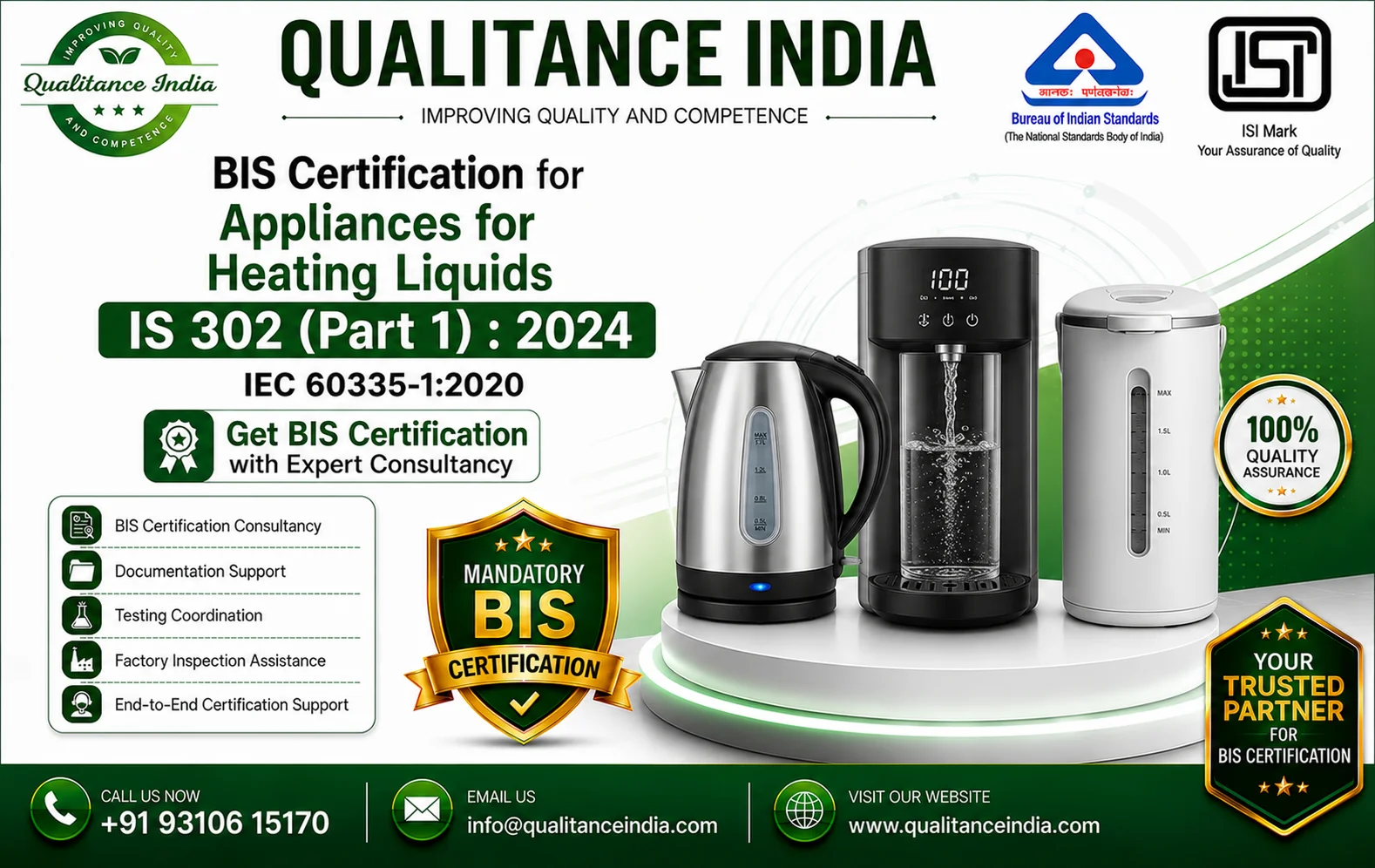
Image ALT Text: "BIS Certification for Appliances for Heating Liquids under IS 302 (Part 1):2024 IEC 60335-1:2020 – Qualitance India Consultancy"
Image Title: "BIS Certification Consultancy for Appliances for Heating Liquids"
Image Caption: "Expert BIS Certification Consultancy for Appliances for Heating Liquids as per IS 302 (Part 1):2024 / IEC 60335-1:2020."
Contact Qualitance India
Qualitance India
BIS Certification Consultancy Experts
📞 Phone: +91 93106 15170
📧 Email: info@qualitanceindia.com
🌐 Website: www.qualitanceindia.com