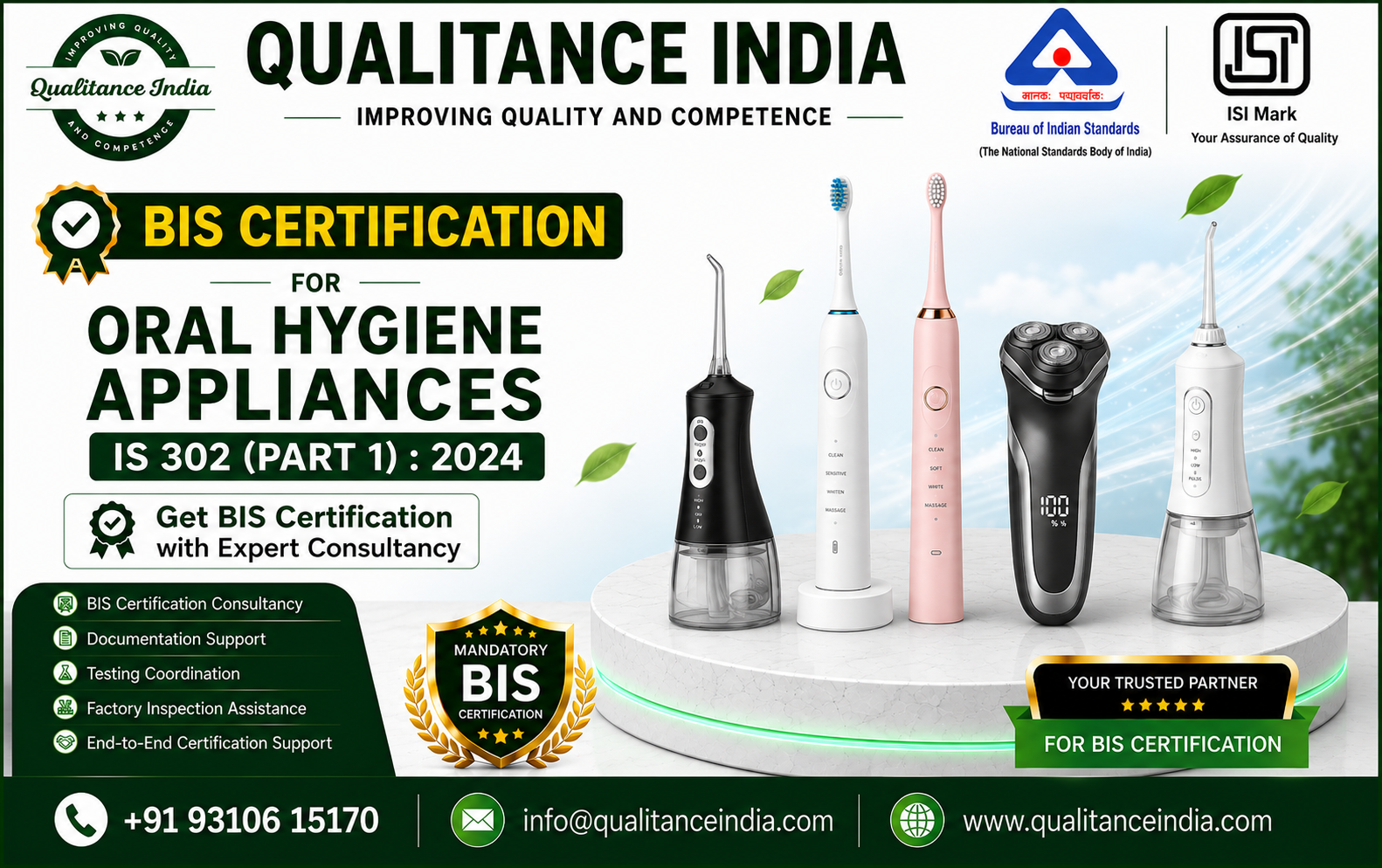
BIS Certification Consultancy for Oral Hygiene Appliances – IS 302 (Part 1):2024 | IEC 60335-1:2020
INTRODUCTION: BIS CERTIFICATION FOR ORAL HYGIENE APPLIANCES
Oral hygiene appliances are increasingly becoming an important category of electrical consumer products in India. Electric toothbrushes, rechargeable toothbrushes, oral irrigators, water flossers and other electrically operated oral-care appliances are widely used by consumers in homes and personal-care environments.
Because these products are electrical appliances and may be used in environments where water and moisture are present, electrical safety and product compliance are important considerations.
Under the applicable regulatory framework for household, commercial and similar electrical appliances, products falling within the applicable scope of IS 302 (Part 1):2024 / IEC 60335-1:2020 are required to meet the prescribed safety requirements. The BIS official upcoming QCO list identifies the broader category of electrical appliances under this standard with an implementation date of 01 October 2026. The exact applicability to a particular oral hygiene appliance should be confirmed based on its construction, electrical characteristics, intended use and whether another specific QCO or product standard applies.
Qualitance India provides end-to-end BIS Certification Consultancy for Oral Hygiene Appliances, supporting manufacturers and eligible foreign manufacturers through product applicability assessment, documentation, testing coordination, BIS application filing, technical compliance, factory inspection assistance and licence approval support.
If you manufacture or plan to import electrical oral hygiene appliances for the Indian market, starting the BIS compliance process early can help you prepare for the upcoming implementation requirements and avoid last-minute certification challenges.
ABOUT ORAL HYGIENE APPLIANCES
Oral hygiene appliances are electrical or battery-operated products designed to support personal oral care and cleaning.
Modern oral-care products may use rechargeable batteries, direct electrical supply, charging bases, motors, pumps, vibration systems or other electrical components. Depending on the product design and intended application, different technical and safety requirements may apply.
Common examples include:
- Electric toothbrushes
- Rechargeable electric toothbrushes
- Battery-operated toothbrushes
- Sonic toothbrushes
- Powered toothbrushes
- Oral irrigators
- Water flossers
- Electric dental cleaning appliances
- Other electrically operated oral hygiene appliances falling within the applicable scope
The precise regulatory classification should always be determined by evaluating the complete product construction, rated voltage, power source, intended use and applicable standards.
WHAT IS BIS CERTIFICATION?
BIS Certification is a conformity assessment mechanism administered by the Bureau of Indian Standards (BIS). Under the applicable certification framework, manufacturers demonstrate that their products comply with relevant Indian Standards and fulfil the prescribed certification requirements.
For products covered under the applicable mandatory QCO framework, certification is generally operated through the BIS Scheme-I / ISI Mark Scheme, subject to the specific requirements applicable to the product.
For electrical appliances covered by IS 302 (Part 1):2024, manufacturers may need to demonstrate compliance through appropriate documentation, product testing, factory assessment and other BIS requirements before obtaining the required licence.
The BIS standard IS 302 (Part 1):2024 / IEC 60335-1:2020 is titled Household and Similar Electrical Appliances – Safety Part 1: General Requirements (Seventh Revision). BIS also provides a product manual for certification under Scheme-I to support uniform certification practices and assist prospective applicants.
WHY IS BIS CERTIFICATION IMPORTANT FOR ORAL HYGIENE APPLIANCES?
BIS compliance is important because oral hygiene appliances can involve electrical components, rechargeable batteries, motors, heating elements in certain designs, charging systems and exposure to moisture.
BIS certification helps manufacturers demonstrate conformity with applicable safety requirements and provides confidence to customers, distributors and business partners.
Key benefits include:
- Compliance with applicable Indian regulatory requirements
- Improved electrical safety
- Better product quality assurance
- Increased consumer confidence
- Stronger market acceptance
- Support for legal market entry
- Reduced risk of regulatory non-compliance
- Better readiness for future regulatory enforcement
For businesses preparing for the 01 October 2026 implementation date applicable to the broader IS 302 (Part 1):2024 electrical-appliance category, early preparation can be particularly valuable.
SCOPE OF IS 302 (PART 1):2024 / IEC 60335-1:2020
IS 302 (Part 1):2024 is the Indian adoption of IEC 60335-1:2020 and establishes general safety requirements for household and similar electrical appliances.
The BIS official information describes the standard as covering household and similar electrical appliances and places it within the safety standards framework for electrical appliances.
The broader QCO framework referenced by BIS applies to specified electrical appliances intended for household, commercial or similar applications, subject to the stated voltage limits and exclusions, including products already covered under another applicable QCO.
For an oral hygiene appliance, applicability should be assessed individually. In addition to the general requirements of IS 302 (Part 1), the product may also need to meet relevant particular requirements depending on its product category and construction.
For oral hygiene appliances, the BIS standards documentation references IEC 60335-2-52, which contains particular requirements for oral hygiene appliances. This means product-specific assessment is important rather than relying only on the general requirements of Part 1.
PRODUCTS THAT MAY REQUIRE BIS APPLICABILITY ASSESSMENT
Depending on design, power source and intended use, the following products may require evaluation for BIS certification:
- Electric Toothbrushes
- Rechargeable Electric Toothbrushes
- Battery-Operated Toothbrushes
- Sonic Toothbrushes
- Powered Toothbrushes
- Oral Irrigators
- Water Flossers
- Electric Oral Cleaning Appliances
- Other Similar Electrical Oral Hygiene Appliances
Important: Product coverage should be confirmed through a technical applicability assessment before filing the BIS application. A product may also be subject to a specific particular standard or another regulatory requirement.
ENFORCEMENT DATE: 01 OCTOBER 2026
The BIS official upcoming QCO information lists IS 302 (Part 1):2024 / IEC 60335-1:2020 for the broader category of applicable electrical appliances with an implementation date of 01 October 2026.
Therefore, manufacturers and businesses dealing with electrical oral hygiene appliances should review their product applicability and begin preparing documentation and testing requirements well before the applicable implementation date.
The exact applicability to an individual oral hygiene product should be determined based on the product's technical specifications and the applicable QCO and standard requirements.
APPLICABLE QCO DETAILS
The relevant regulatory framework is associated with the Safety of Household, Commercial and Similar Electrical Appliances (Quality Control) Order.
BIS's Scheme-I information lists IS 302 (Part 1):2024 / IEC 60335-1:2020 under the certification framework for safety of household, commercial and similar electrical appliances and references the applicable QCO notifications.
The QCO framework is designed to ensure that covered electrical appliances comply with the applicable Indian Standards and certification requirements.
Important: Whether a specific oral hygiene appliance is covered should be confirmed through product-specific assessment. Products covered under another QCO may not fall under the same QCO.
WHO NEEDS BIS CERTIFICATION FOR ORAL HYGIENE APPLIANCES?
The requirement may apply to manufacturers producing covered electrical oral hygiene appliances for the Indian market.
This may include:
- Indian manufacturers
- Foreign manufacturers supplying products to India
- Manufacturers using different brand names
- OEM manufacturers
- ODM manufacturers
- Contract manufacturers
- Businesses planning to launch new electrical oral-care products in India
For foreign manufacturers, additional requirements may apply under the BIS certification process, including arrangements related to an Authorized Indian Representative (AIR) where applicable.
Importers and distributors should also verify that the products they source are compliant with the applicable mandatory certification requirements before placing them on the Indian market.
ELIGIBILITY CRITERIA FOR BIS CERTIFICATION
To apply for BIS certification, the manufacturer generally needs to demonstrate the ability to consistently manufacture products conforming to the applicable Indian Standard.
Important areas include:
- Valid manufacturing facility
- Defined manufacturing process
- Adequate production infrastructure
- Quality control arrangements
- Testing facilities or suitable testing arrangements
- Appropriate technical documentation
- Product samples for testing
- Proper product identification and model details
- Compliance with applicable BIS requirements
- Availability of required manufacturing and quality records
The exact eligibility and documentation requirements depend on the product, manufacturing location, certification scheme and applicable BIS process.
COMPLETE BIS CERTIFICATION PROCESS FOR ORAL HYGIENE APPLIANCES
The BIS certification process generally involves several technical and administrative stages.
STEP 1: PRODUCT APPLICABILITY ASSESSMENT
The first step is to identify the correct Indian Standard and determine whether the product falls within the applicable QCO.
For oral hygiene appliances, the product should be evaluated based on:
- Product function
- Electrical input
- Rated voltage
- Power source
- Battery configuration
- Charging arrangement
- Construction
- Intended use
- Product category
- Applicable particular requirements
STEP 2: DOCUMENTATION PREPARATION
The manufacturer prepares the technical and legal documents required for the BIS application.
STEP 3: SAMPLE TESTING
Product samples are tested according to the applicable requirements at the appropriate BIS-recognized or BIS-approved testing facility, as applicable.
STEP 4: BIS APPLICATION FILING
The application is submitted through the applicable BIS certification process along with required documents and test reports.
STEP 5: FACTORY INSPECTION
BIS officials may assess the manufacturing facility, production process and quality control system as part of the certification process.
STEP 6: NON-CONFORMITY CLOSURE
If any non-conformities are identified, corrective action and supporting evidence may be required.
STEP 7: BIS LICENCE APPROVAL
After successful completion of the applicable requirements, BIS may grant the licence to use the Standard Mark subject to the applicable certification conditions.
STEP 8: CONTINUED COMPLIANCE
After certification, the manufacturer must continue to maintain product quality and comply with applicable BIS requirements, including surveillance and renewal obligations.
REQUIRED DOCUMENTS FOR BIS CERTIFICATION
The exact document list may vary depending on the application and manufacturer, but commonly required information may include:
- Manufacturer name and address
- Factory registration details
- Business registration documents
- Manufacturing process flow chart
- Product technical specification
- Product catalogue
- Product drawings
- Circuit diagrams
- PCB details, where applicable
- Bill of materials
- Critical component details
- User manual
- Product label artwork
- Rating label details
- Brand/trademark authorization, where applicable
- Quality control records
- In-house testing arrangements
- Calibration certificates
- Test equipment details
- Test reports
- Authorized signatory details
- Authorization documents for foreign manufacturers, where applicable
A complete document review before application submission can help reduce avoidable delays.
LABORATORY TESTING REQUIREMENTS
Testing is an important part of the BIS certification process.
For oral hygiene appliances, testing requirements depend on the product configuration and applicable standards.
Potential safety considerations may include:
- Protection against electric shock
- Protection against moisture
- Electrical insulation
- Leakage current
- Dielectric strength
- Temperature rise
- Abnormal operation
- Mechanical strength
- Constructional requirements
- Marking and instructions
- Battery and charging safety, where applicable
- Protection against ingress of water, where relevant
The applicable particular requirements for oral hygiene appliances should also be reviewed where relevant. BIS documentation specifically references IEC 60335-2-52 for particular requirements concerning oral hygiene appliances.
The final test plan should be determined according to the exact product design and applicable BIS requirements.
FACTORY INSPECTION PROCESS
Factory inspection is conducted to verify that the manufacturer has adequate systems to consistently produce compliant products.
During the inspection, areas that may be reviewed include:
- Manufacturing facilities
- Production machinery
- Assembly process
- Quality control system
- Incoming material inspection
- In-process inspection
- Final product inspection
- Testing facilities
- Calibration records
- Quality records
- Traceability systems
- Product identification
- Storage arrangements
- Handling of non-conforming products
Proper preparation before the inspection can help manufacturers address documentation gaps and technical non-conformities in advance.
COMMON REASONS FOR BIS APPLICATION DELAYS OR REJECTION
Manufacturers may face delays due to:
- Incorrect standard selection
- Incomplete documentation
- Incorrect product classification
- Inconsistent product specifications
- Inadequate test reports
- Testing failures
- Missing technical documents
- Unclear model or variant details
- Inadequate in-house testing facilities
- Missing calibration records
- Factory inspection non-conformities
- Incorrect labelling
- Incomplete corrective action
A technical pre-assessment before filing the application can help identify potential compliance issues.
BIS CERTIFICATION COST FACTORS
The total cost of BIS certification depends on several factors.
Major cost components may include:
- BIS application fees
- Government-prescribed certification charges
- Laboratory testing fees
- Inspection expenses
- Sample transportation
- Documentation preparation
- Consultant or professional service fees
- Foreign manufacturer-related expenses, where applicable
- Additional testing due to product variants
The final cost should be evaluated based on the product, number of models, testing requirements, manufacturing location and certification route.
BIS CERTIFICATION TIMELINE
The certification timeline can vary significantly from one application to another.
Factors affecting the timeline include:
- Product complexity
- Number of models
- Testing laboratory availability
- Test report completion
- Documentation accuracy
- Factory readiness
- Inspection scheduling
- Non-conformity resolution
- BIS application processing
Manufacturers should therefore begin the process early instead of waiting until the implementation date approaches.
For products potentially covered by the upcoming 01 October 2026 implementation date, early preparation can provide additional time to resolve testing or documentation issues.
BENEFITS OF BIS CERTIFICATION FOR ORAL HYGIENE APPLIANCES
Obtaining applicable BIS certification can provide several benefits:
- Regulatory compliance
- Improved product safety
- Better consumer confidence
- Enhanced market credibility
- Easier business acceptance
- Improved distributor confidence
- Reduced compliance risks
- Stronger brand reputation
- Better readiness for Indian market requirements
For manufacturers planning to launch electric toothbrushes and similar oral-care appliances in India, BIS compliance should be considered an important part of the product launch strategy.
WHY CHOOSE QUALITANCE INDIA FOR BIS CERTIFICATION CONSULTANCY?
Qualitance India provides professional BIS Certification Consultancy for manufacturers and businesses dealing with electrical products.
Our support can include:
- Product applicability assessment
- BIS certification consultancy
- Documentation support
- Product testing coordination
- BIS application filing
- Application follow-up
- Technical compliance support
- Factory inspection assistance
- Corrective action guidance
- BIS licence approval assistance
- End-to-end certification support
Our objective is to help manufacturers understand the applicable requirements and navigate the certification process in a structured and efficient manner.
STEP-BY-STEP BIS CERTIFICATION FLOW CHART
Product Identification
↓
BIS Applicability Assessment
↓
Applicable Standard & Particular Requirements Review
↓
Technical Documentation Preparation
↓
Sample Preparation
↓
Laboratory Testing
↓
Test Report Review
↓
BIS Application Submission
↓
Factory Inspection
↓
Non-Conformity Closure, If Applicable
↓
BIS Evaluation & Approval
↓
Grant of BIS Licence
↓
ISI/BIS Standard Mark Compliance
↓
Ongoing Surveillance & Compliance
25 SEO FAQs – BIS CERTIFICATION FOR ORAL HYGIENE APPLIANCES
1. Is BIS Certification mandatory for Oral Hygiene Appliances?
The applicability depends on the specific product and regulatory scope. Electrical oral hygiene appliances falling within the applicable QCO framework may require BIS certification. Product-specific assessment is recommended.
2. Which standard applies to Oral Hygiene Appliances?
The applicable general safety standard is IS 302 (Part 1):2024 / IEC 60335-1:2020, subject to the product's scope and applicable particular requirements.
3. What is the enforcement date for IS 302 (Part 1):2024?
The BIS official upcoming QCO list specifies 01 October 2026 as the implementation date for the broader applicable electrical appliance category.
4. Does an electric toothbrush require BIS Certification?
An electric toothbrush should undergo a product-specific BIS applicability assessment based on its design, electrical characteristics and applicable standards.
5. Is BIS Certification required for rechargeable toothbrushes?
Rechargeable toothbrushes should be assessed for applicable BIS requirements based on their electrical and charging configuration.
6. Does a water flosser require BIS Certification?
A water flosser may require BIS certification depending on its electrical characteristics and applicable regulatory scope. Technical applicability should be confirmed before applying.
7. What is IS 302 (Part 1):2024?
It is the Indian Standard titled Household and Similar Electrical Appliances – Safety Part 1: General Requirements, aligned with IEC 60335-1:2020.
8. What is IEC 60335-1:2020?
IEC 60335-1:2020 is the international general safety standard for household and similar electrical appliances and is adopted in India as IS 302 (Part 1):2024.
9. Are particular requirements applicable to oral hygiene appliances?
Particular requirements may apply. BIS documentation for the standard references IEC 60335-2-52 for oral hygiene appliances.
10. Who can apply for BIS Certification?
Eligible manufacturers can apply through the applicable BIS certification process. Foreign manufacturers may also have additional requirements.
11. Can a foreign manufacturer obtain BIS Certification?
Yes, foreign manufacturers supplying covered products to India may need to obtain BIS certification and fulfil applicable requirements, including AIR-related requirements where applicable.
12. Is BIS Certification required before selling products in India?
Where a product is covered by a mandatory QCO, the manufacturer must meet the applicable certification requirements before placing the product on the Indian market.
13. How long does BIS Certification take?
The timeline depends on testing, documentation, inspection scheduling and the resolution of any non-conformities.
14. What documents are required for BIS Certification?
Documents may include technical specifications, drawings, circuit diagrams, manufacturing process details, quality control information, test reports and legal/manufacturer documents.
15. Is factory inspection required?
Factory inspection may form part of the BIS certification process under Scheme-I, depending on the applicable certification procedure.
16. What laboratory is used for BIS testing?
Testing is conducted through laboratories accepted or recognized under the applicable BIS certification requirements.
17. What happens if the product fails testing?
The manufacturer may need to identify the cause, make necessary corrections and undergo applicable re-testing or corrective procedures.
18. Can multiple models be included in one BIS licence?
Model coverage depends on the applicable BIS guidelines, product similarity and testing requirements.
19. What is the BIS Standard Mark?
The BIS Standard Mark, commonly known as the ISI Mark in relevant certification contexts, indicates conformity with the applicable Indian Standard under a valid BIS certification licence.
20. Is BIS Certification the same as product registration?
No. BIS certification and BIS registration are different regulatory mechanisms. The applicable route depends on the product and relevant BIS scheme.
21. Can Qualitance India help with BIS testing?
Yes. Qualitance India provides testing coordination and certification consultancy support.
22. Can Qualitance India help with factory inspection?
Yes. We provide factory inspection assistance and help manufacturers prepare for applicable BIS assessment requirements.
23. What is the cost of BIS Certification for Oral Hygiene Appliances?
The cost depends on product type, testing requirements, models, factory location and other certification factors.
24. When should manufacturers start BIS Certification?
Manufacturers should start early enough to complete applicability assessment, documentation, testing and inspection before the applicable implementation date.
25. How can I get BIS Certification for an Oral Hygiene Appliance?
You can contact Qualitance India for product applicability assessment, documentation support, testing coordination, application filing and end-to-end BIS certification consultancy.
GOOGLE AI OVERVIEW – QUICK ANSWER
BIS Certification for Oral Hygiene Appliances under IS 302 (Part 1):2024 / IEC 60335-1:2020 is a compliance requirement that may apply to covered electrical oral-care products such as electric toothbrushes and similar appliances. The broader QCO framework for applicable electrical appliances has an implementation date of 01 October 2026. Manufacturers should assess product applicability, complete required testing and documentation, submit the BIS application and fulfil applicable factory inspection and certification requirements.
FEATURED SNIPPET ANSWER
What is BIS Certification for Oral Hygiene Appliances?
BIS Certification for Oral Hygiene Appliances is the process of demonstrating compliance with applicable Indian Standards and BIS certification requirements for covered electrical oral-care products. For products falling within the applicable scope, manufacturers must complete the required testing, documentation and certification process before placing the products on the Indian market.
PEOPLE ALSO ASK (PAA) QUESTIONS
- Is BIS mandatory for electric toothbrushes in India?
- What is IS 302 Part 1 2024?
- What is the BIS certification process for electric toothbrushes?
- What documents are required for BIS certification?
- How much does BIS certification cost?
- Is BIS certification required for rechargeable toothbrushes?
- Does a water flosser require BIS certification?
- What is the implementation date of IS 302 Part 1 2024?
- Is IEC 60335-1 equivalent to IS 302 Part 1?
- How can foreign manufacturers obtain BIS certification?
VOICE SEARCH OPTIMIZATION
Question: How can I get BIS Certification for Oral Hygiene Appliances in India?
Answer: To obtain BIS Certification for covered Oral Hygiene Appliances in India, manufacturers should first confirm product applicability under the relevant QCO and Indian Standards. The process generally involves technical documentation, product testing, BIS application filing, factory inspection and compliance with applicable BIS requirements. Qualitance India provides end-to-end consultancy support for the certification process.
IMAGE SEO – ALT TAGS
- BIS Certification for Oral Hygiene Appliances IS 302 Part 1 2024
- BIS Certification Consultancy for Electric Toothbrush
- BIS Certification for Rechargeable Electric Toothbrush
- BIS Certification for Oral Irrigator in India
- BIS Certification for Water Flosser
- IS 302 Part 1 2024 BIS Certification
- IEC 60335-1 2020 Oral Hygiene Appliances
- BIS ISI Mark Certification for Oral Care Appliances
- BIS Testing for Electric Toothbrush
- BIS Certification Consultancy Qualitance India
- Mandatory BIS Certification for Electrical Oral Hygiene Appliances
- BIS Licence for Oral Hygiene Appliances
- BIS Certification Process for Electric Toothbrush
- BIS Compliance for Oral Hygiene Appliances
- BIS Certification for Battery Operated Oral Hygiene Appliances
FAQ SCHEMA CONTENT
Use the 25 FAQ questions and answers provided above as the FAQPage schema source. Implement only questions and answers that are visibly present on the published page and comply with current Google structured-data guidelines.
SERVICE SCHEMA SUGGESTION
Service Name: BIS Certification Consultancy for Oral Hygiene Appliances
Provider: Qualitance India
Service Type: BIS Certification Consultancy
Applicable Standard: IS 302 (Part 1):2024 / IEC 60335-1:2020
Service Area: India
Contact: +91 93106 15170
Email: info@qualitanceindia.com
Website: qualitanceindia.com
ORGANIZATION SCHEMA SUGGESTION
Organization Name: Qualitance India
Tagline: Improving Quality and Competence
Phone: +91 93106 15170
Email: info@qualitanceindia.com
Website: qualitanceindia.com
BREADCRUMB STRUCTURE
Home
→ BIS Certification Consultancy
→ Electrical Appliances BIS Certification
→ Oral Hygiene Appliances BIS Certification
ARTICLE SCHEMA SUGGESTION
Article Title: BIS Certification for Oral Hygiene Appliances – IS 302 (Part 1):2024
Description: Complete guide to BIS Certification Consultancy for Oral Hygiene Appliances, including applicability, testing, documents, factory inspection, process and implementation date.
Author: Qualitance India
Publisher: Qualitance India
Category: BIS Certification / Electrical Appliance Compliance
INTERNAL LINKING STRATEGY
Link this page naturally to relevant Qualitance India pages such as:
- BIS Certification Consultancy
- IS 302 (Part 1):2024 Certification
- BIS Certification for Electrical Appliances
- BIS Certification for DC Supplied Appliances
- BIS Certification for Battery-Operated Appliances
- BIS Testing and Laboratory Coordination
- BIS Certification for Personal Care Appliances
- BIS Certification for Massage Appliances
- BIS Certification for Vaporizers
- BIS Certification for Electric Shavers and Hair Clippers
Use descriptive anchor text such as “BIS Certification for Electrical Appliances” rather than generic anchors like “Click Here.”
EXTERNAL AUTHORITY REFERENCES
For authoritative regulatory information, refer readers to:
Bureau of Indian Standards (BIS) – official information on Scheme-I and product certification.
BIS Standard Details – official information for IS 302 (Part 1):2024 / IEC 60335-1:2020.
BIS Upcoming QCOs – official implementation information for the applicable electrical appliance category.
RELATED BIS SERVICES
- BIS Certification for Electric Toothbrushes
- BIS Certification for Water Flossers
- BIS Certification for Oral Irrigators
- BIS Certification for Massage Appliances
- BIS Certification for Vaporizers
- BIS Certification for Personal Care Appliances
- BIS Certification for Electric Shavers
- BIS Certification for Hair Clippers
- BIS Certification for Battery-Operated Electrical Appliances
- BIS Certification for DC-Supplied Electrical Appliances
RELATED BLOG TOPICS
- BIS Certification for Electric Toothbrushes in India
- BIS Certification for Water Flossers and Oral Irrigators
- Complete Guide to IS 302 (Part 1):2024
- BIS Certification Process for Electrical Appliances
- BIS Certification for Battery-Operated Appliances
- IS 302 Part 1 2024 QCO Implementation Guide
- BIS Certification for Personal Care Electrical Appliances
- BIS Testing Requirements for Electrical Appliances
- BIS Factory Inspection Process Explained
- BIS Certification for Foreign Manufacturers
STRONG LEAD GENERATION CTA
Planning to manufacture or import Oral Hygiene Appliances in India?
Do not wait until the implementation deadline approaches.
Qualitance India can assist you with:
✔ Product Applicability Assessment
✔ BIS Documentation Support
✔ Laboratory Testing Coordination
✔ BIS Application Filing
✔ Technical Compliance Support
✔ Factory Inspection Assistance
✔ BIS Licence Approval Support
✔ End-to-End Certification Consultancy
Get Expert BIS Certification Consultancy for Oral Hygiene Appliances under IS 302 (Part 1):2024.
Call: +91 93106 15170
Email: info@qualitanceindia.com
Website: qualitanceindia.com
META TAGS FOR SOCIAL SHARING
Open Graph Title: BIS Certification for Oral Hygiene Appliances | IS 302 Part 1:2024
Open Graph Description: Complete BIS Certification Consultancy for Oral Hygiene Appliances under IS 302 (Part 1):2024 / IEC 60335-1:2020. Get expert support for testing, documentation, application and factory inspection.
Twitter Card Title: BIS Certification for Oral Hygiene Appliances – IS 302:2024
Twitter Card Description: Qualitance India provides end-to-end BIS Certification Consultancy for Oral Hygiene Appliances with documentation, testing and certification support.
SUGGESTED PAGE TITLE & H2/H3 STRUCTURE
H1: BIS Certification Consultancy for Oral Hygiene Appliances – IS 302 (Part 1):2024
H2: Introduction
H2: About Oral Hygiene Appliances
H2: What is BIS Certification?
H2: Why BIS Certification is Important
H2: Scope of IS 302 (Part 1):2024
H2: Products Covered
H2: Enforcement Date – 01 October 2026
H2: Applicable QCO Details
H2: Who Needs BIS Certification?
H2: Eligibility Criteria
H2: Complete BIS Certification Process
H3: Product Applicability Assessment
H3: Documentation
H3: Product Testing
H3: BIS Application
H3: Factory Inspection
H3: Licence Approval
H2: Required Documents
H2: Laboratory Testing Requirements
H2: Factory Inspection Process
H2: Common Reasons for Delays or Rejection
H2: Cost Factors
H2: Timeline
H2: Benefits
H2: Why Choose Qualitance India
H2: FAQs
H2: Conclusion
TABLE OF CONTENTS
- Introduction
- About Oral Hygiene Appliances
- What is BIS Certification?
- Why BIS Certification is Important
- Scope of IS 302 (Part 1):2024
- Products Covered
- Enforcement Date
- Applicable QCO Details
- Who Needs BIS Certification?
- Eligibility Criteria
- Complete BIS Certification Process
- Required Documents
- Laboratory Testing
- Factory Inspection
- Common Reasons for Rejection
- Cost Factors
- Timeline
- Benefits
- Why Choose Qualitance India
- FAQs
- CTA
- Conclusion
KEYWORD DENSITY GUIDANCE
Use the primary keyword “BIS Certification for Oral Hygiene Appliances” naturally throughout the page.
Recommended approach:
- H1: 1 time
- Introduction: 1 time
- One or two H2 headings: naturally
- Main content: approximately 0.5%–1% overall keyword usage
- FAQs: naturally where relevant
- Meta Title: 1 time
- Meta Description: 1 time
- Image ALT: use variations rather than repeating the exact keyword everywhere
Avoid keyword stuffing. Google AI and search engines generally benefit more from clear topical coverage, accurate information, helpful answers and strong user experience than repetitive keyword insertion.
GOOGLE AI OVERVIEW OPTIMIZATION TIPS
To improve the page's chances of being understood and surfaced by search systems:
- Clearly state the product and applicable standard in the first paragraph.
- Mention the implementation date clearly.
- Provide direct answers to common questions.
- Use descriptive H2 and H3 headings.
- Include authoritative BIS references.
- Keep technical claims accurate and product-specific.
- Add original consultancy expertise and practical guidance.
- Use FAQ content that genuinely answers user questions.
- Add appropriate structured data.
- Maintain consistent business information across the website.
- Keep the content updated when BIS/QCO requirements change.
- Build internal links from related BIS service pages.
- Add author and company credibility information.
- Use clear contact information and a strong service CTA.
EEAT CONTENT SIGNALS TO ADD
For stronger trust signals, the page should clearly show:
- Qualitance India company information
- Consultant/service expertise
- Contact details
- Updated publication date
- Last reviewed/updated date
- BIS official references
- Accurate standard references
- Transparent explanation of certification process
- Clear distinction between general guidance and product-specific applicability
SEO-OPTIMIZED CONCLUSION
BIS Certification for Oral Hygiene Appliances under IS 302 (Part 1):2024 / IEC 60335-1:2020 is an important compliance consideration for manufacturers and businesses dealing with electrical oral-care products in India.
With the broader applicable electrical appliance category scheduled for implementation from 01 October 2026, manufacturers should assess their products, review the applicable standards, prepare technical documentation and plan testing and certification activities in advance.
The exact applicability of BIS certification should be determined based on the product's technical characteristics, intended use, electrical configuration and applicable regulatory requirements. For oral hygiene appliances, particular requirements may also need to be considered in addition to the general requirements of IS 302 (Part 1).
Qualitance India supports manufacturers with product applicability assessment, documentation, laboratory testing coordination, BIS application filing, technical compliance, factory inspection assistance and BIS licence approval support.
Contact Qualitance India today for professional BIS Certification Consultancy for Oral Hygiene Appliances and prepare your product for the applicable Indian regulatory requirements.
Call Us: +91 93106 15170
Email: info@qualitanceindia.com
Website: qualitanceindia.com