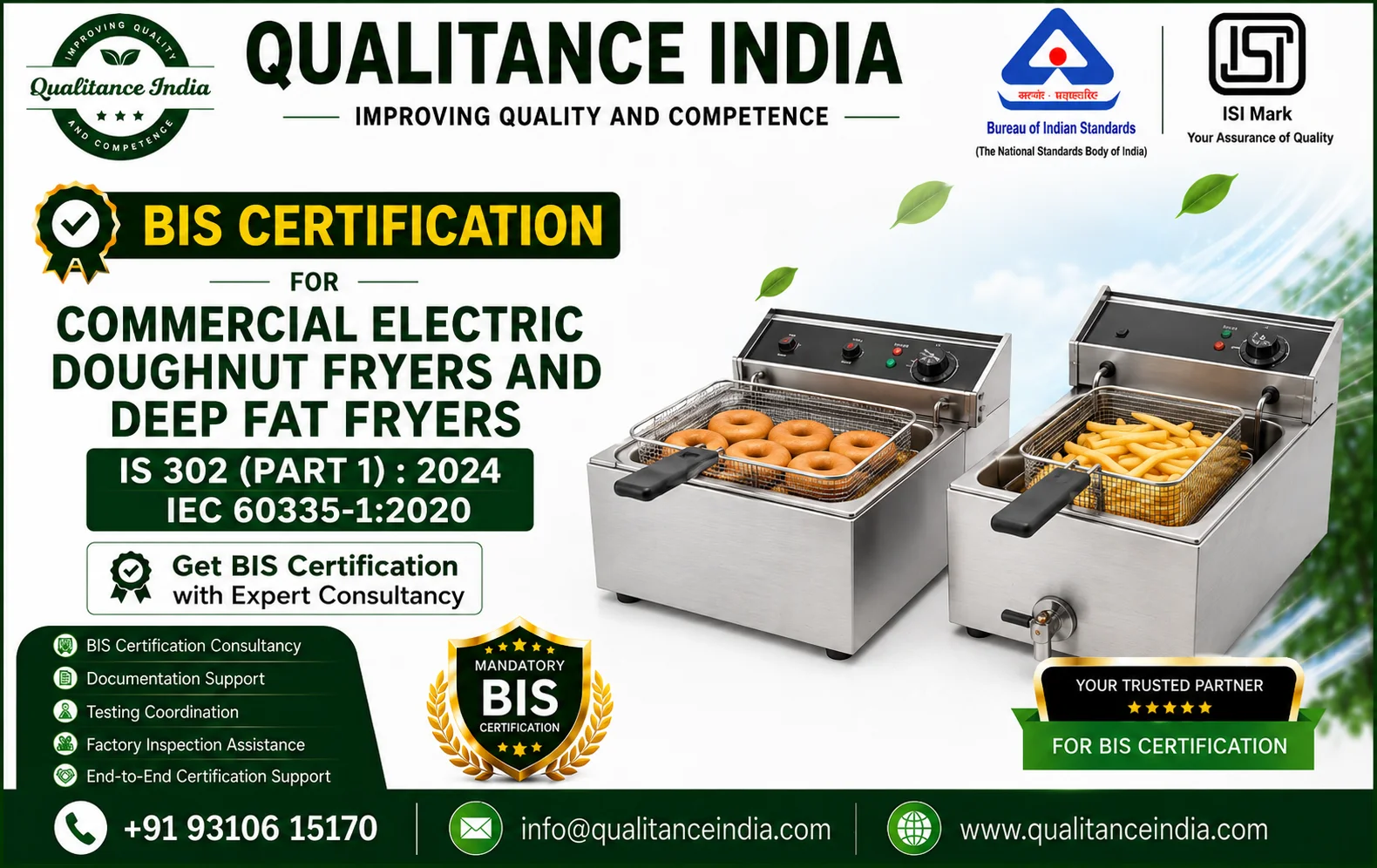
BIS Certification Consultancy for Commercial Electric Doughnut Fryers and Deep Fat Fryers | IS 302 (Part 1):2024 |
Introduction
Commercial Electric Doughnut Fryers and Deep Fat Fryers are widely used in restaurants, hotels, bakeries, cafés, fast-food outlets, commercial kitchens, catering establishments and food-service businesses. These appliances use electrical energy for heating cooking oil or fat and therefore require appropriate attention to electrical safety, heating performance, construction and safe operation.
The Bureau of Indian Standards (BIS) has included Commercial Electric Doughnut Fryers and Deep Fat Fryers in the illustrative list of electrical appliances covered under IS 302 (Part 1):2024 | IEC 60335-1:2020. The official BIS upcoming-QCO information specifically lists this product category under the Safety of Household, Commercial and Similar Electrical Appliances framework.
For manufacturers, importers, OEMs, exporters and brands dealing in commercial electric frying equipment, understanding BIS compliance requirements in advance is important for regulatory planning and uninterrupted market access.
Qualitance India provides professional BIS Certification Consultancy for Commercial Electric Doughnut Fryers and Deep Fat Fryers, supporting businesses with product applicability assessment, documentation, laboratory testing coordination, BIS application assistance and certification-related compliance.
Implementation Date Provided for This Service: 01 August 2026
Important Regulatory Note: The date 01 August 2026 has been provided as the implementation date for this service page. However, the latest official BIS upcoming-QCO information currently lists the broader IS 302 (Part 1):2024 | IEC 60335-1:2020 category with an implementation date of 01 October 2026. The 2026 QCO also provides different implementation dates based on enterprise category. Businesses should verify the latest applicable QCO, amendments and transition provisions before treating 01 August 2026 as the statutory deadline.
About Commercial Electric Doughnut Fryers and Deep Fat Fryers
Commercial Electric Doughnut Fryers and Deep Fat Fryers are professional cooking appliances designed to heat cooking oil or fat to the required temperature for frying food products.
These appliances may be used for preparing:
- Doughnuts
- French fries
- Potato products
- Fried snacks
- Chicken products
- Fish products
- Samosas and similar foods
- Other commercial fried food items
Commercial electric fryers may include:
- Electric heating elements
- Oil tanks or frying vessels
- Temperature controllers
- Thermostats
- Timers
- Control panels
- Safety cut-outs
- Thermal protection systems
- Drainage arrangements
- Insulated enclosures
- Indicator lamps or electronic displays
The exact BIS applicability and certification requirements should be determined based on the appliance's construction, intended use, rated voltage, electrical characteristics and applicable regulatory framework.
What is BIS Certification for Commercial Electric Doughnut Fryers and Deep Fat Fryers?
BIS Certification is a conformity assessment mechanism administered by the Bureau of Indian Standards.
Where a product is covered by a mandatory Quality Control Order, manufacturers must demonstrate conformity with the applicable Indian Standard and fulfill the prescribed BIS certification requirements before placing the product on the Indian market.
The official BIS information specifically identifies Commercial Electric Doughnut Fryers and Deep Fat Fryers as an illustrative product category under IS 302 (Part 1):2024 | IEC 60335-1:2020.
The certification process may involve:
- Product applicability assessment
- Applicable standard review
- Technical documentation
- Product testing
- BIS application
- Factory inspection, where applicable
- Quality-control verification
- Grant of BIS licence
- Compliance with applicable Standard Mark requirements
For manufacturers and importers, starting the certification process early can help reduce the risk of testing delays and regulatory complications.
Applicable Standard: IS 302 (Part 1):2024 | IEC 60335-1:2020
The applicable general safety standard is:
IS 302 (Part 1):2024 | IEC 60335-1:2020
Title: Household and Similar Electrical Appliances — Safety — Part 1: General Requirements
The BIS revised standard is based on IEC 60335-1:2020 and covers general safety requirements applicable to electrical appliances within its scope. BIS has also published implementation guidance concerning the transition from the earlier IS 302 (Part 1):2008 standard to IS 302 (Part 1):2024.
For Commercial Electric Doughnut Fryers and Deep Fat Fryers, the compliance evaluation may address areas such as:
- Protection against electric shock
- Marking and instructions
- Protection against access to live parts
- Power input and current
- Heating
- Temperature rise
- Leakage current
- Electric strength
- Moisture resistance
- Abnormal operation
- Mechanical strength
- Construction
- Internal wiring
- Earthing
- External flexible cords
- Creepage distances
- Clearances
- Resistance to heat and fire
- Components
- Stability and mechanical safety
The applicable product-specific requirements should also be reviewed wherever relevant to the particular appliance.
Scope of BIS Certification
BIS compliance evaluation for Commercial Electric Doughnut Fryers and Deep Fat Fryers may involve assessment of the complete appliance and its critical electrical and heating components.
The evaluation may consider:
- Rated voltage
- Rated frequency
- Rated power
- Heating element design
- Oil capacity
- Temperature control
- Thermostats
- Thermal cut-outs
- Control panel
- Switches
- Electronic controls
- Safety devices
- Electrical insulation
- Earthing arrangements
- Internal wiring
- Enclosure
- Frying vessel
- Accessible surfaces
- Protection against overheating
- User controls
- Product markings
Special attention may be required for the relationship between the electrical heating system and hot oil or fat, particularly with regard to temperature control, abnormal operation and protection against overheating.
Products Covered Under This Category
The product category may include, subject to applicable BIS scope:
Commercial Electric Doughnut Fryers
Electric frying appliances specifically designed for commercial doughnut production and similar food-service applications.
Commercial Electric Deep Fat Fryers
Electrical appliances that heat cooking oil or fat for deep frying in commercial environments.
Electric Commercial Frying Units
Professional electric frying appliances used in restaurants, cafés, hotels and commercial kitchens.
Commercial Countertop Electric Fryers
Compact electrical fryers designed for professional food-service operations.
Commercial Electric Frying Equipment
Other similar electrical frying appliances may require product-specific applicability assessment.
Note: The final applicability of BIS certification depends on the product's technical construction, intended application, rated voltage and applicable BIS/QCO requirements.
Implementation Date: 01 August 2026
The implementation date provided for this service page is:
01 August 2026
Manufacturers, importers and businesses dealing with Commercial Electric Doughnut Fryers and Deep Fat Fryers should begin their compliance preparation well in advance.
However, the latest official BIS upcoming-QCO page currently lists the broader IS 302 (Part 1):2024 | IEC 60335-1:2020 category with an implementation date of 01 October 2026. The 2026 QCO states that the order comes into force on 01 October 2026, while small and micro enterprises are subject to the dates specified for their categories.
Therefore, if 01 August 2026 is being used as a product-specific implementation date for your service page, it is advisable to verify the exact legal basis and latest applicable notification before publishing it as the mandatory statutory deadline.
Applicable QCO Details
The relevant regulatory framework is the:
Safety of Household, Commercial and Similar Electrical Appliances (Quality Control) Order
The 2026 QCO states that it applies to electrical appliances intended for household, commercial or similar applications with rated voltage not exceeding 250 V for single-phase appliances and 480 V for other appliances, including applicable DC-supplied and battery-operated appliances, unless the products fall under another applicable QCO or mandatory BIS certification framework.
The QCO requires covered goods to conform to the corresponding Indian Standard and bear the Standard Mark under a BIS licence as per the applicable conformity assessment scheme. It also provides provisions relating to exports, small and micro enterprises, limited R&D imports and declared stock.
Businesses should verify:
- Latest QCO notification
- Applicable amendments
- Implementation date
- Enterprise classification
- Product applicability
- Transition provisions
- Exemptions
- Certification route
- Standard Mark requirements
before manufacturing, importing or selling covered products.
Why BIS Certification is Important for Commercial Electric Fryers
Commercial electric fryers are frequently used at high temperatures and under demanding operating conditions. Proper safety evaluation is therefore important for manufacturers and users.
Electrical Safety
BIS compliance helps ensure that applicable electrical safety requirements are addressed.
Heating Safety
Heating elements, thermostats and thermal protection systems are important for safe operation.
Protection Against Electric Shock
The appliance should provide appropriate protection against access to hazardous live parts.
Quality Assurance
Compliance with applicable Indian Standards supports consistency in product quality and safety.
Regulatory Compliance
Where mandatory certification applies, businesses must meet the prescribed BIS requirements for market access.
Customer Confidence
BIS compliance can strengthen confidence among commercial buyers, distributors and professional kitchen operators.
Who Needs BIS Certification?
The applicable BIS requirements may affect:
- Indian manufacturers
- Foreign manufacturers
- Overseas exporters
- Importers
- OEM manufacturers
- ODM manufacturers
- Private-label brands
- Commercial kitchen equipment manufacturers
- Commercial fryer manufacturers
- Restaurant equipment suppliers
- Hotel equipment suppliers
- Bakery equipment manufacturers
- Food-service equipment suppliers
Where mandatory BIS certification applies, the manufacturer must complete the applicable certification process before commercial market placement.
Eligibility Criteria for BIS Certification
Manufacturers should generally have:
- Identifiable manufacturing premises
- Suitable production facilities
- Quality-control procedures
- Required testing facilities
- Competent technical personnel
- Representative product samples
- Product specifications
- Circuit diagrams
- Technical drawings
- Bill of Materials
- Heating element specifications
- Thermostat details
- Thermal cut-out specifications
- Control-system details
- Product labels
- User instructions
Foreign manufacturers may have additional requirements depending on the applicable BIS certification procedure.
Complete BIS Certification Process
Step 1: Product Applicability Assessment
The first step is to determine whether the Commercial Electric Doughnut Fryer or Deep Fat Fryer falls within the applicable BIS certification framework.
The assessment may consider:
- Product function
- Commercial application
- Rated voltage
- Rated power
- AC/DC operation
- Heating technology
- Oil capacity
- Product construction
- Model variations
Step 2: Applicable Standard Review
The applicable general safety standard is:
IS 302 (Part 1):2024 | IEC 60335-1:2020
The applicable product-specific requirements should also be reviewed where relevant.
Step 3: Technical Documentation
The manufacturer prepares:
- Product specifications
- Technical datasheets
- Circuit diagrams
- Wiring diagrams
- Product drawings
- Bill of Materials
- Heating element details
- Thermostat specifications
- Thermal protection details
- Control-system details
- Safety device information
- Product photographs
- Rating label
- User manual
- Manufacturing process flow
- Quality-control plan
Step 4: Sample Preparation
Representative samples should be prepared according to applicable testing requirements.
The submitted samples should accurately represent the product models covered by the certification application.
Step 5: Laboratory Testing
The samples may be tested against applicable electrical and safety requirements.
Testing may cover:
- Marking and instructions
- Protection against access to live parts
- Power input and current
- Heating
- Temperature rise
- Leakage current
- Electric strength
- Moisture resistance
- Abnormal operation
- Mechanical strength
- Stability
- Construction
- Internal wiring
- Earthing
- Creepage and clearance
- Heat and fire resistance
- Applicable safety requirements
BIS laboratory testing information specifically lists Commercial Electric Doughnut Fryers and Deep Fat Fryers under the product-wise testing information for IS 302 (Part 1):2024. The published testing charge shown in the BIS LIMS document is $45,000? No—this is an Indian BIS document and the listed amount is ₹45,000 for the stated test category; current applicable charges should always be verified with BIS or the selected laboratory before budgeting.
Step 6: BIS Application Submission
The applicable BIS application is submitted with:
- Manufacturer details
- Factory information
- Product details
- Brand information
- Model information
- Technical documents
- Test reports
- Quality-control information
Step 7: Factory Inspection
Where required, BIS officials may inspect the manufacturing facility.
The inspection may verify:
- Manufacturing facilities
- Production process
- Quality-control systems
- Testing facilities
- Calibration records
- Raw-material inspection
- In-process testing
- Final product testing
Step 8: Technical Evaluation
BIS evaluates the application, test reports and inspection findings.
If observations are raised, the manufacturer may need to provide clarification or corrective action.
Step 9: Grant of BIS Licence
After successful completion of the applicable requirements, BIS may grant the licence to the eligible manufacturer.
The manufacturer must then follow applicable requirements for using the BIS Standard Mark.
Step 10: Ongoing Compliance
After certification, manufacturers should maintain:
- Consistent product quality
- Approved production processes
- Routine testing
- Calibration
- Quality-control records
- Correct product marking
- Applicable surveillance compliance
Changes to heating elements, thermostats, thermal cut-outs, controllers or other critical components should be evaluated for their potential impact on certification.
Required Documents
Commonly required documents may include:
- Company registration documents
- Factory registration details
- Factory address proof
- Factory layout
- Manufacturing process flow chart
- Product technical specifications
- Product datasheet
- Circuit diagram
- Wiring diagram
- Product photographs
- Rating label artwork
- Bill of Materials
- Heating element specifications
- Thermostat details
- Thermal cut-out details
- Control-system specifications
- Safety device details
- User manual
- Quality-control plan
- Testing equipment list
- Calibration certificates
- In-house test records
- Authorized signatory details
- Trademark or brand authorization documents, where applicable
The final documentation requirements may vary according to the product and applicable BIS certification procedure.
Testing Requirements
Commercial Electric Doughnut Fryers and Deep Fat Fryers should be evaluated for applicable electrical and safety requirements.
Power Input and Current
The electrical power consumption and current should comply with applicable requirements.
Heating Test
The heating system and temperature rise may be evaluated under specified operating conditions.
Temperature Control
Thermostats and temperature-control systems should function correctly within the applicable requirements.
Protection Against Electric Shock
Accessible parts should provide suitable protection against electric shock.
Leakage Current
Applicable leakage current testing may be conducted to evaluate electrical safety.
Electric Strength
The insulation system may be tested for electrical strength.
Moisture Resistance
Where applicable, the appliance may be evaluated for resistance to moisture.
Abnormal Operation
The fryer may be evaluated under specified foreseeable abnormal operating conditions.
Mechanical Strength
Relevant components may be evaluated for mechanical safety.
Earthing
Applicable earthing provisions should be verified.
Creepage and Clearance
Electrical insulation distances may be evaluated according to applicable requirements.
Heat and Fire Resistance
Relevant materials and components may be assessed for resistance to heat and fire.
Marking and Instructions
The appliance should have appropriate markings, ratings, warnings and instructions.
The final test plan depends on the appliance design and applicable BIS laboratory scope.
Factory Inspection Process
During a BIS factory inspection, the manufacturer may need to demonstrate its ability to consistently manufacture compliant products.
The inspection may cover:
- Raw-material control
- Heating element quality
- Electrical components
- Assembly process
- Internal wiring
- Thermostat installation
- Thermal protection
- Safety controls
- Final product testing
- Quality-control records
- Testing equipment
- Calibration
- Traceability
- Non-conforming product control
Manufacturers should ensure that required infrastructure, competent personnel and quality records are available before inspection.
Common Reasons for BIS Certification Rejection or Delay
Common issues may include:
- Incorrect product classification
- Incorrect standard selection
- Incomplete documentation
- Inconsistent product specifications
- Laboratory test failure
- Excessive temperature rise
- Insulation failure
- Leakage current failure
- Electric strength failure
- Improper earthing
- Inadequate thermal protection
- Thermostat malfunction
- Heating element issues
- Incorrect product marking
- Missing testing facilities
- Expired calibration certificates
- Incomplete quality-control records
- Factory inspection observations
- Incorrect model grouping
- Uncontrolled changes to critical components
A pre-assessment before formal BIS application can help identify potential compliance gaps.
BIS Certification Cost Factors
The total cost may depend on:
- BIS government fees
- Laboratory testing charges
- Number of models
- Number of variants
- Product complexity
- Testing requirements
- Factory inspection
- Additional testing
- Documentation
- Consultancy services
The BIS LIMS product-wise testing information lists ₹45,000 for the Commercial Electric Doughnut Fryers and Deep Fat Fryers test category in the referenced document. However, businesses should verify the current applicable laboratory charges and complete certification costs before budgeting.
Important: The laboratory testing fee is only one component of the overall BIS certification cost. Total expenses can also include applicable BIS fees, inspection-related costs, testing of additional models and professional consultancy.
BIS Certification Timeline
The timeline depends on:
- Product complexity
- Documentation readiness
- Laboratory availability
- Testing results
- Factory readiness
- Inspection scheduling
- BIS observations
- Corrective actions
Manufacturers should start the certification process sufficiently early to accommodate laboratory testing, documentation review and inspection requirements.
Benefits of BIS Certification
Applicable BIS certification can provide:
- Regulatory compliance
- Improved electrical safety
- Better product quality
- Enhanced customer confidence
- Stronger brand credibility
- Better market acceptance
- Reduced compliance risks
- Improved business reputation
- Greater access to commercial and institutional buyers
For commercial frying equipment, BIS compliance can also support procurement confidence among restaurants, hotels, bakeries, catering companies and professional kitchen operators.
Why Choose Qualitance India?
Qualitance India provides professional BIS Certification Consultancy for electrical and commercial appliances.
Our services may include:
- Product applicability assessment
- Standard identification
- Technical documentation support
- BIS application assistance
- Laboratory testing coordination
- Factory inspection preparation
- BIS query support
- Certification follow-up
- Post-certification compliance guidance
We help manufacturers, importers, OEMs and brands understand applicable BIS requirements and navigate the certification process efficiently.
Step-by-Step BIS Certification Flow Chart
Commercial Electric Fryer Product Identification
↓
BIS Applicability Assessment
↓
IS 302 (Part 1):2024 Requirement Review
↓
Product & Technical Evaluation
↓
Documentation Preparation
↓
Representative Sample Preparation
↓
BIS Laboratory Testing
↓
Test Report Review
↓
BIS Application Submission
↓
Factory Inspection, Where Applicable
↓
Corrective Action, If Required
↓
BIS Technical Evaluation
↓
Grant of BIS Licence
↓
Standard Mark Compliance
↓
Ongoing Quality Control & Surveillance
20 SEO FAQs
1. What is BIS Certification for Commercial Electric Doughnut Fryers and Deep Fat Fryers?
It is the applicable BIS conformity assessment requirement for covered commercial electric frying appliances under the IS 302 (Part 1):2024 framework.
2. What is the applicable BIS standard?
The applicable general safety standard is IS 302 (Part 1):2024 | IEC 60335-1:2020.
3. What is the implementation date for Commercial Electric Doughnut Fryers and Deep Fat Fryers?
The implementation date provided for this service page is 01 August 2026. However, the latest official BIS information currently lists the broader IS 302 (Part 1):2024 category with 01 October 2026 as the implementation date. The exact applicable date should be verified against the latest QCO and applicable enterprise category.
4. Which products are covered under this category?
The category specifically includes Commercial Electric Doughnut Fryers and Deep Fat Fryers, subject to applicable BIS scope.
5. Do commercial electric deep fat fryers require BIS certification?
Where the product is covered by the applicable mandatory BIS/QCO requirements, the required certification must be obtained before legal market placement.
6. Do commercial doughnut fryers require BIS certification?
Commercial Electric Doughnut Fryers are specifically listed in the BIS illustrative product category under the IS 302 (Part 1):2024 framework. Applicable certification requirements should be assessed for the specific product.
7. Is laboratory testing required for commercial electric fryers?
Yes, applicable laboratory testing forms part of the BIS certification process.
8. Is factory inspection required?
Factory inspection depends on the applicable BIS conformity assessment procedure.
9. What documents are required for BIS certification?
Technical specifications, circuit diagrams, BOM, product drawings, factory details, quality-control documents and applicable test reports may be required.
10. How much does BIS certification for commercial fryers cost?
The total cost depends on BIS fees, laboratory testing, models, inspection and other applicable expenses. The referenced BIS LIMS document lists ₹45,000 for the stated test category, subject to current verification.
11. How long does BIS certification take?
The timeline depends on testing, documentation, laboratory availability, factory readiness and BIS processing.
12. Can imported commercial deep fat fryers be sold in India without BIS certification?
If the product is subject to mandatory BIS certification, the applicable requirements must be fulfilled before legal market placement.
13. Can multiple fryer models be covered under one BIS licence?
Model grouping depends on BIS guidelines and the technical similarity of the products.
14. What happens if a commercial fryer fails laboratory testing?
The manufacturer may need to correct the identified non-conformity and complete applicable re-testing.
15. Why is BIS certification important for commercial electric fryers?
It helps demonstrate conformity with applicable safety requirements and supports regulatory compliance.
16. Does BIS certification apply to commercial kitchen equipment?
Certain commercial electrical kitchen appliances are included in the illustrative BIS product list and should be assessed individually.
17. Is BIS certification applicable to imported electric doughnut fryers?
Where the imported product falls under mandatory BIS certification requirements, applicable compliance is required before market placement.
18. What safety aspects are evaluated during testing?
Testing may evaluate electrical shock protection, heating, temperature rise, leakage current, electric strength, construction, earthing, insulation and other applicable safety requirements.
19. Can Qualitance India help with BIS laboratory testing?
Yes. Qualitance India can assist with applicable laboratory testing coordination and BIS certification consultancy.
20. How can I start BIS Certification for a Commercial Electric Fryer?
Start with product applicability assessment, followed by standard review, technical documentation, laboratory testing and the applicable BIS certification procedure.
FAQ Schema Content
Use the 20 FAQs above for your website's FAQ Schema. The questions and answers in the structured data should match the FAQs visibly displayed on the webpage.
FAQ Schema should only be implemented for FAQs that are actually visible to users on the page.
Featured Snippet Optimized Answer
What is BIS Certification for Commercial Electric Doughnut Fryers and Deep Fat Fryers?
BIS Certification for Commercial Electric Doughnut Fryers and Deep Fat Fryers is the applicable conformity assessment requirement for covered commercial electrical frying appliances under the IS 302 (Part 1):2024 framework. The process may involve product evaluation, technical documentation, laboratory testing, BIS application, factory inspection where applicable and ongoing quality-control requirements. Commercial Electric Doughnut Fryers and Deep Fat Fryers are specifically included in the BIS illustrative product list.
People Also Ask (PAA) Questions
- Is BIS certification mandatory for commercial deep fat fryers?
- Do commercial doughnut fryers require BIS certification in India?
- What is IS 302 Part 1:2024?
- What is the BIS standard for commercial electric fryers?
- What is the BIS certification process for deep fat fryers?
- How much does BIS certification for commercial fryers cost?
- Is BIS testing required for commercial electric doughnut fryers?
- What documents are required for BIS certification?
- What is the implementation date for IS 302 Part 1:2024?
- Can imported commercial fryers be sold in India without BIS certification?
Voice Search Optimization
“Do commercial electric deep fat fryers require BIS certification in India?”
“What is the BIS standard for commercial doughnut fryers?”
“Do electric doughnut fryers need BIS certification?”
“What is IS 302 Part 1:2024 certification?”
“How can I get BIS certification for a commercial electric fryer?”
“What is the implementation date for commercial electric fryers under BIS?”
SEO Tags Naturally Integrated for Search
BIS Certification for Commercial Electric Doughnut Fryers, BIS Certification for Deep Fat Fryers, BIS Certification Consultancy for Commercial Electric Fryers, BIS Certification for Commercial Fryers, BIS Certification for Electric Doughnut Fryers, BIS Certification for Commercial Kitchen Equipment, IS 302 Part 1:2024, IEC 60335-1:2020, BIS Licence for Commercial Deep Fat Fryers, BIS Testing for Electric Fryers, BIS Certification for Commercial Cooking Appliances, Commercial Kitchen Equipment BIS Certification, ISI Mark Certification, BIS Laboratory Testing, BIS Factory Inspection, QCO 2026, BIS Consultant in India.
Image ALT Tags
- BIS Certification for Commercial Electric Doughnut Fryers
- BIS Certification for Commercial Deep Fat Fryers
- BIS Certification Consultancy for Electric Fryers
- BIS Certification for Commercial Frying Equipment
- IS 302 Part 1:2024 BIS Certification for Electric Fryers
- BIS Certification Consultancy for Commercial Kitchen Fryers
- BIS Licence for Commercial Deep Fat Fryers in India
- BIS Testing for Commercial Electric Doughnut Fryers
- ISI Mark Certification for Commercial Electric Fryers
- BIS Certification for Electric Deep Fat Fryers
- Commercial Electric Fryers BIS Certification
- BIS Certification Consultancy Qualitance India
- IS 302 Part 1:2024 Commercial Fryer Certification
- BIS Certification Process for Deep Fat Fryers
- BIS Certification for Commercial Kitchen Frying Equipment
Internal Linking Strategy
Link this page naturally to relevant Qualitance India service pages:
- BIS Certification under IS 302 (Part 1):2024
- BIS Certification for Cooking Ranges, Hobs, Ovens and Similar Appliances
- BIS Certification for Commercial Electric Kitchen Machines
- BIS Certification for Commercial Electric Grillers and Toasters
- BIS Certification for Commercial Electric Boiling Pans
- BIS Certification for Commercial Electric Bain-Marie
- BIS Certification for Commercial Electric Multi-Purpose Cooking Pans
- BIS Certification for Commercial Electric Forced Convection Ovens
- BIS Certification for Commercial Electric Dishwashing Machines
- BIS Certification for Commercial Electric Rinsing Sinks
- BIS Certification for Commercial Electric Appliances for Keeping Food and Crockery Warm
- Complete BIS Certification Process in India
- BIS Laboratory Testing Services
- BIS Factory Inspection Consultancy
Recommended anchor texts:
“BIS Certification for Commercial Kitchen Appliances”
“BIS Certification for Commercial Electric Cooking Appliances”
“BIS Certification for Deep Fat Fryers”
“BIS Testing for Commercial Electric Fryers”
External Authority References
For regulatory information, use authoritative BIS sources:
BIS Scheme-I / ISI Mark Scheme: Official BIS information covering products under compulsory certification and the IS 302 (Part 1):2024 framework.
BIS Upcoming QCOs: The official BIS upcoming-QCO page currently lists Commercial Electric Doughnut Fryers and Deep Fat Fryers under IS 302 (Part 1):2024 and shows the broader implementation date as 01 October 2026.
Safety of Household, Commercial and Similar Electrical Appliances (QCO) 2026: Official government notification containing the applicable regulatory framework and implementation provisions.
BIS LIMS: Official laboratory information for product-wise testing requirements and charges.
Related BIS Services
- BIS Certification for Commercial Electric Cooking Ranges, Ovens, Hobs and Hob Elements
- BIS Certification for Commercial Electric Griddles and Griddle Grills
- BIS Certification for Commercial Electric Multi-Purpose Cooking Pans
- BIS Certification for Commercial Electric Forced Convection Ovens
- BIS Certification for Commercial Electric Grillers and Toasters
- BIS Certification for Commercial Electric Boiling Pans
- BIS Certification for Commercial Electric Bain-Marie
- BIS Certification for Commercial Electric Appliances for Keeping Food and Crockery Warm
- BIS Certification for Commercial Electric Kitchen Machines
- BIS Certification for Commercial Electric Dishwashing Machines
- BIS Certification for Commercial Electric Rinsing Sinks
Related Blog Suggestions
- BIS Certification for Commercial Kitchen Appliances – Complete Guide
- BIS Certification for Commercial Electric Fryers in India
- BIS Certification for Commercial Electric Doughnut Fryers
- BIS Certification for Deep Fat Fryers – Process, Documents and Testing
- IS 302 (Part 1):2024 – Complete BIS Certification Guide for Electrical Appliances
- BIS Certification Cost and Timeline for Commercial Kitchen Appliances
- BIS Laboratory Testing Process for Commercial Electric Fryers
- BIS Factory Inspection Process – Complete Guide
- QCO 2026 for Electrical Appliances – Important Compliance Update
- BIS Certification for Imported Commercial Kitchen Equipment in India
Strong Lead Generation CTA
Need BIS Certification for Commercial Electric Doughnut Fryers or Deep Fat Fryers?
Are you a manufacturer, importer, OEM or brand dealing in Commercial Electric Doughnut Fryers, Deep Fat Fryers or similar commercial frying equipment?
Qualitance India can assist you with:
Product Applicability Assessment | BIS Documentation | Laboratory Testing Coordination | BIS Application Support | Factory Inspection Preparation | Certification Assistance
Contact Qualitance India Today
Phone: +91 93106 15170
Email: info@qualitanceindia.com
Website: qualitanceindia.com
Get Expert BIS Certification Consultancy for Commercial Electric Doughnut Fryers and Deep Fat Fryers as per IS 302 (Part 1):2024.
SEO-Optimized Conclusion
Commercial Electric Doughnut Fryers and Deep Fat Fryers are important commercial kitchen appliances used in restaurants, hotels, bakeries, cafés, fast-food outlets and professional food-service businesses. Since these appliances combine electrical heating systems with high-temperature cooking oil or fat, appropriate safety and compliance evaluation is essential.
The official BIS upcoming-QCO information specifically lists Commercial Electric Doughnut Fryers and Deep Fat Fryers under the IS 302 (Part 1):2024 | IEC 60335-1:2020 framework. Manufacturers and importers should therefore assess their product-specific BIS obligations and prepare the required documentation, testing and certification activities in advance.
The implementation date provided for this service is 01 August 2026. However, the latest official BIS information currently shows 01 October 2026 as the implementation date for the broader IS 302 (Part 1):2024 category, with additional provisions for small and micro enterprises under the 2026 QCO. Businesses should verify the latest applicable notification, amendments and transition provisions before relying on a specific date as the final statutory deadline.
Qualitance India provides professional BIS Certification Consultancy to help manufacturers, importers, OEMs and brands understand applicable requirements and navigate the certification process.
Prepare Your Commercial Electric Doughnut Fryers and Deep Fat Fryers for BIS Compliance. Contact Qualitance India for Professional BIS Certification Consultancy Today.