BIS Certification for Cooking Ranges, Hobs, Ovens and Similar Appliances | IS 302 (Part 1):2024 | IEC 60335-1:2020 | Enforcement Date 01 October 2026
BIS Certification for Cooking Ranges, Hobs, Ovens and Similar Appliances under IS 302 (Part 1):2024
Introduction
The demand for modern kitchen appliances has increased rapidly in India due to urbanization, smart homes, changing lifestyles, and growing consumer awareness regarding energy-efficient and safe electrical appliances. Products such as Cooking Ranges, Built-in Ovens, Freestanding Ovens, Gas-Electric Cooking Ranges, Induction Hobs, Ceramic Hobs, Electric Cooktops, and Similar Domestic Appliances have become essential equipment in residential kitchens, hotels, restaurants, commercial establishments, and institutional facilities.
Since these appliances operate using electricity, high temperatures, and heating elements, ensuring electrical safety, mechanical reliability, fire resistance, insulation performance, and user protection is critical. Faulty or substandard appliances may lead to electric shock, overheating, burns, fire hazards, or property damage.
To enhance consumer safety and ensure uniform quality standards, the Government of India has notified mandatory BIS Certification for Cooking Ranges, Hobs, Ovens and Similar Appliances under the applicable Quality Control Order (QCO). These products must comply with IS 302 (Part 1):2024, aligned with IEC 60335-1:2020, before they can be manufactured, imported, sold, distributed, or marketed in India.
The mandatory enforcement date for General Enterprises is 01 October 2026. Manufacturers should begin preparations well in advance to avoid disruptions in production or sales.
This comprehensive guide explains everything manufacturers, importers, brand owners, OEMs, exporters, and foreign manufacturers need to know about BIS Certification, including product scope, applicable standards, documentation, testing, inspection, compliance requirements, and how Qualitance India can assist throughout the certification process.
What are Cooking Ranges, Hobs, Ovens and Similar Appliances?
Cooking Ranges, Hobs, Ovens and Similar Appliances are electrically operated household cooking equipment designed for preparing, heating, baking, grilling, roasting, or cooking food.
These appliances are commonly installed in:
- Residential Homes
- Apartments
- Hotels
- Restaurants
- Commercial Kitchens
- Institutional Kitchens
- Catering Facilities
- Cafeterias
- Educational Institutions
- Hospitality Industry
The product category includes a wide variety of appliances with different heating technologies, capacities, and installation methods.
Products Covered Under This Category
The scope generally includes:
- Electric Cooking Ranges
- Built-in Cooking Ranges
- Freestanding Cooking Ranges
- Electric Hobs
- Ceramic Hobs
- Induction Hobs
- Glass Cooktops
- Built-in Ovens
- Electric Ovens
- Fan-assisted Ovens
- Convection Ovens
- Grill Ovens
- Combination Cooking Appliances
- Multifunction Cooking Appliances
- Similar Domestic Cooking Appliances
Manufacturers should confirm the exact applicability of their products under the relevant BIS notification and standard.
Applicable Indian Standard
The applicable safety standard is:
IS 302 (Part 1):2024
Safety of Household and Similar Electrical Appliances
Aligned with IEC 60335-1:2020
This standard specifies general safety requirements for household and similar electrical appliances. Product-specific requirements may also apply depending on the type of appliance.
Applicable International Standard
The Indian Standard is harmonized with:
IEC 60335-1:2020
Household and Similar Electrical Appliances – Safety – General Requirements.
Alignment with IEC standards promotes internationally recognized safety practices and helps manufacturers meet consistent safety expectations.
Enforcement Date
According to the applicable Quality Control Order:
General Enterprises
Mandatory from: 01 October 2026
Eligible Small and Micro Enterprises may have later implementation dates if specified in the notification.
Manufacturers should not wait until the last few months before enforcement. BIS Certification involves documentation, testing, technical review, and, where applicable, factory inspection.
Why BIS Certification is Mandatory
Electrical cooking appliances involve several safety risks if not properly designed or manufactured.
Potential hazards include:
- Electric Shock
- Fire Hazards
- Overheating
- Insulation Failure
- Mechanical Failure
- High Surface Temperatures
- Component Malfunction
- Short Circuit
- Leakage Current
- Burns to Users
Mandatory BIS Certification helps ensure that appliances comply with recognized safety requirements before reaching consumers.
Objectives of BIS Certification
The certification system aims to:
- Improve electrical safety.
- Protect consumers.
- Promote quality manufacturing.
- Reduce unsafe products.
- Ensure compliance with Indian regulations.
- Increase confidence in certified products.
- Support fair competition in the marketplace.
Benefits of BIS Certification
Obtaining BIS Certification offers numerous advantages:
- Legal compliance with mandatory regulations.
- Authorization to use the ISI Mark.
- Enhanced consumer trust.
- Improved product quality.
- Better acceptance in retail and institutional markets.
- Reduced product safety risks.
- Stronger brand reputation.
- Greater competitiveness in the Indian market.
Industries Covered
This certification is relevant for:
- Home Appliance Manufacturers
- Kitchen Appliance Manufacturers
- OEM Manufacturers
- Electrical Appliance Manufacturers
- Importers
- Brand Owners
- Foreign Manufacturers exporting to India
- Hospitality Equipment Suppliers
- Commercial Kitchen Equipment Companies
Importance of Early Compliance
Manufacturers should begin the certification process well before 01 October 2026 to avoid:
- Delays in market entry.
- Interrupted production schedules.
- Sales restrictions after enforcement.
- Additional compliance costs due to last-minute preparation.
Early preparation also allows sufficient time to organize technical documentation, complete product testing, and address any observations raised during the certification process.
What is the ISI Mark?
The ISI Mark is issued under the Bureau of Indian Standards' certification scheme and indicates that a product complies with the applicable Indian Standard.
For products covered under mandatory Quality Control Orders, manufacturers are permitted to apply the ISI Mark only after obtaining a valid BIS licence and complying with all applicable licence conditions.
Why Choose Qualitance India?
Qualitance India provides end-to-end consultancy for BIS Certification, helping manufacturers navigate every stage of the compliance process.
Our services include:
- Product applicability assessment.
- Documentation preparation.
- BIS application filing.
- Product testing coordination.
- Factory inspection assistance.
- Technical compliance review.
- Query resolution with BIS.
- Support until licence grant.
- Post-certification guidance and renewal support.
Our goal is to simplify the certification process and help businesses achieve timely compliance with confidence.
Complete BIS Certification Process for Cooking Ranges, Hobs, Ovens and Similar Appliances
IS 302 (Part 1):2024 | IEC 60335-1:2020
Mandatory BIS Certification | Enforcement Date: 01 October 2026
Complete BIS Certification Process for Cooking Ranges, Hobs, Ovens and Similar Appliances
Manufacturers planning to manufacture, import, distribute, or sell Cooking Ranges, Hobs, Ovens, and Similar Appliances in India must obtain BIS Certification (ISI Mark Licence) before the mandatory enforcement date.
These products are electrical appliances used daily in homes, hotels, restaurants, commercial kitchens, and institutional facilities. Since they operate using electricity and generate high temperatures, they must comply with strict safety requirements prescribed under IS 302 (Part 1):2024, harmonized with IEC 60335-1:2020.
The BIS certification process evaluates product safety, electrical performance, insulation, construction, manufacturing quality, and quality management systems. Manufacturers should initiate certification well before 01 October 2026 to avoid regulatory issues or market disruptions.
Step 1 – Product Applicability Assessment
The first step is confirming that the appliance falls under the applicable Quality Control Order (QCO) and Indian Standard.
Products typically covered include:
- Electric Cooking Ranges
- Electric Hobs
- Ceramic Hobs
- Induction Hobs
- Electric Ovens
- Built-in Ovens
- Freestanding Ovens
- Combination Cooking Appliances
- Multifunction Cooking Appliances
- Similar Household Electrical Cooking Appliances
Choosing the correct product category ensures that the application is processed under the appropriate BIS standard.
Step 2 – Technical Product Evaluation
Before filing the application, manufacturers should review the product against the requirements of IS 302 (Part 1):2024.
The technical evaluation generally includes:
- Product Construction
- Electrical Rating
- Rated Voltage
- Rated Frequency
- Rated Power
- Heating System
- Temperature Controls
- Thermostats
- Insulation System
- Earthing Arrangement
- Power Cord
- Plug Configuration
- Internal Wiring
- Protective Devices
- Product Marking
- User Instructions
Any non-conformity should be addressed before laboratory testing.
Step 3 – Documentation Preparation
Complete documentation is essential for a smooth BIS certification process. Proper records demonstrate that the manufacturer has the capability to consistently produce compliant products.
Company Documents Required
Manufacturers generally prepare:
- Certificate of Incorporation
- GST Registration
- PAN Card
- Factory Licence
- MSME Certificate (if applicable)
- Import Export Code (for exporters)
- Trademark Registration (if available)
- Factory Address Proof
- Board Resolution / Authorization Letter
- Authorized Signatory Details
Manufacturing Documents
The following documents are commonly required:
- Manufacturing Process Flow Chart
- Factory Layout
- Production Capacity Details
- Machinery List
- Assembly Line Details
- Standard Operating Procedures (SOPs)
- Quality Control Plan
- Incoming Material Inspection Procedure
- Finished Goods Inspection Procedure
- Packaging Procedure
- Storage Procedure
- Preventive Maintenance Schedule
Technical Documents
Manufacturers should prepare:
- Product Drawings
- Electrical Circuit Diagram
- Wiring Diagram
- Bill of Materials (BOM)
- Component List
- Product Catalogue
- User Manual
- Installation Instructions
- Product Labels
- Name Plate Details
- Technical Datasheets
Quality Management Documents
BIS generally reviews documentation related to quality management, including:
- Quality Manual
- Incoming Material Inspection Reports
- In-Process Inspection Records
- Final Inspection Reports
- Calibration Certificates
- Internal Test Reports
- Corrective Action Reports
- Customer Complaint Register
- Product Traceability Records
- Internal Audit Reports
- Training Records for Quality Personnel
Well-maintained records help demonstrate a robust manufacturing and quality assurance system.
Step 4 – Product Testing
Product testing is a critical requirement of BIS Certification. The objective is to verify that the appliance complies with the safety requirements of IS 302 (Part 1):2024 / IEC 60335-1:2020.
Testing is carried out in accordance with the applicable standard through a BIS-recognized laboratory or as required by the certification scheme.
Typical Safety Tests
1. Visual Examination
The product is inspected for:
- Construction Quality
- Mechanical Finish
- Labels
- Markings
- Safety Warnings
- Accessibility of Live Parts
2. Protection Against Electric Shock
Testing verifies that users cannot accidentally come into contact with hazardous live parts during normal operation.
3. Input Power and Current Test
The appliance is checked to ensure that power consumption and current draw are within acceptable limits.
4. Heating Test
The appliance is operated under specified conditions to evaluate:
- Temperature Rise
- Surface Temperature
- Internal Component Temperature
- Stability During Operation
5. Leakage Current Test
Electrical leakage is measured to verify user safety and compliance with insulation requirements.
6. High Voltage (Dielectric Strength) Test
The insulation system is subjected to high-voltage testing to ensure adequate electrical insulation between live parts and accessible metal components.
7. Earth Continuity Test
Earthing arrangements are verified to ensure fault currents can be safely conducted without creating hazards.
8. Moisture Resistance Test
Where applicable, the appliance is evaluated for resistance to moisture ingress and continued electrical safety after exposure.
9. Mechanical Strength Test
Mechanical parts such as handles, knobs, doors, hinges, and control panels are examined to ensure they can withstand normal use.
10. Stability Test
The appliance is assessed to verify that it remains stable during intended operation and is not prone to tipping.
11. Temperature Control Verification
Thermostats, sensors, and thermal cut-outs are evaluated to confirm proper operation and prevention of overheating.
12. Abnormal Operation Test
The appliance is subjected to certain abnormal operating conditions to assess whether it continues to provide adequate protection against hazards.
13. Endurance Test
Repeated operation may be performed to verify long-term reliability and durability under specified conditions.
14. Resistance to Heat and Fire
Insulating materials and plastic components are evaluated for their ability to resist heat and reduce the risk of fire propagation.
15. Electrical Component Inspection
Critical components such as switches, wiring, connectors, heating elements, and protective devices are examined for compliance and reliability.
Step 5 – Submission of BIS Application
Once documentation and testing are complete, the manufacturer submits the BIS application.
The application generally includes:
- Company Details
- Factory Details
- Product Description
- Applicable Standard (IS 302 (Part 1):2024)
- Test Reports
- Technical Documents
- Manufacturing Information
- Authorized Signatory Details
Providing complete and accurate information helps avoid unnecessary delays.
Step 6 – Technical Scrutiny by BIS
BIS reviews the submitted application to verify:
- Product Specifications
- Test Reports
- Technical Documentation
- Quality Management Records
- Product Marking
- Manufacturing Capability
- Compliance with Applicable Requirements
If clarification is required, BIS may issue technical queries. Prompt responses help speed up the approval process.
Step 7 – Factory Inspection
Depending on the certification scheme, BIS may conduct a factory inspection to assess whether the manufacturing facility is capable of consistently producing compliant products.
Manufacturing Facility Review
Inspectors may examine:
- Incoming Material Storage
- Assembly Line
- Wiring Section
- Heating Element Installation
- Control Panel Assembly
- Product Testing Area
- Final Inspection Area
- Packaging Department
- Finished Goods Warehouse
Production Process Assessment
The inspection may review:
- Process Flow
- Work Instructions
- Batch Identification
- Process Controls
- Production Records
- Traceability System
- Maintenance Records
Quality Control System
Inspectors may verify:
- Incoming Material Inspection
- In-Process Quality Checks
- Final Product Inspection
- Calibration Records
- Internal Test Reports
- Non-Conforming Product Control
- Corrective Action System
Testing Equipment Verification
Typical testing equipment includes:
- Insulation Resistance Tester
- High Voltage Tester
- Leakage Current Tester
- Earth Continuity Tester
- Power Analyzer
- Temperature Measuring Instruments
- Electrical Safety Test Equipment
- Digital Multimeters
- Calibrated Measuring Devices
All instruments should have valid calibration certificates.
Step 8 – Grant of BIS Licence
If the manufacturer successfully complies with all applicable requirements, BIS grants the licence under Scheme-I (ISI Mark Scheme).
The manufacturer is then authorized to affix the ISI Mark on Cooking Ranges, Hobs, Ovens, and Similar Appliances manufactured in accordance with IS 302 (Part 1):2024 and the licence conditions.
Post-Certification Compliance
After obtaining the BIS licence, manufacturers should continue to:
- Maintain consistent product quality.
- Conduct routine quality inspections.
- Keep calibration certificates up to date.
- Preserve production and inspection records.
- Cooperate with BIS surveillance activities.
- Address customer complaints promptly.
- Renew the BIS licence within the prescribed timelines.
Common Reasons for Delay or Rejection
Some common issues include:
- Incorrect product classification.
- Incomplete documentation.
- Non-conforming test reports.
- Missing calibration records.
- Inadequate quality control procedures.
- Incorrect product marking.
- Delayed responses to BIS queries.
- Poor traceability and record keeping.
Tips for Faster BIS Certification
Manufacturers can streamline the certification process by:
- Confirming the correct applicability of IS 302 (Part 1):2024.
- Preparing complete documentation before application.
- Conducting internal product evaluations.
- Calibrating all testing and measuring equipment.
- Coordinating product testing early.
- Maintaining organized production and quality records.
- Responding promptly to BIS communications.
- Working with experienced BIS consultants.
Why Choose Qualitance India?
Obtaining BIS Certification for electrical cooking appliances requires technical expertise, regulatory knowledge, and careful documentation. Qualitance India offers comprehensive consultancy services to simplify the process.
Our Services
- BIS Certification Consultancy
- ISI Mark Consultancy
- Product Standard Identification
- Documentation Preparation
- BIS Application Filing
- Product Testing Coordination
- Factory Inspection Assistance
- Technical Compliance Review
- BIS Query Resolution
- Licence Approval Support
- Renewal & Ongoing Compliance
- Foreign Manufacturer Certification (FMCS) Support
Our experienced team assists manufacturers from the initial assessment through licence approval, helping ensure timely compliance with IS 302 (Part 1):2024 / IEC 60335-1:2020 before the 01 October 2026 enforcement date.
BIS Certification for Cooking Ranges, Hobs, Ovens and Similar Appliances
IS 302 (Part 1):2024 | IEC 60335-1:2020 | Enforcement Date: 01 October 2026
Frequently Asked Questions (FAQs)
1. Is BIS Certification mandatory for Cooking Ranges, Hobs, Ovens and Similar Appliances?
Yes. Under the applicable Quality Control Order (QCO), these products must comply with IS 302 (Part 1):2024 before they can be manufactured, imported, sold, or distributed in India. The enforcement date is 01 October 2026.
2. Which Indian Standard applies?
IS 302 (Part 1):2024 (aligned with IEC 60335-1:2020).
3. What is the enforcement date?
01 October 2026 for General Enterprises (subject to the applicable QCO and any MSME provisions).
4. What products are covered?
The standard generally covers:
- Electric Cooking Ranges
- Electric Hobs
- Ceramic Hobs
- Induction Hobs
- Built-in Ovens
- Electric Ovens
- Combination Cooking Appliances
- Similar Household Electrical Cooking Appliances
5. Is the ISI Mark compulsory?
Yes. Products covered under the mandatory BIS scheme must bear the ISI Mark only after obtaining a valid BIS licence.
6. Can foreign manufacturers obtain BIS Certification?
Yes. Foreign manufacturers exporting these products to India can apply under the Foreign Manufacturers Certification Scheme (FMCS).
7. Can importers apply directly?
Generally, the manufacturer is the applicant. Importers or brand owners may coordinate with the manufacturer during the certification process.
8. Is factory inspection required?
Depending on the applicable BIS certification scheme, factory assessment or inspection may be required.
9. Are laboratory tests mandatory?
Yes. Product testing is an essential part of the certification process.
10. How long does the certification process take?
The timeline depends on document readiness, product testing, BIS review, and inspection requirements.
11. What happens if a product is sold without BIS Certification after the enforcement date?
Manufacturing, importing, selling, or distributing products covered under a mandatory QCO without the required BIS certification may lead to regulatory action under the applicable laws.
12. Why should manufacturers start early?
Early preparation allows sufficient time for product testing, documentation, technical review, and any corrective actions before the enforcement date.
Why Manufacturers Choose Qualitance India
Manufacturers trust Qualitance India because we provide complete end-to-end BIS consultancy with a focus on timely compliance and technical accuracy.
Our Expertise Includes:
- BIS Certification Consultancy
- ISI Mark Certification
- Documentation Preparation
- Product Testing Coordination
- Factory Inspection Assistance
- Technical Compliance Review
- Application Filing
- BIS Query Handling
- FMCS Support
- Renewal & Compliance Support
- Manufacturer Guidance from Start to Finish
Why Early BIS Certification Matters
Waiting until the enforcement deadline can create unnecessary challenges, such as:
- Increased testing demand
- Longer processing times
- Delays in market entry
- Supply chain disruptions
- Temporary inability to sell regulated products
Starting the process early helps manufacturers remain compliant and continue business operations smoothly.
Google AI Overview Optimized Summary
Cooking Ranges, Hobs, Ovens and Similar Appliances covered under IS 302 (Part 1):2024 and aligned with IEC 60335-1:2020 require mandatory BIS Certification before the enforcement date of 01 October 2026. Manufacturers must obtain a BIS licence, complete applicable product testing, and comply with quality and safety requirements before using the ISI Mark. Qualitance India provides complete consultancy for documentation, testing coordination, factory inspection assistance, BIS application filing, and end-to-end certification support.
Featured Snippet Optimized Answer
What is BIS Certification for Cooking Ranges, Hobs, Ovens and Similar Appliances?
BIS Certification is a mandatory product certification required for specified household electrical cooking appliances under IS 302 (Part 1):2024. It verifies compliance with prescribed safety requirements before the products can be legally manufactured, imported, or sold in India. The mandatory enforcement date is 01 October 2026.
High-Traffic
- BIS Certification for Cooking Ranges
- BIS Certification for Hobs
- BIS Certification for Ovens
- Cooking Ranges BIS Certification India
- Electric Oven BIS Certification
- Built-in Oven ISI Certification
- IS 302 Part 1 2024
- IEC 60335-1:2020
- Kitchen Appliance BIS Licence
- Household Electrical Appliance Certification
- ISI Mark for Ovens
- ISI Certification for Hobs
- BIS Consultant India
- BIS Certification Consultant
- BIS Registration for Kitchen Appliances
- Electrical Appliance Compliance
- BIS Licence for Manufacturers
- FMCS BIS Certification
- BIS Certification Process India
- Home Appliance ISI Mark
- Electric Cooking Appliance Certification
- BIS Approval for Kitchen Equipment
- Mandatory BIS Certification 2026
- BIS Certification Consultancy India
- Qualitance India BIS Services
Internal Linking Suggestions
Link this blog to related pages on your website, such as:
- BIS Certification Services
- ISI Mark Certification
- FMCS for Foreign Manufacturers
- Electrical Appliance BIS Certification
- Kitchen Appliance Certification
- BIS Documentation Support
- Factory Inspection Assistance
- Product Testing Coordination
- BIS Quality Control Orders (QCO)
- Contact Us
Image SEO
Image File Name
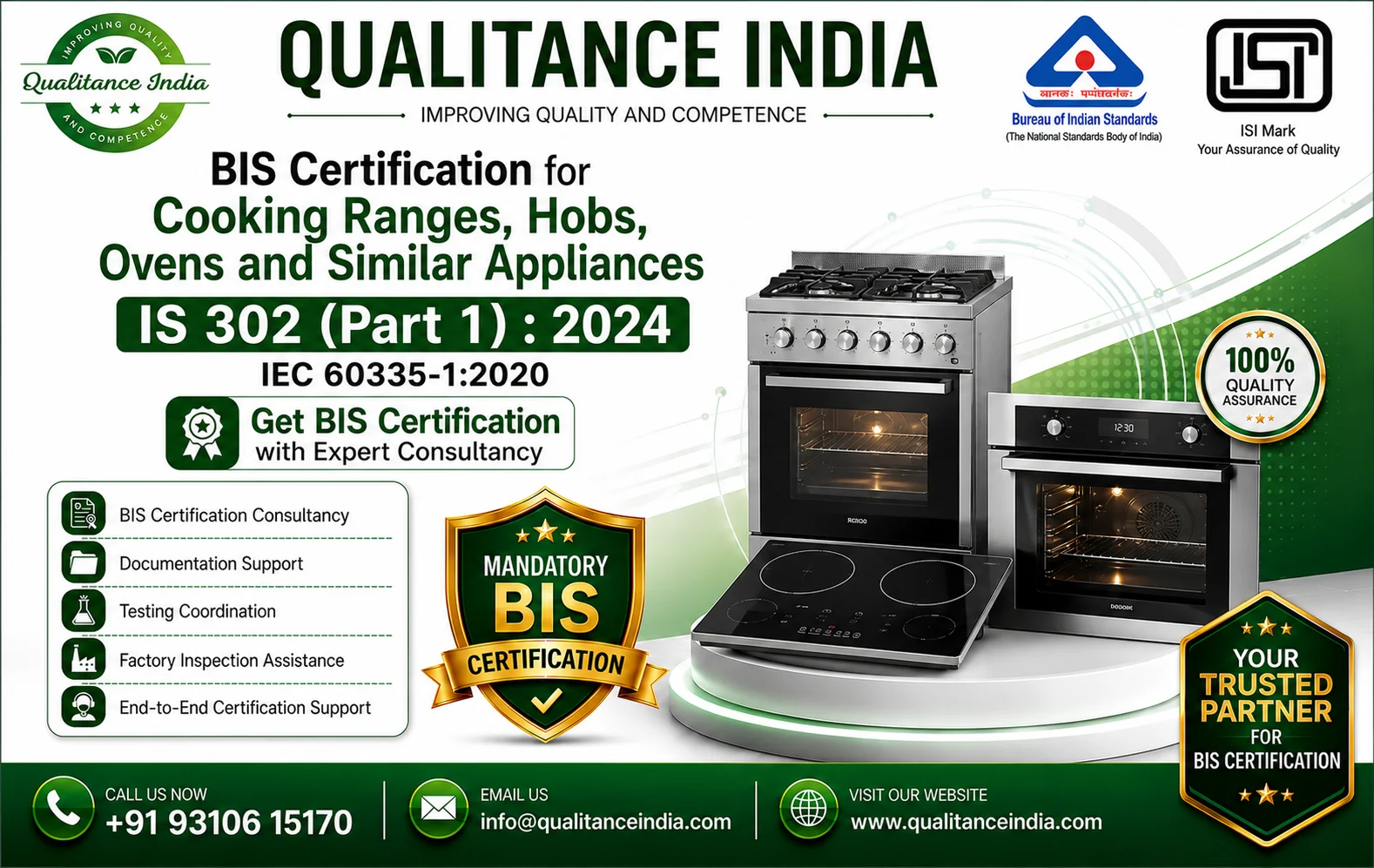
bis-certification-cooking-ranges-hobs-ovens-is302-part1-2024.jpgImage Alt Text
BIS Certification for Cooking Ranges, Hobs, Ovens and Similar Appliances IS 302 (Part 1):2024 IEC 60335-1:2020
Image Title
Cooking Ranges, Hobs & Ovens BIS Certification
Image Caption
Mandatory BIS Certification for Cooking Ranges, Hobs, Ovens and Similar Appliances under IS 302 (Part 1):2024 | Enforcement Date: 01 October 2026
Recommended Schema Markup
To improve visibility in Google Search and AI-powered results, implement:
- Article Schema
- FAQ Schema
- Organization Schema
- Local Business Schema
- Breadcrumb Schema
- WebPage Schema
- Service Schema
These structured data types can help search engines better understand your content and improve eligibility for rich results.
Conclusion
The mandatory BIS Certification requirement for Cooking Ranges, Hobs, Ovens and Similar Appliances under IS 302 (Part 1):2024 represents an important step toward improving electrical safety and product quality in India. With the 01 October 2026 enforcement date approaching, manufacturers, importers, and foreign suppliers should begin the certification process early to avoid delays and ensure uninterrupted market access.
Preparing documentation, completing product testing, and meeting BIS requirements in advance can significantly streamline the approval process. Working with an experienced consultancy can further reduce compliance challenges.
Contact Qualitance India
Need BIS Certification for Cooking Ranges, Hobs, Ovens and Similar Appliances?
Qualitance India provides complete support from initial applicability assessment to final BIS licence approval.
Our Services
- BIS Certification Consultancy
- ISI Mark Certification
- FMCS for Foreign Manufacturers
- Product Testing Coordination
- Documentation Support
- Factory Inspection Assistance
- BIS Application Filing
- Technical Compliance Review
- Post-Certification Support
Contact Details
- Company: Qualitance India
- Phone: +91 93106 15170
- Email: info@qualitanceindia.com
- Website: www.qualitanceindia.com
Final SEO Checklist Before Publishing
- ✅ Primary keyword in the title
- ✅ Primary keyword in the first paragraph
- ✅ H2 and H3 headings optimized
- ✅ Meta title under ~60 characters
- ✅ Meta description around 150–160 characters
- ✅ Descriptive SEO-friendly URL
- ✅ Image with optimized filename, alt text, and caption
- ✅ Internal links to related services
- ✅ FAQ section for rich results
- ✅ Schema markup implemented
- ✅ Mobile-friendly formatting
- ✅ Fast page loading and compressed images
- ✅ Clear call-to-action and contact information
This completes a comprehensive SEO-optimized blog structure designed to improve visibility in Google Search and AI-powered search experiences while providing useful information for manufacturers seeking BIS certification.