BIS Certification for Tool Steel Forgings for Metal Forming – IS 13387:1992
Introduction
Tool steel forgings are important engineering materials used for manufacturing dies, tooling and other components required for metal forming operations. These materials are designed to provide the necessary combination of hardness, strength, toughness, wear resistance and performance under demanding forming conditions.
IS 13387:1992 – Tool Steel Forgings for Metal Forming – Specification specifies requirements for tool steel forgings used in metal forming applications. The standard addresses aspects including manufacture, freedom from defects, decarburization, dimensions and tolerances, chemical composition and hardness. BIS has published a Product Manual for this standard under Scheme-I of the BIS Conformity Assessment Regulations, 2018.
Tool steel forgings covered by this standard are used for both cold forming and hot forming applications, with different steel designations grouped according to their intended applications.
About Tool Steel Forgings for Metal Forming
Tool steel forgings are specially manufactured steel products used where tooling must withstand significant mechanical stresses, repeated loading, friction and, in some applications, elevated temperatures.
They can be used to manufacture:
- Dies
- Press dies
- Forging dies
- Extrusion dies
- Wire drawing dies
- Thread rolling dies
- Cold forging rolls
- Powder pressing dies
- Dies for upsetters
- Other metal forming tools
The appropriate grade depends on the intended application and whether the tool is used for cold or hot forming.
What is IS 13387:1992?
IS 13387:1992 is the Indian Standard titled:
Tool Steel Forgings for Metal Forming – Specification
The BIS Product Manual identifies the standard as having one amendment and provides certification guidance for manufacturers seeking a BIS licence under Scheme-I.
The standard establishes requirements relating to:
- Manufacture
- Decarburization
- Freedom from defects
- Dimensions
- Tolerances
- Chemical composition
- Hardness
- Additional requirements where applicable
Scope of IS 13387:1992
IS 13387:1992 covers tool steel forgings intended for metal forming applications.
The standard classifies tool steel forgings into designations for:
Cold Forming
These include materials used for:
- Dies for cold forming
- Press dies
- Wire drawing dies
- Powder pressing dies
- Thread rolling dies
- Cold forging dies
- Cold forging rolls
Hot Forming
These include materials used for:
- Press forging dies
- Upsetter dies
- Extrusion dies
- Hot forging dies used in hammers and presses
The BIS Product Manual groups the various designations according to these applications.
Tool Steel Designations Covered
The Product Manual identifies several groups of designations.
Examples include:
Group 1 – Dies for Cold Forming
- T158
- T118Cr2
- T103V2
Group 2 – Press Dies for Cold Forming
- T90Mn6Cr2V2W2
Group 3 – Wire Drawing and Related Dies
- T215Cr48
- T150Cr48Mo10V4
- T210Cr54
- T100Cr20Mo10V4
Group 4 – Hot Forming
- T37Cr20Si4Mo50V4
- T37Cr20Si4Mo50V4W5
- T30Cr10V4W38
Group 5 – Hot Forging in Hammer and Press
- T55Ni8Cr3Mo3V2
- T55Ni8Cr4Mo5V2
The grouping is important when determining the scope of a BIS licence.
Product Grouping for BIS Certification
Product grouping can simplify certification where multiple designations fall within an approved group.
For example, the BIS Product Manual provides that for certain groups, one sample of any one designation from the group can be drawn to cover the designations within that group.
However, the manufacturer must have the necessary manufacturing and testing facilities for all designations included within the licence scope. BIS also requires covered designations to be tested independently in rotation during the operation of the licence.
Therefore, manufacturers should decide the proposed licence scope carefully before submitting the application.
Raw Material Requirements
Chemical composition is an important requirement for tool steel forgings.
The BIS Product Manual states that the ladle analysis of the steel must comply with Clause 10 of IS 13387:1992.
Manufacturers purchasing steel from an external steel producer should obtain a test certificate from the steel manufacturer showing conformity of the steel's chemical composition with the requirements of the Indian Standard.
The raw-material records should be maintained for traceability.
Manufacturing Process
The manufacturing process may generally involve:
Steel Procurement
Suitable tool steel is procured according to the required designation.
Raw Material Inspection
Incoming steel is checked against purchase specifications and test certificates.
Heating
The steel is heated under controlled conditions suitable for forging.
Forging
The heated material is forged into the required shape and dimensions.
Heat Treatment
Applicable heat-treatment operations are carried out to achieve the required properties.
Machining
Forgings may undergo rough or finish machining depending on the product requirements.
Inspection
The finished forgings are inspected for:
- Dimensions
- Tolerances
- Surface condition
- Internal defects
- Decarburization
- Hardness
Final Testing
Chemical and physical requirements are verified according to the applicable testing scheme.
Important Product Requirements
Manufacture
The manufacturing process must comply with the requirements of the standard.
The BIS inspection and testing scheme applies to manufacturers both with steel-making facilities and those purchasing steel or ingots for producing forgings.
Decarburization
Decarburization is an important characteristic for tool steel because excessive surface decarburization can affect hardness and tool performance.
The BIS Product Manual specifies testing for decarburization under Clause 7 of IS 13387:1992.
Freedom from Defects
Each forging should be adequately inspected to ensure freedom from harmful internal and surface defects.
The Product Manual requires appropriate inspection of each forging for defects.
Dimensions and Tolerances
The forgings must comply with applicable dimensions and tolerances specified by the standard.
Rough-machined forging tolerances may be agreed between the manufacturer and purchaser as applicable.
Chemical Composition
Chemical composition is one of the major requirements.
Depending on the grade, the chemical analysis can involve elements such as:
- Carbon
- Silicon
- Manganese
- Nickel
- Chromium
- Molybdenum
- Vanadium
- Aluminium
- Copper
- Boron
- Tin
- Tungsten
- Sulphur
- Phosphorus
- Oxygen
The Product Manual identifies these elements under the testing equipment and chemical-composition requirements.
Hardness
Hardness testing is another important requirement for tool steel forgings.
The BIS inspection scheme specifies hardness testing for one sample from each heat.
BIS Certification for Tool Steel Forgings
BIS certification for Tool Steel Forgings for Metal Forming is operated under Scheme-I of the BIS Conformity Assessment Regulations, 2018.
The BIS Product Manual provides guidance regarding:
- Product scope
- Sampling
- Product grouping
- Testing equipment
- Inspection and testing
- Licence scope
- Marking
- Test certificates
A manufacturer seeking certification needs to demonstrate that the product and manufacturing facilities comply with the applicable requirements.
Quality Control Order
Tool Steel Forgings for Metal Forming under IS 13387:1992 are included in the Steel and Steel Products regulatory framework.
The relevant Quality Control Order identifies:
IS 13387:1992 – Steel or Steel Products – Tool Steel Forgings for Metal Forming
with implementation from 13 May 2021. The order also identifies relevant ITC(HS) codes for the product.
Manufacturers and importers should verify the latest applicable regulatory requirements before manufacturing, importing or supplying the product.
Who Needs BIS Certification?
BIS certification requirements can apply to manufacturers producing tool steel forgings covered under IS 13387:1992 and the applicable Quality Control Order.
This may include:
- Tool steel forging manufacturers
- Steel forging manufacturers
- Die manufacturers producing covered tool steel forgings
- Metal forming tool manufacturers
- Automotive component suppliers
- Engineering industries
- Heavy engineering manufacturers
- Industrial tooling manufacturers
- Manufacturers supplying tool steel forgings to Indian customers
Documents Required
Common documents required for the certification process may include:
- Company registration documents
- Factory address proof
- Factory layout
- Manufacturing process flow
- Machinery list
- Forging equipment details
- Heat-treatment equipment details
- Product specifications
- Product drawings
- Grade/designation details
- Raw-material specifications
- Steel manufacturer's test certificates
- Chemical analysis reports
- Heat-treatment records
- Inspection records
- Testing equipment list
- Calibration certificates
- Internal test reports
- Quality-control records
- Product photographs
- Packing and marking details
- Authorized signatory documents
- Trademark documents, where applicable
The final document requirement depends on the manufacturing setup and proposed licence scope.
Testing Requirements
Testing under IS 13387:1992 can include:
Chemical Composition
Testing of applicable alloying and impurity elements.
Decarburization
Determination of decarburized depth or applicable characteristics.
Freedom from Defects
Inspection for harmful surface and internal defects.
Dimensions and Tolerances
Verification of required dimensions and applicable tolerances.
Hardness
Hardness testing according to the standard.
Additional Tests
Additional tests may be carried out where agreed between the manufacturer and purchaser.
BIS Laboratory Testing
BIS LIMS currently lists IS 13387:1992 – Tool Steel Forgings for Metal Forming – Specification in its laboratory scope.
A current BIS LIMS listing shows a testing charge of ₹17,000 excluding taxes for the listed scope up to 200 mm diameter, with the listed testing scope including characteristics such as hardness, machining allowance, freedom from defects and chemical-composition parameters.
The actual laboratory cost can vary according to:
- Product size
- Grade
- Testing scope
- Laboratory
- Additional tests
- Product grouping
- Sample requirements
Therefore, the final testing charges should be confirmed before sample submission.
Sample Requirements
The BIS Product Manual specifies prepared test specimens for physical testing including:
- Decarburization
- Freedom from defects
- Hardness
For chemical testing, the manual specifies 5 pieces of 50 mm length / 50 g drilling, with the heat-affected zone discarded where gas cutting is used.
Because tool steel forgings can be bulky, the Product Manual states that market samples are not to be drawn for the product.
Testing Equipment
Manufacturers should maintain suitable testing facilities as required for the applicable product scope.
Important equipment can include:
- Microscope with 100X magnification
- Sample preparation equipment
- Polishing equipment
- Vernier caliper
- Steel scale
- Steel tape
- Radius gauge
- Weighing scale
- Brinell hardness testing machine
- Chemical analysis equipment
- Spectrometer
- Sample preparation equipment
The BIS Product Manual provides an indicative list of major testing equipment required for testing against IS 13387:1992.
Factory Inspection
During the factory assessment, important areas can include:
Raw Material Control
Verification of steel grades, heat numbers and supplier test certificates.
Forging Process
Review of forging operations and production controls.
Heat Treatment
Verification of heat-treatment facilities and records.
Testing Facilities
Inspection of testing equipment and laboratory arrangements.
Calibration
Verification of calibration plans and records.
Product Inspection
Checking dimensions, tolerances, defects and hardness.
Chemical Testing
Verification of chemical-analysis arrangements or applicable external test arrangements.
Traceability
Checking heat number, control-unit and production records.
Marking
Verification of BIS marking and licence details after certification.
The Product Manual requires manufacturers to prepare and implement a calibration plan and maintain test records.
Control Unit
For the purpose of the BIS inspection and testing scheme, material representing forgings of the same cast, grade and manufactured under uniform production conditions at the same location constitutes a control unit.
This control-unit concept is important for production records, testing and traceability.
Test Certificate
For each consignment of BIS-certified material conforming to IS 13387:1992, a test certificate is required.
The Product Manual indicates that the test certificate should include information such as:
- Standard Mark
- Control Unit number
- Test results
- Order number
- Size
- Grade
- Quantity
- Chemical composition
- Mechanical properties
- Decarburization
- Freedom from defects
- Hardness
- Additional tests, where applicable
BIS Marking
After obtaining the BIS licence, conforming production covered by the licence can be marked with the applicable BIS Standard Mark and licence number (CM/L) according to the certification conditions.
The Product Manual specifically provides for incorporation of the Standard Mark and licence number and requires marking and packing according to the Indian Standard.
Common Reasons for Certification Delays
Manufacturers may experience delays due to:
- Incorrect grade selection
- Incorrect product grouping
- Incomplete chemical-composition records
- Missing steel manufacturer's test certificates
- Inadequate forging-process documentation
- Improper heat-treatment records
- Decarburization failure
- Hardness failure
- Dimensional non-conformity
- Surface defects
- Internal defects
- Inadequate testing facilities
- Missing calibration records
- Poor traceability of heat numbers
- Incomplete test records
- Factory not ready for assessment
- Incorrect marking or documentation
Proper preparation before submitting the BIS application can help avoid unnecessary delays.
Cost of BIS Certification
The overall cost depends on:
- BIS application charges
- Laboratory testing
- Product grade
- Number of designations
- Product grouping
- Factory inspection
- Sample preparation
- Testing equipment
- Retesting, if required
- Documentation
- Consultancy charges
BIS LIMS currently shows a listed testing charge of ₹17,000 excluding taxes for one listed IS 13387:1992 testing scope up to 200 mm diameter.
The complete certification cost should be calculated after reviewing the manufacturer's exact grades, sizes and proposed licence scope.
Certification Timeline
The time required depends on:
- Factory readiness
- Documentation
- Product grouping
- Sample preparation
- Laboratory availability
- Testing
- BIS application scrutiny
- Factory assessment
- Test-report evaluation
- Closure of observations
A precise timeline can be estimated after reviewing the manufacturer's product range and factory facilities.
Benefits of BIS Certification
Compliance with Applicable Requirements
Helps manufacturers meet the requirements applicable to tool steel forgings under the relevant regulatory framework.
Product Quality
Testing and inspection help maintain consistency in chemical and physical properties.
Customer Confidence
BIS certification demonstrates conformity with the applicable Indian Standard.
Market Acceptance
Certification is important where compliance with the applicable Quality Control Order is required.
Better Traceability
Control-unit records and test certificates improve traceability.
Manufacturing Control
Regular inspection and testing support consistent manufacturing quality.
Business Credibility
BIS certification can strengthen confidence among industrial buyers and engineering customers.
Why Choose Qualitance India?
Qualitance India provides BIS certification consultancy for manufacturers and suppliers dealing with products covered by Indian Standards.
For Tool Steel Forgings for Metal Forming as per IS 13387:1992, assistance can include:
- Product applicability assessment
- Grade and designation review
- Product grouping guidance
- Documentation support
- Testing requirement review
- Laboratory coordination
- Sample preparation guidance
- BIS application assistance
- Factory inspection preparation
- Testing-facility review
- Quality-control documentation
- Test report coordination
- Observation closure assistance
- BIS licence support
Qualitance India
Phone: +91-9310-615-170
Email: info@qualitanceindia.com
Website: https://qualitanceindia.com/
BIS Certification Process
Product & Grade Identification
↓
IS 13387:1992 Requirement Review
↓
Cold/Hot Forming Application Assessment
↓
Product Grouping
↓
Factory & Testing Facility Review
↓
Documentation Preparation
↓
Sample Preparation
↓
Laboratory Testing
↓
BIS Application
↓
BIS Scrutiny
↓
Factory Assessment
↓
Test Report Evaluation
↓
Observation Closure
↓
BIS Licence Grant
↓
Standard Mark Compliance
Frequently Asked Questions
1. What is IS 13387:1992?
IS 13387:1992 is the Indian Standard for Tool Steel Forgings for Metal Forming – Specification.
2. What are tool steel forgings used for?
They are used for manufacturing tools and dies for metal forming operations such as cold forming, hot forging, extrusion, wire drawing and related applications.
3. Does IS 13387 cover cold forming applications?
Yes. The standard includes designations intended for cold forming applications.
4. Does IS 13387 cover hot forming applications?
Yes. The standard also covers tool steel designations used for hot forming applications.
5. Which designations are covered?
Examples include T158, T118Cr2, T103V2, T90Mn6Cr2V2W2, T215Cr48, T150Cr48Mo10V4, T210Cr54, T100Cr20Mo10V4 and several hot-forming grades.
6. Is BIS certification applicable to IS 13387:1992?
IS 13387:1992 is included in the BIS certification framework, and BIS has issued a Product Manual for certification under Scheme-I.
7. Is there a Quality Control Order for this product?
Yes. IS 13387:1992 is included in the Steel and Steel Products Quality Control Order framework, with implementation listed from 13 May 2021.
8. What chemical elements are tested?
Depending on the applicable designation, chemical analysis can include carbon, silicon, manganese, nickel, chromium, molybdenum, vanadium, tungsten, sulphur, phosphorus and other specified elements.
9. Is hardness testing required?
Yes. Hardness testing is included in the BIS inspection and testing scheme and is specified at one sample per heat.
10. Is decarburization tested?
Yes. Decarburization is specifically identified as a requirement under Clause 7.
11. Are defects checked?
Yes. Forgings are required to be adequately inspected for harmful internal and surface defects.
12. What is a control unit?
Forgings of the same cast, grade and manufactured under uniform production conditions at the same location constitute a control unit under the BIS inspection scheme.
13. Is a chemical test certificate required for purchased steel?
Yes. Forging manufacturers purchasing steel externally should ensure that the steel is received with a manufacturer's test certificate showing the required ladle analysis.
14. Does a forging manufacturer need its own chemical laboratory?
Not necessarily in every case. The Product Manual states that in-house chemical testing for ladle analysis is required for manufacturers having steel-making facilities; forging manufacturers purchasing steel externally can rely on the steel manufacturer's ladle-analysis certificate as specified.
15. What is the current BIS laboratory charge?
One current BIS LIMS listing shows ₹17,000 excluding taxes for the listed IS 13387:1992 scope up to 200 mm diameter.
16. What samples are required?
The Product Manual specifies prepared specimens for physical tests and five pieces of 50 mm length/50 g drilling for chemical testing, subject to the stated sampling conditions.
17. Is factory inspection required?
Factory assessment forms part of the applicable BIS certification process under Scheme-I.
18. Can multiple grades be included in one BIS licence?
Multiple designations may be covered according to the applicable grouping guidelines, provided the manufacturer has the necessary manufacturing and testing facilities for the complete scope.
19. Can Qualitance India help with IS 13387 certification?
Yes. Qualitance India can assist with product assessment, grouping, documentation, laboratory coordination, application preparation and factory inspection preparation.
20. How long does BIS certification take?
The timeline depends on product scope, documentation, laboratory testing, factory readiness, inspection and BIS scrutiny.
People Also Ask
What is tool steel forging?
Tool steel forging is a forged steel product manufactured from tool steel for applications requiring high strength, hardness, wear resistance and dimensional stability.
What is IS 13387?
IS 13387:1992 is the Indian Standard for Tool Steel Forgings for Metal Forming.
Is BIS certification mandatory for tool steel forgings?
Tool Steel Forgings covered by IS 13387:1992 fall under the applicable steel and steel products regulatory framework. Manufacturers should verify the latest QCO requirements applicable to their exact product.
What are cold-forming tool steels?
These are tool steel grades designed for dies and tooling used in cold metal forming operations.
What are hot-forming tool steels?
These are tool steel grades designed for tooling used in hot forging, pressing and extrusion applications.
What tests are required for IS 13387?
Important requirements include chemical composition, decarburization, freedom from defects, dimensions and tolerances and hardness, with additional tests where applicable.
What is the BIS licence process for tool steel forgings?
It generally involves product assessment, grade/grouping selection, documentation, sample testing, BIS application, factory assessment, closure of observations and grant of licence.
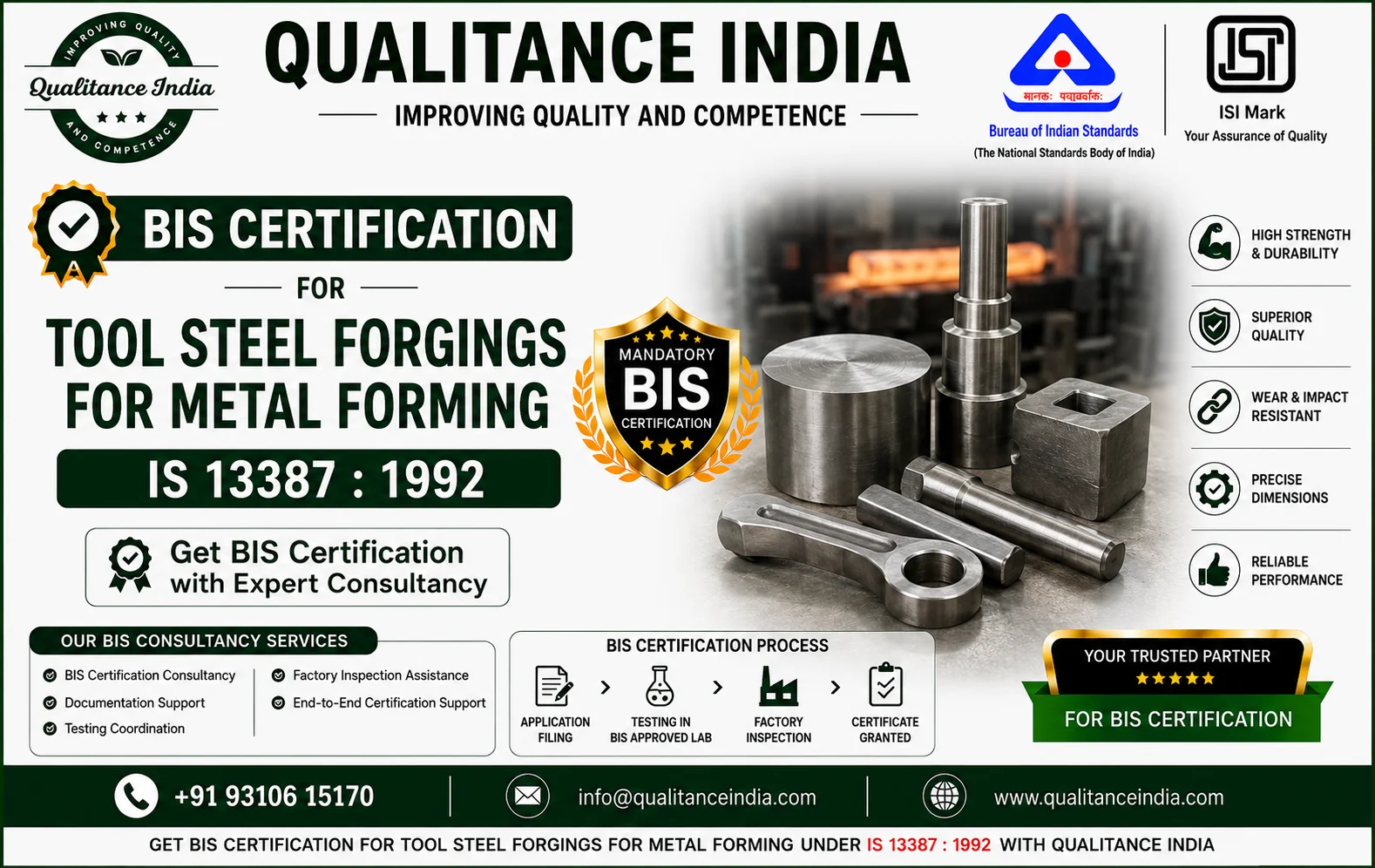
Website Image Text
TOOL STEEL FORGINGS FOR METAL FORMING
IS 13387:1992
BIS CERTIFICATION CONSULTANCY
Qualitance India
+91-9310-615-170
info@qualitanceindia.com
qualitanceindia.com
Image Text Suggestions
- BIS Certification for Tool Steel Forgings
- Tool Steel Forgings for Metal Forming
- IS 13387:1992 BIS Certification
- BIS Licence for Tool Steel Forgings
- Tool Steel Forging Testing
- Cold Forming Tool Steel BIS Certification
- Hot Forming Tool Steel BIS Certification
- Tool Steel Forgings Manufacturer
- IS 13387 Testing
- BIS Certification for Steel Products
- Tool Steel Chemical Composition Testing
- Tool Steel Hardness Testing
- Tool Steel Forgings Factory Inspection
- ISI Mark for Tool Steel Forgings
- Qualitance India BIS Certification Consultancy
Related Services
- BIS Certification Consultancy
- BIS Certification for Steel Products
- BIS Certification for Steel Forgings
- BIS Licence for Tool Steel
- ISI Mark Certification
- BIS Product Testing
- BIS Factory Inspection
- BIS Certification under Quality Control Orders
- Steel Product Certification
- Chemical Composition Testing
- Hardness Testing
- Forging Product Certification
Related Topics for Your Website
- BIS Certification for Steel Forgings
- BIS Certification for Alloy Steel Forgings
- BIS Certification for Steel Products under Quality Control Orders
- BIS Certification for Die Steel Products
- BIS Certification for High Speed Steel
- BIS Certification for Engineering Steel Products
- BIS Certification for Steel Bars and Rods
- BIS Certification for Forged Steel Components
- BIS Certification for Tool Manufacturing Materials
- BIS Certification Process for Steel Manufacturers
Need BIS Certification for Tool Steel Forgings?
If you manufacture Tool Steel Forgings for Metal Forming covered under IS 13387:1992, proper preparation of product grades, raw-material records, manufacturing facilities, testing arrangements and quality-control documentation is important for the BIS certification process.
Qualitance India can assist with product assessment, product grouping, documentation, laboratory testing coordination, BIS application and factory inspection preparation.
Qualitance India
Phone: +91-9310-615-170
Email: info@qualitanceindia.com
Website: https://qualitanceindia.com/
Contact Qualitance India for assistance with BIS Certification for Tool Steel Forgings as per IS 13387:1992.
Conclusion
Tool Steel Forgings for Metal Forming are critical engineering materials used in the manufacture of dies and tooling for cold and hot forming applications. IS 13387:1992 establishes requirements relating to manufacture, decarburization, freedom from defects, dimensions and tolerances, chemical composition and hardness.
The BIS Product Manual provides specific grouping guidelines for different cold-forming and hot-forming designations, along with sampling, testing, factory-control and marking requirements.
The product is also included in the applicable Steel and Steel Products Quality Control Order framework, with the implementation date listed as 13 May 2021.
Manufacturers should therefore ensure that their raw materials, forging process, heat treatment, testing facilities, chemical composition, hardness, dimensional control and product traceability are properly maintained.
Qualitance India can support manufacturers throughout the BIS certification process for Tool Steel Forgings for Metal Forming – IS 13387:1992.