BIS Certification for Welding Cables – IS 9857:1990
Introduction
Welding cables are flexible electrical cables specially designed for carrying current between welding equipment and the welding electrode or workpiece. They are required to withstand repeated bending, movement and the electrical and thermal conditions associated with welding operations.
In India, IS 9857:1990 – Welding Cables – Specification (First Revision) specifies requirements and test methods for single-core flexible cables used in welding circuits. BIS's Product Manual confirms that certification under this standard is operated under Scheme-I of the BIS Conformity Assessment Regulations, 2018.
The standard covers welding cables using copper or aluminium conductors with specified types of coverings. The BIS Product Manual provides requirements for raw materials, sampling, product grouping, testing equipment and inspection and testing.
This guide explains the requirements and certification process for manufacturers seeking BIS certification for Welding Cables as per IS 9857:1990.
About Welding Cables
Welding cables are single-core flexible cables designed for use in welding circuits.
They are generally required to provide:
- Electrical conductivity
- Flexibility
- Mechanical durability
- Insulation
- Resistance to the operating environment
- Suitable current-carrying capability
The BIS Product Manual identifies welding cables with copper (plain/tinned) or aluminium conductors and covering types SE1/SE3 within the certification scope.
What is IS 9857:1990?
IS 9857:1990 is titled:
Welding Cables – Specification (First Revision)
The standard specifies requirements and test methods for single-core flexible cables used in welding circuits. BIS's standards information also identifies IS 9857:1990 as the first revision of the Welding Cables specification.
The BIS Product Manual currently available for this standard identifies one amendment to IS 9857:1990.
Scope of IS 9857:1990
IS 9857:1990 covers single-core flexible cables intended for welding circuits.
The cables are designed for applications where the combination of ambient temperature and load-induced heating results in a steady conductor temperature not exceeding:
- 60°C for general-service normal-duty elastomeric compound
- 90°C for heat-resisting, oil-resisting and flame-retardant (HOFR) normal-duty elastomeric compound
These applications and temperature characteristics are identified in BIS's cable standards compendium.
Types of Welding Cables
The BIS Product Manual identifies certification scope based on:
Conductor Material
- Plain copper conductor
- Tinned copper conductor
- Aluminium conductor
Covering
- SE1
- SE3
Cable Size
The licence scope is specified according to the applicable conductor material, covering type and cable size.
Manufacturers producing multiple combinations should carefully determine their proposed licence scope before testing.
Applications of Welding Cables
Welding cables are commonly used with:
- Arc welding machines
- Welding transformers
- Welding generators
- Welding power sources
- Industrial welding equipment
- Fabrication equipment
- Construction welding equipment
- Automotive welding operations
- Heavy engineering applications
- Shipbuilding and repair
- General metal fabrication
The cable must be suitable for the particular welding equipment and operating conditions.
Raw Material Requirements
The BIS Product Manual identifies the following conductor raw materials:
- Plain or tinned annealed high-conductivity copper wires
- Aluminium wires
The Product Manual references IS 8130 for the applicable conductor requirements.
Manufacturers should maintain proper records for:
- Raw-material specifications
- Supplier details
- Purchase records
- Material test certificates
- Conductor grade
- Batch/lot identification
- Traceability
Manufacturing Process
A typical welding cable manufacturing process may include:
1. Conductor Procurement
Suitable copper or aluminium conductor material is selected according to the required product.
2. Wire Drawing
Where applicable, conductor wires are processed to the required dimensions.
3. Annealing
Copper wires may undergo annealing to achieve the required flexibility and electrical characteristics.
4. Stranding
Individual wires are stranded together to form the flexible conductor.
5. Tinning
For tinned copper cables, the conductor wires undergo the applicable tinning process.
6. Insulation/Covering
The appropriate elastomeric covering is applied over the conductor.
7. Extrusion
The covering material is extruded uniformly around the conductor.
8. Cooling
The cable passes through controlled cooling arrangements.
9. Surface Inspection
The finished cable is inspected for surface defects.
10. Electrical and Physical Testing
Samples are tested against the requirements of IS 9857:1990.
11. Length Measurement and Packing
The cable is packed in suitable coils or drums with appropriate identification.
Important Requirements
Conductor
The conductor must comply with the applicable requirements for the selected conductor material.
The use of plain or tinned annealed high-conductivity copper wires or aluminium wires is identified in the BIS Product Manual.
Flexibility
Since welding cables are frequently moved and bent during welding operations, flexibility is an important characteristic.
Electrical Performance
The cable must provide suitable electrical performance under its intended operating conditions.
Insulation/Covering
The covering should provide the required insulation and mechanical protection.
Temperature Performance
The applicable cable type must be suitable for the specified conductor operating temperature.
Testing Requirements
Testing is an important part of BIS certification for Welding Cables.
Depending on the applicable cable type and certification scope, testing can include:
- Conductor resistance
- Conductor dimensions
- Overall dimensions
- Electrical tests
- Insulation/covering tests
- Mechanical tests
- Ageing-related tests
- Flexibility-related tests
- Flame-retardant characteristics where applicable
- Marking and identification
- Other applicable tests specified by IS 9857:1990
The exact test programme should be checked against the latest applicable standard, Product Manual and Scheme of Inspection and Testing.
BIS Laboratory Testing
BIS LIMS currently lists testing facilities for IS 9857:1990 – Welding Cables – Specification (First Revision).
Current BIS LIMS listings show different laboratory scopes and charges. For example, one listing shows a testing charge of ₹8,500, while another listing shows ₹11,400 for its listed scope.
The final laboratory cost depends on:
- Laboratory
- Cable type
- Conductor material
- Cable size
- Testing scope
- Applicable test parameters
Therefore, the current laboratory quotation should be confirmed before sample submission.
Sample Requirements
The BIS Product Manual specifies the following sample requirements:
Copper/Aluminium Wire Before Stranding
5 metres
Copper Wire for Purity Test
100 grams
Finished Welding Cable
15 metres
These sample quantities are specified in the BIS Product Manual for IS 9857:1990.
Proper sample identification and traceability should be maintained during the certification process.
Product Grouping
The BIS Product Manual contains specific grouping guidelines in Annex A.
Product grouping is important where the manufacturer produces multiple:
- Conductor materials
- Cable types
- Coverings
- Sizes
The scope of a BIS licence is determined based on the applicable grouping requirements and test evidence.
Manufacturers should review the grouping requirements before deciding which sizes and variants to include in the initial application.
Testing Equipment
The BIS Product Manual provides a list of testing equipment under Annex B.
Depending on the product scope, the manufacturer may require suitable facilities for:
- Electrical resistance testing
- Dimensional measurement
- Conductor testing
- Tensile testing
- Elongation testing
- Ageing tests
- Insulation/covering tests
- Flexibility testing
- Flame-related testing where applicable
- Other specified tests
All applicable measuring and testing equipment should be properly maintained and calibrated.
Factory Inspection
During the BIS factory assessment, important areas can include:
Raw Material Inspection
Verification of conductor material and covering materials.
Manufacturing Process
Inspection of wire processing, stranding, covering and extrusion processes.
Testing Facility
Verification of available testing equipment.
Calibration
Checking calibration certificates and calibration schedules.
Quality Control
Review of incoming, in-process and finished-product testing.
Traceability
Verification of batch, lot and production records.
Finished Product
Inspection of cable dimensions, appearance, marking and other applicable characteristics.
Packing and Marking
Review of product identification and packing arrangements.
Quality Control
Manufacturers should maintain proper controls for:
- Incoming raw materials
- Conductor dimensions
- Conductor resistance
- Stranding
- Covering thickness
- Extrusion parameters
- Finished cable dimensions
- Electrical performance
- Physical properties
- Production batches
- Testing records
- Calibration
A proper quality-control system helps maintain consistency between production batches.
Documents Required
Common documents for BIS certification may include:
- Company registration documents
- Factory address proof
- Factory layout
- Manufacturing process flow
- Machinery list
- Product specifications
- Cable drawings
- Conductor details
- Raw-material specifications
- Supplier test certificates
- Internal test reports
- Testing equipment list
- Calibration certificates
- Quality-control plan
- Inspection records
- Product photographs
- Packing details
- Marking details
- Authorized signatory documents
- Trademark documents, where applicable
The final documentation depends on the manufacturer's factory and proposed licence scope.
BIS Marking
After BIS licence grant, the manufacturer can use the applicable BIS Standard Mark and licence number (CM/L) according to the certification conditions.
Product identification should clearly communicate the required information applicable to the certified cable.
The Standard Mark should only be used for products covered within the approved BIS licence scope.
BIS Licence Scope
The BIS Product Manual indicates that the licence scope can be described in terms of:
Welding Cables with Copper (Plain/Tinned)/Aluminium Conductor, Type of Covering SE1/SE3, for Sizes up to and including the approved size.
Therefore, manufacturers should carefully define:
- Conductor material
- Copper type
- Covering type
- Cable size
- Proposed product range
before applying for certification.
Who Needs BIS Certification?
The applicable BIS requirements can affect manufacturers producing Welding Cables covered under IS 9857:1990.
This can include:
- Welding cable manufacturers
- Electrical cable manufacturers
- Flexible cable manufacturers
- Welding equipment suppliers manufacturing cables
- Industrial cable manufacturers
- Electrical product manufacturers
- Cable assembly manufacturers where the product falls within the standard's scope
Importers should separately verify the current regulatory requirements applicable to imported Welding Cables.
Eligibility Requirements
A manufacturer should generally have:
- Suitable manufacturing premises
- Conductor processing facilities
- Stranding machinery
- Extrusion machinery
- Suitable covering compound processing facilities
- Measuring equipment
- Testing facilities or permitted testing arrangements
- Quality-control procedures
- Calibration arrangements
- Trained technical personnel
- Batch traceability
Common Reasons for Certification Delays
Manufacturers may experience delays due to:
- Incorrect product classification
- Incorrect conductor selection
- Incorrect covering type
- Incomplete product specifications
- Poor raw-material records
- Conductor resistance failure
- Dimensional non-conformity
- Insulation/covering failure
- Mechanical test failure
- Ageing test failure
- Inadequate testing equipment
- Missing calibration certificates
- Incomplete quality-control records
- Improper sample preparation
- Factory not ready for inspection
- Incorrect product marking
Proper technical preparation before the BIS application can help reduce avoidable delays.
Cost of BIS Certification
The overall cost can depend on:
- BIS application charges
- Laboratory testing
- Number of cable types
- Conductor material
- Cable sizes
- Product grouping
- Sample transportation
- Factory inspection
- Testing equipment
- Calibration
- Retesting
- Documentation
- Consultancy charges
Current BIS LIMS listings demonstrate that laboratory charges can vary between laboratories and testing scopes.
Certification Timeline
The certification timeline depends on:
- Product scope
- Documentation readiness
- Factory readiness
- Sample preparation
- Laboratory availability
- Testing duration
- BIS application processing
- Factory assessment
- Test report evaluation
- Closure of observations
A realistic timeline can be estimated after reviewing the manufacturer's product range and existing testing facilities.
Benefits of BIS Certification
Compliance with Applicable Requirements
Helps manufacturers meet the applicable requirements for certified Welding Cables.
Product Quality
Testing helps verify electrical, mechanical and physical characteristics.
Customer Confidence
BIS certification provides confidence that the product conforms to the applicable Indian Standard.
Market Acceptance
Certification supports supply where BIS certification is required.
Better Manufacturing Control
Regular inspection and testing help maintain consistent production quality.
Product Traceability
Proper batch and test records improve traceability.
Business Credibility
Certification can strengthen confidence among industrial and commercial customers.
Why Choose Qualitance India?
Qualitance India provides BIS certification consultancy for manufacturers dealing with electrical and industrial products covered by Indian Standards.
For Welding Cables as per IS 9857:1990, assistance can include:
- Product applicability assessment
- Conductor and covering review
- Product scope planning
- Product grouping guidance
- Documentation support
- Testing requirement review
- Laboratory coordination
- Sample preparation guidance
- BIS application assistance
- Factory inspection preparation
- Quality-control documentation
- Test report coordination
- Observation closure assistance
- BIS licence support
Qualitance India
Phone: +91-9310-615-170
Email: info@qualitanceindia.com
Website: https://qualitanceindia.com/
BIS Certification Process
Product Identification
↓
IS 9857:1990 Requirement Review
↓
Conductor & Covering Identification
↓
Size & Product Scope Assessment
↓
Product Grouping Review
↓
Factory & Testing Facility Assessment
↓
Documentation Preparation
↓
Sample Preparation
↓
Laboratory Testing
↓
BIS Application
↓
BIS Scrutiny
↓
Factory Assessment
↓
Test Report Evaluation
↓
Observation Closure
↓
BIS Licence Grant
↓
BIS Standard Mark
Frequently Asked Questions
1. What is IS 9857:1990?
IS 9857:1990 is the Indian Standard for Welding Cables – Specification (First Revision).
2. What are welding cables used for?
They are single-core flexible cables used in welding circuits.
3. What conductor materials are covered?
The BIS Product Manual identifies plain/tinned annealed high-conductivity copper wires and aluminium wires.
4. What covering types are covered?
The Product Manual identifies SE1 and SE3 covering types within the certification scope.
5. What sample size is required?
The Product Manual specifies 15 metres of finished welding cable, along with specified samples of conductor material where applicable.
6. Is BIS certification available for Welding Cables?
Yes. BIS has a Product Manual for IS 9857:1990 under Scheme-I of the BIS Conformity Assessment Regulations, 2018.
7. Is product grouping applicable?
Yes. The Product Manual contains grouping guidelines in Annex A.
8. What tests are performed on Welding Cables?
Testing depends on the applicable product scope and can include electrical, dimensional, mechanical and covering-related tests.
9. Is conductor resistance tested?
Electrical characteristics including conductor-related requirements form part of conformity evaluation.
10. Is flexibility important for welding cables?
Yes. Welding cables are designed for flexible use in welding circuits and must meet the applicable requirements of the standard.
11. What temperature ratings are mentioned for Welding Cables?
BIS's cable standards compendium identifies 60°C for general-service normal-duty elastomeric compound and 90°C for heat-resisting, oil-resisting and flame-retardant normal-duty elastomeric compound.
12. Is factory inspection required?
Factory assessment forms part of the applicable BIS certification process under Scheme-I.
13. Is testing equipment required at the factory?
The manufacturer needs appropriate testing arrangements according to the applicable certification requirements and product scope.
14. Can multiple sizes be covered in one BIS licence?
Multiple sizes can potentially be covered according to the applicable product grouping and testing requirements.
15. Can copper and aluminium Welding Cables be included together?
The licence scope can depend on the applicable grouping requirements. Each proposed conductor type should be assessed before application.
16. What is the current laboratory testing cost?
Current BIS LIMS listings show different charges depending on the laboratory and scope, including examples of ₹8,500 and ₹11,400.
17. What documents are required?
Factory documents, manufacturing details, product specifications, raw-material information, testing details, calibration records and quality-control documents are commonly required.
18. What causes Welding Cable testing failure?
Common issues can include conductor resistance, dimensions, covering properties, mechanical performance and other applicable test failures.
19. Can Qualitance India help with IS 9857 certification?
Yes. Qualitance India can assist with product assessment, documentation, laboratory coordination, BIS application and factory inspection preparation.
20. How can I start BIS certification for Welding Cables?
You can start by sharing your conductor material, covering type, cable sizes, manufacturing process and factory testing facilities.
People Also Ask
What is IS 9857 used for?
IS 9857:1990 specifies requirements and test methods for single-core flexible cables used in welding circuits.
Are welding cables flexible?
Yes. Welding cables are specifically designed as flexible cables for welding circuits.
What is the difference between copper and aluminium welding cables?
The primary difference is the conductor material. The applicable product requirements must be verified for the selected conductor type.
What is SE1 covering?
SE1 is one of the covering types identified in the BIS Product Manual for Welding Cables under IS 9857:1990.
What is SE3 covering?
SE3 is another covering type identified within the BIS certification scope for Welding Cables.
How do I obtain BIS certification for Welding Cables?
The process generally involves product assessment, documentation, sample testing, BIS application, factory assessment and licence grant.
Website Image Text
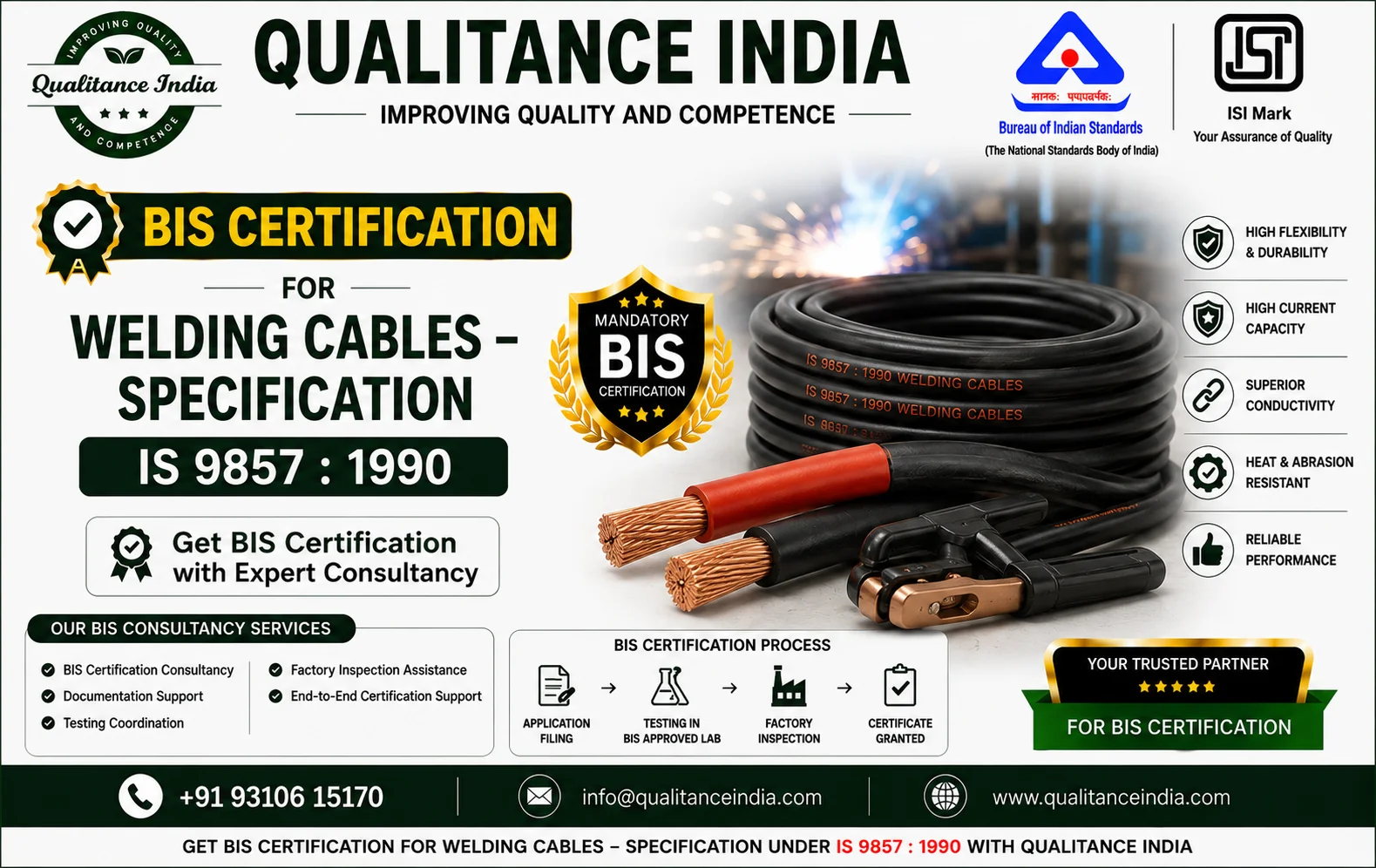
WELDING CABLES
IS 9857:1990
BIS CERTIFICATION CONSULTANCY
Qualitance India
+91-9310-615-170
info@qualitanceindia.com
qualitanceindia.com
Image Text Suggestions
- BIS Certification for Welding Cables
- Welding Cables IS 9857:1990
- BIS Licence for Welding Cables
- Welding Cable Testing
- IS 9857 Certification
- Copper Welding Cable BIS Certification
- Aluminium Welding Cable BIS Certification
- SE1 Welding Cable Certification
- SE3 Welding Cable Certification
- Welding Cable Quality Testing
- Welding Cable Factory Inspection
- Welding Cable Manufacturer BIS Certification
- BIS Certification for Electrical Cables
- ISI Mark for Welding Cables
- Qualitance India BIS Certification Consultancy
Related Services
- BIS Certification Consultancy
- BIS Certification for Electrical Cables
- BIS Certification for PVC Cables
- BIS Certification for Elastomer Insulated Cables
- BIS Product Testing
- BIS Factory Inspection
- ISI Mark Certification
- Electrical Cable Testing
- Conductor Testing
- Cable Quality Testing
- BIS Certification under Scheme-I
Related Topics for Your Website
- BIS Certification for Electrical Cables
- BIS Certification for PVC Insulated Cables
- BIS Certification for Elastomer Insulated Cables
- BIS Certification for Flexible Cables
- Welding Cable Testing Requirements
- Copper Welding Cable BIS Certification
- Aluminium Welding Cable Certification
- BIS Certification Process for Cable Manufacturers
- BIS Testing Requirements for Electrical Cables
- BIS Certification for Industrial Cables
Need BIS Certification for Welding Cables?
If you manufacture Welding Cables covered under IS 9857:1990, proper preparation of the conductor, covering, cable sizes, manufacturing process, testing facilities and quality-control documentation is important.
Qualitance India can assist with product assessment, product grouping, documentation, laboratory coordination, BIS application and factory inspection preparation.
Qualitance India
Phone: +91-9310-615-170
Email: info@qualitanceindia.com
Website: https://qualitanceindia.com/
Contact Qualitance India for assistance with BIS Certification for Welding Cables as per IS 9857:1990.
Conclusion
Welding cables are essential flexible electrical cables used in welding circuits and industrial fabrication applications. IS 9857:1990 specifies requirements and test methods for single-core flexible welding cables and covers applicable conductor and covering configurations.
For BIS certification, manufacturers need to carefully assess their conductor material, covering type, cable sizes, manufacturing process, product grouping, testing facilities and quality-control system.
The BIS Product Manual provides specific guidance on sampling, grouping, testing equipment and inspection and testing requirements.
With proper preparation and technical documentation, manufacturers can make the BIS certification process more systematic and ensure that their Welding Cables comply with the applicable requirements of IS 9857:1990.
Qualitance India can support manufacturers throughout the BIS certification process for Welding Cables as per IS 9857:1990.