
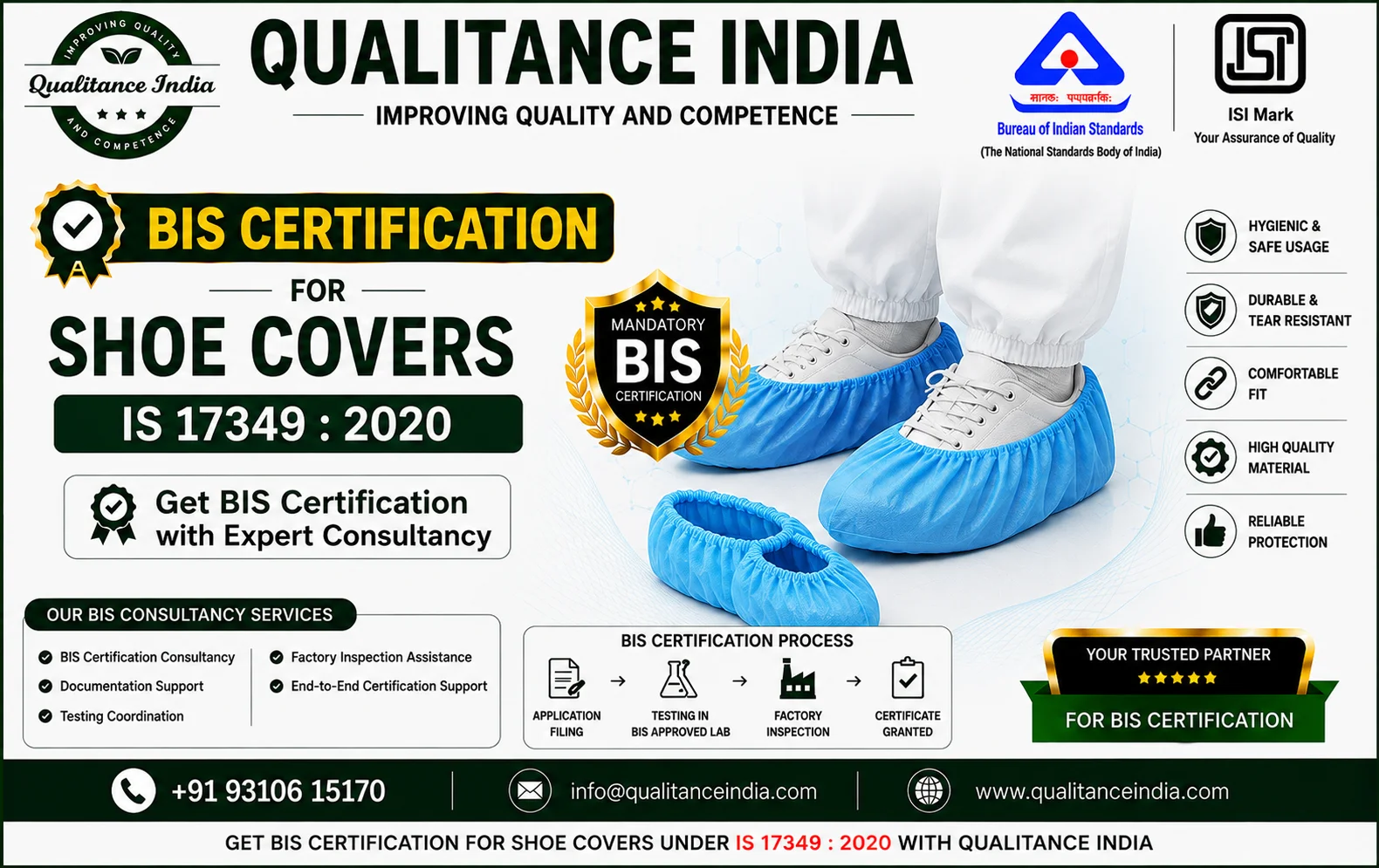
BIS Certification for Shoe Covers | IS 17349:2020 | BIS Consultancy
Introduction
Shoe covers are widely used in hospitals, clinics, laboratories, pharmaceutical manufacturing facilities, cleanrooms and other controlled environments where preventing the transfer of microorganisms, particles and contaminants is important.
IS 17349:2020 – Medical Textiles – Shoe Covers – Specification specifies requirements for shoe covers intended for medical purposes. The standard covers both disposable and reusable shoe covers and focuses on hygiene, cleanliness and performance characteristics.
The BIS Product Manual for IS 17349:2020 provides the framework for certification under Scheme-I of the BIS Conformity Assessment Regulations, 2018. BIS has also issued a revised Product Manual in August 2025.
For manufacturers of medical shoe covers, understanding the applicable material, performance, testing, manufacturing and marking requirements is essential before applying for a BIS licence.
About Shoe Covers
Medical shoe covers are protective covers worn over footwear to help reduce the movement of:
- Microorganisms
- Dust
- Particles
- Contaminants
- Fluids
They are commonly used in:
- Hospitals
- Dental clinics
- Operation theatres
- Laboratories
- Pharmaceutical facilities
- Medical manufacturing units
- Healthcare facilities
- Cleanrooms
- Research facilities
IS 17349:2020 covers disposable as well as reusable shoe covers for medical purposes.
What is IS 17349:2020?
IS 17349:2020 is titled:
Medical Textiles – Shoe Covers – Specification
The standard establishes requirements intended to ensure that medical shoe covers provide suitable hygienic and performance characteristics during their intended use.
The BIS technical information identifies requirements related to:
- Cleanliness
- Tensile strength
- Bursting strength
- Manufacture
- Workmanship
- Packaging
Scope of IS 17349:2020
The standard applies to shoe covers intended for medical purposes.
The product can be:
Disposable Shoe Covers
Designed for single-use applications.
Reusable Shoe Covers
Designed for repeated use and suitable processing according to their intended application.
The standard aims to help protect patients, materials and the environment from the transfer of microorganisms, particulates and contaminants.
Important Requirements for Shoe Covers
Cleanliness
Cleanliness is an important requirement because shoe covers are used in environments where contamination control is necessary.
The BIS technical information identifies microbial contamination assessment using ISO 11737-1 for evaluating cleanliness.
Tensile Strength
Shoe covers should have adequate strength to withstand handling and normal use.
The standard identifies tensile-strength testing under dry and wet conditions. For non-woven covers, IS 15891 (Part 3) is referenced, while woven covers use IS 1969 (Part 1), as described in BIS technical information.
Bursting Strength
Bursting strength assesses the ability of the shoe cover to withstand internal pressure without rupturing.
IS 1966 (Part 1) is identified for this testing.
Water Resistance
Water resistance is an important performance characteristic for medical shoe covers because they can come into contact with liquids during use.
Slip Resistance
The BIS technical information notes that medical shoe covers are expected to provide suitable slip-resistant performance.
Workmanship
The finished shoe cover should be manufactured with suitable workmanship and should not have unacceptable defects that could affect its intended use.
Packaging
The standard also includes requirements concerning hygienic manufacture and packaging of shoe covers.
Raw Material Requirements
The current BIS Product Manual states that the shoe cover shall be made from a suitable material that is not prohibited for the intended purpose under any applicable law or regulation in force.
Compliance may be established through:
- Material supplier's test certificate
- Material supplier's declaration
- Shoe cover manufacturer's declaration
The current 2025 Product Manual contains this requirement under the raw-material section.
Manufacturers should therefore maintain proper raw-material records and identify the materials used in the finished product.
Materials Used in Shoe Covers
Depending on the product design, medical shoe covers may be manufactured using suitable textile or non-woven materials.
Possible product constructions can include:
- Non-woven fabric
- Woven fabric
- Multi-layer constructions
- Coated or treated materials
- Other suitable materials permitted for the intended application
The exact material and construction should be assessed against the requirements of IS 17349:2020 before certification.
Types of Shoe Covers
Disposable Non-Woven Shoe Covers
These are generally intended for single-use applications.
Reusable Shoe Covers
These are designed for repeated use and require suitable durability and processing characteristics.
Waterproof Shoe Covers
These may be designed with additional resistance against liquid penetration.
Medical Cleanroom Shoe Covers
These can be used in controlled healthcare, laboratory and pharmaceutical environments.
The exact product scope should be determined according to the manufacturer's construction and intended application.
Manufacturing Process
A typical shoe-cover manufacturing process may include the following stages:
1. Raw Material Selection
Suitable fabric or material is selected according to the product specification.
2. Incoming Material Inspection
The material is checked for quality, dimensions and identification.
3. Material Preparation
The fabric is prepared and cut according to the required shoe-cover dimensions.
4. Cutting
Individual shoe-cover components are cut.
5. Joining
The components are joined using stitching, ultrasonic welding, heat sealing or another suitable process depending on the construction.
6. Elastic Attachment
Where applicable, elastic material is attached around the opening.
7. Finishing
Edges and joints are finished to achieve the required product quality.
8. Inspection
The finished product is checked for:
- Dimensions
- Workmanship
- Seams
- Elastic attachment
- Surface defects
- Cleanliness
- General appearance
9. Laboratory Testing
Representative samples are tested according to the applicable requirements.
10. Packing
Products are packed hygienically and identified appropriately.
Testing Requirements
Testing is an important part of BIS certification.
Depending on the product construction and applicable requirements, testing can include:
- Cleanliness
- Microbial contamination
- Tensile strength
- Bursting strength
- Water resistance
- Slip resistance
- Dimensional requirements
- Workmanship
- Packaging-related requirements
BIS's technical information specifically identifies microbial cleanliness, tensile strength and bursting strength among the key requirements of IS 17349:2020.
The exact testing programme should be confirmed against the latest standard and Product Manual before samples are submitted.
Laboratory Testing
Testing should be carried out through an appropriate laboratory according to the applicable BIS certification requirements.
The tests may vary depending on whether the product is:
- Woven
- Non-woven
- Disposable
- Reusable
- Single-layer
- Multi-layer
The testing laboratory should be selected based on its applicable scope for IS 17349:2020.
Manufacturers should obtain the latest laboratory quotation and testing scope before submitting samples.
Sample Requirements
The current BIS Product Manual states:
Sampling Guidelines: None
for IS 17349:2020.
This does not mean that manufacturers can submit any product sample. Samples should properly represent the product proposed for certification and should be selected according to the applicable BIS application and testing procedure.
Product Grouping
Manufacturers may have several shoe-cover variants based on:
- Material
- Fabric construction
- Size
- Disposable/reusable design
- Layer construction
- Water-resistant construction
- Manufacturing method
The BIS Product Manual provides grouping guidance through Annex A.
Proper grouping can help manufacturers define the licence scope correctly and avoid unnecessary duplication of testing.
Factory Requirements
A manufacturer applying for BIS certification should have suitable arrangements for:
- Raw-material storage
- Production
- Cutting
- Stitching/joining
- Finishing
- Product inspection
- Testing
- Packaging
- Finished-product storage
The factory should also maintain appropriate records demonstrating consistent manufacturing and quality control.
Factory Inspection
During BIS factory assessment, the manufacturing facility may be reviewed for:
Raw Materials
Supplier documents, material specifications and incoming inspection.
Machinery
Cutting, stitching, welding, sealing and other applicable machinery.
Production Process
The complete manufacturing process from raw material to finished shoe cover.
Quality Control
Incoming, in-process and finished-product inspection.
Testing Equipment
Availability and suitability of required testing and measuring equipment.
Calibration
Calibration records for applicable measuring and testing equipment.
Product Identification
Identification of product types, batches and variants.
Packaging
Packing and identification arrangements.
Records
Production, inspection and testing records.
Quality Control
Manufacturers should maintain suitable quality checks for:
- Raw material
- Fabric quality
- Dimensions
- Tensile strength
- Bursting strength
- Water resistance
- Slip resistance
- Microbial cleanliness
- Workmanship
- Elastic attachment
- Seams and joints
- Finished-product appearance
- Packaging
Proper batch identification and traceability should also be maintained.
Documents Required
Common documents for BIS certification may include:
- Company registration documents
- Factory address proof
- Factory layout
- Manufacturing process flow
- Machinery list
- Product specifications
- Product drawings
- Product dimensions
- Raw-material specifications
- Material supplier certificates
- Material declarations
- Internal test reports
- Laboratory test reports
- Testing equipment list
- Calibration certificates
- Quality-control plan
- Production records
- Inspection records
- Product photographs
- Packaging details
- Marking details
- Authorized signatory documents
- Trademark documents, where applicable
The exact document requirement depends on the applicant, manufacturing arrangement and proposed licence scope.
QCO Requirement
Shoe Covers are specifically listed under the Medical Textiles Quality Control Order against:
IS 17349:2020 – Medical Textiles – Shoe Covers – Specification
The 2024 QCO specifies an implementation date of:
1 April 2024.
Therefore, manufacturers dealing in products covered by this requirement should ensure compliance with the applicable BIS certification requirements.
Who Needs BIS Certification?
BIS certification requirements can apply to manufacturers producing shoe covers covered under IS 17349:2020 and the applicable Medical Textiles regulatory framework.
This may include:
- Medical shoe-cover manufacturers
- Disposable shoe-cover manufacturers
- Reusable shoe-cover manufacturers
- Non-woven shoe-cover manufacturers
- Medical textile manufacturers
- Hospital supply manufacturers
- Healthcare product manufacturers
- Cleanroom product manufacturers
- Medical disposable manufacturers
- Institutional healthcare suppliers
Importers should separately verify the requirements applicable to imported products.
Eligibility Requirements
A manufacturer should generally have:
- Suitable manufacturing premises
- Appropriate raw-material sourcing
- Manufacturing machinery
- Product inspection arrangements
- Testing facilities or permitted testing arrangements
- Quality-control procedures
- Calibration arrangements
- Production records
- Batch traceability
- Competent technical personnel
- Suitable packing arrangements
Common Reasons for Certification Delays
Some common causes of delay can include:
- Incorrect product classification
- Incorrect material declaration
- Non-conforming raw material
- Tensile-strength failure
- Bursting-strength failure
- Microbial cleanliness failure
- Water-resistance failure
- Slip-resistance issues
- Incorrect dimensions
- Poor workmanship
- Inadequate testing facilities
- Missing calibration records
- Incomplete quality records
- Incorrect samples
- Factory not ready for assessment
- Incomplete documentation
- Incorrect product marking
Proper preparation before application can help avoid unnecessary delays.
BIS Standard Mark
After successful grant of the BIS licence, the manufacturer can use the applicable BIS Standard Mark and licence number (CM/L) according to BIS certification conditions.
The Standard Mark should only be used for products covered under the approved licence scope and in the manner prescribed by BIS.
BIS granted its All India First Licence for Medical Textiles – Shoe Covers as per IS 17349:2020 in June 2024, demonstrating that the standard is being implemented through the BIS certification framework.
Cost of BIS Certification
The overall cost can depend on:
- BIS application charges
- Laboratory testing
- Number of product variants
- Product grouping
- Sample preparation
- Factory assessment
- Testing equipment
- Calibration
- Retesting, if required
- Documentation
- Consultancy charges
The final cost should therefore be calculated after reviewing the product construction and proposed licence scope.
Certification Timeline
The time required for BIS certification can depend on:
- Product configuration
- Documentation readiness
- Sample availability
- Laboratory availability
- Testing results
- BIS application processing
- Factory readiness
- Factory assessment
- Closure of observations
Manufacturers with multiple product variants should finalise their certification scope before beginning laboratory testing.
Benefits of BIS Certification
Regulatory Compliance
Helps manufacturers meet applicable requirements for medical shoe covers.
Product Quality
Testing verifies important performance and hygiene characteristics.
Customer Confidence
Certification can increase confidence among hospitals, laboratories and institutional buyers.
Market Acceptance
BIS certification supports market access where certification is required.
Consistent Production
Quality-control procedures help manufacturers maintain consistent product quality.
Better Documentation
The certification process encourages proper production, testing and inspection records.
Business Credibility
BIS certification can strengthen the credibility of manufacturers supplying medical textile products.
Why Choose Qualitance India?
Qualitance India provides BIS certification consultancy for medical textiles and various products covered by Indian Standards.
For Shoe Covers as per IS 17349:2020, assistance can include:
- Product applicability assessment
- Product scope review
- Material assessment
- Product grouping guidance
- Documentation support
- Testing requirement review
- Laboratory coordination
- Sample preparation guidance
- BIS application assistance
- Factory inspection preparation
- Quality-control documentation
- Test report coordination
- Observation closure assistance
- BIS licence support
Qualitance India
Phone: +91-9310-615-170
Email: info@qualitanceindia.com
Website: https://qualitanceindia.com/
BIS Certification Process
Product Identification
↓
IS 17349:2020 Requirement Review
↓
Raw Material Assessment
↓
Product Type & Grouping Review
↓
Factory & Testing Facility Assessment
↓
Documentation Preparation
↓
Sample Preparation
↓
Laboratory Testing
↓
BIS Application
↓
BIS Scrutiny
↓
Factory Assessment
↓
Test Report Evaluation
↓
Observation Closure
↓
BIS Licence Grant
↓
BIS Standard Mark
Frequently Asked Questions
1. What is IS 17349:2020?
IS 17349:2020 is the Indian Standard titled Medical Textiles – Shoe Covers – Specification.
2. What are medical shoe covers?
Medical shoe covers are protective covers worn over footwear to reduce the transfer of microorganisms, particulates and contaminants.
3. Does IS 17349 cover disposable shoe covers?
Yes. The standard covers both disposable and reusable shoe covers intended for medical purposes.
4. Does IS 17349 cover reusable shoe covers?
Yes. Reusable shoe covers are included within the scope of the standard.
5. What tests are required for shoe covers?
Important tests include microbial cleanliness, tensile strength and bursting strength, along with other applicable performance requirements.
6. Is microbial cleanliness tested?
Yes. Microbial contamination is assessed as part of the cleanliness requirements.
7. Is tensile strength tested?
Yes. Tensile strength is tested under dry and wet conditions according to the applicable product construction.
8. Is bursting strength tested?
Yes. Bursting strength is one of the requirements addressed under the standard.
9. Is water resistance important for medical shoe covers?
Yes. Water resistance is identified as an important performance characteristic for medical shoe covers.
10. Is slip resistance important?
Yes. Slip resistance is an important safety characteristic for shoe covers used in healthcare environments.
11. What raw materials can be used?
The shoe cover must be made from suitable material that is not prohibited for the intended purpose under applicable laws or regulations.
12. Is a raw-material declaration required?
Yes. Material supplier certificates/declarations and/or a manufacturer declaration may be used to establish compliance with the raw-material requirement.
13. Is product grouping applicable?
Yes. The Product Manual provides grouping guidance through Annex A.
14. What is the sampling requirement?
The current Product Manual states that there are no separate sampling guidelines for IS 17349:2020.
15. Is BIS certification mandatory for shoe covers?
Shoe Covers are included in the Medical Textiles QCO against IS 17349:2020, with an implementation date of 1 April 2024.
16. When was the first BIS licence granted for shoe covers?
BIS announced an All India First Licence for Medical Textiles – Shoe Covers as per IS 17349:2020 on 20 June 2024.
17. Is factory inspection required?
Factory assessment forms part of the applicable BIS certification process under Scheme-I.
18. Can one manufacturer certify multiple shoe-cover variants?
Potentially, subject to the applicable product grouping and licence-scope requirements.
19. What documents are required?
Typical documents include factory details, manufacturing process, machinery information, product specifications, raw-material documents, test reports, calibration records and quality-control records.
20. Can Qualitance India help with BIS certification for shoe covers?
Yes. Qualitance India can assist with product assessment, documentation, laboratory coordination, BIS application and factory inspection preparation.
People Also Ask
What is BIS certification for shoe covers?
It is the conformity assessment process for medical shoe covers covered under IS 17349:2020 and the applicable Medical Textiles regulatory requirements.
What is IS 17349?
IS 17349:2020 is the Indian Standard for Medical Textiles – Shoe Covers – Specification.
Is BIS certification mandatory for medical shoe covers?
Shoe Covers are included under the Medical Textiles QCO against IS 17349:2020, with implementation specified from 1 April 2024.
What are the tests for medical shoe covers?
Key requirements include microbial cleanliness, tensile strength and bursting strength, along with applicable product requirements.
Are disposable shoe covers covered by BIS?
Yes. IS 17349:2020 covers disposable as well as reusable shoe covers for medical purposes.
Are reusable shoe covers covered under IS 17349?
Yes. The standard covers reusable medical shoe covers as well.
How do I obtain a BIS licence for shoe covers?
The process generally involves product assessment, documentation, testing, BIS application, factory assessment and conformity evaluation.
Website Image Text
SHOE COVERS
IS 17349:2020
BIS CERTIFICATION CONSULTANCY
MEDICAL TEXTILES
Qualitance India
+91-9310-615-170
info@qualitanceindia.com
qualitanceindia.com
Image Text Suggestions
- BIS Certification for Shoe Covers
- BIS Licence for Shoe Covers
- Shoe Covers IS 17349:2020
- Medical Shoe Cover Certification
- Medical Textile BIS Certification
- Disposable Shoe Cover BIS Certification
- Reusable Shoe Cover BIS Certification
- IS 17349:2020 Certification
- Shoe Cover Testing
- Medical Shoe Cover Testing
- Shoe Cover Factory Inspection
- Medical Textile Testing
- BIS Certification for Medical Shoe Covers
- Shoe Cover Quality Testing
- Qualitance India BIS Certification Consultancy
Related Services
- BIS Certification for Medical Textiles
- BIS Certification for Dental Bib/Napkins
- BIS Certification for Bed Sheet and Pillow Cover
- BIS Certification for Hospital Textiles
- Medical Textile Testing
- BIS Product Testing
- BIS Factory Inspection
- ISI Mark Certification
- Medical Textile QCO Consultancy
- BIS Licence Consultancy
Related Topics for Your Website
- BIS Certification for Medical Textiles
- BIS Certification for Disposable Shoe Covers
- BIS Certification for Reusable Shoe Covers
- IS 17349:2020 Testing Requirements
- Medical Shoe Cover Testing
- Medical Textiles Quality Control Order
- BIS Certification for Hospital Products
- Medical Shoe Cover Manufacturing Requirements
- BIS Certification Process for Medical Textile Manufacturers
- Shoe Cover Testing Requirements in India
Need BIS Certification for Shoe Covers?
If you manufacture Medical Shoe Covers covered under IS 17349:2020, proper assessment of your raw materials, product construction, testing facilities, quality-control system and documentation is important.
Qualitance India can assist manufacturers with product assessment, product grouping, documentation, laboratory coordination, BIS application and factory inspection preparation.
Qualitance India
Phone: +91-9310-615-170
Email: info@qualitanceindia.com
Website: https://qualitanceindia.com/
Contact Qualitance India for assistance with BIS Certification for Shoe Covers as per IS 17349:2020.
Conclusion
IS 17349:2020 – Medical Textiles – Shoe Covers – Specification establishes requirements for disposable and reusable shoe covers intended for medical purposes. The standard focuses on hygiene, cleanliness and performance so that shoe covers can help control the transfer of microorganisms, particulates and contaminants in healthcare environments.
Important characteristics include microbial cleanliness, tensile strength and bursting strength, along with requirements related to manufacture, workmanship and packaging.
Shoe Covers are also covered under the Medical Textiles Quality Control framework, with the 2024 QCO specifying 1 April 2024 as the implementation date.
Manufacturers should therefore carefully review their material, product construction, product variants, testing arrangements, quality-control procedures and factory facilities before applying for certification.
With proper preparation of technical documents, representative samples and factory records, manufacturers can make the BIS certification process more systematic.
Qualitance India can assist manufacturers with BIS certification consultancy for Shoe Covers as per IS 17349:2020, including product assessment, documentation, testing coordination, application support and factory inspection preparation.