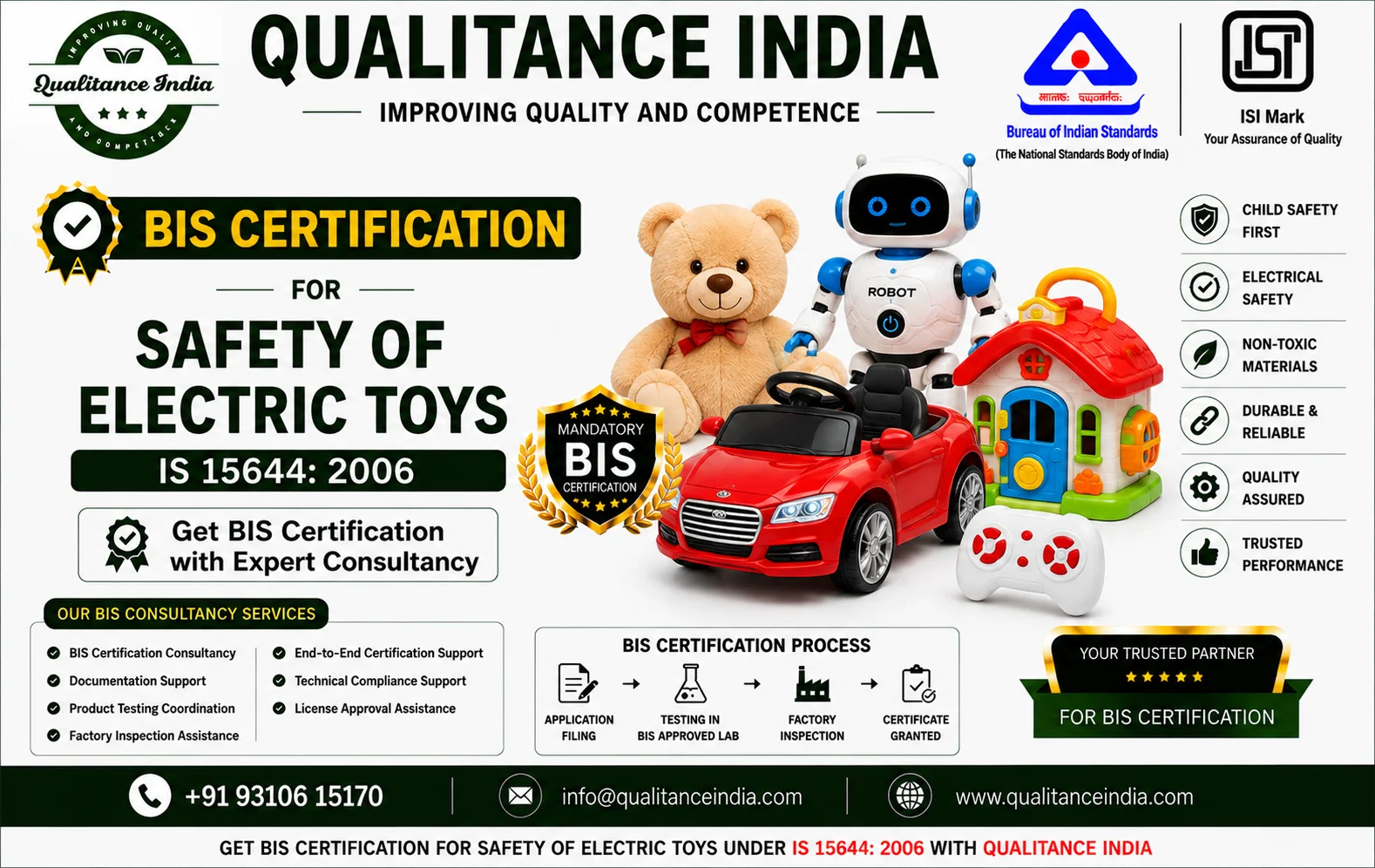
BIS Certification Consultancy for Safety of Electric Toys | IS 15644:2006 | BIS & ISI Mark Certification
Introduction
Electric toys are toys in which at least one function depends on electricity. They may operate using batteries, rechargeable batteries or other electrical power arrangements, and can include a wide variety of products such as electrically operated toy vehicles, constructional sets, experimental sets, functional toys, video toys and toys containing electrical functions.
Because children may directly interact with these products, electrical safety is especially important. Risks can include electric shock, overheating, fire, mechanical hazards, moisture-related problems, damaged cords, excessive temperatures and other safety concerns.
In India, IS 15644:2006 – Safety of Electric Toys specifies safety requirements for toys having at least one function dependent on electricity. The standard is based on IEC 62115:2003. BIS's official material explains that electric toys must also meet the applicable requirements of IS 9873, because IS 9873 addresses hazards other than those arising from the use of electricity.
Electric Toys are covered under the Toys (Quality Control) Order, 2020, with subsequent amendments. BIS's current Scheme-I listing continues to identify IS 15644:2006 – Safety of Electric Toys under the compulsory certification framework.
Qualitance India provides end-to-end BIS Certification Consultancy for Electric Toys as per IS 15644:2006, including product classification, grouping guidance, documentation, laboratory testing coordination, BIS application support and factory inspection preparation.
What is IS 15644:2006?
IS 15644:2006 is titled:
“Safety of Electric Toys”
The standard deals with the safety of toys that have at least one function dependent on electricity. The BIS preview states that the scope includes constructional sets, experimental sets, functional toys and video toys, as well as toys using electricity for secondary functions.
The standard covers important electrical and related safety requirements including:
- Power input
- Heating and abnormal operation
- Electrical strength at operating temperature
- Moisture resistance
- Resistance to humidity
- Electric strength at room temperature
- Mechanical strength
- Construction
- Protection of cords and wires
- Components
- Screws and connections
- Clearance and creepage distances
- Resistance to heat and fire
- Radiation, toxicity and similar hazards
- Marking and instructions
The current BIS LIMS database lists these test areas for IS 15644:2006.
What are Electric Toys?
Electric toys are toys that contain an electrical function. Electricity may be supplied through:
- Non-rechargeable batteries
- Rechargeable batteries
- A transformer connected to the mains
- Other permitted electrical arrangements
The official BIS scope specifically notes that examples include constructional sets, experimental sets, functional toys and video toys. Toys using electricity only for a secondary function can also fall within the standard.
Examples can include:
- Battery-operated toy cars
- Electric ride-on toys
- Electronic educational toys
- Toy construction sets
- Electronic game toys
- Toy instruments
- Toys with lights or sound
- Toys with electrically operated movement
- Interactive electronic toys
- Certain video toys
The applicability of IS 15644:2006 depends on the actual design and electrical function of the toy.
Scope of IS 15644:2006
The scope of the standard is broad because it applies to toys having at least one function dependent on electricity.
The standard also covers toys where electricity is only a secondary function. An official BIS example is a doll's house containing an interior lamp.
The BIS scope document also states that:
- Transformers for toys are not themselves considered toys.
- Battery chargers are not considered toys merely because they are supplied with a toy.
- Certain products specifically excluded from the standard include toy steam engines, scale models for adult collectors, sports equipment, certain aquatic equipment, collectively used playground equipment, amusement machines, professional toys installed in public places, certain teaching-context heating products, portable child-appealing luminaires and Christmas decorations.
Manufacturers should therefore determine applicability from the actual product design rather than relying only on the product's marketing name.
Important Electrical Safety Requirement
The BIS product information for IS 15644:2006 states that the working voltage between any two accessible parts of the toy shall not exceed 24 V when the toy is supplied at its rated voltage.
This is an important design consideration for manufacturers because accessible conductive parts and electrical architecture need to be evaluated accordingly.
Is BIS Certification Mandatory for Electric Toys?
Yes. BIS certification is mandatory for Electric Toys covered under the applicable Toys Quality Control framework.
BIS's current compulsory-certification page lists:
IS 15644:2006 – Safety of Electric Toys
under Electric Toys, with the Toys (Quality Control) Order, 2020 and subsequent amendments. The current BIS listing also records the Toys (Quality Control) Amendment Order, 2024 and the Transition Facilitation (Quality Control) Order, 2026.
For manufacturers, compliance therefore involves the BIS certification process and the applicable requirements of IS 15644:2006 together with relevant secondary toy-safety standards.
Toys Quality Control Order
The Toys QCO provides the regulatory framework for compulsory certification of toys.
BIS categorises toys for certification into two primary types:
| Toy Category | Primary Standard |
|---|---|
| Non-Electric Toys | IS 9873 (Part 1):2019 |
| Electric Toys | IS 15644:2006 |
BIS's official FAQ explains that a manufacturer may apply under one of these primary standards depending on the type of toy. Where both electric and non-electric toy licences are required, separate applications are required.
The official FAQ also explains that samples are tested against the primary standard and applicable secondary standards such as relevant parts of IS 9873.
BIS Certification for Electric Toys
BIS Certification confirms that the electric toy has been assessed against the applicable BIS safety requirements.
The certification process for electric toys is more than simply checking electrical components. Depending on the toy, the applicable conformity assessment can also involve relevant requirements under the IS 9873 series, because toy safety includes mechanical, physical, chemical and other hazards. BIS explicitly states that electric toys must also comply with IS 9873-1 and other applicable secondary standards.
After the BIS licence is granted, the manufacturer can use the BIS Standard Mark / ISI Mark according to the applicable licence and regulatory requirements.
Who Needs BIS Certification for Electric Toys?
BIS certification is relevant to manufacturers producing electric toys covered by IS 15644:2006.
This can include:
- Electric Toy Manufacturers
- Battery-Operated Toy Manufacturers
- Electronic Toy Manufacturers
- Toy Vehicle Manufacturers
- Ride-On Toy Manufacturers
- Educational Electronic Toy Manufacturers
- Interactive Toy Manufacturers
- Video Toy Manufacturers
- Electronic Game Toy Manufacturers
- OEM Toy Manufacturers
- Contract Toy Manufacturers
Importers and distributors should also verify their obligations under the current Toys QCO and BIS framework.
BIS Certification Eligibility Requirements
A manufacturer seeking BIS certification should generally have:
- Manufacturing premises
- Toy assembly facilities
- Electrical assembly facilities
- Appropriate machinery
- Product drawings
- Circuit diagrams
- Product specifications
- Component specifications
- Battery/power-source details
- Raw-material control
- Production process controls
- Testing equipment
- Calibration arrangements
- Quality-control personnel
- Inspection procedures
- Production records
- Test records
- Product traceability
- Packaging and marking arrangements
The exact requirements depend on the toy type, electrical architecture, age category and applicable secondary standards.
BIS Certification Process for Electric Toys
Step 1 – Product Applicability Assessment
The first step is to determine whether the product is an electric toy within the scope of IS 15644:2006.
The review considers:
- Electrical function
- Power source
- Rated voltage
- Accessible electrical parts
- Age category
- Construction
- Intended use
Step 2 – Primary and Secondary Standards Assessment
For an electric toy, IS 15644:2006 is the primary standard.
Applicable secondary toy standards under the IS 9873 series also need to be identified according to the toy's characteristics. BIS's official FAQ confirms that samples are assessed against the primary and applicable secondary standards.
Step 3 – Product Grouping
Toy manufacturers commonly produce many models and SKUs. BIS has grouping provisions so that representative models can be tested instead of testing every individual model.
The BIS FAQ explains that toys of similar design, made from the same materials and falling under a single sub-category can be treated as a series, with a representative model tested for that series.
Step 4 – Documentation Preparation
Technical, manufacturing and quality-control documents are prepared.
Step 5 – Sample Preparation
The current BIS toy Product Manual specifies a sample quantity of approximately 3–10 pieces, depending on the product and the quantity needed to complete testing.
The exact sample requirement should be confirmed for the particular toy series and applicable test programme before submission.
Step 6 – Laboratory Testing
Representative samples are tested against IS 15644:2006 and applicable secondary toy standards.
Step 7 – BIS Application
The manufacturer submits the BIS application with the required technical and factory information.
Step 8 – Factory Assessment
BIS assesses the manufacturing facility, testing arrangements, quality-control system and documentation.
Step 9 – Observation Closure
Any observations or non-conformities are addressed through corrective action.
Step 10 – BIS Licence Grant
After successful conformity assessment, BIS grants the licence for the approved toy scope.
Step 11 – ISI Marking
The manufacturer can mark products covered by the licence according to applicable BIS requirements.
Testing Requirements for Electric Toys
Testing is one of the most important stages of electric-toy certification.
The current BIS LIMS database identifies testing for IS 15644:2006 across several safety areas.
Marking and Instructions
The toy's markings and safety instructions are checked for compliance.
The current BIS laboratory listing identifies Clause 7.0 – Marking and Instructions.
Power Input
The toy's power input is evaluated under Clause 8.
Correct rated power information is important for electrical safety and product documentation.
Heating and Abnormal Operation
The toy is assessed under normal and abnormal operating conditions to identify risks caused by overheating or improper operation.
The BIS LIMS database identifies Clause 9.0 – Heating and Abnormal Operation.
Electrical Strength at Operating Temperature
The insulation and electrical structure are assessed under operating-temperature conditions.
BIS LIMS identifies Clause 10.0 – Electrical Strength at Operating Temperature.
Moisture Resistance
Electrical toys may be exposed to moisture during foreseeable use.
The applicable moisture-resistance requirements are listed under Clause 11.1.
Resistance to Humidity
Humidity-related electrical safety is also evaluated where applicable.
The current BIS LIMS database lists Clause 11.2 – Resistant to Humidity.
Electric Strength at Room Temperature
Electrical insulation is assessed under room-temperature conditions under Clause 12.
Mechanical Strength
The toy is evaluated to determine whether its construction can withstand applicable mechanical stresses.
The BIS LIMS database identifies Clause 13.0 – Mechanical Strength.
Construction
Construction requirements are evaluated across several subclauses of Clause 14.
Current BIS LIMS listings identify multiple construction-related tests under IS 15644:2006.
Protection of Cords and Wires
Protection of cords and wires is particularly important for toys that contain flexible electrical leads or similar connections.
The BIS LIMS database separately identifies Clause 15 requirements for protection of cords and wires.
Components
Components used in the electrical system are evaluated under the applicable requirements.
Clause 16 is identified in the current BIS laboratory testing scope.
Screws and Connections
Requirements for screws, connections and applicable insulating components are included under Clause 17.
Clearance and Creepage Distances
Clearance and creepage distances are important for preventing electrical tracking, arcing and insulation breakdown.
The BIS LIMS database lists Clause 18.0 – Clearance and Creepage Distance.
Resistance to Heat and Fire
The standard includes tests such as:
- Ball pressure test
- Glow wire test
- Needle flame test
where applicable.
The current BIS LIMS listing identifies these under Clause 19.
Radiation, Toxicity and Similar Hazards
Clause 20 addresses radiation, toxicity and similar hazards.
The BIS product information also highlights protection against toxic and similar hazards as an important part of electric-toy safety.
Heating and Abnormal Operation
Heating and abnormal operation testing is important because electric toys can include:
- Motors
- LEDs
- Heating-producing components
- Batteries
- Charging systems
- Electronic controls
The manufacturer needs to ensure that foreseeable abnormal conditions do not create unacceptable hazards.
The current BIS LIMS listing identifies Clause 9 as a specific test area.
Electrical Strength and Insulation
Electrical toys must provide adequate protection against electric shock and insulation breakdown.
Testing can include:
- Electrical strength at operating temperature
- Electrical strength at room temperature
- Moisture-related insulation performance
- Applicable electrical safety checks
These areas are directly identified in the current BIS laboratory testing scope.
Mechanical Strength
Electrical toys must also withstand the mechanical forces associated with foreseeable use.
Mechanical-strength testing is identified under Clause 13 of IS 15644:2006.
Mechanical safety can be particularly important for:
- Toy vehicles
- Ride-on toys
- Toys with moving parts
- Interactive toys
- Toys containing removable components
Cords and Wires
Where a toy includes cords or wires, their protection is important to avoid:
- Damage
- Pulling
- Twisting
- Insulation failure
- Exposure of conductors
- Electrical hazards
The current BIS LIMS database identifies separate testing for protection of cords and wires.
Clearance and Creepage Distances
The design of electrical toys must provide suitable clearance and creepage distances between electrically different parts.
These requirements help reduce the risk of:
- Short circuit
- Arcing
- Insulation failure
- Electrical tracking
Clause 18 of IS 15644:2006 specifically addresses these requirements.
Heat and Fire Safety
Electric toys must be designed so that components do not create unacceptable heat or fire hazards.
Depending on applicability, testing may include:
- Ball pressure
- Glow wire
- Needle flame
These tests are included in the current BIS LIMS testing scope.
Radiation and Toxicity
The electric-toy standard also addresses radiation, toxicity and similar hazards.
This is important for products containing:
- Light-emitting components
- Electronic systems
- Materials that may be accessible to children
The BIS product summary specifically identifies radiation, toxicity and similar hazards as areas addressed by IS 15644:2006.
Electric Toys and IS 9873 Requirements
Electric-toy certification does not end with IS 15644.
The official BIS scope for IS 15644 says that electric toys also have to comply with ISO 8124-1, and BIS's Indian certification framework addresses applicable IS 9873 parts for other hazards.
BIS's official FAQ specifically confirms that toy samples can be tested against the primary standard and applicable secondary standards, including relevant parts of IS 9873.
This can involve requirements relating to:
- Mechanical and physical properties
- Flammability
- Migration of certain elements
- Finger paints
- Certain phthalates
- Other applicable toy-safety requirements
The applicable secondary standards depend on the toy's design, materials, function and intended age category.
Product Grouping for Electric Toys
Product grouping is highly important because toy manufacturers often have a large number of models and SKUs.
BIS's official FAQ explains that models of similar design, made from the same materials and falling within one sub-category can be treated as a series. A representative model can then be selected for testing to cover that series.
The grouping process can consider factors such as:
- Toy design
- Materials
- Electrical construction
- Function
- Starting age
- Specific purpose
- Sub-category
- Power source
- Similarity of components
Proper grouping can reduce unnecessary testing while maintaining conformity.
Manufacturing Process for Electric Toys
A typical manufacturing process may include:
- Raw-material receiving
- Incoming inspection
- Plastic or metal component manufacturing
- PCB/electronic component assembly
- Motor or actuator installation
- Battery compartment assembly
- Wiring
- Switch/control assembly
- Housing assembly
- Mechanical assembly
- Software/functional configuration, where applicable
- Electrical safety inspection
- Functional testing
- Final inspection
- Packing
- Marking
The exact process depends on the toy design.
Manufacturers should maintain appropriate controls for both electrical and non-electrical components.
BIS Factory Inspection for Electric Toys
Factory assessment is an important part of the BIS certification process.
During inspection, BIS may examine:
Manufacturing Facilities
Production machinery, assembly lines and component-manufacturing facilities.
Electrical Assembly
PCB, wiring, battery, switch, motor and electronic assembly operations.
Component Control
Incoming inspection and traceability of electrical and mechanical components.
Testing Facilities
Available facilities for applicable routine tests.
Calibration
Calibration records for measuring and testing equipment.
Quality Control
Incoming, in-process and final inspection systems.
Production Records
Batch and model-wise production records.
Testing Records
Routine and periodic test records.
Product Traceability
Model, batch, date and other applicable identification.
Marking and Packaging
Product markings, warnings, instructions and packaging information.
In-House Testing Requirements
BIS's official toy FAQ explains that manufacturers do not necessarily have to establish every testing facility for every requirement within the factory.
The Product Manual includes a Scheme of Inspection and Testing specifying test frequencies and which tests can be subcontracted to BIS-recognised laboratories. BIS specifically notes that, for electric toys, in-house facilities are required only for the specified electric-toy tests that the Product Manual requires manufacturers to establish, and only where applicable to the toys being manufactured.
This is particularly relevant for MSME toy manufacturers.
BIS Product Manual and Sampling
The BIS toy Product Manual provides grouping and sampling guidance to manage the large number of toy models manufactured by many companies.
The current Product Manual identifies 3–10 pieces as the indicative sample size, depending on the toy's size and the quantity needed for complete testing.
The official BIS FAQ also confirms that BIS does not test every model or SKU individually where grouping provisions can be applied.
Documents Required for BIS Certification
Typical documents may include:
- Company registration documents
- Factory address proof
- Factory layout
- Manufacturing process flow chart
- Machinery list
- Product drawings
- Circuit diagrams
- Electrical specifications
- Rated voltage and power details
- Battery details
- Charger/power-supply details, where applicable
- Component specifications
- PCB details
- Motor details
- Raw-material information
- Supplier details
- Test equipment list
- Calibration certificates
- Quality-control plan
- Product grouping details
- Age-category information
- Production records
- Test records
- Product photographs
- Packaging artwork
- Warning labels
- Instructions
- Marking details
- Authorised signatory documents
- Trademark documents, where applicable
The final documentation requirement depends on the toy type and proposed BIS licence scope.
Marking and Instructions
Marking is specifically addressed under Clause 7.0 of IS 15644:2006, and current BIS LIMS listings identify marking and instructions as part of the testing scope.
Manufacturers should ensure that:
- Product identification is clear
- Electrical ratings are correctly stated
- Required warnings are provided
- Instructions are supplied where applicable
- Age-related information is consistent
- BIS Standard Mark is applied according to licence conditions
The exact marking requirements should be checked against the current BIS certification documents applicable to the product.
Common Reasons for BIS Certification Delays
Manufacturers may face delays because of:
- Incorrect product classification
- Incorrect primary standard
- Incorrect toy grouping
- Incorrect age-category assessment
- Incomplete electrical drawings
- Incorrect rated voltage
- Power-input mismatch
- Heating failure
- Electrical-strength failure
- Moisture-resistance failure
- Mechanical-strength failure
- Cord or wire protection failure
- Insufficient clearance or creepage
- Component non-conformity
- Heat or fire-test failure
- Radiation or toxicity concerns
- Incomplete IS 9873 testing
- Inadequate laboratory facilities
- Missing calibration records
- Incorrect sample selection
- Factory not ready for inspection
- Incomplete documentation
- Incorrect marking or instructions
A pre-certification product and grouping review can help reduce avoidable delays.
BIS Certification Cost for Electric Toys
There is no single fixed BIS certification cost applicable to every electric toy manufacturer.
The total cost can depend on:
- BIS application fees
- Laboratory testing
- Number of toy series
- Product grouping
- Electrical configuration
- Applicable IS 9873 secondary tests
- Sample quantity
- Factory assessment
- Testing equipment
- Calibration
- Documentation
- Retesting, if required
- Consultancy charges
Current BIS LIMS listings show different testing charges for IS 15644:2006.
For example, one current BIS listing from URS Products and Testing Pvt. Ltd. shows a total testing charge of ₹15,000 excluding taxes for the listed scope. Another current BIS listing from Precision Laboratories shows ₹16,500, while the Southern Regional Laboratory lists a testing entry of ₹7,050.
These laboratory charges should not be considered the complete BIS certification cost because the overall project can also include application, applicable secondary testing, factory assessment, equipment, calibration, documentation and consultancy expenses.
BIS Certification Timeline
The timeline for electric-toy BIS certification can vary depending on:
- Number of toy series
- Product grouping
- Electrical configuration
- Applicable IS 9873 tests
- Documentation readiness
- Sample preparation
- Laboratory availability
- Test results
- BIS application scrutiny
- Factory readiness
- Factory assessment
- Observation closure
Toy grouping can significantly influence the amount of testing required.
Benefits of BIS Certification for Electric Toys
Regulatory Compliance
Helps manufacturers comply with applicable BIS and Toys QCO requirements.
ISI Mark
Allows eligible manufacturers to use the BIS Standard Mark on products covered by the approved licence.
Electrical Safety
Testing addresses electrical shock, insulation, abnormal-operation and other relevant hazards.
Better Product Quality
Mechanical, electrical and construction checks help improve overall product reliability.
Child Safety
The applicable toy-safety framework helps address risks beyond electrical hazards as well.
Customer Confidence
BIS certification can strengthen confidence among parents, retailers, distributors and institutional buyers.
Market Acceptance
Certification supports legal market access where BIS certification is compulsory.
Better Manufacturing Controls
The BIS certification process encourages structured testing, inspection, calibration and traceability.
Business Credibility
A valid BIS licence can strengthen the manufacturer's position in the Indian toy market.
Why Choose Qualitance India?
Qualitance India provides professional BIS Certification Consultancy for manufacturers seeking BIS and ISI Mark certification.
For Safety of Electric Toys as per IS 15644:2006, our consultancy support can include:
- Product applicability assessment
- IS 15644:2006 requirement review
- Primary and secondary standard assessment
- Toy-age-category review
- Product grouping guidance
- Series identification
- Documentation preparation
- Sample selection guidance
- Laboratory testing coordination
- IS 9873 testing coordination
- BIS application assistance
- Factory inspection preparation
- Testing equipment guidance
- Quality-control documentation
- Observation closure support
- BIS licence assistance
Our support is designed to help manufacturers manage the certification process from product assessment and grouping through testing, BIS application, factory assessment and licence approval.
Contact Qualitance India
Phone: +91 93106 15170
Email: info@qualitanceindia.com
Website: qualitanceindia.com
BIS Certification Process – Quick Flow
Product Identification
↓
IS 15644:2006 Requirement Review
↓
Electric Toy Classification
↓
Age Category & Toy Series Assessment
↓
Primary & Secondary Standards Identification
↓
Product Grouping & Scope Finalisation
↓
Documentation Preparation
↓
Representative Sample Preparation
↓
IS 15644 + Applicable IS 9873 Testing
↓
BIS Application
↓
Application Scrutiny
↓
Factory Assessment
↓
Observation Closure
↓
BIS Licence Grant
↓
ISI Mark on Approved Electric Toys
Frequently Asked Questions
1. What is IS 15644:2006?
IS 15644:2006 is the Indian Standard for Safety of Electric Toys. It is based on IEC 62115:2003.
2. What is an electric toy?
An electric toy is a toy having at least one function dependent on electricity. Electricity can be supplied through batteries or other electrical sources.
3. Is BIS certification mandatory for electric toys?
Yes. IS 15644:2006 is included under the compulsory BIS certification framework for Electric Toys.
4. What is the primary standard for electric toys?
The primary standard for Electric Toys is IS 15644:2006.
5. Do electric toys also require IS 9873 testing?
Yes, where applicable. BIS states that electric toys must also comply with applicable secondary toy-safety standards, including relevant parts of IS 9873.
6. Does BIS test every toy model?
No. BIS provides grouping guidelines so that representative models can be tested for a series of sufficiently similar toys.
7. What is a toy series for BIS certification?
BIS's FAQ explains that models with similar design, made from the same materials and covered under one sub-category can be treated as a series, with one representative model tested for that series.
8. What are the main tests under IS 15644?
Important tests include power input, heating and abnormal operation, electrical strength, moisture resistance, mechanical strength, construction, cord and wire protection, components, clearance and creepage, heat and fire, and radiation/toxicity-related requirements.
9. What is the 24 V requirement for electric toys?
The BIS product summary states that the working voltage between any two accessible parts shall not exceed 24 V when the toy is operated at its rated voltage.
10. What is the current sample quantity?
The current toy Product Manual indicates 3–10 pieces, depending on the size of the toy and the quantity needed for complete testing.
11. Is factory inspection required?
Yes. Factory assessment forms part of the BIS certification process.
12. Do manufacturers need every testing facility in-house?
No. BIS's official FAQ states that certain tests can be subcontracted to BIS-recognised laboratories according to the Product Manual and Scheme of Inspection and Testing.
13. What is tested for protection of cords and wires?
The electrical safety evaluation includes requirements intended to prevent damage and hazardous exposure of cords and wires. Clause 15 is specifically identified in the BIS laboratory testing scope.
14. What are the heat and fire tests?
Depending on applicability, the testing scope includes ball pressure, glow wire and needle flame tests.
15. How much does BIS testing for electric toys cost?
Current BIS LIMS entries show different laboratory charges. Examples include ₹7,050, ₹15,000 and ₹16,500, depending on the laboratory and scope.
16. How long does BIS certification take?
The timeline depends on grouping, number of toy series, applicable IS 9873 testing, laboratory testing, documentation, BIS application processing and factory assessment.
17. Can one BIS licence cover multiple toy models?
Yes, where the models meet the applicable BIS grouping criteria. Representative models can be tested for a qualifying series.
18. Can Qualitance India help with IS 15644:2006 certification?
Yes. Qualitance India provides product assessment, grouping guidance, documentation, laboratory coordination, BIS application support and factory inspection preparation.
People Also Ask
What is BIS certification for electric toys?
BIS certification for electric toys is the conformity-assessment process for demonstrating compliance with IS 15644:2006 – Safety of Electric Toys and applicable secondary toy-safety requirements.
Is IS 15644:2006 under a QCO?
Yes. IS 15644:2006 is listed under the Toys (Quality Control) Order, 2020 and subsequent amendments.
What is the BIS standard for electric toys?
The primary Indian Standard is IS 15644:2006 – Safety of Electric Toys.
Do battery-operated toys need BIS certification?
A battery-operated toy can fall within IS 15644:2006 when at least one of its functions depends on electricity.
What tests are required for electric toys?
Testing can include electrical strength, heating, abnormal operation, moisture resistance, mechanical strength, construction, cord and wire protection, clearance and creepage, heat/fire resistance and radiation/toxicity-related requirements.
Does an electric toy also need IS 9873?
Applicable IS 9873 requirements can apply in addition to IS 15644:2006 because the toy-safety framework addresses hazards beyond electricity.
How do I get an ISI Mark for electric toys?
The manufacturer must obtain the applicable BIS licence for the electric-toy scope and comply with BIS testing, grouping, factory, marking and continuing-conformity requirements.
Related BIS Certification Services
- BIS Certification for Non-Electric Toys – IS 9873
- BIS Certification for Safety of Toys
- BIS Certification for Battery Operated Toys
- BIS Certification for Electronic Toys
- BIS Certification for Toy Vehicles
- BIS Certification for Ride-On Electric Toys
- BIS Certification for Educational Toys
- BIS Certification for Children Products
- BIS & ISI Mark Certification
- BIS Factory Inspection Assistance
- BIS Testing Coordination
- BIS Certification Consultancy
Conclusion
IS 15644:2006 – Safety of Electric Toys is the primary Indian Standard for toys having at least one function dependent on electricity. The standard addresses important safety areas including power input, heating and abnormal operation, electrical strength, moisture resistance, mechanical strength, construction, protection of cords and wires, components, clearance and creepage distances, resistance to heat and fire, radiation, toxicity and similar hazards.
For BIS certification, electric toys are treated separately from non-electric toys, with IS 15644:2006 serving as the primary standard. BIS also makes clear that applicable secondary standards from the IS 9873 series may need to be considered because toy safety involves hazards beyond electrical safety.
Manufacturers should therefore carefully assess the toy's electrical function, age category, design, materials, product series, applicable IS 9873 requirements, testing facilities and documentation before filing a BIS application.
BIS's grouping system is particularly useful for toy manufacturers producing multiple models and SKUs because qualifying models of similar design, material and sub-category can be organised into series and tested through representative samples.
The current BIS laboratory database also confirms that testing facilities and charges are available for IS 15644:2006 across multiple laboratories, with charges varying according to the laboratory and testing scope.
Qualitance India provides end-to-end BIS Certification Consultancy for Safety of Electric Toys as per IS 15644:2006, including product assessment, primary and secondary standard identification, toy-series grouping, documentation, laboratory testing coordination, BIS application support and factory inspection preparation.
For BIS Certification and ISI Mark Consultancy for Electric Toys, contact Qualitance India today.
Phone: +91 93106 15170
Email: info@qualitanceindia.com
Website: qualitanceindia.com