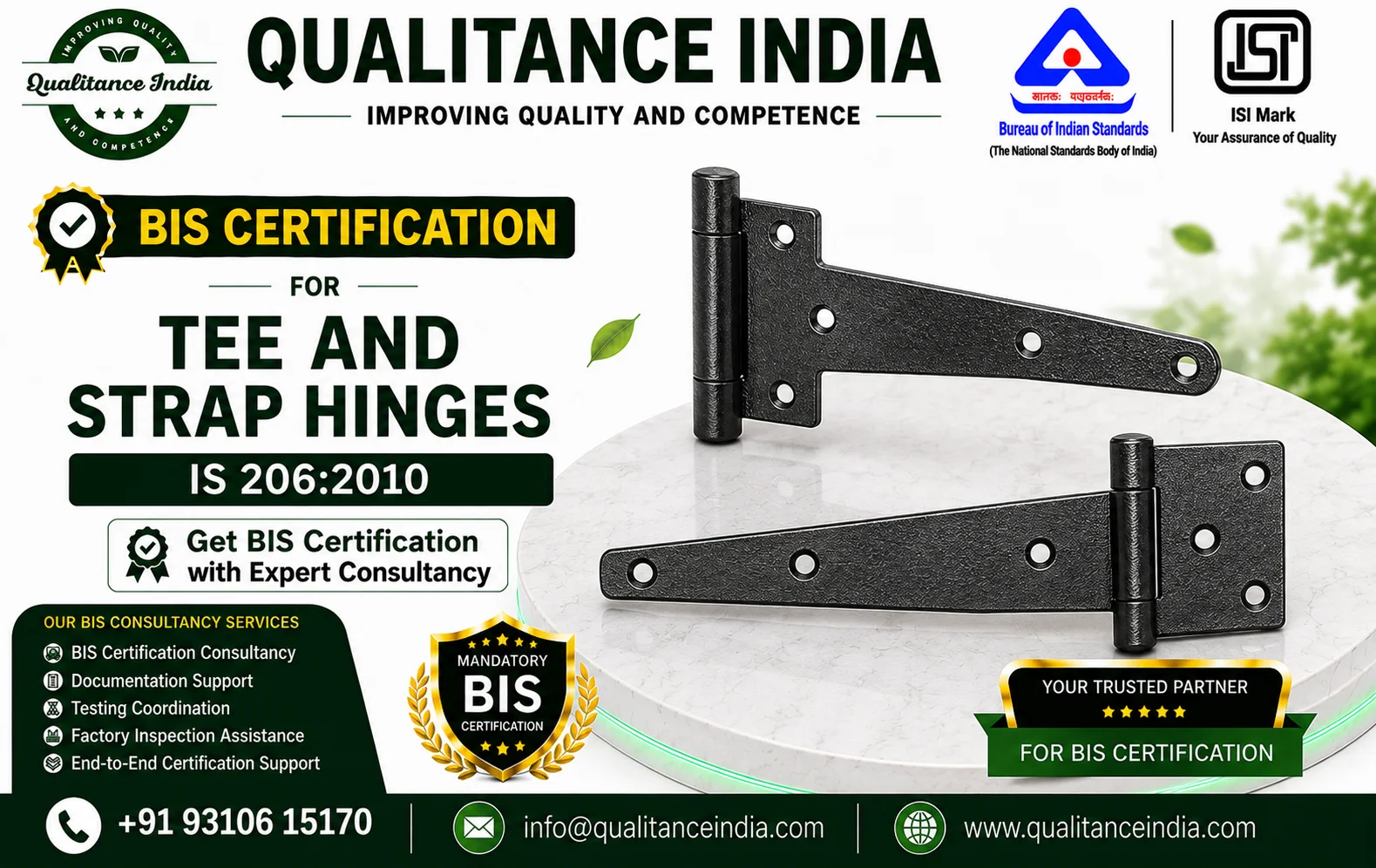
BIS Certification Consultancy for Tee and Strap Hinges | IS 206:2010
Introduction
Tee and Strap Hinges are commonly used for doors, gates, windows, cabinets and other applications where a suitable hinge mechanism is required. These hinges are designed to provide movement between two connected components while maintaining adequate strength and durability.
In India, IS 206:2010 – Tee and Strap Hinges – Specification (Fifth Revision) specifies requirements for Tee and Strap Hinges. BIS currently lists IS 206:2010 under the Hinges product category covered by the Hinges Quality Control Order.
The BIS product manual for IS 206:2010 provides information regarding raw materials, product grouping, sample size, test equipment, inspection and testing arrangements and the scope of the licence.
Qualitance India provides BIS Certification Consultancy for Tee and Strap Hinges as per IS 206:2010, including product assessment, documentation, laboratory testing coordination, BIS application assistance and factory inspection preparation.
Product ke baare mein
Tee and Strap Hinges are hardware components used to connect and support movable doors, gates, shutters and similar structures.
The product generally consists of components such as:
- Hinge flap or strap
- Knuckles
- Hinge pin
- Screw holes
- Fixing arrangement
- Surface finish
Tee hinges and strap hinges are available in different types and weight categories depending on their intended application.
The BIS product manual identifies categories including light weight, medium weight and heavy weight variants.
Applicable IS Standard
The applicable standard is:
IS 206:2010 – Tee and Strap Hinges – Specification (Fifth Revision)
The BIS product manual confirms that the standard is IS 206:2010 and provides certification-related information for Tee and Strap Hinges.
BIS also lists IS 206:2010 under its Scheme-I product certification requirements for hinges.
Scope of Standard
IS 206:2010 covers requirements for Tee and Strap Hinges.
The standard addresses aspects including:
- Types of hinges
- Dimensions
- Tolerances
- Raw materials
- Manufacture
- Workmanship
- Finish
- Packing
- Marking
BIS laboratory information for IS 206:2010 specifically lists testing relating to dimensions and tolerances, workmanship, finish and marking.
The standard also provides different categories and types of Tee and Strap Hinges, and the certification scope needs to be properly defined according to the manufacturer's products.
Product Requirements
Types of Tee Hinges
The BIS product manual identifies Tee Hinge categories such as:
- Light Weight – Type 1
- Light Weight – Type 2
- Medium Weight – Type 1
- Medium Weight – Type 2
- Heavy Weight – Type 1
- Heavy Weight – Type 2
- Heavy Weight – Type 3
Types of Strap Hinges
The product manual identifies Strap Hinge categories including:
- Light Weight
- Medium Weight – Type 1
- Medium Weight – Type 2
- Heavy Weight
The exact product scope should be finalised according to the applicable requirements of IS 206:2010.
Testing Requirements
Testing is an important part of BIS certification for Tee and Strap Hinges.
The BIS laboratory information for IS 206:2010 includes requirements related to:
- Dimensions and tolerances
- Workmanship
- Finish
- Marking
- Hinge types
- Raw-material requirements
- Screw holes
- Other applicable characteristics
Laboratory listings also show material-composition testing for the flap and pin.
The exact tests, test methods and acceptance requirements should be followed according to the current applicable standard and BIS certification documents.
Raw Material Requirements
The BIS Product Manual for IS 206:2010 identifies the following raw materials:
Mild Steel Sheet
Grade 0 of IS 1079
Mild Steel Wire
Minimum 1/4H grade of IS 280
These material requirements should be properly controlled and documented by the manufacturer.
Manufacturers should maintain:
- Raw-material specifications
- Supplier details
- Purchase records
- Material identification
- Inspection records
- Test certificates
- Batch traceability
Proper raw-material control helps maintain consistency in finished hinges.
Manufacturing Requirements
A typical manufacturing process for Tee and Strap Hinges may include:
- Raw-material procurement
- Raw-material inspection
- Sheet and wire preparation
- Cutting
- Forming
- Flap manufacturing
- Knuckle formation
- Pin preparation
- Hole formation
- Assembly
- Finishing
- Surface treatment, where applicable
- Dimensional inspection
- Final quality inspection
- Testing
- Packing
The actual process can vary depending on the manufacturer's machinery and product type.
Manufacturing controls should ensure that the finished hinge meets the applicable dimensions, tolerances, workmanship and finish requirements.
BIS Certification Process
Step 1 – Product Assessment
The Tee and Strap Hinges are reviewed against IS 206:2010.
Step 2 – Product Scope Finalisation
The applicable hinge types, weight categories, sizes and variants are identified.
Step 3 – Factory Assessment
The manufacturing facility and quality-control arrangements are reviewed.
Step 4 – Documentation Preparation
The required technical and factory documents are prepared.
Step 5 – Sample Preparation
Representative samples are selected according to the applicable certification requirements.
Step 6 – Laboratory Testing
Samples are tested against the relevant requirements of IS 206:2010.
Step 7 – BIS Application
The manufacturer submits the BIS application along with supporting documents.
Step 8 – Application Scrutiny
BIS reviews the submitted application and supporting information.
Step 9 – Factory Inspection
The manufacturing facility is assessed as applicable.
Step 10 – Observation Closure
Any observations or non-conformities identified during the process need to be addressed.
Step 11 – Licence Grant
After successful completion of the applicable requirements, the BIS licence is granted for the approved product scope.
Step 12 – BIS Marking
The manufacturer can mark the approved products according to the applicable BIS licence and marking requirements.
Documents Required
The manufacturer may need documents such as:
- Company registration documents
- Factory address proof
- Factory layout
- Manufacturing process flow
- Machinery list
- Product drawings
- Product specifications
- Product catalogue
- Raw-material details
- Raw-material specifications
- Supplier details
- Quality-control plan
- Testing equipment list
- Calibration certificates
- Internal test reports
- Production records
- Inspection records
- Product photographs
- Packaging details
- Marking details
- Authorised signatory documents
- Trademark documents, where applicable
The exact documents depend on the manufacturer and proposed certification scope.
Factory Inspection
During factory inspection, different aspects of manufacturing and quality control may be reviewed.
Manufacturing Machinery
The machinery used for cutting, forming, drilling, knuckle formation, assembly and finishing may be checked.
Raw Material
Mild steel sheet and mild steel wire should be properly identified and controlled according to the applicable requirements.
Production Process
Manufacturing operations should be carried out under suitable process controls.
Testing Equipment
The required measuring and testing equipment should be available as applicable.
Calibration
Applicable measuring instruments should have valid calibration records.
Quality Control
Incoming, in-process and final inspection procedures should be maintained.
Records
Production, inspection and testing records should be available.
Finished Products
Finished hinges should be properly identified and stored.
Marking
Product marking should comply with the applicable BIS requirements.
Product Quality Checks
Manufacturers should conduct appropriate quality checks during production.
These may include:
- Raw-material inspection
- Dimensional inspection
- Tolerance checks
- Screw-hole inspection
- Knuckle inspection
- Pin inspection
- Workmanship inspection
- Surface-finish inspection
- Final product inspection
- Marking verification
- Packing inspection
BIS laboratory information specifically identifies dimensions and tolerances, workmanship, finish and marking as test/inspection areas for IS 206:2010.
Common Reasons for Testing/Certification Failure
Manufacturers may face problems due to:
- Incorrect product classification
- Incorrect product grouping
- Incorrect dimensions
- Dimensional variation
- Improper tolerances
- Incorrect raw material
- Poor knuckle formation
- Incorrect pin dimensions
- Improper screw-hole positioning
- Poor workmanship
- Unsatisfactory finish
- Incorrect marking
- Inadequate testing equipment
- Missing calibration records
- Incomplete documentation
- Factory not properly prepared
- Incorrect samples
Proper product evaluation before testing can help reduce avoidable delays.
BIS Marking
After the BIS licence is granted, the manufacturer must follow the applicable marking requirements.
The manufacturer should ensure that:
- Product identification is correct.
- Applicable standard information is correctly represented.
- BIS licence details are used as required.
- BIS Standard Mark is applied according to the licence conditions.
- Packaging information is accurate.
The exact marking requirements should be followed from the current BIS licence and applicable certification documents.
Who Needs BIS Certification
BIS certification requirements may be relevant to manufacturers of:
- Tee Hinges
- Strap Hinges
- Light Weight Hinges
- Medium Weight Hinges
- Heavy Weight Hinges
- Gate Hinges
- Door Hardware Manufacturers
- Architectural Hardware Manufacturers
- Metal Hardware Manufacturers
- Hardware OEM Manufacturers
- Private Label Manufacturers
The Hinges Quality Control Order covers Tee and Strap Hinges under IS 206:2010. BIS currently lists IS 206:2010 under the compulsory Scheme-I product certification framework for hinges.
Cost
The total cost of BIS certification can vary depending on:
- BIS application charges
- Laboratory testing
- Number of product types
- Number of sizes
- Product grouping
- Factory inspection
- Testing equipment
- Calibration
- Documentation
- Retesting, if required
- Consultancy charges
Therefore, the exact cost should be calculated after reviewing the manufacturer's product range and factory setup.
Timeline
The certification timeline depends on:
- Product readiness
- Product grouping
- Documentation
- Sample preparation
- Laboratory testing
- Test results
- BIS application scrutiny
- Factory readiness
- Factory inspection
- Closure of observations
Proper preparation of samples, documents and factory facilities can help reduce unnecessary delays.
Benefits
Better Product Quality
Testing and inspection help maintain conformity with the applicable standard.
Customer Confidence
BIS certification can increase confidence among customers, dealers and institutional buyers.
Regulatory Compliance
It helps manufacturers comply with applicable BIS certification requirements.
Market Acceptance
Certification supports market access where BIS certification is mandatory.
Consistent Manufacturing
Quality-control requirements encourage consistent production.
Business Credibility
BIS certification can strengthen the manufacturer's credibility in the hardware and building-material market.
Why Choose Qualitance India
Qualitance India provides BIS Certification Consultancy for manufacturers dealing with Indian Standards and BIS certification requirements.
For Tee and Strap Hinges as per IS 206:2010, our support can include:
- Product applicability assessment
- IS 206:2010 requirement review
- Product grouping guidance
- Product scope finalisation
- Documentation support
- Sample preparation guidance
- Laboratory testing coordination
- BIS application assistance
- Factory inspection preparation
- Quality-control documentation
- Testing equipment guidance
- Observation closure support
- BIS licence assistance
Our objective is to help manufacturers manage the certification process systematically from product assessment through testing, factory inspection and licence grant.
Complete Process
Product Identification
↓
IS 206:2010 Requirement Review
↓
Type, Weight & Size Assessment
↓
Product Grouping
↓
Factory Assessment
↓
Documentation Preparation
↓
Sample Preparation
↓
Laboratory Testing
↓
BIS Application
↓
Application Scrutiny
↓
Factory Inspection
↓
Observation Closure
↓
BIS Licence Grant
↓
BIS Marking
20 Frequently Asked Questions
1. What is IS 206:2010?
IS 206:2010 is the Indian Standard for Tee and Strap Hinges – Specification (Fifth Revision).
2. What products are covered under IS 206:2010?
The standard covers Tee Hinges and Strap Hinges in specified types, weight categories and sizes.
3. What types of Tee Hinges are covered?
The BIS product manual identifies Light Weight, Medium Weight and Heavy Weight types with specified sub-types.
4. What types of Strap Hinges are covered?
The product manual identifies Light Weight, Medium Weight and Heavy Weight Strap Hinges.
5. What raw material is specified for Tee and Strap Hinges?
The product manual specifies Mild Steel Sheet of Grade 0 of IS 1079 and Mild Steel Wire of minimum 1/4H grade of IS 280.
6. Is BIS certification applicable to Tee and Strap Hinges?
Yes. IS 206:2010 is listed under the compulsory Scheme-I product certification requirements for hinges.
7. What tests are performed?
Testing and inspection areas include dimensions and tolerances, workmanship, finish, marking and applicable material requirements.
8. Is raw-material testing required?
Applicable material requirements, including material composition of the flap and pin, are included in BIS laboratory scopes for IS 206:2010.
9. Is factory inspection required?
Factory assessment forms part of the applicable BIS certification process.
10. What documents are required?
Factory, product, manufacturing, raw-material, testing and quality-control documents may be required.
11. Can multiple hinge sizes be covered?
Yes, the certification scope can include applicable sizes subject to product grouping and BIS requirements.
12. Can different hinge types be covered under one licence?
This depends on the applicable product grouping and certification scope.
13. What happens if a sample fails?
The cause of failure should be identified and corrective action taken according to the applicable BIS procedure.
14. Why is product grouping important?
Proper grouping helps determine the appropriate samples and certification scope.
15. Why is dimensional inspection important?
Dimensions and tolerances are specified requirements for Tee and Strap Hinges.
16. Why is workmanship important?
Proper workmanship helps ensure that the finished hinge is manufactured consistently and performs as intended.
17. How much does BIS certification cost?
The cost depends on product types, sizes, testing, factory assessment and other applicable expenses.
18. How long does BIS certification take?
The timeline depends on testing, documentation, BIS scrutiny, factory inspection and closure of observations.
19. Can an existing hinge manufacturer apply for BIS certification?
Yes, manufacturers having suitable facilities and meeting the applicable requirements can apply.
20. Can Qualitance India help with IS 206:2010 certification?
Yes. Qualitance India provides support for product assessment, documentation, testing coordination, BIS application and factory inspection preparation.
People Also Ask
What is the BIS standard for Tee and Strap Hinges?
The applicable standard is IS 206:2010 – Tee and Strap Hinges – Specification.
Is BIS certification mandatory for Tee Hinges?
Tee and Strap Hinges are included in the compulsory BIS product-certification framework for hinges.
What raw material is used for Tee and Strap Hinges?
The BIS product manual identifies Mild Steel Sheet and Mild Steel Wire with specified grades as the raw materials.
What are the types of Tee Hinges?
The standard covers specified Light Weight, Medium Weight and Heavy Weight Tee Hinge types.
What are the types of Strap Hinges?
The standard includes Light Weight, Medium Weight and Heavy Weight Strap Hinges.
What is tested for Tee and Strap Hinges?
Dimensions, tolerances, workmanship, finish, marking and applicable material requirements are among the areas covered by BIS laboratory testing information.
How can I obtain BIS Certification for Tee and Strap Hinges?
The process generally involves product assessment, product grouping, documentation, sample testing, BIS application, factory inspection and licence grant.
Related BIS Certification Services
- BIS Certification for Steel Butt Hinges
- BIS Certification for Stainless Steel Butt Hinges
- BIS Certification for Non-Ferrous Metal Butt Hinges
- BIS Certification for Parliament Hinges
- BIS Certification for Continuous Piano Hinges
- BIS Certification for Steel Back Flap Hinges
- BIS Certification for Door Hardware
- BIS Certification for Rim Latches
- BIS Certification for Tower Bolts
- ISI Mark Certification
- BIS Testing Assistance
- BIS Factory Inspection Assistance
Related Topics
- IS 206:2010 Tee and Strap Hinges
- BIS Certification for Tee Hinges
- BIS Certification for Strap Hinges
- Tee Hinge Testing Requirements
- Strap Hinge Testing Requirements
- BIS Hinges Quality Control Order
- BIS Certification for Door Hardware
- Tee and Strap Hinge Product Grouping
- BIS Factory Inspection for Hinges
- BIS Certification Consultancy in India
Contact Qualitance India
Phone: +91 93106 15170
Email: info@qualitanceindia.com
Website: qualitanceindia.com
For assistance with BIS Certification for Tee and Strap Hinges as per IS 206:2010, contact Qualitance India for product assessment, documentation, testing coordination and BIS certification support.
Conclusion
IS 206:2010 – Tee and Strap Hinges – Specification (Fifth Revision) provides requirements for Tee and Strap Hinges, including their types, dimensions, tolerances, raw materials, workmanship, finish, packing and marking.
BIS currently includes Tee and Strap Hinges under the compulsory product-certification framework for hinges, making proper product assessment, testing, documentation and factory preparation important for manufacturers.
Manufacturers should ensure that their raw materials, manufacturing processes, product dimensions, workmanship, testing facilities and quality-control records are properly maintained.
Qualitance India provides BIS Certification Consultancy for Tee and Strap Hinges as per IS 206:2010, supporting manufacturers with product assessment, product grouping, documentation, laboratory testing coordination, BIS application and factory inspection preparation.
Phone: +91 93106 15170
Email: info@qualitanceindia.com
Website: qualitanceindia.com