
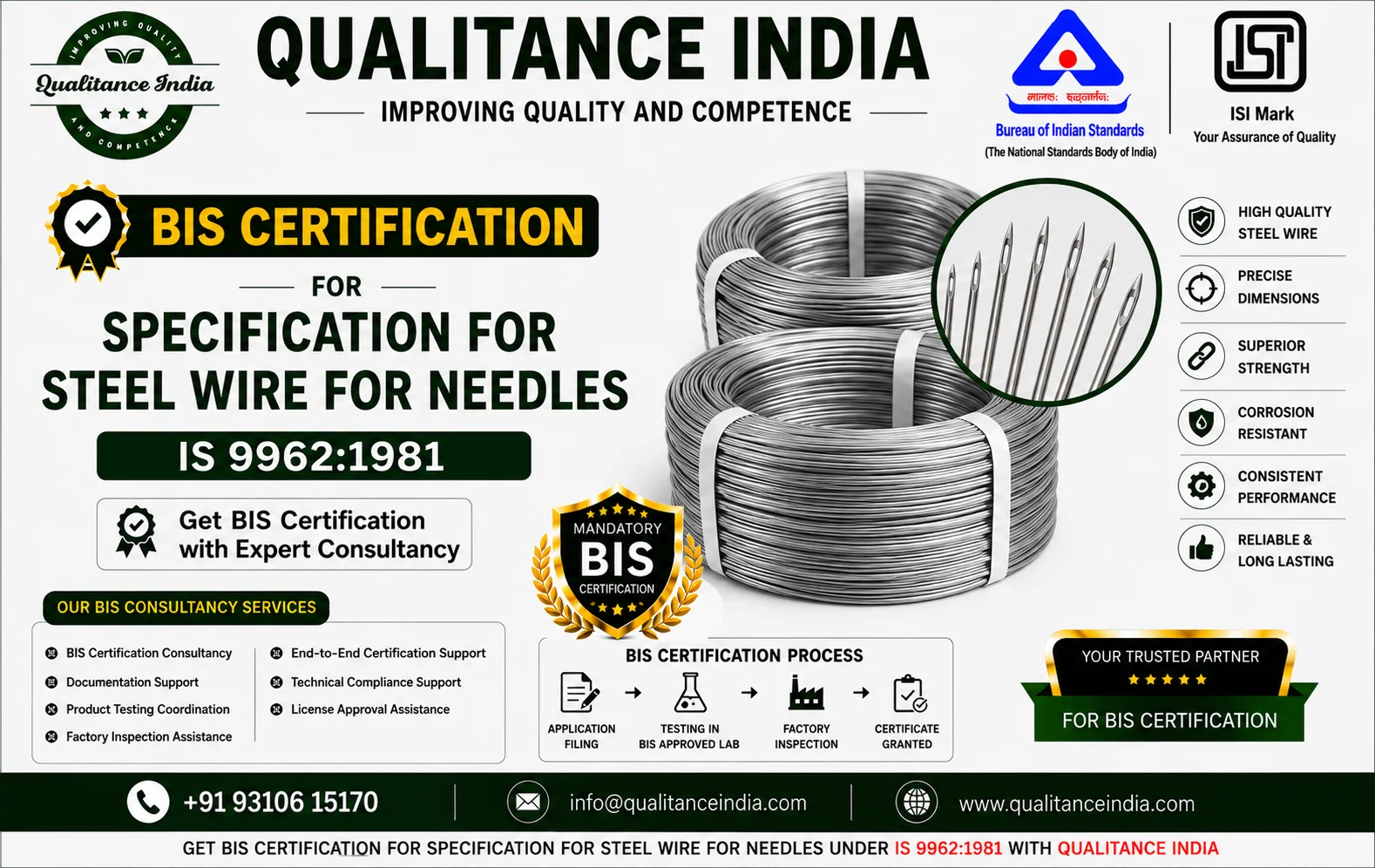
BIS Certification Consultancy for Steel Wire for Needles | IS 9962:1981 | BIS & ISI Mark Certification
Introduction
Steel wire for needles is a precision steel-wire product used for manufacturing different types of needles, including hand-sewing needles and other specialized needle products. Since needle manufacturing requires accurate dimensions, suitable mechanical properties, controlled surface condition and consistent wire quality, the steel wire used as an input material must meet defined technical requirements.
In India, IS 9962:1981 – Specification for Steel Wire for Needles specifies the requirements for steel wire intended for needle manufacturing. The standard covers different chemical-composition grades, wire sizes and surface finishes. BIS's product information highlights requirements relating to chemical composition, tensile strength, surface finish, decarburization and dimensional accuracy.
The current BIS Product Manual PM/9962/2 dated October 2024 provides certification guidance under Scheme-I of the BIS Conformity Assessment Regulations, 2018. It records two amendments to IS 9962:1981 and provides grouping and testing guidance for applicants and existing licence holders.
Steel Wire for Needles is included in the Steel and Steel Products (Quality Control) Order, 2024. The QCO specifically lists IS 9962:1981 – Specification for Steel Wire for Needles and provides “With immediate effect” as the enforcement date.
Qualitance India provides end-to-end BIS Certification Consultancy for Steel Wire for Needles as per IS 9962:1981, including product scope assessment, grade and size grouping, documentation, sample preparation, laboratory testing coordination, BIS application support and factory inspection preparation.
What is IS 9962:1981?
IS 9962:1981 is titled:
“Specification for Steel Wire for Needles”
The standard is intended for steel wire used in manufacturing needles. BIS's product summary states that the standard is designed to ensure the wire has appropriate strength, flexibility, dimensional accuracy and surface quality for needle-manufacturing applications.
The standard addresses important characteristics such as:
- Chemical composition
- Carbon
- Manganese
- Silicon
- Sulphur
- Phosphorus
- Chromium, where applicable
- Molybdenum, where applicable
- Nickel, where applicable
- Tensile strength
- Wire dimensions
- Surface finish
- Decarburization
- Freedom from defects
- Coated finish
- Marking
The current BIS testing database contains laboratory testing arrangements for IS 9962:1981.
What is Steel Wire for Needles?
Steel wire for needles is a precision steel wire manufactured to meet the requirements needed for needle production.
The wire may be supplied in different:
- Chemical-composition grades
- Diameters
- Surface finishes
- Coated conditions
The controlled properties help needle manufacturers carry out subsequent forming, pointing, machining and other manufacturing operations.
BIS's product information specifically identifies the application of IS 9962:1981 for different needle types, including hand-sewing needles and gramophone needles.
Applications of Steel Wire for Needles
Steel wire conforming to IS 9962:1981 can be used for manufacturing different needle products, depending on the wire grade, size and purchaser requirements.
Applications may include:
- Hand-sewing needles
- Industrial sewing needles
- Specialized needle products
- Certain precision needle components
- Other needle-manufacturing applications covered by the standard
The final suitability depends on the actual wire specification and intended needle application.
Scope of IS 9962:1981
The BIS Product Manual identifies the following main scope parameters:
Chemical Composition Grades
- Grade I
- Grade II
- Grade III
Wire Size
The Product Manual identifies wire sizes from:
0.125 mm to 4.50 mm
and also permits other sizes as agreed between the relevant parties.
Surface Finish
The scope includes:
- Bright drawn
- Copper coated
- Brass coated
- Bronze coated
These parameters are important when finalising a BIS licence scope.
Is BIS Certification Mandatory for Steel Wire for Needles?
Yes. Steel Wire for Needles under IS 9962:1981 is covered under the compulsory BIS certification framework.
The Steel and Steel Products (Quality Control) Order, 2024 specifically lists:
IS 9962:1981 – Specification for Steel Wire for Needles
with ITC (HS) codes:
- 72171010
- 72171020
- 72171030
- 72179019
- 72179091
- 72179099
The QCO specifies:
Implementation: With immediate effect.
The current BIS Scheme-I page also continues to list IS 9962:1981 under the Steel and Iron Products compulsory-certification framework.
Steel and Steel Products Quality Control Order
The current steel QCO framework is important for manufacturers of Steel Wire for Needles.
The QCO requires covered steel products to conform to their applicable Indian Standards and operate under the BIS certification framework.
For IS 9962:1981, the 2024 QCO lists the product and states immediate enforcement.
Manufacturers should also verify the latest amendments, exemptions and government notifications applicable to their particular product and supply arrangement.
Important Update to IS 9962:1981
Manufacturers should not rely only on old copies of the standard.
BIS issued implementation guidelines for Amendment No. 2 to IS 9962:1981 on 16 October 2024. The circular states that the amendment was to be implemented by 28 January 2025. It also notes updates to reference standards and changes to the method for determining decarburization under IS 6396/ISO 3837.
The current Product Manual PM/9962/2 dated October 2024 reflects the revised certification framework.
Therefore, manufacturers seeking certification today should use the current applicable version and amendments, especially for decarburization and referenced test methods.
BIS Certification for Steel Wire for Needles
BIS Certification demonstrates that the manufacturer's steel wire complies with the applicable requirements of IS 9962:1981.
The current BIS Product Manual confirms certification under Scheme-I of the BIS Conformity Assessment Regulations, 2018.
After successful conformity assessment and grant of the BIS licence, the manufacturer can use the BIS Standard Mark / ISI Mark on products covered by the approved licence scope and subject to the applicable marking requirements.
Who Needs BIS Certification for Steel Wire for Needles?
BIS certification is relevant to manufacturers producing steel wire covered by IS 9962:1981.
This can include:
- Steel Wire Manufacturers
- Needle Wire Manufacturers
- Precision Wire Manufacturers
- Sewing Needle Material Manufacturers
- Industrial Needle Wire Manufacturers
- Medical Needle Material Manufacturers, where applicable
- Spring and Precision Wire Processing Units, where the product specifically falls under IS 9962
- Steel Wire Drawing Units
- Specialty Steel Wire Manufacturers
- OEM Manufacturers
- Contract Manufacturers
Importers and other businesses dealing in covered steel wire should separately verify their obligations under the current QCO and BIS framework.
BIS Certification Eligibility Requirements
A manufacturer seeking BIS certification should generally have suitable manufacturing and quality-control facilities.
These may include:
- Wire drawing machinery
- Wire finishing facilities
- Heat treatment facilities, where applicable
- Coating facilities
- Straightening and coiling equipment
- Dimensional inspection facilities
- Chemical-analysis laboratory
- Tensile-testing facilities
- Decarburization-testing arrangement
- Surface inspection facilities
- Calibration system
- Quality-control personnel
- Production records
- Testing records
- Batch/lot traceability
- Marking and packing arrangements
The final requirements depend on the proposed grade, size and finish.
BIS Certification Process for Steel Wire for Needles
Step 1 – Product Applicability Assessment
The product is reviewed against IS 9962:1981.
The assessment includes:
- Chemical-composition grade
- Wire size
- Surface finish
- Manufacturing process
- Intended application
- Proposed licence scope
Step 2 – Grade Assessment
IS 9962:1981 identifies:
- Grade I
- Grade II
- Grade III
The manufacturer should identify which grade or grades are intended to be covered.
Step 3 – Size Scope Assessment
The manufacturer determines the lowest and highest wire sizes intended for the licence.
The Product Manual identifies the normal size range as 0.125 mm to 4.50 mm, with other sizes possible by agreement.
Step 4 – Finish Assessment
The proposed finish is identified:
- Bright drawn
- Copper coated
- Brass coated
- Bronze coated
Each coated finish intended for the licence requires appropriate consideration under the grouping guidelines.
Step 5 – Product Grouping
Grouping is finalised before sample selection.
BIS's Product Manual provides separate requirements for grades, size ranges and coated finishes.
Step 6 – Documentation Preparation
Technical, factory and quality-control documents are prepared.
Step 7 – Sample Preparation
Samples representing the proposed scope are prepared according to BIS requirements.
The exact sampling plan should be confirmed from the current Product Manual and laboratory requirements before submission.
Step 8 – Laboratory Testing
Representative samples are tested against the applicable requirements of IS 9962:1981.
Step 9 – BIS Application
The manufacturer submits the BIS application together with the required documentation.
Step 10 – Factory Assessment
BIS assesses manufacturing facilities, testing arrangements and quality-control systems.
Step 11 – Observation Closure
Any observations raised by BIS are addressed through corrective action and supporting evidence.
Step 12 – BIS Licence Grant
After successful conformity assessment, BIS grants the licence for the approved scope.
Step 13 – ISI Marking
The manufacturer can use the BIS Standard Mark on covered products according to the licence conditions.
Testing Requirements for Steel Wire for Needles
Testing is a critical component of BIS certification for this precision steel wire.
BIS's product information identifies important quality parameters including:
- Chemical composition
- Tensile strength
- Surface finish
- Decarburization
- Dimensional accuracy
The BIS laboratory database currently provides testing entries for IS 9962:1981.
Chemical Composition
Chemical composition is one of the most important requirements because it determines the metallurgical characteristics of the wire.
The BIS laboratory scope identifies tests for:
- Carbon
- Manganese
- Silicon
- Sulphur
- Phosphorus
and, where applicable:
- Chromium
- Molybdenum
- Nickel
The exact chemical limits depend on the grade of wire.
Carbon
Carbon content has a significant effect on strength, hardness and processing behaviour.
IS 9962 classifies wires by chemical composition into three grades, so manufacturers should ensure that carbon content meets the requirement of the declared grade.
Manganese and Silicon
Manganese and silicon are controlled alloying elements that influence the mechanical and metallurgical behaviour of the wire.
Their specified limits depend on the applicable grade.
Sulphur and Phosphorus
Sulphur and phosphorus are controlled because excessive levels can adversely affect steel quality and processing performance.
The applicable limits should be verified against the current edition and amendments to IS 9962:1981.
Chromium, Molybdenum and Nickel
For applicable grades, BIS laboratory testing can include chromium, molybdenum and nickel.
These elements should be controlled according to the chemical-composition requirements of the relevant grade.
Tensile Strength
Tensile strength is an important mechanical property for needle wire.
The wire needs sufficient strength for subsequent needle-manufacturing operations such as forming and shaping.
The applicable tensile-strength requirement depends on the grade and wire size.
Surface Finish
Surface condition is particularly important for precision wire.
The standard recognises:
- Bright drawn finish
- Copper coated finish
- Brass coated finish
- Bronze coated finish
A suitable surface finish supports downstream processing and can help protect the wire against surface-related defects and corrosion, depending on the finish.
Decarburization
Decarburization is a critical metallurgical characteristic for steel wire.
Excessive decarburization can alter the surface properties of the wire and affect strength and processing behaviour.
BIS issued Amendment No. 2 implementation guidelines in 2024 specifically updating the decarburization test method with reference to IS 6396/ISO 3837.
Manufacturers should therefore ensure that their current decarburization testing method matches the latest applicable requirement.
Dimensional Accuracy
Needle manufacturing is a precision application, making wire diameter and dimensional consistency important.
The Product Manual identifies wire sizes from 0.125 mm to 4.50 mm, subject to the standard's provisions.
Dimensional controls should be maintained during wire drawing and finishing.
Typical measurements may include:
- Wire diameter
- Diameter tolerance
- Surface condition
- Straightness, where applicable
Freedom from Surface Defects
The wire should be controlled for unacceptable surface defects.
Manufacturers should maintain inspection systems capable of identifying:
- Cracks
- Laps
- Surface marks
- Scratches
- Other defects that could affect downstream needle manufacturing
The precise acceptance requirements should be taken from the applicable clauses of IS 9962:1981.
Product Grouping for IS 9962:1981
Product grouping is one of the most important parts of BIS certification for Steel Wire for Needles.
The current Product Manual specifies:
Chemical Composition
Samples of each grade—Grade I, Grade II and Grade III—intended to be covered in the scope must be tested.
Wire Size
For a given range of sizes, samples of:
- Highest size
- Lowest size
from the intended range should be tested.
Coated Finish
For coated finishes:
- Copper coated
- Brass coated
- Bronze coated
a sample of each type of coated finish must be tested.
However, where coated-finish product has been tested, bright drawn uncoated finish may be added to the scope on that basis, subject to the Product Manual provisions.
The licence scope is restricted according to the manufacturing and testing facilities available.
During the operation of the licence, samples of each variety covered in the scope are required to be tested in rotation.
Raw Material Requirements
The current Product Manual states:
Raw Material: No specific requirement.
This does not mean that raw-material control is unimportant.
Manufacturers should maintain:
- Supplier qualification
- Raw-material specifications
- Material certificates
- Incoming inspection
- Heat/lot identification
- Chemical analysis
- Batch traceability
- Purchase records
Good raw-material control is necessary to achieve consistent chemical composition and final wire properties.
Manufacturing Process for Steel Wire for Needles
A typical manufacturing process may include:
- Raw-material receiving
- Incoming material inspection
- Wire-rod preparation
- Pickling or surface preparation
- Wire drawing
- Intermediate annealing, where applicable
- Further drawing
- Surface finishing
- Coating, where applicable
- Final drawing
- Dimensional inspection
- Surface inspection
- Tensile testing
- Chemical testing
- Decarburization testing
- Coiling
- Final inspection
- Packing
- Marking
The actual manufacturing route depends on the grade, diameter and surface finish.
BIS Factory Inspection for Steel Wire for Needles
Factory assessment is an important part of BIS certification under Scheme-I.
During factory inspection, BIS may examine:
Wire Drawing Facilities
Drawing machines and process controls.
Surface Preparation
Facilities and procedures for preparing wire surfaces.
Coating Facility
Applicable equipment for copper, brass or bronze coating.
Finishing
Controls for achieving the specified surface finish.
Testing Laboratory
The manufacturer should maintain appropriate test facilities for the applicable routine checks.
Chemical Analysis
Facilities for determining chemical composition.
Tensile Testing
Suitable equipment for tensile-strength evaluation.
Decarburization Testing
Appropriate arrangement using the current applicable method.
Dimensional Inspection
Suitable instruments for accurate measurement of wire diameter.
Calibration
Testing and measurement equipment should be included in an appropriate calibration system.
Traceability
Heat, batch and coil-level identification should be maintained.
Testing Equipment for IS 9962:1981
The exact equipment requirement should be confirmed against the latest BIS Product Manual and approved licence scope.
Depending on the testing programme, facilities may include:
- Optical emission spectrometer or equivalent chemical-analysis equipment
- Carbon-analysis equipment
- Sulphur/phosphorus analysis facilities
- Micrometers
- Precision diameter gauges
- Vernier calipers
- Tensile Testing Machine
- Surface inspection equipment
- Decarburization testing arrangement
- Coating-related testing equipment
The actual equipment requirement can vary depending on the grade, size and surface finish included in the proposed BIS licence.
Quality Control and Inspection
A strong quality-control system is essential for needle wire because small variations in wire diameter, chemical composition or surface quality can affect downstream manufacturing.
Manufacturers should establish controls covering:
- Raw-material inspection
- Chemical composition
- Wire drawing
- Diameter
- Surface condition
- Coating
- Tensile strength
- Decarburization
- Non-conforming product
- Final inspection
- Traceability
The BIS Product Manual also requires samples of varieties covered by the licence to be tested in rotation during licence operation.
BIS Marking Requirements
Products conforming to IS 9962:1981 and covered by the BIS licence can carry the applicable BIS Standard Mark / ISI Mark.
Marking should comply with the current standard, BIS Product Manual and licence conditions.
The manufacturer should also ensure that product identification permits traceability by relevant:
- Grade
- Size
- Finish
- Batch/lot
- Coil number
The exact marking format should be confirmed from the current BIS documents before implementation.
Documents Required for BIS Certification
Typical documents may include:
- Company registration documents
- Factory address proof
- Factory layout
- Manufacturing process flow chart
- Machinery list
- Product specifications
- Grade details
- Wire size range
- Surface-finish details
- Product drawings/specifications
- Raw-material information
- Material test certificates
- Supplier details
- Chemical-analysis records
- Testing equipment list
- Calibration certificates
- Quality Assurance Plan
- Inspection records
- Production records
- Test reports
- Decarburization records
- Surface-finish records
- Product photographs
- Packing details
- Marking details
- Authorised signatory documents
- Trademark documents, where applicable
The final document list depends on the product scope and manufacturing setup.
Common Reasons for BIS Certification Delays
Manufacturers may face delays because of:
- Incorrect standard selection
- Failure to implement the latest amendment
- Incorrect grade declaration
- Incorrect size scope
- Incorrect coated finish
- Chemical-composition failure
- Tensile-strength failure
- Excessive decarburization
- Dimensional non-conformity
- Surface defects
- Coating defects
- Incomplete traceability
- Inadequate testing facilities
- Missing calibration records
- Incorrect sample selection
- Incorrect grouping
- Factory not ready for inspection
- Incomplete documentation
- Incorrect BIS marking
The 2024 amendment to IS 9962 specifically updated the decarburization test method, so using an outdated testing method can create an avoidable compliance issue.
BIS Certification Cost for Steel Wire for Needles
There is no single fixed BIS certification cost applicable to every manufacturer.
The total cost may depend on:
- BIS application fees
- Laboratory testing
- Number of grades
- Size range
- Surface finishes
- Number of representative samples
- Factory assessment
- Testing equipment
- Calibration
- Documentation
- Retesting, if required
- Consultancy charges
Current BIS LIMS shows an entry for IS 9962:1981 – Specification for Steel Wire for Needles with all grades, all sizes and all designations and a listed testing charge of ₹11,500 at one laboratory. Other BIS laboratory entries may have different test scopes and charges.
The ₹11,500 figure is a laboratory-specific testing charge and should not be considered the total BIS certification cost.
BIS Certification Timeline
The certification timeline can vary depending on:
- Number of grades
- Size range
- Coated finishes
- Product grouping
- Documentation readiness
- Sample preparation
- Laboratory availability
- Testing
- BIS application scrutiny
- Factory readiness
- Factory assessment
- Observation closure
A properly planned grouping strategy can help manufacturers avoid unnecessary testing and reduce certification delays.
Benefits of BIS Certification for Steel Wire for Needles
Regulatory Compliance
Helps manufacturers comply with the applicable Steel QCO and BIS certification requirements.
ISI Mark
Allows eligible manufacturers to use the BIS Standard Mark on products covered by the approved licence.
Consistent Wire Quality
Chemical, dimensional and mechanical controls support consistent steel-wire quality.
Better Needle Manufacturing
Controlled wire properties support downstream needle manufacturing and precision operations.
Customer Confidence
BIS certification can strengthen confidence among needle manufacturers and industrial buyers.
Market Acceptance
Certification supports legal supply where BIS certification is mandatory.
Better Quality Control
Regular testing and traceability encourage systematic manufacturing controls.
Business Credibility
A valid BIS licence can strengthen the manufacturer's position in the precision steel-wire market.
Why Choose Qualitance India?
Qualitance India provides professional BIS Certification Consultancy for manufacturers seeking BIS and ISI Mark certification.
For Steel Wire for Needles as per IS 9962:1981, our consultancy support can include:
- Product applicability assessment
- IS 9962:1981 requirement review
- Latest amendment review
- Grade I / II / III assessment
- Wire-size assessment
- Surface-finish assessment
- Product grouping guidance
- Documentation preparation
- Sample selection guidance
- Laboratory testing coordination
- Decarburization-test guidance
- BIS application assistance
- Factory inspection preparation
- Quality-control documentation
- Testing equipment guidance
- Observation closure support
- BIS licence assistance
Our support is designed to help manufacturers manage the certification process from product assessment and grouping through laboratory testing, BIS application, factory assessment and licence approval.
Contact Qualitance India
Phone: +91 93106 15170
Email: info@qualitanceindia.com
Website: qualitanceindia.com
BIS Certification Process – Quick Flow
Product Identification
↓
IS 9962:1981 Requirement Review
↓
Latest Amendment Verification
↓
Grade I / II / III Assessment
↓
Size Range Assessment
↓
Bright / Copper / Brass / Bronze Finish Assessment
↓
Product Grouping & Scope Finalisation
↓
Documentation Preparation
↓
Representative Sample Preparation
↓
Chemical & Mechanical Testing
↓
Decarburization & Surface Testing
↓
BIS Application
↓
Application Scrutiny
↓
Factory Assessment
↓
Observation Closure
↓
BIS Licence Grant
↓
ISI Mark on Approved Steel Wire
Frequently Asked Questions
1. What is IS 9962:1981?
IS 9962:1981 is the Indian Standard titled Specification for Steel Wire for Needles.
2. Is BIS certification mandatory for Steel Wire for Needles?
Yes. IS 9962:1981 is specifically listed in the Steel and Steel Products (Quality Control) Order, 2024 with immediate implementation.
3. What grades are covered?
The Product Manual identifies Grade I, Grade II and Grade III according to chemical composition.
4. What sizes are covered?
The Product Manual identifies sizes from 0.125 mm to 4.50 mm, with provision for other sizes as agreed.
5. What surface finishes are covered?
The standard covers Bright Drawn, Copper Coated, Brass Coated and Bronze Coated finishes.
6. What are the main tests for steel wire for needles?
Important requirements include chemical composition, tensile strength, dimensional accuracy, surface finish, decarburization and freedom from defects.
7. Which chemical elements are tested?
Depending on the grade, testing can include carbon, manganese, silicon, sulphur, phosphorus and applicable alloying elements such as chromium, molybdenum and nickel.
8. Is decarburization testing required?
Yes. Decarburization is an important characteristic, and BIS issued Amendment No. 2 implementation guidance in 2024 updating the applicable test method to IS 6396/ISO 3837.
9. How does size grouping work?
For a proposed range, samples from the highest and lowest sizes in the intended range are tested according to the Product Manual's grouping guidelines.
10. How are different grades grouped?
A separate sample of each chemical-composition grade intended for the licence—Grade I, II and III—must be tested.
11. How are coated finishes grouped?
A sample of each coated finish intended to be covered—copper, brass or bronze—must be tested. Where the coated finish has been tested, bright drawn finish may also be added to the scope under the applicable grouping provisions.
12. Is factory inspection required?
Yes. Factory assessment forms part of the BIS Scheme-I certification process.
13. Is the latest amendment important?
Yes. BIS's October 2024 implementation circular states that Amendment No. 2 had to be implemented by 28 January 2025 and that the decarburization test method was updated.
14. What is the current BIS testing cost?
One current BIS LIMS entry shows ₹11,500 excluding taxes for IS 9962:1981 covering all grades, sizes and designations at the listed laboratory. Other laboratories may have different scopes and charges.
15. What documents are required for BIS certification?
Typical documents include factory details, product specifications, grade and size information, manufacturing process, machinery details, testing equipment, calibration certificates, raw-material records and quality-control documents.
16. Can Qualitance India help with IS 9962:1981 certification?
Yes. Qualitance India provides product assessment, grade and size grouping, documentation, laboratory testing coordination, BIS application support and factory inspection preparation.
People Also Ask
What is BIS certification for steel wire for needles?
BIS certification for steel wire for needles is the conformity-assessment process for demonstrating compliance with IS 9962:1981 – Specification for Steel Wire for Needles.
Is IS 9962:1981 under a QCO?
Yes. IS 9962:1981 is specifically included under the Steel and Steel Products (Quality Control) Order, 2024 with immediate implementation.
What is the BIS standard for needle wire?
The applicable Indian Standard is IS 9962:1981 – Specification for Steel Wire for Needles.
What grades of needle wire are covered?
The BIS Product Manual identifies Grade I, Grade II and Grade III.
What size range is covered under IS 9962?
The normal size range identified by the Product Manual is 0.125 mm to 4.50 mm, with other sizes possible by agreement.
What finishes are available for needle wire?
The standard includes bright drawn, copper coated, brass coated and bronze coated finishes.
What tests are performed on needle wire?
Testing includes chemical composition, tensile strength, dimensions, surface condition and decarburization, as applicable.
How do I get an ISI Mark for steel wire for needles?
A manufacturer must obtain the applicable BIS licence for IS 9962:1981 and then comply with the BIS requirements for Standard Marking and continuing conformity.
Frequently Searched Keywords
- BIS Certification for Steel Wire for Needles
- BIS Certification for Needle Wire
- IS 9962:1981 Certification
- BIS Licence for Needle Wire
- Steel Wire for Needles BIS Licence
- Needle Wire Testing
- IS 9962 BIS Certification
- ISI Mark for Steel Wire
- Steel Wire for Needles QCO
- Steel QCO 2024 IS 9962
- Needle Manufacturing Wire Certification
- Precision Steel Wire BIS Certification
- BIS Certification Consultancy
- BIS Consultant for Steel Wire
Related BIS Certification Services
- BIS Certification for Steels for Pneumatic Tools – IS 5651:1987
- BIS Certification for Steel Wire for Rivets – IS 4882:1979
- BIS Certification for Mild Steel Wire for Cotter Pins – IS 10794:1984
- BIS Certification for High Carbon Steel Wire Rods
- BIS Certification for Steel Wire Products
- BIS Certification for Cold Rolled Steel Strips
- BIS Certification for Special Steel Products
- BIS & ISI Mark Certification
- BIS Factory Inspection Assistance
- BIS Testing Coordination
Conclusion
IS 9962:1981 – Specification for Steel Wire for Needles establishes requirements for steel wire intended for needle-manufacturing applications. BIS's product information highlights important characteristics such as chemical composition, tensile strength, surface finish, decarburization and dimensional accuracy.
The current BIS Product Manual, PM/9962/2 dated October 2024, operates under Scheme-I and identifies Grade I, Grade II and Grade III, wire sizes from 0.125 mm to 4.50 mm, and finishes including bright drawn, copper coated, brass coated and bronze coated.
IS 9962:1981 is specifically included in the Steel and Steel Products (Quality Control) Order, 2024, with immediate effect for implementation.
Manufacturers should pay particular attention to grade selection, size grouping, coated-finish grouping, chemical composition, tensile strength, dimensional accuracy, surface quality and decarburization testing. BIS's Amendment No. 2 implementation guidelines issued in October 2024 also updated the decarburization test method, making the use of current testing requirements especially important.
Qualitance India provides end-to-end BIS Certification Consultancy for Steel Wire for Needles as per IS 9962:1981, including product assessment, grade and size grouping, documentation, sample selection, laboratory testing coordination, BIS application support and factory inspection preparation.
For BIS Certification and ISI Mark Consultancy for Steel Wire for Needles, contact Qualitance India today.
Phone: +91 93106 15170
Email: info@qualitanceindia.com
Website: qualitanceindia.com