
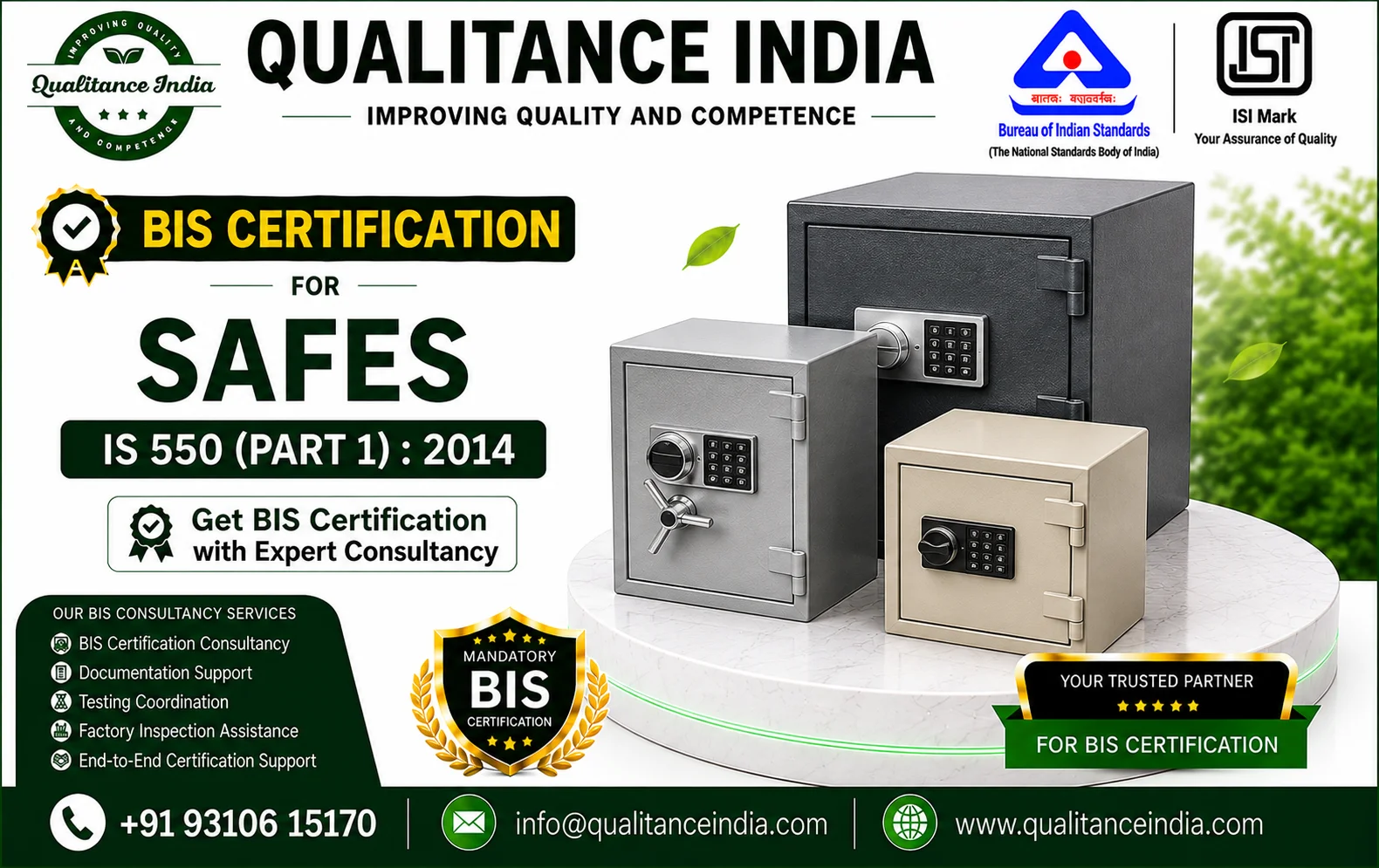
BIS Certification Consultancy for Safes | IS 550 (Part 1):2014 BIS & ISI Mark Certification
Introduction
Safes are security products designed to protect valuables, important documents, cash and other articles against unauthorized access and, depending on the approved class, against burglary and fire-related risks. Because a safe is a security-critical product, its construction, dimensions, locking arrangement, material, workmanship, painting and resistance performance need to meet specified requirements.
In India, IS 550 (Part 1):2014 – Safes specifies requirements for safes. BIS operates certification for the product under Scheme-I, and the BIS Product Manual provides guidance for prospective applicants and existing licensees.
Safes are also covered under the Safes, Safe Deposit Locker Cabinets and Key Locks (Quality Control) Order, 2023. The current BIS compulsory-certification listing specifically includes IS 550 (Part 1):2014 – Safes, under the QCO notified through S.O. 5293(E) dated 8 December 2023.
Qualitance India provides end-to-end BIS Certification Consultancy for Safes as per the applicable requirements of IS 550, including product scope assessment, class and type assessment, documentation, testing coordination, BIS application support and factory inspection preparation.
What is IS 550 (Part 1):2014?
IS 550 (Part 1):2014 is titled:
“Safes – Part 1 Specification (Fifth Revision)”
The standard was established on 19 November 2014, replacing the earlier IS 550 (Part 1):2003 version.
The BIS Product Manual for the 2014 standard provides certification guidance under Scheme-I and identifies important areas such as:
- Dimensions and sizes
- Construction and workmanship
- Material
- Locks
- Internal fixtures
- Painting
- Marking
- Burglary resistance
- Fire endurance
- Fire and impact performance, where applicable
Important Update to IS 550
Manufacturers should be careful about relying only on older references to IS 550 (Part 1):2014.
BIS subsequently issued an amendment to IS 550 (Part 1):2022, and the revised Product Manual dated August 2024 incorporates the current standard framework. The amendment introduced Class E, clarified that the standard covers high-security burglary-resistant safes with double-wall construction on all six sides, and revised the provisions relating to key-lock grades. BIS stated that Class E manufacturers had to obtain inclusion in the BIS licence scope by 10 December 2024, with compulsory certification for the product effective from 8 June 2024 under the QCO.
Therefore, manufacturers seeking certification today should verify the latest applicable version, amendments and current BIS Product Manual before finalising their licence scope.
What are Safes?
Safes are secure storage units designed to restrict unauthorized access to valuables and important articles.
Depending on their design and approved class, safes may incorporate:
- Steel body and door construction
- Locking mechanisms
- Lock bolts
- Reinforced doors
- Internal fixtures
- Shelves or fittings
- Protective coatings
- Fire-resistant construction, where applicable
- Burglary-resistant construction, where applicable
The exact requirements depend on the class, type, size and construction of the safe.
Classes of Safes under BIS Certification
The BIS Product Manual for the earlier IS 550 (Part 1):2014 framework identifies the following safe classes:
- Class D
- Class C
- Class CC
- Class CCC
- Class BB
- Class A
- Class A+
- Class AA
- Class AAA
- Class X
The later BIS revision incorporates Class E as an additional class. The August 2024 Product Manual identifies the scope as:
E / D / C / CC / CCC / BB / A / A+ / AA / AAA / X.
Manufacturers should therefore identify the class applicable to their current safe design before preparing samples and applying for certification.
Types of Safes Covered
The BIS Product Manual identifies the safe type as:
- Single Door
- Double Door
The grouping provisions also provide an important scope advantage: where a double-door safe is tested, corresponding single-door safes of the same and lower sizes may also be covered, subject to the applicable grouping requirements.
Scope of BIS Licence for Safes
The BIS licence scope can be based on parameters such as:
- Safe class
- Single-door or double-door type
- Size
- Declared nominal weight
- Manufacturing capability
- Testing capability
The BIS Product Manual states that manufacturers must declare the sizes of the various classes intended to be included in the licence together with their respective nominal weights. The licence scope may also be restricted according to the manufacturing and testing capabilities available at the factory.
For current certification, the latest applicable BIS Product Manual should be used because the standard and product manual have undergone later revisions.
Is BIS Certification Mandatory for Safes?
Yes. Safes covered by IS 550 (Part 1) are included under the Safes, Safe Deposit Locker Cabinets and Key Locks (Quality Control) Order, 2023.
The QCO specifies that covered products must conform to the corresponding Indian Standard and bear the BIS Standard Mark under a BIS licence according to Scheme-I. The Order also provides exemptions and phased provisions for certain enterprise categories and for goods manufactured domestically for export.
The current BIS compulsory-certification listing continues to identify:
IS 550 (Part 1):2014 – Safes
under the QCO.
The regulatory position should always be checked against the latest QCO, amendments and applicable exemptions.
Safes, Safe Deposit Locker Cabinets and Key Locks QCO, 2023
The Safes, Safe Deposit Locker Cabinets and Key Locks (Quality Control) Order, 2023 covers:
| Product | Indian Standard |
|---|---|
| Safes | IS 550 (Part 1):2014 |
| Safe Deposit Locker Cabinets | IS 5244:2020 |
| Key Locks for Security Equipment | IS 17566:2021 |
The Order was notified through S.O. 5293(E) dated 8 December 2023 and requires covered products to conform to the applicable standard and bear the Standard Mark under a BIS licence.
The QCO came into force after six months from publication. BIS subsequently clarified that the product became subject to compulsory BIS certification from 8 June 2024.
Who Needs BIS Certification for Safes?
BIS certification is relevant to manufacturers producing safes covered by the applicable scope of IS 550.
This can include:
- Safe Manufacturers
- Security Equipment Manufacturers
- Steel Safe Manufacturers
- Commercial Safe Manufacturers
- Bank Safe Manufacturers
- Office Safe Manufacturers
- Industrial Safe Manufacturers
- Home Safe Manufacturers
- High-Security Safe Manufacturers
- OEM Manufacturers
- Contract Manufacturers
Businesses importing or selling covered products should separately verify their responsibilities under the applicable QCO and BIS framework.
BIS Certification Eligibility Requirements
A manufacturer seeking BIS certification should generally have suitable manufacturing and quality-control arrangements.
These may include:
- Manufacturing premises
- Safe manufacturing machinery
- Product drawings
- Product specifications
- Suitable raw-material sources
- Manufacturing process controls
- Lock assembly facilities
- Testing and measuring equipment
- Calibration system
- Trained quality-control personnel
- Inspection procedures
- Production records
- Testing records
- Storage facilities
- Product identification system
- Marking arrangements
The actual requirements depend on the safe class, type, size and proposed BIS licence scope.
BIS Certification Process for Safes
Step 1 – Product Applicability Assessment
The safe is first assessed against the applicable requirements of IS 550.
The review may include:
- Class
- Door type
- Size
- Weight
- Construction
- Locking system
- Material
- Internal fixtures
- Fire or burglary performance, where applicable
Step 2 – Class and Type Assessment
The manufacturer identifies the applicable safe class and whether the product is single-door or double-door.
Correct classification is important because testing and product grouping are linked to the approved class and size.
Step 3 – Product Scope Finalisation
The proposed BIS licence scope is finalised based on the intended classes, sizes and types.
The BIS Product Manual provides grouping guidance based on the highest size in each class and corresponding lower sizes.
Step 4 – Documentation Preparation
Technical, manufacturing and quality-control documents are prepared.
Step 5 – Sample Preparation
Representative safe samples are prepared according to the applicable requirements of IS 550 and the latest BIS Product Manual.
The sample requirements should be confirmed from the current edition and applicable clause before testing.
Step 6 – Laboratory Testing
The applicable samples are tested against the relevant requirements of the standard.
Step 7 – BIS Application
The manufacturer submits the BIS application with the required documentation and supporting information.
Step 8 – Factory Assessment
BIS assesses the manufacturing facility, machinery, testing arrangements and quality-control system.
Step 9 – Observation Closure
Where BIS identifies observations or deficiencies, the manufacturer takes corrective action and provides the required evidence.
Step 10 – BIS Licence Grant
After successful conformity assessment, BIS grants the licence for the approved scope.
Step 11 – ISI Marking
The manufacturer can apply the BIS Standard Mark to products covered by the licence according to applicable BIS marking requirements.
Testing Requirements for Safes
Testing is an important part of BIS certification because safe performance depends on both construction quality and resistance characteristics.
The BIS Product Manual identifies routine and type-testing requirements relating to areas such as:
Dimensions and Sizes
The dimensions and sizes of safes are checked against the applicable requirements.
Weight
The declared nominal weight is an important part of the safe licence scope and marking requirements.
Material
Applicable material requirements are checked against the provisions of the standard.
The Product Manual notes that material testing may not be required where the material is already ISI Marked or is accompanied by an appropriate test certificate, subject to the specified conditions.
Construction and Workmanship
The construction and workmanship of the safe are evaluated.
This can include the body, door, joints, fittings and other structural elements.
Locks
Locking systems are an important part of safe certification.
The Product Manual identifies a cycle-test arrangement for locks and specifies periodic control of lock batches or consignments.
The 2024 amendment to IS 550 (Part 1):2022 also changed the lock requirement to specify a minimum Grade A4 or higher.
Internal Fixtures
Internal fixtures are checked according to the applicable requirements.
Painting
The paint finish is evaluated according to the standard.
Cross Hatch Test
Where applicable, the coating is subjected to the cross-hatch test.
Burglary Resistance
Burglary resistance is a major performance area for applicable safe classes.
Fire Endurance
Where required for the approved safe class, fire endurance testing is carried out.
Fire and Impact
Applicable safes may also require fire and impact performance testing.
The BIS Product Manual identifies burglary resistance, fire endurance and fire/impact tests as type tests with a four-year testing cycle for each approved class, while additional testing is required for initial design approval or subsequent design changes.
Burglary Resistance Testing
Burglary resistance is particularly important for high-security safes.
The revised framework for IS 550 specifies that high-security burglary-resistant safes are covered by requirements for double-wall construction on all six sides.
The applicable burglary-resistance test requirements depend on the safe class and approved product design.
Manufacturers should therefore finalise the desired class and construction before arranging type testing.
Fire Resistance Testing
Some safe classes may require fire-related performance testing.
The BIS Product Manual identifies:
- Fire Endurance
- Fire and Impact
as applicable type tests.
The testing requirement should be confirmed based on the exact safe class and current version of the standard.
BIS Factory Inspection for Safes
Factory assessment is an important part of the BIS Scheme-I certification process.
During factory inspection, BIS may assess:
Manufacturing Machinery
Machinery used for steel processing, body fabrication, door construction, welding, assembly, locking-system installation and finishing.
Raw Material Storage
Identification, storage and traceability of raw materials.
Production Process
Controls maintained throughout safe manufacturing.
Locking System
Arrangement for assembly and quality control of locks and locking components.
Testing Facilities
Availability of required measuring and testing equipment.
The BIS Product Manual identifies equipment such as:
- Steel scales
- Measuring tapes
- Vernier calipers
- Micrometers
- Try squares
- Protractors
- Weighing equipment
- Wire gauges
- Lock cycle-testing arrangements
- Coat meter
- Cross-hatch testing tools
Calibration
The manufacturer should maintain an appropriate calibration plan for testing equipment.
Quality Control
Incoming, in-process and final inspection arrangements should be maintained.
Test Records
The manufacturer should maintain records demonstrating conformity.
In-House Testing and Quality Assurance
The BIS Product Manual requires manufacturers to establish a suitable quality-control system and maintain test records.
The revised Product Manual recommends a Quality Assurance Plan defining the control unit and the frequency and number of samples for different tests. It also expects manufacturers to establish appropriately equipped in-house testing facilities for routine tests, subject to the provisions applicable to MSME manufacturers.
The recommended control unit is:
Safes of the same class manufactured in one week.
Manufacturers must ensure that production covered under the BIS licence continues to conform to all applicable requirements.
Documents Required for BIS Certification
Typical documents may include:
- Company registration documents
- Factory address proof
- Factory layout
- Manufacturing process flow chart
- Machinery list
- Product drawings
- Safe construction details
- Product specifications
- Class and size details
- Lock details
- Raw-material specifications
- Material test certificates
- Supplier details
- Testing equipment list
- Calibration certificates
- Quality Assurance Plan
- Inspection records
- Production records
- Test reports
- Product photographs
- Packing details
- Marking details
- Authorised signatory documents
- Trademark documents, where applicable
The final documentation requirement depends on the manufacturer, product class, size, type and licence scope.
Product Grouping for Safes
Product grouping is one of the most important parts of BIS certification for safes.
The BIS Product Manual states that safes are classified according to the applicable safe classes and that, for consideration of grouping, the highest size from each class is tested for all requirements to include lower sizes in that class.
The Manual also provides that:
- Double-door testing can cover corresponding single-door safes of the same and lower sizes.
- The manufacturer must declare sizes and nominal weights for the classes intended to be covered.
- The licence scope may be restricted based on manufacturing and testing capabilities.
Proper product grouping can help manufacturers avoid unnecessary testing and certification delays.
Marking Requirements for Safes
BIS marking is an important part of certified safe production.
The Product Manual specifies that, in addition to the applicable marking requirements of IS 550, the following should also be marked:
- Size
- Serial Number
- Nominal declared weight of the safe
Products conforming to the standard and covered by the BIS licence are required to carry the Standard Mark according to the applicable BIS requirements.
Scheme of Inspection and Testing
The BIS certification framework requires manufacturers to maintain an effective inspection and testing system.
The Product Manual specifies:
- Suitable laboratory facilities
- Calibration planning
- Test records
- Control units
- Routine testing
- Type testing
- Product marking
- Handling of non-conforming products
For the earlier Product Manual, safes of the same class manufactured in one week constituted a control unit. The revised framework continues to use the same recommended control-unit concept while updating the Quality Assurance Plan and testing provisions.
Common Reasons for BIS Certification Delays
Manufacturers may experience delays due to:
- Incorrect safe classification
- Incorrect product scope
- Incorrect size declaration
- Incorrect nominal weight
- Incomplete product drawings
- Incorrect material specification
- Lock non-conformity
- Construction defects
- Dimensional non-conformity
- Poor welding or workmanship
- Painting defects
- Failure in burglary testing
- Failure in fire-related testing
- Inadequate testing equipment
- Missing calibration records
- Incomplete test records
- Incorrect product grouping
- Factory not ready for assessment
- Incorrect marking
A pre-certification technical review can help identify many of these issues before the BIS application is submitted.
BIS Certification Cost for Safes
There is no single fixed BIS certification cost applicable to every safe manufacturer.
The total cost depends on factors such as:
- BIS application fees
- Product class
- Number of classes
- Product sizes
- Type of safe
- Laboratory testing
- Burglary testing
- Fire testing, where applicable
- Factory assessment
- Testing equipment
- Calibration
- Documentation
- Retesting
- Consultancy charges
The cost can vary significantly between a basic safe and a high-security safe requiring additional type testing.
For an accurate quotation, the manufacturer's safe class, size, type, construction and intended licence scope should be reviewed before testing.
BIS Certification Timeline for Safes
The certification timeline depends on:
- Product classification
- Product scope
- Documentation readiness
- Sample availability
- Laboratory testing
- Type-test requirements
- Application scrutiny
- Factory readiness
- Factory assessment
- Closure of observations
Manufacturers can reduce avoidable delays by finalising the safe class, size range, type and technical documentation before submitting the BIS application.
Benefits of BIS Certification for Safes
Regulatory Compliance
Helps manufacturers meet applicable BIS and QCO requirements.
ISI Mark
Allows eligible manufacturers to use the BIS Standard Mark on products covered by the licence.
Security Performance
Testing requirements support the assessment of applicable burglary and security characteristics.
Fire Performance
Where applicable, fire endurance and fire-impact testing provide a basis for evaluating fire-related performance.
Customer Confidence
BIS certification can strengthen customer confidence in the quality and conformity of security products.
Market Acceptance
Certification supports legal market access where BIS certification is compulsory.
Better Quality Control
Regular inspection, testing and recordkeeping encourage systematic manufacturing controls.
Business Credibility
A valid BIS licence can improve credibility with banks, businesses, institutions, security-system buyers and other customers.
Why Choose Qualitance India?
Qualitance India provides professional BIS Certification Consultancy for manufacturers seeking BIS and ISI Mark certification.
For Safes as per IS 550, our consultancy support can include:
- Product applicability assessment
- IS 550 requirement review
- Safe class assessment
- Single-door / double-door assessment
- Size and weight scope guidance
- Product grouping guidance
- Documentation preparation
- Sample preparation guidance
- Laboratory testing coordination
- Type-test coordination
- BIS application assistance
- Factory inspection preparation
- Quality Assurance Plan support
- Testing equipment guidance
- Observation closure support
- BIS licence assistance
Our support is designed to help manufacturers manage the BIS certification process from product assessment through testing, application, factory assessment and licence approval.
Contact Qualitance India
Phone: +91 93106 15170 Email: info@qualitanceindia.com Website: qualitanceindia.com
BIS Certification Process – Quick Flow
Product Identification ↓ IS 550 Requirement Review ↓ Safe Class Assessment ↓ Single Door / Double Door Assessment ↓ Size & Weight Scope Finalisation ↓ Product Grouping ↓ Documentation Preparation ↓ Sample Preparation ↓ Type / Laboratory Testing ↓ BIS Application ↓ Application Scrutiny ↓ Factory Assessment ↓ Observation Closure ↓ BIS Licence Grant ↓ ISI Mark on Approved Safes
Frequently Asked Questions
1. What is IS 550 (Part 1):2014?
IS 550 (Part 1):2014 is the Indian Standard for Safes – Part 1 Specification. It is the fifth revision of the standard.
2. Is BIS certification mandatory for safes?
Yes. Safes are covered under the Safes, Safe Deposit Locker Cabinets and Key Locks (Quality Control) Order, 2023, and the BIS compulsory-certification listing includes IS 550 for Safes.
3. What is the applicable BIS certification scheme?
Safes are certified under Scheme-I / ISI Mark Scheme.
4. Which classes of safes are covered?
The earlier IS 550 (Part 1):2014 framework identified Classes D, C, CC, CCC, BB, A, A+, AA, AAA and X. The later revised framework additionally includes Class E.
5. Are single-door and double-door safes covered?
Yes. The BIS Product Manual identifies Single Door and Double Door types.
6. What is product grouping for safes?
For grouping, the highest size from each class is tested for the applicable requirements to cover lower sizes within that class, subject to BIS conditions. Double-door testing can also cover corresponding single-door safes of the same and lower sizes.
7. Is testing required for burglary resistance?
Yes, burglary resistance is an important type-testing requirement for applicable safe classes.
8. Is fire testing required for safes?
Fire endurance and fire-impact testing may apply depending on the approved safe class and requirements of the standard.
9. What lock requirements apply to safes?
The 2024 amendment to the revised IS 550 specifies that the lock grade shall be minimum A4 or higher.
10. What additional information must be marked on safes?
The BIS Product Manual specifies marking of size, serial number and nominal declared weight, in addition to the applicable standard marking requirements.
11. Is factory inspection required for BIS certification of safes?
Yes. Factory assessment is part of the Scheme-I certification process.
12. What documents are required for BIS certification?
Typical documents include factory details, product drawings, safe class and size information, manufacturing process, machinery details, raw-material information, testing arrangements, calibration records and quality-control documents.
13. How much does BIS certification for safes cost?
The cost depends on safe class, sizes, type, testing requirements, factory assessment, equipment, documentation and other certification expenses.
14. How long does BIS certification for safes take?
The timeline depends on the product scope, testing, documentation, BIS application scrutiny, factory assessment and closure of observations.
15. Can Qualitance India help with BIS certification for safes?
Yes. Qualitance India provides consultancy support for product assessment, class and scope guidance, documentation, testing coordination, BIS application and factory inspection preparation.
People Also Ask
What is BIS certification for safes?
BIS certification for safes is the conformity-assessment process for demonstrating that covered safes meet the applicable requirements of IS 550 and the BIS certification framework.
Is IS 550 under a QCO?
Yes. Safes covered by IS 550 are included under the Safes, Safe Deposit Locker Cabinets and Key Locks (Quality Control) Order, 2023.
What is the BIS standard for safes?
The applicable standard is IS 550 (Part 1):2014 – Safes, with later revisions and amendments to be considered for current certification.
What are the classes of safes under BIS?
The current revised framework includes Class E, D, C, CC, CCC, BB, A, A+, AA, AAA and X.
Are double-door safes covered under IS 550?
Yes. The BIS Product Manual identifies both single-door and double-door safes.
What tests are required for safes?
Testing can include dimensions, construction and workmanship, locks, internal fixtures, painting, cross-hatch, and applicable burglary resistance, fire endurance and fire-impact tests.
How do I get an ISI Mark for safes?
A manufacturer must obtain the appropriate BIS licence for the applicable safe scope and then comply with BIS requirements for Standard Marking and ongoing conformity.
Related BIS Certification Services
- BIS Certification for Safe Deposit Locker Cabinets – IS 5244:2020
- BIS Certification for Key Locks for Security Equipment – IS 17566:2021
- BIS Certification for Door Hardware
- BIS Certification for Security Products
- BIS & ISI Mark Certification
- BIS Factory Inspection Assistance
- BIS Testing Coordination
- BIS Certification Consultancy
Conclusion
IS 550 (Part 1):2014 – Safes establishes important requirements for the construction, dimensions, workmanship, locks, painting and applicable resistance performance of safes.
Safes are covered under the Safes, Safe Deposit Locker Cabinets and Key Locks (Quality Control) Order, 2023, and BIS's current compulsory-certification listing identifies IS 550 under the Safes category. The QCO requires covered products to conform to the applicable Indian Standard and carry the Standard Mark under a BIS licence according to Scheme-I, subject to applicable provisions and exemptions.
For current certification work, manufacturers should also consider the later revision and amendment framework, including the addition of Class E and updated requirements relating to high-security construction and lock grades. BIS's revised 2024 Product Manual identifies the current licence scope as including E, D, C, CC, CCC, BB, A, A+, AA, AAA and X, with single-door and double-door types.
Manufacturers should therefore carefully finalise the safe class, type, size, declared weight, construction, testing requirements and product grouping before beginning the BIS certification process.
Qualitance India provides end-to-end BIS Certification Consultancy for Safes, including product assessment, class and scope guidance, documentation, testing coordination, BIS application assistance, factory inspection preparation and BIS licence support.
For BIS Certification and ISI Mark Consultancy for Safes, contact Qualitance India today.
Phone: +91 93106 15170 Email: info@qualitanceindia.com Website: qualitanceindia.com