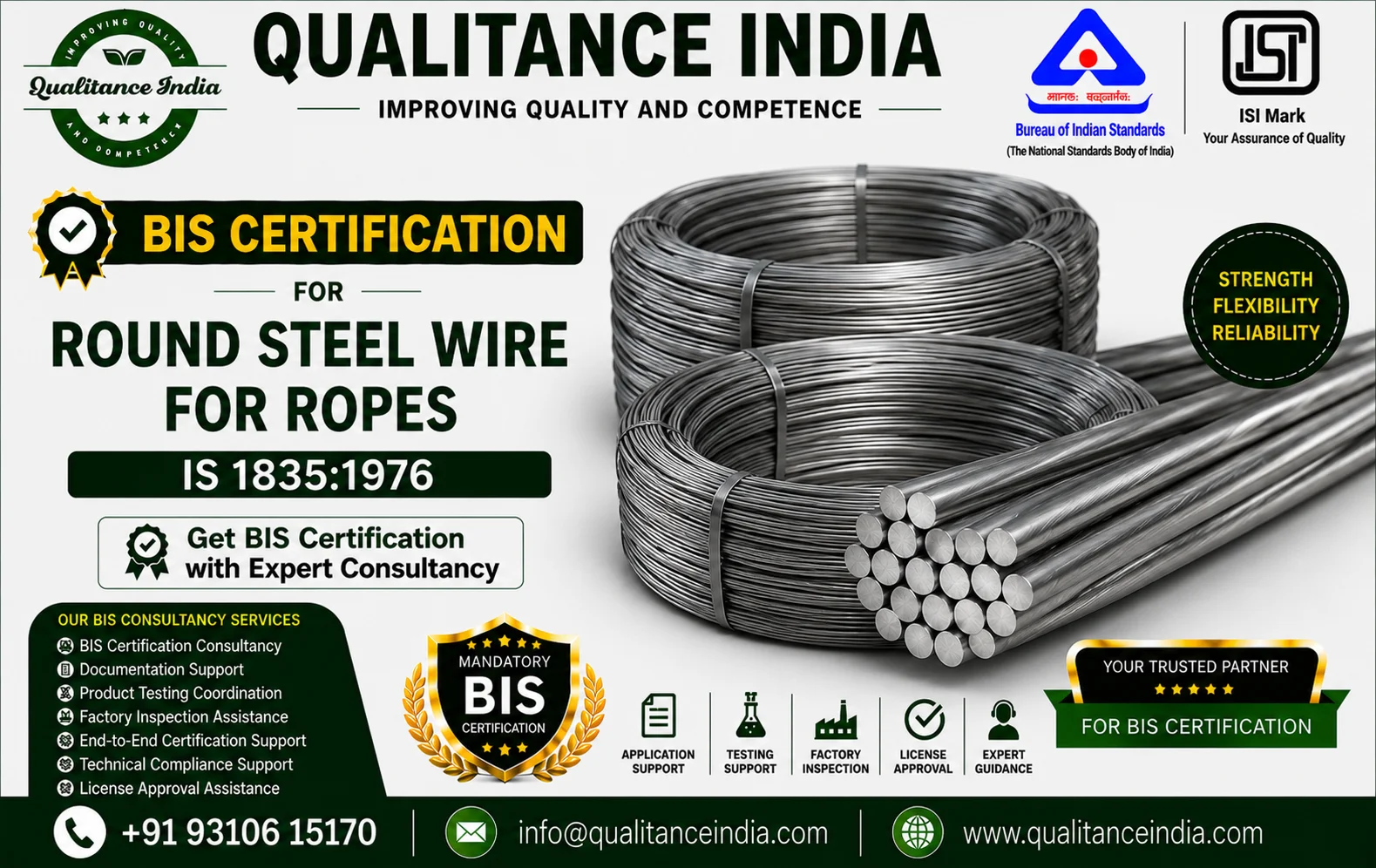
BIS Certification Consultancy for Round Steel Wire for Ropes | IS 1835:1976 | BIS & ISI Mark Certification
Introduction
Round steel wire for ropes is a precision steel-wire product used as a basic material in the manufacture of wire ropes for industrial, construction, lifting, mining, engineering and other applications. Because wire ropes can be subjected to tension, bending, repeated loading and demanding service conditions, the quality of the steel wire used in their manufacture is extremely important.
In India, IS 1835:1976 – Specification for Round Steel Wire for Ropes (Third Revision) specifies requirements for round steel wires intended for rope manufacture. The BIS Product Manual provides certification guidance under Scheme-I of the BIS Conformity Assessment Regulations, 2018 and identifies product parameters such as finish, galvanizing type, tensile designation and size.
The Steel and Steel Products (Quality Control) Order, 2024 specifically lists IS 1835:1976 – Round steel wire for ropes and specifies implementation with immediate effect.
Qualitance India provides end-to-end BIS Certification Consultancy for Round Steel Wire for Ropes as per IS 1835:1976, including product scope assessment, grade and tensile-designation review, grouping guidance, documentation, sample preparation, laboratory testing coordination, BIS application support and factory inspection preparation.
What is IS 1835:1976?
IS 1835:1976 is titled:
“Specification for Round Steel Wire for Ropes”
The BIS Product Manual identifies it as the Third Revision and records two amendments. Certification is operated under Scheme-I.
The standard deals with important characteristics of round steel wire for ropes, including:
- Chemical composition
- Tensile strength
- Diameter and dimensional tolerances
- Torsion
- Reverse bend
- Wrapping
- Zinc coating
- Zinc-coating uniformity
- Adhesion
- Freedom from defects
- Marking
- Packing
The BIS inspection scheme and testing equipment list confirm these major test areas.
What is Round Steel Wire for Ropes?
Round steel wire for ropes is steel wire manufactured to controlled chemical, dimensional and mechanical requirements for subsequent use in wire-rope production.
Depending on the product specification, the wire can be supplied as:
- Bright wire
- Galvanized wire
- Coil
- Bundle
- Piece form
The BIS Product Manual identifies these delivery and finish characteristics as part of the product designation.
Applications of Round Steel Wire
Round steel wire conforming to IS 1835:1976 can be used in the production of wire ropes intended for demanding industrial applications.
Typical applications may include:
- Lifting ropes
- Crane ropes
- Mining ropes
- Hoisting ropes
- Industrial wire ropes
- Construction equipment ropes
- Engineering applications
- Marine and infrastructure applications
The exact end use depends on the wire-rope design, tensile designation and purchaser requirements.
Scope of IS 1835:1976
The BIS Product Manual identifies the product scope using several parameters.
Finish
- Bright wire
- Galvanized wire
Galvanizing Type
For galvanized wire:
- Type A
- Type AB
- Type B
Delivery Form
The Product Manual identifies:
- Bundle
- Coil
- Piece form
Tensile Designation
The applicable tensile designation must be declared according to the standard.
Wire Size
The Product Manual provides an example scope from:
0.20 mm up to and including 5.00 mm.
The grouping guidance specifically refers to tensile designation, nominal diameter and finish type.
Is BIS Certification Mandatory for Round Steel Wire for Ropes?
Yes. Round Steel Wire for Ropes under IS 1835:1976 is covered by the compulsory BIS certification framework.
The Steel and Steel Products (Quality Control) Order, 2024 specifically lists:
IS 1835:1976 – Round steel wire for ropes
and states:
Implementation: With immediate effect.
The QCO lists applicable ITC (HS) codes including:
- 72171010
- 72171020
- 72171030
- 72172010
- 72172020
- 72172030
- 72179091
- 72179099
- 72299033
- 72299040
Manufacturers should also verify the latest amendments, notifications and applicable exemptions before making a final compliance decision.
BIS Certification for Round Steel Wire
BIS Certification demonstrates that the manufacturer's steel wire has been assessed for conformity with the applicable requirements of IS 1835:1976.
The BIS Product Manual states that certification is operated under Scheme-I of the BIS Conformity Assessment Regulations, 2018.
After successful conformity assessment and grant of the BIS licence, the manufacturer can apply the BIS Standard Mark / ISI Mark to products covered by the approved licence scope and according to applicable marking requirements.
Who Needs BIS Certification for Round Steel Wire?
BIS certification is relevant to manufacturers producing round steel wire covered by IS 1835:1976.
This can include:
- Steel Wire Manufacturers
- Wire Rope Raw-Material Manufacturers
- Round Steel Wire Manufacturers
- Galvanized Steel Wire Manufacturers
- Wire Rope Manufacturers
- Steel Wire Drawing Units
- High-Tensile Wire Manufacturers
- Industrial Wire Manufacturers
- Engineering Steel Wire Manufacturers
- OEM Manufacturers
- Contract Manufacturers
Importers and businesses dealing with covered products should separately verify their obligations under the current QCO and BIS framework.
BIS Certification Eligibility Requirements
A manufacturer seeking BIS certification should generally have suitable manufacturing, testing and quality-control facilities.
These may include:
- Wire drawing machinery
- Heat-treatment facilities, where applicable
- Galvanizing equipment
- Coiling equipment
- Straightening equipment, where applicable
- Dimensional inspection facilities
- Tensile-testing facility
- Torsion-testing facility
- Reverse-bend equipment
- Wrapping-test equipment
- Zinc-coating testing equipment
- Chemical-analysis facility
- Calibration system
- Quality-control personnel
- Production records
- Testing records
- Batch and coil traceability
The final requirements depend on the proposed tensile designation, wire size and finish.
BIS Certification Process for Round Steel Wire for Ropes
Step 1 – Product Applicability Assessment
The product is first assessed against IS 1835:1976.
The review includes:
- Bright or galvanized wire
- Galvanizing type
- Tensile designation
- Nominal diameter
- Delivery form
- Manufacturing process
- Proposed licence scope
Step 2 – Product Scope Finalisation
The manufacturer determines the grades, tensile designations, sizes and finish types intended to be included in the BIS licence.
Step 3 – Product Grouping Assessment
BIS grouping is reviewed before sample selection.
The Product Manual requires samples to represent the applied range of tensile designations, nominal diameter and finish type.
Step 4 – Documentation Preparation
Technical, factory and quality-control documents are prepared.
Step 5 – Sample Preparation
The BIS Product Manual specifies:
Mechanical testing sample: 10 metres
Chemical testing sample: 5 metres.
Step 6 – Laboratory Testing
Representative samples are tested against the applicable requirements of IS 1835:1976.
Step 7 – BIS Application
The manufacturer submits the application with the required technical and factory documentation.
Step 8 – Factory Assessment
BIS assesses the manufacturing facility, testing arrangements, process controls and quality-management system.
Step 9 – Observation Closure
Any observations raised by BIS are addressed through corrective action.
Step 10 – BIS Licence Grant
After successful conformity assessment, BIS grants the licence for the approved scope.
Step 11 – ISI Marking
The manufacturer can mark conforming products according to applicable BIS requirements.
Testing Requirements for IS 1835:1976
Testing is one of the most important stages of BIS certification.
The BIS Product Manual identifies equipment and tests covering chemical, mechanical, dimensional and coating requirements.
Chemical Composition
Chemical composition is a fundamental requirement because the steel chemistry influences the strength and performance of wire.
The BIS test-equipment list identifies chemical analysis for:
- Carbon
- Sulphur
- Phosphorus
- Manganese
- Silicon
- Nickel
- Copper
- Chromium
The applicable composition requirements are based on the relevant grade/tensile designation and the requirements of IS 1835:1976.
Carbon
Carbon affects strength and other metallurgical characteristics of rope wire.
The specified carbon range depends on the relevant chemical grade.
Sulphur and Phosphorus
Sulphur and phosphorus are controlled because excessive levels can adversely affect steel performance and processing.
Manganese and Silicon
Manganese and silicon form part of the chemical-composition control for the relevant grades.
Nickel, Copper and Chromium
Where applicable to the selected grade, these elements are also controlled.
The BIS Product Manual provides instrumental and chemical-analysis methods for the applicable elements.
Tensile Strength
Tensile strength is one of the most important mechanical requirements for wire used in rope manufacture.
The BIS Product Manual identifies a Tensile Testing Machine for the tensile-strength test.
During certification, the applicable tensile designation must be declared and tested according to the relevant requirements.
Diameter and Dimensional Tolerance
Round steel wire must maintain the specified nominal diameter and applicable dimensional tolerance.
The Product Manual identifies:
- Steel scale
- Vernier calipers
- Micrometer
for dimensional measurements.
The inspection scheme specifies diameter control for each coil.
Torsion Test
The torsion test evaluates the ability of the wire to withstand twisting without unacceptable failure.
The BIS Product Manual identifies a Torsion Testing Machine for this purpose.
The inspection scheme lists torsion testing as a mechanical test under the applicable requirements.
Reverse Bend Test
Reverse bend testing evaluates the wire's resistance to repeated bending.
The BIS Product Manual identifies a Reverse Bend Testing Machine and references the applicable test requirements.
The inspection scheme states that reverse-bend testing may be carried out when required by the rope specification and specified by the purchaser.
Wrapping Test
Wrapping testing evaluates the ductility-related performance of the wire.
The Product Manual identifies a wrapping machine and magnifying glass for this purpose.
The inspection scheme specifies wrapping testing as and when required by the purchaser for bright wires only.
Zinc-Coating Uniformity
For galvanized wires, the zinc coating must have the required uniformity.
The BIS Product Manual identifies the relevant equipment and chemicals for determining coating uniformity.
The inspection scheme specifies:
1 sample in every 5 coils or part thereof for each control unit.
The frequency may also be agreed between buyer and manufacturer under the stated conditions.
Mass of Zinc Coating
The mass of zinc coating is another important requirement for galvanized rope wire.
The BIS Product Manual identifies the applicable weighing and chemical-analysis arrangement, with the test referenced to IS 6745.
The inspection scheme specifies:
1 sample in every 5 coils or part thereof for each control unit.
Adhesion of Zinc Coating
Adhesion testing checks whether the galvanized coating adheres properly to the steel wire.
The Product Manual identifies mandrels of suitable sizes for the adhesion test.
For galvanized wires, the inspection scheme specifies one sample in every five coils or part thereof for each control unit.
Freedom from Defects
The finished wire should be free from unacceptable defects.
The inspection scheme specifies freedom-from-defects inspection with:
2 samples from each coil.
The manufacturer should maintain suitable visual and dimensional inspection to identify surface defects before dispatch.
Product Grouping for IS 1835:1976
Product grouping is especially important for manufacturers producing several types and sizes of rope wire.
The BIS Product Manual identifies the following grouping parameters:
- Bright / galvanized finish
- Galvanizing Type A, AB or B
- Tensile designation
- Nominal diameter
- Delivery form
The grouping guidelines require samples for the range of tensile designations, nominal diameter and finish types applied for.
Bright Finish
One bright-finish sample for each tensile designation applied for is tested for physical, mechanical and chemical tests, preferably using the lowest size.
Galvanized Finish
For covering galvanized types, an additional galvanized sample of any tensile designation and the highest size is used for coating tests.
Type A, AB and B Galvanizing
The Product Manual states that where all galvanizing types are to be covered, the most stringent type, Type A, should be tested for coating.
For covering only Type AB and Type B, testing of a Type-AB sample is sufficient for the coating test under the specified grouping provision.
The manufacturer must have complete manufacturing and testing facilities for the sizes, grades and tensile designations included in the proposed licence scope.
Raw Material Requirements
The BIS Product Manual states that raw material can be:
Any raw material suitable for achieving the required chemical composition and desired mechanical properties.
It gives IS 7904 – High Carbon Steel Wire Rods as an example that covers the varieties of IS 1835.
Manufacturers should maintain suitable control over:
- Raw-material grade
- Heat/cast number
- Supplier details
- Material certificate
- Chemical composition
- Incoming inspection
- Lot traceability
Manufacturing Process for Round Steel Wire for Ropes
A typical manufacturing process may include:
- Raw-material receiving
- Heat/cast identification
- Chemical verification
- Surface preparation
- Wire drawing
- Intermediate processing
- Heat treatment, where applicable
- Final drawing
- Galvanizing, where applicable
- Zinc-coating inspection
- Dimensional inspection
- Tensile testing
- Torsion testing
- Reverse-bend/wrapping testing, where applicable
- Adhesion testing for galvanized wire
- Final inspection
- Coiling or bundling
- Packing
- Marking
The actual manufacturing sequence depends on the manufacturer's process and product configuration.
BIS Factory Inspection for Round Steel Wire
Factory assessment is an important part of Scheme-I certification.
During factory inspection, BIS may examine:
Wire Drawing Machinery
Equipment used to achieve the required diameter.
Heat-Treatment Facilities
Applicable equipment used for producing the required mechanical properties.
Galvanizing Plant
Equipment used for producing Type A, AB or B galvanized wire.
Coiling and Bundling
Facilities for the declared delivery form.
Chemical Laboratory
Facilities for chemical-composition testing.
Tensile Testing
Availability of a suitable tensile-testing machine.
Torsion Testing
Availability of torsion-testing equipment.
Reverse Bend and Wrapping
Equipment for applicable ductility tests.
Zinc-Coating Testing
Facilities for coating uniformity, mass and adhesion.
Calibration
The manufacturer must prepare a calibration plan for testing equipment.
Test Records
The manufacturer must maintain test records for conformity assessment.
Quality Control and Scheme of Inspection
The BIS Product Manual requires a suitably equipped and staffed laboratory and requires the manufacturer to prepare a calibration plan and maintain test records.
The defined control unit is:
All round steel wire for ropes drawn to the same dimensions, representing the same cast, tensile designation and type, and manufactured under uniform production conditions.
The inspection scheme specifies that the applicable tests and levels of control are to be carried out on the whole production covered by the plan and appropriate records maintained.
Routine Testing Requirements
Important routine controls under the BIS inspection scheme include:
| Test / Requirement | Frequency |
|---|---|
| Chemical Composition | 1 sample from each cast |
| Freedom from Defects | 2 samples from each coil |
| Diameter Tolerance | Each coil |
| Zinc-Coating Uniformity | 1 sample in every 5 coils or part thereof |
| Mass of Zinc Coating | 1 sample in every 5 coils or part thereof |
| Tensile Test | 1 sample in every 5 coils or part thereof |
| Torsion Test | Same frequency as tensile |
| Reverse Bend | When required by rope specification/purchaser |
| Wrapping | When required by purchaser for bright wire |
| Adhesion | 1 sample in every 5 coils or part thereof for galvanized wire |
| Marking | Each package/coil |
These frequencies are based on the BIS Product Manual's Scheme of Inspection and Testing.
Test Certificate Requirements
The BIS inspection scheme requires a test certificate for each consignment of BIS-certified material conforming to IS 1835:1976.
The certificate contains information including:
- Standard Mark
- Cast/control-unit number
- Test results
- Nominal size
- Grade and tensile designation
- Quantity
- Chemical composition
- Mechanical properties
- Type and mass of zinc coating
- Special requirements, where applicable
The BIS sample test certificate provided in the Product Manual confirms these fields.
Marking Requirements
The Standard Mark and licence number are required to be incorporated according to the BIS licence schedule and applicable standard requirements, provided the marked product conforms to the specification.
The inspection scheme also requires product packages/coils to carry relevant identification such as:
- Type
- Size
- Tensile designation
- Manufacturer's trade name or trademark
- Other agreed markings
The exact marking format should be implemented according to the current BIS licence and applicable standard requirements.
Documents Required for BIS Certification
Typical documents may include:
- Company registration documents
- Factory address proof
- Factory layout
- Manufacturing process flow chart
- Machinery list
- Product specifications
- Grade details
- Tensile designation details
- Size range
- Bright/galvanized finish details
- Galvanizing type
- Raw-material details
- Material test certificates
- Heat/cast records
- Supplier details
- Testing equipment list
- Calibration certificates
- Quality Assurance Plan
- Inspection records
- Production records
- Test reports
- Coating-test records
- Product photographs
- Packing details
- Marking details
- Test-certificate format
- Authorised signatory documents
- Trademark documents, where applicable
The final document requirement depends on the manufacturer's proposed licence scope.
Common Reasons for BIS Certification Delays
Manufacturers may experience delays because of:
- Incorrect standard selection
- Incorrect tensile designation
- Incorrect product size
- Incorrect galvanizing type
- Incomplete chemical-composition declaration
- Chemical composition failure
- Diameter non-conformity
- Tensile-strength failure
- Torsion failure
- Reverse-bend failure
- Wrapping-test failure
- Zinc-coating mass failure
- Zinc-coating uniformity failure
- Coating-adhesion failure
- Surface defects
- Inadequate testing equipment
- Missing calibration records
- Poor cast/coil traceability
- Incorrect sample selection
- Incorrect product grouping
- Factory not ready for inspection
- Incomplete test records
- Incorrect BIS marking
The BIS grouping requirements should be assessed before sample selection because different tensile designations, sizes and finish types can affect the certification scope.
BIS Certification Cost for Round Steel Wire
There is no single fixed BIS certification cost applicable to every manufacturer.
The total cost may depend on:
- BIS application fees
- Laboratory testing
- Number of tensile designations
- Size range
- Bright/galvanized scope
- Galvanizing type
- Number of representative samples
- Factory assessment
- Testing equipment
- Calibration
- Documentation
- Retesting, if required
- Consultancy charges
Current BIS LIMS information shows a testing entry for IS 1835:1976 with a listed testing charge of ₹4,500 excluding taxes at one BIS laboratory. The same current listing identifies facilities for diameter, tensile, torsion, reverse bend, wrapping, chemical composition and zinc-coating tests, with exclusions for copper, nickel and chromium in the referenced facility.
This ₹4,500 is a laboratory-specific testing charge and should not be treated as the complete BIS certification cost.
BIS Certification Timeline
The timeline can vary depending on:
- Product scope
- Tensile designations
- Size range
- Galvanizing type
- Documentation readiness
- Sample preparation
- Laboratory availability
- Testing
- BIS application scrutiny
- Factory readiness
- Factory assessment
- Closure of observations
Manufacturers can reduce avoidable delays by finalising product grouping and arranging the required testing facilities before filing the application.
Benefits of BIS Certification for Round Steel Wire
Regulatory Compliance
Helps manufacturers comply with applicable BIS and Steel QCO requirements.
ISI Mark
Allows eligible manufacturers to use the BIS Standard Mark on approved products.
Consistent Mechanical Properties
Tensile and torsion testing helps establish consistent wire performance.
Better Dimensional Control
Diameter testing supports consistency in rope-wire production.
Galvanizing Quality
Coating-mass, uniformity and adhesion tests help maintain galvanized-wire quality.
Customer Confidence
BIS certification can strengthen confidence among wire-rope manufacturers and industrial buyers.
Market Acceptance
Certification supports legal supply where BIS certification is mandatory.
Better Traceability
Control-unit, cast and coil records support traceability throughout production.
Why Choose Qualitance India?
Qualitance India provides professional BIS Certification Consultancy for manufacturers seeking BIS and ISI Mark certification.
For Round Steel Wire for Ropes as per IS 1835:1976, our consultancy support can include:
- Product applicability assessment
- IS 1835:1976 requirement review
- Grade and tensile-designation assessment
- Wire-size assessment
- Bright/galvanized assessment
- Galvanizing Type A / AB / B assessment
- Product grouping guidance
- Documentation preparation
- Sample selection guidance
- Laboratory testing coordination
- BIS application assistance
- Factory inspection preparation
- Testing equipment guidance
- Quality-control documentation
- Observation closure support
- BIS licence assistance
Our support is designed to help manufacturers manage the certification process from product assessment through laboratory testing, BIS application, factory assessment and licence approval.
Contact Qualitance India
Phone: +91 93106 15170
Email: info@qualitanceindia.com
Website: qualitanceindia.com
BIS Certification Process – Quick Flow
Product Identification
↓
IS 1835:1976 Requirement Review
↓
Tensile Designation Assessment
↓
Size Range Assessment
↓
Bright / Galvanized Assessment
↓
Galvanizing Type A / AB / B Assessment
↓
Product Grouping & Scope Finalisation
↓
Documentation Preparation
↓
Representative Sample Preparation
↓
Chemical & Mechanical Testing
↓
Zinc-Coating Testing
↓
BIS Application
↓
Application Scrutiny
↓
Factory Assessment
↓
Observation Closure
↓
BIS Licence Grant
↓
ISI Mark on Approved Steel Wire
Frequently Asked Questions
1. What is IS 1835:1976?
IS 1835:1976 is the Indian Standard for Round Steel Wire for Ropes.
2. Is BIS certification mandatory for round steel wire for ropes?
Yes. IS 1835:1976 is specifically listed in the Steel and Steel Products (Quality Control) Order, 2024, with implementation with immediate effect.
3. What types of wire are covered?
The BIS Product Manual identifies bright wire and galvanized wire Type A, AB or B.
4. What sizes are covered?
The Product Manual provides an example of sizes from 0.20 mm up to and including 5.00 mm.
5. What delivery forms are covered?
The Product Manual identifies bundle, coil and piece form.
6. What is the sample size?
The BIS Product Manual specifies 10 metres for mechanical tests and 5 metres for chemical tests.
7. What are the main tests for IS 1835?
Important tests include chemical composition, diameter, tensile strength, torsion, reverse bend, wrapping, zinc-coating uniformity, zinc-coating mass and adhesion.
8. Is reverse-bend testing always required?
The BIS inspection scheme states that reverse-bend testing may be conducted when required by the rope specification and specified by the purchaser.
9. Is wrapping testing required for all wires?
No. The scheme specifies wrapping testing as and when required by the purchaser for bright wires only.
10. How frequently is zinc coating checked?
Uniformity and mass of zinc coating are specified at one sample in every five coils or part thereof for each control unit.
11. How frequently is tensile strength tested?
The inspection scheme specifies one sample in every five coils or part thereof for each control unit for tensile testing.
12. What is the control unit?
The control unit consists of round steel wire drawn to the same dimensions, representing the same cast, tensile designation and type, and manufactured under uniform production conditions.
13. Is a test certificate required?
Yes. The BIS inspection scheme requires a test certificate for each consignment of BIS-certified material, containing the Standard Mark, control-unit/cast details and corresponding test results.
14. What testing equipment is required?
The BIS Product Manual identifies equipment such as a tensile-testing machine, torsion-testing machine, reverse-bend machine, wrapping machine, micrometers, vernier calipers and zinc-coating test equipment.
15. How much does BIS testing cost?
A current BIS LIMS entry shows a testing charge of ₹4,500 excluding taxes for IS 1835:1976 at one listed laboratory. The exact cost can vary by laboratory and testing scope.
16. Is factory inspection required?
Yes. Factory assessment forms part of the BIS Scheme-I certification process.
17. Can different tensile designations be covered in one licence?
The applicable scope depends on the manufacturer's declared tensile designations and BIS grouping requirements. The Product Manual requires representative samples for the tensile-designation range applied for.
18. Can bright and galvanized wires be included in one licence?
The licence scope can include both where the applicable grouping and testing requirements are satisfied. Separate sampling provisions apply for bright and galvanized finishes.
19. Can all galvanizing types be covered through one coating sample?
The Product Manual states that Type A, as the most stringent type, can be tested to cover all types of galvanizing; for Type AB and B only, a Type-AB coating sample is sufficient under the stated grouping provision.
20. Can Qualitance India help with IS 1835 certification?
Yes. Qualitance India provides product assessment, scope and grouping guidance, documentation, laboratory testing coordination, BIS application support and factory inspection preparation.
People Also Ask
What is BIS certification for round steel wire for ropes?
BIS certification for round steel wire for ropes is the conformity-assessment process for demonstrating compliance with IS 1835:1976 under the BIS certification framework.
Is IS 1835:1976 under a QCO?
Yes. IS 1835:1976 is specifically listed under the Steel and Steel Products (Quality Control) Order, 2024.
What is the BIS standard for rope wire?
The applicable Indian Standard is IS 1835:1976 – Specification for Round Steel Wire for Ropes.
What is the size range for IS 1835 wire?
The BIS Product Manual gives an example size scope from 0.20 mm to 5.00 mm.
What are the types of galvanized rope wire?
The Product Manual identifies Type A, Type AB and Type B galvanized wire.
What tests are performed on round steel wire for ropes?
Testing can include chemical composition, diameter, tensile strength, torsion, reverse bend, wrapping, zinc coating mass, coating uniformity and coating adhesion.
How do I get an ISI Mark for round steel wire?
A manufacturer must obtain the applicable BIS licence for IS 1835:1976 and then comply with BIS requirements for Standard Marking, testing and continuing conformity.
Frequently Searched Keywords
- BIS Certification for Round Steel Wire for Ropes
- BIS Certification for Rope Wire
- IS 1835:1976 Certification
- BIS Licence for Round Steel Wire
- Round Steel Wire BIS Certification
- Steel Wire for Ropes BIS Licence
- ISI Mark for Rope Wire
- Galvanized Steel Wire for Ropes
- Bright Steel Wire for Ropes
- IS 1835 BIS Certification
- Round Steel Wire Testing
- Rope Wire QCO
- Steel QCO 2024 IS 1835
- BIS Certification Consultancy
- BIS Consultant for Steel Wire
Related BIS Certification Services
- BIS Certification for Galvanized Steel Barbed Wire – IS 278:2009
- BIS Certification for Steel Wire for Needles – IS 9962:1981
- BIS Certification for Steels for Pneumatic Tools – IS 5651:1987
- BIS Certification for Low Carbon Galvanized Steel Wires – IS 3975:1999
- BIS Certification for Steel Wires for Mechanical Springs
- BIS Certification for Wire Ropes
- BIS Certification for Steel Wire Products
- BIS Certification for Steel Products
- BIS & ISI Mark Certification
- BIS Factory Inspection Assistance
- BIS Testing Coordination
Conclusion
IS 1835:1976 – Specification for Round Steel Wire for Ropes establishes important requirements for steel wire used in wire-rope manufacturing. The BIS Product Manual identifies bright wire and galvanized wire, including galvanized Types A, AB and B, along with tensile designation, nominal diameter and delivery form. The Product Manual provides an example size range of 0.20 mm to 5.00 mm.
The standard is included in the Steel and Steel Products (Quality Control) Order, 2024, where IS 1835:1976 is listed with immediate-effect implementation.
Testing covers important characteristics such as chemical composition, diameter, tensile strength, torsion, reverse bend, wrapping, zinc-coating uniformity, zinc-coating mass and adhesion. The BIS inspection scheme also requires suitable laboratory facilities, calibration planning, test records, traceability and Standard Marking.
Manufacturers should carefully plan their BIS licence scope because grouping depends on the tensile designation, nominal diameter and finish type. The BIS Product Manual also provides specific grouping provisions for bright and galvanized wires and different galvanizing types.
A proper certification preparation process should therefore include product-scope assessment, grade and tensile-designation selection, size grouping, chemical and mechanical testing, galvanizing controls, documentation, calibration, traceability and factory readiness.
Qualitance India provides end-to-end BIS Certification Consultancy for Round Steel Wire for Ropes as per IS 1835:1976, including product assessment, scope and grouping guidance, documentation, sample preparation, laboratory testing coordination, BIS application support and factory inspection preparation.
For BIS Certification and ISI Mark Consultancy for Round Steel Wire for Ropes, contact Qualitance India today.
Phone: +91 93106 15170
Email: info@qualitanceindia.com
Website: qualitanceindia.com