
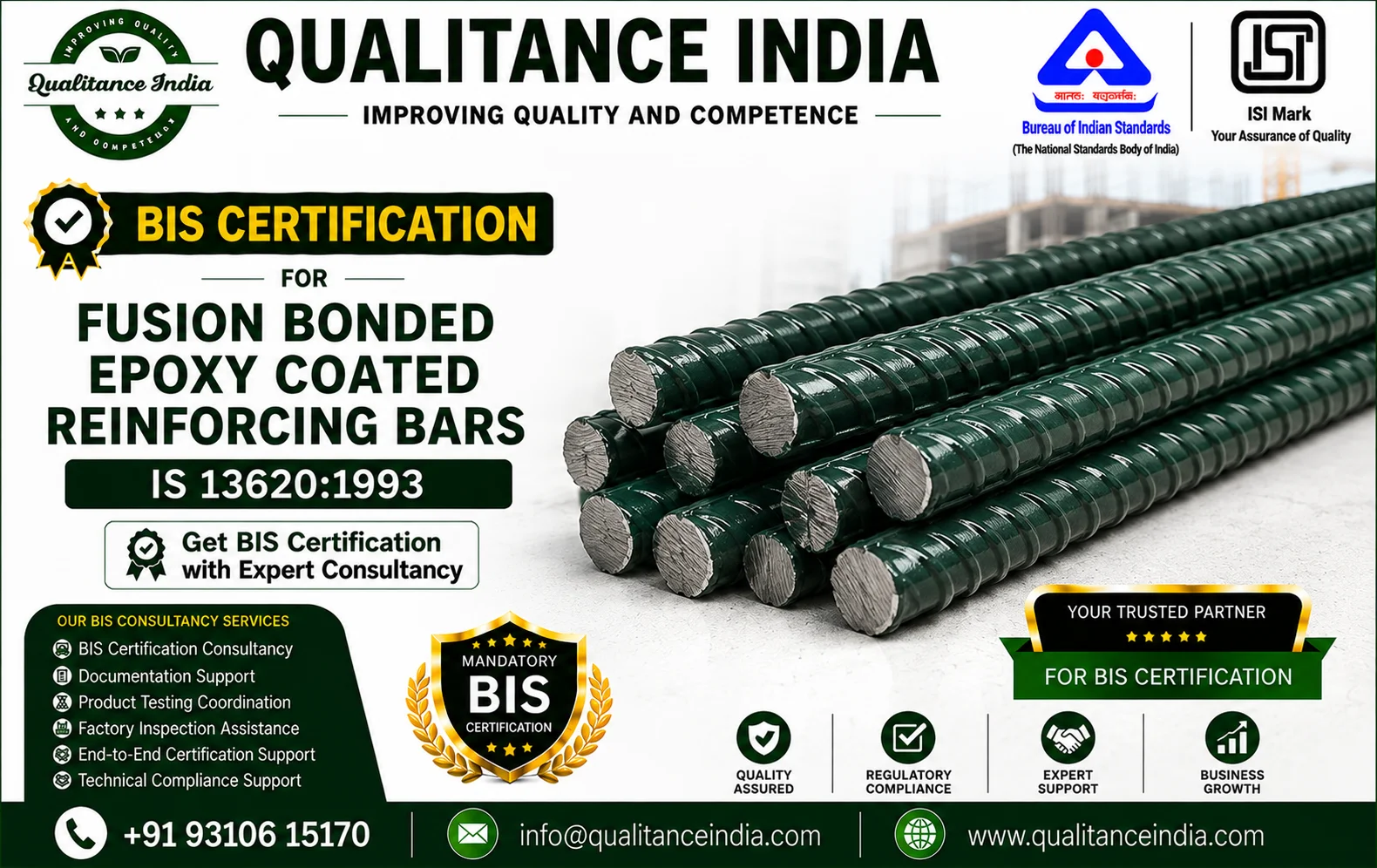
BIS Certification Consultancy for Fusion Bonded Epoxy Coated Reinforcing Bars | IS 13620:1993 | BIS & ISI Mark Certification
Introduction
Fusion bonded epoxy coated reinforcing bars are steel reinforcement bars provided with a protective epoxy coating to reduce corrosion of reinforcement embedded in concrete. They are particularly useful in structures where reinforcement may be exposed to chloride, saline, industrial or other aggressive environments.
In India, IS 13620:1993 – Fusion Bonded Epoxy Coated Reinforcing Bars – Specification covers deformed steel reinforcing bars provided with a protective epoxy coating applied by the electrostatic spray method. The standard specifies requirements for the coating material, surface preparation, coating application and important properties such as coating thickness, continuity, adhesion, bond strength, chemical resistance, abrasion resistance, impact resistance and hardness.
The BIS Product Manual for IS 13620:1993 states that certification is operated under Scheme-I of the BIS Conformity Assessment Regulations, 2018. The product is also listed in BIS's current compulsory-certification Scheme-I framework.
The Steel and Steel Products (Quality Control) Order, 2024 specifically includes IS 13620:1993 – Fusion Bonded Epoxy Coated Reinforcing Bars – Specification and provides for conformity to the standard with immediate effect. The QCO also requires covered steel products to be accompanied by a Test Certificate bearing the Standard Mark issued by a BIS-certified manufacturer.
Qualitance India provides end-to-end BIS Certification Consultancy for Fusion Bonded Epoxy Coated Reinforcing Bars as per IS 13620:1993, including product assessment, scope and grouping guidance, documentation, testing coordination, BIS application support and factory inspection preparation.
What is IS 13620:1993?
IS 13620:1993 is titled:
“Fusion Bonded Epoxy Coated Reinforcing Bars – Specification”
The standard covers deformed steel reinforcing bars with protective epoxy coating applied by the electrostatic spray method. The steel reinforcing bars to be coated are based on the applicable requirements for reinforcing steel, while the epoxy coating material is governed by the coating requirements specified in the standard.
The BIS Product Manual records one amendment to IS 13620:1993 and provides certification guidance for prospective applicants and existing licensees.
The standard addresses important areas including:
- Coating material
- Reinforcing steel
- Surface preparation
- Application of coating
- Coating thickness
- Continuity of coating
- Adhesion
- Bond strength to concrete
- Chemical resistance
- Resistance to applied voltage
- Abrasion resistance
- Impact resistance
- Hardness
- Repair of coating damage
What are Fusion Bonded Epoxy Coated Reinforcing Bars?
Fusion bonded epoxy coated reinforcing bars are steel reinforcement bars covered with a protective epoxy coating.
The coating is applied by an electrostatic spray process. The powder coating is applied to the steel bar and then subjected to the thermal treatment recommended for the epoxy resin so that the coating cures into a continuous protective layer.
The coating helps provide additional protection against corrosion and is particularly relevant for reinforced-concrete structures exposed to aggressive environments.
Typical applications may include:
- Bridges
- Flyovers
- Marine and coastal structures
- Parking structures
- Water infrastructure
- Industrial structures
- Roads and infrastructure projects
- Structures exposed to saline environments
- Concrete structures exposed to chloride contamination
Why are Epoxy Coated Reinforcing Bars Used?
Ordinary reinforcing steel can be vulnerable to corrosion when moisture, chlorides or other aggressive substances reach the steel.
An epoxy coating creates a barrier between the reinforcing steel and the surrounding environment.
The purpose of the BIS standard is not merely to check whether the bar is coated, but to establish requirements for:
- Coating thickness
- Coating continuity
- Coating adhesion
- Bond strength
- Chemical resistance
- Resistance to applied voltage
- Abrasion resistance
- Impact resistance
- Hardness
These requirements are intended to ensure that the coated reinforcing bar provides the specified level of protection and performance.
Scope of IS 13620:1993
The BIS Product Manual states that IS 13620:1993 covers fusion bonded epoxy coated reinforcing bars in sizes from:
6 mm to 50 mm.
For product grouping, the BIS Product Manual divides these sizes into two groups:
| Group | Size |
|---|---|
| Group I | Up to and including 20 mm |
| Group II | Above 20 mm |
The highest size from each group is tested for all requirements to cover the corresponding sizes within that group, subject to the applicable BIS grouping provisions.
The manufacturer must declare the sizes intended to be covered by the BIS licence, and the final scope may be restricted according to the manufacturer's manufacturing and testing capabilities. During licence operation, the covered sizes are to be tested in rotation as far as possible.
Is BIS Certification Mandatory for Epoxy Coated Reinforcing Bars?
Yes. Fusion Bonded Epoxy Coated Reinforcing Bars under IS 13620:1993 are covered by mandatory BIS certification requirements.
The current BIS Scheme-I listing includes IS 13620:1993 – Fusion bonded epoxy coated reinforcing bars in the compulsory-certification framework.
The Steel and Steel Products (Quality Control) Order, 2024 lists IS 13620:1993 with ITC (HS) codes 72142090 and 72159090 and specifies “With immediate effect” for implementation.
The QCO also requires covered steel products to be accompanied by a Test Certificate bearing the Standard Mark issued by a BIS-certified manufacturer with each consignment, subject to the provisions of the Order.
Steel and Steel Products Quality Control Order, 2024
The current steel QCO is important for manufacturers of epoxy coated reinforcing bars.
The 2024 Order:
- Includes IS 13620:1993
- Requires conformity to the specified Indian Standard
- Requires the Standard Mark through the BIS certification framework
- Requires a Test Certificate bearing the Standard Mark with each covered consignment
- Excludes certain steel products manufactured domestically for export according to the conditions of the Order
- Provides that BIS amendments or revisions to listed standards apply from their publication date
For IS 13620:1993, the scheduled implementation is with immediate effect.
Current Status of IS 13620:1993
The current BIS product-certification listings continue to identify IS 13620:1993 as the applicable product standard for fusion bonded epoxy coated reinforcing bars. BIS's Product Manual page also continues to list the IS 13620 product manual.
At the same time, BIS has initiated a first-revision project for IS 13620, with the project approved on 20 March 2025. The BIS project page identifies IS 13620:1993 as the standard being revised.
Therefore, manufacturers applying for certification should use the current applicable IS 13620:1993 requirements and also monitor BIS notifications for any future revision or amendment.
Who Needs BIS Certification for Epoxy Coated Reinforcing Bars?
BIS certification is relevant to manufacturers producing fusion bonded epoxy coated reinforcing bars covered by IS 13620:1993.
This may include:
- Epoxy Coated Rebar Manufacturers
- Reinforcing Bar Coating Manufacturers
- Steel Reinforcement Manufacturers
- TMT Bar Coating Manufacturers
- Construction Steel Manufacturers
- Infrastructure Material Manufacturers
- Bridge and Highway Material Suppliers
- Corrosion Protection Product Manufacturers
- Precast and Concrete Industry Suppliers
- OEM Manufacturers
- Contract Manufacturers
Importers, distributors and buyers dealing with covered products should separately verify their obligations under the current QCO and BIS requirements.
BIS Certification Eligibility Requirements
A manufacturer seeking BIS certification should generally have suitable manufacturing, coating and quality-control facilities.
These may include:
- Manufacturing premises
- Reinforcing steel preparation facilities
- Surface-preparation equipment
- Epoxy powder coating system
- Electrostatic spray equipment
- Curing facilities
- Bar handling equipment
- Inspection facilities
- Testing laboratory
- Calibration arrangements
- Product drawings and specifications
- Raw-material control
- Coating-material control
- Production records
- Test records
- Traceability system
- Packing and marking arrangements
The exact requirements depend on the bar size range, coating process and proposed BIS licence scope.
BIS Certification Process for Fusion Bonded Epoxy Coated Reinforcing Bars
Step 1 – Product Applicability Assessment
The product is first assessed against IS 13620:1993.
The review includes:
- Reinforcing bar type
- Bar sizes
- Steel grade
- Coating material
- Coating process
- Surface preparation
- Curing process
- Intended licence scope
Step 2 – Raw Material Assessment
The BIS Product Manual identifies:
Coating material: Clause 3 and Annex A of IS 13620
Reinforcing steel: IS 1786.
The manufacturer should ensure that the reinforcing bars used as input material comply with the applicable IS 1786 requirements.
Step 3 – Size Grouping
The proposed sizes are grouped into:
Group I: Up to and including 20 mm
Group II: Above 20 mm
The highest size from each applicable group is tested to represent the group.
Step 4 – Documentation Preparation
Technical, manufacturing and quality-control documents are prepared.
Step 5 – Sample Preparation
The BIS Product Manual specifies different sample quantities depending on the test:
- Coating thickness and uniformity: 1 full-length coated bar
- Bond strength: 2 coated bars × 1 metre and 2 uncoated bars × 1 metre
- Chemical resistance, adhesion, impact, hardness, abrasion resistance and resistance to applied voltage: 12 pieces × 1 metre
- Chemical test: 5 bars × 5 cm
Step 6 – Laboratory Testing
Representative samples are tested against the applicable requirements.
Step 7 – BIS Application
The manufacturer submits the BIS application and technical documentation.
Step 8 – Factory Assessment
BIS assesses the manufacturing facility, coating process, testing arrangements and quality-control system.
Step 9 – Observation Closure
Any observations raised during assessment are addressed with corrective action and supporting evidence.
Step 10 – BIS Licence Grant
After successful conformity assessment, BIS grants the licence for the approved product scope.
Step 11 – ISI Mark and Test Certificate
The manufacturer can apply the BIS Standard Mark to products covered by the licence and comply with the test-certificate requirements applicable under the steel QCO.
Testing Requirements for Epoxy Coated Reinforcing Bars
Testing is a major part of BIS certification because the coating must remain continuous, properly bonded and durable while maintaining the required interaction with concrete.
The BIS Product Manual identifies a wide range of product and coating tests.
Coating Thickness Test
Coating thickness is one of the basic acceptance characteristics.
The BIS Product Manual identifies a digital coat meter for coating-thickness measurement.
The Product Manual's inspection scheme specifies one sample for every 20 bars for coating thickness.
The standard requires measurements to be made on the straight portion of the bar between deformations and ribs using suitable non-destructive magnetic gauges.
Continuity of Coating
The epoxy coating must provide continuous protection without unacceptable holidays.
The BIS Product Manual identifies a 67.5-volt holiday detector and coat meter for continuity testing.
The Product Manual's inspection scheme specifies one sample for every 20 bars for continuity.
Adhesion of Coating
Adhesion testing verifies that the epoxy coating remains properly bonded to the reinforcing bar.
The Product Manual identifies a 150 mm diameter wooden mandrel, protractor, stopwatch and thermometer for adhesion testing.
The specified testing frequency is based on bar size:
- Up to 16 mm: 1 sample per 1 tonne
- Above 16 mm up to 25 mm: 1 sample per 2 tonnes
- Above 25 mm: 1 sample per 4 tonnes
If a failure occurs, twice the number of samples are tested and the lot may be accepted when the retested samples pass.
Bond Strength to Concrete
Bond strength is particularly important because the reinforcing bar has to transfer stresses to concrete.
The BIS Product Manual identifies:
- Cube moulds
- Tamping rod
- Pull-out testing machine
- Slip-measuring equipment
- Water bath
for bond-strength testing.
The Product Manual's sampling requirements include 2 coated bars of 1 metre and 2 uncoated bars of 1 metre for the bond-strength test.
The standard requires the bond performance of the coated bars to be compared with corresponding uncoated bars. The bond-strength requirement is an important reason why the coating process cannot be judged only by appearance or thickness.
Chemical Resistance Test
The epoxy coating must resist specified chemical environments.
The Product Manual identifies testing using solutions including:
- Distilled water
- Calcium chloride solution
- Sodium hydroxide solution
- Calcium hydroxide solution
along with a temperature-controlled bath and weighing equipment.
The standard describes chemical-resistance testing over an extended exposure period and requires the coating to remain free from unacceptable blistering, softening, loss of bond and other specified failures.
Resistance to Applied Voltage
Resistance to applied voltage is another important coating-performance test.
The BIS Product Manual identifies:
- Non-conductive test vessel
- Electrodes
- Sodium chloride electrolyte
- Power supply cell
for this test.
The underlying standard specifies a 2 V applied potential in a 7% NaCl electrolyte for the relevant accelerated-corrosion test and specifies conditions for observing coating failure and undercutting.
Abrasion Resistance
The coating must be sufficiently resistant to abrasion during handling and service.
The BIS Product Manual identifies a:
Taber abrasor or equivalent
with CS-10 wheels and a 1 kg load for abrasion testing.
The underlying standard specifies the applicable abrasion-performance criterion for the coating system.
Impact Test
Impact resistance checks the coating's ability to withstand mechanical damage.
The Product Manual identifies:
- Tup
- Drop tube
- Specimen holder
for impact testing.
This test is important because reinforcing bars can experience mechanical handling during transportation, storage and construction.
Hardness Test
Hardness testing is included among the coating-performance requirements.
The BIS Product Manual identifies a suitable hardness tester for this test.
Chemical Test of Reinforcing Steel
The BIS Product Manual specifies a separate chemical-test sample of 5 bars × 5 cm.
The reinforcing steel input is linked to IS 1786 in the Product Manual, and the inspection scheme requires the reinforcing steel to be ISI marked and segregated lot/cast wise on receipt.
Surface Preparation Requirements
Surface preparation is one of the most critical stages in the epoxy coating process.
The Product Manual specifically requires controls for surface preparation and the inspection scheme identifies surface preparation as a process control applied to each bar.
Proper surface preparation is essential because contamination, scale, rust, oil or unsuitable surface profile can adversely affect coating adhesion.
Application of Epoxy Coating
The epoxy coating is applied by the electrostatic spray method.
The standard describes the use of electrostatically charged dry powder sprayed onto the grounded reinforcing bar, followed by thermal treatment to produce a fully cured finish.
The BIS Product Manual's inspection scheme identifies application of coating as a control required for each bar.
Coating Repair
Coating damage may occur during handling or processing.
The standard provides requirements concerning compatible patching or repair material and appropriate repair practices. The repair material should be compatible with the coating system and suitable for use in the intended environment.
Manufacturers should maintain documented procedures for:
- Identifying coating damage
- Preparing damaged areas
- Applying approved repair material
- Rechecking repaired areas
- Maintaining repair records
Raw Material Requirements
The BIS Product Manual identifies two critical inputs:
Coating material: Clause 3 and Annex A of IS 13620
Reinforcing steel: IS 1786.
The inspection scheme states that reinforcing bars shall be ISI marked and, on receipt, should be segregated lot/cast wise.
For coating material, the inspection scheme specifies checking each consignment or once every three months, whichever is earlier.
Manufacturing Process for Epoxy Coated Reinforcing Bars
A typical production process may include:
- Receiving reinforcing steel
- Checking IS 1786 compliance
- Lot/cast-wise segregation
- Surface preparation
- Surface cleanliness inspection
- Electrostatic epoxy powder application
- Curing
- Coating thickness inspection
- Holiday/continuity inspection
- Adhesion inspection
- Repair of coating damage, where required
- Final quality inspection
- Packing
- Marking
- Test-certificate preparation
The actual process can vary according to the coating plant design and production technology.
BIS Factory Inspection for Epoxy Coated Reinforcing Bars
Factory inspection is an important part of Scheme-I certification.
During factory assessment, BIS may examine:
Reinforcing Steel Storage
ISI-marked reinforcing steel should be properly identified and segregated lot/cast wise.
Surface Preparation
The surface-preparation process and related inspection records.
Epoxy Powder Storage
Storage conditions, identification and traceability of coating material.
Coating Plant
Electrostatic powder application and curing arrangements.
Coating Thickness Testing
Availability of digital coat-meter facilities.
Holiday Detection
Availability of the specified holiday detector for coating continuity.
Adhesion Testing
Mandrel and associated equipment required for coating adhesion testing.
Bond-Strength Testing
Suitable pull-out testing arrangements or controlled access to permitted external testing facilities.
Chemical Resistance and Other Type Tests
Arrangements for required type tests, either in-house or through permitted recognised/empanelled laboratories.
Calibration
The manufacturer must maintain a calibration plan for test equipment.
Quality Records
Production and test records must be maintained to establish conformity.
Testing Equipment for IS 13620:1993
The BIS Product Manual identifies major equipment including:
- Temperature-controlled bath
- Thermometer
- Weighing balance
- Non-conductive test vessel
- Electrodes
- Power supply cell
- 150 mm diameter wooden mandrel
- Protractor
- Stopwatch
- Cube moulds
- Tamping rod
- Pull-out testing machine
- Dial micrometer or slip-measuring equipment
- Water bath
- Taber abrasor
- CS-10 wheel
- 1 kg load
- Impact-test tup
- Drop tube
- Specimen holder
- Hardness tester
- Digital coat meter
- 67.5 V holiday detector
- Coat meter
The Product Manual specifically states that the equipment list is indicative and not exhaustive.
Product Grouping for IS 13620:1993
Product grouping is based mainly on bar size.
The BIS Product Manual identifies:
Group I: up to and including 20 mm
Group II: above 20 mm
The highest size from each applicable group is tested to cover the sizes within that group.
For example, a manufacturer intending to cover sizes in both groups should plan representative testing for the highest size in each group according to the BIS grouping requirements.
The final licence scope remains subject to the manufacturer's actual manufacturing and testing capability.
Scheme of Inspection and Testing
The BIS Product Manual specifies an in-house laboratory and test-record system as part of the certification framework.
The manufacturer must prepare a calibration plan for testing equipment and maintain records of tests used to establish conformity.
The Product Manual defines the control unit as:
All Fusion Bonded Epoxy Coated Reinforcing Bars manufactured from the same coating material under similar manufacturing conditions in eight hours.
The inspection scheme includes controls for:
- Coating material
- Reinforcing steel
- Surface preparation
- Coating application
- Coating thickness
- Coating continuity
- Adhesion of coating
The scheme also permits specified subcontracting to laboratories recognised by BIS or Government laboratories empanelled by BIS.
Routine Testing Requirements
The Product Manual identifies the following important frequencies:
Coating Material
Each consignment or once every three months, whichever is earlier.
Surface Preparation
Each bar.
Application of Coating
Each bar.
Coating Thickness
One sample every 20 bars.
Continuity of Coating
One sample every 20 bars.
Adhesion
Frequency varies according to bar size:
- Up to 16 mm: one sample per 1 tonne
- Above 16 mm up to 25 mm: one sample per 2 tonnes
- Above 25 mm: one sample per 4 tonnes
These frequencies are from the BIS Product Manual's inspection scheme; the manufacturer can propose justified alternative levels of control for approval under the provisions stated in the manual.
Documents Required for BIS Certification
Typical documents may include:
- Company registration documents
- Factory address proof
- Factory layout
- Manufacturing process flow chart
- Machinery list
- Reinforcing-bar specifications
- Epoxy coating specifications
- Product drawings
- Bar size range
- IS 1786 input-material details
- Raw-material test certificates
- Epoxy powder test certificates
- Supplier details
- Surface-preparation procedure
- Coating-process procedure
- Curing procedure
- Repair procedure
- Testing equipment list
- Calibration certificates
- Quality Assurance Plan
- Inspection records
- Production records
- Test reports
- Coating thickness records
- Holiday-test records
- Adhesion-test records
- Bond-strength records
- Product photographs
- Packing details
- Marking details
- Test-certificate format
- Authorised signatory documents
- Trademark documents, where applicable
The actual documentation requirement depends on the manufacturer's plant, product size range and proposed BIS licence scope.
Marking and Test Certificate Requirements
The BIS Product Manual states that labelling and marking are to comply with IS 13620:1993 and that all conforming production covered by the licence should be marked with the Standard Mark.
In addition, the Steel and Steel Products QCO, 2024 requires covered steel products to be accompanied by a Test Certificate bearing the Standard Mark issued by a BIS-certified manufacturer with each consignment.
Manufacturers should therefore establish an effective system for:
- Product identification
- Batch/lot traceability
- Size identification
- Test-result recording
- Standard Marking
- Test-certificate preparation
Common Reasons for BIS Certification Delays
Manufacturers may face certification delays because of:
- Incorrect bar-size scope
- Incorrect grouping
- Non-ISI-marked reinforcing steel input
- Poor lot/cast segregation
- Inadequate surface preparation
- Coating-thickness failure
- Holiday/continuity failure
- Adhesion failure
- Bond-strength failure
- Chemical-resistance failure
- Impact-test failure
- Abrasion-resistance failure
- Hardness-test failure
- Resistance-to-voltage failure
- Inadequate epoxy powder control
- Improper curing
- Inadequate testing facilities
- Missing calibration records
- Poor traceability
- Incomplete inspection records
- Factory not ready for assessment
- Incorrect marking
- Incomplete test certificates
A technical review before the BIS application can help identify many of these problems before factory assessment.
BIS Certification Cost for Epoxy Coated Reinforcing Bars
There is no single fixed BIS certification cost applicable to every manufacturer.
The total project cost can depend on:
- BIS application fees
- Laboratory testing
- Bar-size groups
- Number of representative samples
- Bond-strength testing
- Chemical-resistance testing
- Type tests
- Factory assessment
- Testing equipment
- Calibration
- Documentation
- Retesting
- Consultancy charges
Current BIS LIMS entries show that IS 13620:1993 is available within BIS laboratory testing scopes, but some individual test facilities vary by laboratory. For example, one current BIS LIMS entry notes that a facility is not available for niobium, vanadium, titanium, aluminium, chlorine, pull-out test and abrasion resistance and instead lists the available test scope.
Therefore, laboratory selection should be based on the complete required testing scope, rather than only comparing one quoted test price.
For an accurate quotation, the manufacturer's bar sizes, coating process, testing facilities and proposed BIS licence scope should be assessed first.
BIS Certification Timeline
The certification timeline can vary depending on:
- Bar-size range
- Product grouping
- Documentation readiness
- Sample preparation
- Laboratory availability
- Chemical testing
- Coating tests
- Bond-strength testing
- Type testing
- BIS application scrutiny
- Factory readiness
- Factory assessment
- Observation closure
Manufacturers can reduce avoidable delays by preparing the coating process, testing equipment, raw-material records and product documentation before submitting the BIS application.
Benefits of BIS Certification for Epoxy Coated Reinforcing Bars
Regulatory Compliance
Helps manufacturers meet applicable BIS and Steel QCO requirements.
ISI Mark
Allows eligible manufacturers to use the BIS Standard Mark on products covered by the approved licence.
Corrosion Protection
Epoxy coating provides a protective barrier designed to reduce corrosion risk of reinforcing steel.
Better Coating Quality
Thickness, continuity and adhesion testing helps maintain consistent coating performance.
Bond Performance
Bond-strength testing helps assess the interaction between the coated reinforcement and concrete.
Better Durability
Chemical resistance, abrasion and impact testing help evaluate coating durability under specified conditions.
Customer Confidence
BIS certification can strengthen confidence among infrastructure companies, contractors, concrete-product manufacturers and government-project suppliers.
Market Acceptance
Certification supports legal market access where BIS certification is mandatory.
Better Quality Control
The BIS inspection scheme encourages documented and systematic control of coating production.
Why Choose Qualitance India?
Qualitance India provides professional BIS Certification Consultancy for manufacturers seeking BIS and ISI Mark certification.
For Fusion Bonded Epoxy Coated Reinforcing Bars as per IS 13620:1993, our consultancy support can include:
- Product applicability assessment
- IS 13620:1993 requirement review
- Reinforcing-steel input assessment
- Bar-size assessment
- Group I / Group II grouping guidance
- Epoxy coating material assessment
- Surface-preparation review
- Coating-process review
- Testing-equipment assessment
- Documentation preparation
- Sample selection guidance
- Laboratory testing coordination
- Bond-strength testing coordination
- BIS application assistance
- Factory inspection preparation
- Quality Assurance Plan support
- Observation closure support
- BIS licence assistance
Our support is designed to help manufacturers manage the certification process from product assessment and process preparation through testing, BIS application, factory assessment and licence approval.
Contact Qualitance India
Phone: +91 93106 15170
Email: info@qualitanceindia.com
Website: qualitanceindia.com
BIS Certification Process – Quick Flow
Product Identification
↓
IS 13620:1993 Requirement Review
↓
IS 1786 Reinforcing Steel Assessment
↓
Epoxy Coating Material Assessment
↓
Bar Size Grouping
↓
Surface Preparation Review
↓
Coating Process & Curing Review
↓
Documentation Preparation
↓
Representative Sample Preparation
↓
Coating & Performance Testing
↓
BIS Application
↓
Application Scrutiny
↓
Factory Assessment
↓
Observation Closure
↓
BIS Licence Grant
↓
ISI Mark & Test Certificate
Frequently Asked Questions
1. What is IS 13620:1993?
IS 13620:1993 is the Indian Standard for Fusion Bonded Epoxy Coated Reinforcing Bars – Specification. It covers deformed steel reinforcing bars provided with protective epoxy coating applied by the electrostatic spray method.
2. Is BIS certification mandatory for epoxy coated reinforcing bars?
Yes. IS 13620:1993 is included in the BIS compulsory-certification framework and in the Steel and Steel Products QCO.
3. What is the applicable BIS certification scheme?
The BIS Product Manual specifies certification under Scheme-I.
4. What sizes are covered under IS 13620:1993?
The BIS Product Manual identifies sizes from 6 mm to 50 mm.
5. How are the sizes grouped?
The sizes are divided into two groups:
Group I: up to and including 20 mm
Group II: above 20 mm
The highest size from each group is tested to cover the corresponding sizes within that group.
6. What reinforcing steel is used?
The BIS Product Manual identifies IS 1786 as the reinforcing-steel input standard.
7. What are the main tests for epoxy coated rebars?
Important tests include coating thickness, continuity, adhesion, bond strength to concrete, chemical resistance, resistance to applied voltage, abrasion resistance, impact and hardness.
8. What is the sample requirement?
The sampling requirements vary by test. The Product Manual specifies one full-length coated bar for coating thickness/uniformity, coated and uncoated bars for bond strength, 12 pieces of 1 metre for several coating-performance tests, and five 5-cm bars for chemical testing.
9. How often is coating thickness checked?
The BIS Product Manual's inspection scheme specifies one sample every 20 bars.
10. How often is adhesion testing performed?
For sizes up to 16 mm, one sample per 1 tonne; above 16 mm up to 25 mm, one sample per 2 tonnes; and above 25 mm, one sample per 4 tonnes.
11. Is bond-strength testing required?
Yes. Bond strength to concrete is a specified performance requirement, and the BIS Product Manual identifies a pull-out testing arrangement for this test.
12. Is factory inspection required?
Yes. Factory assessment forms part of the BIS Scheme-I certification process.
13. Is the epoxy coating process important for BIS certification?
Yes. Surface preparation and coating application are controlled process requirements, and the BIS inspection scheme identifies both as production-stage controls.
14. Does the current Steel QCO apply to IS 13620:1993?
Yes. The 2024 Steel and Steel Products QCO lists IS 13620:1993 and specifies immediate implementation.
15. Is IS 13620:1993 currently being revised?
Yes. BIS initiated a first-revision project for IS 13620:1993, with project approval dated 20 March 2025. The current certification listing, however, continues to identify IS 13620:1993.
16. How much does BIS certification cost?
The total cost depends on product size, testing scope, laboratory facilities, factory assessment, documentation, equipment and consultancy. BIS LIMS shows different available testing scopes by laboratory.
17. How long does BIS certification take?
The timeline depends on the bar-size scope, laboratory testing, documentation, factory readiness, application scrutiny and closure of observations.
18. Can Qualitance India help with IS 13620:1993 certification?
Yes. Qualitance India provides assistance with product assessment, grouping, documentation, testing coordination, BIS application and factory inspection preparation.
People Also Ask
What is BIS certification for epoxy coated reinforcing bars?
BIS certification for epoxy coated reinforcing bars is the conformity-assessment process for demonstrating compliance with IS 13620:1993 under the BIS Scheme-I framework.
Is IS 13620:1993 under a QCO?
Yes. IS 13620:1993 is specifically listed under the Steel and Steel Products (Quality Control) Order, 2024.
What is the BIS standard for fusion bonded epoxy coated rebar?
The applicable standard currently listed by BIS is IS 13620:1993 – Fusion Bonded Epoxy Coated Reinforcing Bars – Specification.
What is the purpose of epoxy coating on reinforcing bars?
The epoxy coating provides a protective barrier intended to reduce corrosion of reinforcing steel, particularly in aggressive environments.
What tests are required for epoxy coated reinforcement?
Key tests include coating thickness, continuity, adhesion, bond strength, chemical resistance, resistance to applied voltage, abrasion resistance, impact and hardness.
What is the size range under IS 13620?
The BIS Product Manual identifies 6 mm to 50 mm.
How do I get an ISI Mark for epoxy coated reinforcing bars?
A manufacturer must obtain the applicable BIS licence for IS 13620:1993 and comply with BIS requirements for testing, Standard Marking, quality control and continuing conformity.
Related BIS Certification Services
- BIS Certification for High Strength Deformed Steel Bars and Wires – IS 1786
- BIS Certification for Indented Wire for Prestressed Concrete – IS 6003:2010
- BIS Certification for Uncoated Stress Relieved Strand – IS 6006:2014
- BIS Certification for Low Relaxation Seven-Wire Strand – IS 14268
- BIS Certification for Steel Reinforcement Products
- BIS Certification for Prestressed Concrete Materials
- BIS Certification for Steel Products
- BIS & ISI Mark Certification
- BIS Factory Inspection Assistance
- BIS Testing Coordination
- BIS Certification Consultancy
Conclusion
IS 13620:1993 – Fusion Bonded Epoxy Coated Reinforcing Bars – Specification establishes requirements for deformed reinforcing bars protected with a fusion bonded epoxy coating. The standard covers not only the coating itself but also important performance characteristics such as coating thickness, continuity, adhesion, bond strength to concrete, chemical resistance, resistance to applied voltage, abrasion resistance, impact and hardness.
The BIS Product Manual identifies a size range of 6 mm to 50 mm and divides the products into two groups: up to and including 20 mm, and above 20 mm. The highest size from each group is tested for grouping purposes, subject to the applicable BIS requirements.
IS 13620:1993 is included in the Steel and Steel Products (Quality Control) Order, 2024, with immediate effect, and the QCO requires covered steel products to be accompanied by a Test Certificate bearing the Standard Mark issued by a BIS-certified manufacturer.
Manufacturers should therefore carefully control the IS 1786 reinforcing-steel input, epoxy coating material, surface preparation, electrostatic coating process, curing, coating thickness, holiday detection, adhesion, testing, calibration and product traceability before applying for BIS certification. The BIS Product Manual specifically requires reinforcing steel to be ISI marked and segregated lot/cast wise on receipt.
BIS has also initiated a first revision project for IS 13620, approved on 20 March 2025, so manufacturers should monitor BIS notifications for any future revision or amendment.
Qualitance India provides end-to-end BIS Certification Consultancy for Fusion Bonded Epoxy Coated Reinforcing Bars as per IS 13620:1993, including product assessment, bar-size grouping, documentation, testing coordination, BIS application support and factory inspection preparation.
For BIS Certification and ISI Mark Consultancy for Epoxy Coated Reinforcing Bars, contact Qualitance India today.
Phone: +91 93106 15170
Email: info@qualitanceindia.com
Website: qualitanceindia.com