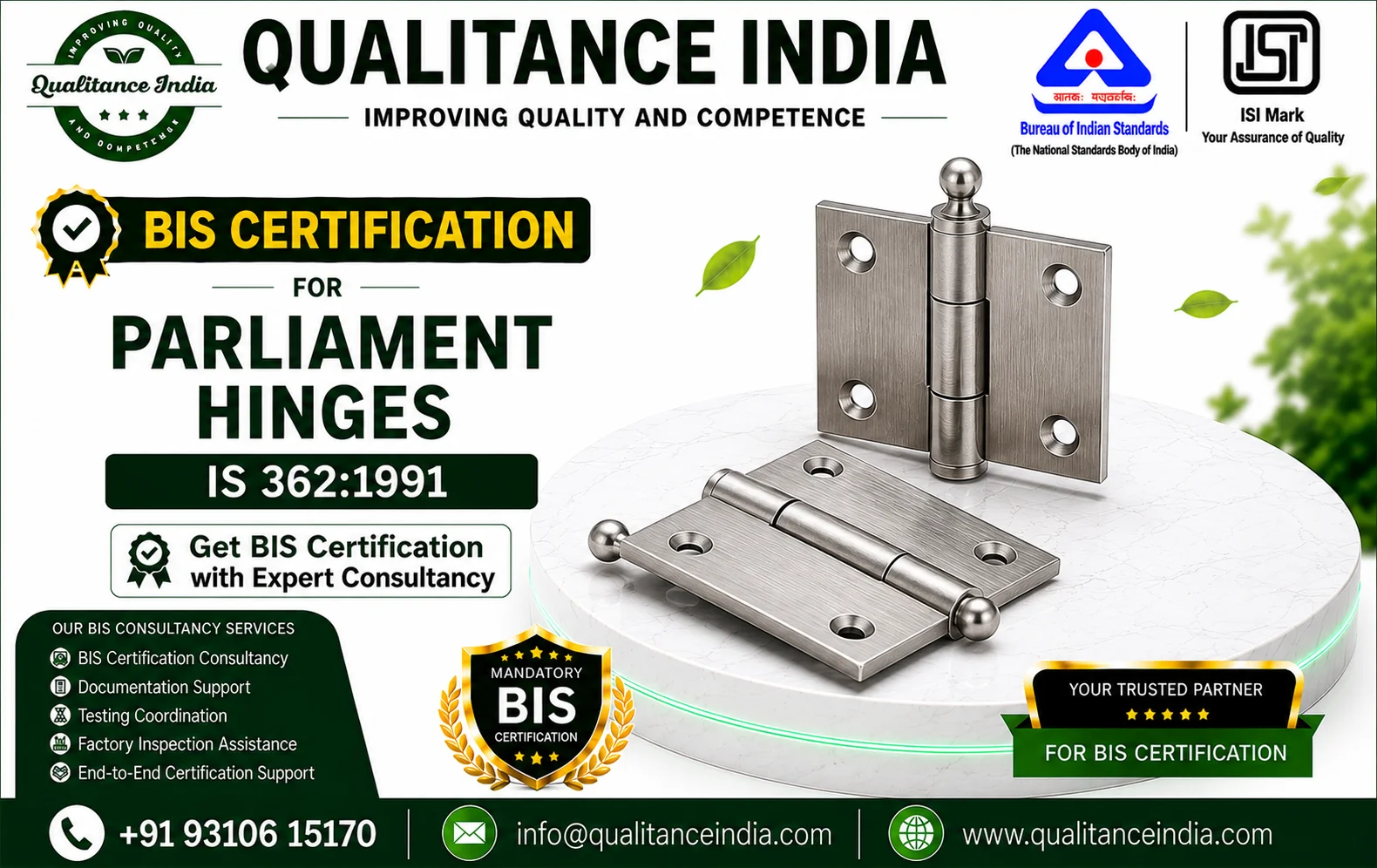
BIS Certification Consultancy for Parliament Hinges | IS 362:1991 | BIS & ISI Mark Certification
Introduction
Parliament hinges are specialized door and window hardware designed to allow a door or window to open through a wide angle, including applications where approximately 180-degree opening is required. They are commonly used in construction, furniture, doors, windows and other architectural hardware applications.
The performance and durability of a parliament hinge depend on its material, dimensions, manufacturing quality, knuckle and pin construction, screw-hole arrangement and surface finish. IS 362:1991 – Parliament Hinges – Specification establishes requirements intended to ensure consistency and suitability of these hinges.
The BIS Product Manual for IS 362:1991 provides certification guidance under Scheme-I of the BIS Conformity Assessment Regulations, 2018 and can also be used by prospective applicants seeking a BIS certification licence. The Product Manual identifies Type 1, Type 2 and Type 3 parliament hinges and specifies a sample size of 6 parliament hinges.
Parliament hinges are covered under the current Hinges (Quality Control) Order, 2025. The order specifically lists IS 362:1991 – Parliament Hinges and provides 1 July 2025 as the implementation date. The current BIS compulsory-certification listing also includes IS 362:1991 under the Hinges category.
Qualitance India provides end-to-end BIS Certification Consultancy for Parliament Hinges as per IS 362:1991, including product assessment, scope and grouping guidance, documentation, testing coordination, BIS application support and factory inspection preparation.
What is IS 362:1991?
IS 362:1991 is titled:
“Parliament Hinges – Specification”
The standard specifies requirements for parliament hinges used in construction and furniture applications. BIS's product summary describes parliament hinges as a type of hinge that allows doors or windows to open to approximately 180 degrees. It identifies three broad types:
- Cast
- Pressed
- Fabricated
The product summary also identifies typical material arrangements, including cast brass for cast hinges, mild steel or aluminium alloy for pressed hinges, and extruded aluminium alloy for fabricated hinges.
The standard addresses important quality characteristics such as:
- Material
- Dimensions and tolerances
- Manufacturing requirements
- Knuckles
- Pins
- Screw holes
- Surface finish
- Workmanship
- Marking and packing
What are Parliament Hinges?
Parliament hinges are door and window hinges designed with an extended hinge arrangement that allows the door or window to open wider than with many conventional hinge designs.
They are used in applications where:
- Wide opening is required
- Door clearance is important
- Furniture or architectural hardware requires a specific hinge configuration
- A 180-degree opening arrangement is desired
A parliament hinge generally includes components such as:
- Hinge flaps
- Knuckles
- Hinge pin
- Screw holes
- Fixing components
- Surface finish or protective coating
The exact construction depends on the type and material of the hinge.
Types of Parliament Hinges under IS 362:1991
The BIS Product Manual identifies three types of parliament hinges.
Type 1 – Cast
Type 1 parliament hinges are identified as cast hinges.
The Product Manual identifies the material as:
Cast Brass
The standard provides size designations including:
50 mm, 65 mm, 75 mm, 100 mm, 125 mm, 150 mm, 175 mm and 200 mm.
Type 2 – Pressed
Type 2 parliament hinges are identified as pressed hinges.
The applicable materials are:
- Mild Steel
- Aluminium Alloy
Separate samples are required for each material intended to be included within the licence scope.
Type 3 – Fabricated
Type 3 parliament hinges are identified as fabricated hinges.
The BIS Product Manual identifies:
Extruded Aluminium Alloy
as the applicable material.
Scope of IS 362:1991
Correctly determining the product scope is one of the most important steps in BIS certification for parliament hinges.
The BIS Product Manual defines scope according to:
- Type
- Material
- Size
The applicable types are:
Type 1 – Cast Type 2 – Pressed Type 3 – Fabricated
For Type 1, the identified size range includes 50 mm to 200 mm in the specified sizes. For Type 2, separate sampling applies for mild steel and aluminium alloy.
The manufacturer should declare the varieties of parliament hinges intended to be included in the BIS licence. The Product Manual also states that the licence scope may be restricted according to the manufacturer's manufacturing and testing capabilities.
Is BIS Certification Mandatory for Parliament Hinges?
Yes. Parliament Hinges under IS 362:1991 are covered by the current BIS compulsory certification framework.
The Hinges (Quality Control) Order, 2025 lists IS 362:1991 among the Indian Standards applicable to hinges. The order requires the specified goods to conform to the applicable Indian Standard and bear the Standard Mark under a BIS licence in accordance with Scheme-I. The implementation date specified in the 2025 order is 1 July 2025.
The BIS current Scheme-I listing also identifies IS 362:1991 – Parliament Hinges under the Hinges QCO category and references the 2023, 2024 and 2025 Hinges QCO notifications.
The 2025 order superseded the earlier Hinges (Quality Control) Order, 2024. Manufacturers should therefore rely on the current 2025 order and any subsequent amendments or exemptions applicable to their business.
Hinges Quality Control Order, 2025
The Hinges (Quality Control) Order, 2025 covers several types of hinges, including:
| Product | Indian Standard |
|---|---|
| Stainless Steel Butt Hinges | IS 12817:2020 |
| Steel Butt Hinges | IS 1341:2018 |
| Non-ferrous Metal Butt Hinges | IS 205:1992 |
| Tee and Strap Hinges | IS 206:2010 |
| Parliament Hinges | IS 362:1991 |
| Continuous (Piano) Hinges | IS 3818:1992 |
| Steel Back Flap Hinges | IS 3843:1995 |
| Double-acting Spring Hinges | IS 453:1993 |
| Cabinet Hinges | IS 18297:2023 |
The current order was notified on 21 March 2025 and specifies 1 July 2025 as the implementation date for the listed hinge standards.
The order also states that the latest version of the relevant Indian Standards, including amendments notified by BIS, shall apply.
BIS Certification for Parliament Hinges
BIS Certification confirms that the manufacturer's parliament hinges have been assessed against the applicable requirements of IS 362:1991.
The BIS Product Manual confirms that certification for the product is operated under Scheme-I of the BIS Conformity Assessment Regulations, 2018.
After obtaining the BIS licence, the manufacturer can use the BIS Standard Mark / ISI Mark on products covered by the approved licence scope and subject to applicable BIS marking conditions.
Who Needs BIS Certification for Parliament Hinges?
BIS certification is relevant to manufacturers producing parliament hinges covered by IS 362:1991.
This can include:
- Parliament Hinge Manufacturers
- Door Hardware Manufacturers
- Window Hardware Manufacturers
- Architectural Hardware Manufacturers
- Builder Hardware Manufacturers
- Furniture Hardware Manufacturers
- Brass Hardware Manufacturers
- Aluminium Hardware Manufacturers
- Mild Steel Hardware Manufacturers
- OEM Manufacturers
- Contract Manufacturers
Importers and sellers should also verify their obligations under the current Hinges QCO and applicable BIS requirements.
BIS Certification Eligibility Requirements
A manufacturer seeking BIS certification should generally have appropriate manufacturing and quality-control arrangements.
These may include:
- Manufacturing premises
- Suitable hinge manufacturing machinery
- Casting facilities, where applicable
- Pressing/forming facilities, where applicable
- Aluminium fabrication facilities, where applicable
- Product drawings
- Product specifications
- Raw-material control
- Manufacturing process controls
- Inspection procedures
- Testing and measuring facilities
- Calibration arrangements
- Trained quality-control personnel
- Production records
- Testing records
- Storage facilities
- Product identification and marking arrangements
The exact requirements depend on the type, material, size and proposed BIS licence scope.
BIS Certification Process for Parliament Hinges
Step 1 – Product Applicability Assessment
The manufacturer's parliament hinge is first reviewed against IS 362:1991.
The assessment includes:
- Type
- Material
- Size
- Construction
- Manufacturing method
- Intended licence scope
Step 2 – Type and Material Identification
The applicable type is determined:
Type 1 – Cast Type 2 – Pressed Type 3 – Fabricated
For Type 2, the material is also specifically identified as mild steel or aluminium alloy.
Step 3 – Product Scope Finalisation
The manufacturer declares the varieties intended for inclusion in the BIS licence.
The BIS Product Manual states that grouping is based on type, material and size and that the licence scope may be restricted according to available manufacturing and testing capabilities.
Step 4 – Documentation Preparation
Technical, factory and quality-control documents are prepared.
Step 5 – Sample Preparation
The BIS Product Manual specifies a sample size of:
6 nos. of Parliament Hinges.
For grouping, one sample each of the smallest and highest size from each type is to be tested to cover the applicable size range. For Type 2, separate samples of each material are required for the material to be included in the scope.
Step 6 – Laboratory Testing
The samples are tested against the applicable requirements of IS 362:1991.
Step 7 – BIS Application
The manufacturer submits the BIS application with the required documents and technical information.
Step 8 – Factory Assessment
BIS assesses the manufacturing facility, machinery, testing arrangements and quality-control system.
Step 9 – Observation Closure
If BIS identifies observations or deficiencies, corrective action is taken and supporting evidence is submitted.
Step 10 – BIS Licence Grant
After successful conformity assessment, BIS grants the licence for the approved product scope.
Step 11 – ISI Marking
The manufacturer can mark products covered by the licence according to the applicable BIS Standard Mark requirements.
Testing Requirements for Parliament Hinges
Testing is an important part of BIS certification for parliament hinges.
The BIS Product Manual identifies major areas including dimensions and tolerances, manufacture and finish.
Material
The material used for the hinge must comply with the applicable requirements of IS 362:1991.
The Product Manual states that material testing is carried out on each consignment and that no further testing is required where the material is accompanied by a test certificate or is ISI marked, subject to the applicable provisions.
Dimensions and Tolerances
Dimensions are checked against the applicable tables and figures of the standard.
These dimensional requirements are important for proper fit, interchangeability and operation of the hinge.
Manufacture
Manufacturing requirements cover areas such as:
- General construction
- Knuckles
- Pins
- Screw holes
- Workmanship
The BIS Product Manual requires manufacture-related controls and identifies manufacture as part of the regular inspection and testing framework.
Knuckles
Knuckles are an important mechanical component of parliament hinges.
The standard specifies requirements relating to their construction and workmanship.
Pins
The hinge pins should meet the applicable construction and dimensional requirements.
Screw Holes
The number, position and dimensions of screw holes are important for proper installation.
BIS's product summary also highlights screw-hole specifications as an important requirement of IS 362:1991.
Finish
Surface finish is another important requirement.
Depending on the material and product type, applicable finishes can include:
- Bright finish
- Satin finish
- Anodized finish
- Electro-galvanized finish
The BIS Product Manual identifies finish testing and refers to anodizing coating thickness measurement or the applicable equipment and chemicals under IS 1868.
BIS Factory Inspection for Parliament Hinges
Factory assessment is an important part of BIS certification under Scheme-I.
During factory inspection, BIS may assess:
Manufacturing Machinery
Machinery and facilities appropriate to the applicable hinge type.
Raw Material Storage
Proper identification, storage and traceability of materials.
Production Process
Controls maintained during casting, pressing, fabrication, machining, assembly and finishing, as applicable.
Dimensional Inspection
Availability of equipment such as:
- Vernier caliper
- Micrometer
- Other applicable dimensional measuring equipment
Finish Testing
For applicable aluminium products, anodizing coating thickness equipment may be required.
The BIS Product Manual identifies dimensional measuring equipment and finish-testing equipment in its test-equipment list.
Calibration
The manufacturer must prepare a calibration plan for test equipment and maintain appropriate records.
Quality Control
Incoming, in-process and final inspection arrangements should be maintained.
Test Records
The manufacturer must maintain test records to demonstrate conformity.
Testing Equipment for IS 362:1991
The BIS Product Manual identifies major equipment for parliament-hinge testing, including:
- Vernier caliper
- Micrometer
- Countersunk-head wood screws as per IS 6760
- Anodizing coating thickness gauge
- Applicable equipment and chemicals as per IS 1868
The list in the Product Manual is described as indicative and should not be treated as exhaustive.
Product Grouping for Parliament Hinges
Product grouping is especially important where a manufacturer produces multiple sizes, materials or types.
The BIS Product Manual classifies parliament hinges according to:
- Type
- Material
- Size
Type 1
For cast brass parliament hinges, the smallest and highest size from the intended range are tested for grouping.
Type 2
For pressed hinges, separate samples are required for:
- Mild steel
- Aluminium alloy
Type 3
Fabricated hinges using extruded aluminium alloy are covered separately.
The manufacturer should declare all varieties intended to be included in the licence. The licence scope may be restricted according to the manufacturing and testing capabilities available at the factory.
Scheme of Inspection and Testing
The BIS Product Manual specifies a Scheme of Inspection and Testing for parliament hinges.
The manufacturer is required to maintain:
- A suitably equipped laboratory
- Calibration plan
- Test records
- Applicable inspection controls
- Labelling and marking arrangements
- Packing arrangements
- Control over non-conforming products
The Product Manual specifies routine controls including:
- Material: one sample from each consignment
- Dimensions and tolerances: samples for each type and size from every two hours of production
- Manufacture: each hinge
- Visual finish: each hinge
- Anodic coating for aluminium alloy hinges: one sample from aluminium alloy anodized in a production shift
This makes a proper quality-control system important for both obtaining and maintaining the BIS licence.
Documents Required for BIS Certification
Typical documents may include:
- Company registration documents
- Factory address proof
- Factory layout
- Manufacturing process flow chart
- Machinery list
- Product drawings
- Hinge specifications
- Type details
- Material details
- Size details
- Raw-material information
- Material test certificates
- Supplier details
- Testing equipment list
- Calibration certificates
- Quality-control plan
- Inspection records
- Production records
- Test reports
- Product photographs
- Packing details
- Marking details
- Authorised signatory documents
- Trademark documents, where applicable
The final documentation requirement depends on the applicant, manufacturing setup and proposed licence scope.
Packing and Marking Requirements
Marking and labelling are part of the BIS certification requirements.
The manufacturer should ensure that the product carries the required information according to IS 362:1991 and the BIS licence conditions.
The BIS Product Manual specifically requires labelling and marking according to the standard and states that all production conforming to the Indian Standard and covered by the licence should carry the Standard Mark.
Packing of hinges and bolts should also comply with the applicable requirements of the standard.
Common Reasons for BIS Certification Delays
Manufacturers may experience delays because of:
- Incorrect hinge type
- Incorrect material declaration
- Incorrect size scope
- Incomplete product drawings
- Dimensional non-conformity
- Incorrect screw-hole dimensions
- Poor knuckle construction
- Pin-related defects
- Poor workmanship
- Surface-finish defects
- Anodizing non-conformity
- Inadequate testing equipment
- Missing calibration records
- Incomplete production records
- Incorrect sample selection
- Incorrect product grouping
- Factory not ready for inspection
- Documentation deficiencies
- Incorrect BIS marking
Proper product assessment and scope finalisation before testing can help reduce avoidable certification delays.
BIS Certification Cost for Parliament Hinges
There is no single fixed BIS certification cost applicable to every manufacturer.
The total cost may depend on:
- BIS application fees
- Laboratory testing charges
- Hinge type
- Material
- Number of sizes
- Product grouping
- Factory assessment
- Testing equipment
- Calibration
- Documentation
- Retesting, if required
- Consultancy charges
Current BIS LIMS listings show different testing charges for IS 362:1991 depending on the laboratory and testing scope. For example, current listings show charges of ₹5,000 at one laboratory and ₹12,500 at another current listing.
These laboratory charges should not be considered the complete BIS certification cost because the overall project can include BIS application, factory assessment, equipment, documentation, calibration and consultancy expenses.
For an accurate quotation, the hinge type, material, sizes and proposed licence scope should be assessed first.
BIS Certification Timeline
The certification timeline can vary depending on:
- Product type
- Material
- Size range
- Product grouping
- Documentation readiness
- Sample availability
- Laboratory testing
- Test results
- BIS application scrutiny
- Factory readiness
- Factory assessment
- Closure of observations
Manufacturers can reduce delays by finalising their product scope, documentation, samples and testing arrangements before submitting the application.
Benefits of BIS Certification for Parliament Hinges
Regulatory Compliance
Helps manufacturers comply with applicable BIS and Hinges QCO requirements.
ISI Mark
Allows eligible manufacturers to use the BIS Standard Mark on products covered by the approved licence.
Consistent Product Quality
Dimensional, manufacturing and finish controls help maintain consistent hinge quality.
Better Product Performance
Proper control of dimensions, knuckles, pins and screw holes supports reliable hinge operation.
Customer Confidence
BIS certification can strengthen confidence among builders, furniture manufacturers, contractors and hardware buyers.
Market Acceptance
Certification supports legal market access where BIS certification is mandatory.
Better Quality Control
The BIS inspection and testing framework encourages systematic manufacturing controls.
Business Credibility
A valid BIS licence can strengthen the manufacturer's position in the architectural and builder-hardware market.
Why Choose Qualitance India?
Qualitance India provides professional BIS Certification Consultancy for manufacturers seeking BIS and ISI Mark certification.
For Parliament Hinges as per IS 362:1991, our consultancy support can include:
- Product applicability assessment
- IS 362:1991 requirement review
- Type 1 / Type 2 / Type 3 assessment
- Material assessment
- Size assessment
- Product grouping guidance
- Documentation preparation
- Sample selection guidance
- Laboratory testing coordination
- BIS application assistance
- Factory inspection preparation
- Testing equipment guidance
- Quality-control documentation
- Observation closure support
- BIS licence assistance
Our support is designed to help manufacturers manage the certification process from product assessment and scope finalisation through laboratory testing, BIS application, factory assessment and licence approval.
Contact Qualitance India
Phone: +91 93106 15170 Email: info@qualitanceindia.com Website: qualitanceindia.com
BIS Certification Process – Quick Flow
Product Identification ↓ IS 362:1991 Requirement Review ↓ Type Assessment ↓ Material Assessment ↓ Size & Scope Finalisation ↓ Product Grouping ↓ Documentation Preparation ↓ Sample Preparation – 6 Hinges ↓ Laboratory Testing ↓ BIS Application ↓ Application Scrutiny ↓ Factory Assessment ↓ Observation Closure ↓ BIS Licence Grant ↓ ISI Mark on Approved Parliament Hinges
Frequently Asked Questions
1. What is IS 362:1991?
IS 362:1991 is the Indian Standard titled Parliament Hinges – Specification.
2. Is BIS certification mandatory for parliament hinges?
Yes. Parliament Hinges under IS 362:1991 are included in the Hinges (Quality Control) Order, 2025, with implementation from 1 July 2025.
3. What is the applicable BIS certification scheme?
Parliament hinges are certified under Scheme-I / ISI Mark Scheme.
4. What types of parliament hinges are covered?
The BIS Product Manual identifies Type 1 – Cast, Type 2 – Pressed and Type 3 – Fabricated.
5. What materials are covered?
The Product Manual identifies cast brass for Type 1, mild steel or aluminium alloy for Type 2, and extruded aluminium alloy for Type 3.
6. What sizes are covered under IS 362:1991?
For Type 1, the Product Manual identifies 50 mm, 65 mm, 75 mm, 100 mm, 125 mm, 150 mm, 175 mm and 200 mm.
7. What is the BIS sample size for parliament hinges?
The BIS Product Manual specifies 6 parliament hinges as the sample size.
8. How does product grouping work?
For each type, one sample of the smallest and highest size from the applicable range is tested. For Type 2, separate samples are required for mild steel and aluminium alloy to cover those materials.
9. What tests are required for parliament hinges?
Important requirements include material, dimensions and tolerances, manufacturing, knuckles, pins, screw holes and finish.
10. Is testing required for aluminium alloy hinges?
Yes. For applicable aluminium alloy hinges, anodic coating thickness is included in the inspection and testing framework.
11. Is factory inspection required?
Yes. Factory assessment forms part of the BIS certification process under Scheme-I.
12. What equipment is required for testing?
The BIS Product Manual identifies equipment such as vernier calipers, micrometers, countersunk-head wood screws and anodizing coating thickness gauges, along with applicable equipment under IS 1868.
13. How much does BIS certification for parliament hinges cost?
The total cost depends on product type, material, sizes, laboratory testing, BIS application, factory assessment, documentation and other expenses. Current BIS LIMS listings show different laboratory charges depending on the laboratory.
14. How long does BIS certification take?
The timeline depends on product scope, documentation, sample testing, BIS application processing, factory assessment and closure of observations.
15. Can Qualitance India help with IS 362:1991 certification?
Yes. Qualitance India provides product assessment, scope and grouping guidance, documentation, laboratory testing coordination, BIS application assistance and factory inspection preparation.
People Also Ask
What is BIS certification for parliament hinges?
BIS certification for parliament hinges is the conformity assessment process for demonstrating compliance with IS 362:1991 – Parliament Hinges – Specification under the BIS certification framework.
Is IS 362:1991 under a QCO?
Yes. IS 362:1991 is specifically listed under the Hinges (Quality Control) Order, 2025.
What is the BIS standard for parliament hinges?
The applicable Indian Standard is IS 362:1991 – Parliament Hinges – Specification.
What are the types of parliament hinges?
The BIS Product Manual identifies Cast, Pressed and Fabricated types, designated Type 1, Type 2 and Type 3 respectively.
What materials are used for parliament hinges?
The Product Manual identifies cast brass, mild steel, aluminium alloy and extruded aluminium alloy, depending on the hinge type.
What is the sample requirement for IS 362:1991?
The BIS Product Manual specifies 6 parliament hinges as the sample size.
How do I get an ISI Mark for parliament hinges?
A manufacturer needs to obtain the applicable BIS licence for IS 362:1991 and then comply with BIS requirements for Standard Marking and continuing conformity.
Related BIS Certification Services
- BIS Certification for Door Handles – IS 208:2020
- BIS Certification for Rim Latches – IS 1019:1974
- BIS Certification for Steel Butt Hinges – IS 1341:2018
- BIS Certification for Non-Ferrous Metal Butt Hinges – IS 205:1992
- BIS Certification for Tee and Strap Hinges – IS 206:2010
- BIS Certification for Continuous Piano Hinges – IS 3818:1992
- BIS Certification for Steel Back Flap Hinges – IS 3843:1995
- BIS Certification for Cabinet Hinges – IS 18297:2023
- BIS & ISI Mark Certification
- BIS Factory Inspection Assistance
- BIS Testing Coordination
Conclusion
IS 362:1991 – Parliament Hinges – Specification establishes important requirements for the material, dimensions, manufacture, knuckles, pins, screw holes and finish of parliament hinges.
The BIS Product Manual identifies Type 1 – Cast, Type 2 – Pressed and Type 3 – Fabricated hinges. It also provides grouping guidance based on type, material and size and specifies 6 parliament hinges as the sample size.
Parliament hinges are included in the Hinges (Quality Control) Order, 2025, which lists IS 362:1991 and specifies 1 July 2025 as the implementation date. The current BIS Scheme-I listing also includes Parliament Hinges under the Hinges QCO category.
Manufacturers should therefore carefully finalise the hinge type, material, size range, product grouping, raw-material control, testing facilities, calibration system, quality-control records and proposed licence scope before applying for BIS certification.
Qualitance India provides end-to-end BIS Certification Consultancy for Parliament Hinges as per IS 362:1991, including product assessment, scope and grouping guidance, documentation, sample preparation, laboratory testing coordination, BIS application support and factory inspection preparation.
For BIS Certification and ISI Mark Consultancy for Parliament Hinges, contact Qualitance India today.
Phone: +91 93106 15170 Email: info@qualitanceindia.com Website: qualitanceindia.com