BIS Certification Consultancy for Corrugated Aluminium Sheet | IS 1254:2007 | BIS & ISI Mark Certification
Introduction
Corrugated aluminium sheets are widely used for roofing, cladding, industrial applications, building projects and other applications where a lightweight sheet with a corrugated profile is required. Their alloy and temper, thickness, width, length, corrugation profile, mechanical properties, dimensional accuracy and surface finish are important for achieving consistent product performance.
In India, IS 1254:2007 – Corrugated Aluminum Sheet specifies requirements for corrugated aluminium sheets. The current BIS Product Manual PM/IS 1254/2, June 2024 provides certification guidance under Scheme-I of the BIS (Conformity Assessment) Regulations, 2018.
The standard covers corrugated aluminium sheets for General Purpose, Industrial, Building and High Stiffness Industrial use. The BIS Product Manual identifies applicable alloys and tempers as 19000 H4, 31000 H4, 31500 H4, 40800 H4 and 51300 H4, as specified in IS 737.
The product is also included under the current Aluminium and Aluminium Alloy Products (Quality Control) Order, 2026. The order specifically lists IS 1254:2007 – Corrugated Aluminium Sheet and requires covered products to bear the BIS Standard Mark under a BIS licence according to Scheme-I. For IS 1254:2007, the 2026 QCO specifies implementation with immediate effect for general, small and micro enterprises.
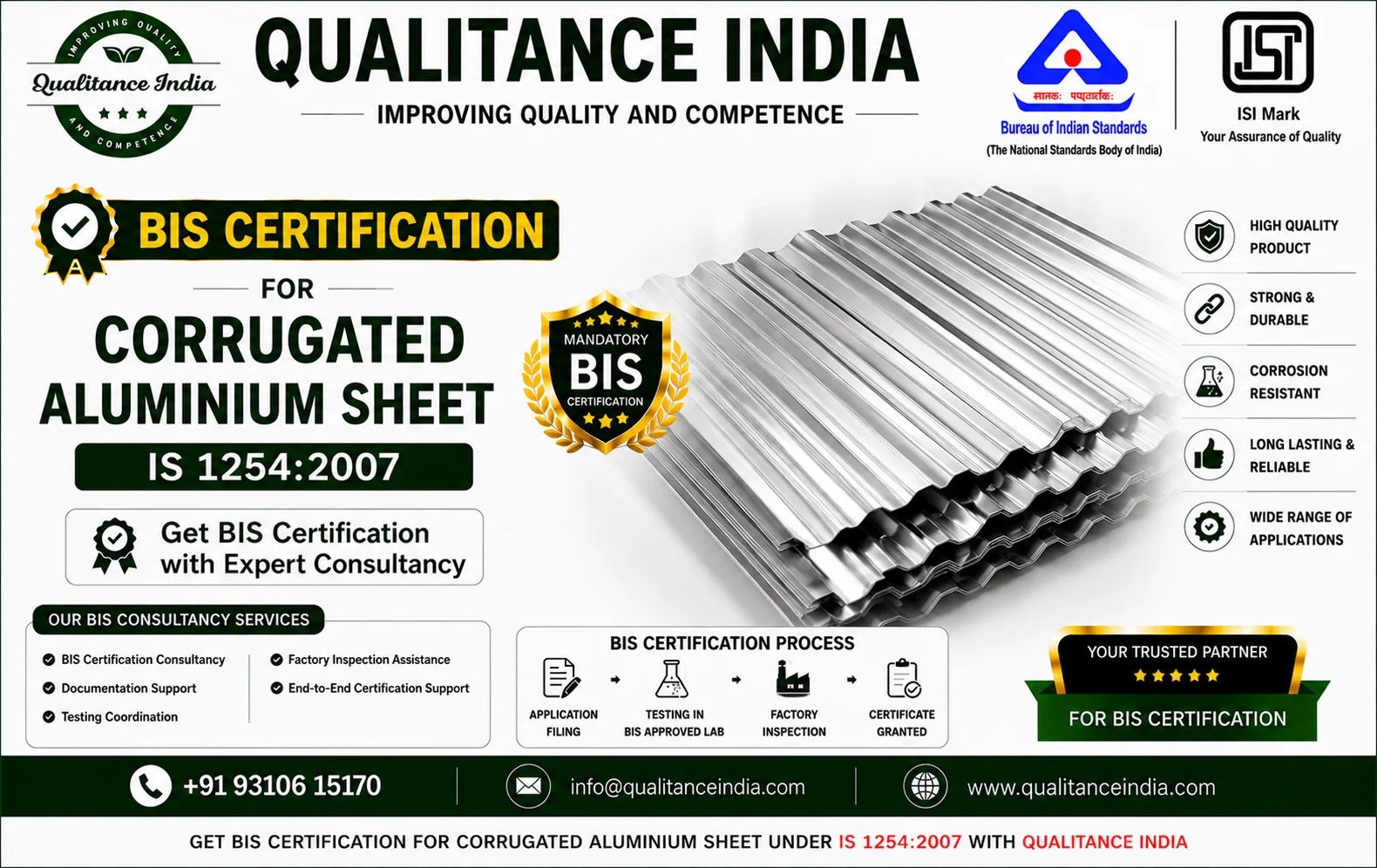
Qualitance India provides end-to-end BIS Certification Consultancy for Corrugated Aluminium Sheet as per IS 1254:2007, including product scope assessment, alloy and profile grouping, documentation, laboratory testing coordination, BIS application support and factory inspection preparation.
What is IS 1254:2007?
IS 1254:2007 is titled:
“Corrugated Aluminum Sheet”
The current BIS Product Manual records one amendment to the standard and provides guidance for certification under Scheme-I.
IS 1254:2007 specifies requirements for corrugated aluminium sheets intended for:
- General Purpose use
- Industrial use
- Building use
- High Stiffness Industrial use
The standard addresses important characteristics such as:
- Aluminium alloy and temper
- Profile
- Thickness
- Width
- Length
- Corrugation depth
- Corrugation pitch
- Mechanical properties
- Chemical composition
- Freedom from defects
- Finish
- Dimensions and tolerances
- Marking and packing
The current BIS Product Manual specifically defines the licence scope through alloy/temper, profile and size parameters.
What is Corrugated Aluminium Sheet?
Corrugated aluminium sheet is an aluminium sheet formed into a regular corrugated profile. The corrugations increase the sheet's stiffness while retaining the lightweight characteristics of aluminium.
These sheets can be used in applications such as:
- Roofing
- Industrial buildings
- Building cladding
- Factory structures
- General-purpose sheet applications
- Industrial sheet applications
- High-stiffness applications
The actual use and suitability depend on the profile, alloy, temper, dimensions and applicable product requirements.
Scope of Corrugated Aluminium Sheet under IS 1254:2007
The BIS Product Manual provides detailed scope parameters for IS 1254:2007.
Alloy and Temper
The identified alloy and temper combinations are:
- 19000 H4
- 31000 H4
- 31500 H4
- 40800 H4
- 51300 H4
These are specified in relation to IS 737.
Profiles
The Product Manual identifies the following profiles:
- 8/75 – General Purpose Sheet
- 10/75 – General Purpose Sheet
- 16/75 – General Purpose Sheet
- Industrial Sheet
- Building Sheet
- High Stiffness Industrial Sheet
- Any other profile agreed between manufacturer and purchaser.
Size
The BIS licence scope includes:
- Thickness
- Overall width
- Length
The exact minimum and maximum dimensions are recorded in the individual licence scope according to the manufacturer's manufacturing and testing capabilities.
Because alloy, temper, profile and size directly affect the licence scope, manufacturers should finalise these parameters before sample testing.
Is BIS Certification Mandatory for Corrugated Aluminium Sheet?
Yes. Corrugated Aluminium Sheet under IS 1254:2007 is covered under the compulsory BIS certification framework.
The Aluminium and Aluminium Alloy Products (Quality Control) Order, 2026, issued under S.O. 1319(E), specifically lists IS 1254:2007 – Corrugated Aluminium Sheet. The order requires listed products to conform to the corresponding Indian Standard and bear the Standard Mark under a BIS licence according to Scheme-I.
The 2026 QCO came into force on 13 March 2026, and for IS 1254:2007 the implementation date is specified as immediate effect for general enterprises, small enterprises and micro enterprises.
The current BIS compulsory-certification page also lists IS 1254:2007 under the Aluminium and Aluminium Alloy Products category and records the 2026 QCO.
Aluminium and Aluminium Alloy Products Quality Control Order, 2026
The current QCO superseded the earlier Aluminium and Aluminium Alloy Products (Quality Control) Order, 2025.
For covered products, the order provides for compulsory use of the BIS Standard Mark under a BIS licence according to Scheme-I. It also states that the latest version of the relevant Indian Standard, including notified amendments, is applicable.
The order provides certain exclusions and special provisions, including an exemption for goods manufactured domestically for export and a provision for specified imports up to 200 kg per year for R&D by aluminium-product manufacturers, subject to conditions.
For manufacturers of Corrugated Aluminium Sheet, the key point is that IS 1254:2007 is presently covered and its QCO implementation is immediate.
BIS Certification for Corrugated Aluminium Sheet
BIS Certification is the conformity-assessment process through which a manufacturer demonstrates that the corrugated aluminium sheet complies with the applicable requirements of IS 1254:2007.
The BIS Product Manual confirms that certification for the product is operated under Scheme-I.
After successful completion of the conformity-assessment process and grant of the BIS licence, the manufacturer can use the BIS Standard Mark / ISI Mark on products covered by the approved licence scope and according to applicable BIS marking conditions.
Who Needs BIS Certification for Corrugated Aluminium Sheet?
BIS certification is relevant to manufacturers producing corrugated aluminium sheets covered by IS 1254:2007.
This can include:
- Corrugated Aluminium Sheet Manufacturers
- Aluminium Sheet Manufacturers
- Roofing Sheet Manufacturers
- Aluminium Roofing Manufacturers
- Building Material Manufacturers
- Industrial Sheet Manufacturers
- Aluminium Fabrication Manufacturers
- Cladding Material Manufacturers
- Metal Roofing Manufacturers
- OEM Manufacturers
- Contract Manufacturers
Importers and other businesses dealing with covered products should independently verify their obligations under the current QCO and BIS framework.
BIS Certification Eligibility Requirements
A manufacturer seeking BIS certification should generally have appropriate manufacturing and quality-control arrangements.
These may include:
- Manufacturing premises
- Aluminium sheet processing facilities
- Corrugation equipment
- Cutting facilities
- Forming equipment
- Product drawings
- Technical specifications
- Raw-material control
- Manufacturing process controls
- Testing and measuring equipment
- Calibration arrangements
- Quality-control personnel
- Inspection procedures
- Production records
- Testing records
- Product identification system
- Packing and marking arrangements
The exact requirements depend on the alloy/temper, profile, size range and proposed licence scope.
BIS Certification Process for Corrugated Aluminium Sheet
Step 1 – Product Applicability Assessment
The manufacturer's product is first assessed against IS 1254:2007.
The assessment includes:
- Alloy
- Temper
- Profile
- Thickness
- Width
- Length
- Intended use
- Manufacturing process
- Proposed BIS licence scope
Step 2 – Alloy and Temper Assessment
The manufacturer determines the alloy and temper intended for certification.
The BIS Product Manual identifies:
19000 H4 / 31000 H4 / 31500 H4 / 40800 H4 / 51300 H4.
Step 3 – Profile Identification
The applicable profile is identified, such as:
- 8/75
- 10/75
- 16/75
- Industrial
- Building
- High Stiffness Industrial
- Other mutually agreed profile.
Step 4 – Product Grouping and Scope Finalisation
The BIS licence scope is finalised according to alloy, profile and size grouping.
Step 5 – Documentation Preparation
Technical, factory and quality-control documents are prepared.
Step 6 – Sample Preparation
The current BIS Product Manual specifies:
Chemical tests: 5 pieces of 5 cm × 5 cm
Mechanical tests: 1 sheet of 1 metre length.
The Product Manual also states that dimensions and tolerances including thickness, width, length, squareness, depth and pitch of corrugation are to be carried out in the factory on full-size sheets.
Step 7 – Laboratory Testing
The relevant samples are tested for applicable chemical and mechanical requirements.
Step 8 – Factory Dimensional Checks
Full-size sheets are checked at the factory for applicable dimensions and corrugation parameters.
Step 9 – BIS Application
The manufacturer submits the BIS application with the required documentation and technical information.
Step 10 – Factory Assessment
BIS assesses the production facilities, testing arrangements and quality-control system.
Step 11 – Observation Closure
Any deficiencies or observations raised by BIS are addressed and supporting evidence is submitted.
Step 12 – BIS Licence Grant
After successful conformity assessment, BIS grants the licence for the approved scope.
Step 13 – ISI Marking
The manufacturer can mark products covered by the licence according to applicable BIS Standard Mark conditions.
Testing Requirements for Corrugated Aluminium Sheet
Testing is one of the most important stages of BIS certification.
The current BIS Product Manual identifies testing related to material, mechanical properties, dimensions and tolerances.
Chemical Composition
The aluminium alloy is checked for the applicable chemical-composition requirements specified through the relevant provisions of IS 737.
The Product Manual identifies laboratory equipment including a spectrometer and associated analytical equipment and reagents for chemical analysis.
Mechanical Properties
Mechanical-property testing is performed according to the applicable requirements of IS 737.
The BIS Product Manual identifies:
- Universal Tensile Testing Machine
- Bend Testing Machine with suitable mandrels
for mechanical-property testing.
Dimensions and Tolerances
The following parameters are specifically identified:
- Thickness
- Width
- Length
- Squareness
- Depth of corrugation
- Pitch of corrugation
The Product Manual states that these measurements are to be performed in the factory on full-size sheets.
Freedom from Defects
The sheet should comply with the applicable requirements relating to freedom from defects.
Finish and Workmanship
The finished sheets should meet the applicable requirements relating to surface finish and workmanship.
Raw Material Requirements
Raw-material control is particularly important for Corrugated Aluminium Sheet.
The BIS Product Manual specifies that the corrugated sheet shall be made from aluminium sheets in the following alloy and temper combinations as specified in IS 737:
- 19000 H4
- 31000 H4
- 31500 H4
- 40800 H4
- 51300 H4
Manufacturers should maintain proper records for:
- Alloy designation
- Temper
- Supplier
- Purchase records
- Material test certificates
- Incoming inspection
- Lot identification
- Heat/batch traceability
- Material conformity
Good raw-material control helps maintain consistent mechanical properties, corrugation quality and dimensional stability.
Manufacturing Process for Corrugated Aluminium Sheet
A typical manufacturing process may include:
- Raw-material receiving
- Alloy and temper verification
- Incoming inspection
- Sheet preparation
- Corrugation/forming
- Profile inspection
- Cutting to required length
- Width and thickness inspection
- Squareness inspection
- Surface inspection
- Mechanical-property verification
- Final inspection
- Packing
- Marking
The actual manufacturing process can vary depending on the corrugation equipment, profile and production technology.
The manufacturer should maintain suitable process controls throughout production.
BIS Factory Inspection for Corrugated Aluminium Sheet
Factory assessment is an important part of the Scheme-I certification process.
During factory inspection, BIS may assess:
Manufacturing Machinery
Machinery used for sheet preparation, corrugation, forming and cutting.
Raw Material Storage
Storage, identification and traceability of aluminium alloy sheets.
Production Process
Controls maintained during corrugation and finishing.
Dimensional Inspection
Availability of equipment for checking:
- Thickness
- Width
- Length
- Squareness
- Corrugation depth
- Corrugation pitch
The BIS Product Manual identifies equipment such as micrometer, vernier caliper, steel tape, cord, flat table and depth gauge for dimensional checks.
Mechanical Testing
The factory or applicable laboratory arrangement should have facilities for tensile and bend testing according to the Product Manual.
Chemical Testing
Where applicable, facilities should be available for chemical-composition analysis.
Calibration
The manufacturer should maintain a calibration plan for applicable testing and measuring equipment.
Quality Control
Incoming, in-process and final inspection procedures should be implemented.
Records
Production and test records should be maintained.
Testing Equipment for IS 1254:2007
The current BIS Product Manual provides an indicative list of test equipment.
Important equipment includes:
- Spectrometer
- Analytical balance
- Hot plate
- Hot air oven
- Photometer
- Laboratory glassware and chemical-analysis equipment
- Universal Tensile Testing Machine
- Bend Testing Machine with suitable mandrels
- Micrometer
- Vernier caliper
- Steel tape
- Cord
- Flat table
- Depth gauge
The Product Manual describes the list as indicative for guidance, so manufacturers should confirm the applicable equipment against the latest BIS requirements and their approved licence scope.
Product Grouping for Corrugated Aluminium Sheet
Product grouping is particularly important for manufacturers producing several alloy, profile and size combinations.
The BIS Product Manual identifies the following grouping:
| Group | Profile / Use |
|---|---|
| Group 1 | 8/75 – General Purpose Sheet |
| Group 2 | 10/75 – General Purpose Sheet |
| Group 3 | 16/75 – General Purpose Sheet |
| Group 4 | Industrial Sheet |
| Group 5 | Building Sheet |
| Group 6 | High Stiffness Industrial Sheet |
| Group 7 | Any other profile agreed between manufacturer and purchaser |
For each group, the Product Manual states that a sample of the highest overall width of any thickness/length is drawn and tested to cover sizes within the group. Separate samples are required for each alloy designation.
The licence scope is restricted based on the manufacturer's manufacturing and testing capabilities. During the operation of the licence, samples of each variety covered should be drawn and tested in rotation to the extent possible.
Quality Assurance Plan
The BIS Product Manual requires manufacturers and applicants to implement a Quality Assurance Plan consisting of regular testing and in-process controls designed to ensure that products carrying the Standard Mark conform to the Indian Standard.
The manufacturer should define:
- Control unit
- Frequency of testing
- Number of samples
- Routine testing
- In-process controls
- Test-record requirements
The recommended control unit is:
All corrugated aluminium sheets of the same size, profile and manufactured from the same raw material, i.e. sheets of the same alloy designation/temper on the line.
In-House Testing Requirements
The Product Manual expects manufacturers to establish a suitably equipped and staffed in-house laboratory for routine testing and factory-based controls. Some tests may be subcontracted to BIS-recognised/empanelled laboratories or laboratories having valid NABL accreditation, as permitted under the applicable provisions.
This means the manufacturer should plan the testing infrastructure before applying for BIS certification rather than arranging facilities only after factory inspection is scheduled.
Documents Required for BIS Certification
Typical documents may include:
- Company registration documents
- Factory address proof
- Factory layout
- Manufacturing process flow chart
- Machinery list
- Corrugation machinery details
- Product drawings
- Profile details
- Alloy and temper details
- Size range
- Raw-material specifications
- Material test certificates
- Supplier details
- Testing equipment list
- Calibration certificates
- Quality Assurance Plan
- Inspection records
- Production records
- Test reports
- Product photographs
- Packing details
- Marking details
- Authorised signatory documents
- Trademark documents, where applicable
The final document list depends on the applicant's manufacturing setup and proposed BIS licence scope.
Marking and Packing Requirements
The BIS Product Manual includes labelling, marking and packing within the certification requirements.
The Standard Mark and Licence Number (CM/L) are to be incorporated on the product and on the test certificate accompanying each consignment, subject to the product conforming to the applicable requirements.
Manufacturers should ensure that product identification, marking and packing comply with the current version of IS 1254:2007 and applicable BIS licence conditions.
Common Reasons for BIS Certification Delays
Manufacturers may face delays because of:
- Incorrect alloy designation
- Incorrect temper
- Incorrect profile
- Incorrect size scope
- Improper product grouping
- Incomplete technical drawings
- Chemical-composition failure
- Mechanical-property failure
- Thickness variation
- Width or length non-conformity
- Incorrect corrugation depth
- Incorrect corrugation pitch
- Squareness issues
- Surface defects
- Inadequate testing facilities
- Missing calibration records
- Incomplete quality-control records
- Incorrect sample selection
- Factory not ready for inspection
- Documentation deficiencies
- Incorrect BIS marking
A technical assessment before submitting the BIS application can help reduce avoidable certification delays.
BIS Certification Cost for Corrugated Aluminium Sheet
There is no single fixed BIS certification cost applicable to every manufacturer.
The total cost can depend on:
- BIS application fees
- Laboratory testing
- Alloy and temper combinations
- Number of profiles
- Size range
- Product grouping
- Number of samples
- Factory assessment
- Testing equipment
- Calibration
- Documentation
- Retesting, if required
- Consultancy charges
Current BIS LIMS information shows a ₹12,500 testing-charge entry for IS 1254:2007 – Corrugated aluminium sheet, with the entry effective from 24 March 2026. The detailed laboratory testing scope includes chemical/mechanical and dimensional-related requirements.
This laboratory charge should not be treated as the complete BIS certification cost because the overall project can include BIS application, factory assessment, testing infrastructure, calibration, documentation and consultancy expenses.
BIS Certification Timeline
The BIS certification timeline can depend on:
- Product scope
- Alloy and temper
- Profile
- Size range
- Documentation readiness
- Sample preparation
- Laboratory testing
- Test results
- BIS application scrutiny
- Factory readiness
- Factory assessment
- Observation closure
Manufacturers can reduce delays by finalising the product grouping, technical documents, samples and factory testing arrangements before submitting the application.
Benefits of BIS Certification for Corrugated Aluminium Sheet
Regulatory Compliance
Helps manufacturers comply with the applicable BIS requirements and current QCO.
ISI Mark
Allows eligible manufacturers to use the BIS Standard Mark on products covered by the approved licence.
Consistent Product Quality
Chemical, mechanical and dimensional controls help maintain consistent sheet quality.
Better Product Performance
Correct alloy, temper and corrugation profile support the intended product characteristics.
Customer Confidence
BIS certification can strengthen confidence among builders, contractors, industrial buyers and distributors.
Market Acceptance
Certification supports legal market access where BIS certification is compulsory.
Better Quality Control
A structured quality-assurance system encourages consistent production and inspection.
Business Credibility
A valid BIS licence can strengthen the manufacturer's position in the aluminium sheet and building-material market.
Why Choose Qualitance India?
Qualitance India provides professional BIS Certification Consultancy for manufacturers seeking BIS and ISI Mark certification.
For Corrugated Aluminium Sheet as per IS 1254:2007, our consultancy support can include:
- Product applicability assessment
- IS 1254:2007 requirement review
- Alloy and temper assessment
- Profile assessment
- Size-range assessment
- Product grouping guidance
- Documentation preparation
- Sample selection guidance
- Laboratory testing coordination
- BIS application assistance
- Factory inspection preparation
- Quality Assurance Plan support
- Testing equipment guidance
- Quality-control documentation
- Observation closure support
- BIS licence assistance
Our support is designed to help manufacturers manage the certification process from product assessment and scope finalisation through laboratory testing, BIS application, factory assessment and licence approval.
Contact Qualitance India
Phone: +91 93106 15170
Email: info@qualitanceindia.com
Website: qualitanceindia.com
BIS Certification Process – Quick Flow
Product Identification
↓
IS 1254:2007 Requirement Review
↓
Alloy & Temper Assessment
↓
Profile Identification
↓
Thickness, Width & Length Scope Finalisation
↓
Product Grouping
↓
Documentation Preparation
↓
Sample Preparation
↓
Chemical & Mechanical Testing
↓
Factory Dimensional Inspection
↓
BIS Application
↓
Application Scrutiny
↓
Factory Assessment
↓
Observation Closure
↓
BIS Licence Grant
↓
ISI Mark on Approved Products
Frequently Asked Questions
1. What is IS 1254:2007?
IS 1254:2007 is the Indian Standard for Corrugated Aluminum Sheet.
2. Is BIS certification mandatory for corrugated aluminium sheet?
Yes. IS 1254:2007 is included in the compulsory BIS certification framework under the Aluminium and Aluminium Alloy Products (Quality Control) Order, 2026.
3. When did the current QCO become applicable to IS 1254:2007?
For Corrugated Aluminium Sheet under IS 1254:2007, the 2026 QCO specifies immediate effect for general enterprises, small enterprises and micro enterprises.
4. Which aluminium alloys and tempers are covered?
The BIS Product Manual identifies 19000 H4, 31000 H4, 31500 H4, 40800 H4 and 51300 H4.
5. Which profiles are covered?
The Product Manual identifies 8/75, 10/75, 16/75, Industrial Sheet, Building Sheet and High Stiffness Industrial Sheet, along with other profiles agreed between the manufacturer and purchaser.
6. What is the BIS sample requirement?
For chemical testing, the Product Manual specifies 5 pieces of 5 cm × 5 cm. For mechanical testing, it specifies 1 sheet of 1 metre length.
7. Which dimensions are checked at the factory?
The Product Manual specifies factory checks for thickness, width, length, squareness, corrugation depth and corrugation pitch on full-size sheets.
8. What raw material is required?
The corrugated sheet must be manufactured from aluminium sheets in the specified alloy and temper combinations conforming to the applicable requirements of IS 737.
9. How does product grouping work?
Grouping is based on profile/use and alloy designation. For each group, the highest overall width of any thickness/length is sampled and tested to cover sizes within the group, while separate samples are required for each alloy designation.
10. Is factory inspection required?
Yes. Factory assessment is part of the BIS Scheme-I certification process.
11. What testing equipment is required?
The Product Manual identifies equipment such as spectrometers and chemical-analysis equipment, Universal Tensile Testing Machine, Bend Testing Machine, micrometer, vernier caliper, steel tape, cord, flat table and depth gauge.
12. What is the current BIS laboratory testing charge?
BIS LIMS currently shows a ₹12,500 testing-charge entry for IS 1254:2007, effective from 24 March 2026 for the listed laboratory entry.
13. What documents are required for BIS certification?
Typical documents include factory details, product drawings, alloy and temper details, profile and size information, manufacturing-process documents, raw-material records, testing arrangements, calibration records and quality-control documents.
14. How long does BIS certification take?
The timeline depends on product grouping, documents, sample preparation, laboratory testing, application scrutiny, factory assessment and closure of observations.
15. Can Qualitance India help with IS 1254:2007 certification?
Yes. Qualitance India provides product assessment, scope and grouping guidance, documentation, testing coordination, BIS application assistance and factory inspection preparation.
People Also Ask
What is BIS certification for corrugated aluminium sheet?
BIS certification for corrugated aluminium sheet is the conformity-assessment process for demonstrating compliance with IS 1254:2007 under the BIS Scheme-I certification framework.
Is IS 1254:2007 under a QCO?
Yes. IS 1254:2007 is specifically listed under the Aluminium and Aluminium Alloy Products (Quality Control) Order, 2026.
What is the BIS standard for corrugated aluminium sheets?
The applicable Indian Standard is IS 1254:2007 – Corrugated Aluminum Sheet.
Which alloys are covered under IS 1254:2007?
The current BIS Product Manual identifies 19000 H4, 31000 H4, 31500 H4, 40800 H4 and 51300 H4.
Which profiles are covered under IS 1254:2007?
The Product Manual identifies 8/75, 10/75, 16/75, Industrial, Building and High Stiffness Industrial profiles, plus other profiles mutually agreed between manufacturer and purchaser.
What tests are required for corrugated aluminium sheets?
The certification framework includes chemical-composition and mechanical-property testing, together with factory checks for thickness, width, length, squareness, corrugation depth and corrugation pitch.
How do I get an ISI Mark for corrugated aluminium sheet?
A manufacturer must obtain the applicable BIS licence for IS 1254:2007 and comply with BIS requirements for Standard Marking and continuing conformity.
Related BIS Certification Services
- BIS Certification for Aluminium Sheet and Strip – IS 737:2008
- BIS Certification for Aluminium Plate – IS 736:1986
- BIS Certification for Aluminium Bars and Rods – IS 733
- BIS Certification for Aluminium Wire – IS 739:1992
- BIS Certification for Aluminium Composite Panel – IS 17682:2021
- BIS Certification for Aluminium Foil – IS 16011:2012
- BIS Certification for Aluminium Products
- BIS & ISI Mark Certification
- BIS Factory Inspection Assistance
- BIS Testing Coordination
- BIS Certification Consultancy
Conclusion
IS 1254:2007 – Corrugated Aluminum Sheet establishes requirements for corrugated aluminium sheets used for general-purpose, industrial, building and high-stiffness industrial applications. The current BIS Product Manual identifies the applicable alloy and temper combinations as 19000 H4, 31000 H4, 31500 H4, 40800 H4 and 51300 H4, along with defined corrugation profiles and size parameters.
The standard is currently covered under the Aluminium and Aluminium Alloy Products (Quality Control) Order, 2026. The QCO was issued in March 2026, superseded the 2025 order, and specifically lists IS 1254:2007. For Corrugated Aluminium Sheet, the implementation date is immediate effect for general, small and micro enterprises.
Manufacturers should therefore carefully finalise the alloy and temper, profile, thickness, width, length and product grouping before beginning BIS testing. Proper raw-material control, dimensional inspection, mechanical testing, calibration and Quality Assurance Plan implementation are also important for BIS certification and continued compliance.
Qualitance India provides end-to-end BIS Certification Consultancy for Corrugated Aluminium Sheet as per IS 1254:2007, including product assessment, alloy and profile scope guidance, documentation, sample preparation, laboratory testing coordination, BIS application support and factory inspection preparation.
For BIS Certification and ISI Mark Consultancy for Corrugated Aluminium Sheet, contact Qualitance India today.
Phone: +91 93106 15170
Email: info@qualitanceindia.com
Website: qualitanceindia.com