
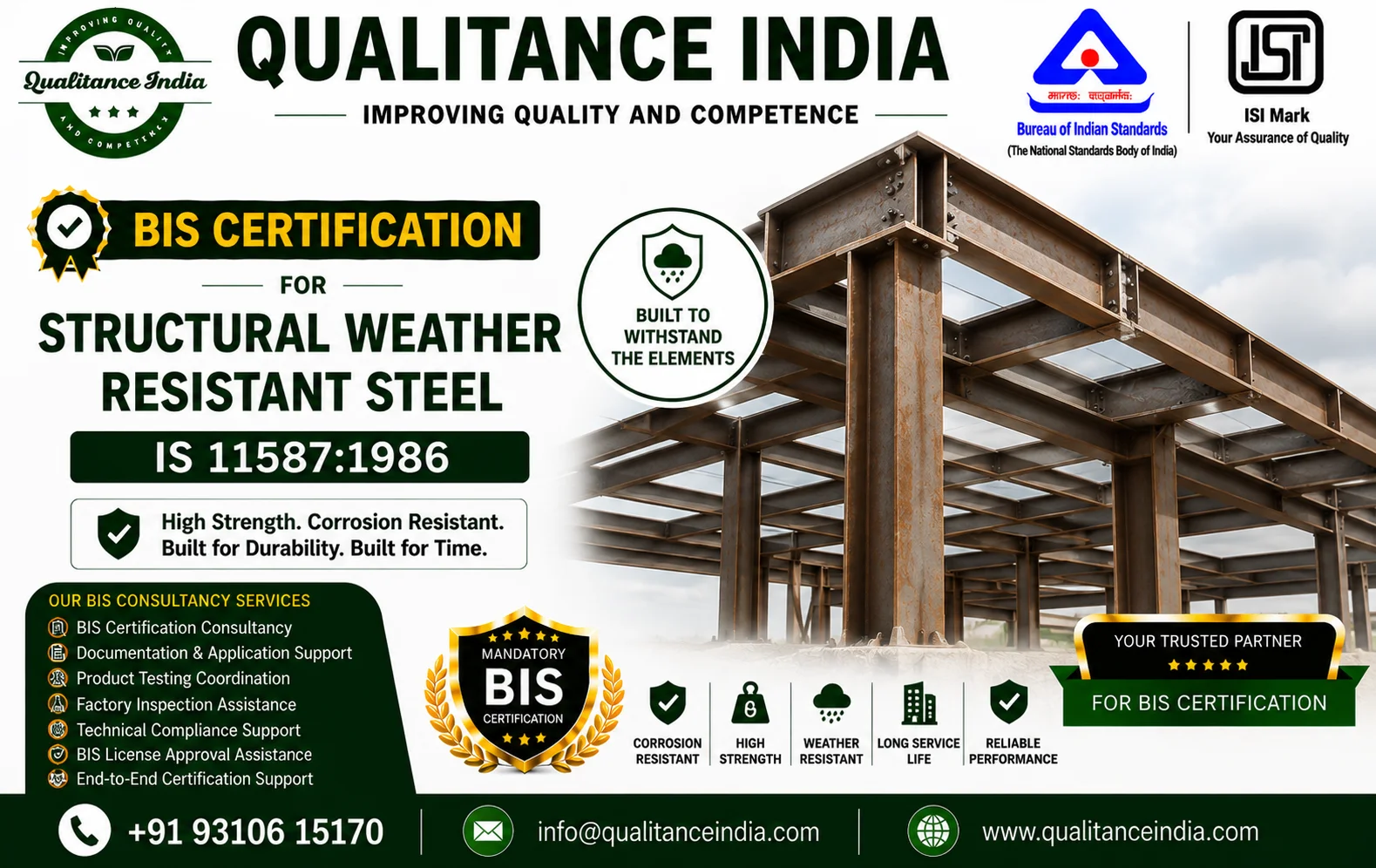
BIS Certification Consultancy for Structural Weather Resistant Steel | IS 11587:1986 | BIS & ISI Mark Certification
Introduction
Structural weather resistant steel is a type of high-strength low-alloy structural steel developed to provide improved resistance to atmospheric corrosion. It is intended for structural applications where steel is exposed to outdoor atmospheric conditions and where improved durability and reduced maintenance are important.
In India, IS 11587:1986 – Specification for Structural Weather Resistant Steel covers weather-resistant structural steels in the form of plates, sheets, strips, sections, bars and other specified forms. The standard is intended for welded, riveted or bolted construction requiring atmospheric corrosion resistance. BIS's technical summary explains that the standard addresses chemical composition, mechanical properties, dimensional requirements and bend-test requirements for the different product forms.
The current BIS Product Manual PM/11587/1, September 2022 provides certification guidance under Scheme-I of the BIS Conformity Assessment Regulations, 2018. It identifies the applicable grades, product forms, grouping guidelines, sample sizes, testing equipment and Scheme of Inspection and Testing.
IS 11587:1986 is also specifically included in the Steel and Steel Products (Quality Control) Order, 2024, where it is listed as Structural Weather Resistant Steel with implementation “With immediate effect.”
Qualitance India provides end-to-end BIS Certification Consultancy for Structural Weather Resistant Steel as per IS 11587:1986, including product assessment, grade and product-form review, grouping guidance, documentation, laboratory testing coordination, BIS application support and factory inspection preparation.
What is IS 11587:1986?
IS 11587:1986 is titled:
“Specification for Structural Weather Resistant Steel”
BIS's Product Manual identifies it as the applicable Indian Standard and records one amendment. The certification framework is operated under Scheme-I.
The standard provides requirements for weather-resistant structural steel used in construction where atmospheric corrosion resistance is required.
Important areas covered by the standard include:
- Chemical composition
- Weldability
- Tensile properties
- Yield strength
- Elongation
- Bend test
- Impact test
- Flattening test, where applicable
- Freedom from defects
- Dimensions
- Tolerances
- Mass
- Marking and packing
The BIS Product Manual identifies these requirements through its testing and inspection scheme.
What is Structural Weather Resistant Steel?
Structural weather resistant steel is steel developed to withstand atmospheric exposure better than conventional structural steel.
Its improved atmospheric corrosion resistance is achieved through controlled chemical composition and alloying. BIS's summary explains that the standard covers high-strength low-alloy weather-resistant structural steels for welded, riveted or bolted construction requiring atmospheric corrosion resistance.
The objective is to improve structural durability in environments where the steel is exposed to weather conditions.
Such steel may be considered for:
- Bridges
- Industrial structures
- Railway structures
- Outdoor steel frameworks
- Infrastructure projects
- Structural platforms
- Storage and material-handling structures
- Buildings and other exposed steel structures
The actual suitability depends on structural design, exposure conditions and project specifications.
Why is Weather Resistant Steel Used?
Atmospheric exposure can cause corrosion of structural steel.
Weather resistant steels are designed with controlled chemistry to provide improved resistance to atmospheric corrosion. This can help reduce corrosion-related deterioration and maintenance requirements in suitable applications.
The BIS technical summary specifically describes the purpose of IS 11587 as providing structural weather-resistant steel for applications requiring atmospheric corrosion resistance.
However, weather resistant steel should not automatically be considered corrosion-proof. The actual performance depends on exposure conditions, design, surface condition, drainage, detailing and environmental factors.
Scope of IS 11587:1986
The BIS Product Manual defines the licence scope using product grades, forms and sizes.
The grades identified in the Product Manual are:
- WR-Fe 480A
- WR-Fe 480B
- WR-Fe 490H
- WR-Fe 490C
- WR-Fe 500
The Product Manual identifies product forms including:
- Plate
- Sheet
- Strip
- Sections
- Bars
- Other applicable forms
It also requires the applicable shapes and nominal size range to be identified in the licence scope.
Grades of Structural Weather Resistant Steel
WR-Fe 480A
WR-Fe 480A is one of the grades identified under IS 11587:1986.
WR-Fe 480B
WR-Fe 480B is another grade included in the Product Manual's licence scope.
WR-Fe 490H
WR-Fe 490H is a higher-strength weather resistant steel grade covered by the standard.
The Product Manual notes a special condition for WR-Fe 490H steel sheet and strip below 3 mm thickness, where a tensile strength of 510 N/mm² or more may apply by agreement between the purchaser and manufacturer.
WR-Fe 490C
WR-Fe 490C is also included in the scope.
The inspection scheme specifically states that the bend test for this grade is optional and is to be performed only when specified by the purchaser.
WR-Fe 500
WR-Fe 500 is also identified in the Product Manual as part of the licence scope.
Is BIS Certification Mandatory for Structural Weather Resistant Steel?
Yes. Structural Weather Resistant Steel under IS 11587:1986 is covered by the compulsory BIS certification framework.
The Steel and Steel Products (Quality Control) Order, 2024 specifically lists:
IS 11587:1986 – Structural Weather resistant steel
and specifies:
Implementation: With immediate effect.
The current BIS Product Manual also provides certification guidance for IS 11587:1986 under Scheme-I.
Manufacturers supplying covered products in India should therefore ensure that their products meet the applicable BIS certification and QCO requirements.
Manufacturers should also verify the latest amendments, exemptions and government notifications before making a final regulatory determination.
Steel and Steel Products Quality Control Order, 2024
The 2024 Steel and Steel Products QCO specifically includes Structural Weather Resistant Steel under IS 11587:1986.
The QCO lists a wide range of ITC (HS) classifications associated with the product and specifies immediate implementation.
This makes BIS certification an important regulatory requirement for manufacturers supplying covered weather-resistant structural steel products.
The QCO framework also requires covered steel products to comply with their corresponding Indian Standards and applicable BIS certification provisions.
BIS Certification for Structural Weather Resistant Steel
BIS Certification demonstrates that a manufacturer's structural weather resistant steel has been assessed for conformity with the applicable requirements of IS 11587:1986.
The Product Manual confirms that certification is operated under Scheme-I of the BIS Conformity Assessment Regulations, 2018.
After successful conformity assessment and grant of the BIS licence, the manufacturer can use the applicable BIS Standard Mark / ISI Mark on covered products according to the licence conditions.
Who Needs BIS Certification for Weather Resistant Steel?
BIS certification is relevant to manufacturers producing Structural Weather Resistant Steel covered by IS 11587:1986.
This can include:
- Weather Resistant Steel Manufacturers
- Structural Steel Manufacturers
- Steel Plate Manufacturers
- Steel Sheet Manufacturers
- Steel Strip Manufacturers
- Structural Section Manufacturers
- Steel Bar Manufacturers
- High Strength Low Alloy Steel Manufacturers
- Engineering Steel Manufacturers
- Infrastructure Steel Manufacturers
- Steel Rolling Mills
- OEM Manufacturers
- Contract Manufacturers
Importers and other businesses dealing with covered steel products should separately verify their obligations under the applicable QCO.
BIS Certification Eligibility Requirements
A manufacturer seeking BIS certification should generally have suitable manufacturing, testing and quality-control facilities.
These may include:
- Steelmaking facilities, where applicable
- Casting facilities
- Rolling facilities
- Section/bar production facilities
- Heat-treatment or controlled cooling facilities, where applicable
- Cutting and finishing facilities
- Chemical-analysis laboratory
- Tensile-testing facility
- Bend-testing facility
- Impact-testing facility
- Dimensional inspection equipment
- Mass-measuring equipment
- Calibration system
- Quality-control personnel
- Production records
- Test records
- Heat/cast traceability
- Marking and packing arrangements
The exact facilities required depend on the grades and product forms included in the proposed BIS licence.
BIS Certification Process for Structural Weather Resistant Steel
Step 1 – Product Applicability Assessment
The manufacturer's product is assessed against IS 11587:1986.
The assessment includes:
- Grade
- Product form
- Shape
- Size
- Manufacturing process
- Intended use
- Proposed BIS licence scope
Step 2 – Grade Selection
The manufacturer identifies the required grade:
WR-Fe 480A / WR-Fe 480B / WR-Fe 490H / WR-Fe 490C / WR-Fe 500
Step 3 – Product Form Assessment
The manufacturer determines whether the proposed scope includes:
- Plates
- Sheets
- Strips
- Sections
- Bars
- Other applicable product forms
Step 4 – Product Grouping
Grouping is assessed according to the Product Manual's Annex A.
The Product Manual provides separate grouping categories for flat products, sections, hollow sections and bars.
Step 5 – Documentation Preparation
Technical, manufacturing and quality-control documentation is prepared.
Step 6 – Sample Preparation
The Product Manual specifies:
Mechanical testing sample: 1 metre
Chemical testing sample: five pieces of 50 mm × 50 mm or 100 g drilling.
Step 7 – Laboratory Testing
Representative samples are tested against the applicable requirements.
Step 8 – BIS Application
The manufacturer submits the BIS application with the required documents and supporting information.
Step 9 – Factory Assessment
BIS assesses manufacturing facilities, testing arrangements and quality-control systems.
Step 10 – Observation Closure
Any observations raised during assessment are addressed through corrective action and supporting records.
Step 11 – BIS Licence Grant
After successful conformity assessment, BIS grants the licence for the approved scope.
Step 12 – ISI Marking
The manufacturer can apply the Standard Mark to products covered by the approved licence.
Testing Requirements for IS 11587:1986
Testing is a critical part of BIS certification for weather resistant structural steel.
The BIS Product Manual identifies the following major tests:
- Chemical composition
- Weldability
- Tensile test
- Bend test
- Impact test
- Flattening test
- Freedom from defects
- Dimensions and tolerances
- Mass
The actual tests applicable to a product depend on its grade and product form.
Chemical Composition and Weldability
Chemical composition is one of the most important requirements of weather resistant steel.
BIS's technical summary states that IS 11587 specifies the chemical composition of the different grades and includes requirements related to weldability.
The Product Manual identifies chemical analysis for:
- Carbon
- Sulphur
- Silicon
- Manganese
- Phosphorus
- Chromium
- Nickel
- Copper
The exact limits depend on the applicable grade.
The laboratory equipment list includes instrumental methods such as:
- Atomic absorption spectrometry
- Inductively coupled plasma atomic emission
- Inductively coupled plasma mass spectrometry
- Spark source optical emission spectrometry
as well as established chemical methods.
Carbon
Carbon affects strength, hardness and weldability.
Because IS 11587 is intended for structural applications, carbon content has to be controlled along with other alloying elements.
The applicable carbon limit depends on the selected grade.
Silicon and Manganese
Silicon and manganese are important constituents of structural steel chemistry.
Their concentrations are controlled according to the specified grade to achieve the required balance of strength, toughness and weldability.
Sulphur and Phosphorus
Sulphur and phosphorus are controlled because excessive levels can adversely affect toughness, weldability and general steel quality.
The applicable limits must be checked against the relevant grade in IS 11587:1986.
Chromium, Nickel and Copper
Chromium, nickel and copper are particularly relevant to weather-resistant steel chemistry.
Controlled alloying contributes to the steel's atmospheric corrosion resistance and required structural properties.
The BIS Product Manual specifically identifies these elements in the chemical-analysis equipment and testing framework.
Tensile Test
Tensile testing is required to determine the mechanical properties of the structural steel.
The BIS Product Manual identifies:
Universal Testing Machine (UTM/TTM)
for tensile testing.
The test is carried out on:
1 sample per control unit.
Mechanical properties include requirements for:
- Yield strength
- Tensile strength
- Elongation
BIS's technical summary confirms that these mechanical properties are specified for the various forms of product.
Special Requirement for WR-Fe 490H
For WR-Fe 490H steel sheet and strip below 3 mm thickness, the BIS Product Manual specifies that a tensile strength of 510 N/mm² or over is applicable by agreement between the purchaser and manufacturer.
This is an important point for manufacturers supplying thin sheet or strip in this grade.
Bend Test
Bend testing evaluates the ductility and bending performance of the steel.
The Product Manual specifies:
1 sample per control unit for bend testing.
The BIS technical summary explains that the standard specifies bending angle and internal bend diameter for the various product forms.
For WR-Fe 490C, the Product Manual states that bend testing is optional and is performed only when specified by the purchaser.
Impact Test
Impact testing evaluates toughness under the specified test conditions.
The Product Manual requires:
3 samples per control unit
for the impact test.
For WR-Fe 480A and WR-Fe 480B, the impact test is carried out when agreed between the purchaser and manufacturer.
For WR-Fe 490H, the impact values and acceptance criteria are to be agreed between the contracting parties.
Therefore, manufacturers should clearly understand the applicable contractual and product requirements before testing.
Flattening Test
The Product Manual identifies flattening testing under Clause 11 and specifies:
1 sample per control unit.
The exact applicability depends on the relevant product form and standard requirements.
Freedom from Defects
The steel product must be appropriately controlled for defects.
The Product Manual specifies:
Each item – Each item
for freedom-from-defects inspection.
Inspection can include identifying unacceptable:
- Cracks
- Surface defects
- Laminations
- Other harmful discontinuities
The exact acceptance criteria should be taken from IS 11587:1986.
Dimensions and Tolerances
Dimensional accuracy is essential for structural steel because the finished material must match the requirements of structural design and fabrication.
The BIS Product Manual identifies dimensions and tolerances under Clauses 13 and 14 and references relevant standards including:
- IS 1852
- IS 12779
- IS 808
- IS 1173
- IS 1252
- IS 1730
- IS 1732
- IS 1863
- IS 2314
- IS 3954
- IS/ISO 16162
The inspection requirement is specified as adequate inspection.
Mass
Mass is also identified as a product characteristic.
The Product Manual specifies a weighing machine for mass determination.
Accurate mass and dimensional records are important for product identification and commercial as well as technical requirements.
Product Grouping for IS 11587:1986
Product grouping is important when a manufacturer wants to include multiple product forms, grades and sizes under a BIS licence.
The BIS Product Manual provides four major grouping categories.
Group 1 – Flat Products
This includes:
- Plates
- Sheets
- Strips
- Bulb flats
- Flat plate for ship-hull structure
- Other listed flat products
For flat products, one sample of any size/type can be drawn to cover all sizes/types being manufactured.
However, one sample from each grade is required to cover that grade.
Group 2 – Sections
This group includes products such as:
- Beams
- Columns
- Channels
- Angles
- Bulb angles
- Sheet-piling sections
- Track shoe sections
- Parallel beam and column sections
- Tee bars
- Other listed sections
One sample of any size/type of section can be drawn to cover all sizes/types being manufactured, while one sample from each grade is required to cover that grade.
Group 3 – Hollow Sections
For hollow sections, the Product Manual provides similar grouping based on one representative size/type and grade-specific testing.
Group 4 – Bars
This group includes:
- Round bars
- Square bars
One sample of any size and shape of bars can be drawn to cover all sizes and shapes being manufactured, while one sample from each grade is required to cover that grade.
The Product Manual further states that while granting or adding varieties, requisite manufacturing facilities and testing equipment must be available. During licence operation, samples of varieties covered by the licence are to be drawn for testing in rotation as far as possible.
Raw Material Requirements
The BIS Product Manual states:
Raw Material: No specific requirement.
This does not mean manufacturers can ignore raw-material control.
Manufacturers should maintain records covering:
- Raw-material source
- Heat/cast number
- Material certificate
- Incoming inspection
- Chemical composition
- Purchase records
- Traceability
- Production heat records
Such controls are essential for maintaining consistent steel chemistry and mechanical performance.
Manufacturing Process for Structural Weather Resistant Steel
A typical manufacturing process may include:
- Raw-material preparation
- Melting
- Chemical composition adjustment
- Refining
- Ladle analysis
- Casting
- Slab/billet preparation
- Reheating
- Rolling
- Controlled cooling, where applicable
- Cutting
- Finishing
- Dimensional inspection
- Chemical testing
- Mechanical testing
- Surface inspection
- Final inspection
- Packing
- Marking
The actual process depends on the manufacturer's technology and product form.
BIS Factory Inspection for Weather Resistant Steel
Factory assessment is an important part of BIS certification.
During factory inspection, BIS may examine:
Steelmaking and Casting
Where applicable, the manufacturer should demonstrate suitable process controls and traceability.
Rolling Facilities
Machinery used to manufacture plates, sheets, strips, sections or bars.
Finishing Facilities
Cutting, sizing, straightening and finishing operations.
Chemical Laboratory
Facilities for chemical analysis and weldability-related testing.
Mechanical Testing Laboratory
The Product Manual identifies a Universal Testing Machine for tensile testing, mandrels for bend tests, a Charpy impact tester for impact testing and UTM attachments for flattening tests.
Dimensional Inspection
The Product Manual identifies equipment including:
- Vernier caliper
- Micrometer
- Steel scale
- Try square
- Radius gauges
- Filler gauges
- Depth gauges
- Straight edges
- Magnetic V-block
- Angle protractor
- Inside and outside calipers
Mass Measurement
A weighing machine is identified for mass measurement.
Calibration
All applicable testing equipment and measuring instruments must be appropriately checked, verified and calibrated, with records maintained.
Quality Records
The manufacturer must maintain test records for tests carried out to establish conformity.
Scheme of Inspection and Testing
The BIS Product Manual includes a detailed Scheme of Inspection and Testing.
It requires:
- A suitably equipped and staffed laboratory
- Periodic checking and calibration of testing equipment
- Maintenance of test records
- Standard Marking
- Proper packing
- Control-unit identification
- Routine testing
- Proper treatment of non-conforming products
The Product Manual defines the control unit as:
The entire quantity of Structural Weather Resistant Steel of the same grade and form, manufactured from the same cast/heat under identical conditions in a day.
This definition is important for production planning and routine testing.
Routine Testing Requirements
The Product Manual identifies the following controls:
| Requirement | Sampling / Frequency |
|---|---|
| Ladle Analysis | One each heat for manufacturers with steelmaking facilities |
| Product Analysis | Applicable according to manufacturing route |
| Tensile Test | 1 sample every control unit |
| Bend Test | 1 sample every control unit |
| Impact Test | 3 samples every control unit |
| Flattening Test | 1 sample every control unit |
| Freedom from Defects | Each item |
| Dimensions & Tolerances | Adequate inspection |
The Product Manual also notes that the levels of control are recommendatory in nature and that a manufacturer may submit its own justified levels of control for approval by the Bureau.
Chemical Testing Frequency
For manufacturers with steelmaking facilities, the Product Manual identifies ladle analysis for each heat.
Product analysis requirements depend on the manufacturing arrangement:
- No product analysis requirement in the specified case for manufacturers with steelmaking facilities
- One product-analysis sample from each cast for manufacturers feeding rolling mills through reheating furnaces, subject to the note in the Product Manual
The Product Manual also provides an exception where product-analysis testing is not required if the material is ISI marked and received with a test certificate indicating conformity.
Test Certificate Requirements
The BIS Product Manual requires a test certificate for each consignment of BIS-certified Structural Weather Resistant Steel.
The test certificate should contain information including:
- Standard Mark
- Cast number
- Size
- Dimensions
- Corresponding test results
The Product Manual provides a sample test-certificate format in Annexure-I.
Non-Conforming Product Control
Manufacturers must maintain an effective system for handling rejected or non-conforming material.
The Product Manual requires rejected material that could otherwise be resold to be sheared, cut or deformed in a manner that prevents its use for another purpose except remelting, where applicable.
Separate records must be maintained for rejected or defective materials, including:
- Quantity
- Cast number
- Coil number
- Control-unit number
- Disposal method
Rejected material must not be stored together with conforming material, and any Standard Mark applied to rejected material must be defaced.
Testing Equipment for IS 11587:1986
The Product Manual's equipment list includes major facilities such as:
Chemical Analysis
- Spectrometer
- Atomic absorption equipment
- ICP equipment
- Carbon and sulphur analysis equipment
- Spectrophotometer
- Muffle furnace
- Hot-air oven
- Electronic balance
- Laboratory glassware and chemicals
Tensile Test
- Universal Testing Machine / Tensile Testing Machine
Bend Test
- Steel mandrels
- Bend-test templates
- UTM attachments
- Clamps or vice
- Magnifying glass
Impact Test
- Charpy impact tester
- Thermometer
- Specimen inspection equipment
- Deep freezer
Flattening Test
- UTM with flattening attachment
Defect and Dimensional Inspection
- Vernier caliper
- Micrometer
- Steel scale
- Try square
- Radius gauges
- Filler gauges
- Depth gauges
- Straight edges
- Magnetic V-block
- Protractor
- Inside/outside calipers
Mass
- Weighing machine
The Product Manual states that the equipment list is indicative only and not exhaustive.
Documents Required for BIS Certification
Typical documents may include:
- Company registration documents
- Factory address proof
- Factory layout
- Manufacturing process flow chart
- Machinery list
- Product specifications
- Grade details
- Product-form details
- Size range
- Product drawings
- Raw-material details
- Heat/cast records
- Material test certificates
- Supplier details
- Chemical-analysis records
- Testing equipment list
- Calibration certificates
- Quality Assurance Plan
- Inspection records
- Production records
- Test reports
- Product photographs
- Packing details
- Marking details
- Test certificate format
- Authorised signatory documents
- Trademark documents, where applicable
The final documentation requirements depend on the manufacturer, product scope and BIS application.
Marking Requirements
The BIS Product Manual specifies that the Standard Mark must be incorporated on the product and/or the Test Certificate accompanying each consignment, provided that the material conforms to IS 11587:1986.
The manufacturer must also follow the applicable requirements of IS 11587:1986 for marking and packing.
Product identification should support traceability through details such as:
- Grade
- Size
- Dimensions
- Cast number
- Product form
Common Reasons for BIS Certification Delays
Manufacturers may face delays because of:
- Incorrect grade selection
- Incorrect product form
- Incorrect size scope
- Incorrect grouping
- Chemical-composition failure
- Weldability-related non-conformity
- Tensile-strength failure
- Elongation failure
- Bend-test failure
- Impact-test failure
- Flattening-test failure
- Dimensional non-conformity
- Surface defects
- Inadequate laboratory facilities
- Missing calibration records
- Poor heat/cast traceability
- Incorrect sample selection
- Incomplete test records
- Factory not ready for inspection
- Incorrect BIS marking
- Documentation deficiencies
A technical review before the BIS application can help manufacturers identify these issues early.
BIS Certification Cost for Structural Weather Resistant Steel
There is no single fixed BIS certification cost applicable to every manufacturer.
The total cost may depend on:
- BIS application fees
- Laboratory testing
- Number of grades
- Product forms
- Size range
- Product grouping
- Number of representative samples
- Factory assessment
- Testing equipment
- Calibration
- Documentation
- Retesting, if required
- Consultancy charges
Current BIS LIMS information shows testing charges for IS 11587:1986.
One current BIS laboratory entry lists:
Mechanical testing: ₹5,600
Chemical parameters in Table 1: ₹8,600
excluding taxes.
These are laboratory-testing charges and not the complete BIS certification cost.
The final project cost should be calculated after reviewing the manufacturer's grade, product form, size range, laboratory scope and factory facilities.
BIS Certification Timeline
The certification timeline may vary depending on:
- Number of grades
- Product forms
- Size range
- Grouping
- Documentation readiness
- Sample preparation
- Laboratory availability
- Testing results
- BIS application scrutiny
- Factory readiness
- Factory assessment
- Observation closure
Manufacturers can reduce unnecessary delays by finalising their scope, testing strategy, documents and factory arrangements before submitting the BIS application.
Benefits of BIS Certification for Weather Resistant Steel
Regulatory Compliance
Helps manufacturers meet applicable BIS and Steel QCO requirements.
ISI Mark
Allows eligible manufacturers to use the BIS Standard Mark on products covered by the approved licence.
Better Corrosion Resistance
Weather-resistant steel is specifically designed for improved resistance to atmospheric corrosion.
Structural Applications
Conforming products are suitable for structural applications falling within the standard's scope.
Consistent Mechanical Properties
Chemical and mechanical testing helps establish consistent material quality.
Customer Confidence
BIS certification can improve confidence among structural steel buyers, contractors and infrastructure companies.
Market Acceptance
Certification supports legal market access where BIS certification is mandatory.
Better Quality Control
The BIS inspection scheme encourages systematic chemical, mechanical and dimensional control.
Why Choose Qualitance India?
Qualitance India provides professional BIS Certification Consultancy for manufacturers seeking BIS and ISI Mark certification.
For Structural Weather Resistant Steel as per IS 11587:1986, our consultancy support can include:
- Product applicability assessment
- IS 11587:1986 requirement review
- Grade assessment
- Product-form assessment
- Size and shape assessment
- Product grouping guidance
- Sample selection guidance
- Chemical testing coordination
- Mechanical testing coordination
- Documentation preparation
- BIS application assistance
- Factory inspection preparation
- Testing equipment guidance
- Quality-control documentation
- Observation closure support
- BIS licence assistance
Our support is designed to help manufacturers manage the certification process from product assessment through laboratory testing, BIS application, factory assessment and licence approval.
Contact Qualitance India
Phone: +91 93106 15170
Email: info@qualitanceindia.com
Website: qualitanceindia.com
BIS Certification Process – Quick Flow
Product Identification
↓
IS 11587:1986 Requirement Review
↓
Grade Selection
↓
Plate / Sheet / Strip / Section / Bar Assessment
↓
Size & Shape Assessment
↓
Product Grouping
↓
Documentation Preparation
↓
Representative Sample Preparation
↓
Chemical Composition Testing
↓
Tensile Testing
↓
Bend / Impact / Applicable Tests
↓
Dimensional & Defect Inspection
↓
BIS Application
↓
Application Scrutiny
↓
Factory Assessment
↓
Observation Closure
↓
BIS Licence Grant
↓
ISI Mark on Approved Weather Resistant Steel
Frequently Asked Questions
1. What is IS 11587:1986?
IS 11587:1986 is the Indian Standard titled Specification for Structural Weather Resistant Steel.
2. What is structural weather resistant steel?
It is high-strength low-alloy structural steel designed for improved resistance to atmospheric corrosion and intended for structural construction requiring weather resistance.
3. Is BIS certification mandatory for IS 11587 steel?
Yes. IS 11587:1986 is specifically listed in the Steel and Steel Products (Quality Control) Order, 2024, with implementation with immediate effect.
4. What grades are covered?
The BIS Product Manual identifies WR-Fe 480A, WR-Fe 480B, WR-Fe 490H, WR-Fe 490C and WR-Fe 500.
5. What product forms are covered?
The Product Manual identifies plate, sheet, strip, sections, bars and other applicable forms.
6. What is the BIS mechanical-test sample size?
The Product Manual specifies 1 metre for mechanical testing.
7. What is the chemical-test sample size?
The Product Manual specifies five pieces of 50 mm × 50 mm or 100 g drilling for chemical testing.
8. What are the main tests for Structural Weather Resistant Steel?
Important tests include chemical composition, weldability, tensile test, bend test, impact test, flattening test where applicable, freedom from defects, dimensions and tolerances and mass.
9. Is impact testing required for every grade?
The applicable requirement depends on the grade and agreement between purchaser and manufacturer. For WR-Fe 480A and WR-Fe 480B, the Product Manual states that impact testing is performed when agreed between the purchaser and manufacturer.
10. Is bend testing mandatory for WR-Fe 490C?
The Product Manual states that bend testing for WR-Fe 490C is optional and is performed only when specified by the purchaser.
11. What is special about WR-Fe 490H below 3 mm?
For WR-Fe 490H steel sheet and strip below 3 mm thickness, the Product Manual states that tensile strength of 510 N/mm² or above applies by agreement between purchaser and manufacturer.
12. What is the control unit for IS 11587?
The control unit is the entire quantity of Structural Weather Resistant Steel of the same grade and form made from the same cast/heat under identical conditions in a day.
13. Is product grouping available?
Yes. The Product Manual provides grouping guidelines for flat products, sections, hollow sections and bars.
14. Is factory inspection required?
Yes. Factory assessment forms part of the BIS Scheme-I certification process.
15. What testing equipment is required?
The Product Manual identifies equipment such as UTM, bend-test mandrels, Charpy impact tester, chemical-analysis equipment, dimensional gauges and weighing equipment.
16. Is a test certificate required?
Yes. The Product Manual requires a test certificate for each consignment of BIS-certified Structural Weather Resistant Steel containing the Standard Mark, cast number, size, dimensions and corresponding test results.
17. What are the current BIS laboratory charges?
One current BIS laboratory listing shows ₹5,600 for mechanical testing and ₹8,600 for chemical parameters, excluding taxes.
18. How much does complete BIS certification cost?
The complete cost depends on the product scope, grades, product forms, testing, BIS application, factory assessment, equipment, documentation and consultancy.
19. How long does BIS certification take?
The timeline depends on the product scope, testing, documentation, application scrutiny, factory assessment and closure of observations.
20. Can Qualitance India help with IS 11587:1986 certification?
Yes. Qualitance India provides product assessment, grade and scope guidance, documentation, laboratory testing coordination, BIS application support and factory inspection preparation.
People Also Ask
What is BIS certification for Structural Weather Resistant Steel?
BIS certification for Structural Weather Resistant Steel is the conformity-assessment process for demonstrating compliance with IS 11587:1986 under the BIS Scheme-I framework.
Is IS 11587:1986 under a QCO?
Yes. IS 11587:1986 is specifically included in the Steel and Steel Products (Quality Control) Order, 2024.
What is the BIS standard for weather resistant steel?
The applicable Indian Standard is IS 11587:1986 – Specification for Structural Weather Resistant Steel.
What grades are available under IS 11587?
The BIS Product Manual identifies WR-Fe 480A, WR-Fe 480B, WR-Fe 490H, WR-Fe 490C and WR-Fe 500.
What products are covered under IS 11587?
Plates, sheets, strips, sections, bars and other applicable forms are included in the Product Manual's licence scope.
What tests are performed on weather resistant steel?
Testing includes chemical composition, weldability, tensile properties, bend test, impact test, flattening where applicable, freedom from defects, dimensions and mass.
What is the purpose of weather resistant steel?
It is intended for structural applications requiring improved resistance to atmospheric corrosion.
How do I get an ISI Mark for weather resistant steel?
A manufacturer must obtain the applicable BIS licence for IS 11587:1986 and comply with BIS requirements for testing, marking, inspection and continuing conformity.
Frequently Searched Keywords
- BIS Certification for Structural Weather Resistant Steel
- BIS Certification for Weather Resistant Steel
- IS 11587:1986 Certification
- BIS Licence for Weather Resistant Steel
- IS 11587 BIS Certification
- Structural Weather Resistant Steel BIS Licence
- Weather Resistant Steel Testing
- Weather Resistant Steel QCO
- Steel QCO 2024 IS 11587
- WR-Fe 480A BIS Certification
- WR-Fe 480B BIS Certification
- WR-Fe 490H BIS Certification
- WR-Fe 490C BIS Certification
- WR-Fe 500 BIS Certification
- BIS Certification Consultancy
- BIS Consultant for Structural Steel
- ISI Mark for Weather Resistant Steel
Related BIS Certification Services
- BIS Certification for Fire Resistant Steel – IS 15103:2002
- BIS Certification for Structural Steel – IS 2062
- BIS Certification for Steel with Improved Seismic Resistance – IS 15962:2012
- BIS Certification for Galvanized Structural Steel – IS 16732:2019
- BIS Certification for Steel Plates
- BIS Certification for Steel Sections
- BIS Certification for Steel Bars
- BIS Certification for Special Steel Products
- BIS Certification for High Strength Steel
- BIS & ISI Mark Certification
- BIS Factory Inspection Assistance
- BIS Testing Coordination
Conclusion
IS 11587:1986 – Specification for Structural Weather Resistant Steel establishes requirements for high-strength low-alloy weather-resistant structural steels intended for applications where improved atmospheric corrosion resistance is required. BIS's technical summary confirms that the standard covers plates, sheets, strips, sections and bars and specifies requirements for chemical composition, mechanical properties, dimensions and bend performance.
The current BIS Product Manual identifies the grades WR-Fe 480A, WR-Fe 480B, WR-Fe 490H, WR-Fe 490C and WR-Fe 500 and provides product-grouping guidance for flat products, sections, hollow sections and bars.
IS 11587:1986 is specifically listed under the Steel and Steel Products (Quality Control) Order, 2024, with immediate-effect implementation. This makes BIS compliance an important requirement for manufacturers supplying covered structural weather resistant steel products in India.
Manufacturers should pay particular attention to grade selection, product form, grouping, chemical composition, weldability, tensile strength, bend and impact requirements, dimensions, defect inspection, heat/cast traceability, testing facilities, calibration and test certificates.
The BIS Product Manual specifies a 1-metre mechanical-test sample and five 50 mm × 50 mm pieces or 100 g drilling for chemical testing, together with detailed requirements for routine testing and quality control.
Current BIS LIMS information also shows separate laboratory charges for mechanical and chemical testing of IS 11587:1986; one listed laboratory currently shows ₹5,600 for mechanical testing and ₹8,600 for chemical parameters, excluding taxes.
Qualitance India provides end-to-end BIS Certification Consultancy for Structural Weather Resistant Steel as per IS 11587:1986, including product assessment, grade and product-form review, product grouping, documentation, laboratory testing coordination, BIS application support and factory inspection preparation.
For BIS Certification and ISI Mark Consultancy for Structural Weather Resistant Steel, contact Qualitance India today.
Phone: +91 93106 15170
Email: info@qualitanceindia.com
Website: qualitanceindia.com