
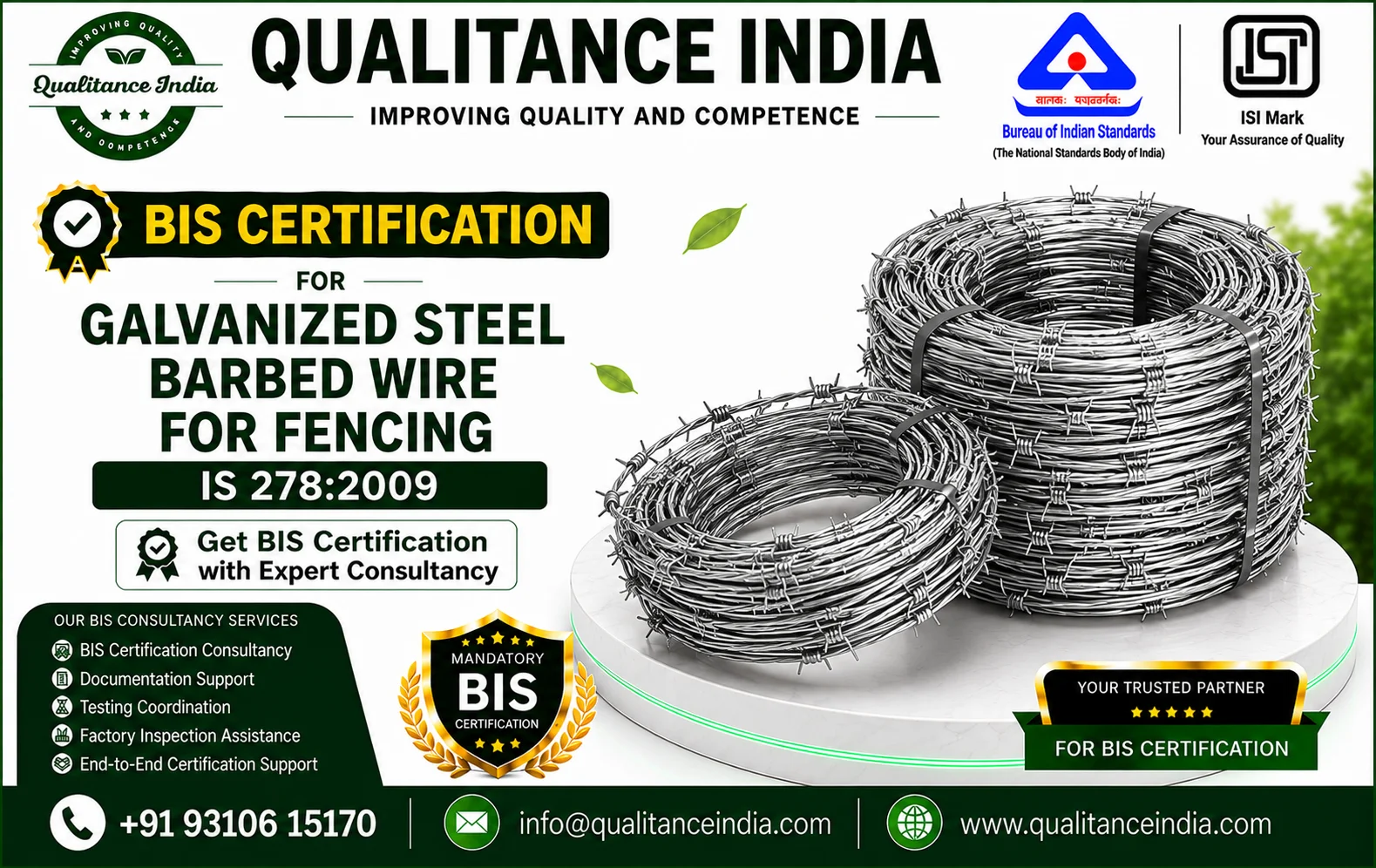
BIS Certification Consultancy for Galvanized Steel Barbed Wire for Fencing | IS 278:2009 | BIS & ISI Mark Certification
Introduction
Galvanized steel barbed wire is widely used for fencing agricultural land, industrial premises, warehouses, construction sites, railway boundaries, government properties and other areas where controlled access and perimeter protection are required. The quality of the wire, diameter, barb dimensions, zinc coating, tensile strength, construction and workmanship directly affect the durability and performance of the fencing material.
In India, IS 278:2009 – Galvanized Steel Barbed Wire for Fencing – Specification (Fourth Revision) specifies requirements for galvanized steel barbed wire used for fencing. The BIS Product Manual provides guidance for certification under Scheme-I and is also intended for prospective manufacturers seeking a BIS licence.
IS 278:2009 is included in the current BIS compulsory certification framework under the Steel Wires or Strands, Nylon or Wire Ropes and Wire Mesh (Quality Control) Order, 2023. The BIS Scheme-I listing specifically identifies IS 278:2009 – Galvanized Steel Barbed Wire for Fencing under this category.
Qualitance India provides end-to-end BIS Certification Consultancy for Galvanized Steel Barbed Wire for Fencing as per IS 278:2009, including product scope assessment, documentation, sample preparation guidance, laboratory testing coordination, BIS application support and factory inspection preparation.
What is IS 278:2009?
IS 278:2009 is titled:
“Galvanized Steel Barbed Wire for Fencing – Specification (Fourth Revision)”
The standard specifies requirements for galvanized steel barbed wire used for fencing applications.
The BIS Product Manual identifies the product under Scheme-I and provides requirements relating to:
- Product type
- Size designation
- Protective coating
- Raw material
- Manufacturing
- Dimensions
- Barb construction
- Workmanship
- Tensile strength
- Breaking load
- Zinc coating
- Ductility
- Packing
- Marking
What is Galvanized Steel Barbed Wire?
Galvanized steel barbed wire is fencing wire manufactured using steel wire and provided with a zinc coating for corrosion protection. Sharp barbs are incorporated at specified intervals to create a physical barrier around the protected area.
Barbed wire generally consists of:
- Line wire
- Point wire
- Barbs
- Zinc coating
- Protective treatment, where applicable
The final product must comply with the applicable dimensional, mechanical and coating requirements of IS 278:2009.
Types of Barbed Wire Covered Under IS 278:2009
The BIS Product Manual identifies two product types:
Type A – Iowa Type
Type A is identified as the Iowa Type of galvanized steel barbed wire.
Type B – Glidden Type
Type B is identified as the Glidden Type of galvanized steel barbed wire.
A manufacturer should correctly identify the product type before selecting samples and finalising the BIS licence scope.
Size Designations under IS 278:2009
The BIS Product Manual identifies the following size designations:
1 / 2 / 3 / 4 / 5 / 6
The applicable requirements include dimensions such as:
- Diameter of line wire
- Diameter of point wire
- Mass of completed barbed wire
- Distance between two barbs
- Number of lays between consecutive barbs
Because the licence scope can depend on product type and size designation, manufacturers should determine the required scope before testing.
Protective Coating for Barbed Wire
Galvanizing is an important part of barbed wire quality because the zinc coating helps protect the steel wire from corrosion.
The BIS Product Manual identifies the protective coating as:
With or without Chromating.
The applicable coating requirements include:
- Mass of zinc coating on line wire
- Mass of zinc coating on point wire
- Uniformity of zinc coating
- Ductility and related coating performance
Is BIS Certification Mandatory for Galvanized Steel Barbed Wire?
Yes. Galvanized Steel Barbed Wire for Fencing under IS 278:2009 is included in the BIS compulsory certification framework.
The Steel Wires or Strands, Nylon or Wire Ropes and Wire Mesh Quality Control Order, 2023 specifically lists:
IS 278:2009 – Galvanized Steel Barbed Wire for Fencing
The Order makes BIS the certifying and enforcing authority for the listed products and requires covered goods to conform to the applicable Indian Standard and bear the Standard Mark under a BIS licence, subject to the provisions of the Order.
The current BIS Scheme-I page continues to list IS 278:2009 under this compulsory certification framework.
Manufacturers should verify the latest QCO amendments and applicable exemptions before taking a final regulatory decision.
BIS Certification for Barbed Wire
BIS Certification is the conformity assessment process through which a manufacturer demonstrates that its galvanized steel barbed wire complies with the applicable requirements of IS 278:2009.
The BIS Product Manual confirms that certification is operated under Scheme-I of the BIS Conformity Assessment Regulations, 2018.
After the BIS licence is granted, the manufacturer can use the BIS Standard Mark / ISI Mark on products covered by the approved licence scope and subject to applicable marking requirements.
Who Needs BIS Certification for Barbed Wire?
BIS certification is relevant to manufacturers producing galvanized steel barbed wire covered by IS 278:2009.
This can include:
- Galvanized Barbed Wire Manufacturers
- Steel Barbed Wire Manufacturers
- Fencing Wire Manufacturers
- Industrial Fencing Product Manufacturers
- Agricultural Fencing Manufacturers
- Boundary Fencing Manufacturers
- Security Fencing Manufacturers
- Steel Wire Manufacturers
- Metal Fencing Product Manufacturers
- OEM Manufacturers
- Contract Manufacturers
Importers and other businesses dealing with covered products should independently verify their obligations under the applicable QCO and BIS framework.
BIS Certification Eligibility Requirements
A manufacturer applying for BIS certification should have suitable manufacturing and quality-control arrangements.
These may include:
- Manufacturing premises
- Wire drawing machinery
- Galvanizing facilities
- Barbed wire manufacturing machinery
- Raw-material storage
- Product drawings and specifications
- Quality-control procedures
- Testing and measuring equipment
- Calibration arrangements
- Trained quality-control personnel
- Production records
- Testing records
- Product identification system
- Packing and marking arrangements
The exact requirements depend on the manufacturer's product type, size designation and proposed licence scope.
BIS Certification Process for Galvanized Steel Barbed Wire
Step 1 – Product Applicability Assessment
The product is first reviewed against IS 278:2009 to confirm its applicability.
The assessment generally includes:
- Type A or Type B
- Size designation
- Line wire diameter
- Point wire diameter
- Barb dimensions
- Coating
- Manufacturing process
Step 2 – Product Scope Finalisation
The proposed BIS licence scope is determined based on the applicable product type and size designation.
The Product Manual identifies:
Type: Type A / Type B Size Designation: 1 / 2 / 3 / 4 / 5 / 6 Protective Coating: With or without Chromating
Step 3 – Raw Material Assessment
The BIS Product Manual identifies mild steel wire conforming to IS 280 as the product raw material.
The manufacturer should maintain proper raw-material specifications and traceability.
Step 4 – Documentation Preparation
Technical, factory and quality-control documents are prepared.
Step 5 – Sample Preparation
The BIS Product Manual specifies:
Chemical tests: 50 grams or 5 cm × 5 specimens
Remaining tests: 3 metres
Representative samples should be selected according to the intended licence scope.
Step 6 – Laboratory Testing
Samples are tested against the applicable requirements of IS 278:2009.
Step 7 – BIS Application
The manufacturer submits the BIS application with the required documents and test information.
Step 8 – Factory Assessment
BIS assesses the manufacturing facility, machinery, testing arrangements and quality-control system.
Step 9 – Observation Closure
If observations are raised, the manufacturer takes corrective action and submits the required evidence.
Step 10 – BIS Licence Grant
After successful conformity assessment, BIS grants the licence for the approved product scope.
Step 11 – ISI Marking
The manufacturer can mark compliant barbed wire according to the applicable BIS Standard Mark requirements and licence conditions.
Testing Requirements for Barbed Wire
Testing is an important part of BIS certification for galvanized steel barbed wire.
The current BIS LIMS listings identify testing requirements for IS 278:2009 covering dimensional, manufacturing, mechanical and coating characteristics.
Diameter of Line Wire
The diameter of the line wire is checked according to the applicable size designation.
Diameter of Point Wire
The point wire diameter is verified.
Mass of Completed Barbed Wire
The mass of the finished barbed wire is checked against the applicable requirements.
Distance Between Barbs
The distance between consecutive barbs is measured.
Number of Lays
The number of lays between consecutive barbs is checked.
Manufacture
The manufacturing requirements of the barbed wire are examined.
Cut Angle of Barbs
The cut angle of the barbs is checked where applicable.
Length of Barbs
The length of the barbs is measured.
Finishing of Barbs
The finishing and construction of the barbs are examined.
Freedom from Defects
The finished product is checked for defects that could affect its performance or usability.
Tensile Strength
The tensile strength of the applicable wire is tested.
Breaking Load
Breaking load is evaluated according to the applicable requirements.
Mass of Zinc Coating
The mass of zinc coating is checked separately for:
- Line wire
- Point wire
Uniformity of Zinc Coating
The uniformity of the zinc coating is tested.
Ductility
The ductility of the applicable galvanized wire is evaluated.
Chemical Composition
The raw material is evaluated for the specified chemical composition where applicable. BIS LIMS identifies tests referring to the relevant provisions of IS 7887 for chemical elements.
Raw Material Requirements
The BIS Product Manual identifies Mild Steel Wire – IS 280 as the product raw material for IS 278:2009.
Manufacturers should maintain records for:
- Raw-material grade
- Supplier details
- Purchase records
- Material test certificates
- Incoming inspection
- Batch identification
- Material traceability
Good raw-material control helps maintain consistent diameter, mechanical properties and coating performance in the finished barbed wire.
Manufacturing Process for Galvanized Steel Barbed Wire
A typical manufacturing process may include:
- Raw-material receiving
- Wire inspection
- Wire drawing or sizing
- Galvanizing
- Surface treatment
- Chromating, where applicable
- Barbed wire formation
- Barb formation
- Dimensional inspection
- Zinc coating inspection
- Tensile and mechanical testing
- Final inspection
- Packing
- Marking
The exact production process may vary according to the manufacturer's machinery and technology.
The manufacturer should maintain suitable process controls throughout production.
BIS Factory Inspection for Barbed Wire
Factory assessment is an important part of the BIS Scheme-I certification process.
During inspection, BIS may assess:
Wire Manufacturing Machinery
Machinery used for wire drawing, sizing and preparation.
Galvanizing Facility
Equipment and process controls for applying the zinc coating.
Barbed Wire Manufacturing Machinery
Machinery used for twisting line wires and producing barbs.
Raw Material Storage
Proper storage and traceability of steel wire.
Production Process
Controls maintained at each stage.
Testing Facilities
Availability of appropriate testing and measuring equipment.
Calibration
Calibration status of applicable instruments and testing equipment.
Quality Control
Incoming, in-process and final inspection systems.
Records
Production and test records demonstrating conformity.
Product Identification
Proper identification of product type and size designation.
BIS Marking
Arrangements for Standard Marking after grant of the BIS licence.
Testing Equipment for IS 278:2009
The BIS Product Manual provides a list of test equipment for the standard and refers manufacturers to its equipment annexure.
Depending on the applicable testing requirements, facilities may include equipment for:
- Diameter measurement
- Mass measurement
- Length measurement
- Barb measurement
- Tensile testing
- Breaking-load testing
- Zinc-coating measurement
- Ductility testing
- Chemical analysis
- Visual inspection
The exact equipment requirement should be confirmed against the latest applicable BIS Product Manual and licence scope.
Product Grouping for Barbed Wire
Product grouping is important when a manufacturer produces different barbed-wire types and sizes.
The BIS Product Manual provides grouping guidance in Annex A and identifies licence scope through:
- Product Type
- Size Designation
- Protective Coating
Because Type A, Type B and different size designations can affect the proposed licence scope, manufacturers should finalise the grouping before laboratory testing.
Proper grouping can help avoid unnecessary sample testing and certification delays.
Packing and Marking Requirements
Packing and marking are important parts of BIS compliance.
The finished product should be properly identified according to the applicable requirements of IS 278:2009.
The BIS Product Manual specifically identifies marking as part of the certification requirements, and BIS LIMS lists marking under the applicable testing scope.
The manufacturer should ensure that the product and packaging carry the required information and Standard Mark according to the BIS licence conditions.
Common Reasons for BIS Certification Delays
Manufacturers may experience delays because of:
- Incorrect product type
- Incorrect size designation
- Incorrect wire diameter
- Incorrect barb dimensions
- Poor barb finishing
- Incorrect raw material
- Inadequate galvanizing
- Zinc-coating failure
- Tensile-strength failure
- Breaking-load failure
- Ductility failure
- Dimensional non-conformity
- Inadequate testing equipment
- Missing calibration records
- Incomplete production records
- Incorrect product grouping
- Incorrect samples
- Factory not ready for assessment
- Documentation deficiencies
- Incorrect BIS marking
A technical review before filing the BIS application can help reduce avoidable delays.
BIS Certification Cost for Barbed Wire
There is no single fixed BIS certification cost applicable to every manufacturer.
The total cost can depend on:
- BIS application fees
- Laboratory testing charges
- Product type
- Size designation
- Coating arrangement
- Number of samples
- Factory assessment
- Testing equipment
- Calibration
- Documentation
- Retesting, if required
- Consultancy charges
BIS LIMS currently lists multiple laboratory entries for IS 278:2009 with different charges. For example, current listings show charges such as ₹4,100, ₹4,200, ₹4,500, ₹6,000, ₹9,500 and ₹19,500, depending on the laboratory and testing scope.
These are laboratory testing charges only and should not be treated as the complete BIS certification cost.
For an accurate quotation, the manufacturer's product type, size designation, coating and manufacturing details should be reviewed first.
BIS Certification Timeline
The certification timeline can vary depending on:
- Product type
- Size designation
- Product grouping
- Documentation readiness
- Sample availability
- Laboratory testing
- Test results
- BIS application scrutiny
- Factory readiness
- Factory assessment
- Observation closure
Manufacturers can reduce unnecessary delays by finalising the product scope, samples, documents and testing facilities before starting the application.
Benefits of BIS Certification for Galvanized Steel Barbed Wire
Regulatory Compliance
Helps manufacturers meet applicable BIS and QCO requirements.
ISI Mark
Allows eligible manufacturers to use the BIS Standard Mark on products covered by the approved licence.
Consistent Product Quality
Testing helps maintain uniform dimensional, mechanical and coating characteristics.
Corrosion Protection
Proper zinc-coating requirements support the protective performance of galvanized wire.
Customer Confidence
BIS certification can strengthen buyer confidence in the quality and conformity of the fencing product.
Market Acceptance
Certification supports legal market access where BIS certification is mandatory.
Better Quality Control
Regular inspection and testing encourage systematic manufacturing controls.
Business Credibility
A valid BIS licence can improve credibility with fencing contractors, industrial buyers, distributors and institutional customers.
Why Choose Qualitance India?
Qualitance India provides professional BIS Certification Consultancy for manufacturers seeking BIS and ISI Mark certification.
For Galvanized Steel Barbed Wire for Fencing as per IS 278:2009, our consultancy support can include:
- Product applicability assessment
- IS 278:2009 requirement review
- Type A / Type B assessment
- Size designation assessment
- Product grouping guidance
- Raw-material assessment
- Documentation preparation
- Sample selection guidance
- Laboratory testing coordination
- BIS application assistance
- Factory inspection preparation
- Testing equipment guidance
- Quality-control documentation
- Observation closure support
- BIS licence assistance
Our support is designed to help manufacturers manage the certification process from product assessment and testing through BIS application, factory assessment and licence approval.
Contact Qualitance India
Phone: +91 93106 15170 Email: info@qualitanceindia.com Website: qualitanceindia.com
BIS Certification Process – Quick Flow
Product Identification ↓ IS 278:2009 Requirement Review ↓ Type A / Type B Assessment ↓ Size Designation Finalisation ↓ Coating Assessment ↓ Product Grouping ↓ Documentation Preparation ↓ Sample Preparation ↓ Laboratory Testing ↓ BIS Application ↓ Application Scrutiny ↓ Factory Assessment ↓ Observation Closure ↓ BIS Licence Grant ↓ ISI Mark on Approved Barbed Wire
Frequently Asked Questions
1. What is IS 278:2009?
IS 278:2009 is the Indian Standard for Galvanized Steel Barbed Wire for Fencing – Specification (Fourth Revision).
2. Is BIS certification mandatory for galvanized steel barbed wire?
Yes. IS 278:2009 is included in the BIS compulsory certification framework under the applicable Steel Wires or Strands, Nylon or Wire Ropes and Wire Mesh Quality Control Order.
3. What types of barbed wire are covered?
The BIS Product Manual identifies Type A (Iowa Type) and Type B (Glidden Type).
4. What size designations are covered under IS 278:2009?
The Product Manual identifies size designations 1, 2, 3, 4, 5 and 6.
5. Is chromating covered under IS 278:2009?
Yes. The BIS Product Manual identifies protective coating as with or without Chromating.
6. What raw material is required?
The BIS Product Manual identifies Mild Steel Wire – IS 280 as the product raw material.
7. What is the BIS sample requirement?
For chemical testing, the Product Manual specifies 50 grams or 5 cm × 5 specimens, while for remaining tests the sample size is 3 metres.
8. What tests are required for galvanized steel barbed wire?
Testing can include wire and barb dimensions, manufacturing, workmanship, tensile strength, breaking load, zinc coating mass, coating uniformity, ductility and applicable chemical composition.
9. Is factory inspection required?
Yes. Factory assessment forms part of the BIS Scheme-I certification process.
10. What documents are required for BIS certification?
Typical documents include factory details, machinery information, manufacturing process, product specifications, raw-material records, testing arrangements, calibration records and quality-control documents.
11. What is the BIS Standard Mark for barbed wire?
The BIS Standard Mark, commonly known as the ISI Mark, is applied to products covered under an appropriate BIS licence and subject to the applicable marking requirements.
12. How much does BIS certification for barbed wire cost?
The total cost depends on the product type, size designation, testing, BIS application, factory assessment, equipment, documentation and other applicable expenses. Laboratory charges vary between BIS-recognised testing facilities.
13. How long does BIS certification take?
The timeline depends on product scope, documentation, sample testing, BIS application scrutiny, factory assessment and closure of observations.
14. Can different sizes of barbed wire be included in one BIS licence?
Product grouping and licence scope depend on the applicable type, size designation and BIS grouping requirements.
15. Can Qualitance India help with IS 278:2009 certification?
Yes. Qualitance India provides support for product assessment, documentation, sample selection, laboratory testing coordination, BIS application and factory inspection preparation.
People Also Ask
What is BIS certification for barbed wire?
BIS certification for barbed wire is the conformity assessment process for demonstrating compliance with IS 278:2009 – Galvanized Steel Barbed Wire for Fencing.
Is IS 278:2009 under a QCO?
Yes. IS 278:2009 is specifically listed under the Steel Wires or Strands, Nylon or Wire Ropes and Wire Mesh (Quality Control) Order, 2023.
What is the BIS standard for galvanized steel barbed wire?
The applicable Indian Standard is IS 278:2009 – Galvanized Steel Barbed Wire for Fencing – Specification.
What are Type A and Type B barbed wire?
Type A is identified as Iowa Type, while Type B is identified as Glidden Type under the BIS Product Manual.
What sizes of barbed wire are covered?
Size designations 1 through 6 are identified in the BIS Product Manual.
What is tested for galvanized barbed wire?
Important tests include dimensions, barb construction, tensile strength, breaking load, zinc coating, coating uniformity, ductility and applicable chemical composition.
How do I get an ISI Mark for barbed wire?
A manufacturer must obtain the applicable BIS licence for IS 278:2009 and comply with BIS requirements for Standard Marking and ongoing conformity.
Related BIS Certification Services
- BIS Certification for Galvanized Steel Wire for Fencing
- BIS Certification for Steel Wires
- BIS Certification for Steel Wire Ropes
- BIS Certification for Galvanized Stay Strands
- BIS Certification for Wire Mesh
- BIS Certification for Chain Link Fencing
- BIS Certification for Steel Products
- BIS & ISI Mark Certification
- BIS Factory Inspection Assistance
- BIS Testing Coordination
- BIS Certification Consultancy
Conclusion
IS 278:2009 – Galvanized Steel Barbed Wire for Fencing establishes important requirements relating to the type, size, manufacture, barb dimensions, workmanship, tensile strength, zinc coating and ductility of galvanized steel barbed wire.
The BIS Product Manual identifies Type A (Iowa Type) and Type B (Glidden Type), size designations 1 to 6, and protective coating arrangements with or without Chromating. It also specifies Mild Steel Wire conforming to IS 280 as the product raw material and provides sample and testing guidance under the BIS certification framework.
IS 278:2009 is included in the Steel Wires or Strands, Nylon or Wire Ropes and Wire Mesh (Quality Control) Order, 2023, and the current BIS Scheme-I listing identifies the standard under the compulsory certification framework.
Manufacturers should therefore carefully finalise the product type, size designation, coating arrangement, raw material, testing facilities, quality-control system and proposed licence scope before applying for BIS certification.
Qualitance India provides end-to-end BIS Certification Consultancy for Galvanized Steel Barbed Wire for Fencing as per IS 278:2009, including product assessment, scope and grouping guidance, documentation, sample preparation, laboratory testing coordination, BIS application support and factory inspection preparation.
For BIS Certification and ISI Mark Consultancy for Galvanized Steel Barbed Wire, contact Qualitance India today.
Phone: +91 93106 15170 Email: info@qualitanceindia.com Website: qualitanceindia.com