BIS Certification for Split Air Conditioners | IS 1391 (Part 2):2018 | BIS Certification Consultancy
Introduction
Split Air Conditioners are widely used in residential, commercial and other buildings for maintaining comfortable indoor temperature. A typical split air conditioner consists of an indoor unit, outdoor unit, compressor, heat exchanger, fan, refrigerant circuit, electrical controls and other components.
For manufacturers of Split Air Conditioners in India, compliance with the applicable Indian Standard is an important requirement. IS 1391 (Part 2):2018 – Room Air Conditioners – Specification, Part 2: Split Air Conditioners specifies requirements applicable to split air conditioners.
BIS has included IS 1391 (Part 2):2018 in its compulsory product certification framework. The applicable Quality Control Order also identifies Room Air Conditioners – Split Air Conditioners against IS 1391 (Part 2):2018.
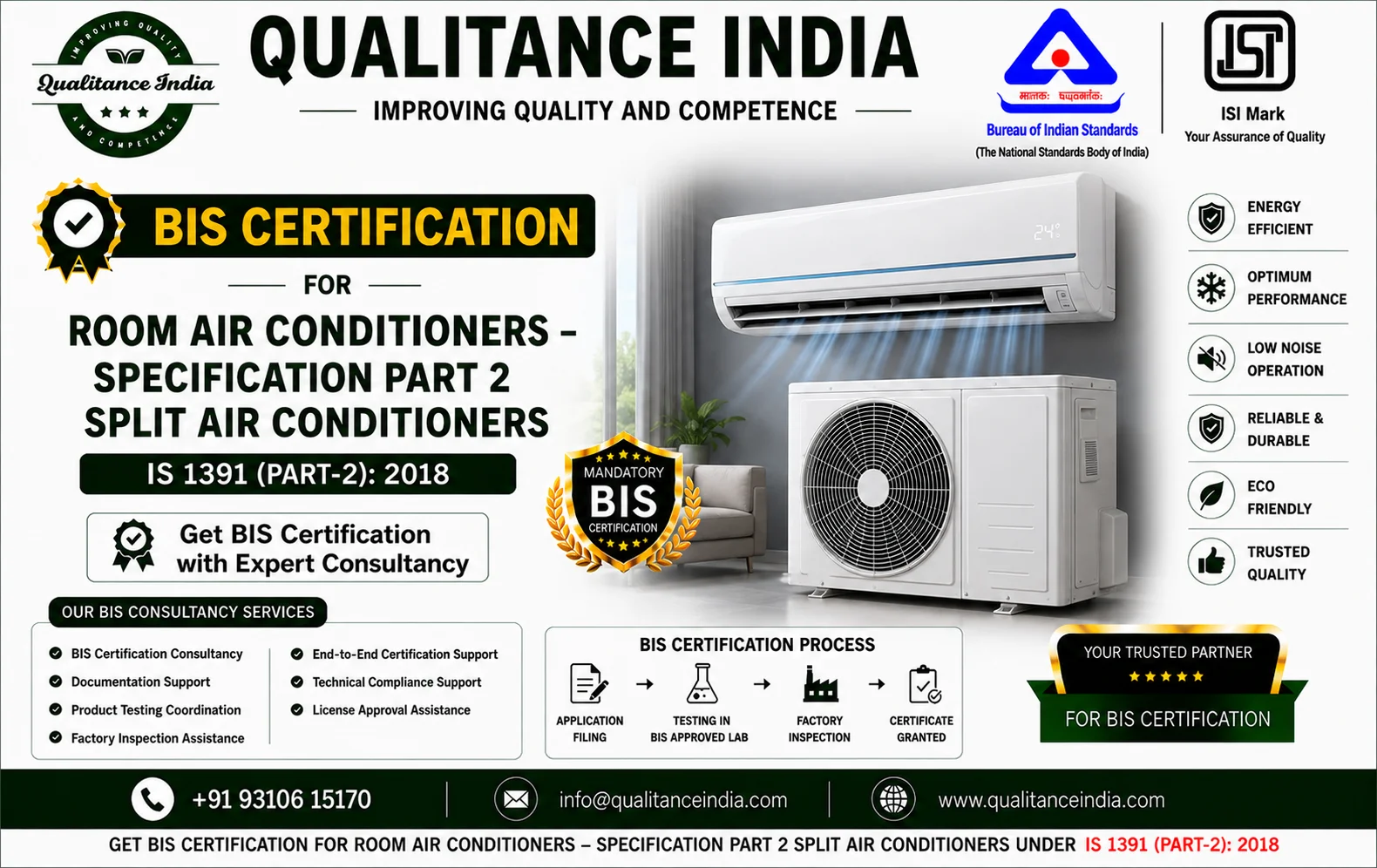
Qualitance India provides BIS Certification Consultancy for Split Air Conditioners, helping manufacturers with product assessment, documentation, laboratory testing coordination, BIS application and factory inspection preparation.
Product ke baare mein
A Split Air Conditioner is an air-conditioning system in which the indoor and outdoor components are separated.
The major components may include:
- Indoor Unit
- Outdoor Unit
- Hermetic Compressor
- Heat Exchanger
- Refrigerant Circuit
- Fan Motor
- Air Filter
- Temperature Sensing Controls
- Electrical Controls
- Drainage Arrangement
- Connecting Pipes
- Electrical Cables
- Remote Control System
Split air conditioners can be designed for:
- Cooling only
- Cooling and heating
- Different cooling capacities
- Different energy-efficiency levels
- Different refrigerants
- Different indoor and outdoor unit configurations
The BIS product manual identifies relevant components and requirements, including electrical cables, temperature sensing controls, hermetic compressors, motors and heat exchangers.
Applicable IS Standard
The applicable standard is:
IS 1391 (Part 2):2018 – Room Air Conditioners – Specification, Part 2: Split Air Conditioners
The BIS product manual specifically identifies this standard as the basis for certification of Split Air Conditioners under Scheme-I.
BIS's current compulsory-certification listing also includes IS 1391 (Part 2):2018 – Room Air Conditioners – Specification Part 2 Split Air Conditioners.
Scope of Standard
IS 1391 (Part 2):2018 deals with requirements for Split Air Conditioners.
The requirements cover important aspects of:
- Construction
- Materials
- Electrical components
- Refrigerant circuit
- Performance
- Cooling capacity
- Heating capacity, where applicable
- Power consumption
- Sound
- Safety
- Leakage
- Earthing
- Electrical strength
- Temperature sensing controls
- Compressor
- Motors
- Heat exchangers
- Marking
The BIS Product Manual provides certification guidance covering sampling, product grouping, testing equipment, Scheme of Inspection and Testing and licence scope.
Product Requirements
A Split Air Conditioner needs to meet applicable requirements relating to construction, performance and safety.
Important product characteristics include:
Cooling Capacity
The air conditioner should achieve the specified cooling capacity under the applicable test conditions.
Heating Capacity
For applicable heat-pump models, heating capacity requirements need to be met.
Power Consumption
The power consumed during applicable operating conditions is evaluated.
Energy Performance
Applicable energy-performance requirements and ISEER-related conditions need to be considered.
Sound Level
The sound performance of the air conditioner is evaluated according to applicable requirements.
Refrigerant Circuit
The refrigeration circuit needs to meet applicable construction and leakage requirements.
Electrical Safety
Electrical safety requirements include applicable insulation, high-voltage, leakage-current and earthing checks.
Condensate Management
Applicable condensate disposal and enclosure-sweat requirements need to be satisfied.
Testing Requirements
Testing is one of the most important stages of BIS Certification for Split Air Conditioners.
BIS laboratory information for IS 1391 (Part 2):2018 identifies testing areas including:
- Physical verification
- Construction
- Materials
- Electrical cable
- Refrigerant cycle
- Grounding terminal and grounding lead wire
- Air filter
- Power factor
- Maximum operating conditions
- Freeze-up test
- Enclosure sweat test
- Power consumption
- Cooling capacity
- Heating capacity
- Maximum heating performance
- Sound test
- General running test
- Pressure/leakage test
- High-voltage test
- Leakage-current test
- Earthing resistance test
The exact tests applicable to a particular model depend on the product configuration and applicable requirements.
Cooling Capacity Test
Cooling capacity is a key performance characteristic of a Split Air Conditioner.
The test evaluates whether the air conditioner can deliver the declared cooling performance under specified conditions.
BIS laboratory listings for IS 1391 (Part 2):2018 specifically identify Cooling Capacity Test as part of the testing scope.
Heating Capacity Test
For applicable cooling-and-heating or heat-pump models, heating capacity is evaluated.
The BIS laboratory scope includes:
- Heating Capacity Test
- Maximum Heating Performance Test
- Power Consumption Test for Heating by Heat Pump
ISEER and Energy Performance
Energy performance is an important aspect of modern Split Air Conditioners.
The BIS testing information identifies the Indian Seasonal Energy Efficiency Ratio (ISEER) and associated test conditions for applicable products.
Manufacturers should therefore ensure that declared energy-performance information corresponds with the applicable test results and regulatory requirements.
Safety Testing
Electrical and operational safety tests may include:
- High Voltage Test
- Leakage Current Test
- Earthing Resistance Test
- General Running Test
- Pressure or Leakage Test
- Protection against access to live parts
These tests are reflected in BIS laboratory information for the applicable air-conditioner standard.
Raw Material Requirements
The BIS Product Manual identifies various component/material requirements for Split Air Conditioners.
The manual specifically refers to:
- Material as per the applicable clause
- Electrical Cables – IS 694 or IS 9968 (Part 1)
- Temperature Sensing Controls – IS/IEC 60730-2-9
- Hermetic Compressors – IS 10617
- Motors
- Heat Exchangers – IS 11329
Manufacturers should maintain suitable records for materials and critical components, including:
- Supplier details
- Material specifications
- Purchase records
- Component test certificates
- Incoming inspection records
- Batch identification
- Traceability records
Manufacturing Requirements
A typical Split Air Conditioner manufacturing process may include:
- Raw-material and component procurement
- Incoming inspection
- Indoor unit assembly
- Outdoor unit assembly
- Heat exchanger assembly
- Fan and motor installation
- Compressor installation
- Refrigeration piping
- Electrical wiring
- Control-system installation
- Brazing and joining
- Leak testing
- Vacuuming
- Refrigerant charging
- Electrical safety testing
- Performance testing
- Final inspection
- Marking
- Packing
The actual manufacturing process may vary depending on the manufacturer's design and production technology.
BIS Certification Process
Step 1 – Product Assessment
The Split Air Conditioner models are reviewed against IS 1391 (Part 2):2018.
Step 2 – Product Grouping
Models are assessed according to the applicable BIS grouping guidelines.
The BIS Product Manual provides specific grouping guidelines for Split Air Conditioners.
Step 3 – Scope Finalisation
The manufacturer identifies the models and variants proposed for certification.
Step 4 – Factory Assessment
Manufacturing facilities and testing arrangements are reviewed.
Step 5 – Documentation
Technical, factory and quality-control documents are prepared.
Step 6 – Sample Selection
Representative samples are selected according to the applicable BIS requirements.
Step 7 – Laboratory Testing
The samples are tested against the applicable requirements.
Step 8 – BIS Application
The manufacturer submits the BIS application with required information and documents.
Step 9 – Application Scrutiny
BIS examines the submitted application and supporting documents.
Step 10 – Factory Inspection
BIS assesses manufacturing and quality-control arrangements as applicable.
Step 11 – Observation Closure
Any observations or deficiencies identified during the process are addressed.
Step 12 – Licence Grant
After successful completion of the applicable requirements, the BIS licence is granted for the approved scope.
Documents Required
The manufacturer may need documents such as:
- Company registration documents
- Factory address proof
- Factory layout
- Manufacturing process flow
- Machinery list
- Product drawings
- Technical datasheets
- Model list
- Product specifications
- Component details
- Compressor details
- Motor details
- Heat exchanger details
- Refrigerant details
- Electrical cable details
- Supplier information
- Testing equipment list
- Calibration certificates
- Internal test reports
- Quality-control plan
- Inspection records
- Production records
- Product photographs
- Packaging details
- Marking details
- Authorised signatory documents
- Trademark documents, where applicable
The exact document requirement depends on the manufacturer and certification scope.
Factory Inspection
During factory inspection, BIS may assess different areas of manufacturing and quality control.
Manufacturing Machinery
Equipment used for indoor and outdoor unit assembly, piping, brazing, electrical assembly and testing may be reviewed.
Testing Facilities
Required testing and measuring facilities should be available according to the applicable certification requirements.
Calibration
Applicable measuring and testing instruments should have valid calibration records.
Refrigeration Testing
Suitable arrangements should be maintained for leakage, vacuuming, charging and refrigeration-system checks.
Electrical Testing
Applicable electrical safety testing arrangements should be available.
Quality Control
Incoming, in-process and final inspection procedures should be properly maintained.
Records
Production, inspection, testing and calibration records should be available.
Finished Products
Finished air conditioners should be properly identified and traceable.
Product Quality Checks
Manufacturers should maintain quality checks throughout the manufacturing process.
These may include:
- Incoming material inspection
- Component inspection
- Dimensional inspection
- Electrical inspection
- Wiring inspection
- Refrigeration circuit inspection
- Leakage testing
- Vacuum testing
- Refrigerant charging verification
- Cooling performance testing
- Heating performance testing
- Power consumption checks
- Sound checks
- Earthing checks
- Final inspection
- Marking verification
Common Reasons for Testing/Certification Failure
Manufacturers may face testing or certification problems because of:
- Incorrect product grouping
- Incorrect declared cooling capacity
- Inadequate cooling performance
- Heating performance failure
- Excessive power consumption
- ISEER-related non-conformity
- Sound-test failure
- Refrigerant leakage
- Pressure-test failure
- Electrical safety failure
- High-voltage test failure
- Leakage-current failure
- Earthing resistance failure
- Freeze-up failure
- Enclosure sweat failure
- Condensate disposal problems
- Incorrect component specifications
- Inadequate testing equipment
- Missing calibration records
- Incomplete documentation
- Factory not properly prepared
Proper product evaluation before formal testing can help reduce avoidable delays.
BIS Marking
After grant of the BIS licence, the manufacturer must follow the applicable BIS marking requirements.
The manufacturer should ensure that:
- Product identification is correct.
- Applicable standard information is correctly represented.
- BIS licence details are used as required.
- BIS Standard Mark is applied according to licence conditions.
- Product and packaging information is accurate.
The exact marking requirements should always be followed according to the current BIS licence and applicable certification documents.
Who Needs BIS Certification
BIS Certification is relevant to manufacturers of products covered under the applicable compulsory certification requirements.
This may include manufacturers of:
- Split Air Conditioners
- Wall-Mounted Split ACs
- Floor-Mounted Split ACs
- Cooling-Only Split ACs
- Cooling and Heating Split ACs
- Residential Split ACs
- Commercial Split ACs
- OEM Split Air Conditioner Manufacturers
- Private-Label Manufacturers
The applicable Quality Control Order specifically includes Room Air Conditioners – Split Air Conditioners against IS 1391 (Part 2):2018.
BIS's current compulsory-certification listing also includes IS 1391 (Part 2):2018.
Cost
The cost of BIS Certification for Split Air Conditioners depends on several factors, including:
- BIS application charges
- Laboratory testing
- Number of models
- Product grouping
- Cooling capacity
- Heating function
- Testing requirements
- Factory inspection
- Testing equipment
- Calibration
- Retesting, if required
- Consultancy charges
Laboratory charges can vary significantly depending on the laboratory and applicable testing scope. Current BIS LIMS listings show separate charges for different tests and laboratories, so manufacturers should obtain the applicable current quotation before budgeting the certification.
Timeline
The timeline depends on:
- Product readiness
- Product grouping
- Sample availability
- Laboratory availability
- Testing duration
- Test results
- Documentation
- BIS application scrutiny
- Factory readiness
- Factory inspection
- Closure of observations
Split AC certification can involve extensive performance and safety testing, so proper preparation before submission is important.
Benefits
Better Product Quality
Testing helps verify compliance with applicable product requirements.
Improved Customer Confidence
BIS certification can increase confidence among customers, dealers and institutional buyers.
Regulatory Compliance
It helps manufacturers meet applicable mandatory certification requirements.
Market Acceptance
Certification supports the sale of products in markets where BIS certification is required.
Consistent Manufacturing
Quality-control procedures help maintain consistency between production batches.
Business Credibility
BIS certification can strengthen the manufacturer's position in the air-conditioning market.
Why Choose Qualitance India
Qualitance India provides BIS Certification Consultancy for manufacturers of electrical, electronic, refrigeration and air-conditioning products.
For Split Air Conditioners as per IS 1391 (Part 2):2018, our support can include:
- Product applicability assessment
- IS 1391 (Part 2):2018 requirement review
- Product grouping guidance
- Model scope assessment
- Documentation support
- Sample preparation guidance
- Laboratory testing coordination
- BIS application assistance
- Factory inspection preparation
- Testing equipment guidance
- Quality-control documentation
- Observation closure support
- BIS licence assistance
Our objective is to help manufacturers manage the certification process systematically from product assessment through testing, factory inspection and licence grant.
Complete Process
Product Identification
↓
IS 1391 (Part 2):2018 Requirement Review
↓
Model & Capacity Assessment
↓
Product Grouping
↓
Certification Scope Finalisation
↓
Factory Assessment
↓
Documentation Preparation
↓
Sample Selection
↓
Laboratory Testing
↓
BIS Application
↓
Application Scrutiny
↓
Factory Inspection
↓
Observation Closure
↓
BIS Licence Grant
↓
BIS Marking
The BIS Product Manual specifically provides grouping guidelines, sample-size information, test-equipment requirements, Scheme of Inspection and Testing and licence-scope guidance for IS 1391 (Part 2):2018.
20 FAQs
1. What is IS 1391 (Part 2):2018?
IS 1391 (Part 2):2018 is the Indian Standard for Room Air Conditioners – Specification, Part 2: Split Air Conditioners.
2. Is BIS Certification mandatory for Split Air Conditioners?
IS 1391 (Part 2):2018 is included in the compulsory BIS product-certification framework.
3. What products are covered?
The standard covers Split Air Conditioners falling within its applicable scope.
4. What is tested in Split Air Conditioners?
Testing can cover cooling capacity, heating capacity where applicable, power consumption, sound, leakage, electrical safety, earthing and other applicable requirements.
5. Is Cooling Capacity Testing required?
Yes. Cooling Capacity Testing is specifically included in the BIS laboratory testing scope.
6. Is Heating Capacity Testing required?
It is applicable to models having the relevant heating/heat-pump function.
7. Is sound testing required?
Sound testing is included in the applicable testing information for Split Air Conditioners.
8. Is electrical safety testing required?
Yes. Applicable tests include high voltage, leakage current and earthing resistance testing.
9. Is refrigerant leakage testing required?
Applicable pressure and leakage checks form part of the testing requirements.
10. What components are considered under the standard?
Components can include cables, temperature sensing controls, compressors, motors and heat exchangers, among others.
11. Which standard applies to Hermetic Compressors used in Split ACs?
The BIS Product Manual references IS 10617 for Hermetic Compressors.
12. Which standard applies to heat exchangers?
The BIS Product Manual references IS 11329 for heat exchangers.
13. Which standard applies to temperature sensing controls?
The product manual references IS/IEC 60730-2-9 for temperature sensing controls.
14. Can multiple models be covered under one BIS licence?
Product grouping guidelines determine which models can be covered within the applicable certification scope.
15. What documents are required?
Technical, factory, manufacturing, testing, quality-control and product-related documents may be required.
16. Is factory inspection required?
Factory assessment forms part of the applicable BIS certification process.
17. How much does BIS Certification for Split AC cost?
The cost depends on models, grouping, testing, laboratory charges, factory inspection and other applicable expenses.
18. How long does BIS Certification take?
The timeline depends on testing, documentation, BIS scrutiny, factory inspection and closure of observations.
19. Can an OEM manufacturer apply for BIS Certification?
Manufacturers having suitable facilities and meeting the applicable requirements can apply, subject to BIS certification procedures.
20. Can Qualitance India help with Split AC BIS Certification?
Yes. Qualitance India provides consultancy for product assessment, documentation, testing coordination, BIS application and factory inspection preparation.
People Also Ask
What is the BIS standard for Split Air Conditioners?
The applicable standard is IS 1391 (Part 2):2018.
Is BIS Certification required for Split AC in India?
Yes, IS 1391 (Part 2):2018 is included in the compulsory BIS certification framework.
What tests are required for Split Air Conditioners?
Important tests include cooling capacity, power consumption, sound, leakage, electrical safety, earthing and applicable heating-performance tests.
What is tested in a Split AC BIS laboratory?
The testing scope can include construction, material, refrigerant cycle, cooling capacity, heating capacity, power consumption, sound and safety tests.
Is ISEER considered for Split AC certification?
The BIS laboratory information identifies ISEER-related testing conditions for Split Air Conditioners.
What documents are required for Split AC BIS Certification?
Manufacturers generally need product, factory, manufacturing, testing, component and quality-control documents.
How can I get BIS Certification for Split Air Conditioners?
The process generally involves product assessment, grouping, documentation, sample testing, BIS application, factory inspection and licence grant.
Related BIS Certification Services
- BIS Certification for Unitary Air Conditioners – IS 1391 (Part 1)
- BIS Certification for Hermetic Compressors – IS 10617
- BIS Certification for Finned Type Heat Exchangers – IS 11329
- BIS Certification for Ducted and Package Air Conditioners – IS 8148
- BIS Certification for Temperature Sensing Controls
- BIS Certification for Electric Motors
- BIS Certification for Electrical Cables
- ISI Mark Certification
- BIS Testing Assistance
- BIS Factory Inspection Assistance
Related Topics
- IS 1391 (Part 2):2018 Split Air Conditioners
- BIS Certification for Split AC
- Split Air Conditioner Testing Requirements
- Split AC Cooling Capacity Test
- Split AC Heating Capacity Test
- Split AC ISEER Testing
- Split AC BIS Product Grouping
- Split AC Factory Inspection
- BIS Certification for Air Conditioners
- BIS Certification Consultancy in India
Contact Qualitance India
Phone: +91 93106 15170
Email: info@qualitanceindia.com
Website: qualitanceindia.com
For assistance with BIS Certification for Split Air Conditioners as per IS 1391 (Part 2):2018, contact Qualitance India for product assessment, documentation, laboratory testing coordination and BIS certification support.
Conclusion
IS 1391 (Part 2):2018 – Room Air Conditioners – Specification, Part 2: Split Air Conditioners provides requirements covering important aspects of Split Air Conditioner construction, performance and safety.
BIS currently lists IS 1391 (Part 2):2018 under the compulsory product-certification framework, while the applicable Quality Control Order identifies Split Air Conditioners against this Indian Standard.
The certification process involves proper product grouping, sample selection, laboratory testing, documentation, BIS application and factory assessment. The applicable testing can include cooling capacity, heating capacity, power consumption, sound, leakage and electrical safety requirements.
Manufacturers should therefore prepare their products, testing facilities, technical documents and quality-control systems before applying for certification.
Qualitance India provides BIS Certification Consultancy for Split Air Conditioners as per IS 1391 (Part 2):2018, supporting manufacturers through product assessment, documentation, testing coordination, BIS application and factory inspection preparation.
Phone: +91 93106 15170
Email: info@qualitanceindia.com
Website: qualitanceindia.com