BIS Certification Consultancy for Aluminium Composite Panel | IS 17682:2021
Introduction
Aluminium Composite Panel (ACP) is a multi-layer panel widely used for building façades, exterior cladding, interior wall applications, partitions, signage, architectural features and other construction-related applications. Its performance depends on the quality of the aluminium sheets, polymer core, adhesive and protective surface coating.
To provide consistent product performance, manufacturers need to control important parameters such as dimensions, core density, tensile properties, peel strength, coating thickness, coating adhesion, pencil hardness, gloss, weather resistance and chemical resistance. For certain grades, fire-retardance characteristics are also applicable.
In India, Aluminium Composite Panel is covered under IS 17682:2021 – Aluminium Composite Panel. The product is covered under the BIS Scheme-I certification framework, and the current BIS Scheme-I product list continues to identify IS 17682:2021.
The current BIS Product Manual is PM/IS 17682/3/Mar 2025, which records one amendment and provides the current certification guidance for applicants and licensees.
Qualitance India provides end-to-end BIS Certification consultancy for Aluminium Composite Panel manufacturers, including product-scope assessment, documentation, laboratory testing coordination, factory inspection preparation, technical compliance and BIS licence support.
What is Aluminium Composite Panel?
Aluminium Composite Panel is an engineered panel consisting of aluminium alloy sheets combined with a core material and bonded through an appropriate manufacturing process.
The panel normally includes:
- Aluminium alloy sheets
- Polymer-based core material
- Adhesive/bonding system
- Protective surface coating
ACP is commonly selected because of its combination of low weight, flatness, appearance, ease of fabrication and suitability for architectural applications.
Depending on the grade and construction, ACP can also be designed to meet additional fire-performance or functional requirements.
BIS Standard for Aluminium Composite Panel
The applicable standard is:
IS 17682:2021 – Aluminium Composite Panel
The current BIS Product Manual is:
PM/IS 17682/3/Mar 2025
The current manual states:
- Standard: IS 17682:2021
- Amendments: 1
- Sample quantity: 5 panels
- Grouping: Annex-B
- Test equipment: Annex-C
- Scheme of Inspection and Testing: Annex-D
- Possible tests in a day: specified in the Product Manual
- Licence scope: Annex-F
Is BIS Certification Mandatory for Aluminium Composite Panel?
Yes. IS 17682:2021 – Aluminium Composite Panel is included in the current BIS compulsory certification listing under the Aluminium and Aluminium Alloy Products category.
The applicable regulatory framework requires covered products to conform to the relevant Indian Standard and carry the Standard Mark under the applicable BIS certification scheme.
The aluminium-product Quality Control Order framework also states that the latest version of the applicable Indian Standard, including amendments notified by BIS, applies.
Therefore, manufacturers should ensure that their products, raw materials, testing arrangements and production controls correspond to the current BIS requirements.
Current BIS Product Manual for IS 17682:2021
The current Product Manual PM/IS 17682/3/Mar 2025 is especially important for certification planning.
It specifies a sample quantity of:
5 Panels
for laboratory testing for grant of licence, change in scope and applicable factory-surveillance activities.
The Product Manual also requires certain parameters to be declared in the test request. These include:
- Same information as the scope of licence
- Type of coating
- Number of coats
Grades of Aluminium Composite Panel
As per the current grouping provisions, Aluminium Composite Panels are classified into:
- Grade 1
- Grade 2
- Grade 2S
- Grade 3
- Grade 4
- Grade 5
The exact characteristics of each grade and the applicable requirements should be assessed against the current version of IS 17682:2021 and the applicable amendment.
Standard Sizes Covered
The Product Manual identifies the following nominal dimensions:
Length × Width
- 1200 × 2400 mm
- 1200 × 3050 mm
- 1200 × 3660 mm
The nominal thicknesses listed are:
- 2 mm
- 3 mm
- 4 mm
- 5 mm
- 6 mm
Other dimensions may also be used where agreed between the manufacturer and purchaser.
BIS Licence Scope for Aluminium Composite Panel
The current Product Manual identifies the licence scope as:
Product: Aluminium Composite Panel
Grade: 1 / 2 / 3 / 4 / 5
Size: Length × Width × Thickness
Optional Requirements: With / Without
The actual licence scope is subject to the tested varieties and the manufacturing and testing capabilities demonstrated by the manufacturer.
BIS Grouping Guidelines for ACP
Grouping is a major part of the BIS certification process because it determines which varieties need to be tested to establish a particular licence scope.
The current Product Manual identifies:
Grade
Each grade must be tested for all applicable requirements to cover that grade in the licence scope.
Size and Thickness
The highest nominal size and highest thickness are to be tested for all requirements to cover sizes and thicknesses up to and including the tested nominal size and thickness, subject to the applicable grouping conditions.
Optional Requirements
Where optional requirements are selected, one sample from each grade is required to be tested for the applicable optional requirements to cover them in the licence scope.
Protective Coating
The manufacturer must declare the type of protective coating used for each grade. The revised Product Manual also requires the coating type and number of coats to be declared in the test request.
BIS may restrict the final scope according to the manufacturer's actual manufacturing and testing capabilities.
Raw Materials for Aluminium Composite Panel
The current Product Manual identifies the following major raw-material requirements:
1. Polymer Granules
Polymer granules must comply with Clause 5.1 of IS 17682.
2. Aluminium Alloy Sheets
Aluminium alloy sheets must comply with Clause 5.2 of IS 17682.
3. Adhesive
The manufacturer is required to obtain a test certificate for the adhesive according to Clause 5.3 of IS 17682.
4. Surface Coating
The manufacturer must declare the type of coating for each grade according to Clause 5.4 of IS 17682.
Raw-Material Testing and Control
The current Scheme of Inspection and Testing classifies these raw-material checks as subcontractable tests.
The Product Manual specifies testing of:
- Polymer granules – one sample per consignment
- Aluminium alloy sheets – one sample per consignment
- Adhesive – one sample per consignment
- Surface coating – one sample per consignment
No further testing is required for polymer granules where the material is received with the specified test certificate or is ISI Marked, according to the Product Manual.
Manufacturing Process of Aluminium Composite Panel
A typical ACP manufacturing process can involve:
1. Raw-Material Inspection
Aluminium sheets, polymer granules, adhesive and coating materials are checked before use.
2. Core Preparation
The polymer core is produced or prepared according to the manufacturer's process.
3. Aluminium Sheet Preparation
The aluminium sheets are processed and prepared for bonding.
4. Coating
The required protective coating system is applied to the aluminium surface.
5. Bonding
The aluminium sheets and core are bonded through the specified manufacturing process.
6. Lamination
The individual layers are consolidated into a composite panel.
7. Cooling and Conditioning
Panels are stabilized under controlled manufacturing conditions.
8. Cutting and Finishing
Panels are cut to the required dimensions and finished.
9. Inspection and Testing
Finished panels undergo dimensional, mechanical, coating and other applicable testing.
10. Packing and Marking
Conforming panels are marked and packed according to BIS requirements.
Major Tests for Aluminium Composite Panel
The current BIS Product Manual identifies physical, mechanical, coating, fire-retardance and optional performance requirements.
1. Dimensions
Dimensions are checked for conformity with the applicable requirements.
The Product Manual specifically identifies:
- Dimensions
- Straightness
- Squareness
as production-control parameters.
2. Density of Core
The density of the panel core is checked against the applicable requirement.
The specified testing arrangement references IS 13360 (Part 3/Sec 10).
3. Tensile Strength
Tensile strength of the applicable aluminium component is assessed using the relevant test method.
The Product Manual references IS 1608 (Part 1) for tensile strength, yield strength and elongation testing.
4. Yield Strength
Yield strength is evaluated as part of the mechanical-property requirements.
5. Elongation
Elongation is measured as part of the tensile-property evaluation.
6. Peel Strength
Peel strength is an important performance parameter because the bonding between the aluminium skin and core directly affects the durability of the panel.
The Product Manual references testing according to the applicable provisions of IS 17682.
7. Coating Thickness
The thickness of the protective coating is measured to verify conformity.
The Product Manual references IS 6012 for coating-thickness testing.
8. Coating Adhesion
Cross-hatch adhesion is evaluated to determine whether the coating remains properly bonded to the substrate.
The current Product Manual references IS 101 (Part 5/Sec 2) for the test facility.
9. Pencil Hardness
The surface coating is tested for pencil hardness.
The Product Manual references IS 101 (Part 5/Sec 1).
10. Gloss
Surface gloss is measured using a glossmeter.
11. Colour Retention
The current Product Manual includes colour-retention assessment, with a spectrophotometer identified in the equipment list.
12. Chalk Resistance
Chalk resistance is evaluated using the applicable method in IS 17682.
13. Weatherometer Testing
Weather performance includes:
- Resistance to humidity
- Neutral salt spray / corrosion and blistering
- Accelerated weathering
- Gloss retention
- Colour retention
- ΔE
- Chalk resistance
The Product Manual identifies weatherometer-related testing as part of the coating-performance requirements.
14. Chemical Resistance
Chemical resistance is tested against applicable chemicals and agents including:
- HCl
- NaOH
- Mortar
- Detergent
- Nitric acid
The current Product Manual identifies these requirements under the coating tests.
Fire Retardance Requirements
Fire-retardance requirements under Table 4 apply specifically to:
Grade 3, Grade 4 and Grade 5 ACPs.
The applicable tests include:
Limiting Oxygen Index
The limiting oxygen index is determined using the applicable test method.
Smoke Density Rating
Smoke generation is assessed using the relevant test method.
Ignitability
Ignitability is evaluated according to the applicable test procedure.
Flame Spread
The flame-spread characteristics are evaluated where applicable.
Non-Combustibility
Non-combustibility is assessed according to the prescribed test method.
Oxygen Bomb Calorimeter
The gross calorific performance is assessed using the applicable oxygen bomb calorimeter procedure.
The current Product Manual identifies test facilities for these requirements with reference to relevant Indian Standards.
Optional Tests for Aluminium Composite Panel
The standard also provides optional performance requirements.
These include:
- Sound Transmission Class (STC)
- Sound Absorption Coefficient
- Coefficient of Linear Thermal Expansion
- Thermal Conductivity
Where these optional requirements are included in the licence, the applicable tests must be completed according to the grouping provisions.
Testing Equipment Required for ACP
The current Product Manual provides an indicative list of equipment.
For Dimensions, Squareness and Straightness
- Measuring tape
- Vernier caliper
- Micrometer
- Feeler gauge
- Straight edge
- 1200 mm × 1200 mm square
For Core Density
The test arrangement may include:
- Weighing balance
- Immersion vessel
- Pycnometer
- Water bath
For Tensile Properties
- Tensile testing machine
- Sample cutter
- Vernier caliper
- Extensometer
For Peel Strength
- Tensile testing machine
- Sample cutter
- Vernier caliper
For Coating
- Eddy-current coating-thickness instrument
- Cross-hatch cutting equipment
- Pencils
- Glossmeter
- Spectrophotometer
For Weathering
- Salt-spray apparatus
- UV/weathering chamber
- Test fixtures
- Conditioning equipment
For Fire Performance
Depending on the grade and scope:
- Oxygen index tester
- Smoke-density chamber
- Ignitability apparatus
- Flame-spread test equipment
- Non-combustibility test apparatus
- Oxygen bomb calorimeter
For Optional Tests
- Sound-transmission testing facilities
- Sound-absorption testing facilities
- Vitreous silica dilatometer
- Thermal conductivity test apparatus
The current Product Manual provides the relevant test-equipment references in Annex-C.
Quality Assurance Plan for ACP Manufacturers
The Product Manual requires manufacturers and licensees to implement a Quality Assurance Plan consisting of regular testing and in-process controls to ensure that Standard Mark-bearing products conform to the Indian Standard.
The manufacturer must define:
- Control unit
- Test frequency
- Number of samples
- Applicable test requirements
- In-process controls
- Record-keeping procedures
The Quality Assurance Plan is to be submitted to the BIS Branch Office for information.
Control Unit for Aluminium Composite Panel
The current Product Manual recommends that a control unit consist of Aluminium Composite Panels having:
- Same grade
- Same type of protective coating
- Same number of coats
- Same size
- Similar manufacturing conditions
- Same consignment of raw materials
- Manufactured during one day
This definition is important for routine testing and production control.
Routine Testing Requirements
The current Scheme of Inspection and Testing identifies several routine tests.
Every Control Unit
The following are identified as routine requirements:
- Density of core
- Tensile strength
- Yield strength
- Elongation
- Peel strength
- Coating thickness
- Pencil hardness
- Gloss
The Product Manual specifies one sample per control unit for these applicable routine parameters.
Adhesion
One sample is tested once a week for each applicable combination of:
- Grade
- Protective coating type
- Number of coats
Weatherometer – Humidity and Neutral Salt Spray
One sample is tested once every six months, with each grade and coating type/number of coats tested in rotation.
Accelerated Weathering
One sample is tested once a year, with grades, coating types and numbers of coats tested in rotation.
Chemical Resistance
One sample is tested once a month for each applicable grade and protective coating type.
Fire-Test Routine Requirements
For Grades 3, 4 and 5, the Product Manual identifies the following:
- Limiting oxygen index – one sample every control unit
- Smoke density rating – one sample every control unit
- Ignitability – one sample every control unit
- Flame spread – one sample once a year in rotation
- Non-combustibility – one sample once a week
- Oxygen bomb calorimeter – one sample every control unit
Optional-Test Frequency
Where optional requirements are included:
- Sound transmission class – once every three months
- Sound absorption coefficient – once every three months
- Coefficient of linear thermal expansion – once every three months
- Thermal conductivity – once every three months
In-House Laboratory Requirements
The Product Manual expects manufacturers to establish a suitably equipped and staffed in-house laboratory for the routine tests required to maintain product quality.
The manual distinguishes between:
R – Testing required in-house
and
S – Subcontracting permitted
For subcontracted tests, testing may be carried out through:
- BIS-recognized/empanelled laboratories
- Laboratories having valid NABL accreditation according to IS/ISO/IEC 17025
The corresponding reports must remain available for BIS inspection.
MSME Testing Facility Provisions
For MSME manufacturers, maintaining an in-house facility for routine tests marked “R” is optional under the Product Manual.
MSME manufacturers may use:
- Common cluster-based facilities
- Shared testing facilities
- BIS-recognized/empanelled laboratories
- Laboratories having valid NABL accreditation under IS/ISO/IEC 17025
Large Manufacturer Laboratory Requirements
Large-scale manufacturers are expected to maintain an in-house laboratory with facilities for routine tests.
The Product Manual also provides an alternative through the permitted sharing-of-testing-facilities mechanism. Manufacturers must maintain an appropriate calibration plan for relevant in-house equipment.
BIS Sample Size
The current Product Manual specifies:
5 Panels
as the sample quantity for Aluminium Composite Panel certification activities.
Manufacturers should ensure that samples are representative of the proposed grade, size, thickness, coating system and other declared characteristics.
Factory Inspection for BIS Certification
During factory inspection, BIS or the authorized auditor may assess:
Raw Materials
The manufacturer should demonstrate control over:
- Polymer granules
- Aluminium alloy sheets
- Adhesive
- Surface coating
Production
The manufacturing process should match the declared scope.
Testing Facility
The required in-house testing facilities, calibration and technical personnel should be available as applicable.
Quality Records
Records should be maintained for:
- Raw-material inspection
- Production
- Routine tests
- Calibration
- External laboratory reports
- Rejections
- Corrective actions
- Dispatch
Product Marking
BIS marking should be applied correctly only to conforming production covered under the licence.
BIS Marking Requirements for Aluminium Composite Panel
The current Product Manual states that the Standard Mark is to be incorporated indelibly and clearly on each ACP, provided the marked material conforms to the requirements of the specification.
The Product Manual additionally requires the packing boxes to carry:
“For BIS certification details please visit www.bis.gov.in”
Only production conforming to the standard and covered under the licence should bear the Standard Mark.
BIS Testing Laboratories for IS 17682:2021
BIS LIMS currently shows active laboratory scopes for Aluminium Composite Panel under IS 17682:2021. The current listings show laboratories with different combinations of grade/scope and testing charges.
Because some laboratories have exclusions for certain tests and others have different scope coverage, the laboratory should be selected according to the exact product scope and test requirements.
Current BIS Testing Charges for Aluminium Composite Panel
Current BIS LIMS listings show significant variation depending on laboratory and scope.
Examples include:
- ₹50,000 excluding taxes for a displayed scope covering Grades I, 2, 2S, 3, 4 and 5 at one listed laboratory.
- ₹42,000 excluding taxes at another listed laboratory for its displayed scope.
- ₹141,500 for a broader displayed scope at another laboratory.
- Other current listings show extensive scopes around ₹225,000–₹230,000 depending on the laboratory and included tests.
These are laboratory testing charges, not the complete BIS certification cost.
The cost can increase substantially where the scope includes extensive weathering, fire-performance or optional acoustic/thermal tests.
Total Cost of BIS Certification for ACP
The total certification expenditure can depend on:
- BIS application and certification-related charges
- Product testing
- Number of grades
- Size and thickness range
- Coating type
- Number of coating layers
- Fire-performance scope
- Optional requirements
- Laboratory arrangements
- Testing equipment
- Calibration
- Factory inspection
- Corrective action/retesting
- Consultancy and technical documentation
Therefore, a single fixed amount cannot be applied to every Aluminium Composite Panel manufacturer.
Documents Required for BIS Certification
Typical documents may include:
- Company registration documents
- Factory address proof
- Factory layout
- Manufacturing process flow chart
- Machinery list
- Product specifications
- Product drawings
- Grade details
- Size and thickness details
- Coating details
- Number of coating layers
- Polymer granule details
- Aluminium alloy sheet details
- Adhesive details
- Surface-coating details
- Raw-material test certificates
- Testing-equipment list
- Calibration certificates
- In-house test records
- External laboratory reports
- Quality Assurance Plan
- Technical personnel details
- GST/business documents
- Trademark information
- Authorization documents
- Product-marking details
- BIS undertakings and declarations
The final list depends on the proposed product scope and factory structure.
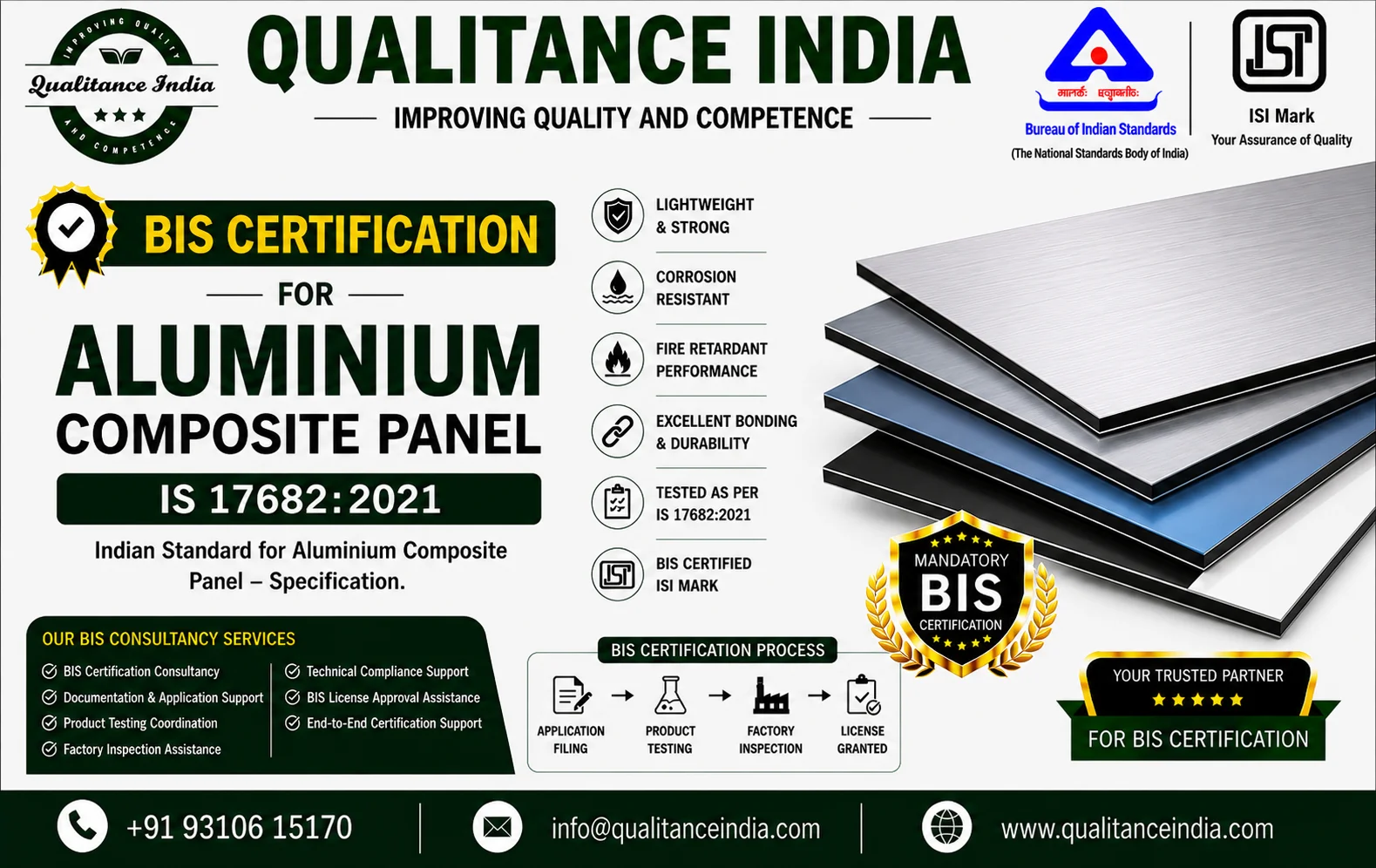
BIS Certification Process for Aluminium Composite Panel
The general process is:
Factory Assessment → Product Scope Finalization → Documentation → BIS Application → Sample Preparation → Laboratory Testing → Factory Inspection → Compliance Closure → BIS Licence → Standard Marking
Scope should be finalized before testing because the grouping rules are linked to grade, size, thickness, coating and optional requirements.
Common Reasons for BIS Certification Delays
ACP manufacturers may face delays because of:
- Incorrect grade selection
- Improper product grouping
- Incorrect size/thickness planning
- Coating-system mismatch
- Inadequate number-of-coats declaration
- Core-density failure
- Tensile-property failure
- Peel-strength failure
- Coating-thickness failure
- Coating-adhesion failure
- Weathering failure
- Chemical-resistance failure
- Fire-test failure
- Insufficient testing equipment
- Calibration problems
- Incomplete laboratory records
- Factory inspection observations
- Incorrect product marking
Proper technical preparation before application can significantly reduce avoidable delays.
Who Needs BIS Certification for Aluminium Composite Panel?
Manufacturers supplying covered Aluminium Composite Panels in India generally require the applicable BIS certification.
This can include ACP manufacturers supplying panels for:
- Building façades
- Exterior cladding
- Interior walls
- Commercial buildings
- Residential buildings
- Offices
- Shopping centres
- Airports
- Hospitals
- Institutional buildings
- Signage
- Architectural applications
The applicability of specific regulatory exemptions should be checked against the current Quality Control Order.
Benefits of BIS Certification for ACP Manufacturers
BIS certification can help manufacturers achieve:
- Regulatory compliance
- Authorization to use the BIS Standard Mark
- Better customer confidence
- Improved product quality
- Better manufacturing controls
- Stronger acceptance in construction and architectural markets
- Better documentation and traceability
- Improved credibility with project purchasers
- Greater consistency of production
BIS Certification for Aluminium Composite Panel – Quick Process
Manufacturer Assessment → Product Scope → Documentation → BIS Application → Testing → Factory Inspection → Compliance → BIS Licence → Standard Mark
Why Choose Qualitance India for ACP BIS Certification?
Qualitance India provides professional BIS Certification consultancy for Aluminium Composite Panel manufacturers.
Our support can include:
- BIS application preparation
- Product scope assessment
- IS 17682 compliance guidance
- Product grouping support
- Grade and size planning
- Coating-scope guidance
- Sample planning
- Laboratory coordination
- Product testing coordination
- Testing-equipment guidance
- Quality Assurance Plan support
- Factory inspection preparation
- Non-conformity response assistance
- BIS licence follow-up
- Post-certification compliance support
We help manufacturers organize their technical, documentation and testing requirements before approaching BIS.
Frequently Asked Questions
1. What is BIS Certification for Aluminium Composite Panel?
It is the BIS conformity assessment process through which an ACP manufacturer demonstrates compliance with IS 17682:2021 and obtains authorization to use the Standard Mark within the approved scope.
2. Which standard applies to Aluminium Composite Panel?
The applicable product standard is IS 17682:2021 – Aluminium Composite Panel.
3. Is BIS certification mandatory for ACP?
Yes. IS 17682:2021 is included in the current BIS compulsory certification listing.
4. What certification scheme applies?
The current Product Manual is issued under Scheme-I of the BIS Conformity Assessment Regulations, 2018.
5. What is the current Product Manual?
The current Product Manual is PM/IS 17682/3/Mar 2025 and records one amendment.
6. What is the sample quantity for ACP BIS certification?
The current Product Manual specifies 5 panels.
7. What grades are covered?
The grouping provisions identify:
- Grade 1
- Grade 2
- Grade 2S
- Grade 3
- Grade 4
- Grade 5
8. What standard dimensions are listed?
Nominal dimensions include 1200 × 2400 mm, 1200 × 3050 mm and 1200 × 3660 mm, with nominal thicknesses of 2, 3, 4, 5 and 6 mm.
9. Can other ACP dimensions be manufactured?
Yes. The Product Manual states that other dimensions may be used as agreed between the manufacturer and purchaser.
10. What raw materials are controlled?
Major controlled inputs include polymer granules, aluminium alloy sheets, adhesive and surface coating.
11. Is coating information required?
Yes. The manufacturer must declare the protective-coating type for each grade, and the test request also requires the coating type and number of coats to be declared.
12. What are the main ACP tests?
Important tests include density of core, tensile strength, yield strength, elongation, peel strength, coating thickness, adhesion, pencil hardness, gloss, weathering and chemical resistance.
13. Which grades require fire-retardance tests?
The Product Manual applies the fire-retardance requirements under Table 4 to Grades 3, 4 and 5.
14. What are the fire tests for ACP?
The applicable fire requirements include limiting oxygen index, smoke density rating, ignitability, flame spread, non-combustibility and oxygen bomb calorimeter testing.
15. What optional tests are available?
Optional tests include sound transmission class, sound absorption coefficient, coefficient of linear thermal expansion and thermal conductivity.
16. What is the control unit for ACP?
The recommended control unit consists of ACP of the same grade, protective-coating type, number of coats and size, produced under similar conditions in one day from the same raw-material consignment.
17. Is an in-house laboratory required?
Routine testing facilities are generally expected, with specific provisions for subcontracting and shared testing facilities.
18. Can MSME manufacturers use external testing facilities?
Yes. For applicable routine tests, MSME manufacturers may use common cluster facilities, shared facilities, BIS-recognized/empanelled laboratories or valid NABL-accredited laboratories according to the Product Manual.
19. Can large manufacturers use shared testing facilities?
The Product Manual provides for sharing-of-testing-facilities arrangements as an alternative to maintaining certain in-house facilities, subject to the applicable BIS provisions.
20. What is the ACP testing cost?
Current BIS LIMS listings show different charges depending on the scope and laboratory, ranging from approximately ₹42,000 to ₹230,000 or more for displayed scopes.
21. Does the laboratory fee include the BIS licence fee?
No. Laboratory testing charges are separate from BIS certification-related costs.
22. What documents are required?
Documents generally include company and factory details, product specifications, machinery, manufacturing process, raw-material information, testing facilities, calibration records, quality documents and proposed marking information.
23. Is factory inspection required?
Factory assessment/inspection is an important part of the BIS licensing process.
24. What marking is required on ACP?
The Standard Mark must be incorporated indelibly and clearly on conforming ACP covered under the licence. The packing boxes must additionally carry the statement “For BIS certification details please visit www.bis.gov.in”.
25. What happens if ACP fails testing?
The manufacturer should investigate the root cause, implement corrective action and follow the applicable BIS retesting/compliance procedure.
26. Can one tested ACP size cover other sizes?
The grouping provisions allow the highest tested nominal size and thickness to cover lower sizes and thicknesses up to the tested values, subject to the applicable conditions.
27. Can one grade cover another grade automatically?
No. Each grade must be considered under the Product Manual's grouping provisions, and each grade is required to be tested for all applicable requirements to establish coverage of that grade.
28. How frequently are coating tests performed after certification?
Routine frequencies vary. For example, coating thickness, pencil hardness and gloss are tested each control unit; adhesion is tested weekly for each applicable combination; weatherometer tests occur at six-month and annual frequencies as specified; and chemical resistance is tested monthly.
29. How frequently are fire tests performed?
For Grades 3, 4 and 5, the Product Manual specifies different frequencies for LOI, smoke density, ignitability, flame spread, non-combustibility and oxygen bomb calorimeter.
30. Can Qualitance India provide complete ACP BIS consultancy?
Yes. Qualitance India provides end-to-end assistance covering application preparation, technical documentation, scope planning, laboratory testing coordination, factory inspection preparation and BIS licence support.
Frequently Searched Topics
- BIS Certification for Aluminium Composite Panel
- IS 17682:2021 BIS Certification
- BIS Licence for ACP
- Aluminium Composite Panel BIS Mark
- ACP Testing
- IS 17682 Testing
- BIS Testing Charges for ACP
- Aluminium Composite Panel Laboratory Testing
- ACP Fire Testing
- ACP Fire Retardant Certification
- ACP Coating Test
- ACP Peel Strength Test
- ACP Weathering Test
- ACP Chemical Resistance Test
- BIS Consultant for ACP Manufacturer
- Aluminium Composite Panel Certification in India
- BIS Licence for Aluminium Composite Panel
- IS 17682 Product Certification
Related BIS Certification Services
Qualitance India also provides consultancy for manufacturers of products covered by Indian Standards and mandatory Quality Control Orders.
Our services include:
BIS Certification Consultancy | BIS Licence | ISI Mark Certification | Product Testing | Documentation Support | Factory Inspection Assistance | Quality Plan Preparation | Technical Compliance Support | Scope Extension | Licence Renewal | End-to-End BIS Support
Contact Qualitance India
Qualitance India BIS Certification Consultancy for Manufacturers
Phone: +91 93106 15170 Email: info@qualitanceindia.com Website: https://qualitanceindia.com/
Manufacturers of Aluminium Composite Panels can contact Qualitance India for assistance with IS 17682:2021 certification, product testing, product grouping, technical documentation, factory inspection preparation and BIS licence support.
Conclusion
Aluminium Composite Panels are widely used in modern construction and architectural applications, making product consistency, coating durability, mechanical performance and, for applicable grades, fire performance important considerations.
IS 17682:2021 – Aluminium Composite Panel is included in the BIS compulsory certification framework. The current PM/IS 17682/3/Mar 2025 Product Manual specifies 5 panels as the sample quantity and provides detailed requirements for grades, dimensions, grouping, raw materials, testing equipment, routine inspection, quality assurance, marking and licence scope.
The licence scope is particularly important because the Product Manual considers grade, size, thickness, protective coating, number of coats and optional requirements. Proper planning of these parameters before testing can help manufacturers avoid unnecessary testing and certification delays.
For manufacturers planning BIS certification for Aluminium Composite Panel, Qualitance India provides professional support for documentation, laboratory testing coordination, product-scope planning, technical compliance, factory inspection preparation and BIS licence processing.