BIS Certification for Tee & Strap Hinges | IS 206:2010 | BIS License Consultancy
Introduction
Tee and Strap Hinges are important hardware components used for doors, gates, shutters, boxes and other applications where a strong and durable hinged connection is required. These hinges are commonly used in residential, commercial, agricultural, industrial and architectural applications.
Because hinges are load-bearing hardware components, their dimensions, material, construction, workmanship, finish, screw-hole arrangement, knuckles and hinge-pin assembly need to be properly controlled.
In India, IS 206:2010 – Tee and Strap Hinges – Specification specifies requirements for Tee and Strap Hinges. The standard is identified as the Fifth Revision in current BIS laboratory records. (bis.gov.in)
BIS currently includes IS 206:2010 under the compulsory Hinges Quality Control Order framework. The current Hinges (Quality Control) Order, 2025 requires covered hinges to conform to the applicable Indian Standard and bear the Standard Mark under a BIS licence according to Scheme-I. (bis.gov.in)
Qualitance India provides end-to-end BIS Certification consultancy for Tee and Strap Hinge manufacturers, including product assessment, documentation, product testing coordination, grouping guidance, factory inspection preparation and BIS licence support.
What Are Tee and Strap Hinges?
Tee and Strap Hinges are mechanical hardware fittings used to connect a movable door, gate, shutter, box or similar structure to a fixed frame or supporting structure.
Tee Hinges
A Tee Hinge generally has a narrow mounting portion connected to a wider horizontal strap, creating a shape resembling the letter “T”.
Tee Hinges are commonly used for:
- Wooden gates
- Garden gates
- Large doors
- Sheds
- Farm structures
- Cabinets and shutters
- Outdoor wooden structures
Strap Hinges
Strap Hinges have an elongated strap-like mounting member and are commonly used for:
- Heavy wooden doors
- Gates
- Boxes
- Chests
- Shutters
- Agricultural structures
- Industrial wooden structures
The particular hinge type and size determine the applicable construction and dimensional requirements.
BIS Standard for Tee and Strap Hinges
The applicable Indian Standard is:
IS 206:2010 – Tee and Strap Hinges – Specification
The standard is identified as the Fifth Revision in current BIS laboratory records. (lims.bis.gov.in)
The BIS Product Manual available for certification is:
PM/IS 206/1/December 2022
The Product Manual identifies:
- Product: Tee and Strap Hinges
- Standard: IS 206:2010
- Certification Scheme: Scheme-I
- Product sample size: 1 No.
- Raw materials: specified mild-steel sheet and wire requirements
- Grouping: Annex A
- Test equipment: Annex B
- Scheme of Inspection and Testing: Annex C
- Possible tests in a day: All tests (bis.gov.in)
Is BIS Certification Mandatory for Tee and Strap Hinges?
Yes.
The Hinges (Quality Control) Order, 2025 specifically lists:
IS 206:2010 – Tee and Strap Hinges
under the Hinges category. The Order requires the specified hinges to conform to the relevant Indian Standard and bear the Standard Mark under a BIS licence according to Scheme-I. (bis.gov.in)
The 2025 Order superseded the earlier Hinges Quality Control Order, 2024. (bis.gov.in)
The current BIS Scheme-I listing continues to include IS 206:2010 – Tee and Strap Hinges under the Hinges QCO framework. (bis.gov.in)
Current Hinges Quality Control Order
The Hinges (Quality Control) Order, 2025 was notified on 21 March 2025 and came into force on publication in the Official Gazette.
It covers:
- Stainless Steel Butt Hinges
- Steel Butt Hinges
- Non-ferrous Metal Butt Hinges
- Tee and Strap Hinges
- Parliament Hinges
- Continuous/Piano Hinges
- Steel Back Flap Hinges
- Double-acting Spring Hinges
- Cabinet Hinges (bis.gov.in)
For the listed products, the Order requires conformity with the applicable Indian Standard and use of the Standard Mark under a BIS licence.
The Order provides an implementation date of 1 July 2025 for the listed hinge products. (bis.gov.in)
Current 2026 Regulatory Update
BIS's current Scheme-I page records additional regulatory notifications associated with the Hinges QCO, including:
- Order for Goods and Articles Exemption against Import – S.O. 775(E), 13 February 2026
- Order for Goods and Articles Exemption against Purchase – S.O. 776(E), 13 February 2026
- Transition Facilitation (Quality Control) Order, 2026 – S.O. 3417(E), 25 June 2026 (bis.gov.in)
The Transition Facilitation Order introduced a separate facilitation mechanism for certain goods covered by notified QCOs. It does not remove the underlying product-quality requirements. Manufacturers should check the latest applicable notification before relying on any transition arrangement. (worldtradescanner.com)
Types of Tee Hinges Covered
The BIS Product Manual classifies Tee Hinges into the following varieties:
Light Weight
- Light Weight Type 1
- Light Weight Type 2
Medium Weight
- Medium Weight Type 1
- Medium Weight Type 2
Heavy Weight
- Heavy Weight Type 1
- Heavy Weight Type 2
- Heavy Weight Type 3 (bis.gov.in)
Types of Strap Hinges Covered
The Product Manual identifies:
- Light Weight Strap Hinges
- Medium Weight Type 1
- Medium Weight Type 2
- Heavy Weight Strap Hinges (bis.gov.in)
The manufacturer must declare the varieties proposed to be covered by the BIS licence.
Product Sizes
Product size is identified according to dimension A in the relevant tables of IS 206:2010.
The Product Manual specifies that the grouping is based on:
Type + Size
and refers manufacturers to Tables 2 to 12 of IS 206:2010 for the applicable size designations. (bis.gov.in)
BIS Product Grouping for Tee and Strap Hinges
Grouping is a very important part of the BIS certification process.
As per the Product Manual, Tee and Strap Hinges are classified based on:
Type
The applicable Tee Hinge and Strap Hinge categories are considered separately.
Size
The size is designated by dimension A according to the relevant product tables.
Representative Samples
The Product Manual specifies that:
One sample from each type having the minimum and maximum size shall be drawn to cover all sizes of hinges in that type tested. (bis.gov.in)
Therefore, manufacturers should prepare a proper type-and-size matrix before applying for certification.
The manufacturer must declare the varieties intended to be covered by the licence, and BIS may restrict the licence scope according to manufacturing and testing capabilities. (bis.gov.in)
BIS Sample Size
The Product Manual specifies:
1 No.
as the product sample size for Tee and Strap Hinges. (bis.gov.in)
Because the grouping provisions require minimum and maximum sizes for each type, manufacturers should coordinate sample selection carefully.
Raw Material Requirements
The current Product Manual identifies the following raw materials:
Mild Steel Sheet
Mild steel sheet – Grade 0 of IS 1079
Mild Steel Wire
Mild steel wire – minimum 1/4H grade of IS 280
These requirements are specifically identified in the BIS Product Manual for IS 206:2010. (bis.gov.in)
Manufacturers should maintain appropriate material records and traceability.
Important documents may include:
- Steel supplier test certificates
- Material grade
- Heat number
- Chemical composition
- Incoming inspection records
- Material traceability records
Manufacturing Process of Tee and Strap Hinges
A typical manufacturing process can include the following stages.
1. Raw Material Inspection
Steel sheets and wire are received and checked against the applicable material requirements.
2. Cutting
Sheet material is cut into the required hinge-flap or strap shapes.
3. Forming
The hinge components are formed according to the required geometry.
4. Knuckle Formation
The hinge knuckles are formed to accommodate the hinge pin.
5. Pin Manufacturing
The hinge pin is produced from the specified wire or other applicable material.
6. Hole Formation
Screw holes are produced according to the applicable dimensions and positions.
7. Assembly
The pin is assembled with the hinge flaps/strap components.
8. Finishing
The hinge receives the required surface finish.
9. Inspection
Dimensions, workmanship, finish and other requirements are checked.
10. Packing and Marking
Conforming hinges are packed and marked according to BIS requirements.
Major BIS Tests for Tee and Strap Hinges
Current BIS laboratory listings for IS 206:2010 identify testing areas covering dimensions and tolerances, workmanship, finish, types, manufacture, knuckles, screw holes, packing and marking. (lims.bis.gov.in)
1. Type Verification
The hinge type is checked against the applicable classification in IS 206.
2. Dimensions
Dimensional inspection is one of the principal requirements.
Depending on the hinge type, dimensions can include:
- Length
- Breadth
- Butt diameter
- Pin diameter
- Flap thickness
- Strap dimensions
- Other applicable dimensions
Current BIS laboratory scopes specifically identify dimensional requirements against the relevant tables and figures. (lims.bis.gov.in)
3. Tolerances
The specified dimensional tolerances must be satisfied.
4. Manufacture
The general method of manufacture and construction must comply with the standard.
5. Knuckles
Knuckle construction and dimensions are important for smooth hinge operation and durability.
6. Hinge Pin
The hinge pin must comply with the applicable material and dimensional requirements.
7. Screw Holes
The standard specifies requirements for:
- Screw-hole size
- Number of screw holes
- Hole position
- Distance from the end
- Applicable screw designation
BIS laboratory listings specifically identify these checks. (lims.bis.gov.in)
8. Workmanship
The finished hinges should be free from unacceptable workmanship defects.
Current BIS laboratory scopes identify Clause 6 – Workmanship as a testing requirement. (lims.bis.gov.in)
9. Finish
The surface finish is checked against the applicable standard requirements.
10. Packing
The packaging should protect the hinges and comply with the applicable packing requirements.
11. Marking
Product marking is checked against the applicable requirements.
Dimensions and Tolerances
Dimensions play a critical role because Tee and Strap Hinges must fit the intended door, gate or shutter assembly.
The manufacturer should maintain suitable dimensional-control instruments such as:
- Vernier caliper
- Micrometer
- Steel scale
- Measuring gauges
- Templates
- Go/No-Go gauges where required
The current BIS laboratory data identifies dimensional and tolerance testing as a principal IS 206 requirement. (lims.bis.gov.in)
Screw-Hole Requirements
Correct screw-hole positioning is particularly important for installation.
The applicable checks can include:
- Number of holes
- Hole dimensions
- Hole positions
- Screw designation
- Distance from hinge ends
- Countersunk/counterbored arrangements where applicable
The BIS laboratory scope specifically lists these aspects for IS 206:2010. (lims.bis.gov.in)
Knuckle and Pin Requirements
The knuckle is the cylindrical section through which the hinge pin passes.
The manufacturer should ensure:
- Proper knuckle formation
- Correct alignment
- Smooth pin movement
- Adequate mechanical integrity
- Proper pin dimensions
- Appropriate clearances
These aspects are part of the manufacturing requirements of IS 206.
Workmanship and Finish
The standard includes requirements for workmanship and finish.
The finished hinge should be properly formed and should not contain unacceptable defects affecting appearance, installation or performance.
Current BIS laboratory listings identify separate testing charges for:
- Workmanship
- Finish
- Marking
under IS 206:2010. (lims.bis.gov.in)
Test Equipment Required
The BIS Product Manual refers to Annex B for the applicable test-equipment requirements. (bis.gov.in)
Typical equipment can include:
- Vernier calipers
- Micrometers
- Steel scales
- Measuring gauges
- Screw-hole gauges
- Thread/diameter gauges
- Templates
- Straight edges
- Inspection fixtures
- Other dimensional inspection equipment
The actual equipment should be finalized according to the manufacturer's proposed product types and sizes.
In-House Testing Facility
The manufacturer should maintain appropriate inspection and testing facilities for applicable requirements under the Scheme of Inspection and Testing.
The facility should include:
- Suitable equipment
- Trained personnel
- Calibration/verification records
- Documented inspection methods
- Proper test records
- Traceability
Where specific testing is permitted to be subcontracted, the applicable external laboratory route may be used according to BIS requirements.
Quality Assurance Plan
A suitable Quality Assurance Plan for Tee and Strap Hinges should include:
- Raw-material inspection
- Steel-grade verification
- Material traceability
- Cutting controls
- Forming controls
- Knuckle formation
- Pin manufacturing
- Screw-hole inspection
- Dimensional inspection
- Workmanship
- Finish
- Packing
- Marking
- Rejection procedure
- Calibration
- Record keeping
The QAP should be aligned with the applicable Scheme of Inspection and Testing.
Control Unit for Tee and Strap Hinges
The applicable control-unit definition should be implemented according to the current Scheme of Inspection and Testing.
The manufacturer should maintain production traceability according to relevant factors such as:
- Hinge type
- Size
- Material batch
- Production batch
- Manufacturing date
- Finish
- Inspection status
This helps ensure that only conforming products are released under the BIS certification.
Factory Inspection for BIS Certification
During factory inspection, BIS may assess:
Raw Material
The manufacturer should demonstrate control over mild-steel sheet and wire.
Manufacturing
The production process should correspond to the declared product scope.
Knuckle and Pin Manufacturing
BIS may verify the manufacturer's ability to produce the required components consistently.
Screw-Hole Production
Hole dimensions and positions should be appropriately controlled.
Laboratory
Inspection and testing equipment should be available and suitable.
Calibration
Applicable measuring equipment should have valid calibration or verification records.
Quality Records
Records may include:
- Incoming-material inspection
- Production records
- Dimensional inspection
- Workmanship inspection
- Finish inspection
- Rejection records
- Calibration records
- Dispatch records
BIS Marking Requirements
IS 206:2010 contains provisions for marking Tee and Strap Hinges and their packaging.
The standard requires individual hinges to carry specified identification information, including the applicable hinge type and size, while package labelling includes manufacturer/trade-mark, type and size information. (law.resource.org)
The use of the BIS Standard Mark is governed by the BIS certification framework and the conditions of the licence.
Manufacturers must ensure that:
- BIS Standard Mark is used only on conforming licensed products
- Product identification is correct
- Type and size are identifiable
- Packaging information is accurate
- Non-conforming hinges are not represented as BIS-certified
BIS Testing Laboratories for IS 206:2010
Current BIS LIMS records show multiple laboratories with active testing scopes for:
IS 206 (2010) – Tee and Strap Hinges – Specification (Fifth Revision). (lims.bis.gov.in)
Current laboratory listings show different testing charges and scopes.
Examples include:
Hindustaan Testing Solutions LLP, Ambala: approximately ₹3,500 for its displayed scope. (lims.bis.gov.in)
IDMA Laboratories Limited, Panchkula: approximately ₹8,200 for the displayed scope, with separate information for material-composition testing. (lims.bis.gov.in)
Other current BIS LIMS listings show testing charges around ₹7,500–₹8,000 for displayed IS 206 scopes. (lims.bis.gov.in)
These are laboratory-specific testing charges, not the complete BIS certification cost.
Total BIS Certification Cost for Tee and Strap Hinges
The total certification cost depends on:
- BIS application-related charges
- Product testing
- Number of product types
- Number of sizes
- Grouping
- Raw-material testing
- Testing equipment
- Calibration
- Factory inspection
- Documentation
- Consultancy
- Re-testing, if required
Because the grouping provisions involve minimum and maximum sizes for each type, scope planning can have a direct effect on testing cost.
Documents Required for BIS Certification
Typical documents may include:
- Company registration documents
- Factory address proof
- Factory layout
- Manufacturing process flow chart
- Machinery list
- Product drawings
- Product specifications
- Tee Hinge types
- Strap Hinge types
- Size range
- Raw-material details
- Steel test certificates
- Material traceability records
- Testing equipment list
- Calibration certificates
- Internal test records
- Quality Assurance Plan
- Production records
- Technical personnel details
- GST/business documents
- Trademark information
- Authorization documents
- Proposed product marking
- BIS declarations and undertakings
The exact documentation depends on the manufacturer's business structure and proposed licence scope.
Common Reasons for BIS Certification Delays
Tee and Strap Hinge manufacturers may face delays because of:
- Applying against an incorrect product scope
- Confusion between Tee and Strap Hinge types
- Incorrect type classification
- Incorrect minimum/maximum size selection
- Dimensional non-conformity
- Screw-hole positioning errors
- Knuckle problems
- Pin-diameter issues
- Workmanship defects
- Surface-finish problems
- Raw-material non-conformity
- Inadequate inspection equipment
- Calibration problems
- Incomplete records
- Factory inspection observations
- Incorrect marking
A pre-assessment of the product range and factory facilities can help reduce these issues.
Who Needs BIS Certification for Tee and Strap Hinges?
Manufacturers producing covered Tee and Strap Hinges for the Indian market should comply with the applicable Hinges QCO requirements.
The requirement can be relevant to:
- Door-hardware manufacturers
- Gate-hardware manufacturers
- Architectural-hardware manufacturers
- Hardware manufacturers
- Metal-hardware manufacturers
- Furniture-hardware manufacturers
- Industrial hardware manufacturers
- OEM manufacturers
- Private-label manufacturers producing covered products
The exact applicability of exemptions or transition provisions should be checked against the latest government notifications.
Benefits of BIS Certification
BIS certification can help manufacturers demonstrate compliance with the applicable Indian Standard and regulatory requirements.
Benefits include:
- Regulatory compliance
- Authorization to use the BIS Standard Mark
- Better customer confidence
- Improved product consistency
- Better manufacturing control
- Better material traceability
- Stronger acceptance among buyers
- Improved quality documentation
- Enhanced market credibility
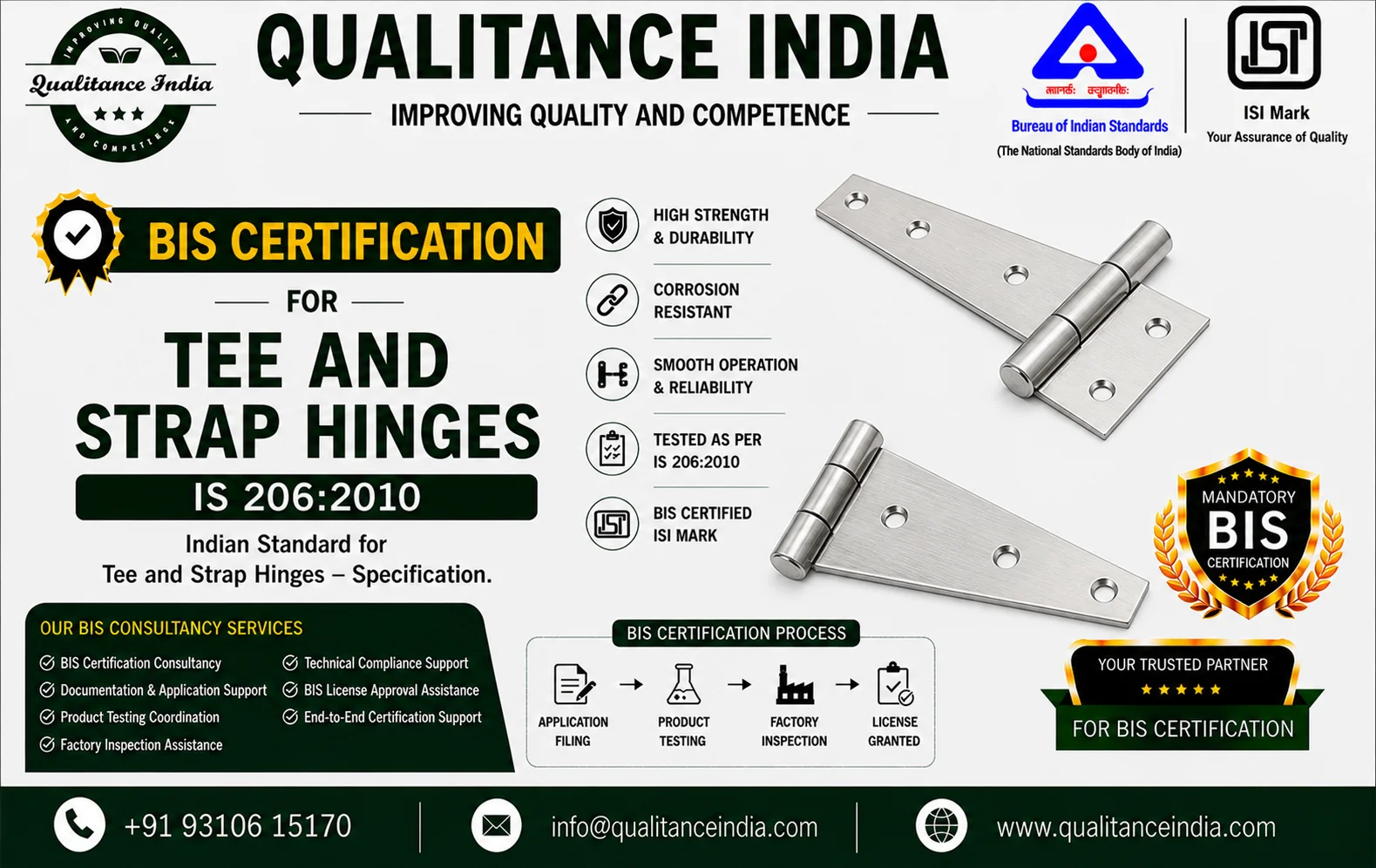
BIS Certification for Tee and Strap Hinges – Quick Process
Manufacturer Assessment → Product Type & Size Finalization → Grouping Assessment → Documentation → BIS Application → Sample Testing → Factory Inspection → Compliance Closure → BIS Licence → Standard Marking
Why Choose Qualitance India?
Qualitance India provides professional BIS Certification consultancy for Tee and Strap Hinge manufacturers.
Our assistance can include:
- BIS applicability assessment
- IS 206 compliance review
- Product-type assessment
- Size and grouping assessment
- Documentation preparation
- Sample planning
- Laboratory selection
- Testing coordination
- Testing-equipment guidance
- Quality Assurance Plan support
- Factory inspection preparation
- Non-conformity response assistance
- BIS application support
- BIS licence follow-up
- Post-certification compliance guidance
We help manufacturers organize the technical, testing and documentation requirements needed for BIS certification.
Frequently Asked Questions
1. What is BIS Certification for Tee and Strap Hinges?
It is the BIS conformity-assessment process through which a manufacturer demonstrates that Tee and Strap Hinges conform to IS 206:2010 and obtains authorization to use the BIS Standard Mark within the approved scope.
2. Which standard applies to Tee and Strap Hinges?
The applicable standard is IS 206:2010 – Tee and Strap Hinges – Specification, identified as the Fifth Revision. (lims.bis.gov.in)
3. Is BIS certification mandatory for Tee and Strap Hinges?
Yes. IS 206:2010 is listed in the Hinges Quality Control Order framework and the current BIS Scheme-I product list. (bis.gov.in)
4. What certification scheme applies?
Certification is under Scheme-I of the BIS Conformity Assessment Regulations, 2018. (bis.gov.in)
5. What is the current Product Manual?
The accessible BIS Product Manual is PM/IS 206/1/December 2022. (bis.gov.in)
6. What is the sample size?
The Product Manual specifies 1 No. as the sample size. (bis.gov.in)
7. What raw materials are specified?
The Product Manual specifies:
- Mild steel sheet – Grade 0 of IS 1079
- Mild steel wire – minimum 1/4H grade of IS 280 (bis.gov.in)
8. How are Tee Hinges classified?
The Product Manual identifies seven Tee Hinge varieties:
- Light Weight Type 1
- Light Weight Type 2
- Medium Weight Type 1
- Medium Weight Type 2
- Heavy Weight Type 1
- Heavy Weight Type 2
- Heavy Weight Type 3 (bis.gov.in)
9. How are Strap Hinges classified?
The identified varieties are:
- Light Weight
- Medium Weight Type 1
- Medium Weight Type 2
- Heavy Weight (bis.gov.in)
10. What is the main basis of product grouping?
Grouping is based on hinge type and size. (bis.gov.in)
11. How are sizes designated?
Size is designated by dimension A according to the relevant tables of IS 206:2010. (bis.gov.in)
12. How are representative samples selected?
The Product Manual specifies one sample from each type having the minimum and maximum size to cover the sizes in that tested type, subject to the applicable grouping provisions. (bis.gov.in)
13. Can all hinge types be covered by one sample?
No. The grouping provisions distinguish between different hinge types and require representative minimum and maximum sizes for each type. (bis.gov.in)
14. What are the major tests for Tee and Strap Hinges?
Major requirements include:
- Type
- Dimensions
- Tolerances
- Manufacture
- Knuckles
- Screw holes
- Workmanship
- Finish
- Packing
- Marking
Current BIS LIMS records confirm these testing areas. (lims.bis.gov.in)
15. Are dimensions and tolerances tested?
Yes. Dimensional conformity and tolerances are important requirements under IS 206:2010. (lims.bis.gov.in)
16. Are screw holes tested?
Yes. Current BIS laboratory scopes identify screw-hole dimensions, number and positioning requirements. (lims.bis.gov.in)
17. Are knuckles tested?
Yes. Knuckle construction and dimensions form part of the manufacturing requirements. (lims.bis.gov.in)
18. Is the hinge pin controlled?
Yes. The applicable pin construction and dimensional requirements must comply with IS 206:2010.
19. Is workmanship tested?
Yes. Workmanship is separately identified in current BIS laboratory scopes. (lims.bis.gov.in)
20. Is finish tested?
Yes. Finish is a separate conformity requirement. (lims.bis.gov.in)
21. Is packing tested?
The standard contains packing requirements, and current BIS LIMS entries identify Clause 8 – Packing. (lims.bis.gov.in)
22. Is marking tested?
Yes. Current BIS laboratory scopes include marking requirements. (lims.bis.gov.in)
23. What is the current BIS testing cost?
Current BIS LIMS examples show approximately ₹3,500 to ₹8,200 for displayed IS 206 scopes, depending on laboratory and test scope. (lims.bis.gov.in)
24. Does laboratory testing cost include BIS certification fees?
No. Laboratory charges are separate from BIS certification-related expenses.
25. Is factory inspection required?
Factory assessment/inspection is an important part of the BIS licensing process, where manufacturing, quality-control and testing arrangements are assessed.
26. What documents are needed for BIS certification?
Typical documents include company details, factory layout, machinery, manufacturing process, product drawings, raw-material information, testing facilities, calibration records and quality documents.
27. Can a manufacturer include both Tee and Strap Hinges?
The licence scope can contain the manufacturer’s declared Tee and Strap Hinge varieties, subject to applicable grouping, testing and BIS approval requirements.
28. Can all sizes be included in the licence?
The grouping provisions provide for representative minimum and maximum sizes for each type, subject to the applicable conditions and the final BIS-approved scope. (bis.gov.in)
29. What happens if the sample fails testing?
The manufacturer must investigate the non-conformity, implement appropriate corrective action and follow the applicable BIS testing/compliance procedure.
30. Can Qualitance India provide complete BIS consultancy?
Yes. Qualitance India provides end-to-end support including product assessment, grouping, documentation, laboratory coordination, testing, factory inspection preparation and BIS licence support.
Frequently Searched Topics
- BIS Certification for Tee Hinges
- BIS Certification for Strap Hinges
- IS 206:2010 BIS Certification
- IS 206 Fifth Revision
- BIS Licence for Tee Hinges
- BIS Licence for Strap Hinges
- Tee Hinge BIS Mark
- Strap Hinge BIS Mark
- Tee Hinge Testing
- Strap Hinge Testing
- IS 206 Testing
- BIS Testing for Hinges
- Tee Hinge Size Testing
- Strap Hinge Size Testing
- Hinge Dimensions and Tolerances
- Hinge Screw Hole Testing
- Hinge Workmanship Testing
- Hinge Finish Testing
- BIS Testing Charges for Hinges
- Hinges QCO 2025
- BIS Consultant for Hinge Manufacturer
- Tee and Strap Hinge Certification in India
Related BIS Certification Services
Qualitance India also provides BIS consultancy for manufacturers of:
Steel Butt Hinges | Stainless Steel Butt Hinges | Non-Ferrous Metal Butt Hinges | Parliament Hinges | Continuous/Piano Hinges | Steel Back Flap Hinges | Double-Acting Spring Hinges | Cabinet Hinges | Rim Latches | Door Hardware | Other Regulated Products
Our services include:
BIS Certification Consultancy | BIS Licence | ISI Mark Certification | Product Testing | Documentation Support | Factory Inspection Assistance | Quality Plan Preparation | Technical Compliance Support | Scope Extension | Licence Renewal | End-to-End BIS Support
Contact Qualitance India
Qualitance India BIS Certification Consultancy for Manufacturers
Phone: +91 93106 15170 Email: info@qualitanceindia.com Website: https://qualitanceindia.com/
Manufacturers of Tee and Strap Hinges can contact Qualitance India for assistance with IS 206:2010 BIS Certification, product grouping, sample planning, laboratory testing, documentation, factory inspection preparation and BIS licence support.
Conclusion
Tee and Strap Hinges are widely used hardware components for doors, gates, shutters, boxes and other movable structures. Their performance depends on correct dimensions, material quality, knuckle construction, hinge-pin arrangement, screw-hole positioning, workmanship and surface finish.
IS 206:2010 – Tee and Strap Hinges – Specification is identified as the Fifth Revision and remains included in the compulsory BIS certification framework for hinges. The current BIS Product Manual PM/IS 206/1/December 2022 specifies 1 sample, identifies specific Tee and Strap Hinge varieties, and provides grouping based on type and size. (bis.gov.in)
The Hinges Quality Control Order, 2025 specifically lists IS 206:2010 and requires covered products to conform to the applicable Indian Standard and bear the Standard Mark under a BIS licence according to Scheme-I. (bis.gov.in)
Current BIS laboratory records show active testing facilities for IS 206:2010 covering dimensions, tolerances, manufacture, knuckles, screw holes, workmanship, finish, packing and marking, with laboratory charges varying according to the testing scope. (lims.bis.gov.in)
For manufacturers, correct type classification, minimum/maximum size planning, suitable raw materials, dimensional control, testing arrangements and factory readiness are essential for successful BIS certification.
With professional support from Qualitance India, Tee and Strap Hinge manufacturers can receive end-to-end assistance for documentation, product testing coordination, grouping, technical compliance, factory inspection preparation and BIS licence processing.