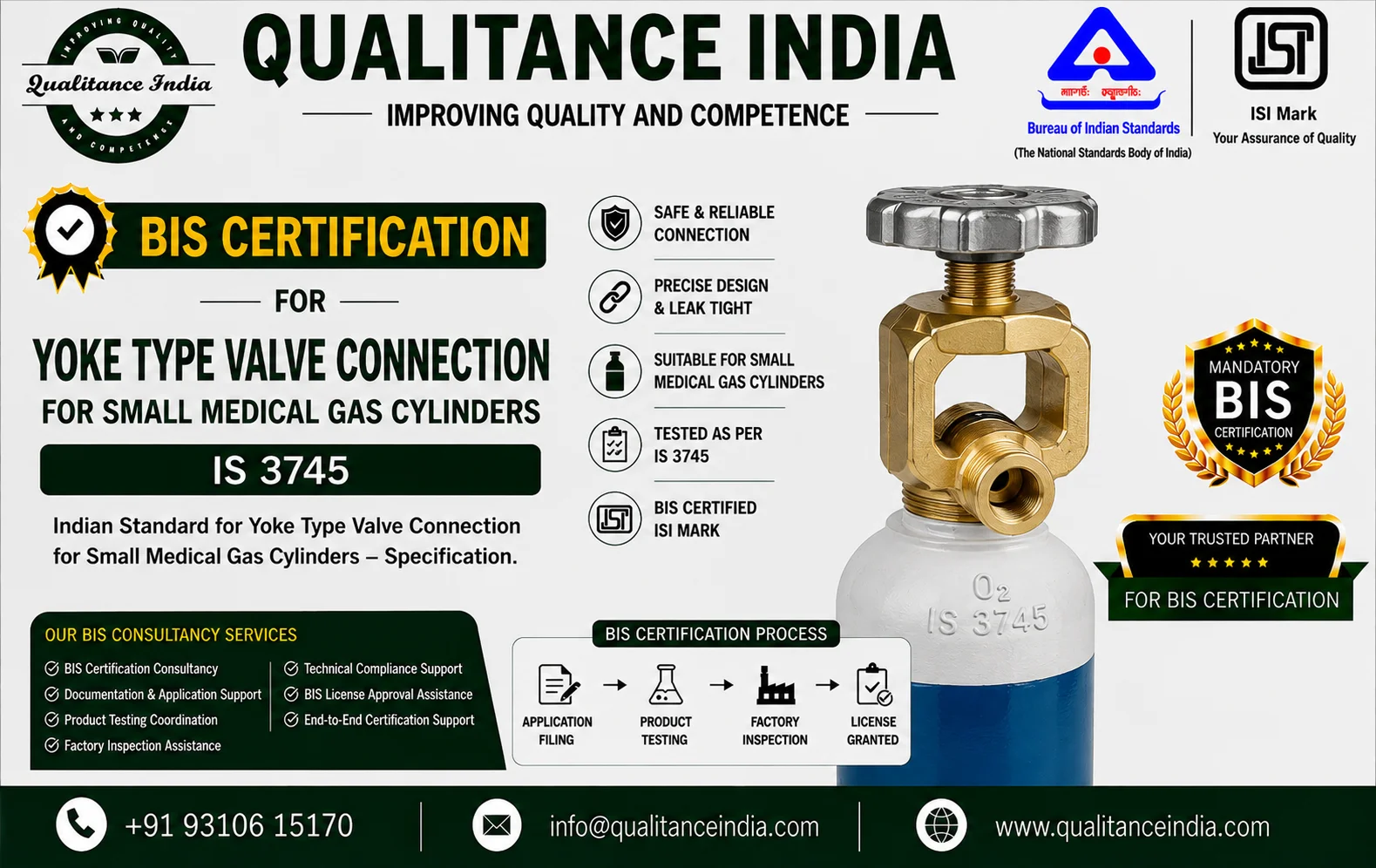
BIS Certification Consultancy for Yoke Type Valve Connections for Small Medical Gas Cylinders | IS 3745
Introduction
Yoke Type Medical Cylinder Valves with Pin Index Connection are specialized valve assemblies used with small medical gas cylinders. These valves are critical components in medical-gas systems because they control the connection between a gas cylinder and the medical-gas delivery equipment.
Correct inlet and outlet connections, dimensional compatibility, material integrity, pressure resistance, leakage performance, operating torque and endurance are essential to safe and reliable operation.
The earlier Indian Standard was IS 3745:2006 – Yoke Type Valve Connections for Small Medical Gas Cylinders – Specification (Second Revision). BIS subsequently revised the standard to IS 3745:2024 – Yoke Type Medical Cylinder Valve with Pin Index Connection (Third Revision). BIS's implementation guideline specified 14 April 2025 as the final date for implementation of the revised standard.
The current BIS Product Manual is PM/IS 3745/3/December 2024 and is issued under Scheme-I of the BIS Conformity Assessment Regulations, 2018.
Qualitance India provides end-to-end BIS Certification consultancy for manufacturers of Yoke Type Medical Cylinder Valves, including product assessment, documentation, laboratory testing coordination, technical compliance, factory inspection preparation and BIS licence support.
Current BIS Standard for IS 3745
The current standard is:
IS 3745:2024 – Yoke Type Medical Cylinder Valve with Pin Index Connection (Third Revision).
The previous standard:
IS 3745:2006 – Yoke Type Valve Connections for Small Medical Gas Cylinders
was superseded after implementation of the revised standard.
BIS's December 2024 Product Manual confirms that certification is now operated against IS 3745:2024.
Important Transition Update
BIS originally prescribed 14 April 2025 as the implementation deadline for IS 3745:2024. BIS subsequently published an archive notice concerning extension of the concurrent-running period of IS 3745:2006 and IS 3745:2024.
For any new application, licence renewal, scope change or transition activity, manufacturers should therefore verify the exact current requirement with BIS and work to the latest applicable standard and Product Manual.
Is BIS Certification Required for IS 3745?
Yes. BIS's current Scheme-I compulsory-certification list includes:
IS 3745 – Yoke Type Valve Connection for Small Medical Gas Cylinders.
The current Product Manual operates the certification process under Scheme-I.
Accordingly, manufacturers of covered products should obtain and maintain the applicable BIS certification before supplying products for applications subject to the compulsory certification framework.
What Are Yoke Type Medical Cylinder Valves?
A Yoke Type Medical Cylinder Valve is a valve designed for connection to a small medical gas cylinder using a pin-index connection arrangement.
Its major functions include:
- Controlling gas flow from the cylinder
- Providing the specified cylinder-to-equipment connection
- Preventing incompatible gas-equipment connections
- Maintaining gas tightness
- Withstanding internal pressure
- Providing reliable repeated operation
- Maintaining dimensional compatibility
The pin-index arrangement is particularly important in medical-gas applications because connection geometry is used to provide gas-specific connection identification.
Medical Gases and Gas Mixtures
The exact gas or gas-mixture configuration is an important part of the licence scope.
The current Product Manual's scope-of-licence format specifically requires declaration of:
- Type of gas/gas mixture
- Inlet connection
- Outlet connection
- Whether a Pressure Relief Device is provided
- PRD flow rate, where applicable
- Other applicable aspects
- PESO approval number
- Approved drawing number
Therefore, manufacturers should finalize the exact valve configuration before submitting their application and samples.
Scope of BIS Licence
The current Product Manual states that the licence scope is to be described against IS 3745:2024 with details including:
Type of Gas/Gas Mixture
The specific gas or mixture for which the valve is designed must be declared.
Inlet Connection
The inlet connection must correspond to the approved configuration.
Outlet Connection
The particular outlet connection must be identified.
Pressure Relief Device
The licence scope must indicate whether a Pressure Relief Device is provided and, where provided, its flow rate.
PESO Approval and Drawing
The scope format also requires reference to applicable PESO approval number and drawing number.
This makes product drawing and regulatory-approval documentation especially important in the certification process.
Product Grouping
The current Product Manual states:
Each variety of valve shall be tested for Grant of Licence (GoL) / Change in Scope of Licence (CSoL).
This is a significant requirement.
A manufacturer should not assume that testing one valve configuration automatically covers every gas, inlet connection, outlet connection or PRD configuration.
The desired licence scope should therefore be finalized before testing.
BIS Sample Requirements
The current Product Manual specifies the following samples:
| Sample Type | Quantity |
|---|---|
| Assembled valves | 5 pieces |
| Samples for tensile and Izod testing | 3 pieces each |
| Valve body pieces for chemical testing | 3 pieces |
| Brass components | 5 pieces |
These sample requirements are specified in the current PM/IS 3745/3/December 2024.
Manufacturers should prepare the samples according to the exact product configuration and test requirements.
Raw Material Requirements
The current Product Manual requires valve-body and component materials to comply with the relevant requirements of IS 3745:2024.
The manufacturer must obtain material test certificates from suppliers, and approved material according to the drawing is to be used. The manufacturer must maintain identification and traceability between the valves and the associated material certificates. Materials with seams, cracks, lamination or other injurious defects must not be used.
For metallic and non-metallic components in contact with medical gas, the revised standard introduced compatibility requirements based on:
- IS/ISO 11114-1 for metallic materials
- IS/ISO 11114-2 for non-metallic materials
This is an important change from the earlier standard.
Material Testing
The current Product Manual identifies:
Chemical Composition of Valve Body
This is a subcontractable test performed on one sample from each material consignment, although further testing is not required where the material is accompanied by the required test certificate or is ISI Marked.
Tensile Strength and Elongation
Tensile strength and percentage elongation are required tests and are carried out for each control unit.
The Product Manual references IS 1608 for the applicable method.
Izod Impact Strength
Izod impact strength is required for each control unit, with the test method referenced to IS 1598.
Important Infrastructure Requirement: Forging and Machining
One of the most important certification requirements for this product concerns the valve housing.
The current Product Manual states that the licensee must possess all requisite infrastructure for forging and machining of the valve housing in its own premises.
The forgings of the valve housing/body and their machining cannot be subcontracted or purchased from outside.
This requirement should be checked carefully before submitting a BIS application.
Manufacturing Process
A typical manufacturing process for a Yoke Type Medical Cylinder Valve can include:
1. Material Procurement
Approved metallic and non-metallic materials are procured with appropriate test certificates and traceability.
2. Forging
The valve housing/body is forged within the manufacturer's own premises.
3. Heat Treatment
The forged component may undergo controlled thermal processing as required.
4. Machining
The valve body, threads, connection interfaces and other features are machined in-house.
5. Component Manufacturing
Brass components and other valve parts are manufactured or processed according to approved drawings.
6. Protective Finish
Applicable surface treatment/electroplating is carried out.
7. Valve Assembly
Internal components, seals and operating components are assembled.
8. Dimensional Inspection
Inlet, outlet and yoke dimensions are verified.
9. Pressure and Leakage Testing
The assembled valve is tested for hydraulic burst pressure and internal/external tightness as applicable.
10. Torque and Endurance Testing
Operating torque and repeated-operation endurance are verified.
11. Final Inspection
Conforming valves are inspected and prepared for marking and dispatch.
Major Tests Under IS 3745:2024
The revised standard introduced important technical changes and additional testing.
The current Product Manual identifies the following major tests.
1. Design Validation
Design validation is required during initial approval and whenever there is a change in design or material.
A fully dimensional sectional drawing and manufacturing scheme must be submitted for approval.
2. Tensile Strength
The material of the valve body is tested for tensile strength.
3. Percentage Elongation
Elongation is evaluated as part of the material mechanical-property testing.
4. Izod Impact Strength
The valve-body material is evaluated for impact strength.
5. Protective Finish – Appearance
The finished valve is examined for appearance according to IS 1068.
This is a routine check on every valve.
6. Protective Finish – Thickness
Coating thickness is verified according to the applicable provisions of IS 1068.
The Product Manual requires one sample from each batch of up to 1000 valves electroplated at a time.
7. Protective Finish – Ductility
Ductility of the protective finish is checked according to IS 1068.
8. Protective Finish – Adhesion
Coating adhesion is checked according to the applicable IS 1068 method.
9. Corrosion Resistance
The protective finish is assessed for corrosion resistance using the applicable salt-spray requirements.
Valve Connection Tests
10. Yoke Dimensions
Yoke dimensions are verified according to the applicable clauses of the standard.
The equipment can include:
- Vernier caliper
- Micrometer
11. Valve Outlet Connections
The outlet connection dimensions are checked against the specified gas-specific configurations.
The current Product Manual covers outlet connections under Clauses 9.1 to 9.11.
12. Valve Inlet Connections
The inlet connection is checked according to Clause 10 of IS 3745:2024 and the applicable provisions of IS 3224.
Suitable thread plug gauges and ring gauges are required.
Pressure Testing
13. Hydraulic Burst Pressure Test
This is one of the most important changes introduced by IS 3745:2024.
BIS specifically identified Hydraulic Burst Pressure Test as a new test added in the revised standard.
The current Product Manual requires this test on 2 valves from each control unit.
A suitable test bench with pressure gauge is required.
14. Internal and External Tightness Test
Every valve is checked for internal and external tightness.
The current Product Manual classifies this as an in-house required test.
Leakage control is especially important for medical gas applications.
Pressure Relief Device Testing
Where a Pressure Relief Device is provided, applicable testing includes:
Minimum Flow Rate
Two valves are tested from each control unit for the applicable PRD flow-rate requirement.
Relief/Bursting Pressure
Two valves are tested from each control unit for the applicable relief/bursting-pressure requirement.
The licence scope must indicate whether a PRD is provided and, where applicable, its flow rate.
Valving Torque Test
The valving torque test evaluates the force/torque required to operate the valve.
The current Product Manual specifies:
One sample out of 5,000 valves of the same type, subject to a minimum of one valve per month.
The test requires a suitable torque wrench and fixture.
Endurance Test
The endurance test evaluates the valve's ability to withstand repeated operation.
The current Product Manual specifies:
One sample out of 5,000 valves of the same type, subject to a minimum of one valve per month.
A holding fixture and cycle counter are required for this test.
BIS's revised-standard implementation guideline states that the endurance-test procedure was modified to align with the procedure specified in IS 3224.
Testing Equipment Required
The current Product Manual lists major equipment required for IS 3745:2024.
Important equipment includes:
- Tensile testing machine
- Izod impact testing machine
- Coating-thickness test equipment
- Salt-spray chamber
- Adhesion-test arrangement
- Thread plug gauges
- Ring gauges
- Hydraulic pressure-test bench
- Pressure gauges
- Torque wrench
- Torque-test fixture
- Endurance-test fixture
- Cycle counter
- Vernier caliper
- Micrometer
The equipment list is indicative and not exhaustive.
Calibration Requirements
The current Product Manual specifies calibration frequencies for important equipment.
Universal Testing Machine
Once a year
Impact Testing Machine
Once every three years
Pressure Gauges
Once a month
Pyrometer Used for Heating Furnace
Once every six months
Master Gauges
Master gauges used to check inspection gauges are to be sent for independent laboratory rechecking once every three years.
Manufacturers should maintain calibration records and ensure that equipment remains valid before performing certification-related testing.
Quality Assurance Plan
The manufacturer should establish a strong Quality Assurance Plan covering:
- Material inspection
- Material certificates
- Heat-number traceability
- Forging controls
- Machining controls
- Heat-treatment controls
- Protective-finish controls
- Dimensional inspection
- Gas-specific connection verification
- Pressure testing
- Leakage testing
- Torque testing
- Endurance testing
- Rejection controls
- Calibration
- Product identification
- Final inspection
All applicable test records must be maintained.
Control Unit for IS 3745:2024
The current Product Manual defines the control unit as:
A lot of valve blanks of the same type and size manufactured in a day from material from the same supplier or blanks from the same heat number, whichever is later, under similar production conditions.
This definition is important for routine testing and finished-lot inspection.
Finished Lot Inspection
The current Product Manual uses the same control unit as the lot for finished-lot inspection.
Depending on lot size, random samples are taken for valve inlet connections, valve outlet connections and internal/external tightness testing:
| Control Unit Size | Sample Size |
|---|---|
| Up to 500 | 13 |
| 501–1000 | 20 |
| Over 1000 | 32 |
If a sample fails one of the specified requirements, the licensee must test all valves in the lot for the failed requirement, segregate the lot and re-offer the segregated lot for BIS inspection as a fresh lot.
Hydraulic burst pressure, coating thickness and applicable PRD pressure/flow tests are performed on 2 valves from each control unit.
Routine Testing
The current Product Manual identifies the following important routine controls:
| Test | Frequency |
|---|---|
| Valve body chemical composition | Each material consignment |
| Tensile strength & elongation | Each control unit |
| Izod impact | Each control unit |
| Protective-finish appearance | Each valve |
| Coating thickness | 1 per 1000 valves or less electroplated at a time |
| Ductility | 1 per 1000 valves or less electroplated at a time |
| Adhesion | 1 per 1000 valves or less electroplated at a time |
| Corrosion resistance | 1 per 1000 valves or less electroplated at a time |
| PRD flow rate, if provided | 2 per control unit |
| PRD relief/bursting pressure, if provided | 2 per control unit |
| Yoke dimensions | Each valve |
| Outlet connections | Each valve |
| Inlet connections | Each valve |
| Hydraulic burst pressure | Each control unit |
| Internal & external tightness | Each valve |
| Valving torque | 1 per 5000 valves, minimum 1/month |
| Endurance | 1 per 5000 valves, minimum 1/month |
These requirements are drawn from the current December 2024 Product Manual.
Material Certificates
The manufacturer must obtain material test certificates from suppliers and maintain a method to identify valves against those certificates.
Where the prescribed material is already accompanied by the required test certificate or is ISI Marked, further testing may not be required for the relevant material requirement, subject to the Product Manual.
This makes supplier control and traceability an important part of factory preparedness.
Fully Dimensional Drawing
For BIS certification, the manufacturer needs a fully dimensional sectional drawing of the valve and a scheme of manufacture.
The current Product Manual states that this drawing and manufacturing scheme are to be submitted to the inspecting authority for final approval by the statutory authority.
The drawing should clearly identify:
- Valve body
- Inlet connection
- Outlet connection
- Yoke
- Pin-index arrangement
- Threads
- Internal components
- Sealing components
- Pressure relief device, if provided
- Relevant dimensions
- Material specifications
PESO Approval and Drawing
The current licence-scope format specifically calls for:
PESO approval number and drawing number
as applicable.
Manufacturers should therefore keep the applicable statutory approval and approved drawing information ready during certification.
Factory Requirements
The BIS Product Manual places particular emphasis on the manufacturer's own infrastructure.
The licensee must have in-house facilities for:
- Forging valve housing
- Machining valve housing
- Required production controls
- Relevant testing and inspection
The forging and machining of the valve housing/body cannot be outsourced or purchased from an external source.
This requirement should be confirmed before the application is submitted.
Factory Inspection
During the BIS assessment, important areas may include:
Raw Material Section
BIS may verify:
- Material certificates
- Heat numbers
- Material identification
- Incoming inspection
Forging Section
The manufacturer should demonstrate its own valve-housing forging capability.
Machining Section
Machining of the valve body should be carried out within the manufacturer's premises.
Surface-Finish Section
Electroplating/protective-finishing controls should be available where applicable.
Assembly Section
Valve assembly must follow the approved design.
Laboratory
Testing equipment should be available, calibrated and operated by competent personnel.
Quality Records
The manufacturer should maintain:
- Production records
- Test reports
- Calibration records
- Material certificates
- Control-unit records
- Rejection records
- Corrective-action records
BIS Marking Requirements
The current Product Manual states that labelling and marking shall be according to IS 3745:2024.
Only valves conforming to the applicable requirements and covered by the BIS licence should carry the Standard Mark.
The manufacturer must ensure:
- Correct BIS Standard Mark
- Product identification
- Approved product configuration
- Traceability
- Applicable licence information
- Proper marking durability
Rejected or non-conforming valves must not be presented as BIS-certified.
Test Certificate and Inspection Records
The current Product Manual includes a prescribed test certificate format for IS 3745 certification.
The certificate records items such as:
- Manufacturer
- Purchaser
- Order number
- Control-unit number
- Valve fittings description
- Outlet number
- Quantity offered
- Valve inlet connection
- Valve outlet connection
- Internal and external tightness
- Hydraulic burst pressure
- Coating thickness
- Tensile/elongation results
- Impact results
- Valving torque
- Endurance test
BIS inspection records also distinguish tests verified from manufacturer records from tests performed during lot inspection.
Important Changes from IS 3745:2006 to IS 3745:2024
The revision from IS 3745:2006 to IS 3745:2024 introduced several significant technical changes.
Material Compatibility
Metallic and non-metallic materials in contact with gas now have modified compatibility requirements referencing IS/ISO 11114-1 and IS/ISO 11114-2.
Valve Design
Specific valve design requirements have been introduced.
Pressure Relief Device
Requirements for pressure relief devices have been specified.
Hydraulic Burst Pressure
Hydraulic burst pressure testing was added as a new product test.
Endurance Testing
The endurance-test procedure was modified to follow the procedure in IS 3224.
These changes should be considered carefully by manufacturers transitioning from the older standard.
BIS Testing Laboratory for IS 3745
The BIS Laboratory Information Management System currently includes IS 3745:2024 – Yoke Type Medical Cylinder Valve with Pin Index Connection in its laboratory scope records.
The LIMS data identifies testing areas including:
- Yoke dimensions
- Outlet connections
- Inlet threads
- Hydraulic burst pressure
- Internal/external tightness
- Valving torque
- Endurance
Laboratory availability and exact test scope should always be checked before sending samples because individual laboratory scopes may contain exclusions.
BIS Testing Cost
The laboratory testing cost for IS 3745 can vary according to:
- Laboratory
- Product variety
- Gas type
- Inlet connection
- Outlet connection
- PRD configuration
- Material testing
- Protective finish
- Number of tests
- Scope of laboratory accreditation/recognition
Current BIS LIMS records do not provide a single universal price applicable to every IS 3745 certification project. Therefore, manufacturers should obtain a laboratory quotation after the exact product scope has been finalized.
Total Cost of BIS Certification
The overall BIS certification expenditure can include:
- BIS application/certification charges
- Product testing
- Sample preparation
- Material testing
- External laboratory testing where permitted
- Testing equipment
- Calibration
- Factory preparation
- Documentation
- Statutory approvals
- Inspection-related expenses
- Re-testing, if required
- Consultancy support
A reliable project estimate should be prepared only after reviewing the actual valve design and proposed licence scope.
Documents Required for BIS Certification
Typical documents may include:
- Company registration documents
- Factory address proof
- Factory layout
- Manufacturing process flow chart
- Machinery list
- Forging-machine details
- Machining-machine details
- Heat-treatment details
- Product drawings
- Fully dimensional sectional drawing
- Scheme of manufacture
- PESO approval information
- Gas/gas-mixture details
- Inlet connection details
- Outlet connection details
- PRD details
- Raw-material specifications
- Material test certificates
- Supplier information
- Laboratory equipment list
- Calibration certificates
- Test procedures
- Test records
- Quality Assurance Plan
- Control-unit records
- Technical personnel details
- GST/business documents
- Trademark information
- Proposed marking details
- BIS declarations and undertakings
The final documentation depends on the product configuration and application.
Quality Control and Traceability
A robust traceability system should connect:
Raw Material → Heat Number → Valve Blank → Forging → Machining → Heat Treatment → Surface Finish → Assembly → Testing → Final Lot → Dispatch
This enables the manufacturer to identify the material and manufacturing history of every production lot.
Common Reasons for BIS Certification Delays
Manufacturers of medical cylinder valves may face delays because of:
- Applying against an outdated standard
- Incorrect gas configuration
- Incomplete approved drawing
- Missing PESO information
- Incorrect inlet connection
- Incorrect outlet connection
- Material incompatibility
- Missing material certificates
- Inadequate forging facility
- Outsourced valve-body machining
- Failed tensile test
- Failed Izod test
- Coating failure
- Leakage failure
- Burst-pressure failure
- Torque failure
- Endurance failure
- Inadequate gauges
- Calibration problems
- Incomplete test records
- Factory inspection observations
The transition to IS 3745:2024 makes it especially important to review the revised technical requirements before testing.
Who Needs BIS Certification for Yoke Type Medical Cylinder Valves?
The requirement is relevant to manufacturers producing covered Yoke Type Medical Cylinder Valves for the applicable Indian market and regulated applications.
Potential manufacturers include:
- Medical-gas equipment manufacturers
- Gas-valve manufacturers
- Medical-cylinder component manufacturers
- Industrial valve manufacturers entering the medical-gas sector
- Specialty gas-equipment manufacturers
The exact regulatory applicability should be checked against the current BIS requirements and the product's intended use.
Benefits of BIS Certification
BIS certification can help manufacturers demonstrate conformity with the applicable Indian Standard and regulatory framework.
Benefits include:
- Compliance with applicable requirements
- Authorization to use the BIS Standard Mark
- Improved customer confidence
- Better product quality
- Improved manufacturing control
- Better material traceability
- Stronger acceptance among institutional buyers
- Better documentation
- Improved process discipline
BIS Certification for Yoke Type Medical Cylinder Valves – Quick Process
Product Assessment → Standard/Revision Verification → Scope Finalization → Drawing & PESO Review → Documentation → Sample Preparation → Laboratory Testing → Factory Inspection → Compliance Closure → BIS Licence → Standard Marking
Why Choose Qualitance India?
Qualitance India provides professional BIS Certification consultancy for Yoke Type Medical Cylinder Valve manufacturers.
Our support can include:
- IS 3745 applicability assessment
- Current-standard/revision review
- Product scope planning
- Gas and connection assessment
- Drawing/document review
- BIS application preparation
- Sample planning
- Laboratory coordination
- Product testing coordination
- Quality Assurance Plan support
- Testing-equipment guidance
- Factory inspection preparation
- Non-conformity response assistance
- BIS licence follow-up
- Post-certification compliance support
We help manufacturers organize the technical and documentation requirements before proceeding with BIS certification.
Frequently Asked Questions
1. What is BIS Certification for Yoke Type Medical Cylinder Valves?
It is the BIS conformity-assessment process for demonstrating conformity of covered Yoke Type Medical Cylinder Valves with the applicable IS 3745 requirements and obtaining authorization to use the BIS Standard Mark.
2. What is the current standard for IS 3745?
The revised standard is IS 3745:2024 – Yoke Type Medical Cylinder Valve with Pin Index Connection (Third Revision).
3. What was the previous standard?
The previous standard was IS 3745:2006 – Yoke Type Valve Connections for Small Medical Gas Cylinders – Specification (Second Revision).
4. Is IS 3745 under compulsory BIS certification?
Yes. BIS's current Scheme-I list includes IS 3745 under compulsory certification.
5. What is the current BIS Product Manual?
The current Product Manual is PM/IS 3745/3/December 2024.
6. What is the sample quantity?
The current Product Manual specifies:
- 5 assembled valves
- 3 pieces each for tensile and Izod material testing
- 3 valve-body pieces for chemical testing
- 5 brass components
7. Does each valve variety require testing?
Yes. The Product Manual states that each variety of valve is to be tested for Grant of Licence or Change in Scope.
8. What is included in the BIS licence scope?
The scope includes gas/gas-mixture type, inlet connection, outlet connection, PRD details where applicable, and applicable PESO approval/drawing information.
9. Is a PESO approval number required?
The current scope format includes PESO approval number and drawing number as applicable.
10. What materials are covered?
The valve body and components must comply with the applicable material requirements of IS 3745:2024. The revised standard also addresses compatibility of metallic and non-metallic materials in contact with gas.
11. Can valve-body forging be outsourced?
No. The current Product Manual requires the licensee to possess the required valve-housing forging infrastructure in its own premises.
12. Can machining of the valve body be outsourced?
No. The Product Manual states that machining of the valve housing/body cannot be subcontracted or purchased from outside.
13. Is hydraulic burst-pressure testing required?
Yes. Hydraulic Burst Pressure Test was added under IS 3745:2024 and is performed on two valves from each control unit under the current Product Manual.
14. Is leakage testing required?
Yes. Internal and external tightness testing is required on each valve.
15. Is tensile testing required?
Yes. Tensile strength and percentage elongation are tested for each control unit.
16. Is Izod impact testing required?
Yes. Izod impact strength is tested for each control unit.
17. Are coating tests required?
Yes, where protective finishing is applicable. Testing includes appearance, thickness, ductility, adhesion and corrosion resistance.
18. Is yoke-dimension testing required?
Yes. Yoke dimensions are checked on every valve.
19. Are inlet and outlet connections tested?
Yes. Inlet and outlet connection requirements are checked on every valve under the current routine-control provisions.
20. Is a pressure relief device compulsory?
The Product Manual provides requirements if a pressure relief device is provided. Where provided, the applicable PRD flow rate and relief/bursting pressure are tested.
21. How often is the valving torque test performed?
One sample from 5,000 valves of the same type, subject to a minimum of one valve per month.
22. How often is the endurance test performed?
One sample from 5,000 valves of the same type, subject to a minimum of one valve per month.
23. What is the control unit?
A control unit is a lot of valve blanks of the same type and size manufactured in a day from the same supplier's material or the same heat number, whichever is later, under similar production conditions.
24. What are the finished-lot inspection sample sizes?
They are:
- Up to 500 valves: 13 samples
- 501 to 1000 valves: 20 samples
- More than 1000 valves: 32 samples
25. What happens if a sample fails during lot inspection?
The licensee must test all valves in the lot for the failed requirement, segregate the lot and re-offer the segregated lot as a fresh lot for BIS inspection.
26. What calibration is required?
The Product Manual specifies annual calibration for the Universal Testing Machine, three-year calibration for the Impact Testing Machine, monthly calibration for pressure gauges and six-month calibration for the furnace pyrometer.
27. Is an in-house laboratory required?
The manufacturer must maintain a suitably equipped and staffed laboratory for the applicable tests identified in the Scheme of Inspection and Testing.
28. Can material testing be subcontracted?
The current Product Manual identifies chemical composition and metallic/non-metallic component compatibility testing as subcontractable, subject to the specified conditions and material certificates.
29. Which external standards are referenced for testing?
Important references include:
- IS 1068 for protective finish
- IS 1608 for tensile testing
- IS 1598 for Izod impact testing
- IS 3224 for inlet connection and the revised endurance-test procedure
- IS/ISO 11114-1 for metallic gas-contact material compatibility
- IS/ISO 11114-2 for non-metallic gas-contact material compatibility
30. Can Qualitance India provide complete BIS consultancy for IS 3745?
Yes. Qualitance India provides end-to-end support including product-scope assessment, documentation, laboratory coordination, technical compliance, factory inspection preparation and BIS licence assistance.
Frequently Searched Topics
- BIS Certification for Yoke Type Medical Cylinder Valve
- IS 3745 BIS Certification
- IS 3745:2024 Certification
- IS 3745:2006 Certification
- Yoke Type Valve BIS Licence
- Medical Gas Cylinder Valve BIS
- Pin Index Valve BIS Certification
- Medical Cylinder Valve Testing
- IS 3745 Testing
- Yoke Type Valve Testing Laboratory
- BIS Testing for Medical Gas Valves
- Hydraulic Burst Pressure Test IS 3745
- Medical Valve Leakage Test
- Medical Cylinder Valve Endurance Test
- Medical Gas Valve Torque Test
- PESO Approval for Medical Gas Valve
- BIS Licence for Medical Gas Valve Manufacturer
- Medical Cylinder Valve Certification in India
- BIS Consultant for Medical Gas Equipment
- IS 3745 Product Certification
Related BIS Certification Services
Qualitance India also provides BIS consultancy for manufacturers of:
Gas Cylinder Valves | Medical Gas Equipment | Pressure Equipment | Engineering Products | Fire-Safety Products | Metal Products | Electrical Products | Medical Products | Industrial Components
Our services include:
BIS Certification Consultancy | BIS Licence | ISI Mark Certification | Product Testing | Documentation Support | Factory Inspection Assistance | Quality Plan Preparation | Technical Compliance Support | Scope Extension | Licence Renewal | End-to-End BIS Support
Contact Qualitance India
Qualitance India BIS Certification Consultancy for Manufacturers
Phone: +91 93106 15170 Email: info@qualitanceindia.com Website: https://qualitanceindia.com/
Manufacturers of Yoke Type Medical Cylinder Valves can contact Qualitance India for assistance with IS 3745 certification, product testing, scope planning, drawing/document review, laboratory coordination, factory inspection preparation and BIS licence support.
Conclusion
Yoke Type Medical Cylinder Valves with Pin Index Connections are important safety-critical components used in medical gas systems. Their connection geometry, material compatibility, pressure integrity, leakage performance, protective finish, operating torque and endurance must be carefully controlled.
The current BIS certification framework is based on the revised IS 3745:2024 – Yoke Type Medical Cylinder Valve with Pin Index Connection, with the current Product Manual PM/IS 3745/3/December 2024. BIS's revision introduced important changes including new design requirements, revised gas-contact material compatibility provisions, pressure-relief-device requirements, a new Hydraulic Burst Pressure Test, and a modified endurance-test procedure.
The Product Manual also contains particularly important manufacturing requirements: the valve-body forging and machining infrastructure must be maintained at the manufacturer's own premises, and each valve variety must be tested for Grant of Licence or Change in Scope.
For manufacturers, successful certification therefore depends on correct product-scope planning, approved drawings, material traceability, in-house manufacturing capability, suitable testing facilities, calibration, quality records and continued compliance.
With professional support from Qualitance India, manufacturers can receive end-to-end assistance for IS 3745 BIS certification, including documentation, laboratory testing coordination, technical compliance, factory inspection preparation and BIS licence processing.