
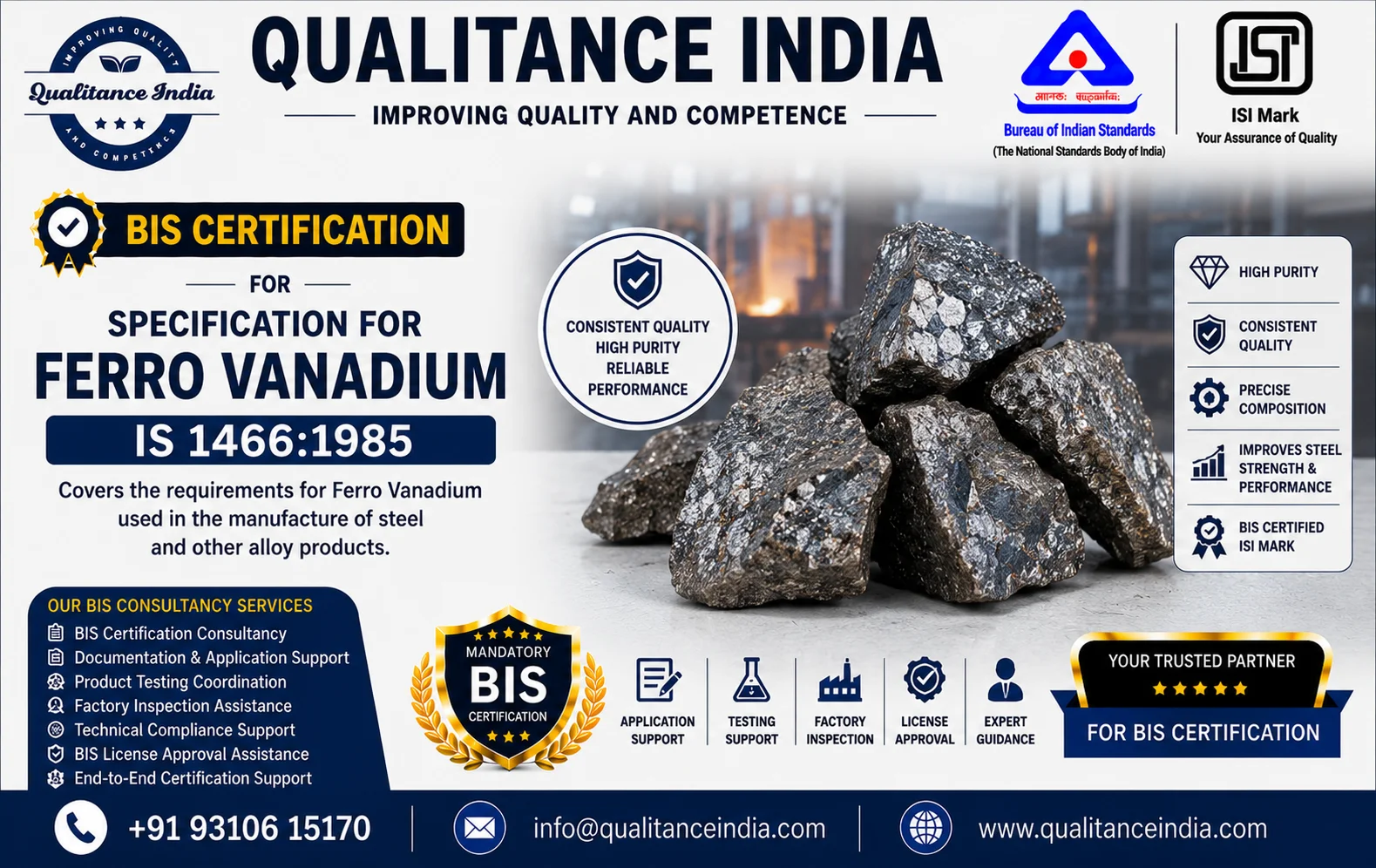
BIS Certification Consultancy for Ferro Vanadium | IS 1466:1985
Introduction
Ferro Vanadium is an important ferroalloy used in the steel industry for producing alloy and high-strength steels. The addition of vanadium can improve important properties of steel, including strength, hardness, wear resistance and high-temperature performance.
For manufacturers and suppliers dealing with Ferro Vanadium in India, compliance with the applicable Indian Standard is important where certification requirements apply.
IS 1466:1985 – Ferro Vanadium specifies requirements relating to the quality and composition of Ferro Vanadium. The standard provides requirements that help maintain consistency in the ferroalloy supplied for industrial applications.
Qualitance India provides BIS Certification Consultancy for Ferro Vanadium as per IS 1466:1985, including assistance with product assessment, documentation, laboratory testing, BIS application and inspection-related requirements.
Product ke baare mein
Ferro Vanadium is a ferroalloy containing vanadium and iron. It is primarily used as an alloying addition during steel manufacturing.
Vanadium-containing steel is used where enhanced mechanical and performance properties are required.
Ferro Vanadium may be used in the production of:
- High-strength low-alloy steel
- Alloy steel
- Tool steel
- High-speed steel
- Structural steel
- Automotive steel
- Engineering steel
- Special-purpose steel
The quality of Ferro Vanadium is strongly dependent on its chemical composition and physical form. Therefore, control over vanadium content, carbon, silicon, sulphur, phosphorus and other specified elements is important.
Applicable IS Standard
The applicable Indian Standard is:
IS 1466:1985 – Ferro Vanadium
The standard specifies requirements for Ferro Vanadium intended for use as an alloying material in steelmaking and related metallurgical applications.
Manufacturers should always verify the latest applicable BIS requirements and current certification status before applying, as standards and regulatory requirements can be revised.
Scope of Standard
IS 1466:1985 covers Ferro Vanadium and specifies requirements relating to its chemical composition and quality.
The standard deals with important characteristics such as:
- Vanadium content
- Carbon content
- Silicon content
- Sulphur content
- Phosphorus content
- Physical form
- Size requirements
- Sampling
- Chemical analysis
- Packing
- Marking
The exact requirements depend on the applicable grade and provisions of the current edition of the standard.
Product Requirements
Ferro Vanadium needs to meet the applicable chemical and physical requirements specified under IS 1466:1985.
Important product characteristics include:
Vanadium Content
Vanadium is the primary alloying element in Ferro Vanadium. The specified vanadium content must conform to the applicable grade requirements.
Carbon
Carbon content needs to remain within the permissible limit specified for the applicable grade.
Silicon
Silicon is another important parameter that may affect the performance and suitability of the ferroalloy.
Sulphur
Sulphur content needs to comply with the applicable requirement.
Phosphorus
Phosphorus is controlled because excessive phosphorus can adversely affect steel properties.
Particle Size
The material should comply with applicable requirements regarding size and physical form.
Appearance
The ferroalloy should have suitable physical characteristics and should be free from unacceptable contamination.
Testing Requirements
Testing is an important part of BIS Certification for Ferro Vanadium.
Depending on the applicable requirements, testing and inspection may cover:
- Chemical composition
- Vanadium content
- Carbon
- Silicon
- Sulphur
- Phosphorus
- Particle size
- Physical condition
- Sampling
- Other applicable characteristics
Chemical analysis is particularly important because Ferro Vanadium is primarily specified according to its chemical composition.
Manufacturers should have suitable testing arrangements or access to a competent laboratory capable of performing the required analysis.
Chemical Composition Testing
Chemical composition testing is one of the most important checks for Ferro Vanadium.
Testing may be carried out to verify the specified alloying and impurity elements.
Important parameters can include:
- Vanadium
- Carbon
- Silicon
- Sulphur
- Phosphorus
The test method should be in accordance with the applicable requirements of IS 1466:1985 and the relevant referenced methods.
Proper sampling is also important because the test sample must adequately represent the production lot.
Sampling Requirements
Representative sampling is essential for Ferro Vanadium certification.
The manufacturer should maintain a systematic procedure for:
- Lot identification
- Sample selection
- Sample preparation
- Sample sealing
- Sample identification
- Laboratory submission
- Test record maintenance
Each production lot should be traceable to the relevant raw materials and manufacturing records.
Raw Material Requirements
The quality of Ferro Vanadium depends on the quality and consistency of the raw materials used during manufacturing.
Depending on the manufacturing process, raw materials may include:
- Vanadium-bearing material
- Iron-containing material
- Reducing agents
- Fluxes
- Other process materials
Manufacturers should maintain suitable records for incoming materials.
These may include:
- Supplier details
- Purchase records
- Material certificates
- Chemical analysis reports
- Batch/lot numbers
- Incoming inspection reports
- Material traceability records
Manufacturing Requirements
A typical Ferro Vanadium manufacturing process may involve:
- Raw material selection
- Incoming material inspection
- Material preparation
- Proportioning
- Mixing
- Smelting or reduction
- Alloy formation
- Cooling
- Crushing
- Screening
- Size classification
- Chemical analysis
- Lot formation
- Final inspection
- Packing
- Marking
The actual process can vary depending on the manufacturer's production technology and raw-material source.
Manufacturers should maintain process controls to ensure consistency from batch to batch.
BIS Certification Process
The BIS Certification process for Ferro Vanadium generally involves the following stages.
Step 1 – Product Assessment
The product is evaluated against the requirements of IS 1466:1985.
Step 2 – Product Scope
Applicable grades, chemical composition and product forms are identified.
Step 3 – Factory Assessment
The manufacturing facility and quality-control arrangements are reviewed.
Step 4 – Documentation
Technical and manufacturing documents are prepared.
Step 5 – Sample Preparation
Representative Ferro Vanadium samples are prepared according to the applicable requirements.
Step 6 – Laboratory Testing
Samples are tested for applicable chemical and physical characteristics.
Step 7 – BIS Application
The application and supporting documents are submitted to BIS.
Step 8 – Application Scrutiny
BIS reviews the application and submitted information.
Step 9 – Factory Inspection
The manufacturing facility may be assessed for production and testing capabilities.
Step 10 – Compliance
Any observations or deficiencies are addressed.
Step 11 – Licence Grant
After successful completion of the applicable requirements, the BIS licence is granted for the approved scope.
Documents Required
Manufacturers may need to prepare documents such as:
- Company registration documents
- Factory address proof
- Factory layout
- Manufacturing process flow
- Machinery details
- Product specifications
- Grade details
- Raw-material details
- Raw-material test reports
- Chemical analysis reports
- Product test reports
- Laboratory details
- Testing equipment list
- Calibration certificates
- Quality-control plan
- Inspection records
- Production records
- Packing details
- Marking details
- Product photographs
- Authorised signatory documents
- Trademark documents, where applicable
The exact document requirements depend on the applicant, product and applicable BIS procedure.
Factory Inspection
Factory inspection helps verify whether the manufacturer has adequate arrangements to consistently produce conforming Ferro Vanadium.
During inspection, areas that may be reviewed include:
Raw Material Storage
Raw materials should be properly identified and stored.
Manufacturing Facilities
Equipment used for material preparation, smelting, crushing and screening may be assessed.
Chemical Testing
Suitable facilities or arrangements should exist for testing chemical composition.
Measuring Equipment
Relevant instruments should have appropriate calibration and verification records.
Quality Control
Incoming, in-process and final product inspection systems should be maintained.
Traceability
Production lots should be identifiable and traceable.
Records
Production, inspection, testing and calibration records should be properly maintained.
Product Quality Checks
Manufacturers should perform appropriate quality checks throughout production.
These may include:
- Raw-material inspection
- Chemical composition verification
- Vanadium content testing
- Carbon testing
- Silicon testing
- Sulphur testing
- Phosphorus testing
- Particle-size inspection
- Appearance inspection
- Lot-wise testing
- Packing inspection
- Marking verification
- Final product inspection
Maintaining consistent quality records can help demonstrate effective production control.
Common Reasons for Testing/Certification Failure
Some common reasons for failure or delay may include:
- Incorrect chemical composition
- Vanadium content outside the specified range
- Excessive carbon
- Excessive silicon
- Excessive sulphur
- Excessive phosphorus
- Improper sampling
- Non-representative test samples
- Incorrect particle size
- Poor raw-material control
- Inadequate chemical testing facilities
- Missing calibration records
- Incomplete production records
- Inadequate traceability
- Incorrect product documentation
- Incorrect marking
- Incomplete BIS application
- Failure to address inspection observations
Pre-testing and proper quality-control procedures can help reduce avoidable failures.
BIS Marking
After certification, the manufacturer must follow the applicable BIS marking requirements.
Product marking should be carried out according to the conditions of the BIS licence and applicable requirements.
Depending on the applicable provisions, marking information may include:
- BIS Standard Mark
- Licence number
- Manufacturer's identification
- Product name
- Grade
- Batch or lot identification
- Size or physical form
- Other required information
Manufacturers should use the exact marking format applicable to their approved BIS certification scope.
Who Needs BIS Certification
BIS Certification requirements depend on the applicable regulatory framework and the product's intended scope.
Manufacturers involved in producing Ferro Vanadium for industrial and steelmaking applications should assess whether their product falls under a compulsory certification requirement.
This may include:
- Ferroalloy manufacturers
- Ferro Vanadium manufacturers
- Metallurgical material manufacturers
- Alloy manufacturers
- Steel-industry material suppliers
- Manufacturers supplying Ferro Vanadium to regulated industries
Before placing a product in the Indian market, manufacturers should verify the latest BIS/QCO requirements applicable to IS 1466:1985.
Cost
The total cost of BIS Certification for Ferro Vanadium depends on several factors.
These may include:
- BIS application charges
- Laboratory testing charges
- Number of grades
- Number of product varieties
- Sample requirements
- Factory inspection expenses
- Testing equipment
- Calibration
- Retesting, if required
- Consultancy charges
Therefore, an exact certification cost can only be estimated after reviewing the product, manufacturing process and proposed certification scope.
Timeline
The certification timeline depends on:
- Product readiness
- Documentation
- Laboratory availability
- Sample preparation
- Testing
- Test results
- BIS application scrutiny
- Factory inspection
- Closure of observations
A manufacturer with properly prepared documentation, testing facilities and quality-control records can generally avoid unnecessary delays.
Benefits
Consistent Product Quality
Testing and quality-control procedures help maintain consistency in Ferro Vanadium production.
Better Customer Confidence
Certification can provide greater confidence to industrial and steel-sector customers.
Regulatory Compliance
Where BIS certification is mandatory, obtaining the required certification helps meet regulatory obligations.
Market Acceptance
Compliance with applicable Indian Standards can support market acceptance.
Better Quality Control
A structured certification system encourages systematic inspection and testing.
Business Credibility
Compliance with relevant standards can strengthen the manufacturer's credibility in the ferroalloy market.
Why Choose Qualitance India
Qualitance India provides BIS Certification Consultancy for manufacturers of industrial, chemical, metallurgical, steel and engineering products.
For Ferro Vanadium as per IS 1466:1985, our support can include:
- Product applicability assessment
- IS 1466:1985 requirement review
- Product scope assessment
- Documentation assistance
- Testing requirement identification
- Laboratory testing coordination
- Sample preparation guidance
- BIS application assistance
- Factory inspection preparation
- Testing equipment guidance
- Quality-control documentation
- Observation closure support
- BIS certification assistance
Our aim is to make the certification process more organised and easier for manufacturers to manage.
Complete Process
Product Identification
↓
IS 1466:1985 Requirement Review
↓
Grade & Product Scope Assessment
↓
Factory & Testing Facility Review
↓
Documentation Preparation
↓
Sample Preparation
↓
Laboratory Testing
↓
BIS Application
↓
Application Scrutiny
↓
Factory Inspection
↓
Observation Closure
↓
BIS Licence Grant
↓
BIS Marking
20 FAQs
1. What is Ferro Vanadium?
Ferro Vanadium is a ferroalloy containing vanadium and iron, primarily used as an alloying addition in steel manufacturing.
2. What is IS 1466:1985?
IS 1466:1985 is the Indian Standard applicable to Ferro Vanadium.
3. Why is Ferro Vanadium used in steelmaking?
Vanadium can improve the strength, hardness, wear resistance and other performance characteristics of steel.
4. What is tested in Ferro Vanadium?
Important tests can include chemical composition and physical characteristics according to the applicable requirements.
5. Is Vanadium content tested?
Yes. Vanadium is the primary alloying element and its content is an important quality parameter.
6. Are impurities tested?
Applicable impurity elements may include carbon, silicon, sulphur and phosphorus.
7. Is sampling important for Ferro Vanadium?
Yes. Representative sampling is important because the laboratory result must accurately represent the production lot.
8. What documents are required for BIS Certification?
Product specifications, factory documents, manufacturing details, testing records, raw-material documents and quality-control records may be required.
9. Is factory inspection required?
Factory assessment may be part of the applicable BIS certification process.
10. Does the manufacturer need testing facilities?
The applicable testing requirements should be assessed and suitable testing arrangements should be maintained.
11. Are calibration certificates required?
Where measuring and testing equipment is used, appropriate calibration or verification records should be maintained.
12. Can multiple grades be included in certification?
The permitted certification scope depends on applicable BIS requirements and the manufacturer's demonstrated capabilities.
13. What can cause Ferro Vanadium testing failure?
Incorrect chemical composition, excessive impurities, improper sampling and other non-conformities can result in failure.
14. Is particle size important?
Where particle-size requirements apply, the Ferro Vanadium should comply with the specified requirements.
15. Can imported Ferro Vanadium require BIS compliance?
Import requirements depend on the applicable regulatory framework and product scope. Importers should verify the current requirements before shipment.
16. How much does BIS Certification cost?
The cost depends on testing, product scope, factory inspection and other applicable charges.
17. How long does certification take?
The timeline depends on testing, documentation, application scrutiny, factory inspection and observation closure.
18. Can Qualitance India help with laboratory testing?
Yes. Qualitance India can assist manufacturers with laboratory-testing coordination and related certification requirements.
19. Can Qualitance India help with BIS application?
Yes. Consultancy support can include documentation and BIS application assistance.
20. Why should manufacturers follow IS 1466:1985?
Following the applicable standard helps maintain consistent Ferro Vanadium quality and supports compliance with relevant certification requirements.
People Also Ask
What is the BIS standard for Ferro Vanadium?
The applicable Indian Standard is IS 1466:1985.
What is Ferro Vanadium used for?
It is primarily used as an alloying addition in steel and other metallurgical applications.
What tests are required for Ferro Vanadium?
Chemical composition and applicable physical characteristics are evaluated according to the requirements of the relevant standard.
What chemical elements are important in Ferro Vanadium?
Vanadium is the primary element, while carbon, silicon, sulphur and phosphorus can also be important specified parameters.
How can I get BIS Certification for Ferro Vanadium?
The process generally involves product assessment, documentation, sample testing, BIS application, factory assessment and completion of applicable requirements.
Who can help with Ferro Vanadium BIS Certification?
Qualitance India provides consultancy support for BIS certification, testing coordination, documentation and factory inspection preparation.
Related BIS Certification Services
- BIS Certification for Ferro Alloys
- BIS Certification for Ferro Manganese
- BIS Certification for Ferro Silicon
- BIS Certification for Ferro Chrome
- BIS Certification for Steel Products
- BIS Certification for Alloy Steel
- BIS Certification for Carbon Steel
- BIS Certification for Metallurgical Products
- BIS Testing Assistance
- BIS Factory Inspection Assistance
Related Topics
- Ferro Vanadium IS 1466:1985
- BIS Certification for Ferro Vanadium
- Ferro Vanadium Testing
- Ferroalloy Certification in India
- Chemical Composition of Ferro Vanadium
- Ferro Vanadium Quality Requirements
- BIS Certification for Ferroalloys
- Ferro Vanadium Manufacturer Certification
- BIS Consultancy for Metallurgical Products
- Indian Standards for Ferroalloys
Contact Qualitance India
Phone: +91 93106 15170
Email: info@qualitanceindia.com
Website: qualitanceindia.com
For assistance with BIS Certification Consultancy for Ferro Vanadium as per IS 1466:1985, contact Qualitance India for product assessment, documentation, testing coordination, BIS application and factory inspection support.
Conclusion
Ferro Vanadium is an important ferroalloy used in the manufacture of different grades of steel where improved strength and other performance properties are required.
IS 1466:1985 provides requirements for Ferro Vanadium, including applicable chemical and physical characteristics. Manufacturers should maintain proper control over raw materials, production processes, sampling, chemical testing, product quality and traceability.
Obtaining and maintaining the applicable BIS certification requires proper preparation of technical documents, testing arrangements, manufacturing facilities and quality-control records.
Qualitance India provides BIS Certification Consultancy for Ferro Vanadium manufacturers, helping with product assessment, documentation, laboratory testing coordination, BIS application and factory inspection preparation.
Phone: +91 93106 15170
Email: info@qualitanceindia.com
Website: qualitanceindia.com