BIS Certification for Wheeled Fire Extinguishers | IS 16018:2012 | BIS Consultancy
Introduction
Wheeled fire extinguishers are high-capacity mobile fire-fighting equipment designed for locations where a larger quantity of extinguishing agent and higher discharge capacity are required. They are commonly used in industrial plants, warehouses, refineries, workshops, storage areas and other locations having significant fire hazards.
Because these extinguishers are pressure-containing safety equipment, their construction, materials, discharge performance, fire-fighting capability, pressure resistance, corrosion resistance and operational durability must meet specified quality requirements.
In India, Wheeled Fire Extinguishers are covered under IS 16018:2012 – Wheeled Fire Extinguishers – Performance and Construction – Specification. The product is included in the mandatory Fire Extinguishers (Quality Control) Order, 2023, which requires covered products to conform to the applicable Indian Standard and bear the Standard Mark under a BIS licence according to Scheme-I.
Qualitance India provides end-to-end BIS Certification consultancy for Wheeled Fire Extinguisher manufacturers, including product scope assessment, documentation, laboratory testing coordination, factory inspection preparation, technical compliance and BIS licence support.
What Are Wheeled Fire Extinguishers?
Wheeled fire extinguishers are fire extinguishers mounted on wheels or a wheeled arrangement so that larger extinguishers can be moved and operated at the location of a fire.
They are particularly useful where:
- Large quantities of extinguishing media are required
- Fire hazards are comparatively high
- The extinguisher cannot conveniently be carried manually
- A longer discharge duration or larger discharge quantity is required
- Industrial and outdoor fire protection is necessary
BIS's fire-extinguisher compendium states that IS 16018:2012 covers wheeled extinguishers with a fully charged mass from 17 kg to 450 kg and includes equipment using water, dry powder, foam, carbon dioxide or clean agents, as applicable.
BIS Standard for Wheeled Fire Extinguishers
The applicable standard is:
IS 16018:2012 – Wheeled Fire Extinguishers – Performance and Construction – Specification
The BIS Product Manual is PM/IS 16018/1/March 2019 and is issued under Scheme-I of the BIS Conformity Assessment Regulations, 2018.
The standard has subsequently been amended. BIS issued guidelines for implementation of Amendment No. 3 to IS 16018:2012, with the implementation deadline of 22 March 2025.
Therefore, manufacturers must ensure compliance with the applicable current version of IS 16018:2012 together with the amendments notified by BIS.
Is BIS Certification Mandatory for Wheeled Fire Extinguishers?
Yes.
The current BIS Scheme-I product list includes:
IS 16018:2012 – Wheeled Fire Extinguishers
under the Fire Extinguishers (Quality Control) Order, 2023.
The QCO requires the specified products to conform to the corresponding Indian Standard and carry the Standard Mark under a BIS licence as per Scheme-I. It also states that the latest version of the relevant Indian Standard, including amendments notified by BIS, applies from the date notified by BIS.
The Order specifically excludes goods manufactured in India for export, subject to the provisions of the Order.
Fire Extinguishers Quality Control Order
The Fire Extinguishers (Quality Control) Order, 2023 was issued by the Ministry of Commerce and Industry on 9 August 2023. It covers both:
- IS 15683:2018 – Portable Fire Extinguishers
- IS 16018:2012 – Wheeled Fire Extinguishers
The Order makes the use of the Standard Mark compulsory for covered products manufactured for the Indian market, subject to the applicable provisions and exemptions.
For manufacturers, this means that obtaining the applicable BIS licence is an important regulatory step before placing covered Wheeled Fire Extinguishers on the Indian market.
BIS Product Manual for IS 16018
The current BIS Product Manual available for IS 16018:2012 is PM/IS 16018/1/March 2019.
The Product Manual specifies:
- Product name: Wheeled Fire Extinguishers
- Standard: IS 16018:2012
- Product sampling provisions
- Raw-material requirements
- Product grouping
- Sample size
- Test equipment
- Scheme of Inspection and Testing
- Licence scope requirements
Sample Size
For the Product Manual, the sample quantity specified is:
20 pairs for all tests.
Because the certification sample requirement is substantial, manufacturers should plan sample preparation carefully before laboratory submission.
Product Grouping for BIS Licence
The Product Manual contains an important grouping condition:
Fire extinguishers of each variety shall be tested separately to cover that particular variety in the Scope of Licence.
The licence scope is based on important product characteristics such as:
- Extinguisher media
- Nominal charge capacity
- Fire rating
- Operating temperature
The Product Manual identifies these characteristics in the licence scope format.
As a result, manufacturers should not assume that testing one extinguisher model automatically covers every other model or variety.
Types of Wheeled Fire Extinguishers
Depending on the extinguishing medium and design, Wheeled Fire Extinguishers can include:
- Water-based extinguishers
- Foam-based extinguishers
- Dry chemical powder extinguishers
- ABC powder extinguishers
- BC powder extinguishers
- Carbon dioxide extinguishers
- Clean-agent extinguishers
- Other applicable types covered by the standard
The applicable scope and testing depend on the specific extinguisher type and construction.
Materials Used in Wheeled Fire Extinguishers
The construction of a wheeled fire extinguisher involves several important components.
Depending on the extinguisher type, these may include:
- Cylinder/body
- Propellant arrangement
- Extinguishing media
- Valve
- Discharge assembly
- Hose
- Nozzle
- Pressure gauge or indicator where applicable
- Wheels and supporting structure
- Operating mechanism
- Safety devices
- Gaskets
- O-rings
- Plastic components
- Labels and marking components
The current BIS fire-extinguisher compendium states that the construction may use carbon steel, stainless steel or aluminium, subject to the applicable requirements of the standard.
Important Changes Under Amendment No. 3
Amendment No. 3 to IS 16018:2012 introduced several important changes.
BIS's implementation guidelines identify changes including:
Extinguishing Agent Requirements
Requirements for extinguishing agents such as:
- ABC powder
- BC powder
- Foam
filled in extinguishers were included in the amended requirements. BIS specified supplier test certificates or an outside-laboratory test report for the relevant requirement.
Gas Cartridge Requirement
The requirement for compliance of gas cartridges as per IS 4947 was removed from Clause 5.2.
Drain Plug
Providing a drain plug, except for water and foam-based extinguishers, was changed to an optional provision.
Pressure Gauges for High-Pressure Cylinders
The requirement to provide pressure gauges in high-pressure cylinders was removed.
Plastic Components
The requirements for plastic components were modified. BIS implementation guidance identifies supplier test certificates or outside-laboratory reports for the relevant requirement.
Pressure Gauges and Indicators for Low-Pressure Extinguishers
The requirements were modified, with the BIS implementation guidance referring to in-house factory test reports or outside-laboratory test reports for the applicable requirement.
Gaskets and O-Rings
The requirements were modified, with supporting supplier test certificates or outside-laboratory reports required as applicable.
Identification Band
The earlier requirement for a painted identification band was modified so that the band can be applied using either a label or paint, as applicable.
These changes are important when preparing a new application, modifying an existing licence or arranging current product testing.
Major BIS Tests for Wheeled Fire Extinguishers
The standard covers extensive performance and construction testing.
Type of Extinguisher
The extinguisher type is verified according to the applicable classification.
Fill Density
The quantity of extinguishing agent relative to the applicable container volume is checked.
Filling Tolerance
The permissible variation in the filling quantity is assessed.
Nominal Charge
The actual nominal charge is verified.
Operating Temperature
The extinguisher is evaluated for operation within the specified temperature range.
Effective Discharge Time
The effective discharge time is tested to ensure that the extinguisher performs as intended.
Bulk Range
The discharge/bulk range performance is evaluated as applicable.
Resistance to Temperature Changes
The extinguisher is subjected to temperature-change conditions to assess performance and integrity.
Intermittent Discharge
The extinguisher is evaluated for intermittent discharge performance.
Fire Performance Test
Fire performance is one of the most important tests.
Depending on the intended rating, testing can include:
- Class A fire tests
- Class B fire tests
- Class C-related performance
- Class D fire tests, where applicable
The current BIS LIMS listings show fire-performance tests for several Class A and B ratings and identify separate arrangements for other fire-test categories.
Mechanical and Durability Tests
Testing may include:
- Resistance to impact
- Resistance to vibration
- Resistance to corrosion
- Nozzle drop test
- Displaced test
- Trailer-mounted durability test, where applicable
BIS laboratory scopes currently list these tests for IS 16018:2012.
Pressure Tests
Pressure-related testing is particularly important for pressure vessels and associated components.
Depending on the extinguisher construction, requirements may cover:
- Service pressure
- Maximum service pressure
- Pressure integrity
- Over-pressure testing
- Burst-related testing
- Leakage
- Pressure gauge performance
- Water resistance
The applicable requirements depend on the type of extinguisher and cylinder construction.
Cylinder Material Tests
Depending on cylinder material, testing can include requirements for:
- Welded low-carbon steel cylinders
- Stainless steel cylinders
- Carbon dioxide cylinders
- Aluminium cylinders
Current BIS LIMS laboratory scopes separately identify these clauses.
Discharge Assembly
The discharge assembly, including applicable hose/nozzle/operating components, is evaluated for conformity.
Plastic Components
Where plastic components are used, they must meet the applicable amended requirements.
Gaskets and O-Rings
Gaskets and O-rings must meet the relevant requirements for compatibility and performance.
Special Requirements for CO₂ Extinguishers
CO₂ extinguishers have additional requirements where applicable. Current BIS LIMS scopes specifically identify special requirements for CO₂ extinguishers under Clause 9.14.
Testing Equipment for Wheeled Fire Extinguishers
A Wheeled Fire Extinguisher manufacturing facility needs suitable testing and inspection arrangements.
Depending on the product scope, equipment can include:
- Weighing balances
- Pressure gauges
- Pressure-test systems
- Leakage-test equipment
- Temperature conditioning equipment
- Discharge testing arrangement
- Fire-test arrangement
- Corrosion test facilities
- Vibration test equipment
- Impact test equipment
- Nozzle/drop test arrangement
- Dimensional inspection tools
- Vernier calipers
- Micrometers
- Measuring scales
- Material-testing equipment
- Hardness/testing equipment where applicable
The BIS Product Manual provides the detailed indicative equipment list in its Annex B.
In-House Testing Facility
Manufacturers must maintain appropriate testing arrangements for the tests assigned as required in the applicable Scheme of Inspection and Testing.
The exact in-house testing requirement depends on:
- Extinguisher type
- Cylinder type
- Fire rating
- Applicable clauses
- R/S categorization
- Manufacturer capability
- Current BIS testing provisions
Where subcontracting is permitted, the test can be performed through an appropriate external laboratory according to BIS requirements.
BIS Testing Laboratory for Wheeled Fire Extinguishers
BIS LIMS currently shows multiple laboratories with active testing scopes for IS 16018:2012.
Current listings include laboratories such as:
- PAAM Testing Labs Private Limited, Greater Noida
- Delhi Test House
- Fire Test & Research Laboratory, Sonipat
- Advance Firetec and Research Lab Pvt. Ltd.
- Atmy Analytical Labs Private Limited
- BIS Central Laboratory
The exact scope, exclusions, validity and applicable charges must be checked before sample submission.
BIS Testing Charges for Wheeled Fire Extinguishers
Testing charges vary considerably depending on the extinguisher type, fire rating, laboratory and scope.
Current BIS LIMS examples include:
- About ₹225,000 excluding taxes for an extensive IS 16018 testing scope at one listed laboratory
- About ₹200,500 for all types and capacities in another listing
- About ₹225,000 for another active laboratory scope
- About ₹265,000 for an extensive scope at another laboratory
Fire performance tests can carry substantial additional charges depending on the fire rating. For example, current listings show separate charges for Class A ratings and Class B ratings, with higher-rated tests costing more.
These amounts are laboratory testing charges only. They are not the total BIS certification cost.
Fire Performance Testing
Fire performance is a critical element of certification.
Current BIS LIMS listings show examples of separate charges for Class A and Class B fire performance tests, including ratings such as:
Class A: 1A, 2A, 3A, 4A, 6A, 10A, 15A and 20A
Class B: 8B, 13B, 21B, 34B, 55B, 70B, 89B, 113B, 144B, 183B and 233B
The actual fire rating tested must correspond to the product and intended licence scope.
Documents Required for BIS Certification
Typical documents for a Wheeled Fire Extinguisher BIS application may include:
- Company registration documents
- Factory address proof
- Factory layout
- Manufacturing process flow chart
- Machinery list
- Product specifications
- Product drawings
- Extinguisher-type details
- Extinguishing-media details
- Nominal capacity details
- Fire-rating details
- Raw-material details
- Supplier test certificates
- Cylinder material details
- Details of pressure-related components
- Quality-control documents
- Testing equipment list
- Calibration certificates
- In-house test reports
- External laboratory test reports, where applicable
- Quality Assurance Plan
- Technical personnel details
- GST/business documents
- Trademark information
- Product marking details
- BIS undertakings and declarations
The final document list should be prepared according to the manufacturer's proposed product scope.
Quality Assurance Plan
The manufacturer should have an effective quality-control system addressing:
- Incoming raw-material inspection
- Cylinder/component inspection
- Extinguishing-agent control
- Assembly controls
- Filling controls
- Pressure controls
- Discharge testing
- Fire-performance requirements
- Routine testing
- Rejection procedures
- Calibration
- Traceability
- Product marking
- Record retention
A proper Quality Assurance Plan helps ensure that production remains consistently compliant after grant of licence.
Factory Inspection for BIS Licence
Factory inspection is an important part of the BIS certification process.
BIS may review:
Manufacturing Facilities
Production machinery and manufacturing processes are examined.
Raw Materials
The conformity and traceability of critical materials and components may be reviewed.
Laboratory
Testing facilities, equipment, calibration and personnel are assessed.
Production Controls
BIS may review whether production controls correspond to the applicable inspection and testing requirements.
Records
Important records include:
- Raw-material inspection
- Production batches
- Filling records
- Test records
- Calibration records
- Rejections
- Corrective actions
- Dispatch records
Marking
The marking system is checked against BIS requirements.
Control and Routine Testing
The Scheme of Inspection and Testing establishes how production is divided into control units and specifies testing frequency for applicable characteristics.
The manufacturer should ensure that routine testing is completed as prescribed and that the corresponding records are maintained.
For safety-critical products like fire extinguishers, production should not be marked unless the applicable conformity requirements have been met.
BIS Marking Requirements
Products covered by the BIS licence are required to bear the BIS Standard Mark in accordance with the applicable certification documents.
The Fire Extinguishers QCO makes the Standard Mark compulsory for covered products manufactured for the Indian market.
The Product Manual also sets out the applicable marking provisions for the licence.
The manufacturer must ensure that:
- Marking is legible
- Marking is durable
- Licence number is shown as required
- Product identification is maintained
- Required operating information is provided
- Only approved products are marked
Important Product Information
Depending on the product and applicable requirements, identification information can include:
- Manufacturer details
- Product type
- Extinguishing medium
- Nominal charge
- Fire rating
- Operating temperature
- Manufacturing information
- Batch/control identification
- BIS licence details
- Standard Mark
The exact marking should follow the applicable standard, Product Manual and BIS licence conditions.
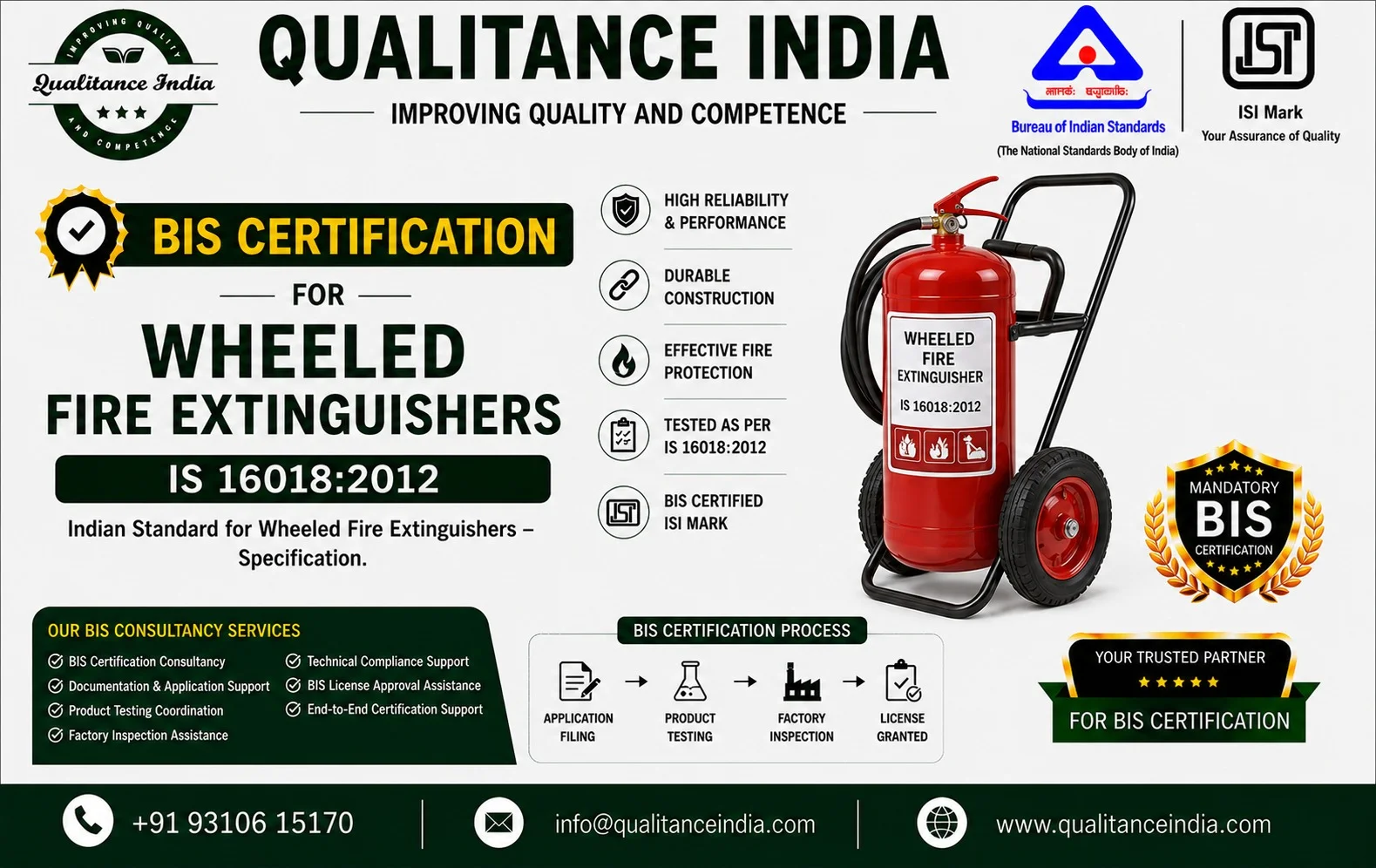
BIS Certification Process for Wheeled Fire Extinguishers
The overall process can be explained as:
Factory Assessment → Product Scope Finalization → Technical Documentation → BIS Application → Sample Preparation → Laboratory Testing → Factory Inspection → Compliance Closure → BIS Licence Grant → Standard Marking
Each stage should be planned carefully because a change in extinguisher type, capacity, media or fire rating can affect the scope and testing requirements.
Common Reasons for BIS Certification Delays
Manufacturers may face delays due to:
- Incorrect product classification
- Wrong licence scope
- Failure to understand separate-variety testing
- Incomplete technical drawings
- Non-conforming extinguishing media
- Pressure-test failure
- Fire-performance failure
- Cylinder material non-conformity
- Inadequate testing equipment
- Calibration issues
- Missing supplier certificates
- Incomplete quality records
- Incorrect product marking
- Factory inspection observations
- Inadequate handling of amendment requirements
The implementation of Amendment No. 3 makes it particularly important to review current requirements before testing or inspection.
Cost of BIS Certification for Wheeled Fire Extinguishers
There is no single fixed BIS certification cost for all Wheeled Fire Extinguisher manufacturers.
The total cost can depend on:
- BIS application and certification charges
- Laboratory testing
- Fire-performance testing
- Number of extinguisher varieties
- Nominal charge capacity
- Fire rating
- Extinguishing media
- Cylinder material
- Testing equipment
- Calibration
- Factory inspection
- Documentation
- Corrective action and re-testing
- Consultancy requirements
Because different varieties are individually relevant to licence scope, the number of products proposed can significantly affect the testing budget.
Who Needs BIS Certification?
BIS certification is generally required for manufacturers of covered Wheeled Fire Extinguishers supplying the Indian market under the Fire Extinguishers QCO.
This includes manufacturers producing extinguishers for:
- Industrial plants
- Warehouses
- Refineries
- Manufacturing facilities
- Power plants
- Workshops
- Commercial buildings
- Storage facilities
- High-hazard areas
- Fire-safety distributors
Manufacturers should check whether any specific exemption under the applicable QCO applies to their situation.
Why BIS Certification Is Important
BIS certification helps demonstrate that the product has been assessed against the applicable Indian Standard and is subject to the required conformity controls.
For manufacturers, certification can support:
- Regulatory compliance
- Use of the BIS Standard Mark
- Better customer confidence
- Product quality consistency
- Institutional acceptance
- Better quality documentation
- Improved market credibility
- Structured production control
- Greater confidence among fire-safety purchasers
Why Choose Qualitance India for BIS Certification?
Qualitance India provides BIS Certification consultancy for Wheeled Fire Extinguisher manufacturers.
Our assistance can include:
- BIS application preparation
- Product scope assessment
- IS 16018 compliance guidance
- Amendment compliance review
- Product grouping guidance
- Sample planning
- Laboratory coordination
- Testing coordination
- Documentation preparation
- Testing-equipment guidance
- Quality Assurance Plan support
- Factory inspection preparation
- Non-conformity assistance
- BIS licence follow-up
- Post-certification compliance support
Our objective is to help manufacturers prepare their technical, testing and documentation requirements in an organized manner.
Quick BIS Certification Process
Manufacturer Assessment → Product Scope → Documentation → BIS Application → Sample Testing → Factory Inspection → Compliance → BIS Licence → Standard Mark
Frequently Asked Questions
1. What is BIS Certification for Wheeled Fire Extinguishers?
It is the BIS conformity assessment process through which a manufacturer demonstrates compliance of Wheeled Fire Extinguishers with IS 16018:2012 and obtains authorization to use the BIS Standard Mark within the approved scope.
2. Which standard applies to Wheeled Fire Extinguishers?
The applicable standard is IS 16018:2012 – Wheeled Fire Extinguishers – Performance and Construction – Specification.
3. Is BIS certification mandatory for Wheeled Fire Extinguishers?
Yes. IS 16018:2012 is listed under the Fire Extinguishers (Quality Control) Order, 2023, under the compulsory BIS Scheme-I framework.
4. What is the sample size for BIS testing?
The BIS Product Manual specifies 20 pairs for all tests.
5. Does one test sample cover all extinguisher varieties?
Not necessarily. The Product Manual states that fire extinguishers of each variety are to be tested separately for inclusion of that variety in the licence scope.
6. What factors are included in the licence scope?
The Product Manual identifies extinguisher media, nominal charge capacity, fire rating and operating temperature as important licence-scope characteristics.
7. What types of fire extinguishing media can be covered?
Depending on the applicable product and standard requirements, wheeled extinguishers may use water, dry powder, foam, carbon dioxide and clean agents.
8. What is the mass range covered by IS 16018?
BIS's fire-extinguisher compendium describes the standard as applying to wheeled extinguishers with a fully charged mass from 17 kg to 450 kg.
9. What are the important BIS tests?
Important areas include operating temperature, discharge performance, temperature resistance, corrosion, impact, vibration, pressure-related performance, fire tests, discharge assembly and applicable component requirements.
10. Is fire-performance testing mandatory?
The applicable fire-performance testing depends on the extinguisher's intended fire rating and scope. Current BIS laboratory listings show separate Class A and Class B fire-performance tests.
11. What Class A fire ratings are available for testing?
Current BIS LIMS listings show ratings including 1A, 2A, 3A, 4A, 6A, 10A, 15A and 20A.
12. What Class B fire ratings are available?
Current BIS LIMS listings show ratings including 8B, 13B, 21B, 34B, 55B, 70B, 89B, 113B, 144B, 183B and 233B.
13. Is Amendment No. 3 applicable?
Yes. BIS issued implementation guidelines for Amendment No. 3 and specified 22 March 2025 as the last date for implementation.
14. What changed in Amendment No. 3?
Important changes include requirements for extinguishing agents, modified plastic-component requirements, revised low-pressure gauge provisions, modified gasket/O-ring requirements and changes relating to drain plugs and identification bands.
15. Is pressure testing required?
Yes, applicable pressure and integrity requirements form an important part of the standard, depending on the extinguisher and cylinder construction.
16. Are cylinder-material tests required?
Where applicable, the standard and laboratory scope include requirements for welded low-carbon steel, stainless steel, CO₂ and aluminium cylinders.
17. Can external laboratories be used?
Where subcontracting is permitted under the applicable certification documents, testing can be carried out through the permitted laboratory arrangements.
18. What documents are required?
Typical documents include factory details, machinery information, manufacturing process, product specifications, drawings, raw-material information, testing facilities, calibration documents, quality records and applicable declarations.
19. What is the BIS testing cost?
Testing charges vary by laboratory and product scope. Current BIS LIMS listings show extensive IS 16018 packages in the approximate range of ₹2.0 lakh to ₹2.65 lakh excluding taxes, with fire-performance tests potentially charged separately.
20. Does the laboratory testing cost include BIS certification fees?
No. Laboratory testing charges and BIS certification-related charges are separate components of the total project cost.
21. Can one BIS licence cover several capacities?
It depends on the applicable grouping and licence-scope provisions. Manufacturers should finalize the product scope before sample testing because each variety can require separate testing.
22. What happens if the product fails fire testing?
The manufacturer generally needs to investigate the cause, implement corrective action and follow the applicable retesting/compliance procedure.
23. Is factory inspection required?
Factory assessment/inspection is an important part of the BIS licensing process, where BIS assesses manufacturing and testing capabilities against the applicable requirements.
24. Can Qualitance India assist with BIS testing?
Yes. Qualitance India provides laboratory coordination and sample-testing support for BIS certification.
25. Can Qualitance India assist with factory inspection?
Yes. Assistance can include factory-readiness assessment, document review, testing-equipment guidance and inspection preparation.
26. Can existing BIS licensees get support for amendment compliance?
Yes. Existing licensees can obtain technical assistance to review current amendment requirements and align their documentation, testing and production controls accordingly.
Frequently Searched Topics
- BIS Certification for Wheeled Fire Extinguishers
- IS 16018:2012 BIS Certification
- BIS Licence for Wheeled Fire Extinguishers
- Wheeled Fire Extinguisher Testing
- IS 16018 Testing
- Fire Extinguisher BIS Mark
- Fire Extinguisher Certification in India
- BIS Testing Charges for Fire Extinguishers
- Wheeled Fire Extinguisher Fire Test
- Class A Fire Extinguisher BIS Testing
- Class B Fire Extinguisher BIS Testing
- Fire Extinguisher Manufacturer BIS Licence
- BIS Consultant for Fire Extinguishers
- BIS Certification Consultancy for Fire Fighting Equipment
Related BIS Certification Services
Qualitance India also provides consultancy for various BIS-regulated products, including fire-safety equipment, engineering products, electrical products, construction products, metal products, chemicals, textiles and other products covered by Indian Standards and Quality Control Orders.
Our services include:
BIS Certification Consultancy | BIS Licence | ISI Mark Certification | Product Testing | Documentation Support | Factory Inspection Assistance | Quality Plan Preparation | Technical Compliance | Scope Extension | Licence Renewal | End-to-End BIS Support
Contact Qualitance India
Qualitance India BIS Certification Consultancy for Manufacturers
Phone: +91 93106 15170 Email: info@qualitanceindia.com Website: https://qualitanceindia.com/
For Wheeled Fire Extinguisher manufacturers, Qualitance India can assist with product scope assessment, IS 16018 compliance, laboratory testing coordination, documentation, factory inspection preparation and BIS licence support.
Conclusion
Wheeled Fire Extinguishers are critical fire-safety products used where higher extinguishing capacity and mobility are required. Their construction and performance must comply with stringent requirements covering extinguishing media, discharge, fire performance, pressure integrity, durability, corrosion resistance and other safety characteristics.
IS 16018:2012 is included under the Fire Extinguishers (Quality Control) Order, 2023, making BIS certification under Scheme-I an important requirement for covered products supplied to the Indian market.
BIS has also implemented Amendment No. 3 to IS 16018:2012, with several important technical changes affecting extinguishing agents, plastic components, gauges, gaskets, O-rings and other requirements.
Manufacturers should therefore finalize their product scope carefully, arrange the correct samples, ensure laboratory capability and prepare the factory in accordance with the current BIS requirements.
With professional support from Qualitance India, manufacturers can receive end-to-end assistance for documentation, testing, technical compliance, factory inspection preparation and BIS licence processing for Wheeled Fire Extinguishers.