
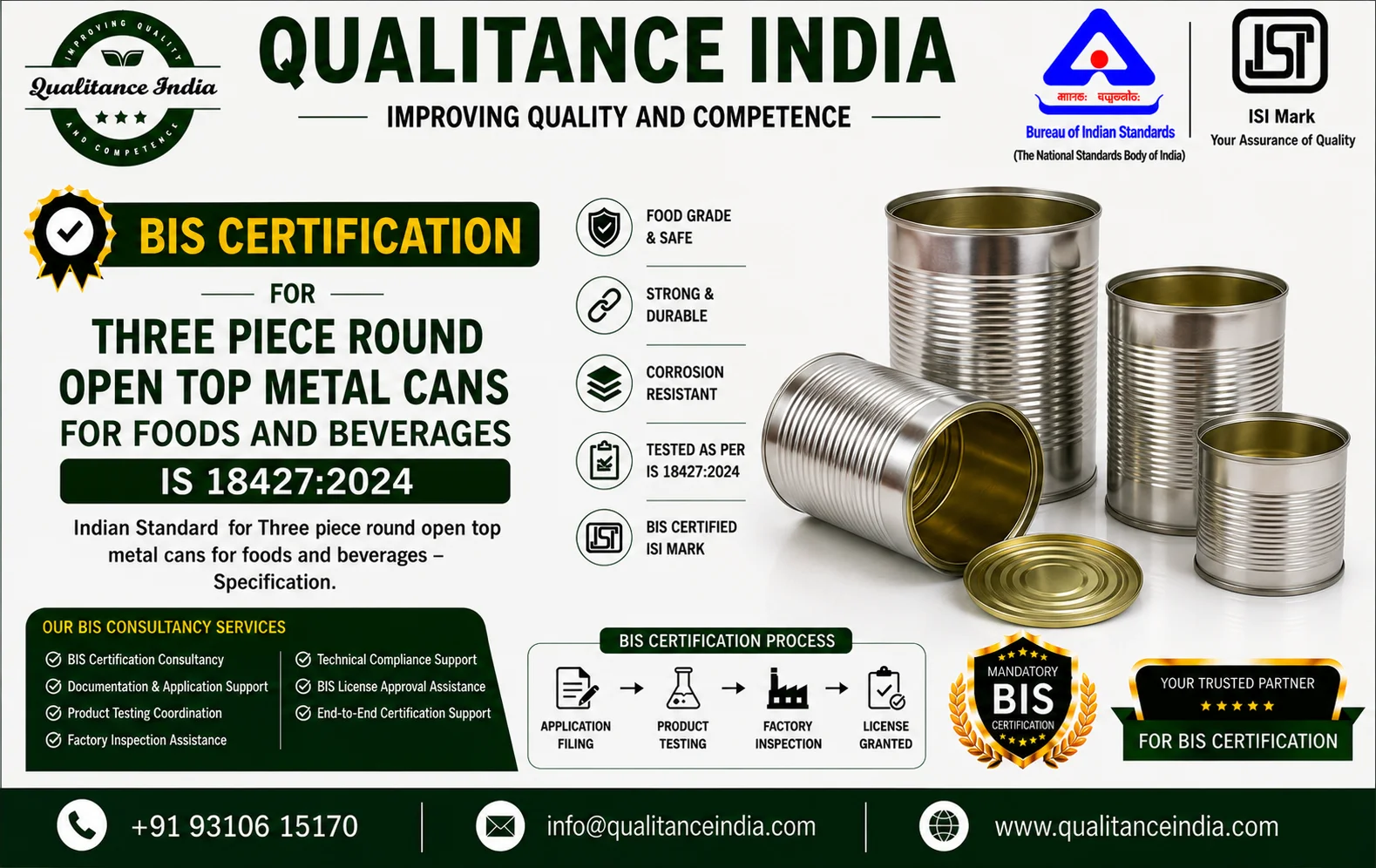
BIS Certification Consultancy for Three Piece Round Open Top Metal Cans for Foods & Beverages | IS 18427:2024 | BIS & ISI Mark Certification
Introduction
Three Piece Round Open Top Metal Cans are widely used for packaging food and beverage products where a strong, durable and properly sealed metal container is required. These cans are manufactured using a can body, two ends and associated components, with different designs available according to the type of opening, necking, seaming and food-processing requirements.
In India, IS 18427:2024 – Three Piece Round Open Top Metal Cans for Foods and Beverages – Specification establishes requirements for this important category of food and beverage packaging containers. The current BIS Product Manual PM/IS 18427 dated 2 May 2025 provides certification guidance under Scheme-I of the BIS Conformity Assessment Regulations, 2018 and identifies the applicable product types, raw materials, sampling requirements, product grouping, testing equipment, Quality Assurance Plan and marking requirements.
The current Product Manual specifies a sample quantity of 15 pieces for certification testing. It also requires manufacturers to consider product design, type of food packed, nominal diameter and nominal capacity when determining the licence scope.
IS 18427:2024 is included under the compulsory BIS framework for Cookware, Utensils and Cans for Foods and Beverages. BIS's October 2025 newsletter reported that the 2025 Quality Control Order for this category came into force from 1 October 2025, and the current BIS compulsory-certification page continues to list IS 18427:2024 under the category. The subsequent 2026 Quality Control Order continues to cover Three Piece Round Open Top Metal Cans for Foods and Beverages and requires the Standard Mark under a BIS licence.
An important point for manufacturers is that compliance is not limited to checking the finished can. The current Product Manual covers control of tin plate, lacquers and decorative coatings, inks, lining compounds and can-end sealants, side-stripe systems, aluminium alloys for EOE, aluminium taggers, aluminium foils for POE, surface lubrication and rust-prevention oils, along with dimensional, seam, pressure, vacuum and food-contact migration requirements.
Qualitance India provides end-to-end BIS Certification Consultancy for Three Piece Round Open Top Metal Cans as per IS 18427:2024, including product assessment, licence-scope planning, raw-material review, product grouping, sample preparation, laboratory testing coordination, BIS application assistance, factory inspection preparation, Quality Assurance Plan support and licence assistance.
What is IS 18427:2024?
IS 18427:2024 is titled:
“Three Piece Round Open Top Metal Cans for Foods and Beverages.”
The current BIS Product Manual dated 2 May 2025 identifies Nil amendments for the standard in the Product Manual and confirms that certification is operated under Scheme-I.
The standard is intended for three-piece round open-top metal cans used for food and beverage packaging. The certification framework considers:
- Can design
- Type of food packed
- Nominal diameter
- Nominal capacity
- Tin plate
- Coatings and lacquers
- Printing inks
- End components
- Side seams
- Necking
- Flanging
- Beading
- Double seaming
- Internal lining
- Air pressure
- Vacuum resistance
- Food-contact migration
- Packing and marking
The current BIS Product Manual defines the licence scope through these characteristics and provides detailed grouping provisions.
What are Three Piece Round Open Top Metal Cans?
Three Piece Round Open Top Metal Cans are cylindrical metal packaging containers generally manufactured from three principal body/end components and assembled through forming, welding and seaming operations.
They can be used for different categories of food and beverage products, with the appropriate internal coating and end configuration selected according to the packaged product and processing conditions.
The standard specifically distinguishes cans according to:
- Design
- Food-processing condition
- Diameter
- Capacity
The applicable food categories under the Product Manual are:
Thermally Processed Food Products
and
Non-Thermally Processed Food Products.
Applications of Three Piece Metal Food Cans
Three-piece metal cans are commonly relevant to food and beverage packaging applications such as:
- Processed food products
- Thermally processed foods
- Non-thermally processed foods
- Shelf-stable packaged foods
- Food ingredient packaging
- Industrial food products
- Institutional food packaging
The exact suitability depends on the can construction, internal coating, end design, food product and applicable processing conditions.
Product Types Covered Under IS 18427:2024
The current BIS Product Manual identifies seven major design configurations.
1. Top Side RLT Seamed Can
RLT = Ring, Lid & Tagger
This is one of the recognized top-end configurations under the standard.
2. Top Side POE Seamed Can
POE = Peel Off End
This design uses a peel-off opening arrangement.
3. Top Side NEO Seamed Can
NEO = Non-Easy Open End
This is a conventional non-easy-open-end configuration.
4. Top Side EOE Seamed Can
EOE = Easy Open End
This configuration uses an easy-open end.
The Product Manual specifically requires the material/grade of aluminium alloy used for EOE to be declared where aluminium alloy is used.
5. One-End Single Necked-In Can
This configuration has single necking-in on one end.
6. Both-Side Single Necked-In Can
Both ends have the specified single-necked-in arrangement.
7. Top-Side Double Necked-In and Bottom-Side Single Necked-In Can
This is another specific configuration recognized within the product scope.
These seven design categories are directly identified in the current Product Manual and should be considered when determining the proposed BIS licence scope.
Scope of BIS Certification for IS 18427:2024
The BIS licence scope can be based on:
- Can design
- Type of food packed
- Nominal diameter
- Nominal capacity
The Product Manual defines the licence scope as:
Three Piece Round Open Top Metal Cans for Foods and Beverages
with the above parameters.
Nominal diameter is to be selected according to Table 5 of the standard, while nominal capacities are according to Table 6.
Manufacturers should therefore finalise the intended product range before submitting samples to the laboratory.
Is BIS Certification Mandatory for Three Piece Food Cans?
Yes, IS 18427:2024 is included in the compulsory BIS certification framework for the covered product.
The Cookware, Utensils and Cans for Foods and Beverages (Quality Control) Order, 2025 lists:
IS 18427:2024 – Three Piece Round Open Top Metal Cans for Foods and Beverages
and requires listed goods to conform to the applicable Indian Standard and bear the Standard Mark under a BIS licence according to Scheme-I. The order also excludes domestically manufactured goods meant for export and includes specific provisions for certain imported filled goods, declared stocks and R&D imports.
The 2026 Quality Control Order subsequently superseded the 2025 order for the relevant products and continues to list IS 18427:2024. It again requires the Standard Mark under a BIS licence and retains exclusions for domestically manufactured goods meant for export and for certain goods already imported or manufactured before the applicable implementation date.
BIS's current compulsory-certification page also continues to list IS 18427:2024 in the Cookware, Utensils and Cans category.
Current Regulatory Position
For manufacturers, the current regulatory framework should be understood using the latest QCO rather than older 2023 or 2024 references.
The 2025 QCO listed IS 18427:2024 and BIS reported the Cookware, Utensils and Cans QCO as coming into force from 1 October 2025.
The 2026 QCO, dated 30 March 2026, continues to cover IS 18427:2024 and makes the Standard Mark compulsory under Scheme-I. The 2026 table does not show a separate staggered enterprise-wise implementation date against IS 18427:2024, unlike the entries where dates are specifically printed.
Because QCOs can be amended further, manufacturers should confirm the latest notification and BIS position before beginning a new compliance project.
BIS Certification Scheme for IS 18427:2024
Certification is operated under:
Scheme-I of the BIS Conformity Assessment Regulations, 2018.
The Product Manual is specifically issued to ensure uniformity in certification practice and can be used by existing licensees and prospective applicants.
After successful conformity assessment and grant of the BIS licence, conforming products within the licence scope can carry the applicable BIS Standard Mark / ISI Mark in accordance with the licence conditions.
Who Needs BIS Certification for Three Piece Metal Cans?
The certification framework is relevant to manufacturers producing covered three-piece round open-top metal cans.
This can include:
- Metal Can Manufacturers
- Food Can Manufacturers
- Beverage Can Manufacturers
- Tin Can Manufacturers
- Metal Packaging Manufacturers
- Food Packaging Manufacturers
- Industrial Packaging Manufacturers
- Processed Food Packaging Suppliers
- Canning Industry Suppliers
- Institutional Packaging Manufacturers
- OEM Manufacturers
- Contract Manufacturers
Importers and businesses dealing in covered products should independently verify their obligations under the latest QCO.
BIS Certification Eligibility Requirements
A manufacturer should have an appropriate manufacturing facility and quality-control system.
Depending on the product scope, facilities may include:
- Tinplate handling area
- Sheet cutting equipment
- Printing facilities
- Lacquering/coating facilities
- Body-forming machinery
- Side-seam welding equipment
- Necking machinery
- Flanging equipment
- Beading machinery
- Double-seaming equipment
- End manufacturing facilities
- RLT/NEO assembly facilities
- POE end facilities
- EOE assembly facilities
- Internal lining equipment
- Inspection equipment
- Air-pressure testing equipment
- Vacuum-testing equipment
- Seam measurement equipment
- Quality-control laboratory
- Calibration system
- Raw-material storage
- Finished-product storage
The exact equipment depends on the types and sizes proposed for certification.
BIS Certification Process for Three Piece Round Open Top Metal Cans
Step 1 – Product Applicability Assessment
The product is reviewed against IS 18427:2024.
The assessment includes:
- Can design
- Food type
- Thermal processing
- Diameter
- Capacity
- End configuration
- Seam arrangement
- Coating
- Raw materials
Step 2 – Product Design Identification
The applicable design is identified:
- RLT
- POE
- NEO
- EOE
- Single necked-in
- Double necked-in/single necked-in combination
Step 3 – Food Type Assessment
The manufacturer identifies whether the can is intended for:
Thermally Processed Food Products
or
Non-Thermally Processed Food Products.
This distinction is important for grouping and migration testing.
Step 4 – Diameter and Capacity Finalisation
The proposed nominal diameter and nominal capacity are selected according to the applicable tables of IS 18427:2024.
Step 5 – Product Grouping
Grouping is finalised according to the current Product Manual.
Step 6 – Raw Material Review
The manufacturer verifies tinplate, coatings, inks, sealants and applicable aluminium components.
Step 7 – Technical Documentation
Product drawings and required technical details are prepared.
Step 8 – Sample Preparation
The Product Manual specifies:
15 pieces
as the sample quantity.
Step 9 – Laboratory Testing
The representative samples are tested against the applicable requirements.
Step 10 – BIS Application
The manufacturer submits the application and supporting documentation.
Step 11 – Factory Assessment
BIS assesses the manufacturing and testing arrangements.
Step 12 – Observation Closure
Any observations identified during assessment are addressed.
Step 13 – Licence Grant
After successful completion of the conformity-assessment process, BIS grants the licence for the approved scope.
Step 14 – Standard Marking
Conforming production covered by the licence is marked according to the BIS requirements.
BIS Sample Size for IS 18427:2024
The current Product Manual specifies:
Sample Quantity: 15 pieces.
However, the actual sample selection should reflect the intended product scope and grouping arrangement.
Manufacturers should not simply send 15 random cans without first finalising:
- Design type
- Food-processing category
- Diameter
- Capacity
- EOE/POE/NEO/RLT configuration
- Necking arrangement
The Product Manual also states that the manufacturer must submit drawings for every type intended to be covered by the licence.
Product Grouping for IS 18427:2024
Product grouping is one of the most important parts of certification.
The Product Manual identifies grouping according to:
Design Type
The seven design configurations listed above.
Type of Food Packed
- Thermally processed
- Non-thermally processed
Nominal Diameter
As per Table 5.
Nominal Capacity
As per Table 6.
For consideration of Grant of Licence / Change in Scope of Licence, the Product Manual says that a sample of each type based on design and food type is to be tested.
There is, however, a relaxation:
Samples representing the minimum and maximum largest nominal diameter and nominal capacity can be tested to cover the other nominal diameters and capacities for the particular type, provided the manufacturer has complete manufacturing and testing facilities for those products.
The Product Manual also states that the scope can be restricted according to the manufacturer's manufacturing and testing capabilities.
Drawings and Product Details Required for Each Type
For each type intended for the BIS licence, the manufacturer must submit drawings specifying important construction details.
The current Product Manual identifies:
- Material of EOE, including alloy grade where aluminium alloy is used.
- Type of decorative finish.
- Material of lining used for NEO ends/rings for RLT assembly.
- Type of welding.
- Types of necking.
- Type of beading.
- Seam specification for thermally processed and non-thermally processed cans.
This makes detailed product drawings particularly important during the application stage.
Raw Materials for Three Piece Metal Cans
The current Product Manual identifies the following raw materials:
| Material / Component | Product Manual Reference |
|---|---|
| Tin plate | Clause 5.1 |
| Lacquers & decorative coatings | Clause 5.2 |
| Inks | Clause 5.3 |
| Lining compound / can-end sealants | Clause 5.4.2 |
| Side stripe systems | Clause 5.5 |
| Aluminium alloys for EOE | Clause 5.6.2 |
| Aluminium tagger | Clause 5.7 |
| Aluminium foils for POE | Clause 5.8.2 |
| Surface lubrications & rust-prevention oils | Clause 5.9 |
These are directly identified in the current Product Manual.
Tin Plate Requirements
Tinplate is the principal material for many three-piece metal can bodies.
The manufacturer needs to maintain appropriate control over:
- Tinplate specification
- Thickness
- Material certificate
- Supplier information
- Consignment identification
- Incoming inspection
- Traceability
The current inspection scheme identifies tinplate as a subcontractable/raw-material control item tested once per consignment. It also provides that no further testing is required where the material is accompanied by an appropriate test certificate or is ISI marked, subject to the specified conditions.
Lacquers and Decorative Coatings
Internal and external coatings are important because cans may come into direct contact with food or with the external environment.
The Product Manual identifies Lacquers and Decorative Coatings under Clause 5.2 and provides for consignment-level raw-material control.
Manufacturers should maintain:
- Coating specification
- Supplier certificate
- Batch number
- Incoming inspection records
- Food-contact suitability records, where applicable
Printing Inks
Printing inks may be used for product decoration and information.
The Product Manual identifies Inks under Clause 5.3 and provides for consignment-level control.
Lining Compound and Can-End Sealants
Lining compounds and can-end sealants are important for sealing and food-contact performance.
The Product Manual identifies Lining Compound / Can End Sealants under Clause 5.4.2 and requires consignment-level control in its recommended inspection scheme.
Side Stripe Systems
Side-stripe systems can be important for welded side seams.
The current Product Manual identifies Side Stripe Systems under Clause 5.5 and includes them within the raw-material control framework.
Aluminium Alloy for Easy Open Ends
For EOE designs using aluminium alloy, the manufacturer must declare the alloy grade.
The Product Manual specifically identifies:
Aluminium Alloys (EOE) – Clause 5.6.2.
This information should be incorporated into the product drawing and technical documentation.
Aluminium Tagger
The Product Manual separately identifies Aluminium Tagger Thickness under Clause 5.7 and includes it in the raw-material controls.
Aluminium Foils for POE
Where a peel-off end is used, the applicable aluminium foil requirements are covered under Clause 5.8.2.
The current Product Manual includes Aluminium Foils (POE) in the raw-material control programme.
Surface Lubrication and Rust Prevention
Surface lubrication and rust-prevention oils are also identified as raw-material inputs under Clause 5.9.
Manufacturers should control the type and source of these materials and retain appropriate procurement and conformity records.
Testing Requirements for IS 18427:2024
Testing under IS 18427:2024 covers multiple aspects of the can.
The current Product Manual identifies the following major tests:
- Diameter
- Capacity
- Air pressure
- Vacuum
- Lining compound weight
- Moisture retention
- Welded side-seam quality
- Ball test
- Cone test
- Seam specification
- Overall migration
- Specific migration
The Product Manual also identifies the relevant test equipment.
Diameter Test
Diameter is an important dimensional parameter affecting:
- Product compatibility
- Closure fit
- Filling operations
- Packaging-line compatibility
- Stacking
- Customer specifications
The Product Manual identifies a plug gauge or vernier caliper for diameter measurement.
Capacity Test
Nominal capacity must comply with the applicable requirements.
The Product Manual identifies a weighing balance for the capacity test.
Air Pressure Test
The air-pressure test evaluates the can's ability to withstand internal pressure under the applicable test conditions.
The Product Manual identifies:
Air Pressure Testing Equipment
for Clause 8.1.
Under the Quality Assurance Plan, the air-pressure test is identified as an R – Required test and is recommended on one sample from each control unit.
Vacuum Test
Vacuum resistance is another important can-performance characteristic.
The Product Manual identifies suitable Vacuum Testing Equipment for Clause 8.2.
Under the inspection scheme, the vacuum test is also an R – Required test and is recommended on one sample from each control unit.
Lining Compound Weight
The weight of lining compound is controlled under Clause 7.2.3.2.
The Product Manual identifies:
- Weighing balance
- Oven
for the relevant testing arrangement.
Moisture Retention
Moisture retention of lining compound is also included under Clause 7.2.3.3.
The Product Manual specifies a weighing balance and oven as part of the indicative equipment.
Welded Side Seam Quality
Side-seam quality is extremely important because the body seam is one of the main structural joints of a three-piece can.
The Product Manual identifies two specific methods:
Ball Test
Equipment according to Annex F.
Cone Test
Equipment according to Annex G.
These tests help assess the quality and integrity of the welded side seam.
Seam Specification
The can seam must meet the applicable dimensional requirements.
The Product Manual identifies:
Can Seam Micrometer / Digital Seam Overlap Monitor
for checking the seam specification under Clause 7.7.2.
Proper seam control is essential for:
- Leakage prevention
- Mechanical integrity
- Sealing performance
- Food protection
- Consistent production
Overall Migration Limit Test
Food-contact migration testing is one of the most important parts of IS 18427:2024.
The current Product Manual identifies:
Overall Migration Limit – Clause 8.3.1
and identifies this as an S – Subcontracting permitted test.
The Product Manual also states that the overall migration test cannot normally be completed within the same single-day testing window as most other tests.
Specific Migration Limit Test
The Product Manual also identifies:
Specific Migration Limit – Clause 8.3.2
as an S-type test for which subcontracting is permitted.
The Product Manual specifies that the relevant migration tests are carried out at the recommended frequency of:
One sample once every three months.
Food Simulants and Migration Testing
The Product Manual identifies:
Simulant A to Simulant E
and test equipment according to Methods I to V, as declared by the manufacturer, with reference to IS 9845.
The appropriate simulant and test method depend on the intended application and declared product conditions.
Possible Tests in One Day
The current Product Manual states:
All tests except the Overall Migration Limit test and Specific Migration Limit test can be completed in one day, subject to the applicable testing conditions.
This does not necessarily mean the complete laboratory project will finish in a single day because migration testing can require additional time.
Quality Assurance Plan
The current Product Manual requires manufacturers to implement a Quality Assurance Plan consisting of regular testing and in-process controls designed to ensure that the product bearing the Standard Mark conforms to all requirements of IS 18427:2024.
The manufacturer is expected to:
- Define the control unit
- Define test frequency
- Define sample quantity
- Establish in-process controls
- Maintain test records
- Submit the quality-control system to the BIS Branch Office for information
Control Unit for Three Piece Metal Cans
The Product Manual recommends the control unit as:
Three Piece Round Open Top Metal Cans for Foods and Beverages of the same type, based on design and type of food packed, having the same nominal diameter and same nominal capacity, manufactured in a day under similar process conditions from the same consignment of raw materials.
This definition is very important for daily quality-control planning.
For example, two different can designs or different nominal capacities should not automatically be treated as the same control unit.
In-House Laboratory Requirements
The current Product Manual distinguishes between tests that are required to be maintained in-house and tests that may be subcontracted.
It uses:
R – Required
and
S – Subcontracting permitted.
For subcontracted testing, the Product Manual permits BIS-recognized/empanelled laboratories or laboratories having valid accreditation as per IS/ISO/IEC 17025, with the resulting reports available for BIS inspection.
MSME Testing Facility Provisions
For MSME manufacturers, maintaining a laboratory/in-house testing facility is optional under the Product Manual. MSMEs may use:
- Common cluster-based facilities
- Shared testing facilities
- BIS-recognized/empanelled laboratories
- Laboratories having valid NABL accreditation as per IS/ISO/IEC 17025
This provision can significantly help smaller can manufacturers who do not maintain a complete metal-packaging testing laboratory.
Large Manufacturer Laboratory Requirements
The Product Manual states that large-scale manufacturers, including foreign manufacturers, shall maintain a suitably equipped and staffed in-house laboratory for the applicable routine testing requirements and shall implement a calibration plan.
Alternatively, the Product Manual allows eligible large manufacturers to use the applicable sharing of testing facilities provisions under BIS guidelines.
Testing Equipment for IS 18427:2024
The current Product Manual provides an indicative equipment list.
Important equipment includes:
- Plug gauge
- Vernier caliper
- Weighing balance
- Air-pressure testing equipment
- Vacuum testing equipment
- Oven
- Ball-test equipment
- Cone-test equipment
- Can seam micrometer
- Digital seam overlap monitor
- Appropriate migration-test equipment
- Food simulants for migration testing
The equipment list is described as indicative and for guidance only, so the final facility requirement should be established from the current Product Manual and proposed licence scope.
Manufacturing Process for Three Piece Round Open Top Metal Cans
A typical manufacturing process may include:
- Tinplate receiving
- Incoming material inspection
- Sheet cutting
- Printing
- Lacquering
- Drying/curing
- Body blank preparation
- Body forming
- Side-seam welding
- Side-stripe application
- Necking
- Flanging
- Beading
- End preparation
- RLT/NEO/POE/EOE end assembly
- Double seaming
- Internal inspection
- Seam inspection
- Diameter inspection
- Capacity inspection
- Air-pressure testing
- Vacuum testing
- Migration testing through permitted laboratory arrangements
- Final inspection
- Packing
- Marking
The exact manufacturing route depends on the can design and the intended food application.
Welding and Side Seam Control
Side-seam welding is a critical manufacturing operation.
The manufacturer should control:
- Welding parameters
- Sheet alignment
- Seam consistency
- Side-stripe system
- Weld quality
- Seam dimensions
- Visual appearance
The Product Manual includes specific side-seam quality assessment through ball and cone tests.
Necking Requirements
Necking is specifically identified under Clause 7.4.
The manufacturer should maintain proper process controls for:
- Neck diameter
- Shape
- Transition
- Uniformity
- Surface condition
The applicable necking type must also be declared in the product drawing for each licensed configuration.
Flanging Requirements
Flanging is identified as another manufacturing characteristic under Clause 7.5.
Proper flanging is essential for subsequent end attachment and double-seaming operations.
Beading Requirements
Beading is identified under Clause 7.6.
The manufacturer should maintain consistent bead geometry and workmanship to ensure the can performs properly during handling, filling and stacking.
Double Seam Requirements
Double seaming is identified under Clause 7.7.
Seam dimensions and overlap need to be controlled according to the applicable requirements of the standard.
The Product Manual specifically identifies seam measurement equipment and requires manufacturing control of double seaming.
Product Drawings
Detailed drawings are essential for BIS certification.
For each licensed type, drawings should identify the required parameters, including:
- Can design
- EOE material/grade, if applicable
- Decorative finish
- NEO/RLT lining material
- Welding type
- Necking type
- Beading type
- Seam specification
- Thermally processed or non-thermally processed food application
Packing and Marking Requirements
The current Product Manual requires the BIS Standard Mark to be marked:
legibly and indelibly on the packaging of Three Piece Round Open Top Metal Cans for Foods and Beverages, provided that the cans conform to every requirement of the specification.
Marking and labelling on packaging must comply with Clause 10 of IS 18427:2024.
The additional marking requirements include:
“For BIS certification details please visit www.bis.gov.in”
and:
Batch No. / Control Unit No., Date / Month of Manufacturing.
All production covered by the licence and conforming to the Indian Standard must carry the Standard Mark.
Non-Conforming Products
The Product Manual states that disposal of non-conforming product should be carried out in a manner that does not violate the provisions of the BIS Act, 2016.
Manufacturers should therefore maintain a documented system for:
- Identification
- Segregation
- Rejection
- Rework, where permitted
- Disposal
- Traceability
BIS Factory Inspection for Metal Can Manufacturers
Factory assessment is an important part of Scheme-I certification.
During the factory visit, BIS may review:
Raw Material Storage
- Tinplate
- Coatings
- Inks
- Sealants
- Aluminium components
- Lubricants
Sheet Preparation
Cutting and preparation operations.
Printing and Coating
Printing, lacquering and curing processes.
Can Body Manufacturing
Body forming and dimensional control.
Side Seam
Welding and side-seam inspection.
Necking and Flanging
Process control for end preparation.
Beading
Bead formation and dimensional consistency.
End Assembly
EOE, POE, NEO or RLT arrangements.
Double Seaming
Seam formation and inspection.
Testing Facilities
Diameter, capacity, pressure, vacuum and seam testing.
Laboratory
Availability of routine testing equipment and appropriate staff.
Calibration
Calibration records for measuring and testing instruments.
Quality Control
Incoming, in-process and finished-product controls.
Traceability
Batch and control-unit identification.
Marking and Packing
Correct Standard Mark and required packaging information.
Documents Required for BIS Certification
A manufacturer should generally prepare:
- Company registration documents
- Factory address proof
- Factory layout
- Manufacturing process flow chart
- Machinery list
- Product drawings
- Can design specifications
- Nominal diameter details
- Nominal capacity details
- Food-processing category
- EOE/POE/NEO/RLT details
- Necking details
- Beading details
- Welding details
- Seam specifications
- Tinplate details
- Coating specifications
- Ink details
- Sealant details
- Aluminium-alloy details
- Supplier information
- Material certificates
- Raw-material test reports
- Testing equipment list
- Calibration certificates
- Quality Assurance Plan
- Inspection procedures
- Production records
- Test records
- Migration test reports
- Packing details
- Marking details
- Product photographs
- Authorised signatory documents
- Trademark documents, where applicable
The exact document requirement can vary with the proposed licence scope.
Common Reasons for BIS Certification Delays
Three Piece Metal Can manufacturers may face delays because of:
- Incorrect product classification
- Incorrect can design declaration
- Incorrect food-processing category
- Wrong nominal diameter
- Wrong nominal capacity
- Incomplete product drawings
- Incorrect EOE material declaration
- Improper coating specification
- Inadequate lining compound control
- Side-seam welding failure
- Ball-test failure
- Cone-test failure
- Seam dimensional non-conformity
- Capacity variation
- Air-pressure failure
- Vacuum failure
- Migration-test failure
- Inadequate raw-material records
- Missing supplier certificates
- Incorrect sample selection
- Inadequate testing equipment
- Missing calibration certificates
- Incomplete Quality Assurance Plan
- Poor control-unit records
- Factory not ready for assessment
- Incorrect packaging
- Incorrect BIS marking
A detailed technical review before sample submission can reduce many avoidable delays.
BIS Certification Cost for Three Piece Metal Cans
There is no single fixed total BIS certification cost applicable to every manufacturer.
The total project cost can depend on:
- BIS application fees
- Laboratory testing
- Product design
- Number of configurations
- Diameter
- Capacity
- Food-processing category
- Migration testing
- Factory assessment
- Testing equipment
- Calibration
- Documentation
- Retesting
- Consultancy charges
Current BIS LIMS listings show laboratory-specific testing charges.
Examples currently listed include:
₹34,500 excluding taxes at one current laboratory entry.
Another current BIS LIMS listing shows:
₹60,000 excluding taxes for IS 18427:2024 for its listed testing scope.
A further current laboratory listing shows:
₹15,000 excluding taxes for its listed scope.
These are laboratory testing charges only. They should not be treated as the complete BIS certification cost.
Laboratory prices can change, and the applicable charge depends on the laboratory, test scope and product configuration.
BIS Certification Timeline
The certification timeline depends on:
- Product design
- Grouping
- Sample preparation
- Laboratory availability
- Migration testing
- Documentation
- BIS application scrutiny
- Factory readiness
- Factory inspection
- Observation closure
The current Product Manual states that all tests except the Overall Migration Limit and Specific Migration Limit tests can potentially be completed in one day, subject to applicable conditions.
Since migration tests may require additional time, the complete laboratory stage can extend beyond one day.
Manufacturers can reduce delays by finalising the product drawings, raw-material certificates, samples, testing arrangements and Quality Assurance Plan before filing.
Benefits of BIS Certification for Three Piece Food Cans
Regulatory Compliance
Helps manufacturers comply with the applicable BIS and food-packaging QCO requirements.
BIS Standard Mark
Eligible manufacturers can use the Standard Mark on approved production covered by the BIS licence.
Better Packaging Quality
Testing and process controls help maintain consistent can quality.
Improved Seam Reliability
Side-seam and double-seam controls help support reliable container performance.
Food-Contact Compliance
Migration testing provides an important basis for evaluating applicable food-contact requirements.
Better Product Safety
Control of coatings, lining compounds, sealants and materials supports appropriate food-packaging quality.
Customer Confidence
A valid BIS licence can increase confidence among food manufacturers and packaging buyers.
Institutional Market Acceptance
BIS certification can be important for regulated and institutional procurement.
Better Traceability
Control-unit records, batch identification and test records support production traceability.
Why Choose Qualitance India?
Qualitance India provides professional BIS Certification Consultancy for manufacturers seeking BIS and ISI Mark certification.
For Three Piece Round Open Top Metal Cans for Foods and Beverages as per IS 18427:2024, our consultancy support can include:
- Product applicability assessment
- IS 18427:2024 requirement review
- Can design assessment
- Food-processing category assessment
- Diameter and capacity assessment
- Product grouping guidance
- Product drawing review
- Tinplate review
- Coating and lining review
- EOE / POE / NEO / RLT assessment
- Welding and seam requirement review
- Sample selection guidance
- Laboratory testing coordination
- Air-pressure testing coordination
- Vacuum testing coordination
- Migration testing coordination
- Documentation preparation
- Quality Assurance Plan support
- Testing equipment guidance
- BIS application assistance
- Factory inspection preparation
- Observation closure support
- BIS licence assistance
Our objective is to help manufacturers manage the certification process systematically, from technical product assessment and scope planning through laboratory testing, BIS application, factory inspection and licence approval.
Contact Qualitance India
Phone: +91 93106 15170 Email: info@qualitanceindia.com Website: qualitanceindia.com
BIS Certification Process – Quick Flow
Product Identification ↓ IS 18427:2024 Requirement Review ↓ Can Design Assessment ↓ Food-Processing Category Assessment ↓ Diameter & Capacity Assessment ↓ EOE / POE / NEO / RLT Assessment ↓ Product Grouping & Scope Finalisation ↓ Product Drawing Preparation ↓ Raw Material Verification ↓ Sample Preparation – 15 Cans ↓ Laboratory Testing ↓ Air Pressure & Vacuum Testing ↓ Seam & Welding Testing ↓ Migration Testing ↓ Test Report Review ↓ BIS Application ↓ Application Scrutiny ↓ Factory Assessment ↓ Observation Closure ↓ BIS Licence Grant ↓ Standard Mark on Approved Packaging
Frequently Asked Questions
1. What is IS 18427:2024?
IS 18427:2024 is the Indian Standard for Three Piece Round Open Top Metal Cans for Foods and Beverages.
2. Is BIS certification mandatory for Three Piece Round Open Top Metal Cans?
Yes. IS 18427:2024 is included in the current compulsory BIS framework under the Cookware, Utensils and Cans for Foods and Beverages category.
3. Which BIS scheme applies?
Certification is operated under Scheme-I of the BIS Conformity Assessment Regulations, 2018.
4. What is the BIS sample size?
The current Product Manual specifies 15 pieces.
5. What types of cans are covered?
The Product Manual identifies seven design configurations: RLT, POE, NEO, EOE, one-end single necked-in, both-side single necked-in, and top-side double necked-in with bottom-side single necked-in.
6. What does RLT mean?
RLT refers to a Ring, Lid & Tagger seamed-can configuration.
7. What does POE mean?
POE means Peel Off End.
8. What does NEO mean?
NEO means Non-Easy Open End.
9. What does EOE mean?
EOE means Easy Open End.
10. Are thermally processed and non-thermally processed cans treated separately?
Yes. The Product Manual groups the cans according to Thermally Processed Food Products / Non-Thermally Processed Food Products.
11. What parameters determine the licence scope?
Important parameters include design type, type of food packed, nominal diameter and nominal capacity.
12. What are the nominal diameter and capacity requirements?
Nominal diameter is determined according to Table 5, while nominal capacity is determined according to Table 6 of the standard.
13. Is product grouping available?
Yes. The Product Manual provides detailed grouping guidance in Annex A.
14. Can one sample cover different diameters and capacities?
The Product Manual provides relaxation allowing samples representing the minimum and maximum largest nominal diameter and capacity to cover other diameter/capacity variants for a particular type, provided the manufacturer has complete manufacturing and testing facilities.
15. Does the manufacturer need to submit product drawings?
Yes. Drawings of each type intended for the licence must be submitted with specified technical information.
16. What raw materials are controlled?
Important raw materials include tinplate, lacquers, decorative coatings, inks, lining compounds, can-end sealants, side-stripe systems, EOE aluminium alloys, aluminium taggers, POE aluminium foil and surface lubricants/rust-prevention oils.
17. What tests are required for the can?
Important tests include diameter, capacity, air pressure, vacuum, lining-compound weight, moisture retention, side-seam quality, seam specification and applicable migration tests.
18. Is air-pressure testing required?
Yes. It is identified as an R-type routine test with one sample recommended from each control unit.
19. Is vacuum testing required?
Yes. The Product Manual identifies vacuum testing as an R-type test with one sample recommended from each control unit.
20. How is welded side-seam quality checked?
The Product Manual identifies both Ball Test and Cone Test for welded side-seam quality.
21. Is seam measurement required?
Yes. Seam specification is checked using a Can Seam Micrometer or Digital Seam Overlap Monitor.
22. Are migration tests required?
Yes. The Product Manual identifies both Overall Migration Limit and Specific Migration Limit tests under Clause 8.3.
23. How frequently are migration tests performed under the recommended inspection scheme?
The Product Manual recommends one sample once every three months for both overall and specific migration tests.
24. Which standard is referenced for migration-test methods?
The Product Manual identifies food simulants from Simulant A to Simulant E and methods I to V with reference to IS 9845.
25. What is the control unit?
The recommended control unit is cans of the same design/food type with the same nominal diameter and capacity manufactured in a day under similar conditions from the same raw-material consignment.
26. Is in-house testing mandatory for MSMEs?
The Product Manual states that maintaining an in-house laboratory/testing facility is optional for MSME manufacturers.
27. Can MSMEs use external testing facilities?
Yes. MSMEs may use common cluster facilities, shared facilities, BIS-recognized/empanelled laboratories or appropriately NABL-accredited laboratories according to the Product Manual.
28. What is required for large-scale manufacturers?
Large-scale manufacturers, including foreign manufacturers, are expected to maintain suitably equipped and staffed in-house laboratory facilities for applicable routine tests and implement calibration plans, subject to the facility-sharing provisions.
29. What is required on the packaging?
The Standard Mark must be marked legibly and indelibly on the packaging of conforming cans covered by the BIS licence.
30. What additional information must be marked?
The packaging/label must include the specified BIS certification-details statement and Batch No./Control Unit No. and Date/Month of Manufacturing.
31. What is the current laboratory testing cost?
Current BIS LIMS listings show different charges depending on laboratory and scope, including examples of ₹34,500, ₹60,000 and ₹15,000 excluding taxes at different current entries.
32. Is the laboratory fee the complete BIS certification cost?
No. BIS application fees, factory assessment, equipment, calibration, documentation, retesting and consultancy expenses may be additional.
33. How long does testing take?
The Product Manual states that all tests except the Overall Migration Limit and Specific Migration Limit tests can potentially be completed in one day under the applicable conditions.
34. Is factory inspection required?
Manufacturers seeking BIS certification should be prepared for assessment of the manufacturing facility, testing arrangements, quality controls and records under Scheme-I.
35. Can Qualitance India help with IS 18427:2024 certification?
Yes. Qualitance India provides product assessment, grouping, documentation, sample preparation, laboratory testing coordination, BIS application assistance, factory inspection preparation and Quality Assurance Plan support.
People Also Ask
What is BIS certification for Three Piece Round Open Top Metal Cans?
BIS certification for Three Piece Round Open Top Metal Cans is the conformity-assessment process for demonstrating compliance with IS 18427:2024 under the applicable BIS Scheme-I framework.
Is IS 18427:2024 under a Quality Control Order?
Yes. IS 18427:2024 is listed under the Cookware, Utensils and Cans for Foods and Beverages QCO framework and remains in the current BIS compulsory-certification listing.
What is the BIS standard for three-piece food cans?
The applicable standard is IS 18427:2024 – Three Piece Round Open Top Metal Cans for Foods and Beverages – Specification.
What types of three-piece cans are covered?
The standard covers RLT, POE, NEO, EOE and the specified necked-in configurations.
What food categories are covered?
The Product Manual distinguishes thermally processed and non-thermally processed food products.
What is the BIS sample requirement?
The current Product Manual specifies 15 cans.
What are the main tests for metal food cans?
Key tests include diameter, capacity, air pressure, vacuum, lining compound, side-seam quality, seam specification and food-contact migration tests.
What is the air-pressure test?
It is a test used to evaluate the can's ability to withstand the applicable internal pressure without unacceptable failure.
What is the vacuum test?
It evaluates the can's performance under the applicable vacuum condition.
Why is migration testing important?
Migration testing evaluates whether substances can migrate from food-contact packaging materials into the food simulant within the applicable limits.
Can the can manufacturer use supplier test certificates?
The Product Manual permits certain raw-material controls to be established through test certificates or ISI marking subject to the specified requirements.
Can an MSME use a common laboratory?
Yes. The current Product Manual specifically permits MSMEs to use common cluster facilities, shared facilities and recognized/accredited laboratories under the stated provisions.
What information must be included in the product drawing?
The drawing should include applicable EOE material/grade, decorative finish, lining material, welding type, necking type, beading type and seam specifications.
How do I get an ISI Mark for three-piece metal food cans?
The manufacturer must establish applicability, finalise product scope and grouping, prepare samples and documents, complete testing, submit the BIS application, satisfy factory assessment requirements and obtain the BIS licence before applying the Standard Mark according to the licence conditions.
Frequently Searched Topics
- BIS Certification for Three Piece Round Open Top Metal Cans
- BIS Certification for Food Cans
- IS 18427:2024 Certification
- Three Piece Metal Can BIS Certification
- Metal Food Can BIS Licence
- Food Packaging BIS Certification
- BIS Licence for Metal Cans
- ISI Mark for Food Cans
- Three Piece Can Testing
- IS 18427 Testing
- Food Can Migration Testing
- Metal Packaging Certification
- EOE Can BIS Certification
- POE Can BIS Certification
- NEO Can BIS Certification
- RLT Can BIS Certification
- Thermally Processed Food Cans
- Non-Thermally Processed Food Cans
- Cookware Utensils and Cans QCO
- BIS Certification Consultancy
Related BIS Certification Services
- BIS Certification for Wrought Aluminium Utensils – IS 1660:2024
- BIS Certification for Aluminium Cans for Beverages – IS 14407:2023
- BIS Certification for Stainless Steel Utensils – IS 14756:2024
- BIS Certification for Stainless Steel Sinks – IS 13983:1994
- BIS Certification for Square Tins for Solid Products – IS 916:2000
- BIS Certification for Square Tins for Ghee, Vanaspati and Edible Oils – IS 10325:2000
- BIS Certification for Metal Packaging Containers
- BIS Certification for Food-Contact Packaging
- BIS & ISI Mark Certification
- BIS Laboratory Testing Coordination
- BIS Factory Inspection Assistance
- BIS Documentation Support
- BIS Quality Assurance Plan Support
Useful Website Service Topics
Manufacturers researching metal food-can certification may also need:
- BIS Certification Consultancy
- BIS Application Filing Support
- BIS Product Testing Coordination
- BIS Factory Inspection Assistance
- BIS Documentation Preparation
- BIS Quality Assurance Plan Support
- BIS Scope Extension
- BIS Licence Renewal
- BIS Testing Equipment Guidance
- BIS Regulatory Compliance Support
These services can be linked with the corresponding Qualitance India pages so that visitors can directly move from technical information to the relevant certification assistance.
Product Image Text Suggestions
Suitable wording for a website banner or service image:
BIS Certification for Three Piece Round Open Top Metal Cans
IS 18427:2024 | BIS Licence | ISI Mark
Three Piece Food & Beverage Cans BIS Certification
Metal Food Can Testing & Certification
IS 18427:2024 BIS Certification Consultancy
Suggested descriptive image text:
- Three piece round open top metal cans for foods and beverages
- IS 18427:2024 BIS certification
- BIS licence for metal food cans
- Three piece metal can testing in India
- Food packaging container BIS certification
- EOE, POE, NEO and RLT can certification
Share-Ready Post
BIS Certification for Three Piece Round Open Top Metal Cans – IS 18427:2024
Manufacturing metal cans for food and beverage packaging?
IS 18427:2024 covers Three Piece Round Open Top Metal Cans for Foods and Beverages and includes requirements for:
✔ RLT, POE, NEO and EOE can designs ✔ Necked-in can configurations ✔ Thermally and non-thermally processed food applications ✔ Tinplate and coating controls ✔ Side-seam and welding requirements ✔ Air-pressure testing ✔ Vacuum testing ✔ Seam inspection ✔ Overall migration testing ✔ Specific migration testing ✔ Product grouping ✔ BIS Standard Marking
The current BIS Product Manual specifies 15 cans as the sample quantity and requires detailed product drawings and scope information.
Qualitance India provides complete BIS certification consultancy including product assessment, grouping, sample preparation, laboratory testing coordination, documentation, BIS application support and factory inspection preparation.
📞 +91 93106 15170 📧 info@qualitanceindia.com 🌐 qualitanceindia.com
Conclusion
Three Piece Round Open Top Metal Cans for Foods and Beverages are an important category of food-packaging products covered by IS 18427:2024. The current BIS Product Manual PM/IS 18427 dated 2 May 2025 provides certification guidance under Scheme-I and identifies the applicable product scope, raw-material requirements, sampling, grouping, testing, Quality Assurance Plan and marking provisions.
The current Product Manual specifies 15 pieces as the sample quantity and establishes licence scope according to can design, type of food packed, nominal diameter and nominal capacity. The recognized design categories include RLT, POE, NEO, EOE and the specified necked-in constructions.
Product grouping is a particularly important part of the certification process. For Grant of Licence or Change in Scope, samples of each relevant design and food-processing type are considered, while the Product Manual provides a relaxation allowing representative minimum and maximum largest nominal diameter and capacity samples to cover other sizes and capacities where the manufacturer has the required manufacturing and testing facilities.
The raw-material control framework is also comprehensive. It includes tinplate, lacquers and decorative coatings, inks, lining compounds and can-end sealants, side-stripe systems, aluminium alloys for EOE, aluminium taggers, aluminium foil for POE and surface lubrication/rust-prevention oils.
Testing covers key dimensional and performance characteristics such as diameter, capacity, air pressure, vacuum, lining-compound weight, moisture retention, welded side-seam quality, ball test, cone test and seam specification. For food-contact applications, the Product Manual also includes Overall Migration Limit and Specific Migration Limit testing with applicable food simulants and methods referenced through IS 9845.
The Product Manual defines a control unit using the same design, food-processing category, nominal diameter and nominal capacity, manufactured in a day under similar conditions from the same raw-material consignment. Manufacturers are expected to implement a Quality Assurance Plan, maintain test records and establish appropriate in-process controls.
For laboratory arrangements, the Product Manual allows subcontracting of specified tests to BIS-recognized/empanelled laboratories or appropriately accredited laboratories. MSME manufacturers have additional flexibility to use common cluster facilities, shared facilities and recognized/accredited laboratories instead of maintaining a complete in-house testing laboratory.
Marking is another important requirement. The Standard Mark must be applied legibly and indelibly to the packaging of conforming cans covered by the licence. The packaging must also carry the required BIS certification-details statement and Batch/Control Unit Number and Date/Month of Manufacturing.
The regulatory framework has also evolved. IS 18427:2024 was included in the Cookware, Utensils and Cans for Foods and Beverages (Quality Control) Order, 2025, which BIS reported as effective from 1 October 2025, and the subsequent 2026 QCO continues to cover IS 18427:2024 and requires the Standard Mark under a BIS licence.
Current BIS LIMS records show that laboratory testing costs vary by laboratory and scope. Current examples include ₹34,500, ₹60,000 and ₹15,000 excluding taxes at different listed laboratories. These figures are laboratory charges only and should not be treated as the complete BIS certification cost.
For manufacturers, successful certification depends on careful planning of the can design, food-processing category, diameter, capacity, raw materials, coatings, end configuration, welding, necking, flanging, beading, double seaming, pressure testing, vacuum testing, migration testing, product drawings, Quality Assurance Plan, testing facilities and product marking.
Qualitance India provides end-to-end BIS Certification Consultancy for Three Piece Round Open Top Metal Cans for Foods and Beverages as per IS 18427:2024, including product assessment, licence-scope planning, grouping guidance, documentation, sample preparation, laboratory testing coordination, BIS application support, factory inspection preparation and Quality Assurance Plan assistance.
For BIS Certification and ISI Mark Consultancy for Three Piece Round Open Top Metal Cans, contact Qualitance India today.
Phone: +91 93106 15170 Email: info@qualitanceindia.com Website: qualitanceindia.com