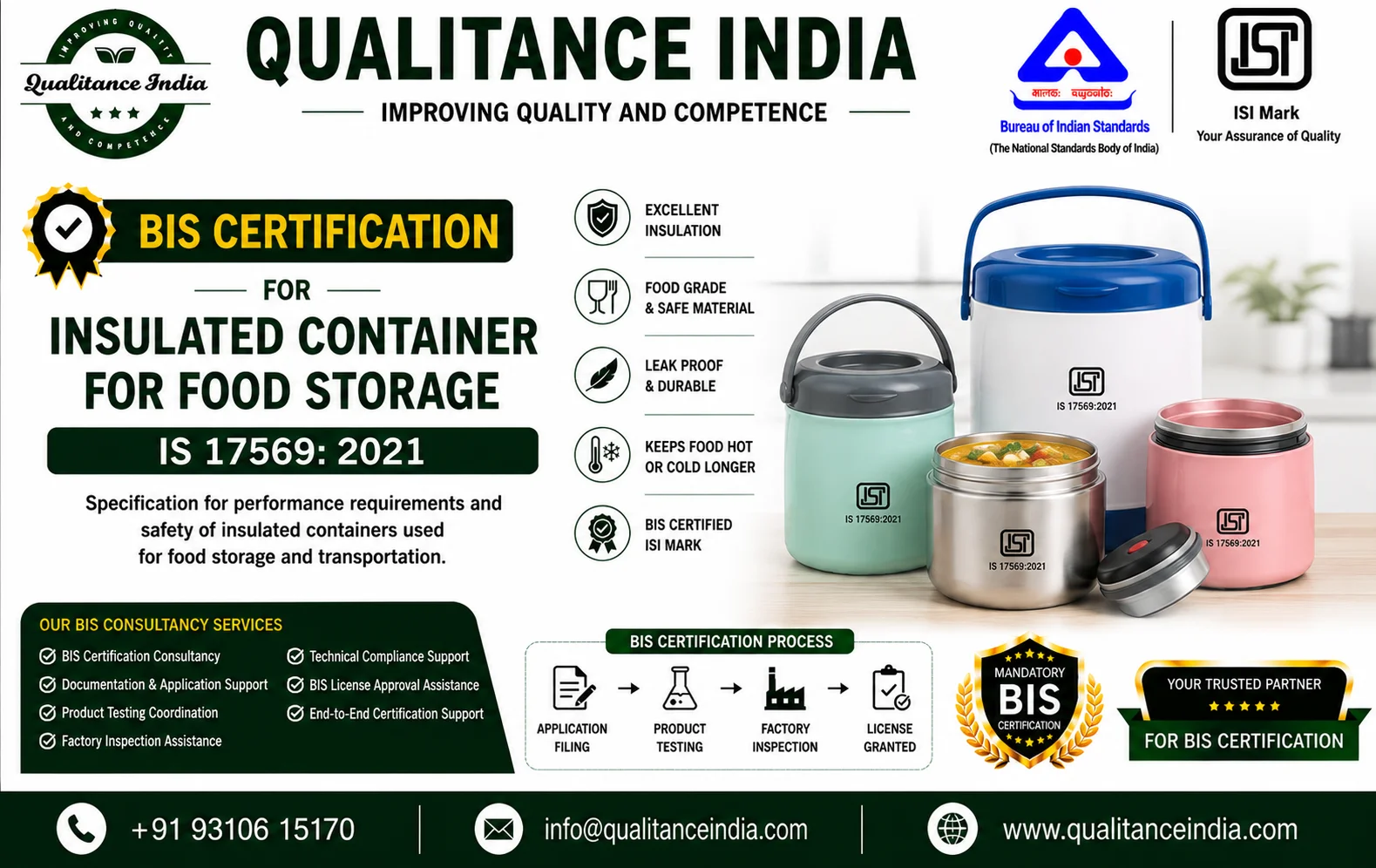
BIS Certification Consultancy for Insulated Containers for Food Storage | IS 17569:2021 | BIS & ISI Mark Certification
Introduction
Insulated containers for food storage are designed to maintain the temperature of food and beverages for a specified period while providing safe and convenient storage and transportation. They are commonly used as lunch boxes, casseroles, hot and cold food containers and other domestic food-storage products.
Because these containers are directly associated with food storage, their material safety, insulation performance, leakage resistance, impact strength, stability, construction and workmanship are important quality parameters.
In India, IS 17569:2021 – Insulated Containers for Food Storage specifies requirements for insulated containers intended for food storage. The current BIS Product Manual PM/IS 17569/4/December 2024 states that certification is operated under Scheme-I of the BIS Conformity Assessment Regulations, 2018 and can be used by existing licensees as well as prospective applicants seeking a BIS licence.
The standard is included in the compulsory BIS certification framework under the Insulated Flask, Bottles and Containers for Domestic Use (Quality Control) Order, 2024. The order specifically lists IS 17569:2021 – Insulated Container for Food Storage and requires covered products to bear the Standard Mark under a BIS licence according to Scheme-I, subject to the order's provisions and exemptions.
Qualitance India provides end-to-end BIS Certification Consultancy for Insulated Containers for Food Storage as per IS 17569:2021, including product assessment, material and type review, capacity grouping, documentation, sample preparation, laboratory testing coordination, BIS application support and factory inspection preparation.
What is IS 17569:2021?
IS 17569:2021 is titled:
“Insulated Containers for Food Storage”
The current BIS Product Manual identifies the product under Scheme-I and establishes certification requirements covering materials, construction, dimensions, thermal performance, mechanical strength, leakage and food-contact safety.
The major requirements include:
- Material
- Manufacture and workmanship
- Welding defects
- Minimum thickness
- Coating thickness
- Capacity
- Heat retention capability
- Cold retention capability
- Drop impact
- Pendulum impact
- Handle strength
- Shoulder-strap strength
- Leakage
- Joint leakage
- Staining
- Thermal insulation
- Shoulder-strap length
- Stability
- Seepage
- Food-contact material safety
- BPA requirements
- Glass-lid performance, where applicable
What are Insulated Containers for Food Storage?
Insulated food-storage containers are containers designed to help maintain the temperature of food for a specified period.
Depending on the design, they can include:
- Stainless-steel inner container
- Plastic outer body
- Stainless-steel outer body
- Plastic inner and outer components
- Vacuum insulation
- Thermal insulation
- Stainless-steel or plastic lid
- Glass lid
- Silicone gasket
- Shoulder strap
- Internal utensils
- Hot/cold box inserts
The exact configuration determines the applicable scope, testing and grouping requirements.
Types of Insulated Containers Covered
The current BIS Product Manual classifies containers based on material, insulation type, usage and nominal capacity.
Type Based on Material
The Product Manual identifies the following categories:
Plastic Outside and Stainless Steel Inside
The outside is made from plastic while the food-contact inner container is stainless steel.
Stainless Steel on Both Sides
Both inner and outer containers are made of stainless steel.
Plastic on Both Sides
The product uses plastic for both inner and outer container construction.
Combination of Materials
A combination of the above arrangements may be included, with each variety specified.
Lid or Bottom Container Variations
Different lid and bottom configurations may also fall within the scope.
Glass Lid with Beading
Containers may have a glass lid with suitable beading.
Hot/Cold Box with Inserts
The Product Manual includes hot/cold boxes containing stainless-steel utensils with stainless-steel or plastic lids.
Classification Based on Insulation
The Product Manual identifies three insulation categories:
- Vacuum Insulated Container
- Thermal Insulated Container Type 1
- Thermal Insulated Container Type 2
The insulation type is important because different designs may require different conformity checks.
Classification Based on Type of Use
IS 17569:2021 identifies two usage categories:
- Table Top
- Used for Transportation
This classification forms part of the licence-scope and grouping framework.
Capacity Groups under IS 17569:2021
The BIS Product Manual divides nominal capacities into three groups:
| Group | Nominal Capacity |
|---|---|
| Group 1 | Up to 1,000 ml |
| Group 2 | Above 1,000 ml and up to 5,000 ml |
| Group 3 | Above 5,000 ml and up to 20,000 ml |
The scope should therefore be planned according to the actual capacity range the manufacturer intends to produce.
Is BIS Certification Mandatory for Insulated Food Containers?
Yes. Insulated Containers for Food Storage under IS 17569:2021 are included in the compulsory BIS certification framework.
The Insulated Flask, Bottles and Containers for Domestic Use (Quality Control) Order, 2024 specifically lists:
IS 17569:2021 – Insulated Container for Food Storage
and requires covered products to conform to the corresponding Indian Standard and bear the Standard Mark under a BIS licence according to Scheme-I.
The current BIS Scheme-I page also lists IS 17569:2021 – Insulated Container for Food Storage under the Insulated Flask, Bottles and Containers for Domestic Use category and references the applicable 2023 and 2024 QCO notifications.
Insulated Flask, Bottles and Containers for Domestic Use QCO 2024
The 2024 QCO covers:
- IS 17790:2022 – Insulated Flask for Domestic Use
- IS 17526:2021 – Domestic Stainless Steel Vacuum Flask/Bottle
- IS 17569:2021 – Insulated Container for Food Storage
The QCO came into force three months after notification for the general category, six months for Small Enterprises and nine months for Micro Enterprises. It also contains exemptions for domestically manufactured goods intended for export and certain qualifying micro/small enterprises under the stated conditions.
Manufacturers should verify the latest applicable notifications, amendments and exemption conditions before making a final compliance decision.
BIS Certification for Insulated Containers
BIS Certification demonstrates conformity of the insulated container with the applicable requirements of IS 17569:2021.
The current BIS Product Manual confirms certification under:
Scheme-I of the BIS Conformity Assessment Regulations, 2018.
After obtaining the BIS licence, the manufacturer can use the BIS Standard Mark / ISI Mark on products included in the approved licence scope and conforming to the standard.
Who Needs BIS Certification for Insulated Food Containers?
BIS certification is relevant to manufacturers producing insulated food-storage containers covered by IS 17569:2021.
This can include:
- Insulated Container Manufacturers
- Food Storage Container Manufacturers
- Lunch Box Manufacturers
- Casserole Manufacturers
- Hot Box Manufacturers
- Cold Box Manufacturers
- Stainless Steel Container Manufacturers
- Plastic Food Container Manufacturers
- Vacuum Insulated Container Manufacturers
- Thermal Insulated Container Manufacturers
- Household Product Manufacturers
- OEM Manufacturers
- Contract Manufacturers
Importers and sellers should separately assess their obligations under the applicable QCO.
BIS Certification Eligibility Requirements
A manufacturer applying for BIS certification should have suitable manufacturing and quality-control arrangements.
Depending on the product configuration, these may include:
- Container manufacturing machinery
- Stainless-steel fabrication facilities
- Plastic moulding facilities
- Welding equipment
- Vacuum insulation equipment
- Thermal insulation filling facilities
- Lid manufacturing facilities
- Glass-lid assembly facilities, where applicable
- Handle and strap assembly facilities
- Testing and measuring equipment
- Food-contact material documentation
- Quality-control personnel
- Calibration system
- Production records
- Batch traceability
- Packing and marking arrangements
The exact requirements depend on the material combination, insulation type, usage type, capacity and proposed licence scope.
BIS Certification Process for Insulated Containers
Step 1 – Product Applicability Assessment
The product is reviewed against IS 17569:2021.
Important parameters include:
- Material combination
- Insulation type
- Usage type
- Nominal capacity
- Lid type
- Internal utensils
- Handle or shoulder strap
- Glass components
- Plastic components
Step 2 – Product Classification
The manufacturer identifies the applicable:
Material Type + Insulation Type + Usage Type + Capacity Group
This is important for product grouping and sample selection.
Step 3 – Scope and Grouping Finalisation
The manufacturer determines the capacities and varieties intended to be included in the BIS licence.
The Product Manual requires the highest nominal capacity from each capacity group for each applicable material type, insulation type and usage type to be separately tested for all requirements. Factory test reports for other intended capacities must also be submitted.
Step 4 – Documentation Preparation
Technical, manufacturing and quality-control documents are prepared.
Step 5 – Sample Preparation
The current BIS Product Manual specifies:
Sample Size: 8 Nos.
Step 6 – Laboratory Testing
The representative samples are tested against the applicable requirements.
Step 7 – BIS Application
The manufacturer submits the BIS application with required technical and factory documents.
Step 8 – Factory Assessment
BIS assesses the manufacturing facility, testing arrangements and quality-control system.
Step 9 – Observation Closure
Any observations raised during the assessment are addressed through corrective action.
Step 10 – BIS Licence Grant
After successful conformity assessment, BIS grants the licence for the approved product scope.
Step 11 – ISI Marking
The manufacturer can apply the BIS Standard Mark to compliant products according to the licence conditions.
Raw Material Requirements for Insulated Food Containers
Raw materials are particularly important because several components can come in direct or indirect contact with food.
The current Product Manual identifies material requirements including:
Welding Electrode
Grade 308L as per IS 5856.
Inner Container
The applicable materials can include:
- Grade N1 or N2 of IS 15997
- Relevant stainless-steel grades under IS 6911
- 304 series under IS 5522
- 316/316L under IS 6911
Outer Container and Lid
Where made from steel, the Product Manual identifies relevant stainless-steel grades including Grade N1/N2 and 304 series or 316/316L under the referenced standards.
Stainless-Steel Rim of Glass Lid
Where provided, the rim should meet the applicable stainless-steel material requirements.
Glass Lid
Safety glass used for the glass lid must comply with the applicable performance requirements of IS 2347.
Stainless-Steel Lid
Applicable stainless-steel grades are identified in the Product Manual.
Internal Utensils
Where internal utensils are supplied with the container, the Product Manual specifies applicable stainless-steel material requirements.
Plastic Components
The material of plastic components must be declared and its conformity established through the supplier's test certificate.
Insulation Material
The insulation material must also be declared and conformity supported through the supplier's test certificate.
Food-Contact Material Requirements
Food safety is an important part of IS 17569:2021.
The BIS Product Manual includes specific provisions for:
- Food-grade stainless steel
- Polymer materials
- Silicone gaskets
- BPA
- Coating safety
- Food-contact migration
- Sensorial characteristics
The current BIS LIMS database specifically lists testing for leaching of food-grade stainless steel, sensorial testing, BPA in polymers, silicone gasket overall migration and defects, and other component requirements.
BPA Requirement
Where polymer components are used, BPA compliance becomes an important requirement.
The BIS testing database lists:
Polymer – Test for BPA
under Clause 7.1.2.2.
Manufacturers should maintain material declarations and appropriate test certificates for plastic food-contact components.
Silicone Gasket Requirements
Where silicone gaskets are used, the BIS testing framework includes:
- Overall migration
- Defects
under the relevant clause.
The gasket material should be suitable for food-contact application and meet the applicable requirements.
Coating Requirements
For coated components, the current Product Manual includes:
- Coating thickness
- Salt-water corrosion
- Adhesion
- Lead limit
- Cadmium limit
The Product Manual identifies IS 9730 for applicable coating-related test methods and IS 9806 for lead and cadmium limits.
Capacity Test
Capacity is an important requirement because the container's declared capacity forms part of the licence scope.
The Product Manual identifies:
Clause 7.3 – Capacity
as a routine factory test. The recommended level of control is three samples from each control unit.
Heat Retention Capability
Heat retention is one of the most important performance characteristics of an insulated food container.
The Product Manual includes testing at:
- 1 hour
- 6 hours
- 12 hours
- 24 hours
The recommended testing frequency varies with the duration and is linked to each capacity and material. For example, 1-hour and 6/12-hour heat-retention tests are recommended once a month, while the 24-hour test is recommended once every three months.
The required equipment includes:
- Hot plate
- Thermometer
- Air conditioner
- Stopwatch
- Torque wrench
Cold Retention Capability
Cold retention evaluates the container's ability to maintain a low temperature for the specified period.
The Product Manual identifies Clause 7.5 – Cold Retention Capability and recommends testing three samples once a month for each capacity and material.
The testing setup includes:
- Refrigerator
- Thermometer
- Air conditioner
- Stopwatch
- Torque wrench
Drop Impact Test
The drop-impact test evaluates the ability of the container to withstand impact during normal handling.
The Product Manual specifies three samples once every three months for this requirement, with additional testing provisions in case of failure.
The required equipment includes a Drop Impact Test Fixture.
Pendulum Impact Test
The pendulum impact test evaluates resistance to impact from another specified direction or condition.
The current Product Manual specifies three samples once every three months.
The equipment includes a Pendulum Impact Test Fixture.
Handle Strength
Containers provided with handles must satisfy the applicable strength requirement.
The Product Manual identifies Clause 7.7 – Fixing Strength of the Handle and recommends three samples once every three months.
Testing may involve:
- Test fixture
- Weighing balance
- Steel balls for loading
- Counter
Shoulder Strap Strength
For products provided with a shoulder strap, the strap strength is tested under the applicable requirement.
The Product Manual recommends testing three samples once every three months.
Leakage Test
Leakage testing is important for food containers because leakage can affect food safety, usability and insulation performance.
The Product Manual identifies Clause 7.9 – Leakage Test as a routine factory test with three samples from each control unit.
The test equipment includes measuring jars, hot plate, thermometer, surfactant, torque wrench and stopwatch.
Joint Leak Test
For certain vacuum insulated stainless-steel containers, the Product Manual identifies a separate Joint Leak Test.
This is a routine test carried out with three samples from each control unit.
The equipment includes:
- Weighing balance with 10 mg accuracy
- Water bath/tub
Staining Test
For stainless-steel products, staining performance is assessed under the applicable requirement.
The Product Manual recommends three samples once every three months.
PUF Insulation
Where Polyurethane Foam (PUF) or another similar thermal insulation material is used, the insulation is checked according to the applicable requirements.
The Product Manual identifies:
Clause 7.12 – Checking of PUF Insulation
with a recommended frequency of one sample once every three months.
The density of PUF is measured using a weighing balance according to Annex F.
Shoulder Strap Length
Where a shoulder strap is provided, its length is checked against the applicable requirement.
The Product Manual identifies Clause 7.13.1 and recommends three samples per control unit.
Stability Test
Container stability is important to prevent accidental tipping during use.
The Product Manual identifies:
Clause 7.13.2 – Stability of Flask
as a routine test with three samples per control unit.
The test uses a plane inclined at 10 degrees.
Seepage Test
The Product Manual also includes a seepage test under Clause 7.14.
Three samples are recommended once every three months, with each variety produced during the period to be tested at least once.
Glass Lid Requirements
Where a glass lid is provided, specific performance requirements apply.
The BIS LIMS database currently lists separate tests for:
- Glass-lid fragmentation
- Ball drop
- Thermal shock
- Free fall
- Thickness of glass lid
- Thickness of stainless-steel rim
These tests are associated with the relevant glass-lid performance requirements of IS 2347.
Internal Utensils
Some insulated food containers may be supplied with internal utensils.
The current BIS requirements include checks for:
- Material
- Thickness
- Plastic lid thickness, where applicable
- BPA, where applicable
The BIS LIMS database identifies these as separate testing parameters.
Product Grouping for IS 17569:2021
Product grouping is a critical part of the BIS certification process.
The current Product Manual divides products based on:
Classification I – Material Type
- Plastic outside + stainless steel inside
- Stainless steel both sides
- Plastic both sides
- Combinations
- Lid/bottom variations
- Glass lid with beading
- Hot/cold box with inserts
Classification II – Insulation Type
- Vacuum insulated
- Thermal insulated Type 1
- Thermal insulated Type 2
Classification III – Nominal Capacity
- Up to 1,000 ml
- Above 1,000 ml to 5,000 ml
- Above 5,000 ml to 20,000 ml
Classification IV – Usage
- Table top
- Transportation
For each material, insulation and usage combination, the highest nominal capacity from each applicable capacity group is selected for independent testing. The factory test reports of other capacities intended to be covered must also be submitted.
BIS Sample Requirement
The current BIS Product Manual specifies:
8 Nos.
as the sample size for IS 17569:2021.
During surveillance, BIS may also draw samples of the inner-container raw material for independent chemical-composition testing.
Control Unit for Insulated Containers
The Product Manual recommends defining the control unit as:
Quantity of all insulated containers of the same type, nominal capacity and usage, manufactured by the same method under similar conditions in a day.
This definition is important for:
- Routine testing
- Batch identification
- Production records
- Traceability
- Quality Assurance Planning
Quality Assurance Plan
The BIS Product Manual expects manufacturers to implement a Quality Assurance Plan containing regular testing and in-process controls.
The manufacturer must:
- Define the control unit
- Define testing frequency
- Define sample quantity
- Maintain test records
- Submit the Quality Assurance Plan to the BIS Branch Office for information
- Ensure conformity across the production covered by the plan
In-House Testing Facilities
The Product Manual expects manufacturers to establish a suitably equipped and staffed in-house laboratory for routine tests and factory-only requirements.
Tests that can be subcontracted may be performed through:
- BIS-recognized/empanelled laboratories
- NABL-accredited laboratories complying with ISO/IEC 17025
For MSME manufacturers, the Product Manual provides flexibility to use common cluster facilities, shared testing facilities or recognized/NABL-accredited laboratories for routine testing.
Large-scale manufacturers are expected to maintain suitable routine-test facilities and a calibration plan, although sharing-of-testing-facilities provisions are also available according to BIS guidelines.
Testing Equipment for IS 17569:2021
The current BIS Product Manual provides an indicative equipment list.
Important equipment includes:
- Vernier calipers
- Micrometers
- Coating thickness gauge
- Measuring jars
- Hot plate
- Thermometers
- Refrigerator
- Stopwatches
- Torque wrench
- Drop impact fixture
- Pendulum impact fixture
- Weighing balance
- Handle test fixture
- Shoulder-strap test fixture
- Water bath/tub
- Inclined plane
- Equipment for food-contact migration testing
- Equipment for sensorial testing
- PUF-density testing equipment
The BIS Product Manual states that the equipment list is indicative and not exhaustive.
BIS Factory Inspection for Insulated Containers
Factory assessment is an important stage of BIS certification.
During inspection, BIS may examine:
Manufacturing Machinery
Equipment for stainless-steel fabrication, plastic moulding, welding, insulation and assembly.
Raw Material
Identification and traceability of stainless steel, plastic, glass, silicone, insulation and other components.
Welding
Welding arrangements and control of welding defects.
Insulation
Vacuum or thermal insulation process and material controls.
Lid and Closure
Inspection of stainless-steel, plastic or glass lids and gaskets.
Handle and Shoulder Strap
Strength and dimensional controls.
Laboratory
Availability of applicable routine testing facilities.
Calibration
Calibration records for measuring and testing equipment.
Quality Control
Incoming, in-process and final inspections.
Records
Production, test, raw-material and batch records.
Food Safety Testing
Because these containers are intended for food storage, food-contact material conformity is an important part of the certification process.
The current BIS LIMS listing includes:
- Leaching test for food-grade stainless steel
- Sensorial test
- BPA testing for polymer
- Silicone gasket overall migration
- Silicone gasket defects
- Glass-lid performance tests
- Material and thickness checks
- Coating lead and cadmium tests
Manufacturers should maintain appropriate supplier certificates and test reports for food-contact materials and components.
Marking Requirements
The current BIS Product Manual states that the Standard Mark given in the licence schedule shall be marked on each insulated container, provided the marked product conforms to all requirements of the specification. It also requires the CM/L licence number and BIS website information to be marked at an appropriate place on the product or package.
The Product Manual specifies the wording:
“For details of BIS certification please visit www.bis.gov.in”.
The manufacturer must apply the Standard Mark only to conforming products covered by the BIS licence.
Rejection and Non-Conforming Products
The Product Manual requires all production covered by the licence and conforming to the Indian Standard to be marked with the Standard Mark.
Non-conforming production must be disposed of in a way that does not violate the provisions of the BIS Act, 2016.
Manufacturers should maintain a documented system for:
- Identification of rejected products
- Segregation
- Rework, where permitted
- Disposal
- Corrective action
- Records
Documents Required for BIS Certification
Typical documents may include:
- Company registration documents
- Factory address proof
- Factory layout
- Manufacturing process flow chart
- Machinery list
- Product drawings
- Product specifications
- Capacity details
- Material combination details
- Insulation type
- Usage type
- Stainless-steel specifications
- Plastic material details
- Glass specifications
- Silicone gasket details
- Insulation-material details
- Raw-material test certificates
- Supplier certificates
- Food-contact test reports
- BPA test reports, where applicable
- Testing equipment list
- Calibration certificates
- Quality Assurance Plan
- Inspection procedures
- Production records
- Test records
- Product photographs
- Packing details
- Marking details
- Test certificate/documentation format
- Authorised signatory documents
- Trademark documents, where applicable
The final document requirements depend on the product configuration and proposed BIS licence scope.
Common Reasons for BIS Certification Delays
Manufacturers may experience delays because of:
- Incorrect product classification
- Incorrect capacity grouping
- Wrong material declaration
- Incorrect insulation type
- Incomplete food-contact material documentation
- BPA non-conformity
- Coating lead or cadmium failure
- Migration-test failure
- Heat-retention failure
- Cold-retention failure
- Leakage failure
- Joint leakage failure
- Impact-test failure
- Handle-strength failure
- Shoulder-strap failure
- Stability failure
- PUF-density issues
- Glass-lid test failure
- Welding defects
- Thickness non-conformity
- Missing calibration records
- Incomplete test records
- Incorrect sample selection
- Factory not ready for inspection
- Incorrect BIS marking
A pre-certification review of the product, materials, testing capability and licence scope can help reduce avoidable delays.
BIS Certification Cost for Insulated Containers
There is no single fixed BIS certification cost for every manufacturer.
The total cost may depend on:
- BIS application fees
- Laboratory testing
- Product type
- Material combination
- Insulation type
- Usage type
- Capacity groups
- Glass-lid configuration
- Internal utensils
- Food-contact testing
- Factory assessment
- Testing equipment
- Calibration
- Documentation
- Retesting, if required
- Consultancy charges
Current BIS LIMS listings show laboratory-specific charges for IS 17569:2021. One current listing shows ₹27,800 excluding taxes for the listed scope, while another current listing shows ₹31,500 excluding taxes. Detailed clause-wise charges are also published by BIS for various tests.
These are laboratory-specific testing charges and not the complete BIS certification cost.
Current BIS Testing Charges
Current BIS LIMS data provides examples of individual testing charges for IS 17569:2021, including:
| Test | Example Listed Charge |
|---|---|
| Manufacture and Workmanship | ₹250 |
| Material | ₹300 |
| Thickness | ₹500 |
| Coating – Lead | ₹500 |
| Coating – Cadmium | ₹500 |
| BPA | ₹500 |
| Capacity | ₹300 |
| Heat Retention | ₹450 |
| Cold Retention | ₹400 |
| Drop Impact | ₹500 |
| Pendulum Impact | ₹450 |
| Handle Strength | ₹450 |
| Shoulder Strap Strength | ₹400 |
| Leakage | ₹450 |
| Joint Leak | ₹400 |
| Staining | ₹400 |
| PUF Insulation | ₹500 |
| Shoulder Strap Length | ₹350 |
These rates are examples from current BIS LIMS listings and can vary by laboratory and testing scope.
BIS Certification Timeline
The certification timeline can vary according to:
- Product configuration
- Capacity range
- Material combination
- Insulation type
- Usage type
- Sample readiness
- Laboratory availability
- Food-contact testing
- Test results
- BIS application scrutiny
- Factory readiness
- Factory assessment
- Observation closure
Manufacturers can reduce avoidable delays by finalising their capacity groups, material declarations, product configuration and testing arrangements before submitting the BIS application.
Benefits of BIS Certification for Insulated Food Containers
Regulatory Compliance
Helps manufacturers meet applicable BIS and QCO requirements.
ISI Mark
Allows eligible manufacturers to use the BIS Standard Mark on approved products.
Food-Contact Safety
Material and food-contact testing helps establish conformity for applicable components.
Thermal Performance
Heat and cold retention testing evaluates the container's insulation performance.
Better Product Reliability
Impact, leakage, handle and stability tests support reliable product performance.
Customer Confidence
BIS certification can strengthen confidence among household and institutional buyers.
Market Acceptance
Certification supports legal market access where BIS certification is mandatory.
Better Quality Control
The Quality Assurance Plan and routine testing framework support consistent production.
Why Choose Qualitance India?
Qualitance India provides professional BIS Certification Consultancy for manufacturers seeking BIS and ISI Mark certification.
For Insulated Containers for Food Storage as per IS 17569:2021, our consultancy support can include:
- Product applicability assessment
- IS 17569:2021 requirement review
- Material classification
- Insulation-type assessment
- Usage-type assessment
- Capacity-group assessment
- Product grouping guidance
- Food-contact material review
- BPA compliance guidance
- Testing strategy
- Sample selection guidance
- Sample preparation
- Laboratory testing coordination
- BIS application assistance
- Factory inspection preparation
- Quality Assurance Plan support
- Testing equipment guidance
- Observation closure support
- BIS licence assistance
Our support is designed to help manufacturers manage the certification process from product assessment and scope finalisation through laboratory testing, BIS application, factory inspection and licence approval.
Contact Qualitance India
Phone: +91 93106 15170 Email: info@qualitanceindia.com Website: qualitanceindia.com
BIS Certification Process – Quick Flow
Product Identification ↓ IS 17569:2021 Requirement Review ↓ Material Type Assessment ↓ Insulation Type Assessment ↓ Usage Type Assessment ↓ Capacity Group Assessment ↓ Product Grouping & Scope Finalisation ↓ Documentation Preparation ↓ Sample Preparation – 8 Nos. ↓ Material & Food-Safety Testing ↓ Heat / Cold Retention Testing ↓ Impact, Leakage & Strength Testing ↓ BIS Application ↓ Application Scrutiny ↓ Factory Assessment ↓ Observation Closure ↓ BIS Licence Grant ↓ ISI Mark on Approved Insulated Containers
Frequently Asked Questions
1. What is IS 17569:2021?
IS 17569:2021 is the Indian Standard for Insulated Containers for Food Storage.
2. Is BIS certification mandatory for insulated food containers?
Yes. IS 17569:2021 is included under the Insulated Flask, Bottles and Containers for Domestic Use (Quality Control) Order, 2024 and the BIS compulsory certification framework.
3. Which BIS scheme applies?
Certification is operated under Scheme-I of the BIS Conformity Assessment Regulations, 2018.
4. What types of containers are covered?
The Product Manual identifies stainless steel, plastic and combination material configurations, including products with glass lids and hot/cold boxes with inserts.
5. What insulation types are covered?
The Product Manual identifies:
- Vacuum insulated containers
- Thermal insulated Type 1
- Thermal insulated Type 2
6. What usage types are covered?
The standard identifies:
- Table top
- Used for transportation
7. What capacity groups are covered?
The Product Manual divides capacity into:
- Up to 1,000 ml
- Above 1,000 ml up to 5,000 ml
- Above 5,000 ml up to 20,000 ml
8. What is the BIS sample size?
The current BIS Product Manual specifies 8 Nos. for sampling.
9. What are the main tests for insulated food containers?
Important tests include capacity, heat retention, cold retention, drop impact, pendulum impact, handle strength, shoulder-strap strength, leakage, joint leakage, staining, PUF insulation, stability, seepage and relevant food-contact material tests.
10. What stainless-steel materials can be used?
The Product Manual identifies relevant grades including N1/N2 under IS 15997, 304 series under IS 5522 and 316/316L under IS 6911 for applicable components.
11. Is BPA testing required?
Where polymer components are applicable, the BIS LIMS testing scope includes BPA testing.
12. Are silicone gaskets tested?
Yes. The current BIS LIMS listing includes overall migration and defects testing for silicone gaskets.
13. Are glass lids covered?
Yes. Where a glass lid is provided, the Product Manual refers to applicable safety-glass performance requirements, and BIS LIMS lists fragmentation, ball drop, thermal shock and free-fall testing.
14. What is the heat-retention testing frequency?
For 1-hour and 6/12-hour heat retention, the recommended frequency is once a month for each capacity and material. The 24-hour heat-retention test is recommended once every three months.
15. What is the cold-retention testing frequency?
Three samples are recommended once a month for each capacity and material.
16. Is leakage testing required?
Yes. Leakage testing is a routine factory test, with three samples from each control unit under the recommended levels of control.
17. Is joint leakage testing required?
Yes, particularly for vacuum-insulated stainless-steel containers covered by the applicable requirement.
18. What is the control unit?
The recommended control unit is all insulated containers of the same type, nominal capacity and usage manufactured by the same method under similar conditions in one day.
19. Is a Quality Assurance Plan required?
Yes. The Product Manual requires manufacturers to implement a Quality Assurance Plan for regular testing and in-process controls.
20. Can testing be subcontracted?
Tests identified as suitable for subcontracting may be performed through BIS-recognized/empanelled laboratories or laboratories having valid NABL accreditation according to ISO/IEC 17025.
21. Are MSMEs allowed to use shared laboratories?
Yes. The Product Manual provides MSMEs with options to use common cluster facilities, shared testing facilities or recognized/NABL-accredited laboratories for routine testing.
22. What marking is required?
The Standard Mark must be marked on each conforming insulated container, and the licence number and BIS website details must also be provided at an appropriate place on the product or package.
23. How much does testing cost?
Current BIS LIMS listings show laboratory-specific total charges such as ₹27,800 and ₹31,500, depending on the laboratory and scope. Individual test charges are also listed separately.
24. Is the laboratory testing fee the complete BIS certification cost?
No. BIS application charges, factory assessment, equipment, calibration, documentation, food-contact testing, retesting and consultancy may be additional.
25. Can Qualitance India help with IS 17569:2021 certification?
Yes. Qualitance India provides product assessment, classification and grouping guidance, documentation, sample preparation, laboratory testing coordination, BIS application support and factory inspection preparation.
People Also Ask
What is BIS certification for insulated food containers?
BIS certification for insulated food containers is the conformity-assessment process for demonstrating compliance with IS 17569:2021 under the BIS Scheme-I framework.
Is IS 17569:2021 under a QCO?
Yes. IS 17569:2021 is specifically listed under the Insulated Flask, Bottles and Containers for Domestic Use (Quality Control) Order, 2024.
What is the BIS standard for insulated food storage containers?
The applicable Indian Standard is IS 17569:2021 – Insulated Containers for Food Storage.
What capacity is covered under IS 17569?
The current BIS Product Manual groups nominal capacities up to 20,000 ml (20 litres) into three capacity groups.
What materials are covered under IS 17569:2021?
The Product Manual covers combinations involving stainless steel, plastic, glass and other specified components depending on the product type.
What insulation types are covered?
Vacuum insulation and Thermal Insulated Types 1 and 2 are identified in the Product Manual.
What tests are required for insulated containers?
Important tests include thermal performance, impact resistance, leakage, handle and shoulder-strap strength, stability, seepage, staining, insulation and food-contact safety.
Is BPA testing required for plastic components?
Yes, BPA testing is included in the current BIS testing framework for applicable polymer components.
How do I get an ISI Mark for insulated food containers?
A manufacturer must obtain the applicable BIS licence for IS 17569:2021 and comply with the approved scope, testing, quality-control, factory and marking requirements.
Frequently Searched Keywords
- BIS Certification for Insulated Containers
- BIS Certification for Food Storage Containers
- IS 17569:2021 Certification
- BIS Licence for Insulated Containers
- Insulated Container BIS Certification
- Food Storage Container BIS Licence
- ISI Mark for Insulated Containers
- Insulated Food Container Testing
- Insulated Food Container QCO
- Insulated Lunch Box BIS Certification
- Casserole BIS Certification
- Hot Box BIS Certification
- Cold Box BIS Certification
- Stainless Steel Insulated Container BIS Certification
- BIS Certification Consultancy
Related BIS Certification Services
- BIS Certification for Insulated Flask – IS 17790:2022
- BIS Certification for Domestic Stainless Steel Vacuum Flask/Bottle – IS 17526:2021
- BIS Certification for Stainless Steel Utensils
- BIS Certification for Food Contact Products
- BIS Certification for Food Storage Containers
- BIS Certification for Household Products
- BIS & ISI Mark Certification
- BIS Factory Inspection Assistance
- BIS Laboratory Testing Coordination
- BIS Certification Consultancy
Conclusion
IS 17569:2021 – Insulated Containers for Food Storage establishes requirements for insulated containers used for storing and transporting food in domestic applications. The current BIS Product Manual classifies these products based on material type, insulation type, usage and nominal capacity and provides detailed grouping and testing requirements.
The BIS Product Manual identifies three capacity groups: up to 1,000 ml, above 1,000 ml up to 5,000 ml and above 5,000 ml up to 20,000 ml. For each material, insulation and usage combination, the highest capacity from the applicable group is independently tested, while factory test reports for the other intended capacities are required for scope consideration.
The standard includes important performance tests such as heat retention, cold retention, drop impact, pendulum impact, handle strength, shoulder-strap strength, leakage, joint leakage, staining, PUF insulation, stability and seepage. It also includes food-contact requirements involving stainless steel, plastic, silicone, coatings, BPA and glass lids, where applicable.
The current Product Manual specifies 8 samples for certification and requires manufacturers to maintain a Quality Assurance Plan with appropriate testing and in-process controls.
For food-contact components, manufacturers should pay particular attention to material declarations, supplier certificates, BPA compliance, migration requirements, lead and cadmium limits, silicone gasket requirements and glass-lid safety testing. These requirements can have a direct impact on the laboratory testing programme and certification timeline.
The Insulated Flask, Bottles and Containers for Domestic Use (Quality Control) Order, 2024 specifically includes IS 17569:2021 and requires covered products to bear the Standard Mark under a BIS licence according to Scheme-I, subject to applicable provisions and exemptions.
Current BIS LIMS listings show laboratory-specific testing charges for IS 17569:2021, including examples of ₹27,800 and ₹31,500 excluding taxes, while individual test charges are also published separately. These laboratory charges should not be treated as the complete BIS certification cost.
For manufacturers, successful BIS certification depends on proper planning of the material combination, insulation type, usage type, capacity groups, food-contact materials, testing facilities, Quality Assurance Plan, calibration, sample preparation, factory inspection and product marking.
Qualitance India provides end-to-end BIS Certification Consultancy for Insulated Containers for Food Storage as per IS 17569:2021, including product assessment, material and type review, capacity grouping, documentation, sample preparation, laboratory testing coordination, BIS application support and factory inspection preparation.
For BIS Certification and ISI Mark Consultancy for Insulated Containers for Food Storage, contact Qualitance India today.
Phone: +91 93106 15170 Email: info@qualitanceindia.com Website: qualitanceindia.com