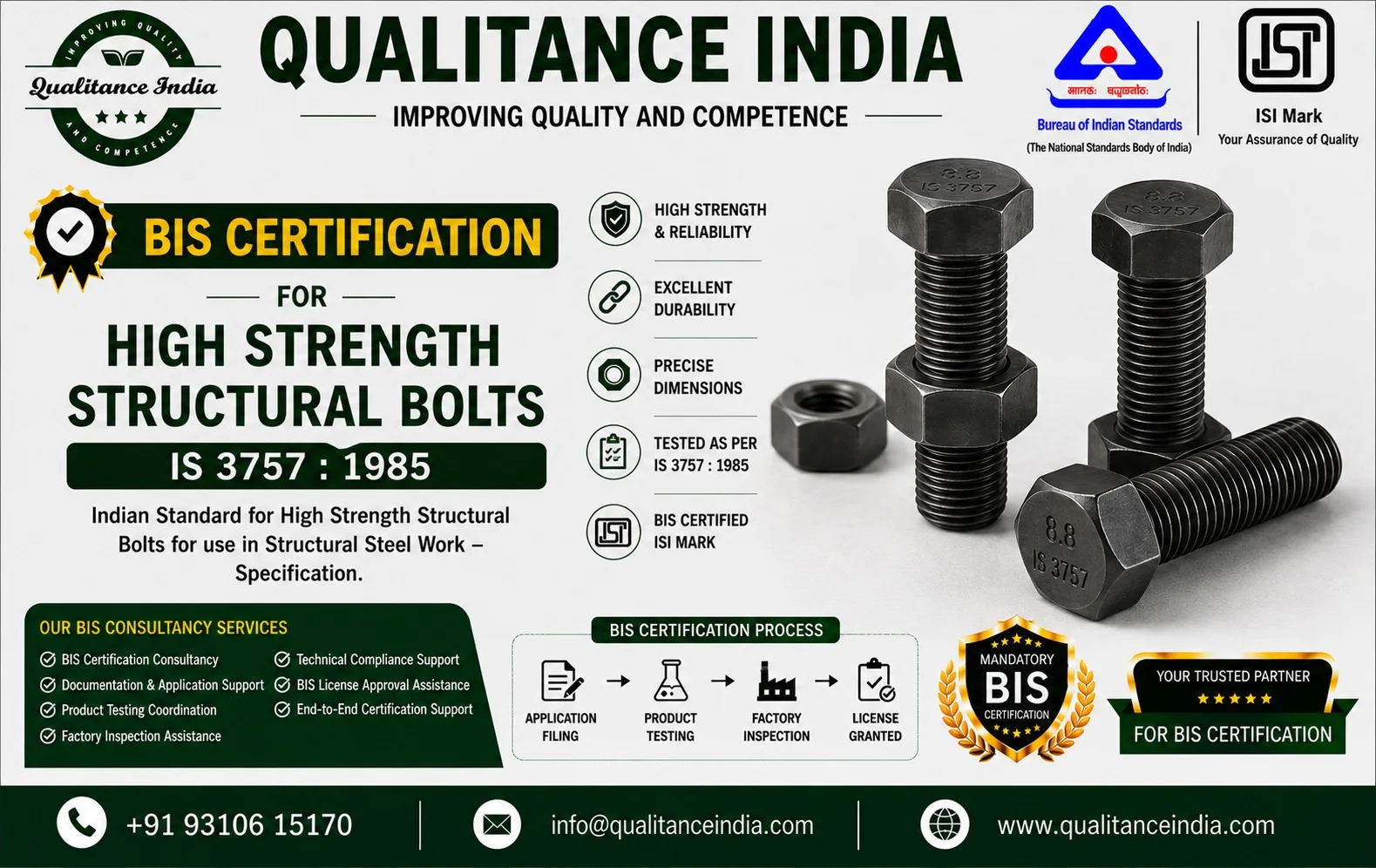
BIS Certification Consultancy for High Strength Structural Bolts | IS 3757:1985
Introduction
High Strength Structural Bolts are critical fastening components used in steel structures where reliable mechanical performance, dimensional accuracy, thread conformity and high tensile strength are essential. They are commonly used in bridges, industrial structures, transmission and infrastructure projects, steel buildings, heavy engineering applications and structural fabrication.
In India, High Strength Structural Bolts are covered by IS 3757:1985 – High Strength Structural Bolts. The BIS Product Manual identifies the product under Scheme-I of the BIS Conformity Assessment Regulations, 2018 and provides requirements relating to sampling, grouping, testing equipment, inspection and testing, and the scope of the BIS licence.
High Strength Structural Bolts are also included in the mandatory Bolts, Nuts and Fasteners (Quality Control) Order. The current QCO reference lists IS 3757:1985 – High Strength Structural Bolts and requires conformity with the applicable Indian Standard and use of the Standard Mark under the BIS certification framework. The QCO also states that the latest version of the Indian Standards, including amendments notified by BIS, applies.
Qualitance India provides end-to-end BIS Certification consultancy for manufacturers of High Strength Structural Bolts, including application preparation, product scope assessment, laboratory coordination, technical documentation, factory inspection preparation and BIS licence support.
What Are High Strength Structural Bolts?
High Strength Structural Bolts are specially manufactured fasteners intended for structural joints requiring high mechanical strength and dependable fastening performance.
Unlike ordinary general-purpose bolts, structural high-strength bolts are manufactured and tested against specified mechanical and dimensional requirements. Their performance is particularly important in structural connections where bolt failure can compromise the integrity of the entire assembly.
Typical applications include:
- Steel buildings
- Bridges and flyovers
- Industrial structures
- Power projects
- Heavy engineering projects
- Transmission structures
- Steel towers
- Structural fabrication
- Infrastructure projects
- Plant and machinery structures
BIS Standard for High Strength Structural Bolts
The applicable Indian Standard is:
IS 3757:1985 – High Strength Structural Bolts
The BIS Product Manual available for this product is PM/IS 3757/1/May 2020. It identifies IS 3757:1985 as the product standard and records 2 amendments in that Product Manual.
The BIS documentation also identifies IS 3757:1985 as the Second Revision and the current certification framework requires manufacturers to comply with the applicable amendments notified by BIS.
Is BIS Certification Mandatory for High Strength Structural Bolts?
Yes. High Strength Structural Bolts covered by IS 3757:1985 are included in the mandatory Bolts, Nuts and Fasteners (Quality Control) Order.
The QCO specifically lists:
IS 3757:1985 – High Strength Structural Bolts
and requires the covered product to comply with the Indian Standard and bear the Standard Mark under a BIS licence. The QCO further specifies that the latest version of the relevant Indian Standards, including amendments notified by BIS, shall apply from the date notified by BIS.
For manufacturers supplying these products in India, BIS certification is therefore an important regulatory requirement.
BIS Product Manual for IS 3757:1985
The Product Manual provides the practical framework used for certification activities.
Key details are:
| Particular | Requirement |
|---|---|
| Product | High Strength Structural Bolts |
| Indian Standard | IS 3757:1985 |
| Certification Scheme | Scheme-I |
| Amendments in Product Manual | 2 |
| Sample Size | 15 nos. |
| Grouping | Annex A |
| Test Equipment | Annex B |
| Scheme of Inspection & Testing | Annex C |
| Possible Tests in a Day | All Tests |
These details are specified in the BIS Product Manual.
BIS Licence Scope for High Strength Structural Bolts
The Product Manual states that the BIS licence scope is defined by:
- Product name
- Property Class
- Size
- Finish
Accordingly, a manufacturer should finalize the proposed product scope before submitting samples for testing.
The scope should be planned carefully because changes in property class, size or finish may affect the testing and the varieties included in the licence.
Raw Material Requirements
The Product Manual directs manufacturers to Clause 4 of IS 3757:1985 for the applicable raw-material requirements.
Depending on the manufacturing process and product specification, important incoming materials can include:
- Steel bars
- Wire rod
- Forging stock
- Heat-treatment inputs
- Plating or galvanizing materials
- Lubricants and process chemicals
The manufacturer should maintain traceability and conformity records for critical raw materials.
Important documents may include:
- Mill test certificates
- Chemical composition reports
- Mechanical-property reports
- Heat number records
- Supplier certificates
- Incoming inspection records
Manufacturing Process of High Strength Structural Bolts
The manufacturing process normally involves several controlled stages.
1. Raw Material Inspection
Steel input material is checked against the specified requirements and traceability is established.
2. Cutting
The raw material is cut into suitable blanks.
3. Heading or Forging
Bolt heads are produced by cold or hot forging as appropriate.
4. Thread Formation
Threads are formed according to the applicable dimensional and thread requirements.
5. Heat Treatment
Heat treatment is used to achieve the required mechanical properties and property class.
6. Cleaning and Surface Preparation
The bolts are cleaned and prepared for the required finish.
7. Surface Finish
Depending on the approved scope, the product may be supplied with the relevant surface finish, including galvanized finish where applicable.
8. Inspection and Testing
Dimensional, mechanical, metallurgical and surface-related testing is carried out.
9. Marking and Packing
Conforming products are identified and marked according to the applicable BIS requirements.
Major Tests for High Strength Structural Bolts
The BIS LIMS currently shows active laboratory scopes for IS 3757:1985 covering a wide range of tests.
Important tests include:
Dimensional Tests
Dimensions are verified against the applicable tables.
The current BIS laboratory scopes identify checks for dimensions such as:
- d
- p
- bref
- c
- da
- e
- k
- kw
- r
- s
- z
- ls
- lg
- l
- Angle
These measurements are part of the dimensional conformity requirements of the standard.
Thread Conformity
The conformity of threads is checked according to the applicable requirements.
Tensile Test on Machined Specimen
Where applicable, tensile testing of a machined specimen includes parameters such as:
- Stress at 0.2% non-proportional elongation
- Tensile strength
- Elongation
- Reduction of area
These parameters are listed in current BIS laboratory scopes.
Tensile Test on Full-Size Bolt
The full-size bolt may be assessed for:
- Ultimate tensile strength
- Vickers hardness
- Breaking position
The test requirements are identified in BIS laboratory listings for IS 3757:1985.
Proof Load Test
Proof load testing is an important requirement for confirming the bolt's ability to withstand the specified load without unacceptable permanent deformation or failure.
Wedge Load Test
The wedge load test evaluates the strength and integrity of the bolt head and shank under the specified test arrangement.
Head Soundness Test
This test checks the soundness of the forged bolt head.
Torsional Test
Torsional performance may be assessed as required by the standard.
Surface Integrity Test
The surface is evaluated for relevant defects that may affect structural performance.
Impact Test
Where applicable, the bolt material is assessed for impact properties.
Hardness Test
Hardness is checked against the applicable requirements of the property class.
Decarburization Test
The decarburization condition of the surface is evaluated because excessive decarburization can affect bolt performance.
Surface Discontinuities Test
The bolts are examined for unacceptable surface discontinuities.
Retempering Test
Retempering-related requirements are also identified in the current BIS laboratory scope.
Galvanization Tests
Where galvanized High Strength Structural Bolts are included in the scope, the BIS laboratory listings identify tests for:
- Uniformity of zinc coating
- Mass of zinc coating
- Passivation
- Adhesion of zinc coating
These are specifically reflected in the current laboratory scope for IS 3757:1985.
Therefore, manufacturers seeking a galvanized product scope should ensure appropriate surface-treatment controls and testing facilities.
BIS Sample Size
The BIS Product Manual specifies:
15 nos.
as the sample size for High Strength Structural Bolts.
The actual samples submitted should represent the product variety proposed for certification and should be selected according to the applicable BIS sampling and grouping provisions.
BIS Grouping Guidelines
The Product Manual refers manufacturers to Annex A for grouping guidelines.
Because the licence scope is based on:
- Property Class
- Size
- Finish
manufacturers should prepare a complete product matrix before application.
A properly planned grouping approach can help prevent unnecessary testing of varieties while ensuring that the desired scope is adequately represented.
BIS may restrict the final licence scope based on the actual manufacturing and testing capability demonstrated by the applicant.
Test Equipment Required
The Product Manual refers manufacturers to Annex B for the detailed test-equipment requirements.
Depending on the proposed product scope, suitable equipment may include:
- Vernier calipers
- Micrometers
- Thread gauges
- Measuring instruments
- Tensile testing machine
- Proof-load testing arrangement
- Hardness tester
- Impact testing machine
- Torsion testing arrangement
- Metallurgical examination facilities
- Decarburization testing equipment
- Surface-discontinuity inspection equipment
- Coating-thickness measurement equipment
- Galvanizing test facilities
- Weighing balance
- Temperature-controlled heat-treatment equipment
The exact equipment requirement should be established from the applicable BIS Product Manual, standard clauses and proposed licence scope.
In-House Testing Facility
Manufacturers should maintain suitable testing facilities for applicable tests identified as required under the Scheme of Inspection and Testing.
The laboratory should have:
- Suitable equipment
- Trained personnel
- Calibration records
- Test procedures
- Reference standards
- Traceability of measurements
- Proper test records
For tests where subcontracting is permitted, the applicable testing may be performed through an appropriate external laboratory in accordance with BIS requirements.
Laboratory Testing for IS 3757:1985
Current BIS LIMS records show multiple laboratories with testing scope for High Strength Structural Bolts under IS 3757:1985.
Current examples include:
Atckon Laboratories LLP, Bahadurgarh Testing scope: IS 3757:1985 Listed charge: ₹23,000 excluding taxes for the displayed scope.
Rajkot Metlab Services LLP, Rajkot Listed charge: ₹25,000 excluding taxes for the displayed scope.
Institute for Auto Parts and Hand Tools Technology, Ludhiana Listed charge: ₹24,380 for the displayed scope.
These are laboratory-specific testing charges. The final amount can change according to the scope, sample requirements, laboratory and applicable taxes.
Important Note About Testing Charges
Laboratory testing charges should not be confused with the total BIS certification cost.
The overall project cost may additionally include:
- BIS application-related charges
- Certification fees
- Inspection-related expenses
- Travel expenses, where applicable
- Testing equipment
- Calibration
- Documentation
- Sample manufacturing
- Re-testing, if required
- Consultancy charges
Quality Assurance Plan
A manufacturer applying for BIS certification should have a clearly defined Quality Assurance Plan covering:
- Raw-material inspection
- Heat-number traceability
- Forging controls
- Threading controls
- Heat-treatment controls
- Surface-finish controls
- Dimensional inspection
- Mechanical testing
- Coating inspection
- Product identification
- Rejection procedures
- Calibration
- Record keeping
The Quality Assurance Plan should be aligned with the applicable Scheme of Inspection and Testing.
Control of Heat Treatment
Heat treatment is particularly important for High Strength Structural Bolts because the required mechanical properties depend strongly on controlled processing.
Manufacturers should maintain records for:
- Furnace identification
- Batch/heat number
- Loading information
- Temperature
- Holding time
- Quenching conditions
- Tempering conditions
- Final hardness
- Batch traceability
Poor heat-treatment control can lead to tensile-strength, hardness, elongation or other mechanical-property failures.
Factory Inspection for BIS Certification
During the BIS inspection process, the manufacturing unit may be assessed for:
Raw Material Storage
Material identification and traceability should be maintained.
Manufacturing Facilities
Forging, heading, threading, heat treatment and finishing processes should be available according to the declared scope.
Testing Laboratory
Relevant testing equipment should be available, functional and calibrated.
Quality Records
Records should demonstrate effective control over production and testing.
Product Identification
Each production batch should be traceable to the relevant raw-material and manufacturing records.
Marking
The Standard Mark and other required product information should be applied correctly.
BIS Marking Requirements
Products manufactured within the approved BIS licence scope and conforming to the applicable requirements must be marked according to the certification documents.
The manufacturer must ensure that:
- Standard Mark is used only on conforming products
- The marking is legible and durable
- Licence-related information is shown as required
- Product identification is maintained
- Unlicensed or non-conforming production is not represented as BIS-certified
The exact marking arrangement should be finalized according to the current licence conditions and applicable BIS requirements.
Documents Required for BIS Certification
Common documents required for a High Strength Structural Bolt BIS application may include:
- Company registration documents
- Factory address proof
- Factory layout
- Manufacturing process flow chart
- Machinery list
- Raw-material details
- Steel mill test certificates
- Heat-number traceability records
- Product drawings
- Product specifications
- Property-class details
- Size range
- Finish details
- Testing equipment list
- Calibration certificates
- Laboratory test reports
- In-house testing records
- Quality Assurance Plan
- Technical personnel details
- GST/business documents
- Trademark information
- Authorization documents
- BIS declarations and undertakings
- Proposed marking details
The exact document list depends on the manufacturer and the requested product scope.
BIS Certification Process for High Strength Structural Bolts
The process generally follows these stages:
Factory Assessment → Product Scope Finalization → Documentation → BIS Application → Sample Preparation → Laboratory Testing → Factory Inspection → Compliance Closure → BIS Licence Grant → Standard Marking
A proper scope assessment before testing is important because the BIS licence scope is linked to property class, size and finish.
Common Reasons for BIS Application Delays
Structural bolt manufacturers may face delays because of:
- Incorrect product scope
- Incorrect property-class selection
- Insufficient size coverage
- Incomplete technical drawings
- Raw-material traceability problems
- Heat-treatment issues
- Failed tensile testing
- Proof-load failure
- Hardness failure
- Thread non-conformity
- Dimensional errors
- Surface discontinuities
- Decarburization failure
- Coating non-conformity
- Calibration issues
- Incomplete quality records
- Factory inspection observations
Proper technical preparation before the BIS application can substantially reduce avoidable delays.
Cost of BIS Certification for High Strength Structural Bolts
There is no universal fixed cost for BIS certification because the total expenditure depends on the manufacturer's product range and facility.
Major cost factors include:
1. Product Testing Testing cost depends on the selected laboratory and scope.
2. Product Varieties More property classes, sizes and finishes can affect testing requirements.
3. Testing Equipment The manufacturer may need to purchase or upgrade laboratory equipment.
4. Calibration Testing equipment must be calibrated appropriately.
5. Factory Inspection Inspection-related expenses may apply.
6. Documentation and Consultancy Technical documentation and professional compliance support may also contribute to the total cost.
Who Needs BIS Certification?
Manufacturers producing High Strength Structural Bolts covered by the applicable QCO and supplying the Indian market generally require the applicable BIS licence.
This can include manufacturers supplying bolts for:
- Structural steel projects
- Bridges
- Industrial buildings
- Infrastructure projects
- Power plants
- Transmission projects
- Heavy engineering
- Steel fabrication
- Industrial construction
Specific exemptions, where applicable, should be checked against the current QCO.
Benefits of BIS Certification
BIS certification can provide manufacturers with:
- Compliance with mandatory quality requirements
- Authorization to use the BIS Standard Mark
- Improved customer confidence
- Better product consistency
- Stronger acceptance in infrastructure projects
- Better quality-control practices
- Improved traceability
- Greater confidence among structural fabricators and purchasers
- Better market credibility
BIS Certification for High Strength Structural Bolts – Quick Process
Manufacturer Assessment → Product Scope → Documentation → BIS Application → Testing → Factory Inspection → Compliance → BIS Licence → Standard Mark
Why Choose Qualitance India?
Qualitance India provides BIS Certification consultancy for manufacturers of High Strength Structural Bolts.
Our support can include:
- BIS application preparation
- Product scope assessment
- IS 3757 compliance guidance
- Property-class and size scope planning
- Grouping guidance
- Documentation preparation
- Sample planning
- Laboratory coordination
- Testing coordination
- Testing-equipment guidance
- Quality Assurance Plan support
- Factory inspection preparation
- Non-conformity response support
- BIS licence follow-up
- Post-certification compliance guidance
Our objective is to help manufacturers prepare their technical, testing and documentation systems before proceeding with BIS certification.
Frequently Asked Questions
1. What is BIS Certification for High Strength Structural Bolts?
It is the BIS conformity assessment process through which a manufacturer demonstrates compliance of High Strength Structural Bolts with IS 3757:1985 and obtains authorization to use the Standard Mark within the approved scope.
2. Which standard applies to High Strength Structural Bolts?
The applicable standard is IS 3757:1985 – High Strength Structural Bolts.
3. Is BIS certification mandatory for High Strength Structural Bolts?
Yes. IS 3757:1985 is included in the mandatory Bolts, Nuts and Fasteners Quality Control Order framework.
4. What certification scheme applies?
The BIS Product Manual identifies the product under Scheme-I.
5. What is the sample size for IS 3757 testing?
The Product Manual specifies 15 nos. as the sample size.
6. What is included in the BIS licence scope?
The Product Manual identifies:
- Property Class
- Size
- Finish
as licence-scope parameters.
7. What are the main tests for High Strength Structural Bolts?
Major tests include dimensional checks, thread conformity, tensile testing, proof load, wedge load, head soundness, torsional testing, hardness, decarburization, surface discontinuities, impact testing and other applicable requirements.
8. Is tensile testing required?
Yes. Current BIS laboratory scopes include both machined-specimen tensile testing and full-size bolt tensile testing as applicable.
9. Is proof load testing required?
Yes. Proof load testing is included in the current BIS laboratory scope for IS 3757:1985.
10. Is hardness testing required?
Yes. Hardness testing is identified in the BIS laboratory scope.
11. Is decarburization testing required?
Yes. Decarburization testing is included among the listed IS 3757:1985 tests.
12. Are galvanized bolts covered?
Galvanized finish can be part of the licence scope, subject to the applicable requirements. Current BIS laboratory listings include zinc-coating mass, uniformity, passivation and adhesion tests.
13. What are the galvanization tests?
The listed tests include:
- Uniformity of zinc coating
- Mass of zinc coating
- Passivation
- Adhesion of zinc coating
14. Can one BIS licence cover multiple sizes?
Potentially, subject to the applicable grouping provisions and approved licence scope. The proposed sizes should be planned before testing.
15. Can one test cover different property classes?
This depends on the applicable grouping provisions and the manufacturer's proposed scope. The licence scope specifically identifies property class, so it should not be assumed that one tested class automatically covers every other class.
16. What raw material is generally used?
Steel of the required grade and chemical/mechanical characteristics is used, with conformity and traceability controlled according to the product requirements.
17. Is heat treatment important?
Yes. Heat treatment has a major influence on strength, hardness and other mechanical characteristics of high-strength bolts.
18. Is an in-house laboratory required?
The applicable testing facilities should be established according to the current Product Manual and Scheme of Inspection and Testing. Specific tests may have different requirements concerning in-house testing and permitted subcontracting.
19. Can external laboratories be used?
Where subcontracting is permitted under the applicable BIS requirements, testing can be carried out through the permitted external laboratory arrangements.
20. What is the current laboratory testing cost?
Current BIS LIMS listings show examples of approximately ₹23,000, ₹24,380 and ₹25,000, excluding taxes or as specifically stated by the laboratory, for displayed IS 3757:1985 scopes.
21. Does the laboratory fee include BIS certification?
No. Laboratory testing and BIS certification-related expenses are separate.
22. What documents are required?
Typical documents include factory details, machinery list, manufacturing process, product drawings, raw-material certificates, testing-equipment details, calibration records, quality documents and legal/company documents.
23. What happens if the bolt fails testing?
The manufacturer needs to investigate the reason for failure, implement corrective action and follow the applicable BIS retesting/compliance process.
24. Is factory inspection required?
Factory inspection is an important part of the BIS licensing process, where the manufacturing and testing capabilities are assessed against the applicable requirements.
25. Can Qualitance India coordinate laboratory testing?
Yes. Qualitance India provides product testing and laboratory coordination support for BIS certification.
26. Can Qualitance India help with factory inspection?
Yes. Assistance can include factory-readiness assessment, document review, testing-equipment guidance and inspection preparation.
27. Can existing manufacturers get support for BIS licence scope extension?
Yes. Qualitance India can assist with technical assessment and documentation for applicable scope-extension activities.
28. Can Qualitance India help with BIS renewal and compliance?
Yes. Consultancy support can also cover ongoing BIS compliance, testing planning, documentation and applicable licence-related activities.
Frequently Searched Topics
- BIS Certification for High Strength Structural Bolts
- IS 3757:1985 BIS Certification
- BIS Licence for Structural Bolts
- High Strength Structural Bolts Testing
- IS 3757 Testing
- BIS Mark for Structural Bolts
- BIS Certification for Structural Fasteners
- High Strength Bolt BIS Licence
- Structural Bolt Testing Laboratory
- BIS Testing Charges for IS 3757
- Property Class Bolt BIS Certification
- Galvanized Structural Bolt BIS Certification
- BIS Consultant for Bolt Manufacturer
- IS 3757 Product Certification
- Structural Fastener BIS Certification in India
Related BIS Certification Services
Qualitance India also provides BIS consultancy for a wide range of products covered by Indian Standards and mandatory Quality Control Orders.
Our services include:
BIS Certification Consultancy | BIS Licence | ISI Mark Certification | Product Testing | Documentation Support | Factory Inspection Assistance | Quality Plan Preparation | Technical Compliance Support | Scope Extension | Licence Renewal | End-to-End BIS Support
Contact Qualitance India
Qualitance India BIS Certification Consultancy for Manufacturers
Phone: +91 93106 15170 Email: info@qualitanceindia.com Website: https://qualitanceindia.com/
Manufacturers of High Strength Structural Bolts can contact Qualitance India for assistance with IS 3757 certification, product testing, documentation, product scope planning, factory inspection preparation and BIS licence support.
Conclusion
High Strength Structural Bolts are essential safety and structural components used in demanding steel and infrastructure applications. Their dimensional accuracy, thread quality, mechanical strength, hardness, surface integrity and applicable coating characteristics must be properly controlled.
IS 3757:1985 is included in the mandatory BIS certification framework under the Bolts, Nuts and Fasteners Quality Control Order. The BIS Product Manual specifies a sample size of 15 bolts, identifies property class, size and finish as key licence-scope parameters, and provides detailed requirements for testing equipment and inspection and testing.
Current BIS laboratory listings also demonstrate that testing can cover a broad range of dimensional, tensile, proof-load, hardness, metallurgical, surface and galvanizing requirements.
For manufacturers, proper product-scope planning and factory preparation are important before applying for BIS certification. With professional assistance from Qualitance India, manufacturers can receive end-to-end support for documentation, laboratory testing, technical compliance, factory inspection preparation and BIS licence processing for High Strength Structural Bolts.