
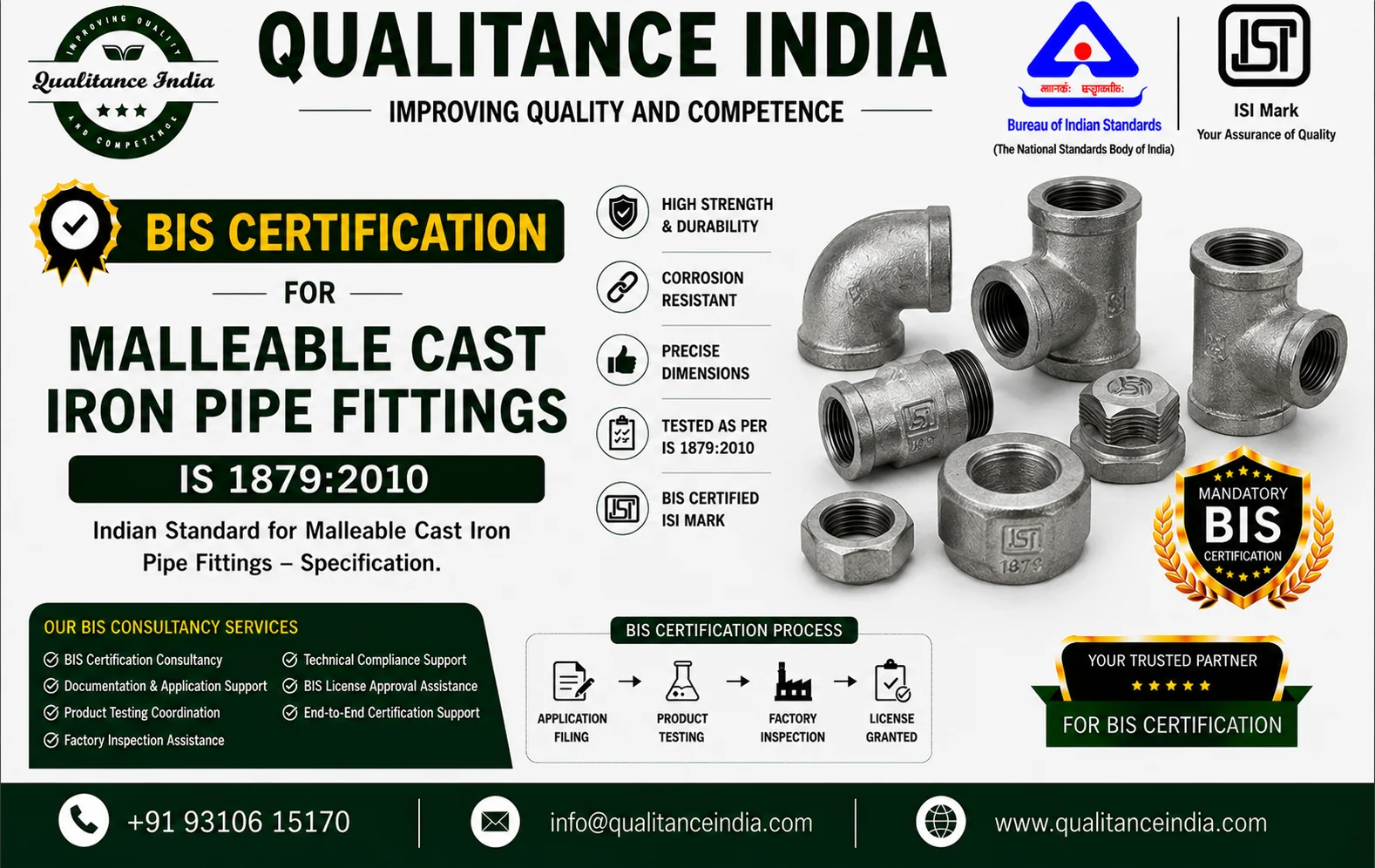
BIS Certification for Malleable Cast Iron Pipe Fittings | IS 1879:2010
Introduction
Malleable Cast Iron Pipe Fittings are important components used for connecting pipes, changing the direction of pipelines and creating reliable joints in fluid and gas transmission systems. These fittings are commonly used in plumbing, industrial piping, water supply, gas pipelines and other general-purpose applications.
To maintain consistent product quality, dimensions, mechanical strength, threading and pressure performance, manufacturers can obtain BIS Certification as per IS 1879:2010 – Malleable Cast Iron Pipe Fittings – Specification.
IS 1879:2010 is the Third Revision of the standard and specifies requirements related to different types of malleable cast iron pipe fittings, their dimensions, threads, mechanical properties, galvanizing and testing requirements.
Manufacturers planning to obtain BIS certification need to ensure that their product, manufacturing facilities, testing arrangements and quality-control system comply with the applicable BIS requirements.
Product ke Baare Mein
Malleable Cast Iron Pipe Fittings are fittings manufactured from malleable cast iron and used for joining pipes and creating different pipeline configurations.
These fittings may be used for:
- Joining two pipes
- Changing pipeline direction
- Creating branch connections
- Connecting pipes of different sizes
- Connecting threaded pipe systems
- General fluid and gas transmission applications
Common fitting configurations include elbows, tees, sockets, unions, bends and other pipe connection fittings covered under the applicable standard.
The correct selection of fitting type, size, thread and material grade is important for ensuring safe and reliable pipeline operation.
Applicable IS Standard
The applicable Indian Standard is:
IS 1879:2010 – Malleable Cast Iron Pipe Fittings – Specification
The standard is listed by BIS as the Third Revision and currently shows five amendments.
The BIS Product Manual for IS 1879:2010 is used as reference for certification under Scheme-I of the BIS Conformity Assessment Regulations, 2018.
Manufacturers should always verify the latest applicable edition, amendments and BIS certification requirements before applying.
Scope of Standard
IS 1879:2010 covers malleable cast iron pipe fittings intended for general-purpose applications.
The standard addresses requirements such as:
- Types of fittings
- Size designations
- Equal and unequal fittings
- Right-hand and left-hand threads
- Dimensions
- Wall thickness
- Thread requirements
- Mechanical properties
- Galvanizing requirements
- Pressure testing
- Compression testing
- Workmanship
- Freedom from defects
- Marking and other applicable requirements
The standard is intended to help ensure that fittings have the required dimensional accuracy, mechanical performance and serviceability.
Product Requirements
Malleable Cast Iron Pipe Fittings manufactured according to IS 1879:2010 need to comply with the applicable requirements of the standard.
Important product requirements include:
1. Type of Fitting
The manufacturer must clearly identify the type of fitting being manufactured.
2. Size Designation
The fitting size must conform to the applicable size designation specified in the standard.
3. Dimensions
Important dimensions such as wall thickness, fitting dimensions, reinforcement and other specified dimensions need to comply with the relevant tables and requirements.
4. Threads
Thread dimensions and alignment must comply with the applicable requirements. BIS testing information specifically identifies thread and thread-alignment checks with reference to IS 554.
5. Mechanical Properties
The material must satisfy applicable mechanical requirements, including tensile strength and elongation.
6. Pressure Performance
Fittings are subject to pressure testing as applicable to the standard.
7. Compression Performance
Compression testing is also included in the BIS testing requirements for applicable fittings.
8. Galvanizing
Where galvanized fittings are covered, the coating must comply with the applicable requirements relating to coating mass, uniformity and adhesion.
9. Workmanship
Fittings should be properly manufactured and free from unacceptable defects that could affect their performance.
Testing Requirements
Testing is an important part of BIS certification for Malleable Cast Iron Pipe Fittings.
BIS laboratory listings for IS 1879:2010 include tests and checks such as:
- Type of fitting
- Size designation
- Equal/unequal fitting verification
- Right-hand and left-hand thread
- Code number
- Tensile strength
- Elongation
- Wall thickness
- Dimensions
- Thread requirements
- Thread alignment
- Freedom from defects
- Compression test
- Pressure test
- Mass of galvanized coating
- Uniformity of galvanized coating
- Adhesion of galvanized coating
- Marking and other applicable checks
The exact testing program depends on the product type, material, size, finish and certification scope.
BIS LIMS currently shows multiple laboratories with testing facilities for IS 1879:2010.
Raw Material Requirements
According to the BIS Product Manual for IS 1879:2010, the product raw material may be:
Any grade as per IS 14329 or as per Clause 6.2 of IS 1879:2010.
The manufacturer should maintain appropriate records and supporting documents related to raw materials.
Important records may include:
- Raw material purchase documents
- Material test certificates
- Chemical composition records
- Mechanical test reports
- Supplier details
- Heat/batch identification
- Internal inspection records
Proper traceability of raw material is important during the BIS assessment process.
Manufacturing Requirements
Manufacturers should have an appropriate manufacturing process capable of consistently producing fittings conforming to IS 1879:2010.
The manufacturing process may include:
Raw Material → Melting → Casting → Heat Treatment → Fettling/Cleaning → Machining → Threading → Galvanizing, if applicable → Inspection → Testing → Packing
The manufacturer should control important manufacturing parameters and maintain quality records.
Particular attention should be given to:
- Casting quality
- Heat treatment
- Dimensional accuracy
- Thread quality
- Wall thickness
- Surface finish
- Galvanizing
- Pressure performance
- Final inspection
BIS Certification Process
The BIS certification process generally involves the following stages:
Step 1 – Identify the Applicable Standard
Confirm that the product falls under IS 1879:2010 and determine the required product scope.
Step 2 – Review Product Requirements
The manufacturer’s product specifications, raw materials, manufacturing process and quality-control arrangements are reviewed against the standard.
Step 3 – Arrange Testing Facilities
Required testing facilities should be available either in-house or through an appropriate external/BIS-recognized testing arrangement, as applicable.
Step 4 – Prepare Documents
All documents required for the BIS application and assessment are prepared.
Step 5 – Submit BIS Application
The manufacturer submits the application to BIS under the applicable certification scheme.
Step 6 – Product Testing
Representative samples are tested according to the applicable requirements of IS 1879:2010.
Step 7 – Factory Inspection
BIS officials assess the manufacturing facility, production process, testing arrangements and quality-control system.
Step 8 – Corrective Action
If any non-conformity is identified, the manufacturer needs to take appropriate corrective action.
Step 9 – Grant of Licence
After successful completion of the applicable assessment and compliance requirements, BIS may grant the licence to use the Standard Mark.
Documents Required
The exact documents depend on the application and BIS requirements, but manufacturers generally need documents such as:
- Company registration documents
- Factory address proof
- Manufacturing process flow chart
- List of manufacturing machinery
- List of testing equipment
- Calibration certificates
- Raw material details
- Raw material test certificates
- Product specifications
- Quality-control plan
- Internal test reports
- Factory layout
- Details of technical personnel
- Pollution/control-related documents, where applicable
- Product drawings
- Packaging and marking details
- BIS application-related documents
- Undertakings and declarations as required by BIS
The final document list should be prepared according to the latest BIS application requirements and product manual.
Factory Inspection
Factory inspection is an important part of the BIS certification process.
During inspection, BIS may evaluate:
- Manufacturing infrastructure
- Raw material storage
- Casting facilities
- Heat-treatment arrangements
- Machining facilities
- Threading facilities
- Galvanizing facilities, where applicable
- Testing facilities
- Calibration status
- Quality-control procedures
- Product identification and traceability
- Inspection records
- Testing records
- Packing and marking arrangements
The manufacturer should ensure that production and testing facilities are operational and that required records are properly maintained.
Product Quality Checks
Before applying for BIS certification, manufacturers should conduct internal checks for:
- Product type
- Size
- Dimensions
- Wall thickness
- Thread dimensions
- Thread alignment
- Mechanical properties
- Surface condition
- Casting defects
- Galvanizing quality
- Coating mass
- Coating uniformity
- Coating adhesion
- Pressure performance
- Compression performance
- Marking
BIS LIMS listings confirm that several of these parameters form part of the testing program for IS 1879:2010.
Common Reasons for Testing or Certification Failure
Some common reasons for non-conformity may include:
- Incorrect fitting dimensions
- Improper wall thickness
- Thread dimensional problems
- Poor thread alignment
- Inadequate mechanical strength
- Casting defects
- Failure during pressure testing
- Failure during compression testing
- Improper galvanizing
- Low coating mass
- Poor coating adhesion
- Inadequate raw material control
- Missing calibration records
- Incomplete testing records
- Incorrect product marking
- Inadequate traceability
- Manufacturing process inconsistencies
Proper pre-assessment and internal testing can help manufacturers reduce the possibility of rejection.
BIS Marking
After obtaining the applicable BIS licence, the manufacturer can use the BIS Standard Mark on products covered within the approved scope and subject to applicable BIS requirements.
The product marking should contain the information prescribed by the relevant standard and BIS certification requirements.
Depending on the applicable requirements, marking may include details such as:
- BIS Standard Mark
- Licence number
- Manufacturer identification
- Product type
- Size/designation
- Batch or identification details
- Other information required by the standard
Manufacturers should follow the latest BIS marking and labelling requirements applicable to their licence.
Who Needs BIS Certification?
BIS certification requirements should be evaluated by:
- Malleable cast iron pipe fitting manufacturers
- Manufacturers supplying fittings to industrial projects
- Plumbing fitting manufacturers
- Pipeline component manufacturers
- Companies supplying fittings for water applications
- Companies supplying fittings for gas applications
- Manufacturers participating in institutional procurement
- Manufacturers seeking BIS-recognized product conformity
- Businesses whose customers or tenders require BIS certification
Whether certification is compulsory for a particular product should be verified against the latest applicable government notification/QCO and BIS requirements. The BIS IS details page currently classifies IS 1879:2010 as Voluntary Certification, so it should not be represented as universally mandatory without checking the latest regulatory position.
BIS Certification Cost
The total cost of BIS certification for Malleable Cast Iron Pipe Fittings depends on several factors, including:
- BIS application-related charges
- Product testing charges
- Number of product types
- Product sizes
- Certification scope
- Factory inspection expenses
- Sample requirements
- Testing laboratory
- Consultant charges, if applicable
BIS LIMS currently lists different testing charges for IS 1879:2010 at different laboratories. For example, current listings show complete/combined testing charges around ₹7,500–₹8,000 at some laboratories, while individual test components may be charged separately depending on the laboratory and scope.
Therefore, manufacturers should obtain the applicable current quotation rather than relying on a fixed certification cost.
BIS Certification Timeline
The timeline depends on:
- Document readiness
- Factory preparedness
- Product testing
- Laboratory availability
- Inspection scheduling
- Corrective actions
- BIS application processing
- Scope of certification
A manufacturer with properly prepared documents, compliant products and ready testing facilities can generally complete the process more efficiently.
Benefits of BIS Certification
BIS certification can provide several business advantages:
1. Better Product Credibility
Certification demonstrates conformity with the applicable Indian Standard.
2. Improved Customer Confidence
Customers can have greater confidence in the quality and performance of certified fittings.
3. Better Market Acceptance
BIS certification can support manufacturers when dealing with customers who specify Indian Standards.
4. Tender Opportunities
Some institutional or project requirements may specify BIS-certified products.
5. Consistent Product Quality
The certification process encourages systematic quality control and testing.
6. Better Manufacturing Control
Manufacturers develop more structured inspection and testing practices.
7. Brand Reputation
Compliance with recognized standards can strengthen the manufacturer's market reputation.
Why Choose Qualitance India?
Qualitance India provides BIS certification consultancy support for manufacturers looking to obtain BIS certification for their products.
Our support can include:
- Applicable IS standard identification
- BIS application guidance
- Documentation support
- Product testing coordination
- Factory inspection preparation
- Quality-control documentation
- Testing equipment guidance
- BIS compliance assistance
- Query and deficiency support
- Licence process assistance
- Post-certification compliance guidance
For manufacturers of Malleable Cast Iron Pipe Fittings, proper preparation before submitting the BIS application can help reduce delays and avoid common compliance problems.
Complete BIS Certification Process
Product Identification
↓
Applicable IS Standard Verification
↓
Product & Manufacturing Process Review
↓
Documentation Preparation
↓
Testing Facility Assessment
↓
BIS Application
↓
Product Sample Testing
↓
Factory Inspection
↓
Non-Conformity Correction, If Any
↓
BIS Evaluation
↓
Grant of BIS Licence
↓
Use of BIS Standard Mark as per Approved Scope
↓
Ongoing Quality & Compliance Maintenance
20 Frequently Asked Questions
1. What is IS 1879:2010?
IS 1879:2010 is the Indian Standard for Malleable Cast Iron Pipe Fittings – Specification. BIS identifies it as the Third Revision.
2. What products are covered under IS 1879:2010?
The standard covers applicable malleable cast iron pipe fittings used for general-purpose pipe connection and transmission applications.
3. Is BIS certification mandatory for IS 1879:2010?
The BIS IS details page currently identifies certification for IS 1879:2010 as voluntary. However, manufacturers should verify the latest government notifications, tender requirements and regulatory conditions applicable to their specific product and market.
4. What raw material is used for these fittings?
The BIS Product Manual specifies any grade as per IS 14329 or as permitted under Clause 6.2 of IS 1879:2010.
5. What testing is required?
Testing can include dimensions, threads, tensile strength, elongation, compression, pressure, defects and galvanizing-related tests, depending on the applicable product scope.
6. Is pressure testing required?
Pressure testing is included in the BIS testing requirements for IS 1879:2010.
7. Is compression testing required?
Yes. Compression testing is included among the tests listed by BIS laboratories for this standard.
8. Are thread tests required?
Yes. Thread and thread-alignment requirements are included in the testing program.
9. Are galvanized fittings covered?
Yes, applicable galvanized fittings have requirements relating to coating mass, uniformity and adhesion.
10. How many samples are required?
The BIS Product Manual specifies 3 fittings for compression testing, tensile test bars, and 3 fittings for galvanizing tests, subject to the applicable sampling/grouping requirements.
11. Does BIS inspect the manufacturing factory?
Yes, factory assessment/inspection forms part of the applicable certification process under Scheme-I.
12. Can a manufacturer apply for multiple sizes?
The certification scope and grouping requirements determine the sizes and product variants that can be covered under a licence. The manufacturer should follow the grouping guidelines in the BIS Product Manual.
13. Can different types of fittings be covered under one licence?
Potentially, depending on the BIS grouping guidelines and the approved scope. The applicable grouping should be evaluated before application.
14. What happens if the product fails testing?
The manufacturer may need to investigate the reason for failure, implement corrective action and undertake the required re-testing or compliance procedure.
15. Is an in-house laboratory required?
Testing arrangements depend on the applicable BIS requirements. The manufacturer should have the required testing capability or make appropriate arrangements through acceptable testing facilities.
16. How much does BIS certification cost?
There is no single fixed cost. Testing, application, inspection, scope and other factors influence the overall cost.
17. How long does BIS certification take?
The timeline varies according to documentation, testing, inspection, corrective actions and BIS processing.
18. Can Qualitance India help with BIS certification?
Yes. Qualitance India provides consultancy support for BIS certification, including documentation, testing coordination, factory inspection preparation and compliance assistance.
19. Can the BIS licence cover future product sizes?
Additional sizes or product variants may require scope extension or other BIS procedures depending on the approved licence scope and grouping requirements.
20. How can I start the BIS certification process?
You can contact Qualitance India with your product details, fitting types, sizes, manufacturing location and existing test/documentation details for an initial assessment.
People Also Ask
What is BIS certification for malleable cast iron pipe fittings?
It is the BIS conformity assessment process for demonstrating that applicable malleable cast iron pipe fittings comply with IS 1879:2010 and the relevant BIS certification requirements.
What is IS 1879?
IS 1879:2010 is the Indian Standard titled Malleable Cast Iron Pipe Fittings – Specification.
What tests are conducted on malleable cast iron pipe fittings?
Tests can include dimensional checks, thread checks, tensile strength, elongation, pressure test, compression test, defect inspection and galvanizing-related tests.
Who can apply for BIS certification?
Eligible manufacturers having the required manufacturing facilities, quality-control arrangements and product compliance can apply under the applicable BIS certification process.
Is BIS marking required?
Where a valid BIS licence is granted for the applicable product and scope, the manufacturer must follow BIS requirements for use of the Standard Mark.
Related BIS Certification Services
- BIS Certification for Cast Iron Products
- BIS Certification for Pipe Fittings
- BIS Certification for Steel Pipe Fittings
- BIS Certification for Industrial Pipe Fittings
- BIS Certification for Plumbing Products
- BIS Certification for Metal Products
- ISI Mark Certification
- BIS Product Testing Services
- BIS Factory Inspection Consultancy
- BIS Documentation Consultancy
- BIS Licence Renewal Support
- BIS Scope Extension Support
- BIS Annual Maintenance Contract
Related Topics
- Malleable Cast Iron Pipe Fittings BIS Certification
- IS 1879:2010 Certification
- BIS Certification for Pipe Fittings
- ISI Mark for Pipe Fittings
- Malleable Iron Fittings Testing
- BIS Testing Requirements for Pipe Fittings
- BIS Factory Inspection Process
- BIS Certification Process in India
- BIS Licence for Manufacturers
- BIS Certification Cost for Pipe Fittings
- BIS Certification Documents
- ISI Mark Certification Consultant
Contact Qualitance India
Phone: +91 93106 15170 Email: info@qualitanceindia.com Website: qualitanceindia.com
Conclusion
Malleable Cast Iron Pipe Fittings are important components in piping systems, and product quality directly affects the reliability and safety of the overall installation.
IS 1879:2010 provides requirements covering important aspects such as fitting types, dimensions, threads, mechanical properties, pressure performance, compression performance, galvanizing and workmanship. BIS's Product Manual provides the certification framework, sampling guidance, grouping requirements and testing references for manufacturers seeking certification.
Manufacturers should carefully evaluate their product range, raw materials, manufacturing process, testing facilities and documentation before starting the BIS certification process.
If you are a Malleable Cast Iron Pipe Fittings Manufacturer and need assistance with BIS certification, product testing, documentation or factory inspection preparation, Qualitance India can assist you throughout the certification process.