
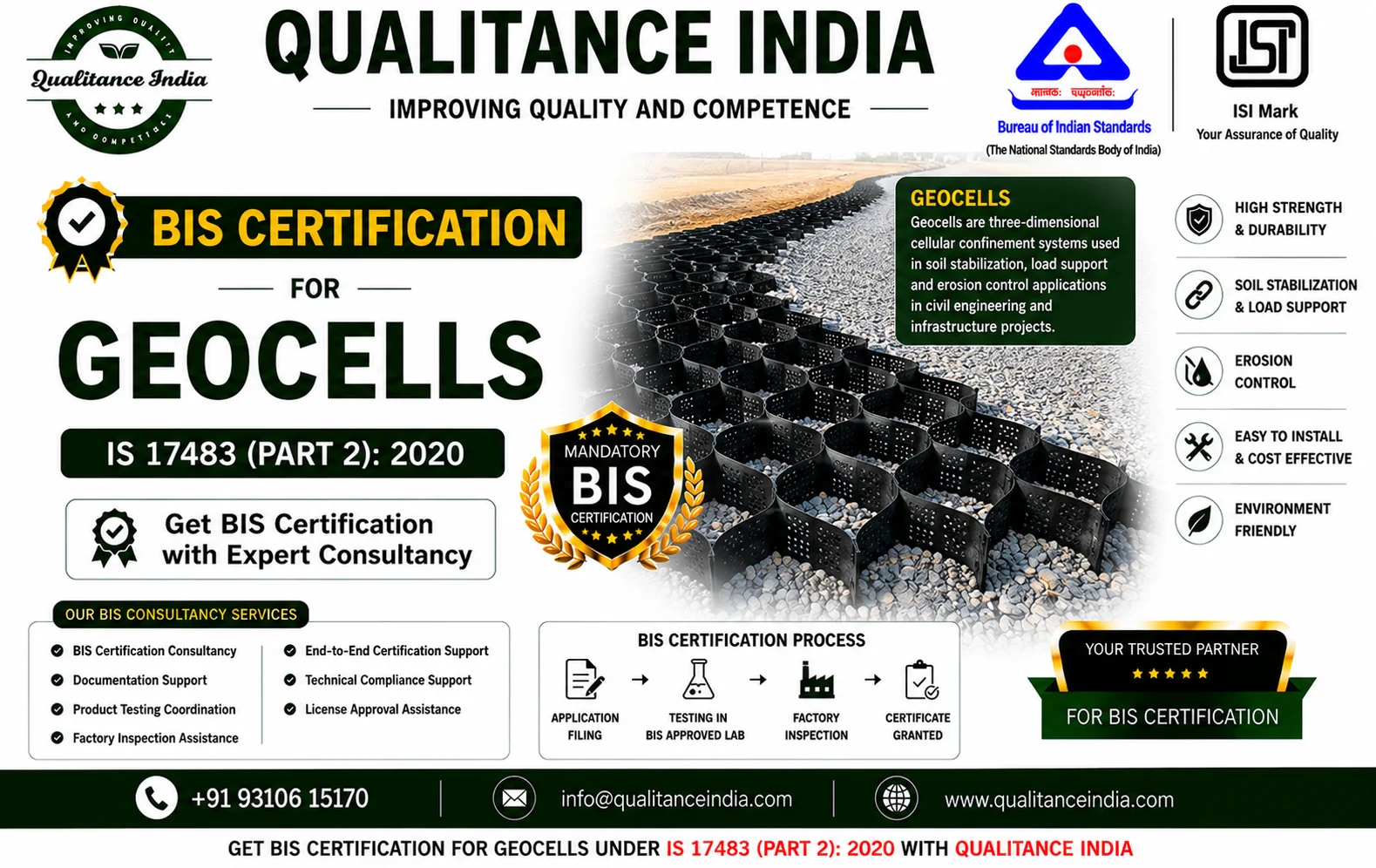
BIS Certification Consultancy for Geocells | IS 17483 (Part 2):2020 | BIS & ISI Mark Certification
Introduction
Geocells are three-dimensional cellular confinement systems used in civil engineering and geotechnical applications to improve soil stability, control erosion and provide reinforcement. They are generally manufactured from polymeric sheets, with interconnected cells that are expanded at the project site and filled with soil, aggregate or other suitable material.
For slope applications, geocells help confine fill material and improve surface stability. Their performance depends on factors such as cell dimensions, weld strength, material quality, wall thickness, resistance to environmental conditions and long-term durability.
In India, IS 17483 (Part 2):2020 – Geosynthetics — Geocells — Specification, Part 2: Slope Erosion Protection Application specifies requirements for geocells intended for slope erosion protection. The BIS Product Manual operates certification under Scheme-I of the BIS Conformity Assessment Regulations, 2018.
IS 17483 (Part 2):2020 is included in the BIS compulsory certification framework for geocells under the Geo Textiles (Quality Control) Order. BIS's current Scheme-I listing includes IS 17483 (Part 2):2020 under the Geo Textiles (Quality Control) Order, 2024.
An important current update is Amendment No. 3 to IS 17483 (Part 2):2020. BIS issued implementation guidelines in April 2026 and specified 28 June 2026 as the last date for implementation. One of the changes allows testing of either Standard oxidative induction time or High pressure oxidative induction time.
Qualitance India provides end-to-end BIS Certification Consultancy for Geocells as per IS 17483 (Part 2):2020, including product applicability assessment, style and grouping review, documentation, sample preparation, laboratory testing coordination, BIS application assistance and factory inspection preparation.
What is IS 17483 (Part 2):2020?
IS 17483 (Part 2):2020 is titled:
“Geosynthetics — Geocells — Specification Part 2 – Slope Erosion Protection Application”.
The standard specifies requirements for geocells intended for slope erosion protection applications.
The current BIS Product Manual identifies important requirements related to:
- Raw material
- Construction
- Dimensions
- Weld spacing
- Depth
- h/Deq ratio
- Texturing
- Perforations
- Seam weld
- Dimensional stability
- Density
- Environmental stress crack resistance
- Carbon black content
- Cell-wall thickness
- Seam peel strength
- Seam weld hang strength
- Resistance to oxidation
- Retained tensile strength
- UV exposure performance
- Friction efficiency
- Oxidative induction time
What are Geocells?
Geocells are polymeric cellular structures used to confine soil, aggregate or other filling materials.
When expanded, they form a three-dimensional honeycomb-like structure. The cells provide lateral confinement and can help improve the stability of material placed within them.
For slope erosion protection, geocells can be used to:
- Reduce surface erosion
- Improve slope stability
- Confine surface fill
- Reduce movement of granular material
- Support vegetation-based slope protection
- Improve resistance to rainfall and surface runoff
Their exact performance depends on the product design, installation method, filling material and site conditions.
Geocells for Slope Erosion Protection
IS 17483 (Part 2):2020 specifically addresses geocells intended for slope erosion protection applications.
The current BIS Product Manual defines the product as:
“Geosynthetics — Geocells for Slope Erosion Protection Application.”
These products can be used in applications such as:
- Embankment slopes
- Roadside slopes
- Railway embankments
- Canal banks
- Riverbank protection
- Mining slopes
- Landscape slopes
- Erosion-prone soil surfaces
- Infrastructure projects
The actual suitability should always be determined by the project designer based on site and engineering requirements.
Scope of IS 17483 (Part 2):2020
The BIS Product Manual identifies the licence scope using the style of the geocell.
The current scope format is:
Weld Spacing × Depth (in mm)
Examples given by BIS include:
- 330 × 150
- 330 × 200
The Product Manual specifically states that the scope of licence is restricted according to the manufacturer's manufacturing and testing capabilities.
Therefore, manufacturers should finalise their desired weld spacing and depth combinations before preparing samples and submitting the BIS application.
Is BIS Certification Mandatory for Geocells?
Yes. Geocells under IS 17483 (Part 2):2020 are included in the compulsory BIS certification framework.
The current BIS Scheme-I listing includes:
IS 17483 (Part 2):2020 – Geocells
under the Geo Textiles (Quality Control) Order, 2024.
The Geocells QCO framework requires covered products to conform to the applicable Indian Standard and carry the Standard Mark under a BIS licence according to the applicable BIS conformity-assessment scheme.
Manufacturers and importers should verify the latest QCO amendments and exemptions applicable to their particular product and business model.
Geo Textiles Quality Control Order
Geocells are included within the broader Geo Textiles Quality Control Order framework.
BIS's current compulsory certification listing places IS 17483 (Part 2):2020 under:
Geo Textiles (Quality Control) Order, 2024 – S.O. 4332(E), dated 03 October 2024.
Earlier geocell implementation material identified 1 January 2024 as the applicable implementation date under the preceding Geo Textiles QCO framework.
Because QCOs can be amended, manufacturers should always verify the current applicable order and notifications before starting certification.
Current Amendment Status of IS 17483 (Part 2):2020
This is an important point for manufacturers.
BIS has issued:
- Amendment No. 1 – May 2023
- Amendment No. 2 – 2024
- Amendment No. 3 – 2026
BIS's April 2026 circular states that Amendment No. 3 was published and that its implementation deadline was 28 June 2026.
The 2026 amendment provides an option to test either:
- Standard oxidative induction time
- High pressure oxidative induction time
BIS also states that the changes introduced through Amendment No. 3 are relaxations and that no separate evidence of conformity to the amended requirements was required for those changes.
The current Product Manual has also been modified accordingly.
Who Needs BIS Certification for Geocells?
BIS certification is relevant to manufacturers producing geocells covered by IS 17483 (Part 2):2020.
This can include:
- Geocell Manufacturers
- Geosynthetic Manufacturers
- Geotechnical Product Manufacturers
- Erosion Control Product Manufacturers
- Soil Stabilisation Product Manufacturers
- Civil Engineering Product Manufacturers
- Infrastructure Material Manufacturers
- Road Construction Material Manufacturers
- Slope Protection Product Manufacturers
- OEM Manufacturers
- Contract Manufacturers
Importers and sellers should separately verify their responsibilities under the applicable QCO.
BIS Certification Eligibility Requirements
A manufacturer applying for BIS certification should generally have suitable manufacturing, testing and quality-control facilities.
These may include:
- Geocell manufacturing line
- HDPE processing facilities
- Sheet extrusion equipment
- Welding equipment
- Texturing equipment
- Perforation equipment, where applicable
- Cutting equipment
- Dimensional inspection equipment
- Seam-weld inspection facilities
- Density-testing facilities
- Carbon black testing facility
- Thickness measurement equipment
- Tensile-testing equipment
- Environmental testing facilities
- UV exposure testing facility
- Oxidation testing facility
- Conditioning laboratory
- Calibration system
- Quality-control personnel
- Production records
- Test records
- Style and batch traceability
The exact facility requirements depend on the proposed licence scope and the applicable testing provisions.
BIS Certification Process for Geocells
Step 1 – Product Applicability Assessment
The manufacturer's product is reviewed against IS 17483 (Part 2):2020.
The assessment includes:
- Geocell application
- Material
- Weld spacing
- Depth
- Cell geometry
- Manufacturing process
- Proposed licence scope
Step 2 – Style Finalisation
The manufacturer determines the styles to be included in the licence.
The BIS Product Manual uses:
Weld Spacing × Depth
to identify the style.
Step 3 – Product Grouping
Grouping is assessed according to Annex A of the BIS Product Manual.
Step 4 – Documentation Preparation
Technical, manufacturing and quality-control documents are prepared.
Step 5 – Sample Preparation
The current BIS Product Manual specifies:
Sample Quantity: 1 geocell.
Step 6 – Laboratory Testing
The representative geocell sample is tested against the applicable requirements of the standard.
Step 7 – BIS Application
The manufacturer submits the BIS application and required documents.
Step 8 – Factory Assessment
BIS assesses manufacturing, testing and quality-control arrangements.
Step 9 – Observation Closure
Any observations identified during assessment are addressed through corrective actions.
Step 10 – BIS Licence Grant
After successful conformity assessment, BIS grants the licence for the approved product scope.
Step 11 – Standard Marking
The manufacturer can apply the BIS Standard Mark to compliant products according to the licence conditions.
Raw Material Requirements for Geocells
The current BIS Product Manual specifies that the material shall be:
HDPE
and shall conform to the requirements given in Clause 4 of IS 17483 (Part 2).
Compliance can be established through:
- Supplier's test certificate
- Third-party laboratory test report
- NABL-accredited laboratory test report
- In-house testing
The Product Manual specifically provides these routes for demonstrating conformity of the raw material.
Proper raw-material control is important because material properties can significantly influence geocell durability and long-term performance.
Construction Requirements
Construction is an important part of geocell certification.
The current Product Manual identifies:
Clause 5.1 – Construction
and requires the manufacturer to implement suitable in-process controls.
Manufacturers should control:
- Cell formation
- Sheet structure
- Weld arrangement
- Cell geometry
- Joint consistency
- Manufacturing defects
- General workmanship
Weld Spacing and Depth
The current Product Manual identifies:
Clause 5.2 – Dimensions (Depth and Weld Spacing).
Five samples are recommended for each control unit for these requirements.
The product style is defined by the combination of:
Weld Spacing × Depth
rather than the earlier pocket-size terminology.
BIS Amendment No. 2 specifically modified the definition of Style Number and replaced the terminology of Pocket Size with Weld Spacing. It also replaced tolerances on final expanded-cell size with tolerances on weld spacing.
h/Deq Ratio
The Product Manual identifies:
Clause 5.2.1 – h/Deq ratio
as a routine manufacturing control.
Five samples are required for this parameter from each control unit under the recommended levels of control.
The ratio helps describe the relationship between the cell depth and equivalent cell dimension.
Texturing
Texturing is covered under Clause 5.3.
The manufacturer is required to maintain appropriate controls over the texture characteristics.
The current recommended sampling level is:
1 sample per control unit.
Perforations
Where perforated geocells are manufactured, perforations are controlled under Clause 5.4.
The Product Manual recommends:
5 samples per control unit.
Seam Weld
Seam weld quality is critical because welded joints hold the geocell structure together.
The Product Manual identifies:
Clause 5.5 – Seam Weld
and recommends:
5 samples per control unit.
Dimensional Stability
Dimensional stability is covered under Clause 6.1.
This requirement helps determine whether the geocell maintains its required dimensions under specified conditions.
The manufacturer is expected to exercise suitable in-process controls to ensure conformity.
Density
Density is one of the important material-performance characteristics for geocells.
The Product Manual identifies density testing under Clause 6.2 and refers to methods in:
IS 13360 (Part 3/Sec 10) IS 13360 (Part 3/Sec 11) IS 13360 (Part 3/Sec 12)
Five samples are recommended per control unit.
Environmental Stress Crack Resistance
Environmental stress crack resistance is an important durability characteristic.
The current Product Manual identifies:
ESCR – NCTL
Notched Constant Tensile Load – 400 hours
This test is referenced to IS 16346 and is recommended once every three years, as well as when there are significant changes in:
- Raw-material supply
- Production technology
- Process
- Product stabilization
ESCR – 5000 Hours
The Product Manual also specifies a 5000-hour ESCR requirement and recommends testing once every three years, with additional testing following significant changes to raw material, technology, process or stabilization.
Carbon Black Content
Carbon black content is important for polymeric products exposed to environmental conditions.
The Product Manual identifies IS 2530 as the relevant test method.
The recommended testing frequency is:
Once a month
and the Product Manual specifically notes this should be considered for each consignment of raw material used.
Cell Wall Thickness
The current Product Manual identifies:
Post-texturing strip/cell wall thickness at a pressure of 2 ± 0.01 kPa
as a testing requirement.
The applicable test equipment is based on IS 13162 (Part 3) and includes a thickness tester with suitable reference plate, presser foot and gauge.
The recommended frequency is:
Once a week.
Seam Peel Strength
Seam peel strength measures the strength of the welded seam.
The Product Manual identifies:
Seam peel-strength per 25 mm of cell depth
with test method Method B of IS 17369 (Part 1).
This is a routine requirement recommended for:
Each control unit.
The required equipment includes:
- Tensile testing machine
- Clamps
Seam Weld Hang Strength
This test evaluates the strength of the welded seam under sustained loading.
The current Product Manual specifies:
100 mm of seam weld under a constant dead weight of 72.5 kg for 7 days at 54 ± 2°C.
The recommended frequency is:
Once every three months.
The equipment includes:
- Clamps
- Tension-testing machine
- Circulating-air oven
Resistance to Oxidation
Resistance to oxidation and retained tensile strength are important long-term performance characteristics.
The Product Manual references IS 17360 for this test.
The recommended frequency is:
Once every five years, and also whenever raw material supply, production technology, process or stabilization changes.
Retention of Breaking Strength After UV Exposure
Geocells used outdoors can be exposed to sunlight and UV radiation.
The Product Manual therefore includes:
Retention of breaking strength after UV exposure of 500 hours.
The UV test uses a xenon arc apparatus under specified irradiation and cycling conditions, followed by tensile testing.
The recommended testing frequency is:
Once every five years, with additional testing when specified raw-material or production changes occur.
Friction Efficiency
Friction efficiency is another requirement for geocells used in slope erosion applications.
The Product Manual refers to:
Annex F of IS 17483 Part 1
and recommends testing:
Once every six months.
The relevant test equipment is a Shear Box Apparatus.
Oxidative Induction Time
Oxidative induction time is an important parameter for evaluating the stabilization of the polymer material.
The current Product Manual identifies:
- Standard oxidative induction time
- High pressure oxidative induction time
and refers to ISO 11357-6.
The recommended frequency is:
Once a year.
The 2026 Amendment No. 3 provides an option to test either Standard OIT or High Pressure OIT.
The equipment is based on a DSC instrument with suitable temperature stability and gas-control arrangements.
BIS Sample Requirement for Geocells
The current BIS Product Manual specifies:
1 geocell
as the sample quantity for grant of licence, change in scope and factory surveillance.
For market surveillance, BIS notes that efforts should be made to procure the required product quantity as far as possible.
Product Grouping for IS 17483 (Part 2):2020
Product grouping is one of the important advantages provided by the current Product Manual.
The BIS grouping provision states that samples of any style, meaning any combination of weld spacing and depth, may be tested to cover the required styles in the licence scope.
For example, where a manufacturer produces:
- 330 × 150
- 330 × 200
- 445 × 200
BIS states that one sample of any style, such as 330 × 150, may be tested to cover all these styles, subject to the applicable provisions.
However, the Product Manual clearly states:
“Scope of licence shall be restricted based on the manufacturing and testing capabilities.”
During licence operation, samples of varieties covered by the licence are to be drawn in rotation to the extent possible.
Control Unit for Geocells
The BIS Product Manual recommends the following control unit:
The entire quantity of geocells of the same style, meaning the same combination of weld spacing × depth, made from the same consignment of raw material under similar conditions in a day.
This definition is important for:
- Routine testing
- Batch identification
- Production records
- Traceability
- Quality-control planning
Quality Assurance Plan
The current Product Manual expects manufacturers to implement a Quality Assurance Plan containing regular testing and in-process controls.
The manufacturer should:
- Define the control unit
- Define testing frequency
- Define sample quantities
- Maintain test records
- Submit the Quality Assurance Plan to the BIS Branch Office for information
- Ensure the entire production covered by the plan is inspected and tested
In-House Laboratory Requirements
The current Product Manual expects manufacturers to establish a suitably equipped and staffed testing facility for routine testing.
It also states that:
- Subcontracting is permitted for tests identified as suitable for subcontracting.
- Testing may be done at BIS-recognized/empanelled laboratories or laboratories having valid NABL accreditation as per ISO/IEC 17025.
- For MSME manufacturers, maintaining an in-house laboratory for routine tests is optional under the applicable provisions.
- MSMEs may use common cluster facilities, shared testing facilities or recognized/NABL-accredited laboratories.
Large-scale manufacturers are expected to maintain suitable in-house facilities for routine tests and a calibration plan, subject to the provisions regarding shared testing facilities.
Testing Equipment for Geocells
The current BIS Product Manual provides an indicative list of equipment.
Important equipment can include:
Dimensions and Weld Spacing
- Vernier calipers
- Cell expansion gauge
- Measuring tape
Texturing
- Profile projector
- Suitable magnifying glass
Asperity Height
- Depth gauge with dial indicator
Density
Depending on the method:
- Analytical balance
- Immersion vessel
- Pycnometer
- Thermometer
- Liquid bath
- Density gradient column
- Gas pyknometer
Carbon Black
- Combustion boat
- Combustion tube
- Gas-flow meter
- Furnace
- Thermometer
- Nitrogen gas
- Trichloroethylene
Cell Wall Thickness
- Thickness tester
- Reference plate
- Presser foot
- Gauge
Seam Peel Strength
- Tensile-testing machine
- Clamps
Seam Weld Hang Strength
- Tension-testing machine
- Circulating-air oven
- Clamps
UV Resistance
- Xenon arc apparatus
- Tension-testing machine
- Clamps
Oxidative Induction Time
- DSC instrument
- Crucibles
- Flowmeter
- Oxygen
- Nitrogen
- Regulators
Conditioning
- Temperature and humidity-controlled laboratory
The BIS equipment list is indicative and for guidance only.
BIS Factory Inspection for Geocells
Factory inspection is an important stage of the certification process.
During the assessment, BIS may examine:
HDPE Raw Material
Raw-material specifications and conformity records.
Manufacturing Line
Extrusion, forming, welding, texturing, perforation and finishing facilities.
Weld Quality
Controls over seam welding and weld spacing.
Dimensional Control
Measurement of:
- Depth
- Weld spacing
- h/Deq ratio
- Cell-wall thickness
- Other applicable dimensions
Laboratory Facilities
Availability of the routine test equipment applicable to the proposed licence scope.
Environmental Testing
Where facilities are required or applicable, BIS may review arrangements for ESCR, oxidation, UV and OIT testing.
Calibration
Calibration status and records for testing equipment.
Quality Records
Production and test records should be available for review.
Traceability
Raw-material consignment, production date and style should be traceable.
Packing and Marking Requirements
The current BIS Product Manual specifies that the Standard Mark shown in the licence schedule must be incorporated legibly and indelibly on the label affixed to each geocell and/or each package of geocells, provided the material conforms to all requirements.
The Product Manual further states that geocell panels may be packed:
- In pallets, or
- In collapsed sheet form
according to the contract or purchase order.
Each pallet must be protected by wrapping with film having a minimum thickness of 50 microns to protect against heat, moisture, oil, grease, dirt, dust and stains.
Identification, Delivery, Storage and Handling
The Product Manual refers to the applicable requirements of the standard for:
- Identification
- Delivery
- Storage
- Handling
Manufacturers should maintain suitable controls so that product traceability and protection are preserved through storage and delivery.
Documents Required for BIS Certification
Typical documents may include:
- Company registration documents
- Factory address proof
- Factory layout
- Manufacturing process flow chart
- Machinery list
- Product drawings
- Geocell specifications
- Weld spacing details
- Depth details
- Style details
- Raw-material specifications
- HDPE supplier details
- Raw-material test certificates
- Material test reports
- Testing equipment list
- Calibration certificates
- Quality Assurance Plan
- Inspection procedures
- Production records
- Test records
- Laboratory reports
- Product photographs
- Packing details
- Marking details
- Batch/lot traceability records
- Authorised signatory documents
- Trademark documents, where applicable
The final documentation requirement depends on the manufacturer and proposed BIS licence scope.
Common Reasons for BIS Certification Delays
Geocell manufacturers may face delays because of:
- Incorrect application category
- Wrong standard selection
- Incorrect style definition
- Incorrect weld spacing
- Incorrect depth
- Dimensional non-conformity
- h/Deq ratio issues
- Texturing non-conformity
- Perforation issues
- Seam-weld failure
- Cell-wall thickness failure
- Seam peel-strength failure
- ESCR failure
- Carbon black content failure
- UV resistance failure
- Oxidation resistance failure
- OIT testing issues
- Inadequate laboratory facilities
- Missing calibration records
- Incomplete traceability
- Incorrect samples
- Factory not ready for inspection
- Incomplete Quality Assurance Plan
- Incorrect BIS marking or packing
A pre-certification assessment of the product, testing capability and licence scope can help prevent avoidable delays.
BIS Certification Cost for Geocells
There is no single fixed BIS certification cost applicable to every geocell manufacturer.
The total cost may depend on:
- BIS application fees
- Laboratory testing
- Product style
- Testing scope
- Number of samples
- Factory assessment
- Testing equipment
- Calibration
- Documentation
- Retesting, if required
- Consultancy charges
For geocells, the overall project cost can vary significantly because certain durability tests require long testing periods or specialised equipment.
Therefore, an accurate quotation should be prepared after reviewing the manufacturer's:
- Raw material
- Style range
- Depth
- Weld spacing
- Product technology
- In-house testing facilities
- Proposed BIS scope
BIS Certification Timeline for Geocells
The certification timeline depends on:
- Product scope
- Style
- Sample readiness
- Laboratory availability
- Routine test results
- Long-duration type testing
- Documentation
- BIS application scrutiny
- Factory inspection
- Observation closure
Some long-term tests, such as ESCR, oxidation and UV-related tests, may require significantly longer testing periods than routine dimensional tests. The current Product Manual lists testing frequencies of up to three and five years for certain characteristics during licence operation.
Because of this, manufacturers should plan their testing strategy well in advance.
Benefits of BIS Certification for Geocells
Regulatory Compliance
Helps manufacturers meet applicable BIS and Geo Textiles QCO requirements.
ISI Mark
Allows eligible manufacturers to use the BIS Standard Mark on products covered by the approved licence.
Product Quality
Testing verifies important dimensional, material and performance characteristics.
Better Slope Protection
Properly manufactured geocells can support slope erosion-control applications.
Long-Term Performance
Durability-related tests address environmental stress, oxidation and UV exposure.
Customer Confidence
BIS certification can strengthen confidence among infrastructure companies, contractors and engineering buyers.
Market Acceptance
Certification supports legal market access where BIS certification is mandatory.
Better Quality Control
The Quality Assurance Plan and routine testing requirements support consistent production.
Why Choose Qualitance India?
Qualitance India provides professional BIS Certification Consultancy for manufacturers seeking BIS and ISI Mark certification.
For Geocells for Slope Erosion Protection as per IS 17483 (Part 2):2020, our consultancy support can include:
- Product applicability assessment
- IS 17483 (Part 2):2020 requirement review
- Latest amendment review
- Style assessment
- Weld spacing assessment
- Depth assessment
- Product grouping guidance
- Licence-scope planning
- Sample selection guidance
- Sample preparation
- Laboratory testing coordination
- HDPE raw-material compliance guidance
- ESCR testing coordination
- UV testing coordination
- Oxidation testing coordination
- OIT testing coordination
- BIS application assistance
- Factory inspection preparation
- Quality Assurance Plan support
- Testing equipment guidance
- Observation closure support
- BIS licence assistance
Our support is designed to help manufacturers manage the certification process from product assessment and grouping through testing, BIS application, factory inspection and licence approval.
Contact Qualitance India
Phone: +91 93106 15170 Email: info@qualitanceindia.com Website: qualitanceindia.com
BIS Certification Process – Quick Flow
Product Identification ↓ IS 17483 (Part 2):2020 Requirement Review ↓ Latest Amendment Review ↓ HDPE Raw Material Assessment ↓ Style – Weld Spacing × Depth Finalisation ↓ Product Grouping ↓ Licence Scope Finalisation ↓ Sample Preparation – 1 Geocell ↓ Dimensional & Construction Testing ↓ Density & Material Testing ↓ Seam Strength Testing ↓ Durability / Environmental Testing ↓ BIS Application ↓ Application Scrutiny ↓ Factory Assessment ↓ Observation Closure ↓ BIS Licence Grant ↓ ISI Mark on Approved Geocells
Frequently Asked Questions
1. What is IS 17483 (Part 2):2020?
IS 17483 (Part 2):2020 is the Indian Standard for Geosynthetics — Geocells — Part 2: Slope Erosion Protection Application.
2. What are geocells used for?
Geocells are used to confine soil or aggregate and provide support in applications such as slope erosion protection, soil stabilisation and related geotechnical works.
3. Is BIS certification mandatory for geocells?
Yes. IS 17483 (Part 2):2020 is listed under the BIS compulsory certification framework for geotextile products.
4. Which BIS scheme applies to geocells?
Certification operates under Scheme-I of the BIS Conformity Assessment Regulations, 2018.
5. What raw material is specified for geocells?
The current BIS Product Manual specifies HDPE as the material and requires conformity with Clause 4 of IS 17483 (Part 2).
6. What is the BIS sample quantity?
The current Product Manual specifies 1 geocell as the sample quantity.
7. How is geocell style defined?
The current Product Manual defines style using Weld Spacing × Depth in mm, for example 330 × 150 or 330 × 200.
8. Can one sample cover different geocell styles?
Yes. The current grouping provisions state that a sample of any style may be tested to cover the required styles in the licence scope, subject to the applicable grouping requirements.
9. What are the main tests for geocells?
Important tests include construction, dimensions, weld spacing, h/Deq ratio, texturing, perforations, seam weld, dimensional stability, density, ESCR, carbon black content, cell-wall thickness, seam peel strength, seam weld hang strength, oxidation resistance, UV resistance, friction efficiency and oxidative induction time.
10. What is ESCR testing?
ESCR means Environmental Stress Crack Resistance. The current Product Manual includes both 400-hour NCTL testing and a 5000-hour ESCR requirement.
11. How often is carbon black content tested?
The Product Manual recommends carbon black testing once a month and notes consideration for each raw-material consignment.
12. How often is seam weld hang strength tested?
The recommended frequency is once every three months.
13. How often is oxidation resistance tested?
The recommended frequency is once every five years, with additional testing following specified changes in raw material, production technology, process or stabilization.
14. How often is UV resistance tested?
Retention of breaking strength after UV exposure of 500 hours is recommended once every five years, with additional testing following specified production changes.
15. What is the latest change in oxidative induction time testing?
Amendment No. 3 allows the option to test either Standard oxidative induction time or High pressure oxidative induction time. BIS set 28 June 2026 as the implementation deadline.
16. What is the control unit for geocells?
The recommended control unit is the entire quantity of geocells of the same style made from the same raw-material consignment under similar conditions in one day.
17. Are in-house laboratory facilities mandatory?
Large manufacturers are expected to maintain suitable facilities for routine tests. MSME manufacturers have provisions allowing the use of cluster, shared or recognised laboratory facilities under the applicable BIS provisions.
18. Is factory inspection required?
Yes. Factory assessment is part of the BIS certification process.
19. Does BIS require a Quality Assurance Plan?
Yes. The current Product Manual requires manufacturers to implement a Quality Assurance Plan containing regular testing and in-process controls.
20. How is the BIS Standard Mark applied?
The Product Manual states that the Standard Mark should be incorporated legibly and indelibly on the label affixed to each geocell and/or package of geocells, provided the material conforms to the specification.
21. How should geocells be packed?
Geocell panels can be packed in pallets or in collapsed sheet form. Pallets must be protected with wrapping film of minimum 50 microns thickness to protect the product from environmental and handling contamination.
22. Can Qualitance India help with IS 17483 (Part 2):2020 certification?
Yes. Qualitance India provides product assessment, style and grouping guidance, documentation, sample preparation, laboratory testing coordination, BIS application support and factory inspection preparation.
People Also Ask
What is BIS certification for geocells?
BIS certification for geocells is the conformity-assessment process for demonstrating compliance with IS 17483 (Part 2):2020 for slope erosion protection applications.
What is the BIS standard for geocells?
The applicable standard is IS 17483 (Part 2):2020 – Geosynthetics — Geocells — Part 2: Slope Erosion Protection Application.
Is IS 17483 Part 2 under a QCO?
Yes. It is included under the Geo Textiles (Quality Control) Order and the current BIS Scheme-I compulsory certification listing.
What material is used for geocells?
The BIS Product Manual specifies HDPE as the product material.
What is the BIS sample requirement for geocells?
The Product Manual specifies 1 geocell for sample quantity.
What is geocell style?
Style is identified as Weld Spacing × Depth, such as 330 × 150 mm.
What tests are required for geocells?
The testing programme includes dimensional, construction, seam, material, density, environmental durability, UV, oxidation, friction and oxidative-induction-time requirements.
What is the latest amendment to IS 17483 Part 2?
BIS published Amendment No. 3 in 2026, with implementation by 28 June 2026. It introduced an option between Standard OIT and High Pressure OIT testing.
How do I get an ISI Mark for geocells?
A manufacturer must obtain the applicable BIS licence for IS 17483 (Part 2):2020 and comply with the approved product scope, testing, quality-control, marking and continuing-conformity requirements.
Frequently Searched Keywords
- BIS Certification for Geocells
- Geocells BIS Certification
- IS 17483 Part 2:2020 Certification
- BIS Licence for Geocells
- Geocell BIS Licence
- ISI Mark for Geocells
- Geocell Testing
- Geocell for Slope Erosion Protection
- Geocell QCO
- Geotextiles QCO 2024
- BIS Certification for Geosynthetics
- Geocell Manufacturer BIS Certification
- HDPE Geocell BIS Certification
- Geocell Slope Protection Certification
- BIS Certification Consultancy
Related BIS Certification Services
- BIS Certification for Geocells – IS 17483 (Part 1):2020
- BIS Certification for Geogrids – IS 17371:2020
- BIS Certification for Geogrids used in Reinforced Soil Retaining Structures – IS 17373:2020
- BIS Certification for Geotextiles used in Pavement Structures
- BIS Certification for HDPE Geomembranes – IS 16352:2020
- BIS Certification for PVC Geomembranes – IS 15909:2020
- BIS Certification for Geotextiles
- BIS Certification for Geosynthetics
- BIS & ISI Mark Certification
- BIS Testing Coordination
- BIS Factory Inspection Assistance
Conclusion
IS 17483 (Part 2):2020 – Geosynthetics — Geocells — Part 2: Slope Erosion Protection Application is an important Indian Standard for geocells designed for slope erosion-control applications.
The current BIS Product Manual confirms that the product material shall be HDPE, the sample quantity for certification is 1 geocell, and the licence scope is identified using the style format Weld Spacing × Depth.
The standard covers a wide range of important requirements, including construction, dimensions, weld spacing, h/Deq ratio, texturing, perforations, seam weld, dimensional stability, density, ESCR, carbon black content, cell-wall thickness, seam peel strength, seam weld hang strength, oxidation resistance, UV performance, friction efficiency and oxidative induction time.
The BIS Product Manual also provides useful product-grouping provisions. A sample of any style can be used to cover the required styles within the licence scope, subject to the grouping provisions and available manufacturing/testing capabilities.
The latest regulatory development is Amendment No. 3, published in 2026. BIS specified 28 June 2026 as the last date for implementation and introduced an option to test either Standard oxidative induction time or High pressure oxidative induction time.
For manufacturers, successful BIS certification requires careful planning of the HDPE raw material, geocell style, weld spacing, depth, dimensions, seam welding, environmental durability, testing facilities, Quality Assurance Plan, calibration and traceability.
The current BIS framework also allows applicable tests to be subcontracted to BIS-recognized/empanelled laboratories or laboratories with valid NABL accreditation, while MSME manufacturers have additional flexibility regarding routine in-house testing facilities under the Product Manual provisions.
Qualitance India provides end-to-end BIS Certification Consultancy for Geocells as per IS 17483 (Part 2):2020, including product applicability assessment, style and grouping review, documentation, sample preparation, laboratory testing coordination, BIS application assistance, factory inspection preparation and licence support.
For BIS Certification and ISI Mark Consultancy for Geocells for Slope Erosion Protection, contact Qualitance India today.
Phone: +91 93106 15170 Email: info@qualitanceindia.com Website: qualitanceindia.com